REVIEW 2 major objections 5 minor 1 cited by
Improved determination of the $\beta$-$\overline{\nu}_e$ angular correlation coefficient $a$ in free neutron decay with the $a$SPECT spectrometer
T0 review · 2 major / 5 minor · reviewed 2026-08-14 · deepseek-v4-flash
Pith's one-line read A 100-day measurement of the proton recoil spectrum in free neutron decay fixes the beta-neutrino angular correlation at -0.10430(84), the most precise value to date.
desk verdict A genuinely new and unusually careful neutron a-coefficient measurement that probably stands, with the main residual worry being the 30 mV work-function transfer uncertainty and the global fit's error scaling. read the letter →
The pith
A machine-rendered reading of the paper's core claim, the machinery that carries it, and where it could break.
The reading
What carries the argument
The load-bearing object is the MAC-E (magnetic adiabatic collimation with electrostatic filter) spectrometer: decay protons are guided along a magnetic field from a high-field decay volume to a low-field analyzing plane, where an applied retardation voltage $U_{AP}$ acts as a high-pass filter on their longitudinal kinetic energy. The transmission function $F_{\mathrm{tr}}(T,\langle U_A\rangle,\langle r_B\rangle)$ depends on the proton kinetic energy $T$, the average effective retardation voltage $\langle U_A\rangle$, and the average magnetic field ratio $\langle r_B\rangle = B_A/B_0$, so the measured integral count-rate spectrum is a convolution of the theoretical recoil spectrum with this filter. The paper determines $\langle r_B\rangle$ from NMR-validated field simulations and $\langle U_A\rangle$ from work-function maps of the electrode surfaces obtained with a scanning vibrating-capacitor probe, then folds all known systematic effects into a global chi-square fit in which $a$ is one common parameter across detector pads and configurations.
What would settle it
Take a second 100-day dataset with in-situ measurement of the decay-volume/analyzing-plane work-function difference, or with electrode surfaces characterized immediately before and after under the same cold ultra-high-vacuum conditions; if the extracted $a$ moves by more than 0.00084 relative to this run, the 30 mV offset assumption underlying the quoted uncertainty is falsified.
Extended reading notes
Core claim
The central discovery is a precise value of the $\beta$-neutrino angular correlation coefficient in free neutron decay, $a = -0.10430(84)$, obtained from the shape of the integral recoil-energy spectrum of protons detected in $4\pi$ by a MAC-E filter spectrometer. Using the standard-model relation $a = (1-|\lambda|^2)/(1+3|\lambda|^2)$, the paper obtains $|\lambda| = 1.2677(28)$. The new $a$ agrees with the previous world average of $-0.1059(28)$ but is 3.3 times more precise, and the derived $\lambda$ disagrees with the most precise $\beta$-asymmetry-based value at about 2.8 standard deviations, indicating a possible systematic difference between the two measurement routes.
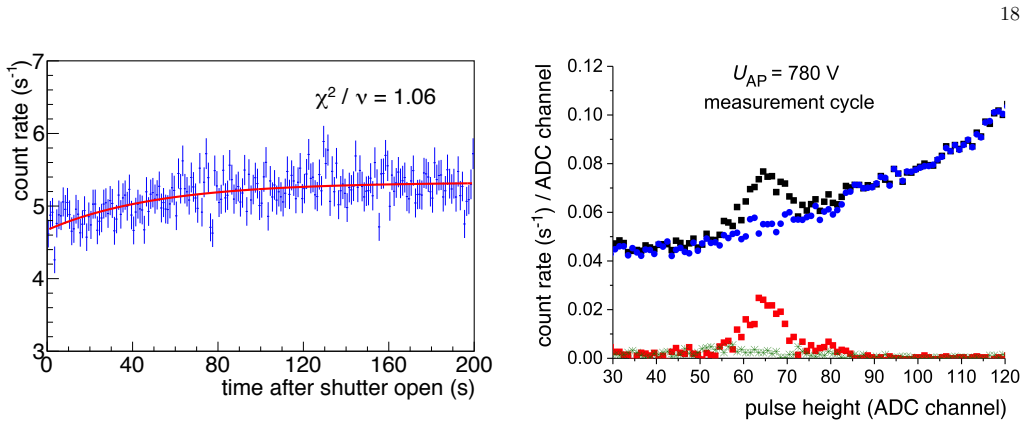
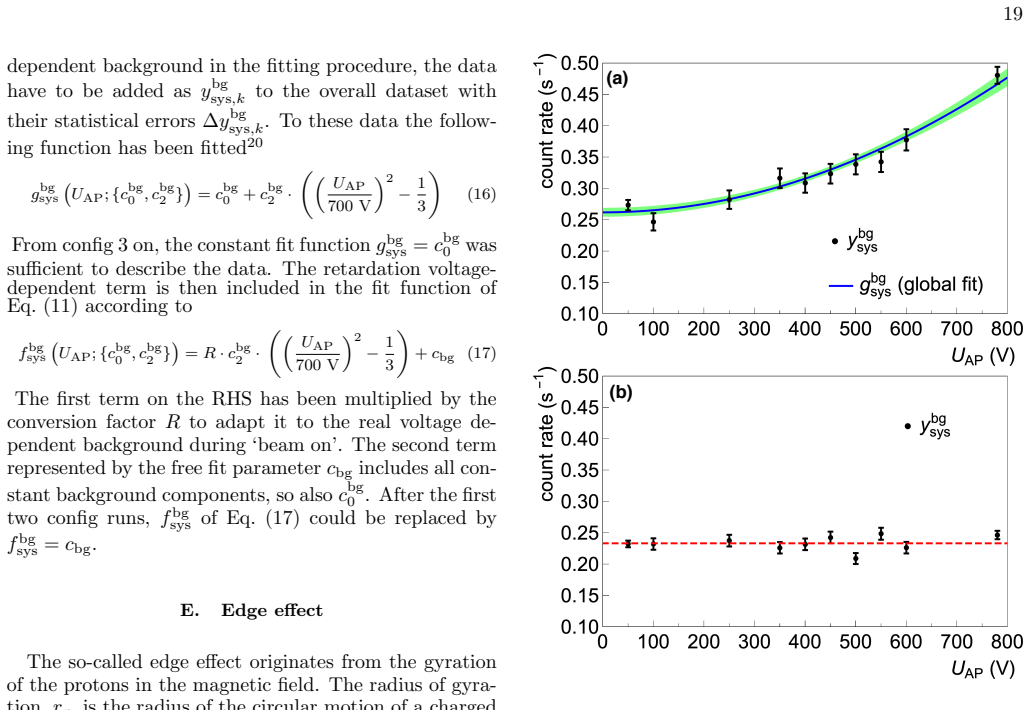
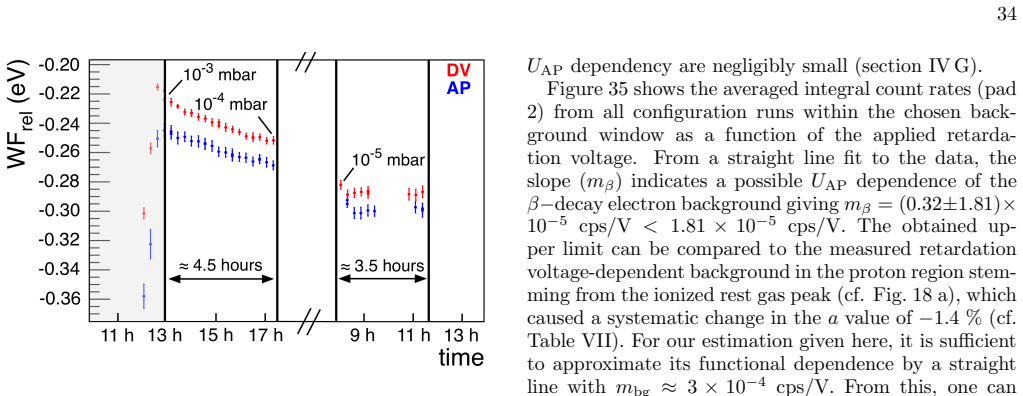
Load-bearing premise
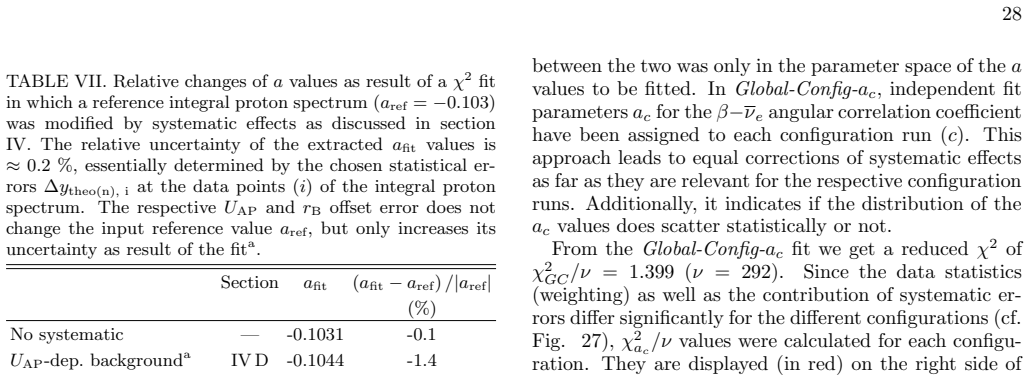
The result leans on the assumption that the effective retarding voltage felt by the protons can be reconstructed from electrode work-function maps measured after the run with a 30 mV offset allowance; if the surfaces' work functions drifted during the 100-day run, $a$ would shift by about 1\% per 80 mV of unaccounted change.
Editorial extensions
If this is right
- The beta-neutrino correlation $a$ is now known to 0.8\%, an improvement by a factor of 3.3 over the previous world average, so the Standard-Model prediction can be tested at correspondingly sharper resolution.
- The derived $|\lambda| = 1.2677(28)$ gives an independent determination of the axial-vector to vector coupling ratio that does not share the beta-asymmetry systematics.
- Combined with the neutron lifetime, the new $\lambda$ enters the expression for $|V_{ud}|$, feeding the most direct neutron-decay test of CKM unitarity.
- The 2.8-sigma difference with the beta-asymmetry route means current neutron-decay data do not agree on a single $\lambda$; further measurements at comparable precision are needed to decide whether the discrepancy is a real physics effect or an unaccounted systematic.
- The paper's upgrade analysis indicates the same technique could reach approximately 0.2\% in $a$ with better work-function control, a larger detector area, and improved beam collimation.
Reading between the lines
- If the 2.8-sigma tension is real rather than a systematic, a combined fit of $a$, the beta-asymmetry $A$, and the neutron lifetime would favor new scalar or tensor contributions; this is a consequence the paper motivates but does not carry out.
- The load-bearing 30 mV offset for $\langle U_A\rangle$ could be tested directly by an in-situ work-function monitor, or by re-measuring the electrode surfaces immediately before and after a future production run under the same cold, ultra-high-vacuum conditions.
- The consistency of the edge-effect loss ratio with a simple analytic expression suggests that deliberately shaping the beam profile, not merely collimating it, could turn the edge effect from a 0.15\% correction into a negligible one.
Signed reviews
Editorial analysis
A structured set of objections, weighed in public.
Referee Report
Summary. The paper reports a new measurement of the beta-antineutrino angular correlation coefficient a in free neutron decay using the aSPECT MAC-E filter spectrometer at the ILL PF1b beam line. The analysis is based on a 100-day production run in 2013, in which integral proton recoil spectra were recorded at several retardation voltages and in several detector/configuration setups. The central value is extracted from a global chi-square fit that simultaneously constrains systematic effects with auxiliary measurements and particle-tracking simulations. The authors obtain a = -0.10430(84), which they state is the most precise measurement of the neutron a coefficient to date, and derive |lambda| = 1.2677(28). The result is consistent with the previous PDG value and disagrees with the PERKEO III lambda determination at about 2.8 sigma.
Significance. If the quoted uncertainty is credible, this is a substantial experimental advance: it improves the world knowledge of the neutron a coefficient by roughly a factor of 3.3 and provides an independent constraint on lambda that is complementary to beta-asymmetry measurements. The paper is strong in its detailed systematic accounting: it includes particle-tracking simulations with about 1e10 tracked protons, KEMField/COMSOL cross-checks, proton-NMR field measurements, Kelvin-probe work-function scans, and cross-checks among seven measurement configurations. It also validates the global-fit likelihood with both profiling and MCMC methods and openly discusses the limitations of the work-function transferability. The main risk to the central claim is not the experimental methodology per se but whether the quoted total uncertainty of 0.00084 is robust, given the poor global fit quality and the load-bearing assumption on the effective retardation voltage <UA>.
major comments (2)
- [§IV C and Appendix A, Table VI]
- [§V, Eqs. (13) and (43), Table VIII]
minor comments (5)
- [§III C, Eq. (11)] The notation for the systematic functions f_sys and g_sys is dense and the distinction between fpar and gpar is not always transparent; a table listing each systematic effect, its auxiliary data, and the corresponding polynomial coefficients would improve readability.
- [§V, Fig. 28] The exclusion of config 2b is justified by two concrete technical reasons, but the decision is made after inspecting the ideogram. A sentence stating that config 2b was designed as a diagnostic rather than a production configuration, and a statement of the selection criterion before the final fit, would clarify the procedure.
- [Appendix D] The text says the classical and Bayesian approaches agree within 2% statistical error; it would be useful to state explicitly whether the comparison is on the central value or on the width of the PDF of a.
- [Appendix A, Fig. 34] The caption of Fig. 34 does not state the temperature at which the vacuum Kelvin-probe test was performed; this is relevant because the run conditions are cold UHV conditions, and the temperature should be clearly reported.
- [Throughout] There are a number of typographical and notation inconsistencies, e.g., 'Marcov chain' in Appendix D, the title uses beta-nu_e while the text uses beta-nu_e, and some axis labels in Figs. 35 and 36 are incomplete. These do not affect the physics but should be corrected in the final version.
Circularity Check
No significant circularity: the reported a is a free parameter of a global fit constrained by independent data and simulations.
full rationale
The central value a = -0.10430(84) is obtained as a free fit parameter in a global chi-square minimization (Eqs. (12)-(13)) against measured integral proton count rates. The theoretical recoil spectrum comes from an independent published calculation (Glück, Phys. Rev. D 47, 2840 (1993)), and the main systematic corrections are anchored to separate measurements and simulations: NMR field maps for the magnetic field ratio, Kelvin-probe work-function scans for the retardation-voltage correction, SRIM-based detector response calculations for backscattering and below-threshold losses, and particle-tracking simulations for the edge effect and trapped-proton losses. None of the equations inserts the final a into its own determination; the normalized spectrum in Eq. (8) depends on the fit parameter a, not on the reported result. The reference value a_ref = -0.103 is used only for diagnostic sensitivity studies in Table VII and not as a constraint in the final Global-a fit, which leaves a free and yields a value consistent with, but more precise than, the PDG average. The identified weakness - transferring Kelvin-probe work-function maps measured under ambient conditions after the 2013 run to cold UHV conditions, contributing the 30 mV offset uncertainty in Table VI and Appendix A - is an external-validity or systematic-uncertainty concern, not a circular reduction, because no measured value of a enters the work-function or field simulations. Self-citations to earlier aSPECT papers for the MAC-E filter transmission function and the KASPER simulation framework are normal internal references; the load-bearing physics is independently established or cross-checked against COMSOL and NMR measurements.
Assumptions & free parameters
free parameters (10)
- a =
-0.10430(84)
- N0 per configuration and pad =
Not tabulated individually
- c_bg, constant background per configuration and pad =
Fit result; cbg approximately 6 cps at 780 V
- c_0^rB, offset =
Offset prior sigma = 4.8e-6; fit results in Table IV
- c_0^UA, c_1^UA =
Fit results from global fit, shown as lines in Fig. 14
- c_bg^0, c_bg^2, R =
Fit results for config 1; R = 0.9(1)
- c_ee^0, c_ee^2, c_ee^4 =
Fit results from global fit, Fig. 20
- c_blt^0, c_blt^4 =
Fit results from global fit, Fig. 22
- c_p^0, c_p^2 =
Fit results from global fit, Fig. 25
- c_tr^{-2}, c_tr^1 =
Fit results from global fit, Fig. 26
assumptions (5)
- domain assumption Standard Model V-A interaction with Fierz interference b = 0
- standard math Proton recoil spectrum of Ref. [55], including recoil, Coulomb and order-alpha radiative corrections, is accurate to 0.1%
- domain assumption Proton motion through the MAC-E filter is adiabatic to better than 4e-4
- ad hoc to paper Work function maps measured after the 2013 run under ambient conditions are representative of the in-situ work functions during the run, with a 30 mV offset uncertainty
- domain assumption Neutron beam polarization is negligible for the 4pi configurations used in the final fit
Cite this review
Pith. "Pith review of Improved determination of the $\beta$-$\overline{\nu}_e$ angular correlation coefficient $a$ in free neutron decay with the $a$SPECT spectrometer." pith.science (2026). https://pith.science/paper/YTJCZPN4
@misc{pith2026190804785,
  author       = {Pith},
  title        = {Pith review of: Improved determination of the $\beta$-$\overline\nu_e$ angular correlation coefficient $a$ in free neutron decay with the $a$SPECT spectrometer},
  year         = {2026},
  howpublished = {\url{https://pith.science/paper/YTJCZPN4}},
  note         = {Machine review of arXiv:1908.04785}
}
abstract
We report on a precise measurement of the electron-antineutrino angular correlation ($a$ coefficient) in free neutron beta-decay from the $a$SPECT experiment. The $a$ coefficient is inferred from the recoil energy spectrum of the protons which are detected in 4$\pi$ by the $a$SPECT spectrometer using magnetic adiabatic collimation with an electrostatic filter. Data are presented from a 100 days run at the Institut Laue Langevin in 2013. The sources of systematic errors are considered and included in the final result. We obtain $a = -0.10430(84)$ which is the most precise measurement of the neutron $a$ coefficient to date. From this, the ratio of axial-vector to vector coupling constants is derived giving $|\lambda| = 1.2677(28)$.
Figures


Figures from the paper (29 more)









Forward citations
Cited by 1 Pith paper
-
Quantum Monte Carlo calculation of $\delta_{\rm NS}$ in $^{10}$C using an effective field theory approach
The first quantum Monte Carlo evaluation of the nuclear-structure-dependent radiative correction in carbon-10 confirms the NCSM dispersion result, with the residual uncertainty set by two undetermined low-energy constants.
Reference graph
Works this paper leans on
-
[1]
particle tracking simulations including the mea- sured work function distributions in the DV along with an analytical approach to quantify the retar- dation voltage-dependent losses due to stored pro- tons in the DV region,
-
[2]
measurements of a with an additional extraction field in the DV
-
[3]
Particle tracking simulations In the simulation, protons are generated throughout the DV weighted with the measured neutron beam pro- file. Here, we only consider protons from the fiducial decay volume, which under optimal conditions would be losslessly guided along the magnetic flux tube onto the two detector pads (2, 3). In the actual B- and E-field configur...
-
[4]
To generate such a field, the connecting electrodes below and above the DV electrode have been set to +4 V and -4 V, respectively
Measurement with additional extraction field In order to quantify the effect of trapped protons on a, an E-field was applied along the z-axis of the DV elec- trode, strong enough to extract any trapped proton. To generate such a field, the connecting electrodes below and above the DV electrode have been set to +4 V and -4 V, respectively. This does not change...
-
[5]
Proton scattering off residual gas The transmission of protons through aSPECT may be modified by scattering of the protons off residual gas atoms. Three different kinds of collision can be distin- guished: The protons may be neutralized by charge ex- change processes, or change their energy and direction due to elastic or inelastic scattering. This problem ha...
2012
-
[6]
1 (b) is based on exact adiabatic proton motion from DV to AP
Adiabaticity The calculation of the integral proton spectrum in Fig. 1 (b) is based on exact adiabatic proton motion from DV to AP. The adiabaticity of the protons in the aSPECT spectrometer was tested in [2] by high-precision tracking simulations for various magnetic fields and for UE8 = −3 kV dipole potential of the lower E ×B electrode E8. According to ...
-
[7]
In aSPECT, the magnetic field is transverse to the neutron beam and protons are detected with 4 π acceptance
Doppler effect due to neutron motion The motion of the decaying particle also changes the observed energies of the outgoing particles relative to the energies in the center-of-mass system (CMS) of the de- caying particle according to: TLAB =TCMS + mp mn Tn + 2 √mp mn √ TCMS·Tn cosθCMS (39) where θCMS is the polar angle in the CMS and Tn ≈ 4 meV is the aver...
-
[8]
Hence, we do not expect any essential systematic uncertainty from the Doppler effect at our current level of accuracy
predicts even smaller relative changes. Hence, we do not expect any essential systematic uncertainty from the Doppler effect at our current level of accuracy. V. FIT RESULTS AND EXTRACTION OF a In order to get a first impression of the quality of the raw data, the individual configurations are fitted sep- arately without any systematic correction. For that we...
Show all 126 references
-
[9]
The angle- and energy-resolved inten- sity distributions of reflected H + ions were mea- sured, e.g., in [82] for incident proton beams in the energy range < 1 keV
Protons which are emitted into the rear hemisphere are guided along the magnetic field lines onto the bottom flange (stainless steel) of theaSPECT spec- trometer (B ≈ 0.11 T) if the electrostatic mirror (EM) is off. The angle- and energy-resolved inten- sity distributions of refle...
-
[10]
In that case the differential proton recoil spectrum ωp(T,a ) (cf
In config 2b, aSPECT operated as a 2π spectrom- eter (EM off). In that case the differential proton recoil spectrum ωp(T,a ) (cf. Fig. 1 a) must be sup- 29 plemented by a cos ϑ term (see Appendix C) ac- cording to W (T,a,c ) =ωp(T,a ) +P·ωps(T,a )· cosϑ (42) whereϑ is the angle b...
2013
-
[11]
For this reason, electrode surfaces with better uniformity of the work function ( e.g., as for gold single crys- tal layers) have to be used
WF differences of polycrystalline gold surfaces as well as their temporal fluctuations result in the current uncertainty of da/a ≈ 0.3 %. For this reason, electrode surfaces with better uniformity of the work function ( e.g., as for gold single crys- tal layers) have to be used....
-
[12]
In par- ticular, the use of a broader magnetic flux tube onto the enlarged SDD detector area of 3 ×3 pads should be realized
The electrode system has to be redesigned. In par- ticular, the use of a broader magnetic flux tube onto the enlarged SDD detector area of 3 ×3 pads should be realized. The uncorrelated statistical er- ror at present contributes with≈ 0.4 % to the total error and was obtained w...
-
[13]
At present, the edge effect corrections (standard beam profile) are under con- trol to a level of ∆ a/a≈ 0.1 %
The major remaining systematic correction (af- ter having eliminated the retardation voltage- dependent background by improved vacuum condi- tions) is the edge effect and proton backscattering at the SDD detector. At present, the edge effect corrections (standard beam profile) ar...
2013
-
[14]
W. J. Marciano and A. Sirlin, Phys. Rev. Lett. 96, 032002 (2006)
2006
-
[15]
From a straight line fit to the data, the slope (mβ) indicates a possible UAP dependence of the β−decay electron background givingmβ = (0.32±1.81)× 10−5 cps/V < 1.81× 10⁻⁵ cps/V
from all configuration runs within the chosen back- ground window as a function of the applied retarda- tion voltage. From a straight line fit to the data, the slope (mβ) indicates a possible UAP dependence of the β−decay electron background givingmβ = (0.32±1.81)× 10−5 cps/V < ...
2013
-
[16]
Baeßler et al., Eur
S. Baeßler et al., Eur. Phys. J. A 38, 17 (2008)
2008
-
[17]
Gl¨ uck, S
F. Gl¨ uck, S. Baeßler, J. Byrne, M. G. D. van der Grin- ten, F. J. Hartmann, W. Heil, I. Konorov, G. Petzoldt, Y. Sobolev, and O. Zimmer, Eur. Phys. J. A 23, 135 (2005)
2005
-
[18]
Zimmer, J
O. Zimmer, J. Byrne, M. van der Grinten, W. Heil, and F. Gl¨ uck, Nucl. Instrum. Methods A440, 548 (2000)
2000
-
[19]
Jackson, S
J. Jackson, S. Treiman, and H. Wyld, Phys. Rev. 106, 517 (1957)
1957
-
[20]
Severijns, M
N. Severijns, M. Beck, and O. Naviliat-Cuncic, Rev. Mod. Phys. 78, 991 (2006)
2006
-
[21]
K. K. Vos, H. W. Wilschut, and R. G. E. Timmermans, Rev. Mod. Phys. 87, 1483 (2015)
2015
-
[22]
Abele, Prog
H. Abele, Prog. Part. Nucl. Phys. 60, 1 (2008)
2008
-
[23]
D. Mund, B. M¨ arkisch, M. Deissenroth, J. Krempel, M. Schumann, H. Abele, A. Petoukhov, and T. Soldner, Phys. Rev. Lett. 110, 172502 (2013)
2013
-
[24]
M¨ arkisch and et al
B. M¨ arkisch and et al. (PERKEO III collaboration), Phys. Rev. Lett. 122, 242501 (2019)
2019
-
[25]
Brown and et al
M.-P. Brown and et al. (UCNA collaboration), Phys. Rev. C 97, 035505 (2018)
2018
-
[26]
Abele, M
H. Abele, M. A. Hoffmann, S. Baeßler, D. Dubbers, F. Gl¨ uck, U. M¨ uller, V. Nesvizhevsky, J. Reich, and O. Zimmer, Phys. Rev. Lett. 88, 211801 (2002)
2002
-
[27]
J. C. Hardy and I. S. Towner, Phys. Rev. C 91, 025501 (2015)
2015
-
[28]
Czarnecki, W
A. Czarnecki, W. J. Marciano, and A. Sirlin, Phys. Rev. Lett. 120, 202002 (2018)
2018
-
[29]
Darius et al., Phys
G. Darius et al., Phys. Rev. Lett. 119, 042502 (2017)
2017
-
[30]
C.-Y. Seng, M. Gorchtein, H. H. Patel, and M. J. Ramsey-Musolf, Phys. Rev. Lett. 121, 241804 (2018)
2018
-
[31]
C.-Y. Seng, M. Gorchtein, and M. J. Ramsey-Musolf, Phys. Rev. D 100, 013001 (2019)
2019
-
[32]
Czarnecki, W
A. Czarnecki, W. J. Marciano, and A. Sirlin, Phys. Rev. D 100, 073008 (2019)
2019
-
[33]
Dubbers, Progr
D. Dubbers, Progr. Part. Nucl. Phys. 26, 173 (1991)
1991
-
[34]
Profumo, M
S. Profumo, M. J. Ramsey-Musolf, and S. Tulin, Phys. Rev. D 75, 075017 (2007)
2007
-
[35]
Konrad, W
G. Konrad, W. Heil, S. Baeßler, D. Pocanic, and F. Gl¨ uck, Proc. 5th Intern. BEYOND 2010 Conf., World Scientific, ISBN 978-981-4340-85-4 , 660 (2011)
2011
-
[36]
Bhattacharya, V
T. Bhattacharya, V. Cirigliano, S. D. Cohen, A. Fil- ipuzzi, M. Gonz´ alez-Alonso, M. L. Graesser, R. Gupta, and H.-W. Lin, Phys. Rev. D 85, 054512 (2012)
2012
-
[37]
Cirigliano, S
V. Cirigliano, S. Gardner, and B. R. Holstein, Prog. Part. Nucl. Phys. 71, 93 (2013)
2013
-
[38]
Gonzalez-Alonso, O
M. Gonzalez-Alonso, O. Naviliat-Cuncic, and N. Sev- erijns, Prog. Part. Nucl. Phys. 104, 165 (2019)
2019
-
[39]
Dubbers and M
D. Dubbers and M. G. Schmidt, Rev. Mod. Phys. 83, 1111 (2011)
2011
-
[40]
Gupta, Y.-C
R. Gupta, Y.-C. Jang, B. Yoon, H.-W. Lin, V. Cirigliano, and T. Bhattacharya, Phys. Rev. D 98, 034503 (2018)
2018
-
[41]
Tanabashi and et al
M. Tanabashi and et al. (Particle Data Group), Phys. Rev. D 98, 030001 (2018)
2018
-
[42]
Stratowa, R
C. Stratowa, R. Dobrozemsky, and P. Weinzierl, Phys. Rev. D 18, 3970 (1978)
1978
-
[43]
Byrne, P
J. Byrne, P. G. Dawber, M. G. D. van der Grinten, C. G. Habeck, F. Shaikh, J. A. Spain, R. D. Scott, C. A. Baker, K. Green, and O. Zimmer, J. Phys. G: Nucl. Part. Phys. 28, 1325 (2002)
2002
-
[44]
H. G. Tompkins and M. R. Pinnel, J. Appl. Phys. 47, 3804 (1976)
1976
-
[45]
Beamson, H
G. Beamson, H. Q. Porter, and D. W. Turner, J. Phys. E: Sci. Instrum. 13, 64 (1980)
1980
-
[46]
Picard et al
A. Picard et al. , Nucl. Instrum. Methods B 63, 345 (1992)
1992
-
[47]
Lobashev and P
V. Lobashev and P. Spivak, Nucl. Instrum. Methods A 240, 305 (1985)
1985
-
[48]
G. E. Konrad, Ph.D. thesis, Johannes Gutenberg- Universit¨ at Mainz, 2011
2011
-
[49]
Gl¨ uck, G
F. Gl¨ uck, G. Drexlin, B. Leiber, S. Mertens, A. Osipow- icz, J. Reich, and N. Wandkowsky, New J. Phys. 15, 083025 (2013)
2013
-
[50]
Abele et al
H. Abele et al. , Nucl. Instrum. Methods A 562, 407 (2006)
2006
-
[51]
Schmidt, Ph.D
C. Schmidt, Ph.D. thesis, Johannes Gutenberg- Universit¨ at Mainz, 2019
2019
-
[52]
A. G. Wunderle, Ph.D. thesis, Johannes Gutenberg- Universit¨ at Mainz, 2017
2017
-
[53]
Maisonobe, Ph.D
R. Maisonobe, Ph.D. thesis, Universit´ e de Grenoble, 2014
2014
-
[54]
Ayala Guardia, Ph.D
F. Ayala Guardia, Ph.D. thesis, Johannes Gutenberg- Universit¨ at Mainz, 2011
2011
-
[55]
Borg, Ph.D
M. Borg, Ph.D. thesis, Johannes Gutenberg-Universit¨ at Mainz, 2010
2010
-
[56]
Simson, Ph.D
M. Simson, Ph.D. thesis, Technische Universit¨ at M¨ unchen, 2010
2010
-
[57]
Mu˜ noz Horta, Ph.D
R. Mu˜ noz Horta, Ph.D. thesis, Johannes Gutenberg- Universit¨ at Mainz, 2011
2011
-
[58]
Konrad, F
G. Konrad, F. A. Guardia, S. Baeßler, M. Borg, F. Gl¨ uck, W. Heil, S. Hiebel, R. Mu˜ noz Horta, and Y. Sobolev, Nucl. Instrum. Methods A 767, 475 (2014)
2014
-
[59]
Furse et al., New J
D. Furse et al., New J. Phys. 19, 053012 (2017)
2017
-
[60]
M. R. Pinnel, Gold Bull. 12, 62 (1979)
1979
-
[61]
M. R. Pinnel and J. E. Bennett, Metall. Trans. 3, 1989 (1972)
1972
-
[62]
J. D. Jackson, Classical electrodynamics (John Wiley & Sons, 1998)
1998
-
[63]
Simson, P
M. Simson, P. Holl, A. M¨ uller, A. Niculae, G. Petzoldt, K. Schreckenbach, H. Soltau, L. Str¨ uder, H.-F. Wirth, 38 and O. Zimmer, Nucl. Instrum. Methods A 581, 772 (2007)
2007
-
[64]
A. Mann, B. Grube, I. Konorov, S. Paul, L. Schmitt, D. P. McElroy, and S. I. Ziegler, IEEE Trans. Nucl. Science 53, 297 (2006)
2006
-
[65]
Simson et al
M. Simson et al. , Nucl. Instrum. Methods A 611, 203 (2009)
2009
-
[66]
Beck et al., Eur
M. Beck et al., Eur. Phys. J. A 44, 499 (2010)
2010
-
[67]
Finlay et al., Eur
P. Finlay et al., Eur. Phys. J. A 52, 206 (2016)
2016
-
[68]
F. M. Fr¨ ankleet al., JINST 9, 07028 (2014)
2014
-
[69]
Kreuz et al., Phys
M. Kreuz et al., Phys. Lett. B 619, 263 (2005)
2005
-
[70]
Gl¨ uck, Phys
F. Gl¨ uck, Phys. Rev. D47, 2840 (1993)
1993
-
[71]
C. D. Hoyle, D. J. Kapner, B. R. Heckel, E. G. Adel- berger, J. H. Gundlach, U. Schmidt, and H. E. Swan- son, Phys. Rev. D 70, 042004 (2004)
2004
-
[72]
Tullney, F
K. Tullney, F. Allmendinger, M. Burghoff, W. Heil, S. Karpuk, W. Kilian, S. Knappe-Gr¨ uneberg, W. M¨ uller, U. Schmidt, A. Schnabel, F. Seifert, Y. Sobolev, and L. Trahms, Phys. Rev. Lett. 111, 100801 (2013)
2013
-
[73]
Allmendinger, W
F. Allmendinger, W. Heil, S. Karpuk, W. Kilian, A. Scharth, U. Schmidt, A. Schnabel, Y. Sobolev, and K. Tullney, Phys. Rev. Lett. 112, 110801 (2014)
2014
-
[74]
Reimer and H
L. Reimer and H. Drescher, J. Phys. D: Appl. Phys. 10, 805 (1977)
1977
-
[75]
T. J. Corona, Ph.D. thesis, Chapel Hill, 2014
2014
-
[76]
D. L. Furse, Ph.D. thesis, MIT, 2015
2015
-
[77]
Lazi´ c, H.ˇStefanˇ ci´ c, and H
P. Lazi´ c, H.ˇStefanˇ ci´ c, and H. Abraham, J. Computa- tional Phys. 213, 117 (2006)
2006
-
[78]
Gl¨ uck and D
F. Gl¨ uck and D. Hilk, Progr. Electromagnetics Research B 74, 1 (2017)
2017
-
[79]
Gl¨ uck, Progr
F. Gl¨ uck, Progr. Electromagnetics Research B 32, 351 (2011)
2011
-
[80]
High Performance Computing (https://www.hpc.uni- mainz.de)
-
[81]
Beringer and et al
J. Beringer and et al. (Particle Data Group), Phys. Rev. D 86, 010001 (2012)
2012
-
[82]
V. A. Vesna, Y. M. Gledenov, V. V. Nesvizhevsky, P. V. Sedyshev, and E. V. Shulgina, Eur. Phys. J. A 47, 43 (2011)
2011
-
[83]
Scott, M
G. Scott, M. Springford, and J. Stockton, J. Phys. E 1, 925 (1968)
1968
-
[84]
Dobrozemsky, Nucl
R. Dobrozemsky, Nucl. Instrum. Methods118, 1 (1974)
1974
-
[85]
Haynes, 97th ed., editor-in-chief, CRC Handbook of Chemistry and Physics (Taylor & Francis Group, 2016)
W. Haynes, 97th ed., editor-in-chief, CRC Handbook of Chemistry and Physics (Taylor & Francis Group, 2016)
2016
-
[86]
R. L. Wells and T. Fort, Surf. Science 32, 554 (1972)
1972
-
[87]
Giordano, F
L. Giordano, F. Cinquini, and G. Pacchioni, Phys. Rev. B 73, 045414 (2006)
2006
-
[88]
Electron emission cross sec- tions from a polycrystalline gold surface,
J. Kyte and J. Dennison, “Electron emission cross sec- tions from a polycrystalline gold surface,” Proceedings of the 9th Rocky Mountain NASA Space Grant Consor- tium Symposium, Salt Lake City, UT, May 2003
2003
-
[89]
Yerozolimsky et al., Phys
B. Yerozolimsky et al., Phys. Lett. B 412, 240 (1997)
1997
-
[90]
Padovani, D
M. Padovani, D. Gallie, and A. E. Glassgold, Astron. Astrophys. 501, 619 (2009)
2009
-
[91]
Yoon, M.-Y
J.-S. Yoon, M.-Y. Song, J.-M. Han, S. H. Hwang, W.-S. Chang, B. Lee, and Y. Itikawa, J. Phys. Chem. Ref. Data 37, 913 (2008)
2008
-
[92]
M¨ uller, F
A. M¨ uller, F. J. Hartmann, S. Paul, G. Petzoldt, R. Picker, M. Simson, H.-F. Wirth, O. Zimmer, and W. Carli, Nucl. Instrum. Methods A 582, 395 (2007)
2007
-
[93]
S. K. Sjue, L. Broussard, M. Makela, P. L. McGaughey, A. R. Young, and B. A. Zeck, Rev. Sci. Instrum. 86, 023102 (2015)
2015
-
[94]
M. Popp, R. Hartmann, H. Soltau, L. Str¨ uder, N. Mei- dinger, P. Holl, N. Krause, and C. von Zanthier, Nucl. Instrum. Methods A 439, 567 (2000)
2000
-
[95]
J. F. Ziegler, M. Ziegler, and J. Biersack, Nucl. Instrum. Methods A 268, 1818 (2010)
2010
-
[96]
Leo, Techniques for Nuclear and Particle Physics Experiments, 2nd ed
W. Leo, Techniques for Nuclear and Particle Physics Experiments, 2nd ed. (Springer, Berlin, Heidelberg, New York, 1994)
1994
-
[97]
Sasao, T
M. Sasao, T. Kanazawa, K. Doi, Y. Watanabe, K. Tane- mura, S. Kato, T. Kenmotsu, M. Wada, H. Yamaoka, M. Kisaki, and K. Tsumori, AIP Conf. Proc. 1869, 020008 (2017)
2017
-
[98]
Abele and et al
H. Abele and et al. (PERKEO II collaboration), Phys. Lett. B 407, 212 (1997)
1997
-
[99]
Liu and et al
J. Liu and et al. (UCNA collaboration), Phys. Rev. Lett. 105, 181803 (2010)
2010
-
[100]
M. P. Mendenhall and et al. (UCNA collaboration), Phys. Rev. C 87, 032501(R) (2013)
2013
-
[101]
Schumann, M
M. Schumann, M. Kreuz, M. Deissenroth, F. Gl¨ uck, J. Krempel, B. M¨ arkisch, D. Mund, A. Petoukhov, T. Soldner, and H. Abele, Phys. Rev. Lett. 100, 151801 (2008)
2008
-
[102]
The capacitor is formed by the sam- ple electrode and the gold-plated tip (Ø = 2 mm) of the Kelvin probe
and [103]. The capacitor is formed by the sam- ple electrode and the gold-plated tip (Ø = 2 mm) of the Kelvin probe. The term relative work function (WF rel) in the context of Kelvin probe measurements tells that the WF of the electrode is measured relative to the WF of the pr...
2014
-
[103]
Y. A. Mostovoi et al., Phys. At. Nucl. 64, 1955 (2001)
2001
-
[104]
Liaud et al., Nucl
P. Liaud et al., Nucl. Phys. A 612, 53 (1997)
1997
-
[105]
P. Bopp, D. Dubbers, L. Hornig, E. Klemt, J. Last, H. Sch¨ utze, S. J. Freedman, and O. Sch¨ arpf, Phys. Rev. Lett. 56, 919 (1986)
1986
-
[106]
V. K. Grigoriev, A. P. Grishin, V. K. Vladimirsky, and E. S. Nikolaevsky, Sov. J. Nucl. Phys. 6, 239 (1968)
1968
-
[107]
Alexandrou, M
C. Alexandrou, M. Constantinou, K. Hadjiyiannakou, K. Jansen, C. Kallidonis, G. Koutsou, and A. Vaquero Aviles-Casco, Phys. Rev. D 96, 054507 (2017)
2017
-
[108]
C. C. Chang et al., Nature 558, 91 (2018)
2018
-
[109]
Liang, Y.-B
J. Liang, Y.-B. Yang, T. Draper, M. Gong, and K.-F. Liu, Phys. Rev. D 98, 074505 (2018)
2018
-
[110]
Ottnad, T
K. Ottnad, T. Harris, H. B. Meyer, G. M. von Hippel, J. Wilhelm, and H. Wittig, EPJ Web Conf. 175, 06026 (2018)
2018
-
[111]
Capitani, M
S. Capitani, M. D. Morte, D. Djukanovic, G. M. von Hippel, J. Hua, B. J¨ ager, P. M. Junnarkar, H. B. Meyer, T. D. Rae, and H. Wittig, Int. J. Mod. Phys. A 34, 1950009 (2019)
2019
-
[112]
Gonzalez-Alonso and J
M. Gonzalez-Alonso and J. M. Camalich, JHEP 2016, 52 (2016)
2016
-
[113]
T. C. Leung, C. L. Kao, W. S. Su, Y. J. Feng, and C. T. Chan, Phys. Rev. B 68, 195408 (2003)
2003
-
[114]
Gl¨ uck, I
F. Gl¨ uck, I. Jo´ o, and J. Last, Nucl. Phys. A593, 125 (1995)
1995
-
[115]
R. W. Pattie, Jr., K. P. Hickerson, and A. R. Young, Phys. Rev. C 88, 048501 (2013)
2013
-
[116]
R. W. Pattie, Jr., K. P. Hickerson, and A. R. Young, Phys. Rev. C 92, 069902(E) (2015)
2015
-
[117]
Lord Kelvin, Philosoph
G. Lord Kelvin, Philosoph. Mag. 46, 82 (1898)
-
[118]
W. A. Zisman, Rev. Sci. Instrum. 3, 367 (1932)
1932
-
[119]
Bundaleski, J
N. Bundaleski, J. Trigueiro, A. Silva, A. Moutinho, and O. Teodoro, J. Appl. Phys. 113, 183720 (2013)
2013
-
[120]
Rahemi and D
R. Rahemi and D. Li, Scripta Materialia 99, 41 (2015)
2015
-
[121]
H¨ olzl, F
J. H¨ olzl, F. K. Schulte, and H. Wagner, Solid Surface Physics (Springer Tracts in Modern Physics, 1979)
1979
-
[122]
Storn and K
R. Storn and K. Price, J Global Optim 11, 341 (1997)
1997
-
[123]
W. H. Press, S. A. Teukolsky, W. T. Vetterling, and B. P. Flannery, Numerical recipes in Fortran 77 Second Edition, Chapter 10.9 (Cambridge University Press, 39 1992)
1992
-
[124]
P. C. Gregory, Bayesian Logical Data Analysis for the Physical Sciences (Cambridge University Press, 2005)
2005
-
[125]
W. K. Hastings, Biometrika 57, 97 (1970)
1970
-
[126]
Metropolis, A
N. Metropolis, A. W. Rosenbluth, M. N. Rosenbluth, A. H. Teller, and E. Teller, J. Chem. Phys. 21, 1087 (1953)
1953
Reviewed August 14, 2026 · model on record in the stance chip above.
Discussion (0). Continue with ORCID to comment.