REVIEW 4 major objections 5 minor 32 references
UltraTac: Integrated Ultrasound-Augmented Visuotactile Sensor for Enhanced Robotic Perception
T0 review · 4 major / 5 minor · reviewed 2026-08-05 · deepseek-v4-flash
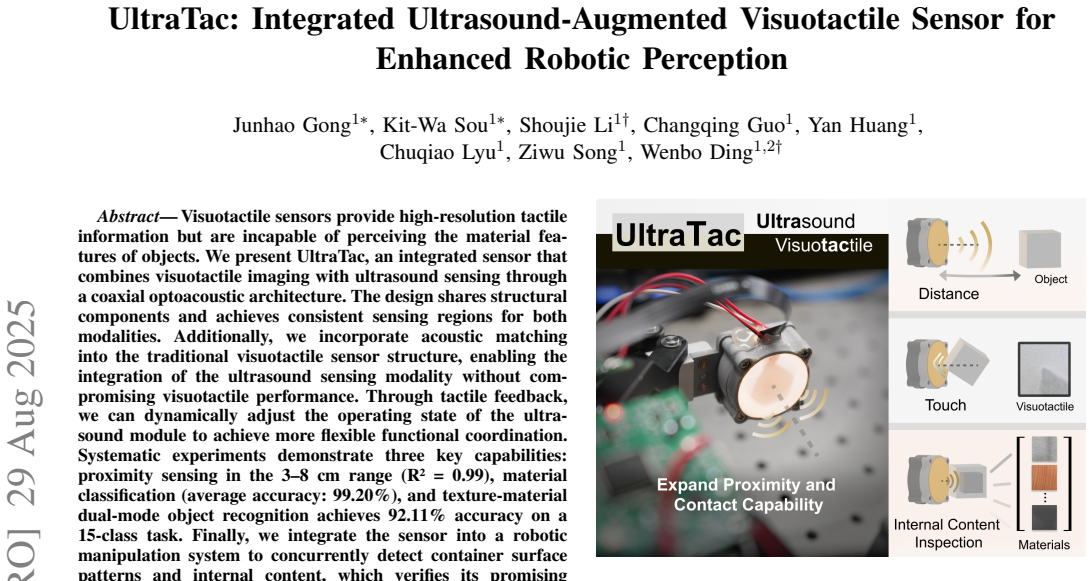
Pith's one-line read UltraTac is a single coaxial fingertip sensor that adds ultrasound to visuotactile imaging, letting robots measure pre-contact distance, classify materials by touch, and inspect closed containers' contents in real time.
desk verdict UltraTac is a genuine new sensor integration with promising demos, but the acoustic matching claim is quantitatively off and the no-compromise claim conflicts with its own limitations section. read the letter →
The pith
A machine-rendered reading of the paper's core claim, the machinery that carries it, and where it could break.
The reading
What carries the argument
The load-bearing object is the coaxial optoacoustic architecture: a ring-shaped PZT transducer surrounding a centrally placed micro-camera, so the optical and acoustic sensing regions coincide (roughly a 15 mm diameter circle). Its enabling materials are the HGM–PDMS composite membrane, which lowers the acoustic impedance mismatch at the sensor–air interface while still blocking light, and the quarter-wavelength-thick acrylic substrate (0.7 mm at 1 MHz) that couples the transducer to the elastomer. The touch-triggered dual-pathway pipeline routes ultrasound echoes to time-of-flight distance estimation before contact and to material classification during contact, using Fourier spectral featur
What would settle it
Measure tactile imaging resolution, for example by counting resolved line pairs in a calibration grid, with the HGM–PDMS membrane versus a conventional opaque membrane; if resolution drops materially, the claim that ultrasound integration does not compromise visuotactile performance fails. Alternatively, measure the ultrasound echo through the fully assembled sensor stack against the bare transducer; a large insertion loss would falsify the matching-layer claim.
Extended reading notes
Core claim
UltraTac's central claim is that visuotactile imaging and ultrasound sensing can share one compact structure rather than requiring separate bulky modules. The paper achieves this with a coaxial arrangement: a micro-camera sits at the center of an annular PZT transducer, and the usual light-blocking elastomer membrane is replaced by an HGM–PDMS composite that serves as both an optical blocker and an acoustic matching layer (1:1 volume ratio, spin-coated at 3000 rpm). A 0.7 mm acrylic substrate acts as a quarter-wavelength matching layer between the PZT and the PDMS, while tungsten-loaded epoxy backs the transducer to suppress unwanted reflections. The sensor runs a touch-triggered dual-pathwa
Load-bearing premise
The HGM–PDMS membrane, at a 1:1 volume ratio, must block light well enough for tactile imaging while also serving as an acoustic matching layer; the paper itself admits that HGM fillers degrade imaging resolution, so this dual function is only partially demonstrated.
Editorial extensions
If this is right
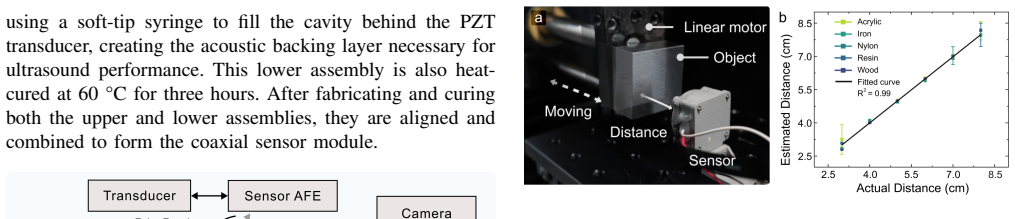
- A single fingertip sensor can provide pre-contact distance estimates accurate to about ±0.5 cm over 3–8 cm, independent of the target material among the five materials tested.
- Ultrasound-based material classification reaches 99.20% average accuracy on uniform blocks, with iron, rubber, and wood at 100% and acrylic and nylon at 98%.
- Combining tactile texture images with ultrasound material features yields 92.11% accuracy on a 15-class task, with misclassifications occurring mainly between shapes of the same material.
- Touch-triggered mode switching lets one ultrasound module serve both proximity detection and contact-based inspection without manual reconfiguration.
- A gripper with two UltraTac sensors can sort closed containers by surface pattern and internal content (air, water, oil) during a single approach-grasp-transport cycle.
Reading between the lines
- The 3 cm lower bound is set by pulse duration and receiver recovery, so raising excitation voltage or shortening the pulse could extend proximity sensing closer to contact; if achieved, the sensor could cover the whole pre-contact-to-contact range without a gap.
- Because the optical and acoustic fields are coaxially aligned, the sensor could fuse surface geometry from tactile images with subsurface echo features to estimate properties such as softness or internal structure, not just discrete material classes.
- The paper notes that HGM fillers degrade imaging resolution; a testable refinement would use a graded membrane with HGM only in the annulus above the transducer and a clear window in the camera's center.
- The same coaxial principle could scale to other transducer shapes or higher frequencies, trading sensing range for finer subsurface resolution at smaller scales.
Signed reviews
Editorial analysis
A structured set of objections, weighed in public.
Referee Report
Summary. The manuscript presents UltraTac, a compact sensor that integrates visuotactile imaging with ultrasound sensing through a coaxial optoacoustic architecture. A ring-shaped PZT transducer surrounds the camera, and the design introduces acoustic matching layers, including an HGM-PDMS membrane and a 0.7 mm acrylic substrate, to enable ultrasound transmission while preserving tactile imaging. A touch-triggered dual-pathway pipeline switches the ultrasound module between ToF proximity sensing and contact-based material classification. Experiments report proximity sensing with R²=0.99 over 3–8 cm, 99.20% material classification accuracy, 92.11% accuracy on a 15-class texture-material task, and a robotic gripper demonstration that distinguishes container surface patterns and internal contents.
Significance. If the empirical results hold, the coaxial optoacoustic architecture is a meaningful contribution to multimodal tactile sensing: it addresses a genuine limitation of visuotactile sensors (no pre-contact or subsurface information) and the integrated 4 cm×4 cm PCB with touch-triggered mode switching is a practical engineering step. The paper provides clear fabrication details, systematic experiments across five materials and fifteen pattern-material classes, and an end-to-end robotic demonstration. However, the central design claim—that the HGM-PDMS layer provides acoustic matching without compromising visuotactile performance—is quantitatively questionable and not directly measured. The classification results also rest on a single train-test split without variance reporting. These issues are load-bearing for the paper's headline claims, though they appear addressable with additional measurements and analysis.
major comments (4)
- [III-B, Eqs. (1)-(2), Table I] The claimed acoustic matching mechanism for the HGM-PDMS membrane is quantitatively unsupported. For PDMS (Z1=1.1 MRayl) to air (Z2=0.000415 MRayl), Eq. (1) gives the optimal matching impedance Zm = sqrt(1.1×0.000415) ≈ 0.021 MRayl. Even if the HGM phase alone has 0.2 MRayl (Table I), a 1:1 HGM/PDMS composite will have effective impedance far above this—Voigt/Reuss bounds give roughly 0.3–0.6 MRayl—an order of magnitude too high. Eq. (2) requires thickness λ/4 ≈ 0.1–0.2 mm at 1.05 MHz, but no thickness or measured impedance of the spin-coated layer is reported. Thus the statement that this layer provides 'optimal acoustic coupling' (Section I) and 'enhanced transmission efficiency' (Section III-B) is not established. Fig. 3(a) shows electrical impedance resonance but does not quantify acoustic transmission through the membrane.
- [Abstract vs. IV-A] The abstract reports proximity sensing R²=0.90, while Section IV-A and the Conclusions report R²=0.99 for the same experiment. This is a direct numerical inconsistency in a headline result. Please correct whichever value is wrong and ensure the abstract matches the body. Additionally, the error bars in Fig. 6(b) are described qualitatively ('consistency across all five materials'); report the standard deviation or confidence interval of the distance estimates.
- [IV-B and IV-C] All classification accuracies (99.20% and 92.11%) come from a single 8:2 train-test split. No cross-validation, repeated random splits, or class-wise confidence intervals are reported. With 200 samples per class in the dual-modal task, a single split can easily yield optimistic estimates by chance. Please provide k-fold cross-validation or repeated split results with mean±std, and report per-class accuracy in addition to the average. This is necessary to substantiate the quantitative performance claims.
- [V vs. Abstract and I] The paper claims that ultrasound is integrated 'without compromising visuotactile performance' (abstract) and that 'optimal acoustic coupling' is achieved 'while preserving optical clarity' (Section I). However, Section V admits that 'HGM fillers—whose particles are larger than conventional ones—degrade imaging resolution.' No quantitative comparison of tactile image resolution, contrast, or contact deformation fidelity with and without HGM is provided. Since the dual-function membrane is the load-bearing premise of the architecture, the no-compromise claim needs either direct evidence (e.g., resolution measurements with and without HGM) or a qualified reformulation.
minor comments (5)
- [IV-D] The internal content inspection experiment is qualitative: 'successful placement' of nine containers is reported without a confusion matrix or accuracy metric. A small quantitative table would strengthen the application claim.
- [III-C] The sentence 'the reception chain gain is set to an amplification factor of 55.5 dB at 1 mV' is ambiguous: is 1 mV the input level or a sensitivity? Clarify the gain specification.
- [Table I] Units are inconsistent: 'MRayls' in the table header vs. 'MRayl' in the text. Also, the PZT impedance range 25–35 MRayl is unusually broad; specify the PZT grade used in the annular transducer.
- [IV-B] Only four spectral features (contrast, kurtosis, skewness, entropy) are listed. With five material classes, these four features likely are not the full XGBoost input; describe the complete feature vector and the number of samples per class in the material classification experiment.
- [References] Reference [32] is to He et al. ECCV 2016 'Identity mappings in deep residual networks,' but the text says ResNet18; cite the original ResNet paper or confirm that the identity-mapping variant was used.
Circularity Check
No significant circularity: the reported results are held-out empirical evaluations of measured ToF and supervised classifiers, not fitted inputs renamed as predictions.
full rationale
The paper's derivation chain is not circular. The acoustic matching design (Sec. III-B) uses standard single-layer impedance matching Eq. (1) and quarter-wave thickness Eq. (2) with published material constants from Table I; no reported experimental result is defined in terms of these equations in a way that forces the stated outcome. Proximity detection (Sec. IV-A) estimates distance from measured echo time-of-flight using the physical relation d = c*t/2 and compares it to independent linear-stage positions; the R^2 = 0.99 is an empirical correlation, not a fitted parameter. Material classification (Sec. IV-B) and dual-modal recognition (Sec. IV-C) use spectral features and neural networks trained on labeled samples with an 8:2 train/test split, so accuracies are evaluated on held-out data and are not equivalent to the training inputs. The only self-citations ([19], [23]) appear in Related Work and are not load-bearing for any design choice or result. The skeptic's quantitative concern about the HGM-PDMS matching layer (that 0.2 MRayl HGM, even mixed with PDMS, is far from the 0.021 MRayl optimum) is a substantive correctness/support criticism, but it is not circularity: the paper may be wrong or under-supported, yet no claim reduces by construction to its own assumptions. The Limitations' admission that HGM fillers degrade imaging resolution contradicts the 'without compromising' phrasing, but that is an inconsistency, not a circular derivation.
Assumptions & free parameters
free parameters (4)
- HGM-to-PDMS volume ratio =
1:1
- Tungsten-to-epoxy volume ratio =
3:2
- Acrylic substrate thickness =
0.7 mm
- Ultrasound operating frequency =
1.05 MHz
assumptions (5)
- standard math Acoustic impedance matching formulas (Eqs. 1 and 2) correctly model the multilayer transducer stack.
- ad hoc to paper HGM-PDMS at 1:1 volume ratio preserves adequate optical clarity for tactile imaging while providing acoustic matching.
- domain assumption Ultrasound echoes through a container wall can distinguish air, water, and oil from spectral features.
- domain assumption Frequency-domain features (spectral contrast, kurtosis, skewness, entropy) are sufficient for material classification.
- domain assumption The camera-derived touch signal reliably detects contact and triggers the ultrasound mode switch.
Cite this review
Pith. "Pith review of UltraTac: Integrated Ultrasound-Augmented Visuotactile Sensor for Enhanced Robotic Perception." pith.science (2026). https://pith.science/paper/YTP4AT5V
@misc{pith2026250820982,
  author       = {Pith},
  title        = {Pith review of: UltraTac: Integrated Ultrasound-Augmented Visuotactile Sensor for Enhanced Robotic Perception},
  year         = {2026},
  howpublished = {\url{https://pith.science/paper/YTP4AT5V}},
  note         = {Machine review of arXiv:2508.20982}
}
abstract
Visuotactile sensors provide high-resolution tactile information but are incapable of perceiving the material features of objects. We present UltraTac, an integrated sensor that combines visuotactile imaging with ultrasound sensing through a coaxial optoacoustic architecture. The design shares structural components and achieves consistent sensing regions for both modalities. Additionally, we incorporate acoustic matching into the traditional visuotactile sensor structure, enabling integration of the ultrasound sensing modality without compromising visuotactile performance. Through tactile feedback, we dynamically adjust the operating state of the ultrasound module to achieve flexible functional coordination. Systematic experiments demonstrate three key capabilities: proximity sensing in the 3-8 cm range ($R^2=0.90$), material classification (average accuracy: 99.20%), and texture-material dual-mode object recognition achieving 92.11% accuracy on a 15-class task. Finally, we integrate the sensor into a robotic manipulation system to concurrently detect container surface patterns and internal content, which verifies its potential for advanced human-machine interaction and precise robotic manipulation.
Figures


Figures from the paper (9 more)



Reference graph
Works this paper leans on
-
[1]
W. Yuan, S. Dong, and E. H. Adelson, ”GelSight: High-resolution robot tactile sensors for estimating geometry and force,” Sensors, vol. 17, no. 12, p. 2762, 2017
work page 2017
-
[2]
M. Lambeta, P.-W. Chou, S. Tian, B. Yang, B. Maloon, V . R. Most, D. Stroud, R. Santos, A. Byagowi, G. Kammerer et al., ”DIGIT: A novel design for a low-cost compact high-resolution tactile sensor with application to in-hand manipulation,” IEEE Robotics and Automation Letters, vol. 5, no. 3, pp. 3838–3845, 2020
work page 2020
-
[3]
D. Ma, E. Donlon, S. Dong, and A. Rodriguez, ”Dense tactile force estimation using GelSlim and inverse FEM,” in 2019 International Conference on Robotics and Automation (ICRA), 2019, pp. 5418- 5424
work page 2019
-
[4]
Z. Kappassov, J.-A. Corrales, and V . Perdereau, ”Tactile sensing in dexterous robot hands—Review,” Robotics and Autonomous Systems, vol. 74, pp. 195–220, 2015
work page 2015
-
[5]
S. Wang, J. Wu, X. Sun, W. Yuan, W. T. Freeman, J. B. Tenenbaum, and E. H. Adelson, ”3D shape perception from monocular vision, touch, and shape priors,” in 2022 IEEE/RSJ International Conference on Intelligent Robots and Systems (IROS), 2022, pp. 2143-2150
work page 2022
-
[6]
R. Li, R. Platt, W. Yuan, A. ten Pas, N. Roscup, M. A. Srinivasan, and E. Adelson, ”Localization and manipulation of small parts using GelSight tactile sensing,” in 2014 IEEE/RSJ International Conference on Intelligent Robots and Systems, 2014, pp. 3988-3993
work page 2014
-
[7]
Shimonomura, ”Tactile image sensors employing camera: A re- view,” Sensors, vol
K. Shimonomura, ”Tactile image sensors employing camera: A re- view,” Sensors, vol. 19, no. 18, p. 3933, 2019
work page 2019
-
[8]
F. R. Hogan, M. Jenkin, S. Rezaei-Shoshtari, Y . Girdhar, D. Meger, and G. Dudek, ‘Seeing Through your Skin: Recognizing Objects with a Novel Visuotactile Sensor’, in 2021 IEEE Winter Conference on Applications of Computer Vision (W ACV), Waikoloa, HI, USA: IEEE, Jan. 2021, pp. 1217–1226
work page 2021
Show all 32 references
-
[9]
F. R. Hogan, J.-F. Tremblay, B. H. Baghi, M. Jenkin, K. Siddiqi, and G. Dudek, ‘Finger-STS: Combined Proximity and Tactile Sensing for Robotic Manipulation’, IEEE Robotics and Automation Letters, vol. 7, no. 4, pp. 10865–10872, Oct. 2022
2022
-
[10]
Song et al., ‘A flexible triboelectric tactile sensor for simultaneous material and texture recognition’, Nano Energy, vol
Z. Song et al., ‘A flexible triboelectric tactile sensor for simultaneous material and texture recognition’, Nano Energy, vol. 93, p. 106798, Mar. 2022
2022
-
[11]
Lee et al., ‘Fingerpad-Inspired Multimodal Electronic Skin for Material Discrimination and Texture Recognition’, Advanced Science, vol
G. Lee et al., ‘Fingerpad-Inspired Multimodal Electronic Skin for Material Discrimination and Texture Recognition’, Advanced Science, vol. 8, no. 9, p. 2002606, May 2021
2021
-
[12]
B. Zhu, T. Geng, G. Jiang, Z. Guan, Y . Li, and X. Yun, ‘Surrounding object material detection and identification method for robots based on ultrasonic echo signals’, Applied Bionics and Biomechanics, vol. 2023, no. 1, p. 1998218, 2023
2023
-
[13]
Cho, H.-K
I.-J. Cho, H.-K. Lee, S.-I. Chang, and E. Yoon, ‘Compliant ultrasound proximity sensor for the safe operation of human friendly robots integrated with tactile sensing capability’, Journal of Electrical En- gineering and Technology, vol. 12, no. 1, pp. 310–316, 2017
2017
-
[14]
Subsurface ultrasound microscopic imaging of the intact eye
Pavlin CJ, Sherar MD, Foster FS. Subsurface ultrasound microscopic imaging of the intact eye. Ophthalmology. 1990 Feb;97(2):244-50
1990
-
[15]
S. Luo, J. Bimbo, R. Dahiya, and H. Liu, ”Robotic tactile perception of object properties: A review,” Mechatronics, vol. 48, pp. 54-67, 2017
2017
-
[16]
R. S. Dahiya, G. Metta, M. Valle, and G. Sandini, ”Tactile sens- ing—From humans to humanoids,” IEEE Transactions on Robotics, vol. 26, no. 1, pp. 1-20, 2010
2010
-
[17]
Luo et al., ‘CompdVision: Combining Near-Field 3D Visual and Tactile Sensing Using a Compact Compound-Eye Imaging System’, Mar
L. Luo et al., ‘CompdVision: Combining Near-Field 3D Visual and Tactile Sensing Using a Compact Compound-Eye Imaging System’, Mar. 15, 2024, arXiv: arXiv:2312.07146. Accessed: Jul. 01, 2024
2024 arXiv
-
[18]
SaLoutos, E
A. SaLoutos, E. Stanger-Jones, M. Guo, H. Kim, and S. Kim, ‘Design of a Multimodal Fingertip Sensor for Dynamic Manipulation’, in 2023 IEEE International Conference on Robotics and Automation (ICRA), London, United Kingdom: IEEE, May 2023, pp. 8017–8024
2023
-
[19]
Li et al., ‘M3Tac: A Multispectral Multimodal Visuotactile Sensor With Beyond-Human Sensory Capabilities’, IEEE Transactions on Robotics, vol
S. Li et al., ‘M3Tac: A Multispectral Multimodal Visuotactile Sensor With Beyond-Human Sensory Capabilities’, IEEE Transactions on Robotics, vol. 40, pp. 4484–4503, 2024
2024
-
[20]
D. Xu, G. E. Loeb, and J. A. Fishel, ‘Tactile identification of objects using Bayesian exploration’, in 2013 IEEE international conference on robotics and automation, 2013, pp. 3056–3061
2013
-
[21]
W. Yuan, C. Zhu, A. Owens, M. A. Srinivasan, and E. H. Adelson, ”Shape-independent hardness estimation using deep learning and a GelSight tactile sensor,” in 2017 IEEE International Conference on Robotics and Automation (ICRA), 2017, pp. 951–958
2017
-
[22]
Z. Song et al., ”SATac: A Thermoluminescence Enabled Tactile Sensor for Concurrent Perception of Temperature, Pressure, and Shear,” 2024 IEEE International Conference on Robotics and Automation (ICRA), Yokohama, Japan, 2024, pp. 5680-5686
2024
-
[23]
Sou, W.-S
K.-W. Sou, W.-S. Chan, K.-C. Lei, Z. Wang, S. Li, D. Peng, and W. Ding, ”A Bio-Inspired Event-Driven Mechanoluminescent Visuotactile Sensor for Intelligent Interactions,” Advanced Functional Materials, 2024
2024
-
[24]
Abderrahmane, G
Z. Abderrahmane, G. Ganesh, A. Crosnier, and A. Cherubini, ”Haptic zero-shot learning: Recognition of objects never touched before,” Robotics and Autonomous Systems, vol. 105, pp. 11-25, 2018
2018
-
[25]
Q. Mao, Z. Liao, J. Yuan, and R. Zhu, ‘Multimodal tactile sensing fused with vision for dexterous robotic housekeeping’, Nature Com- munications, vol. 15, no. 1, p. 6871, 2024
2024
-
[26]
Davis, R
G. Davis, R. Nagarajah, S. Palanisamy, R. A. R. Rashid, P. Rajagopal, and K. Balasubramaniam, ‘Laser ultrasonic inspection of additive manufactured components’, The International Journal of Advanced Manufacturing Technology, vol. 102, pp. 2571–2579, 2019
2019
-
[27]
E. Kerr, T. M. McGinnity, and S. Coleman, ”Material classification based on thermal and surface texture properties evaluated against hu- man performance,” in IEEE International Conference on Autonomous Robot Systems and Competitions (ICARSC), 2018, pp. 168–173
2018
-
[28]
V . T. Rathod, ‘A Review of Acoustic Impedance Matching Techniques for Piezoelectric Sensors and Transducers’, Sensors (Basel), vol. 20, no. 14, p. 4051, Jul. 2020
2020
-
[29]
L. E. Kinsler, A. R. Frey, A. B. Coppens, and J. V . Sanders, Fundamentals of acoustics. John wiley & sons, 2000
2000
-
[30]
D.-S. Lin, X. Zhuang, S. H. Wong, M. Kupnik, and B. T. Khuri-Yakub, ‘Encapsulation of Capacitive Micromachined Ultrasonic Transducers Using Viscoelastic Polymer’, Journal of Microelectromechanical Sys- tems, vol. 19, no. 6, pp. 1341–1351, Dec. 2010
2010
-
[31]
X. Xu, L. Zhang, H. Guo, X. Wang, and L. Kong, ‘Acoustic character- ization of transmitted and received acoustic properties of air-coupled ultrasonic transducers based on matching layer of organosilicon hollow glass microsphere’, Micromachines, vol. 14, no. 11, p. 2021, 2023
2021
-
[32]
K. He, X. Zhang, S. Ren, and J. Sun, ‘Identity mappings in deep residual networks’, in Computer Vision–ECCV 2016: 14th European Conference, Amsterdam, The Netherlands, October 11–14, 2016, Proceedings, Part IV 14, 2016, pp. 630–645
2016
Reviewed August 5, 2026 · model on record in the stance chip above.
Discussion (0). Continue with ORCID to comment.