Fourier Preconditioning for Neural Feature Learning
Pith reviewed 2026-07-03 07:35 UTC · model grok-4.3
The pith
The fast Fourier transform acts as a data-independent preconditioner that concentrates predictive dependence into fewer modes for H-Score feature networks on approximately stationary data.
A machine-rendered reading of the paper's core claim, the machinery that carries it, and where it could break.
Core claim
H-Score networks trained on the Fourier basis achieve lower finite-sample error than on the standard basis for approximately stationary multivariate processes because the FFT diagonalizes the cross-covariance operator and thereby concentrates its singular-value spectrum, allowing the constrained network to capture the dominant dependence with fewer parameters.
What carries the argument
Unitary preconditioning via the fast Fourier transform, which rotates the input so that the singular-value spectrum of the cross-covariance concentrates into fewer dominant modes.
If this is right
- Spectral-entropy and cumulative-dependence-energy metrics can be computed once per dataset to decide whether FFT preconditioning is worthwhile before any training begins.
- In low-data or low-compute regimes the preconditioned network reaches target accuracy with smaller hidden-layer width.
- The same unitary-preconditioning logic applies to any second-order dependence measure that is sensitive to basis choice under capacity constraints.
- When the data are known to be non-stationary the FFT basis is expected to lose its advantage and may increase error.
Where Pith is reading between the lines
- The approach may extend to other unitary transforms such as wavelets when the data exhibit localized rather than global stationarity.
- The preconditioner could be inserted as a fixed layer in any architecture that relies on second-order statistics for representation learning.
- If the concentration effect holds for higher-order dependence measures, the same FFT rotation might improve mutual-information estimators that suffer from similar truncation issues.
Load-bearing premise
The underlying data-generating processes are approximately stationary so that their cross-covariance spectrum aligns with the Fourier basis.
What would settle it
On a dataset whose cross-covariance singular values remain flat after the FFT, the preconditioned network would show no NMSE improvement or would degrade relative to the un-preconditioned baseline.
Figures

read the original abstract
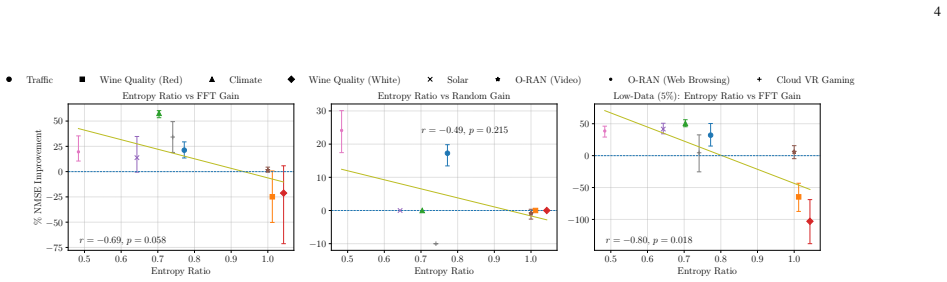
Mutual information (MI)-inspired feature learning techniques are capable of generating low-dimensional embeddings that retain nonlinear dependence structures, but direct estimations of MI suffer from noisy probability distribution estimates in the low-data regime. The H-Score objective, computed from second-order statistics, provides a practical proxy metric for training feature extraction networks. We prove that H-Score is invariant to invertible transformations in the unrestricted functional setting, but becomes sensitive to input basis rotations under constrained approximation classes. Consequently, we study unitary preconditioning for H-Score networks and show that selecting an appropriate basis rotation reduces finite-width truncation error by concentrating predictive dependence into fewer dominant modes. We identify the fast Fourier transform (FFT) as an effective data-independent, low-cost preconditioner for approximately stationary processes, where spectral structure induces concentration of the cross-covariance singular value spectrum. We introduce training-free metrics based on spectral entropy and cumulative dependence energy to quantify basis suitability and predict downstream inference gains prior to network training. Experiments across eight multivariate datasets demonstrate that FFT preconditioning is particularly useful in resource-constrained regimes, achieving up to 50% normalized mean squared error (NMSE) reduction, while the proposed metrics correlate with observed performance gains and correctly identify cases where spectral preconditioning is detrimental.
Editorial analysis
A structured set of objections, weighed in public.
Referee Report
Summary. The paper claims that the H-Score objective is invariant to invertible transformations in the unrestricted functional setting but sensitive to input basis rotations under finite-width approximation classes. It argues that unitary preconditioning (with FFT singled out for approximately stationary processes) reduces finite-width truncation error by concentrating predictive dependence into fewer modes of the cross-covariance singular value spectrum. Training-free metrics based on spectral entropy and cumulative dependence energy are introduced to quantify basis suitability and predict gains. Experiments on eight multivariate datasets show up to 50% NMSE reduction in resource-constrained regimes, with the metrics correlating to observed performance.
Significance. If the central claims hold, the work supplies a practical, data-independent, low-cost preconditioner for H-Score networks together with a theoretical account of why basis choice matters under capacity constraints. The invariance proof, the spectral-concentration argument, and the training-free predictive metrics constitute clear strengths; the multi-dataset empirical evaluation further supports utility in signal-processing settings.
major comments (1)
- [Abstract] Abstract (and the experimental results section): the effectiveness of FFT preconditioning is asserted to arise because 'spectral structure induces concentration of the cross-covariance singular value spectrum' for approximately stationary processes, yet no stationarity diagnostics (lag-1 autocorrelation decay, time-invariance of second moments, or spectral leakage) are reported for any of the eight datasets, nor is a quantitative link shown between the proposed spectral-entropy metric and the empirical singular-value decay rates. This is load-bearing for the mechanistic claim that the observed NMSE reductions are due to the Fourier basis rather than generic rotation effects.
Simulated Author's Rebuttal
We thank the referee for the careful review and constructive feedback. The major comment identifies a gap in supporting the mechanistic claims, which we address below by committing to additions in the revision.
read point-by-point responses
-
Referee: [Abstract] Abstract (and the experimental results section): the effectiveness of FFT preconditioning is asserted to arise because 'spectral structure induces concentration of the cross-covariance singular value spectrum' for approximately stationary processes, yet no stationarity diagnostics (lag-1 autocorrelation decay, time-invariance of second moments, or spectral leakage) are reported for any of the eight datasets, nor is a quantitative link shown between the proposed spectral-entropy metric and the empirical singular-value decay rates. This is load-bearing for the mechanistic claim that the observed NMSE reductions are due to the Fourier basis rather than generic rotation effects.
Authors: We acknowledge that the manuscript does not report explicit stationarity diagnostics (such as lag-1 autocorrelation decay or time-invariance of second moments) for the eight datasets, nor does it include a direct quantitative correlation between the spectral-entropy metric and observed singular-value decay rates. This is a valid observation that bears on the strength of the mechanistic explanation. In the revised version we will add stationarity diagnostics for all datasets and include an analysis (in the main text or supplement) that quantifies the relationship between the spectral-entropy values and the empirical decay rates of the cross-covariance singular values under different bases. These additions will clarify that the reported gains arise from spectral concentration rather than generic rotation effects. revision: yes
Circularity Check
No significant circularity; derivation relies on independent proof and standard Fourier properties
full rationale
The paper states its own proof that H-Score is invariant under invertible maps in the unrestricted case but sensitive under finite-width approximations, then invokes the known diagonalization property of the Fourier basis for wide-sense stationary covariances. Neither step reduces to a fitted parameter from the target data, a self-citation chain, or a redefinition of the claimed outcome. The spectral-entropy metrics are introduced as training-free diagnostics derived from the same second-order statistics already used by H-Score; they are not fitted to the downstream NMSE results. Experiments on eight external datasets provide an independent check. No load-bearing step collapses by construction to its inputs.
Axiom & Free-Parameter Ledger
axioms (2)
- domain assumption H-Score computed from second-order statistics serves as a practical proxy for mutual information in low-data regimes
- domain assumption Finite-width networks induce truncation error that depends on input basis rotations
Reference graph
Works this paper leans on
-
[1]
Neural feature learning in function space,
X. Xu and L. Zheng, “Neural feature learning in function space,”Journal of Machine Learning Research, vol. 25, no. 142, pp. 1–76, 2024
work page 2024
-
[2]
Learning low-dimensional representation for O-RAN testing via transformer- ESN,
J. Dai, R. Zhao, F. Rezazadeh, L. Zheng, H. Wang, and L. Liu, “Learning low-dimensional representation for O-RAN testing via transformer- ESN,” inIEEE MASS, 2025, pp. 127–133
work page 2025
-
[3]
M. Greenacre, P. J. F. Groenen, T. Hastie, A. I. D’Enza, A. I. Markos, and E. Tuzhilina, “Principal component analysis,”Nature Reviews Meth- ods Primers, vol. 2, 2022
work page 2022
-
[4]
Principal component analysis: A natural approach to data exploration,
F. L. Gewers, G. R. Ferreira, H. F. D. Arruda, F. N. Silva, C. H. Comin, D. R. Amancio, and L. D. F. Costa, “Principal component analysis: A natural approach to data exploration,”ACM Computing Surveys, vol. 54, no. 4, pp. 1–34, 2021
work page 2021
-
[5]
X. Chen, Y . Duan, R. Houthooft, J. Schulman, I. Sutskever, and P. Abbeel, “InfoGAN: interpretable representation learning by informa- tion maximizing generative adversarial nets,” inNIPS, 2016, pp. 2180– 2188
work page 2016
-
[6]
Learning deep representations by mutual information estimation and maximization,
R. D. Hjelm, A. Fedorov, S. Lavoie-Marchildon, K. Grewal, P. Bachman, A. Trischler, and Y . Bengio, “Learning deep representations by mutual information estimation and maximization,” inICLR, 2019
work page 2019
-
[7]
Stationary graph processes and spectral estimation,
A. G. Marques, S. Segarra, G. Leus, and A. Ribeiro, “Stationary graph processes and spectral estimation,”IEEE Trans. on Signal Processing, vol. 65, no. 22, pp. 5911–5926, 2017
work page 2017
-
[8]
J. ¨Ofverstedt, J. Lindblad, and N. Sladoje, “Fast computation of mutual information in the frequency domain with applications to global mul- timodal image alignment,”Pattern Recognition Letters, vol. 159, pp. 196–203, 2022
work page 2022
-
[9]
Mutual information-driven visualization and clustering for core KPI selection in O-RAN testing,
A. Pradhan, L. Liu, and H. S. Dhillon, “Mutual information-driven visualization and clustering for core KPI selection in O-RAN testing,” IEEE Wireless Communications, pp. 1–8, 2026
work page 2026
-
[10]
Mutual information in frequency and its application to measure cross-frequency coupling in epilepsy,
R. Malladi, D. H. Johnson, G. P. Kalamangalam, N. Tandon, and B. Aazhang, “Mutual information in frequency and its application to measure cross-frequency coupling in epilepsy,”IEEE Trans. on Signal Processing, vol. 66, no. 11, pp. 3008–3023, 2018
work page 2018
-
[11]
On estimation of modal decompositions,
A. Makur, G. W. Wornell, and L. Zheng, “On estimation of modal decompositions,” inIEEE ISIT, 2020, pp. 2717–2722
work page 2020
-
[12]
Maximal correlation regression,
X. Xu and S.-L. Huang, “Maximal correlation regression,”IEEE Access, vol. 8, pp. 26 591–26 601, 2020
work page 2020
-
[13]
Quantum algorithms for inverse participation ratio estimation in multiqubit and multiqudit systems,
Y . Liu, P. Sierant, P. Stornati, M. Lewenstein, and M. Podzie, “Quantum algorithms for inverse participation ratio estimation in multiqubit and multiqudit systems,”Phys. Rev. A, vol. 111, p. 052614, May 2025
work page 2025
-
[14]
F. Bunea and L. Xiao, “On the sample covariance matrix estimator of reduced effective rank population matrices, with applications to fPCA,” Bernoulli, vol. 21, no. 2, May 2015
work page 2015
-
[15]
Modeling long and short- term temporal patterns with deep neural networks,
G. Lai, W.-C. Chang, Y . Yang, and H. Liu, “Modeling long and short- term temporal patterns with deep neural networks,” inSIGIR, 2018, pp. 95–104
work page 2018
-
[16]
Video streaming network KPIs for O-RAN testing,
J. Dai, R. Zhao, and L. Liu, “Video streaming network KPIs for O-RAN testing,” 2025. [Online]. Available: https://dx.doi.org/10.21227/v8p4- v974
-
[17]
An Analysis of Cloud Gaming Platforms Behavior under Different Network Constraints,
P. Graff, X. Marchal, T. Cholez, S. Tuffin, B. Mathieu, and O. Festor, “An Analysis of Cloud Gaming Platforms Behavior under Different Network Constraints,” inProc. 17th Int. Conf. Netw. Serv. Manag, 2021, p. 7
work page 2021
-
[18]
M. P. I. for Biogeochemistry, “Jena climate dataset,” 2021. [Online]. Available: https://www.kaggle.com/datasets/mnassrib/jena-climate
work page 2021
-
[19]
P. Cortez, A. Cerdeira, F. Almeida, T. Matos, and J. Reis, “Wine quality,” UCI Machine Learning Repository, 2009
work page 2009
discussion (0)
Sign in with ORCID, Apple, or X to comment. Anyone can read and Pith papers without signing in.