REVIEW 4 major objections 5 minor 69 references
Experimental investigation of Markovian and non-Markovian channel addition
T0 review · 4 major / 5 minor · reviewed 2026-08-14 · deepseek-v4-flash
Pith's one-line read A photonic experiment shows that mixing two Markovian dephasing channels can create non-Markovian dynamics, and mixing two non-Markovian channels can restore Markovian behavior.
desk verdict First experimental test of non-convex channel addition, but the nM + nM = M claim rests on one state pair and does not survive the divisibility criterion. read the letter →
The pith
A machine-rendered reading of the paper's core claim, the machinery that carries it, and where it could break.
The reading
What carries the argument
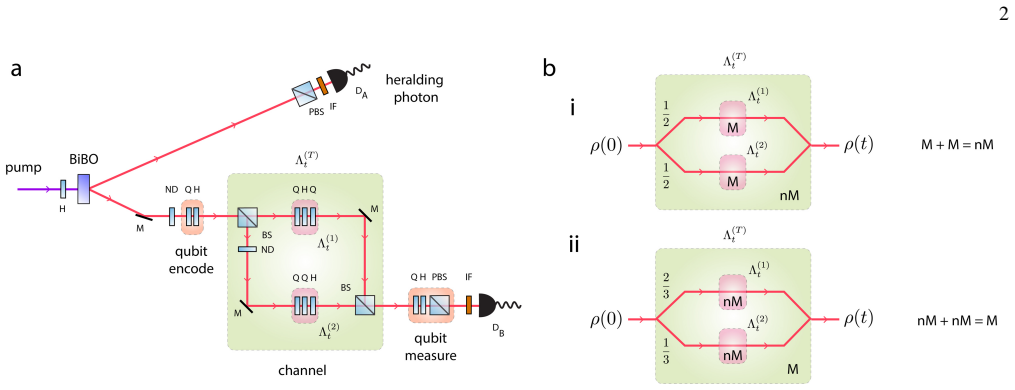
The central object is the convex sum of two quantum channels realized by a two-path interferometer without temporal alignment. A single photon is split at a beamsplitter, each path applies a dephasing channel implemented by probabilistically switching half-wave-plate angles between identity and a Pauli operation, and the paths are recombined at a second beamsplitter whose 50% loss is unbiased and whose paths are not interferometrically aligned, so the resulting output map is the incoherent weighted sum of the two path channels. Classification is carried out by quantum process tomography followed by construction of transfer matrices and the Choi matrix of the intermediate map, whose lowest eigenvalue being negative signals non-divisibility and hence non-Markovianity.
What would settle it
Temporally align the two paths, scan the relative phase, and measure the interference visibility: any nonzero visibility would indicate residual coherence between the paths, meaning the realized map is not the claimed incoherent convex sum. Separately, block each path in turn and measure the transmitted count rate at the second beamsplitter to verify that the loss is truly path-independent; unequal loss would alter the effective mixing weights and invalidate the quantitative comparison to theory.
Extended reading notes
Core claim
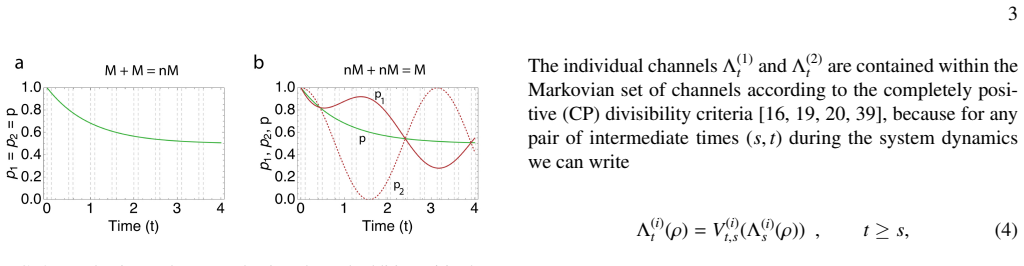
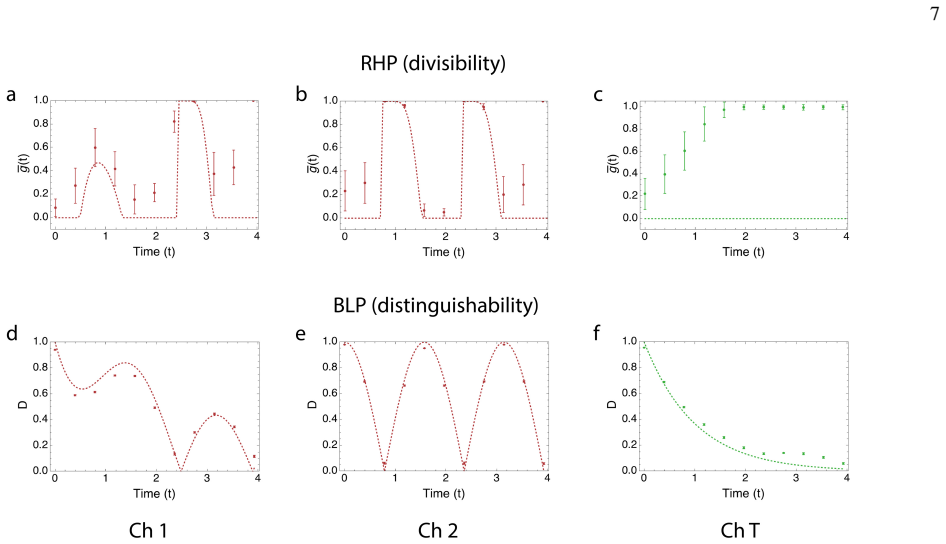
The central claim is that the non-convex geometry of Markovian and non-Markovian channels is physically real in the laboratory. Specifically, for a qubit subject to two independent phase-damping channels, the equal mixture $\Lambda_t^{(T)}(\rho)=\frac{1}{2}(\Lambda_t^{(1)}(\rho)+\Lambda_t^{(2)}(\rho))$ of two Markovian dephasing channels along the $x$ and $y$ axes is a non-Markovian channel, while the weighted mixture $\Lambda_t^{(T)}(\rho)=\frac{2}{3}\Lambda_t^{(1)}(\rho)+\frac{1}{3}\Lambda_t^{(2)}(\rho)$ of two non-Markovian dephasing channels along the $x$ axis is a Markovian phase-damping channel. The authors verify the first case by observing negative lowest eigenvalues of the intermediate Choi matrices, and verify the second case by observing a monotonically decreasing trace distance between two probe states in the interval $t\in[\pi/4,\pi/2]$, concluding that two non-Markovian channels have been added to make a Markovian channel in terms of distinguishability.
Load-bearing premise
The experiment's conclusion rests on the assumption that the two optical paths are combined incoherently without residual interference, and that the 50% loss at the recombining beamsplitter treats both paths equally, so the realized output map is exactly the weighted average of the two individual channel maps.
Editorial extensions
If this is right
- If correct, the results show that proving a channel is Markovian by decomposing it into a mixture of Markovian building blocks is invalid: the mixture can be non-Markovian.
- The results imply that non-Markovian noise can be cancelled or weakened by mixing, so a combination of two memory-bearing channels can behave like a memoryless channel in terms of distinguishability.
- The fragility of the Choi-positivity criterion for boundary cases means that experimental claims of Markovianity should not rest solely on divisibility when the ideal channel has a zero lowest eigenvalue.
- For practical quantum error correction, the work implies that noise models built from convex combinations of simple Markovian dephasings may hide non-Markovian features that affect memory-enhanced correction protocols.
Reading between the lines
- A direct extension would be to scan the mixing weight continuously and map the boundary where the sum of two non-Markovian dephasing channels becomes Markovian, giving a quantitative phase diagram for channel addition.
- The same two-path addition method could be applied to mixtures involving depolarizing or amplitude-damping channels to test whether the non-convexity observed here is a generic feature of channel sets rather than specific to dephasing.
- The authors' identified fragility suggests that future experiments should design Markovian test channels with strictly positive Choi eigenvalues, so that divisibility can certify Markovianity without relying on zero-valued boundaries.
- One could test the distinguishability-based Markovianity witness with more than two initial states to see whether the nM + nM = M conclusion is robust for all probe pairs, not just the chosen $|H\rangle,|V\rangle$ pair.
Signed reviews
Editorial analysis
A structured set of objections, weighed in public.
Referee Report
Summary. The paper reports a photonic experiment that aims to demonstrate the non-convexity of the sets of Markovian and non-Markovian quantum channels. Using a two-path linear-optics setup, it realizes (i) an equal mixture of two dephasing channels, Eqs. (1)-(3), predicted to produce a non-Markovian channel (M + M = nM), and (ii) a weighted 2:1 mixture of two non-Markovian dephasing channels, Eqs. (5)-(7), predicted to produce a Markovian channel (nM + nM = M). The authors perform quantum process tomography at multiple times, reconstruct intermediate Choi eigenvalues, compute the RHP divisibility-based measure, and for the second case also the BLP trace distance for the |H>, |V> pair. They report high process fidelities, find negative minimum Choi eigenvalues for the total channel in case (i), and a decreasing trace distance for the total channel in case (ii). The paper candidly documents places where the data do not match ideal theory, and it uses Monte Carlo error propagation (100 chi matrices per time, 10,000 intermediate maps). The central conclusions, however, are currently stronger than the evidence supports.
Significance. If fully established, this would be the first experimental test of a well-known but counterintuitive theoretical fact: the convex combination of Markovian channels can be non-Markovian, and vice versa. The paper is careful in its error treatment and in reporting disagreements with ideal theory, such as the negative lambda_min of the individual channels in Fig. 3(b). Its strengths include a clear experimental realization of channel addition and the use of two independent Markovianity criteria. Nevertheless, the two case studies have load-bearing gaps: the summands in the first case are not shown to be Markovian, and the 'confirmation' in the second case rests on a single state pair, which is insufficient for the BLP criterion. The manuscript is worth publishing after the claims are corrected and the missing checks are either performed or explicitly identified as open.
major comments (4)
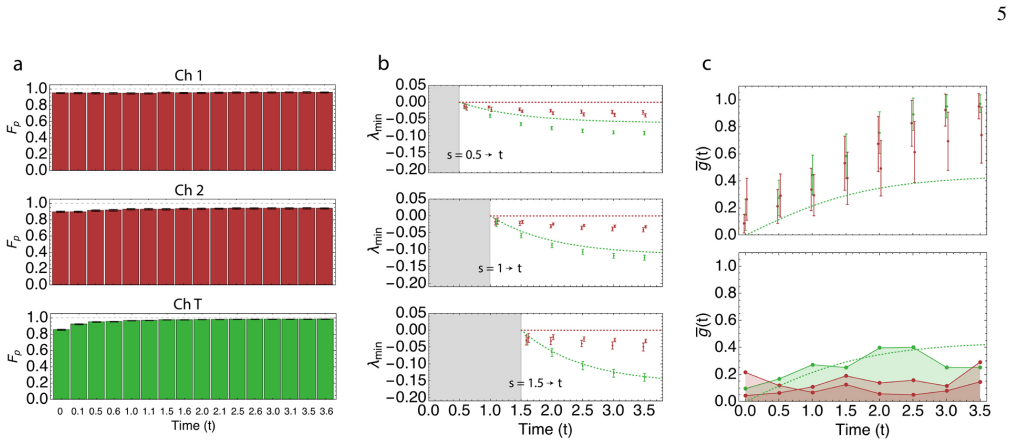
- [III.B, Fig. 3(b)] The M + M = nM case is not experimentally established because the realized individual channels fail the same Markovianity test: lambda_min for Lambda_1 and Lambda_2 is negative for every time pair shown in Fig. 3(b). The paper attributes this to ideal lambda_min = 0 plus experimental noise, but that is an assumption rather than a measurement. The data therefore demonstrate that two weakly non-Markovian channels add to a more strongly non-Markovian channel; they do not directly demonstrate that two Markovian channels can produce a non-Markovian one. To support the central claim, the authors would need either improved precision that resolves lambda_min >= 0 for the summands or an example whose Markovian summands have strictly positive intermediate Choi eigenvalues, which the paper itself notes is not currently known.
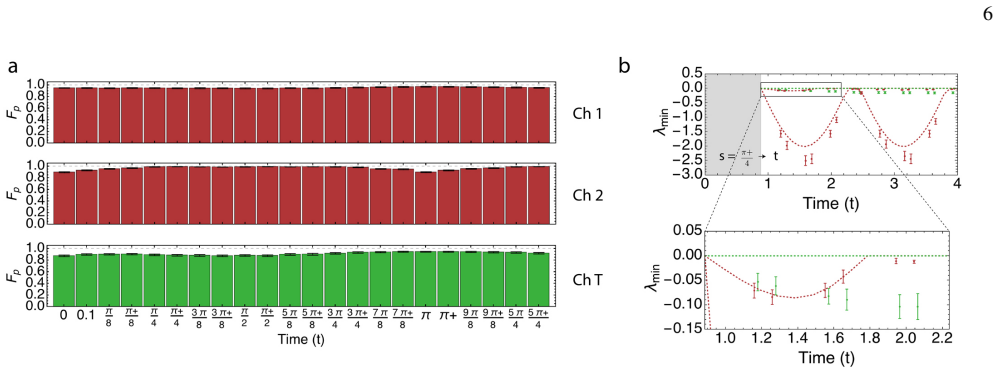
- [III.C, Fig. 5(f)] The statement that two non-Markovian channels have been added to make a Markovian channel 'in terms of distinguishability' does not follow from the data shown. The BLP criterion requires the trace distance between any two initial states to be non-increasing for all times; a decreasing trace distance for a single pair, |H> and |V>, provides only a lower bound on the BLP measure and cannot rule out backflow for another pair such as |+> and |->. Because full chi matrices were reconstructed, the authors should compute D(t) for the complete set of initial pairs, or at least report the maximum over a sufficiently dense set, and show that no derivative is positive before claiming Markovianity in the distinguishability sense.
- [III.C, Figs. 4(b) and 5(c)] The two criteria give conflicting verdicts for the total channel in the second case: by CP divisibility the total channel is non-Markovian (lambda_min < 0 in the inset of Fig. 4(b), gbar(t) > 0 in Fig. 5(c)), while by the single-pair trace distance it appears Markovian. The paper acknowledges this in the body, but the summary in Sec. IV states only that the total channel was 'Markovian in terms of distinguishability'. Given the mismatch, the safe conclusion is that the experiment realizes a channel that is non-Markovian under CP divisibility and exhibits decreasing trace distance for one state pair; it does not demonstrate that two non-Markovian channels sum to a Markovian channel under either standard criterion.
- [II, 'Experimental setup'] The central quantitative claim relies on the assumption that the realized map is exactly the convex combination in Eqs. (3) and (7): the two paths must be added incoherently with the specified weights and no path-dependent loss. The paper states that the paths are not temporally aligned and that the 50% loss at the second beamsplitter is unbiased, but it provides no control measurement supporting these assumptions, such as a characterization of the effective mixture weights with a known input state or a check that blocking each path yields the expected relative transmission. Without such a check, deviations in Figs. 3 and 5 could also be explained by a mismatch between the realized and intended channel weights.
minor comments (5)
- [II.B, Eq. (5)] The definition of p1(t) should be written with explicit parentheses, e.g., p1(t) = (3/2)[(1 + e^{-t})/2 - (1/3) cos^2 t], and it would be helpful to state that 0 <= p_i(t) <= 1 for the considered time range.
- [III.A, Eq. (8)] The transfer matrix F(s) is inverted to obtain F(t,s) = F(t) F(s)^{-1}; the paper should state how the inversion is regularized when the reconstructed F(s) is not exactly invertible due to noise.
- [Figs. 3(b), 4(b)] The data points for channels 1 and 2 are shifted horizontally 'for clarity'; this should be noted in both captions so that readers do not interpret the shift as a physical time offset.
- [III.C, trace distance discussion] Because any state pair gives only a lower bound on the BLP measure, the phrase 'confirm experimentally ... nM + nM = M' should be replaced by a statement such as 'consistent with Markovian behavior for the tested pair'.
- [II, 'Experimental setup'] The phrase 'not interferometrically aligned temporally' should be quantified, for example by giving the path-length difference relative to the photon coherence length, to strengthen the incoherent-addition argument.
Circularity Check
No significant circularity: the experimental channel reconstruction and non-Markovianity measures are independent of the self-cited theoretical predictions.
full rationale
The paper's central claims are experimental tests of the non-convexity of Markovian and non-Markovian channel sets. The specific channel constructions in Eqs. (3) and (7) are taken from Refs. [39] and [43], both co-authored by Wudarski, an author of the present paper. This is a genuine self-citation, but it is not circular here: those prior results are parameter-free, published theoretical statements that do not incorporate the present experimental data, and they are externally falsifiable. The experiment performs quantum process tomography on the realized individual and total channels and computes the RHP divisibility measure and BLP trace-distance measure directly from the reconstructed chi matrices, rather than fitting the data to the theoretical curves. The positive Choi-eigenvalue and trace-distance observations are compared with, not derived from, the cited predictions. The paper also includes explicit limitation statements, e.g., that the total channel in the nM + nM = M case could not be confirmed as Markovian under divisibility and that only a weaker distinguishability-based statement was possible; this further indicates that the data were not forced to match the theoretical expectations. No step in the derivation chain is equivalent to its input by construction, and no fitted parameter is renamed as a prediction. The only circularity-adjacent feature is the reliance on self-cited theory for the channel classifications, which is background support rather than a load-bearing reduction of the experimental result.
Assumptions & free parameters
assumptions (4)
- standard math Choi-Jamiolkowski isomorphism: a map is completely positive iff its Choi matrix is positive.
- domain assumption Non-divisibility of the dynamical map implies non-Markovian dynamics.
- domain assumption The dephasing channels in Eqs. (1), (2), (5), (6) have the claimed Markovian or non-Markovian character from prior theoretical results.
- domain assumption A positive time derivative of the trace distance D(t) witnesses non-Markovian dynamics in the distinguishability sense.
Cite this review
Pith. "Pith review of Experimental investigation of Markovian and non-Markovian channel addition." pith.science (2026). https://pith.science/paper/YUQ26MDS
@misc{pith2026190808085,
  author       = {Pith},
  title        = {Pith review of: Experimental investigation of Markovian and non-Markovian channel addition},
  year         = {2026},
  howpublished = {\url{https://pith.science/paper/YUQ26MDS}},
  note         = {Machine review of arXiv:1908.08085}
}
read the original abstract
The study of memory effects in quantum channels helps in developing characterization methods for open quantum systems and strategies for quantum error correction. Two main sets of channels exist, corresponding to system dynamics with no memory (Markovian) and with memory (non-Markovian). Interestingly, these sets have a non-convex geometry, allowing one to form a channel with memory from the addition of memoryless channels and vice-versa. Here, we experimentally investigate this non-convexity in a photonic setup by subjecting a single qubit to a convex combination of Markovian and non-Markovian channels. We use both divisibility and distinguishability as criteria for the classification of memory effects, with associated measures. Our results highlight some practical considerations that may need to be taken into account when using memory criteria to study system dynamics given by the addition of Markovian and non-Markovian channels in experiments.
Figures
Figures from the paper (2 more)
Reference graph
Works this paper leans on
-
[1]
Schlosshauer, Decoherence, the measurement problem, and interpretations of quantum mechanics, Rev
M. Schlosshauer, Decoherence, the measurement problem, and interpretations of quantum mechanics, Rev. Mod. Phys. 76, 1267 (2005)
2005
-
[2]
We realize this noise by using automated wave plates in the optical paths. For channel 1, we use a QWP-HWP-QWP chain, where the angles of the QWPs are set to zero and the angle of the HWP is set to zero for the identity operation and 45◦ forσx. For channel 2, we use a QWP-QWP-HWP chain, where again the angles of the QWPs are set to zero and the angle of t...
-
[3]
A. A. Clerk, M. H. Devoret, S. M. Girvin, F. Marquardt and R. J. Schoelkopf, Introduction to quantum noise, measurement, and amplification, Rev. Mod. Phys. 82, 1155 (2010)
work page 2010
- [4]
-
[5]
T. D. Ladd, F. Jelezko, R. Laflamme, Y . Nakamura, C. Monroe and J. L. O’Brien, Quantum computers, Nature464, 45 (2010)
work page 2010
-
[6]
H.-P. Breuer and F. Petruccione, The theory of open quantum systems, Oxford University Press, Oxford (2002)
work page 2002
-
[7]
Lidar, Lecture Notes on the Theory of Open Quantum Systems, arXiv:1902.00967 (2019)
Daniel A. Lidar, Lecture Notes on the Theory of Open Quantum Systems, arXiv:1902.00967 (2019)
arXiv 2019
- [8]
Show all 69 references
-
[9]
Vacchini, A
B. Vacchini, A. Smirne, E.-M. Laine, J. Piilo, and H.-P. Breuer, Markovianity and non-Markovianity in quantum and classical systems, New J. Phys. 13, 093004 (2011)
2011
-
[10]
Rivas, S
Á. Rivas, S. F. Huelga and M. B. Plenio, Entanglement and Non-Markovianity of Quantum Evolutions, Phys. Rev. Lett. 105, 050403 (2010)
2010
-
[11]
Breuer, E.-M
H.-P. Breuer, E.-M. Laine and J. Piilo, Measure for the Degree of Non-Markovian Behavior of Quantum Processes in Open Systems, Phys. Rev. Lett. 103, 210401 (2009)
2009
-
[12]
X.-M. Lu, X. Wang and C. P. Sun, Quantum Fisher information flow and non-Markovian processes of open systems, Phys. Rev. A 82, 042103 (2010)
2010
-
[13]
A. K. Rajagopal, A. R. Usha Devi and R. W. Rendell, Kraus representation of quantum evolution and fidelity as manifesta- tions of Markovian and non-Markovian forms, Phys. Rev. A82, 042107 (2010)
2010
-
[14]
S. Luo, S. Fu and H. Song, Quantifying non-Markovianity via correlations, Phys. Rev. A 86, 044101 (2012)
2012
-
[15]
Bylicka, D
B. Bylicka, D. Chru ´sci´nski and S. Maniscalco, Non- Markovianity and reservoir memory of quantum channels: a quantum information theory perspective, Sci. Rep., 4, 5720 (2014)
2014
-
[16]
Lorenzo, F
S. Lorenzo, F. Plastina and M. Paternostro, Geometrical char- acterization of non-Markovianity, Phys. Rev. A 88, 020102(R) (2013)
2013
-
[17]
L. Li, M. J. W. Hall and H. M. Wiseman, Concepts of quantum non-Markovianity: a hierarchy, Phys. Rep. 759, 1-51 (2018)
2018
-
[18]
Lo Gullo, I
N. Lo Gullo, I. Sinayskiy, Th. Busch and F. Petruc- cione, Non-Markovianity criteria for open system dynamics, arXiv:1401.1126 (2014)
2014 arXiv
-
[19]
F. A. Pollock, C. Rodriguez-Rosario, T. Frauenheim, M. Pater- nostro, and K. Modi, Operational markov condition for quan- tum processes, Phys. Rev. Lett. 120, 040405 (2018)
2018
-
[20]
Rivas, S
Á. Rivas, S. F. Huelga and M. B. Plenio, Quantum Non- Markovianity: Characterization, Quantification and Detection, Rep. Prog. Phys. 77, 094001 (2014)
2014
-
[21]
de Vega and D
I. de Vega and D. Alonso, Dynamics of non-Markovian open quantum systems, Rev. Mod. Phys. 89, 015001 (2017)
2017
-
[22]
Breuer, E.-M
H.-P. Breuer, E.-M. Laine, J, Piilo, and B. Vacchini, Collo- quium: Non-Markovian dynamics in open quantum systems, Rev. Mod. Phys. 88, 021002 (2016)
2016
-
[23]
Aolita, F
L. Aolita, F. de Melo and L. Davidovich, Open-system dynam- ics of entanglement:a key issues review, Rep. Prog. Phys. 78, 042001 (2015)
2015
-
[24]
Lo Franco, B
R. Lo Franco, B. Bellomo, S. Maniscalco and G. Compagno, Dynamics of quantum correlations in two-qubit systems within non-Markovian environments, Int. J. Mod. Phys. B27, 1345053 (2013)
2013
-
[25]
Tang, C.-F
J.-S. Tang, C.-F. Li, Y .-L. Li, X.-B. Zou, G.-C. Guo, H.-P. 10 Breuer, E.-M. Laine and J. Piilo, Measuring non-Markovianity of processes with controllable system-environment interaction, Eur. Phys. Lett. 97, 10002 (2012)
2012
-
[26]
N. K. Bernardes, A. Cuevas, A. Orieux, C. H. Monken, P. Mat- aloni, F. Sciarrino and M. F. Santos, Experimental observation of weak non-Markovianity, Sci. Rep. 5, 17520 (2015)
2015
-
[27]
J.-S. Xu, K. Sun, C.-F. Li, X.-Y . Xu, G.-C. Guo, E. Anders- son, R. Lo Franco and G. Compagno, Experimental recovery of quantum correlations in absence of system-environment back- action, Nat. Comm. 4, 2851 (2013)
2013
-
[28]
Z.-X. Man, N. Ba An and Y .-J. Xia, Non-Markovian dynamics of a two-level system in the presence of hierarchical environ- ments, Opt. Exp. 23, 5763-5776 (2015)
2015
-
[29]
Man, Y .-J
Z.-X. Man, Y .-J. Xia and R. Lo Franco, Harnessing non- Markovian quantum memory by environmental coupling, Phys. Rev. A 92, 012315 (2015)
2015
-
[30]
Brito and T
F. Brito and T. Werlang, A knob for Markovianity, New J. Phys. 17, 072001 (2015)
2015
-
[31]
O’Brien, A
J. O’Brien, A. Furusawa and J. Vuckovic, Quantum photonic technologies, Nat. Photon. 3, 687-695 (2005)
2005
-
[32]
Flamini, N
F. Flamini, N. Spagnolo and F. Sciarrino, Photonic quantum information processing: a review, Rep. Prog. Phys. 82 016001 (2019)
2019
-
[33]
Müller, S
M. Müller, S. Diehl, G. Pupillo and P. Zoller, Engineered open systems and quantum simulations with atoms and ions, Adv. Atom. Mol. Opt. Phys. 61, 1 (2012)
2012
-
[34]
Blatt and C
R. Blatt and C. F. Roos, Quantum simulations with trapped ions, Nat. Phys. 8, 277 (2012)
2012
-
[35]
Clarke and F
J. Clarke and F. K. Wilhelm, Superconducting quantum bits, Nature 453, 1031-1042 (2008)
2008
-
[36]
Wendin, Quantum information processing with supercon- ducting circuits: a review, Rep
G. Wendin, Quantum information processing with supercon- ducting circuits: a review, Rep. Prog. Phys. 80 106001 (2017)
2017
-
[37]
M. A. Nielsen and I. L. Chuang, Quantum Computation and Quantum Information, Cambridge University Press, Cambridge (2000)
2000
-
[38]
M. M. Wolf, J. Eisert, T. S. Cubitt and J. I. Cirac, Assess- ing Non-Markovian Quantum Dynamics, Phys. Rev. Lett. 101, 150402 (2008)
2008
-
[39]
Megier, D
N. Megier, D. Chru ´sci´nski, J. Piilo and W. T. Strunz, Eternal non-Markovianity: from random unitary to Markov chain real- isations, Sci. Rep. 7, 6379 (2017)
2017
-
[40]
F. A. Wudarski and F. Petruccione, Robustness and fragility of Markovian dynamics in a qubit dephasing channel, Phys. Rev. A 95, 052130 (2017)
2017
-
[41]
Shrikant, R
U. Shrikant, R. Srikanth and S. Banerjee, Non-Markovian De- phasing and Depolarizing Channels, Phys. Rev. A 98, 032328 (2018)
2018
-
[42]
Breuer, G
H.-P. Breuer, G. Amato and B. Vacchini, Mixing-induced quan- tum non-Markovianity and information flow, New. J. Phys. 20, 043007 (2017)
2017
-
[43]
Chru ´sci´nski, F
D. Chru ´sci´nski, F. A. Wudarski, Non-Markovianity degree for random unitary evolution, Phys. Rev. A 91, 012104 (2015)
2015
-
[44]
F. A. Wudarski and D. Chru´sci´nski, Markovian semigroup from non-Markovian evolutions, Phys. Rev. A93, 042120 (2016)
2016
-
[45]
Bongioanni, L
I. Bongioanni, L. Sansoni, F. Sciarrino, G. Vallone and P. Mat- aloni, Experimental quantum process tomography of non trace- preserving maps, Phys. Rev. A 82, 042307 (2010)
2010
-
[46]
K. A. G. Fisher, R. Prevedel, R. Kaltenbaek and K. J. Resch, Optimal linear optical implementation of a single-qubit damp- ing channel, New. J. Phys. 14, 033016 (2012)
2012
-
[47]
H. Lu, C. Liu, D.-S. Wang, L.-K. Chen, Z.-D. Li, X.-C. Yao, L. Li, N.-L. Liu, C.-Z. Peng, B. C. Sanders, Y .-A. Chen and J.-W. Pan, Universal digital photonic single-qubit quantum channel simulator, arXiv:1505.02879 (2015)
2015 arXiv
-
[48]
Wang and B
D.-S. Wang and B. C. Sanders, Quantum circuit design for ac- curate simulation of qudit channels, New J. Phys. 17, 043004 (2015)
2015
-
[49]
Piani, D
M. Piani, D. Pitkanen, R. Kaltenbaek and N. Lütkenhaus, Linear-optics realization of channels for single-photon multi- mode qudits, Phys. Rev. A 84, 032304 (2011)
2011
-
[50]
Marques, A
B. Marques, A. A. Matoso, W. M. Pimenta, A. J. Gutiérrez- Esparza, M. F. Santos and S. Pádua, Experimental simulation of decoherence in photonics qudits, Sci. Rep. 5, 16049 (2015)
2015
-
[51]
Z.-D. Liu, H. Lyyra, Y .-N. Sun, B.-H. Liu, C.-F. Li, G.-C. Guo, S. Maniscalco and J. Piilo, Experimental implementation of fully controlled dephasing dynamics and synthetic spectral den- sities, Nat. Comm. 9, 3453 (2018)
2018
-
[52]
McCutcheon, A
W. McCutcheon, A. McMillan, J. G Rarity and M. S. Tame, Ex- perimental demonstration of a measurement-based realisation of a quantum channel, New J. Phys. 20, 033019 (2018)
2018
-
[53]
B.-H. Liu, L. Li, Y .-F. Huang, C.-F. Li, G.-C. Guo, E.-M. Laine, H.-P. Breuer and J. Piilo, Experimental control of the transition from Markovian to non-Markovian dynamics of open quantum systems, Nat. Phys. 7, 931 (2011)
2011
-
[54]
Chiuri, C
A. Chiuri, C. Greganti, L. Mazzola, M. Paternostro and P. Mat- aloni, Linear Optics Simulation of Quantum Non-Markovian Dynamics, Sci. Rep. 2, 968 (2012)
2012
-
[55]
Cialdi, M
S. Cialdi, M. A. C. Rossi, C. Benedetti, B. Vacchini, D. Tamas- celli, S. Olivares and M. G. A. Paris, All-optical quantum sim- ulator of qubit noisy channels, Appl. Phys. Lett. 110, 081107 (2017)
2017
-
[56]
Morris, F
J. Morris, F. A. Pollock and K. Modi, Non-Markovian memory in IBMQX4, arXiv:1902.07980 (2019)
2019 arXiv
-
[57]
K.-D. Wu, Z. Hou, G.-Y . Xiang, C.-F. Li, G.-C. Guo, D. Dong and F. Nori, Detecting Non-Markovianity via Quantified Coher- ence: Theory and Experiments, arXiv:1903.03359 (2019)
2019 arXiv
-
[58]
D. C. Burnham and D. L. Weinberg, Observation of Simultane- ity in Parametric Production of Optical Photon Pairs, Phys. Rev. Lett. 25, 84-87 (1970)
1970
-
[59]
C. K. Hong and L. Mandel, Experimental realization of a local- ized one-photon state, Phys. Rev. Lett. 56, 58 (1986)
1986
-
[60]
S. N. Filippov, J. Piilo, S. Maniscalco and M. Ziman, Divisi- bility of quantum dynamical maps and collision models, Phys. Rev. A 96, 032111 (2017)
2017
-
[61]
S. Milz, M. S. Kim, F. A. Pollock and K. Modi, CP divisibil- ity does not mean Markovianity, Phys. Rev. Lett. 123, 040401 (2019)
2019
-
[62]
Anand and T
N. Anand and T. A. Brun, Quantifying non-Markovianity: a quantum resource-theoretic approach, arXiv:1903.03880 (2019)
2019 arXiv
-
[63]
Gorini, A
A. Gorini, A. Kossakowski and E. C. G. Sudarshan, Completely positive dynamical semigroups of N?level systems, J. Math. Phys. 17, 821 (1976)
1976
-
[64]
Lindblad, On the generators of quantum dynamical semi- groups, Comm
G. Lindblad, On the generators of quantum dynamical semi- groups, Comm. Math. Phys. 48, 119 (1976)
1976
-
[65]
I. L. Chuang and M. A. Nielsen, Prescription for experimental determination of the dynamics of a quantum black box, J. Mod. Opt. 44, 2455 (1997)
1997
-
[66]
Jamiolkowski, Linear transformations which preserve trace and positive semidefiniteness of operators
A. Jamiolkowski, Linear transformations which preserve trace and positive semidefiniteness of operators. Rep. Math. Phys. 3, 275 (1972)
1972
-
[67]
Choi, Completely positive linear maps on complex ma- trices
M.-D. Choi, Completely positive linear maps on complex ma- trices. Linear Algebr. Appl. 10, 285 (1975)
1975
-
[68]
D. F. V . James, P. G. Kwiat, W. J. Munro and A. G. White, Measurement of qubits, Phys. Rev. A 64, 052312 (2001)
2001
-
[69]
Jozsa, Fidelity for mixed quantum states
R. Jozsa, Fidelity for mixed quantum states. J. Mod. Opt. 41, 2315 (1994)
1994
Reviewed August 14, 2026 · model on record in the stance chip above.
Discussion (0). Continue with ORCID to comment.