REVIEW 3 major objections 4 minor 52 references
Sensing the spin of an individual Ce adatom
T0 review · 3 major / 4 minor · reviewed 2026-08-14 · deepseek-v4-flash
Pith's one-line read The paper claims that a Kondo-screened scanning tunneling microscope tip can sense the magnetic moment of an individual cerium adatom, measuring an effective spin S = 1/2 that ordinary spectroscopy cannot detect.
desk verdict Convincing demonstration of a Kondo-screened tip as an electrical sensor for a spectroscopically dark Ce moment; the specific S=1/2 assignment is plausible but rests on an unverified coupling model. read the letter →
The pith
A machine-rendered reading of the paper's core claim, the machinery that carries it, and where it could break.
The reading
What carries the argument
The central object is the functionalized sensor tip: a small Ce cluster at the apex that behaves as an effective spin $S = 3/2$ system with a Kondo resonance at zero bias, originating from scattering between two degenerate $m_z = \pm 1/2$ ground states. The Kondo resonance is the sensing element: it is a narrow, many-body feature at the Fermi energy whose position, width, and symmetry are extremely sensitive to magnetic fields and spin polarization. The analysis uses a spin-flip scattering Hamiltonian in which a tunneling electron can scatter from the tip spin and the sample spin in either order; coherent interference between these two sequences leaves only cross terms that describe the coupled system. The coupling between the Ce adatom and the tip spin is represented as a set-point-dependent effective magnetic field $B \propto G$, which grows as the tip-sample distance shrinks (equivalently, the exchange coupling $J_{ts}$ grows linearly with the conductance $G$). Calibration on a well-characterized Fe atom ($S = 2$, $D = -1.6$ meV, $E = 0.3$ meV) fixes the tip's spin parameters and the relation between conductance and distance, so the response to the Ce adatom can be converted into a quantitative effective field and, from that, an effective spin for Ce.
What would settle it
Approach the same functionalized tip to a spectroscopically dark but nonmagnetic adatom (for example Ag or Cu on the same Cu2N film) and sweep the set-point conductance over the same range; if the tip's Kondo resonance splits or shifts in the same way, the effect is not a magnetic readout of the Ce moment. A second test is to measure a known half-integer 4f system, such as a single Yb atom under the same conditions, and check whether the extracted $B$-versus-$G$ slope matches the $S = 1/2$ assignment.
Extended reading notes
Core claim
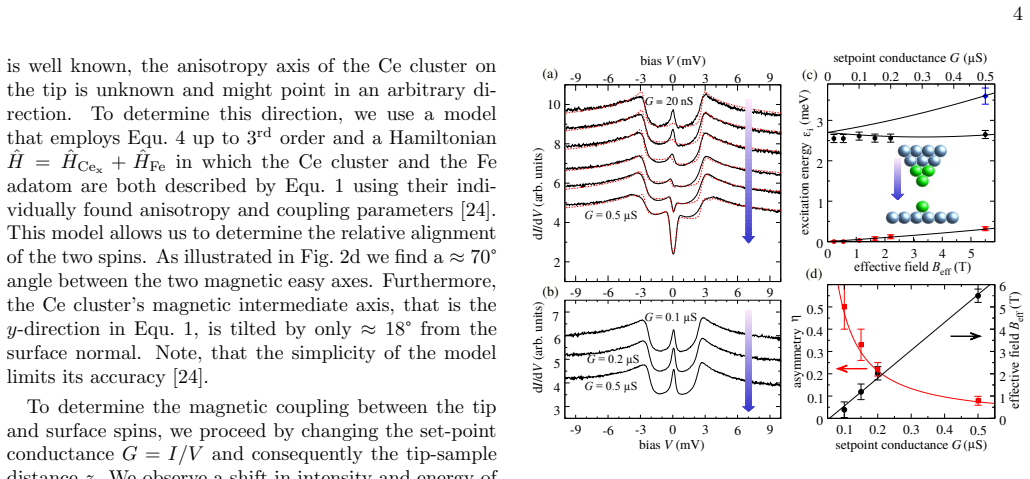
The paper's central claim is that the magnetic moment of an individual Ce adatom on Cu2N/Cu(100) can be detected through its influence on a Kondo-screened spin attached to the STM tip. Single Ce adatoms yield flat, featureless $dI/dV$ spectra, so their 4f moment is invisible in direct tunneling spectroscopy. A Ce cluster transferred to the tip apex instead shows a narrow Kondo resonance (with effective tip spin $S = 3/2$ and two degenerate ground states), and this resonance responds to the local magnetic environment. Approaching the tip to a Ce adatom splits the Kondo peak in a way that grows with set-point conductance $G$; the data are captured by modeling the adatom as a $G$-dependent effective magnetic field acting on the tip spin, with strength $B = (11 \pm 1)\,\mathrm{T}/\mu\mathrm{S} \times G$. The authors interpret the asymmetry of the split peak as spin polarization induced by the Ce moment, and the antiferromagnetic, Ising-like coupling points to a half-integer moment; assuming a spin $S = 1/2$ for Ce gives a coupling strength $J_{ts}^{y} = (2.5 \pm 0.3)\,\mathrm{meV}/\mu\mathrm{S} \times G$. The conclusion is an effective $S = 1/2$ ground state for the Ce 4f moment, sensed electrically for the first time in this system.
Load-bearing premise
The spin value $S = 1/2$ for the Ce adatom rests on the assumption that the adatom acts on the tip spin through a specific, $G$-dependent Ising-like exchange field; the paper states that the coupling mechanism between the two spins is not yet fully known.
Editorial extensions
If this is right
- The same sensor-tip method should work for other 4f elements whose moments are shielded and spectroscopically dark, so long as the tip's Kondo temperature is of order the measurement temperature.
- Because the tip's response is calibrated against Fe in situ, the technique gives a quantitative atomic-scale measure of local exchange fields without requiring spin-polarized tips.
- The linear dependence of the exchange coupling on set-point conductance means that tip-sample distance can be used to tune the effective field acting on the sensor, enabling controlled exploration of the magnetic landscape of a surface.
- This readout of 4f moments could be applied to rare-earth chains or islands on insulating films, providing an electrical probe for the interactions relevant to atomic-scale memory and proposed qubit systems.
- The paper's comparison of tips with different Kondo temperatures sets a design rule for future magnetic sensor tips: the most sensitive are those with $T_K$ near the experimental temperature.
Reading between the lines
- If the Ising-like coupling is real, the same tip should be able to map the local easy-axis direction of a 4f adatom by measuring at different lateral positions or by varying the relative orientation of the two magnetic moments.
- A natural extension is to measure Ce dimers or Ce-Fe pairs with the same tip: the extracted pair coupling could be compared with the single-adatom field to test whether the 4f-5d hybridization that mediates the interaction is additive.
- The method suggests a more general recipe: any spin system with a narrow zero-bias Kondo resonance and known spin could serve as a quantitative field sensor, so molecular Kondo systems might replace metal clusters as more reproducible tips.
- A direct check of the S = 1/2 assignment would be a measurement of the same Ce adatom by electron spin resonance or by superconducting-tip spectroscopy, which should see the corresponding Zeeman or crystal-field excitations if the ground state is indeed a doublet.
Signed reviews
Editorial analysis
A structured set of objections, weighed in public.
Referee Report
Summary. The manuscript reports low-temperature STM/STS experiments on Ce and Fe adatoms on Cu2N/Cu(100). A small Ce cluster is transferred to the STM tip, where it displays a Kondo resonance and an excitation spectrum modeled as an effective S = 3/2 spin. The functionalized tip is calibrated against Fe atoms, yielding an exchange coupling that grows linearly with set-point conductance G. The same tip is then positioned over spectroscopically dark single Ce adatoms: with increasing G, the tip's zero-bias Kondo resonance splits, while no such splitting appears on the bare surface. The authors model the Ce adatom's influence as a G-dependent effective magnetic field B_y = (11 ± 1) T/µS × G and, assuming Ising coupling and S = 1/2, extract J_y^ts = (2.5 ± 0.3) meV/µS × G. They conclude that the tip can sense the 4f moment of a single Ce atom and that the data point to an effective spin S = 1/2 of the Ce adatom.
Significance. The central experimental observation is clean and convincing: the tip Kondo resonance splits over a single Ce adatom as the tip approaches, while over the bare Cu2N surface it does not, and the effect grows monotonically with G. The Fe calibration is a thoughtful control and the transport model is state-of-the-art. If the interpretation is validated, the method offers a route to detect 4f moments that are otherwise invisible to standard STS, which is a meaningful advance for atomic-scale magnetism. However, the specific S = 1/2 assignment is not as strongly supported as the existence of a local moment at Ce: it rests on a particular coupling operator, on effective-field parameters extracted from the same spectra, and on the interpretation of a fit output (η) as spin polarization. The paper's own final paragraph concedes that the coupling mechanism is not fully known.
major comments (3)
- [Fig. 3(c)-(d) and final paragraph] The S = 1/2 assignment is not independently established. The simulated curves in Fig. 3(c) use B_y values that are extracted from fits to the same spectra whose step positions are plotted as symbols, so the agreement is a fit consistency check rather than a falsifiable prediction. The conversion B_y → J_y^ts assumes both an Ising coupling operator and S = 1/2, which is exactly the quantity the paper sets out to determine. The final paragraph states that 'the particular coupling mechanism between the two spins is not yet fully known,' and the assertion that Heisenberg or dipole-dipole interactions fit 'much less adequate' is not accompanied by a quantitative comparison. I request a quantitative model-selection analysis (e.g., residuals or likelihood comparison for Ising vs. Heisenberg vs. dipolar coupling) or a substantial softening of the claim to 'consistent with S = 1/2.'
- [Fig. 3(d) and asymmetry parameter η] The asymmetry parameter η is a fit output, not an independently measured spin polarization. The split-peak lineshape is strongly influenced by η(G), so the apparent agreement between data and simulation may be driven by this free parameter rather than by the magnetic-field model. The authors interpret the decrease of η with G as evidence for an antiferromagnetic singlet formation, but this is a post-hoc interpretation of a fitted quantity. I ask for a sensitivity analysis showing how B_y changes when η(G) is constrained or varied, or for an independent calibration of η on a known magnetic system.
- [Fig. 2(d) and the tip-cluster model] The tip-cluster Hamiltonian, including its D, E, Jρ0 parameters and the relative orientation angles (≈70° easy-axis angle and ≈18° tilt), is determined from the same scattering model that is later used to infer B_y. The caption to Fig. 2(d) acknowledges that 'the simplicity of the model limits its accuracy,' but the propagation of these uncertainties into B_y, J_y^ts, and the S = 1/2 conclusion is not quantified. Given the large number of correlated parameters, the quoted error bars on J_y^ts may be underestimated. Please provide an uncertainty propagation or a parameter-correlation analysis.
minor comments (4)
- [Throughout] There are several typographical errors: 'wFhile' at the top of page 4 should be 'While'; 'the back arrow' in the Fig. 2(d) caption should be 'the black arrow'; and 'e citation energy' in the Fig. 3(c) caption should be 'excitation energy.'
- [Eq. (4)] The symbols U^s and U^t in Eq. (4) are used before being defined; please provide explicit definitions in the text.
- [Fig. 2(f)] The caption to Fig. 2(f) states that the lines are transition energies from model calculations 'using J_ts ∝ G,' but the reader cannot tell how many free parameters were used in the fit. Please specify the fitting procedure and the number of degrees of freedom.
- [Reference [24]] The supplemental material reference [24] appears only as '[url]' in this version. The final manuscript should include the full URL or DOI so that the model details can be verified.
Circularity Check
The S=1/2 assignment for Ce is assumed in the conversion from effective field to exchange coupling, and the B-field model is fit to the same spectra rather than independently predicted.
-
self definitional
[Fig. 3(d) text and final summary paragraph]
"This indicates a half-integer moment of the Ce adatom and assuming S = 1/2, the Ising-like coupling leads to a strength of J ts y = (2.5±0.3) meV/µS×G. ... To summarize, our results point to an effective spin S = 1/2 of single Ce adatoms."
The only quantitative route from the measured spectral splitting to a Ce spin value is through the conversion B -> J, and that conversion requires choosing S_Ce. The paper sets S_Ce = 1/2 to obtain J_y and then presents S = 1/2 as the conclusion. The preceding 'singlet' reasoning does not fix S_Ce: the sensor is modeled as S = 3/2, so a singlet with the Ce moment would require S_Ce = 3/2, not 1/2, and no other observable in Fig. 3 distinguishes 1/2 from other half-integers. Thus the headline spin value is an input assumption rather than an output of the data.
-
fitted input called prediction
[Fig. 3(c) caption and text below Fig. 3(d)]
"Extracted step positions (symbols) and calculated transition energies (lines) for different G and B values, respectively. ... From the data in (a) extracted asymmetry η of the central peak and B field."
B is extracted from the same spectra whose step positions are then compared with 'calculated' transition energies generated using those B values. The match is therefore a fit by construction, not an independent prediction of the model. This does not undermine the real observation of a G-dependent splitting, but it means the model's agreement does not independently validate the assumed effective-field representation or the inferred Ce spin value.
full rationale
The core detection claim is not circular: the paper calibrates the Kondo tip on a well-characterized Fe atom (Fig. 2) and shows that the same tip on the bare Cu2N surface produces no G-dependent splitting (Fig. 3b), so the presence of a local moment at the Ce adatom is externally grounded. The G-dependent splitting of the tip Kondo resonance is a direct, reproducible effect. No load-bearing uniqueness theorem or self-citation chain is used; the model Hamiltonians and transport formalism are standard and are fitted locally. However, the specific conclusion 'effective spin S = 1/2' is weakly supported and partly circular: the only quantitative link between the measured effective field and a spin value is the exchange-coupling conversion that assumes S_Ce = 1/2. The 'singlet' inference is ambiguous because the sensor spin is modeled as S = 3/2, which would require a Ce spin of 3/2 for a total singlet. Moreover, the B(G) values themselves are fit outputs from the same spectra that the model then 'calculates,' so the agreement in Fig. 3(c) is by construction. Therefore the detection of a magnetic moment is convincing, but the S = 1/2 assignment is not independently derived. Score 5 reflects partial circularity on the central spin-value claim, while the primary sensing result retains independent experimental content.
Assumptions & free parameters
free parameters (7)
- Effective B field slope for Ce adatom =
B = (11 +/- 1) T/uS * G
- Ising exchange coupling J_ts^y for Ce-tip =
J_ts^y = (2.5 +/- 0.3) meV/uS * G
- Asymmetry parameter eta(G) =
roughly 0 to 0.5, G-dependent
- Tip Ce cluster spin parameters =
S=3/2, D=-1.3 meV, E=0.18 meV, J rho0 = -0.17
- Fe calibration parameters =
D=-1.6 meV (another Fe atom: -1.85 meV), E=0.3 meV, J rho0 = -0.09, U=0.35
- Fe-tip exchange coupling slope =
J_ts = (1.1 +/- 0.2) meV/uS * G
- Relative spin-axis orientation angles =
about 70 degrees between easy axes; intermediate axis tilted about 18 degrees from surface normal
assumptions (5)
- domain assumption The local moments are described by the effective spin Hamiltonian H = D*Sz^2 + E*(Sx^2 - Sy^2) - g*mu_B*B*S (Eq. 1).
- domain assumption The differential conductance is produced by Kondo-like spin-flip scattering, with transition matrix elements from Eq. 2 and Eq. 4 summed coherently up to third order.
- ad hoc to paper The Ce cluster at the tip apex is an effective S=3/2 spin system similar to Co on Cu2N.
- ad hoc to paper The tip-Ce interaction is an Ising-like exchange that can be represented as a G-dependent effective magnetic field.
- domain assumption The flat spectrum of single Ce adatoms reflects weak 4f hybridization rather than the absence of a magnetic moment.
Cite this review
Pith. "Pith review of Sensing the spin of an individual Ce adatom." pith.science (2026). https://pith.science/paper/YUTH5QOB
@misc{pith2026190808267,
  author       = {Pith},
  title        = {Pith review of: Sensing the spin of an individual Ce adatom},
  year         = {2026},
  howpublished = {\url{https://pith.science/paper/YUTH5QOB}},
  note         = {Machine review of arXiv:1908.08267}
}
read the original abstract
The magnetic moment of rare earth elements originates from electrons in the partially filled 4f orbitals. Accessing this moment electrically by scanning tunneling spectroscopy is hampered by shielding of outer-lying orbitals. Here we show that we can detect the magnetic moment of an individual Ce atom adsorbed on a Cu2N ultrathin film on Cu(100) by using a sensor tip that has its apex functionalized with a Kondo screened spin system. We calibrate the sensor tip by deliberately coupling it to a well characterized Fe atom. Subsequently, we use the splitting of the tip's Kondo resonance when approaching a spectroscopically dark Ce atom to sense its magnetic moment.
Figures


Reference graph
Works this paper leans on
- [1]
- [2]
-
[3]
T. Balashov, T. Miyamachi, T. Schuh, T. M¨ arkl, C. Bresch, and W. Wulfhekel, Surf. Sci. 630, 331 (2014)
work page 2014
-
[4]
M. Steinbrecher, A. Sonntag, M. Dos Santos Dias, M. Bouhassoune, S. Lounis, J. Wiebe, R. Wiesendan- ger, and A. A. Khajetoorians, Nature Comm. 7, 10454 (2016)
work page 2016
-
[5]
F. D. Natterer, K. Yang, W. Paul, P. Willke, T. Choi, T. Greber, A. J. Heinrich, and C. P. Lutz, Nature 543, 226 (2017)
work page 2017
- [6]
-
[7]
F. Patthey, B. Delley, W. D. Schneider, and Y. Baer, Phys. Rev. Lett. 55, 1518 (1985)
work page 1985
-
[8]
F. Patthey, W. D. Schneider, Y. Baer, and B. Delley, Phys. Rev. Lett. 58, 2810 (1987)
work page 1987
Show all 52 references
-
[9]
Patthey, J
F. Patthey, J. M. Imer, W. D. Schneider, H. Beck, Y. Baer, and B. Delley, Phys. Rev. B 42, 8864 (1990)
1990
-
[10]
Laubschat, E
C. Laubschat, E. Weschke, C. Holtz, M. Domke, O. Strebel, and G. Kaindl, Phys. Rev. Lett. 65, 1639 (1990)
1990
-
[11]
D. Ehm, S. H¨ ufner, F. Reinert, J. Kroha, P. Wolfle, O. Stockert, C. Geibel, and H. V. Lohneysen, Phys. Rev. B 76, 045117 (2007)
2007
-
[12]
Kondo, Prog
J. Kondo, Prog. Theor. Phys. 32, 37 (1964)
1964
-
[13]
Kondo, Phys
J. Kondo, Phys. Rev. 169, 437 (1968)
1968
-
[14]
A. C. Hewson, Kondo Problem to Heavy Fermions, The (Cambridge University Press, Cambridge, 1997)
1997
-
[15]
Ternes, A
M. Ternes, A. J. Heinrich, and W. D. Schneider, J. Phys.: Condens. Matter 21, 053001 (2009)
2009
-
[16]
Warner, F
B. Warner, F. E. Hallak, N. Atodiresei, P. Seibt, H. Pr¨ user, V. Caciuc, M. Waters, A. J. Fisher, S. Bl¨ ugel, J. Van Slageren, et al., Nature Comm. 7, 12785 (2016)
2016
-
[17]
J. T. Li, W. D. Schneider, R. Berndt, and B. Delley, Phys. Rev. Lett. 80, 2893 (1998)
1998
-
[18]
Silly, M
F. Silly, M. Pivetta, M. Ternes, F. Patthey, J. P. Pelz, and W. D. Schneider, Phys. Rev. Lett.92, 016101 (2004)
2004
-
[19]
Silly, M
F. Silly, M. Pivetta, M. Ternes, F. Patthey, J. P. Pelz, and W. D. Schneider, New J. Phys. 6, 16 (2004)
2004
-
[20]
N. N. Negulyaev, V. S. Stepanyuk, L. Niebergall, P. Bruno, M. Pivetta, M. Ternes, F. Patthey, and W. D. Schneider, Phys. Rev. Lett. 102, 246102 (2009)
2009
-
[21]
Ternes, M
M. Ternes, M. Pivetta, F. Patthey, and W. D. Schneider, Prog. Surf. Sci. 85, 1 (2010)
2010
-
[22]
Pivetta, M
M. Pivetta, M. Ternes, F. Patthey, and W. D. Schneider, Phys. Rev. Lett. 99, 126104 (2007)
2007
-
[23]
F. M. Leibsle, S. S. Dhesi, S. D. Barrett, and A. W. Robinson, Surf. Sci. 317, 309 (1994)
1994
-
[24]
See supplemental material [url] which includes the refer- ences [25–31]
-
[25]
J. A. Appelbaum, Phys. Rev. Lett. 17, 91 (1966)
1966
-
[26]
P. W. Anderson, Phys. Rev. Lett. 17, 95 (1966)
1966
-
[27]
J. A. Appelbaum, Phys. Rev. 154, 633 (1967)
1967
-
[28]
Spinelli, M
A. Spinelli, M. Gerrits, R. Toskovic, B. Bryant, M. Ternes, and A. F. Otte, Nature Comm. 6, 10046 (2015)
2015
-
[29]
A. A. Khajetoorians, M. Steinbrecher, M. Ternes, M. Bouhassoune, S. Lounis, M. Dos Santos Dias, J. Wiebe, and R. Wiesendanger, Nature Comm. 7, 10620 (2016)
2016
-
[30]
D. J. Choi, R. Robles, S. Yan, J. A. J. Burgess, S. Rolf- Pissarczyk, J. P. Gauyacq, N. Lorente, M. Ternes, and S. Loth, Nano Lett. 17, 6203 (2017)
2017
-
[31]
Hermenau, M
J. Hermenau, M. Ternes, M. Steinbrecher, R. Wiesen- danger, and J. Wiebe, Nano Lett. 18, 1978 (2018)
2018
-
[32]
A. J. Heinrich, J. A. Gupta, C. P. Lutz, and D. M. Eigler, Science 306, 466 (2004)
2004
-
[33]
C. F. Hirjibehedin, C. Y. Lin, A. F. Otte, M. Ternes, C. P. Lutz, B. A. Jones, and A. J. Heinrich, Science 317, 1199 (2007)
2007
-
[34]
Ternes, New J
M. Ternes, New J. Phys. 17, 063016 (2015)
2015
-
[35]
Ternes, Prog
M. Ternes, Prog. Surf. Sci. 92, 83 (2017)
2017
-
[36]
Fano, Phys
U. Fano, Phys. Rev. 124, 1866 (1961)
1961
-
[37]
Madhavan, W
V. Madhavan, W. Chen, T. Jamneala, M. F. Crommie, and N. S. Wingreen, Phys. Rev. B 64, 165412 (2001)
2001
-
[38]
´Ujs´ aghy, J
O. ´Ujs´ aghy, J. Kroha, L. Szunyogh, and A. Zawadowski, Phys. Rev. Lett. 85, 2557 (2000)
2000
-
[39]
Zonda, O
M. Zonda, O. Stetsovych, R. Korytar, M. Ternes, R. Temirov, A. Racanelli, F. S. Tautz, P. Jelinek, T. Novotny, and M. Svec, ArXiv:1811.00351v1 [cond- Mat.Mes-Hall] (2018)
2018 arXiv
-
[40]
A. F. Otte, M. Ternes, S. Loth, K. Von Bergmann, H. Brune, C. P. Lutz, C. F. Hirjibehedin, and A. J. Hein- rich, Nature Physics 4, 847 (2008)
2008
-
[41]
J. C. Oberg, M. R. Calvo, F. Delgado, M. Moro-Lagares, D. Serrate, D. Jacob, J. Fernandez-Rossier, and C. F. Hirjibehedin, Nature Nanotechnology 9, 64 (2013)
2013
-
[42]
Von Bergmann, M
K. Von Bergmann, M. Ternes, S. Loth, C. P. Lutz, and A. J. Heinrich, Phys. Rev. Lett. 114, 076601 (2015)
2015
-
[43]
L. Gao, W. Ji, Y. B. Hu, Z. H. Cheng, Z. T. Deng, Q. Liu, N. Jiang, X. Lin, W. Guo, S. X. Du, et al., Phys. Rev. Lett. 99, 106402 (2007)
2007
-
[44]
Jacobson, T
P. Jacobson, T. Herden, M. Muenks, L. G., O. O. Brovko, V. S. Stepanyuk, M. Ternes, and K. Kern, Nature Comm. 6, 8536 (2015)
2015
-
[45]
Ormaza, N
M. Ormaza, N. Bachellier, M. N. Faraggi, B. Verlhac, 6 P. Abufager, P. Ohresser, L. Joly, M. Romeo, F. Scheurer, M. L. Bocquet, et al., Nano Lett. 17, 1877 (2017)
2017
-
[46]
Muenks, P
M. Muenks, P. Jacobson, M. Ternes, and K. Kern, Nature Comm. 8, 14119 (2017)
2017
-
[47]
Verlhac, N
B. Verlhac, N. Bachellier, L. Garnier, M. Ormaza, P. Ab- ufager, R. Robles, M. L. Bocquet, M. Ternes, N. Lorente, and L. Limot, Science 366, 623 (2019)
2019
-
[48]
K. Yang, W. Paul, F. D. Natterer, J. L. Lado, Y. Bae, P. Willke, T. Choi, A. Ferr´ on, J. Fernandez-Rossier, A. J. Heinrich, et al., Phys. Rev. Lett. 122, 227203 (2019)
2019
-
[49]
S. Loth, C. P. Lutz, and A. J. Heinrich, New J. Phys. 12, 125021 (2010)
2010
-
[50]
Gunnarsson and K
O. Gunnarsson and K. Sch¨ onhammer, Phys. Rev. Lett. 50, 604 (1983)
1983
-
[51]
J. Bork, Y. Zhang, L. Diekhoner, L. Borda, P. Simon, J. Kroha, P. Wahl, and K. Kern, Nature Physics 7, 901 (2011)
2011
-
[52]
G. Czap, P. J. Wagner, F. Xue, L. Gu, J. Li, J. Yao, R. Wu, and W. Ho, Science 364, 670 (2019)
2019
Reviewed August 14, 2026 · model on record in the stance chip above.
Discussion (0). Continue with ORCID to comment.