REVIEW 4 major objections 4 minor 5 references
CountZES: Counting via Zero-Shot Exemplar Selection
T0 review · 4 major / 4 minor · reviewed 2026-08-03 · deepseek-v4-flash
Pith's one-line read CountZES claims that zero-shot object counting can be done without any task-specific training by selecting three complementary exemplars—semantic, density-guided, and feature-consensus—from fixed pretrained models.
desk verdict Genuinely useful inference-only exemplar-selection pipeline for zero-shot counting with strong cross-domain results, but the abstract overstates 'superior performance' against its own Table 1 and the density-guided stage is self-referential. read the letter →
The pith
A machine-rendered reading of the paper's core claim, the machinery that carries it, and where it could break.
The reading
What carries the argument
The central object is the multi-stage exemplar selection pipeline, CountZES. The Detection-Anchored Exemplar (DAE) stage refines a detector box into a single-instance region by scoring SAM masks with text-alignment and entropy. The Density-Guided Exemplar (DGE) stage turns density-map peaks into point prompts for SAM, filters boxes by predicted region count, and selects the box whose count is closest to the mode of all candidate counts while remaining semantically compact. The Feature-Consensus Exemplar (FCE) stage clusters SAM feature embeddings of single-instance boxes and picks the one nearest the majority-cluster centroid. The mechanism is the deliberate diversity of the resulting three-
What would settle it
Take classes where the segmenter is known to split objects (e.g., watches segment into dial and band, eggs into yolk and white). If replacing the segmenter with one that yields complete masks does not reduce CountZES's error on those classes, then exemplar selection itself is not what is driving the reported accuracy; the same could be tested by measuring whether selected exemplar masks cover at least 80% of the annotated instance.
Extended reading notes
Core claim
On its own terms, the paper discovers that zero-shot object counting can be recast as an exemplar-inference problem governed by semantic, statistical, and feature-level priors. CountZES refines a coarse open-vocabulary detection into a single-instance exemplar using text-conditioned similarity peaks and a segmenter; it then derives a second exemplar from density-map peaks whose region count and semantic compactness agree with a pseudo-ground-truth mode; and it selects a third exemplar by clustering segmenter features and choosing the box nearest the majority-cluster centroid. The authors claim this one-exemplar-per-stage diversity is what drives accuracy, and they support the claim with expe
Load-bearing premise
The entire pipeline presumes that a single point prompt reliably makes the segmenter return the whole object, not a fragment of it; when it returns only a dial, a yolk, or a character on a book cover, the selected exemplar is partial and the final count is conditioned on that partial object.
Editorial extensions
If this is right
- A user can count arbitrary categories—cars in aerial views, cells in microscopy—from a class name alone, with no exemplar annotation and no task-specific optimization.
- Any improvement to a single component (detector, segmenter, density estimator) can be dropped into the pipeline directly, since all components remain fixed during inference.
- Because text is used only as an inference-time probe, the method avoids the text-count entanglement that the paper identifies as a source of cross-domain brittleness in other zero-shot counters.
- On the reported benchmarks, CountZES matches or beats several trained zero-shot counting methods while using only frozen pretrained components.
Reading between the lines
- A direct corollary the paper leaves implicit is that per-class accuracy should be predictable from the segmenter's mask completeness for that class; this can be tested by correlating per-class MAE with manual mask-completeness scores.
- The one-exemplar-per-stage rule is a fixed design choice; an adaptive weighting of stages based on detector confidence, density spread, or feature-cluster tightness could improve counts on images where one stage is unreliable.
- The same exemplar-selection logic could extend to other dense prediction tasks, such as promptable instance segmentation or referring localization, where a text prompt must be converted into representative visual support without labels.
Editorial analysis
A structured set of objections, weighed in public.
Referee Report
Summary. CountZES proposes an inference-only pipeline for zero-shot object counting (ZOC) that discovers three exemplars per image through Detection-Anchored (DAE), Density-Guided (DGE), and Feature-Consensus (FCE) stages, then feeds them to a frozen pretrained density estimator. The method uses CLIP, GroundingDINO, SAM, and either CounTR or DSALVANet as fixed backbones, and claims superior ZOC performance while generalizing to natural, aerial, and medical domains. The paper reports results on FSC-147, CARPK, PerSense-D, VGG, and MBM, with ablations attributing gains to each stage.
Significance. If the headline claims held, the contribution would be a modular, training-free exemplar-selection strategy for ZOC, useful in settings where per-class fine-tuning is impractical. The paper is clearly written and includes sensible ablations, cross-domain protocols, and a runtime analysis. It also deserves credit for being explicit about its modularity and for reporting a limitations appendix. However, the central 'superior performance' claim is not supported by the paper's own main table on FSC-147, and the documented dependence on SAM's ability to produce complete single-instance masks imposes a stronger constraint than the abstract conveys. The significance of the work is moderate and conditional on a more careful framing of what is actually demonstrated.
major comments (4)
- [Abstract, Sec. 1, Sec. 5, and Table 1] The claim of 'superior performance among ZOC methods' is contradicted by Table 1 on FSC-147. In the in-domain setting, CountZES reports MAE 15.77, while T2ICount, GeCo, and CountGD report 11.76, 13.30, and 14.76 respectively. The paper's own Section 4 text describes the in-domain MAE as 'competitive,' which is accurate, but the abstract and conclusion use 'superior' without qualification. Even in the cross-domain row, CountingDINO* has lower MAE (20.93 vs 21.09) and much lower RMSE (71.37 vs 110.14). If CountingDINO is excluded because it uses box prompts, that exclusion must be stated wherever 'superior' appears. As written, the paper is internally inconsistent about its main claim.
- [Sec. 3.2, Eqs. (4), (5), (10)-(12)] The DGE stage selects an exemplar using the same density estimator that later produces the final count. Density peaks (Eq. 4), the RoI-count single-instance filter (Eq. 5), the per-box count estimates (Eq. 10), and the pseudo-GT KDE mode (Eqs. 11-12) all come from the same frozen DE. Consequently, the DGE gain in Table 5 may reflect that an exemplar is consistent with the counter's own prior rather than that it is a better exemplar in any transferable sense. This is a circularity risk for the claim that DGE improves exemplar quality. Please provide an analysis where the selection-time DE differs from the final-count DE, or where exemplars selected by DGE are evaluated with an independent counter, to separate self-consistency from true representativeness.
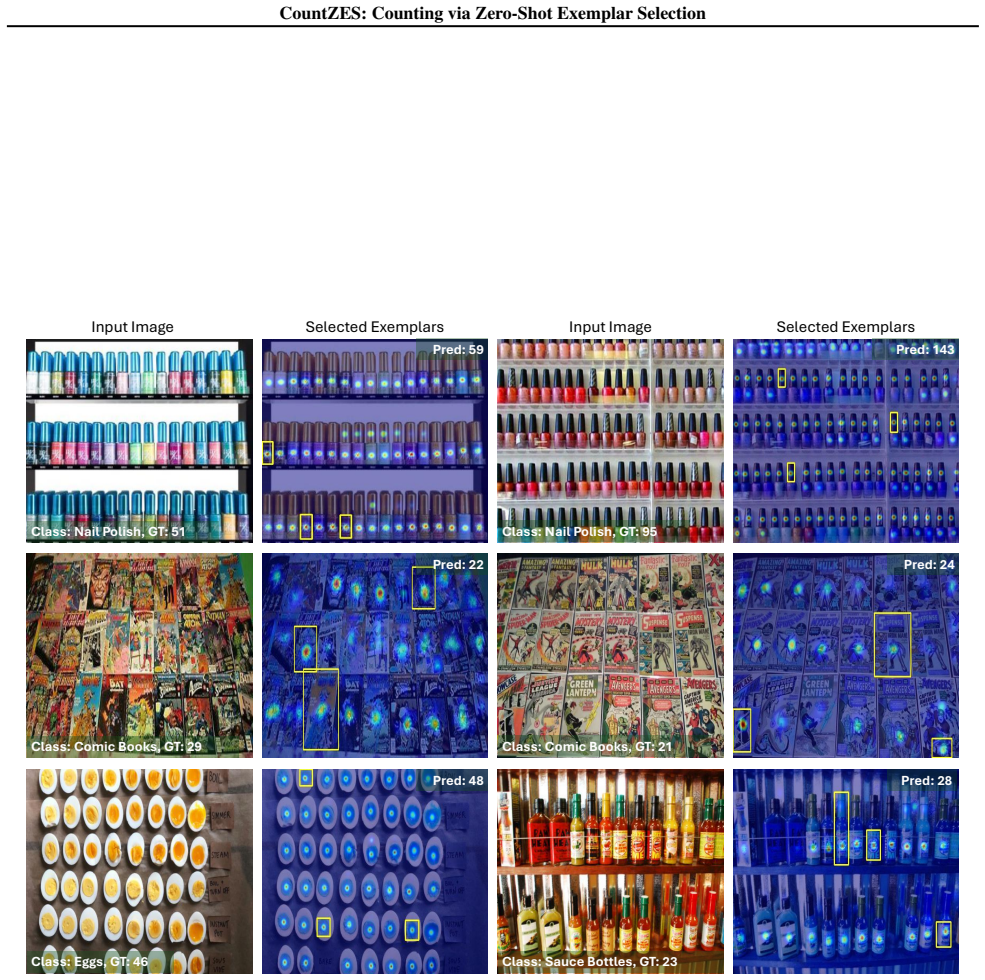
- [Appendix A.7 and Figs. 13-14] The paper explicitly documents that SAM point prompts produce partial masks for watches, nail polishes, comic books, eggs, and sauce bottles, and states that 'residual noise can still propagate when the majority of candidate exemplars are imperfect.' This is a direct limitation on the central generalization claim, because all three stages rely on SAM masks as candidate boxes. Since several of these classes (e.g., eggs, comic books) appear in the benchmark classes used for evaluation, the unconditional wording of the abstract and conclusion is too strong. Please quantify how often partial-mask failures occur across the test splits and report per-class or per-infection performance, or restrict the claims to classes where SAM provides complete instances. A limitation appendix is welcome, but it must be reflected in the paper's central claims.
- [Sec. 4, Tables 3 and 4] The cross-domain comparisons on PerSense-D and VGG/MBM include very few inference-only baselines: only TFOC on PerSense-D, and TFOC on VGG/MBM. Since the paper positions CountZES against inference-only methods, the absence of CountingDINO, TFCAC, OmniCount, and Count Anything from these tables makes it difficult to substantiate 'superior performance among inference-only methods' outside FSC-147. Please add the missing baselines or explicitly justify their exclusion.
minor comments (4)
- [Table 3] The column header 'Density-based Class-wise' is confusing: the table appears to show density-based splits, not class-wise results. Also, the 'Overall' MAE for GeCo (13.12) is higher than each of its Low/Med/High MAE entries, which suggests an inconsistency in how the overall row is computed or labeled.
- [Appendix A.3, Eq. (10)] Eq. (10) states \hat{c}_i \in \mathbb{Z}, but the density estimator returns a continuous count (and Eq. (5) uses fractional predictions like 1<\hat{c}<2). The codomain should be nonnegative reals.
- [References] The bibliography contains Langley (2000), but I do not see a citation to it in the text. Please either cite it or remove it.
- [Throughout] Minor formatting issues: 'Figure.' appears with inconsistent spacing, 'V A-Count' and 'DA VE' formatting is awkward, and Table 1 has two 'CountZES (Ours)' rows that could be distinguished more clearly with explicit 'in-domain' and 'cross-domain' labels in the rows.
Circularity Check
DGE's density-guided selection is self-referential (same density estimator supplies pseudo-GT and final count), but no prediction reduces to its inputs by construction and the central comparisons are external.
-
other
[Section 3.2 (DGE), Eqs. (5), (11)-(12); final-count sentence in Section 3.3]
"To verify whether bi captures a single instance, we compute its integrated density within the region of interest (RoI): c(bi) = ... (5) ... we estimate a pseudo-GT count via consensus among all single-instance candidates ... cpseudo = arg max c p(c). (12) ... Ultimately, bDAE, bDGE, and bFCE constitute the final exemplar set, which is jointly provided as multiple support exemplars to the density estimator to produce the final density map and count prediction."
DGE selects its exemplar by closeness to a pseudo-GT count that is itself the mode of per-box counts computed with the same pretrained density estimator that later produces the final count. Thus the 'count consistency' term in J_DGE is a self-consistency loop: the exemplar is chosen to agree with the estimator's own statistics, and the final count is then generated by that same estimator. This is not a full reduction because the final count is not equal to the pseudo-GT by any equation, but it means the DGE stage does not provide independent evidence of exemplar quality or counting accuracy.
full rationale
The main derivation chain is not circular in the strong sense: CountZES uses fixed pretrained components (CLIP, GroundingDINO, SAM, a pretrained density estimator) and its final count comes from a density estimator applied to the selected exemplar set. No equation in the paper forces the final count to equal a fitted parameter or a pseudo-GT. The DGE stage, however, is self-referential: it uses the same density estimator both to define pseudo-GT (Eqs. 11-12) and to produce the final count, so its selected exemplar is chosen for self-consistency rather than external validation. This is a genuine methodological caveat, but the paper is transparent about calling it 'self-supervised.' The ablation (Table 5) does not exhibit Eq. X = Eq. Y by construction. The external comparisons on FSC-147, CARPK, PerSense-D, VGG, and MBM are benchmark-reported numbers, so the central empirical claim is falsifiable and not definitionally forced. Notably, the paper's own Table 1 shows CountZES is not the best on FSC-147 (MAE 15.77 vs T2ICount 11.76; cross-domain MAE 21.09 vs CountingDINO 20.93), which undermines the 'superior performance compared to SOTA' wording; that is a correctness/internal-consistency concern, not circularity. Appendix A.7 also explicitly documents SAM partial-mask failures, which limits the accuracy claim but again is not a circular-derivation issue. No load-bearing self-citation or imported uniqueness theorem is present; the only self-citation is the PerSense-D dataset definition, which is not an argumentative premise. Overall, the paper has one self-referential selection mechanism but no constructive reduction, so a modest circularity score is appropriate.
Assumptions & free parameters
free parameters (8)
- alpha in Eqs. (1) and (6) =
0.5
- w_sim / w_ent in Eq. (3) =
0.5 / 0.5
- SSES percentile start, step, and max peaks =
p=90, Δp=10, k=16
- Density peak threshold T_D =
μ_D + 2σ_D
- RoI single-instance interval =
(1, 2)
- GroundingDINO detection threshold =
0.15
- FRES cluster count =
2
- Entropy histogram bins and Laplace smoothing =
B=20, ε=1e-8
assumptions (7)
- domain assumption CLIP text-image similarity is a reliable dense semantic grounder for arbitrary class names.
- domain assumption GroundingDINO returns at least one text-aligned detection box per image.
- domain assumption SAM point prompts yield complete, single-instance masks.
- domain assumption Off-the-shelf density estimators (CounTR/DSALVANet) produce density maps whose peaks and RoI counts are reliable in the target domain.
- domain assumption The KDE mode of per-box count estimates is a valid pseudo-GT.
- domain assumption Window-attention-based feature upsampling (AnyUp) preserves enough spatial detail for small boxes.
- domain assumption Entropy and percentile-rank scores correlate with instance purity.
Cite this review
Pith. "Pith review of CountZES: Counting via Zero-Shot Exemplar Selection." pith.science (2026). https://pith.science/paper/YUXQOBRB
@misc{pith2026251216415,
  author       = {Pith},
  title        = {Pith review of: CountZES: Counting via Zero-Shot Exemplar Selection},
  year         = {2026},
  howpublished = {\url{https://pith.science/paper/YUXQOBRB}},
  note         = {Machine review of arXiv:2512.16415}
}
read the original abstract
Object counting in complex scenes is particularly challenging in the zero-shot (ZS) setting, where instances of unseen categories are counted using only a class name. Existing ZS counting methods that infer exemplars from text often rely on off-the-shelf open-vocabulary detectors (OVDs), which in dense scenes suffer from semantic noise, appearance variability, and multi-instance proposals. Alternatively, random image-patch sampling is employed, which fails to accurately delineate object instances. Since counting is sensitive to exemplar quality, such selection strategies often yield poorly representative exemplars, leading to inaccurate count estimation. To address these issues, we propose CountZES, an inference-only approach for object counting via ZS exemplar selection. CountZES discovers diverse exemplars through three synergistic stages: Detection-Anchored Exemplar (DAE), Density-Guided Exemplar (DGE), and Feature-Consensus Exemplar (FCE). DAE refines OVD detections to isolate precise single-instance exemplars. DGE introduces a density-driven, self-supervised paradigm to identify statistically consistent and semantically compact exemplars, while FCE reinforces visual coherence through feature-space clustering. Together, these stages yield a complementary exemplar set that balances textual grounding, count consistency, and feature representativeness. Experiments on diverse datasets demonstrate CountZES superior performance among ZOC methods while generalizing effectively across domains.
Figures


Figures from the paper (11 more)


Reference graph
Works this paper leans on
-
[4]
Countingdino: A training-free pipeline for class-agnostic counting using unsupervised backbones
Pacini, G., Bianchi, L., Ciampi, L., Messina, N., Amato, G., and Falchi, F. Countingdino: A training-free pipeline for class-agnostic counting using unsupervised backbones. arXiv preprint arXiv:2504.16570,
-
[5]
Wimmer, T., Truong, P., Rakotosaona, M.-J., Oech- sle, M., Tombari, F., Schiele, B., and Lenssen, J. E. Anyup: Universal feature upsampling.arXiv preprint arXiv:2510.12764,
-
[2018]
Can sam count anything? an empirical study on sam counting.arXiv preprint arXiv:2304.10817,
Ma, Z., Hong, X., and Shangguan, Q. Can sam count anything? an empirical study on sam counting.arXiv preprint arXiv:2304.10817,
-
[2023]
Crafting papers on machine learning
Langley, P. Crafting papers on machine learning. In Langley, P. (ed.),Proceedings of the 17th International Conference on Machine Learning (ICML 2000), pp. 1207–1216, Stan- ford, CA,
2000
-
[2025]
Countr: Transformer-based generalised visual counting.arXiv preprint arXiv:2208.13721,
Liu, C., Zhong, Y ., Zisserman, A., and Xie, W. Countr: Transformer-based generalised visual counting.arXiv preprint arXiv:2208.13721,
Reviewed August 3, 2026 · model on record in the stance chip above.
Discussion (0). Sign in to comment.