Vibrations Drive Ultrafast Intersystem Crossing of a Photoexcited Cr(III) Complex
Pith reviewed 2026-06-28 11:42 UTC · model grok-4.3
The pith
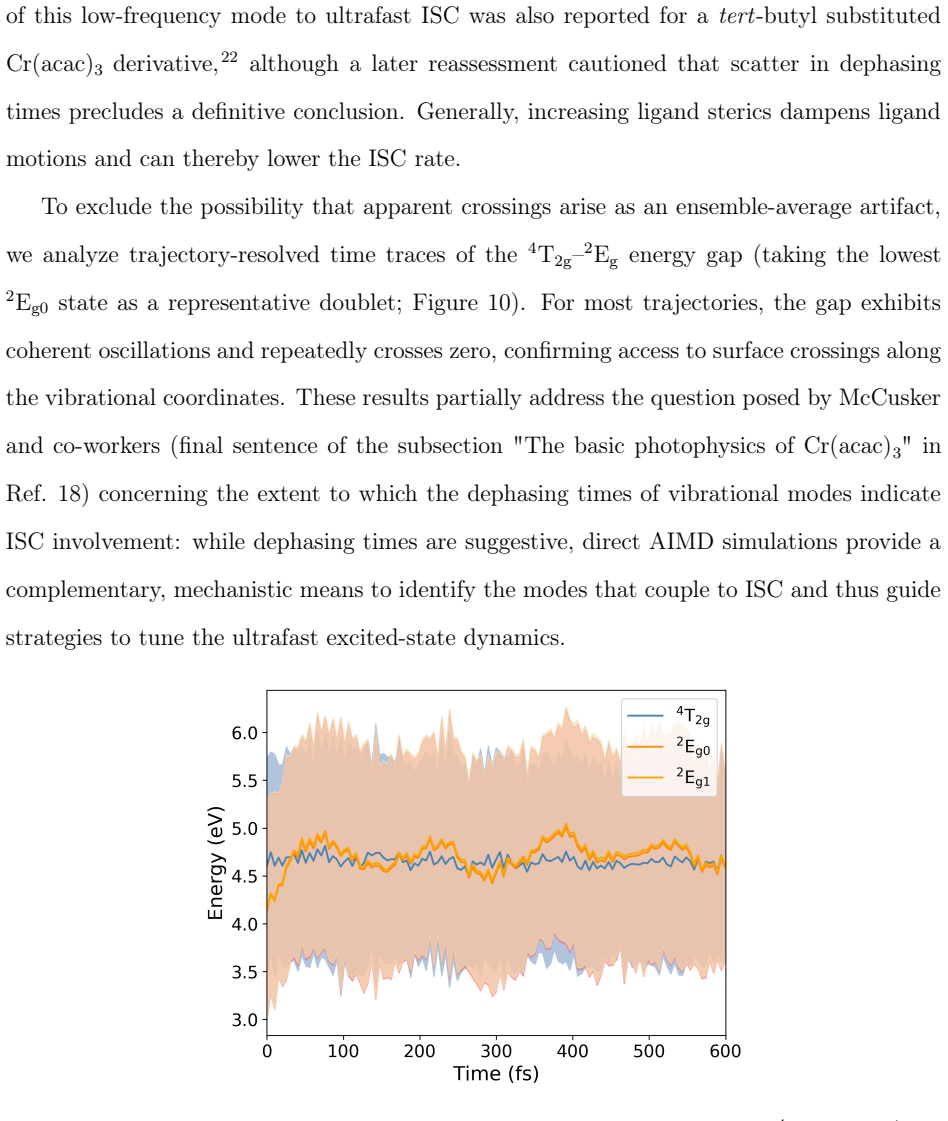
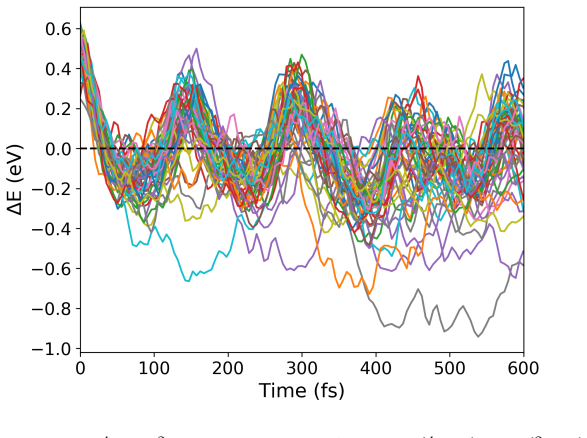
Vibrations in a Cr(III) complex periodically close the 4T2g-2Eg energy gap to zero, enabling ultrafast intersystem crossing while spin-orbit coupling stays constant.
A machine-rendered reading of the paper's core claim, the machinery that carries it, and where it could break.
Core claim
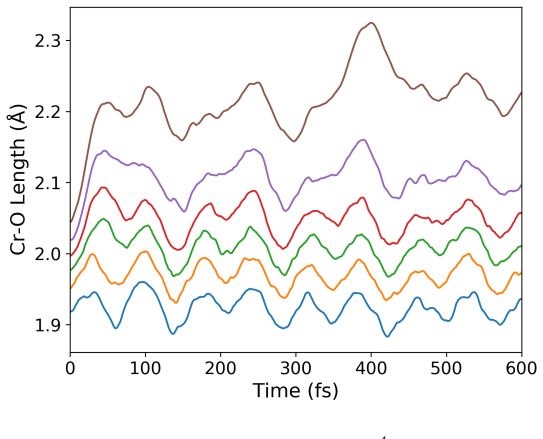
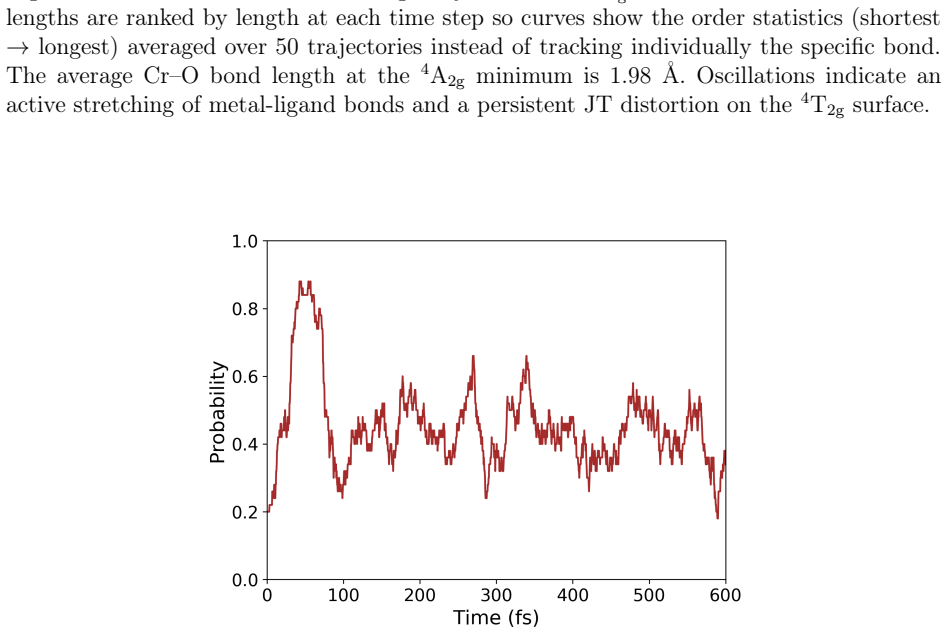
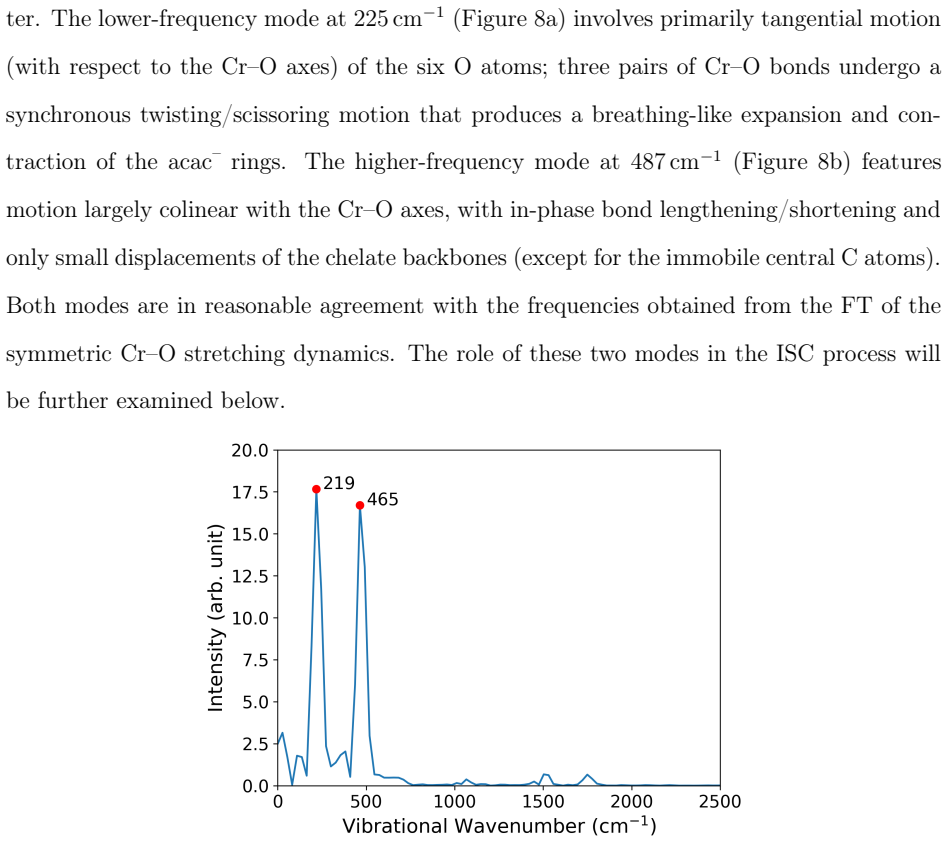
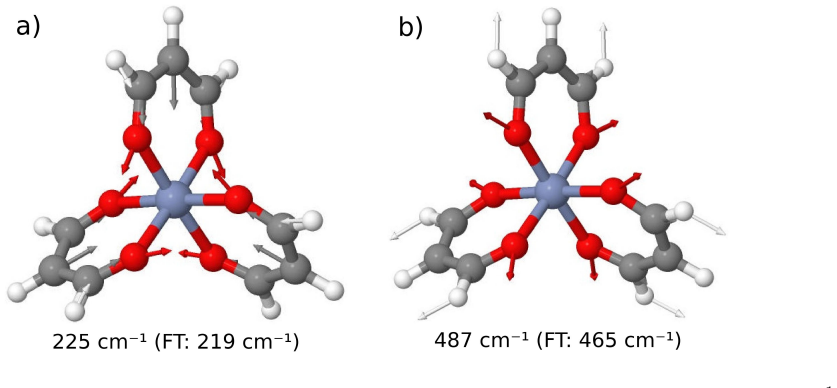
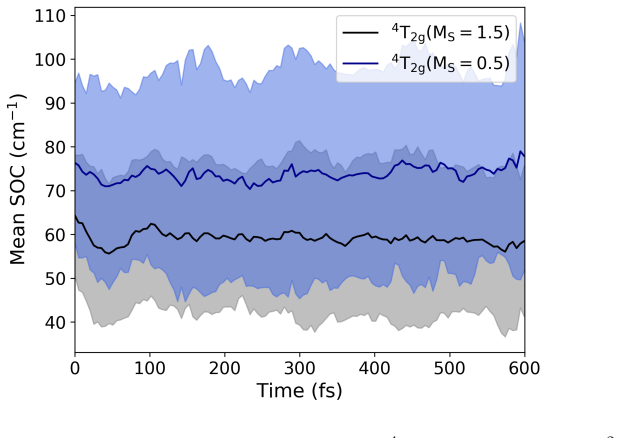
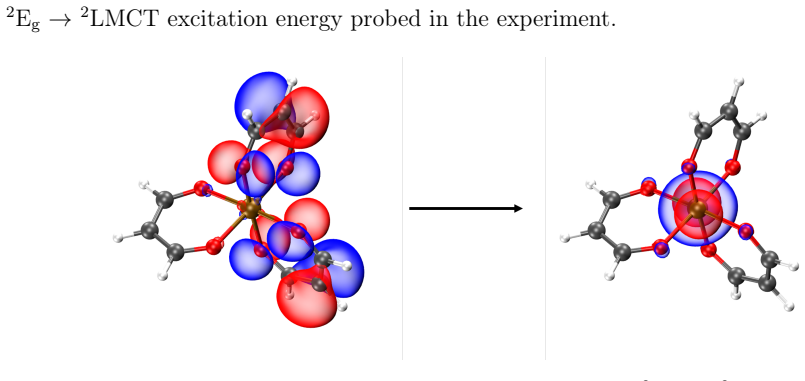
Ab initio molecular dynamics in the 4T2g state of the Cr(III) complex reveals persistent Jahn-Teller distortion along with symmetric stretching vibrations at 219 cm^{-1} and 465 cm^{-1}. SA-CASSCF calculations identify corresponding normal modes at 225 cm^{-1} and 487 cm^{-1} and show that the lower-frequency twisting/scissoring mode modulates the 4T2g/2Eg energy gap until it periodically reaches zero, while spin-orbit coupling remains essentially invariant at approximately 60-80 cm^{-1}. Single-point excited-state absorption calculations from 2Eg to a higher LMCT state indicate that previously observed coherences in transient absorption spectra originate from nuclear motion on the 2Eg surfa
What carries the argument
The twisting/scissoring vibrational mode that periodically zeros the 4T2g/2Eg energy gap.
If this is right
- Intersystem crossing occurs through vibrational modulation of the energy gap rather than changes in spin-orbit coupling strength.
- Coherences seen in transient absorption spectra result from wavepacket motion on the 2Eg surface after the crossing.
- The complex maintains a Jahn-Teller distortion throughout the excited-state dynamics.
- Ligand choice can be used to tune the frequencies of modes that control the rate of spin conversion.
- Symmetric metal-ligand bond stretches occur at well-defined frequencies of roughly 220 and 465 cm^{-1}.
Where Pith is reading between the lines
- Similar vibrational-gap-closing mechanisms may operate in other Jahn-Teller-active 3d metal complexes and could be tested by comparing ISC rates across ligand series.
- Targeting ligands that amplify the amplitude of the low-frequency twisting mode might shorten or lengthen ISC times in a predictable way.
- The finding suggests that coherent vibrational control of spin states could be engineered without needing to alter spin-orbit coupling itself.
Load-bearing premise
The SA-CASSCF method with its chosen active space accurately tracks how nuclear motion changes the 4T2g and 2Eg energy gap without major errors from the electronic-structure approximation.
What would settle it
Time-resolved measurements that track the instantaneous 4T2g-2Eg gap during the first few hundred femtoseconds after excitation and find it never reaches zero at the frequency of the twisting mode would falsify the mechanism.
Figures
read the original abstract
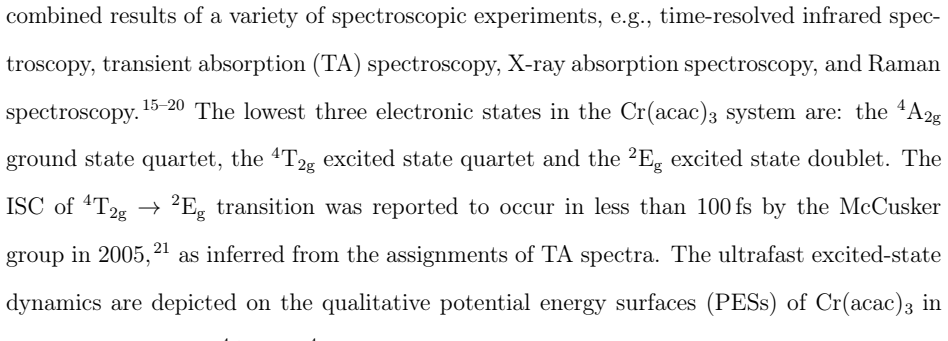
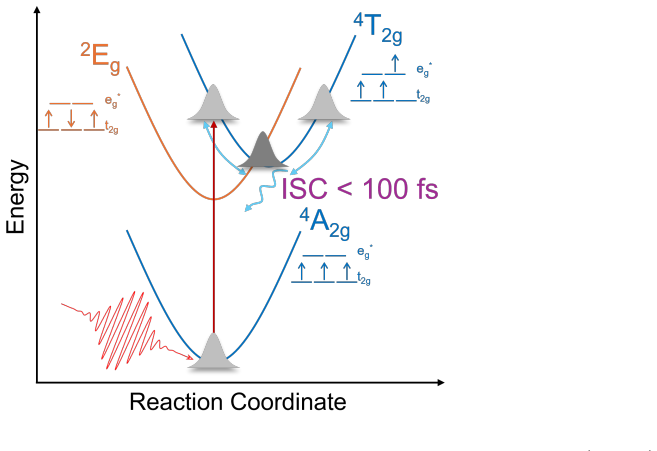
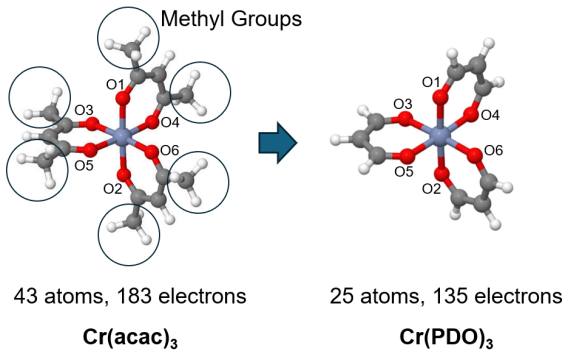
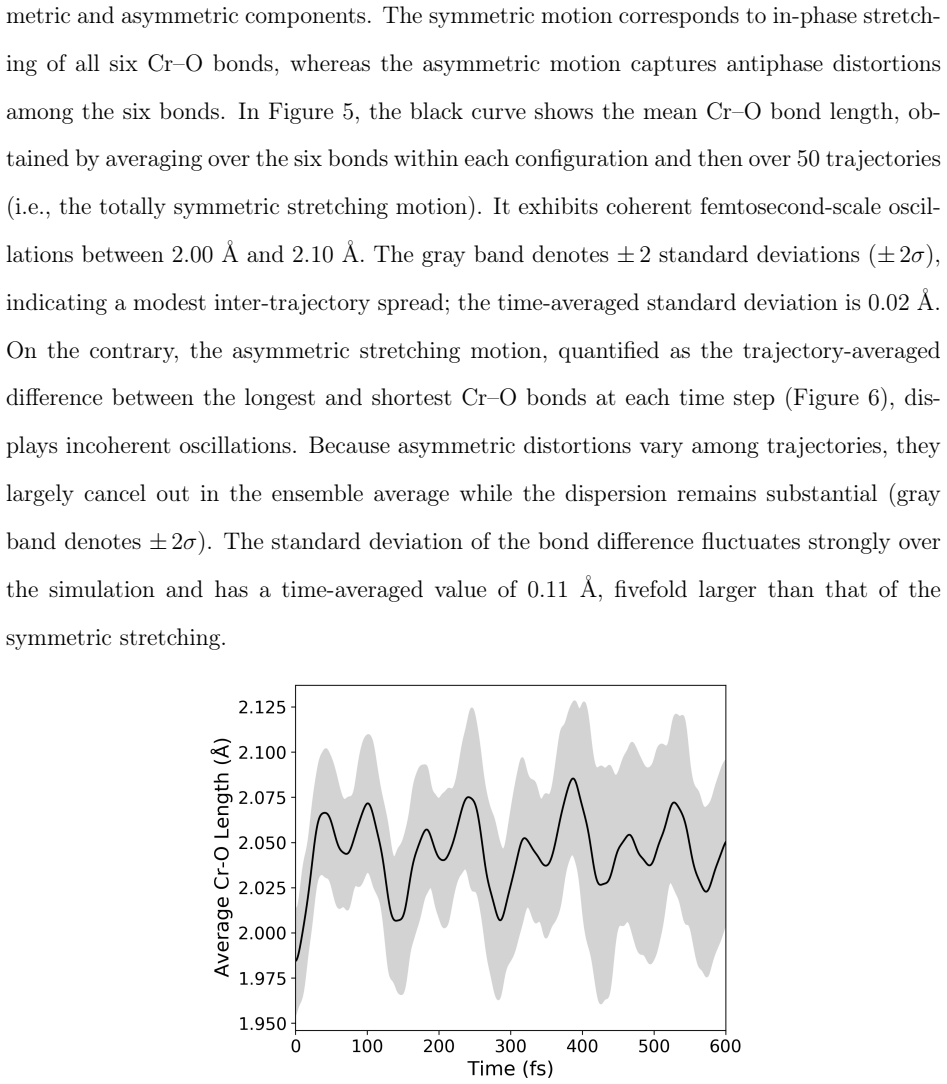
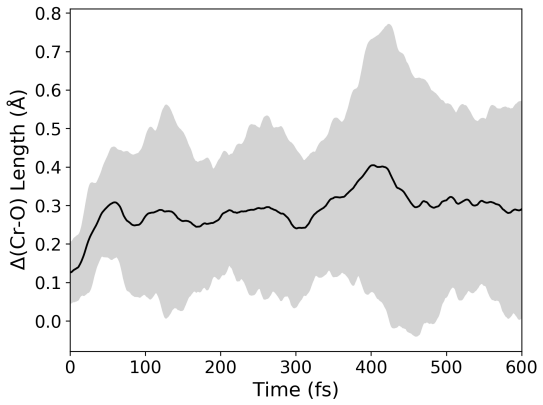
The Cr(III) coordination complex serves as an archetypical 3d transition metal system for probing ultrafast excited-state dynamics with spin conversion due to its intrinsic intersystem crossing (ISC) pathway, $^{4}T_{2g} \rightarrow ^{2}E_{g}$, upon photoexcitation. Here we conduct ab initio molecular dynamics simulations in the $^{4}T_{2g}$ state of a model Cr(III) coordination complex, followed by analyses of multireference electronic structure properties. Across 50 trajectories, the compound retains a persistent Jahn-Teller distortion in the excited state, while exhibiting prominent symmetric metal-ligand bond stretching vibrations with frequencies of 219 cm$^{-1}$ and 465 cm$^{-1}$. State-averaged complete active space self-consistent field (SA-CASSCF) calculations obtain two corresponding normal modes at 225 cm$^{-1}$ and 487 cm$^{-1}$ with symmetric stretching character. The lower-frequency twisting/scissoring mode strongly modulates the $^{4}T_{2g}/^{2}E_{g}$ energy gap, periodically zeroing the energy gap, whereas spin-orbit coupling is essentially invariant to vibrational motion ($\approx$ 60-80 cm$^{-1}$). Furthermore, calculations of single-point excited-state absorption from $^{2}E_{g}$ to a higher ligand-to-metal charge-transfer (LMCT) state indicate that the coherences previously observed in transient absorption spectra arise from nuclear motion on the $^{2}E_{g}$ surface. These results provide insights into the correlation between vibrational motion and electronic transitions, which can facilitate rational molecular design of transition metal complexes with desired excited-state properties by leveraging ligand versatility.
Editorial analysis
A structured set of objections, weighed in public.
Referee Report
Summary. The manuscript reports ab initio molecular dynamics (AIMD) simulations in the 4T2g state of a model Cr(III) complex across 50 trajectories, followed by SA-CASSCF calculations. It claims that the complex retains a persistent Jahn-Teller distortion, exhibits symmetric metal-ligand stretching modes (~219 and 465 cm^{-1} from MD; 225 and 487 cm^{-1} from SA-CASSCF), and that a lower-frequency twisting/scissoring mode strongly modulates the 4T2g/2Eg energy gap (periodically zeroing it) while spin-orbit coupling remains invariant (~60-80 cm^{-1}). This vibration-driven gap modulation is proposed as the mechanism for ultrafast 4T2g → 2Eg intersystem crossing, with additional single-point calculations linking transient absorption coherences to nuclear motion on the 2Eg surface.
Significance. If the central claim holds, the work supplies a concrete, simulation-based mechanism linking specific vibrational modes to spin conversion in archetypal 3d transition-metal complexes. The direct use of AIMD trajectories plus multireference electronic-structure analysis (rather than fitted models) is a methodological strength that could inform ligand-design strategies for controlling excited-state lifetimes.
major comments (2)
- [SA-CASSCF calculations and energy-gap analysis (abstract and corresponding results section)] The headline result—that the lower-frequency mode periodically zeros the 4T2g/2Eg gap while SOC stays flat—rests entirely on SA-CASSCF energies evaluated along the AIMD trajectories. For Cr(III) d3 systems the 4T2g–2Eg splitting is known to be sensitive to dynamic correlation; CASPT2 benchmarks on [Cr(H2O)6]3+ show substantial shifts relative to CASSCF. Without a comparison to CASPT2 or NEVPT2 (or at least an active-space convergence test), the reported gap modulation amplitude and the “periodic zeroing” mechanism could be an artifact of the chosen electronic-structure level.
- [Methods and results describing the SA-CASSCF setup and gap modulation] No information is provided on active-space selection/validation, basis-set convergence, or statistical error bars on the gap modulation across the 50 trajectories. Because the central mechanistic claim depends quantitatively on the amplitude and periodicity of this modulation, these omissions prevent assessment of whether the reported behavior is robust.
minor comments (1)
- [Results on vibrational frequencies] A direct side-by-side table or figure comparing the MD-derived frequencies (219, 465 cm^{-1}) with the SA-CASSCF normal modes (225, 487 cm^{-1}) would improve clarity.
Simulated Author's Rebuttal
We thank the referee for their thorough review and valuable feedback on our manuscript. We address each of the major comments below and will make the necessary revisions to strengthen the work.
read point-by-point responses
-
Referee: [SA-CASSCF calculations and energy-gap analysis (abstract and corresponding results section)] The headline result—that the lower-frequency mode periodically zeros the 4T2g/2Eg gap while SOC stays flat—rests entirely on SA-CASSCF energies evaluated along the AIMD trajectories. For Cr(III) d3 systems the 4T2g–2Eg splitting is known to be sensitive to dynamic correlation; CASPT2 benchmarks on [Cr(H2O)6]3+ show substantial shifts relative to CASSCF. Without a comparison to CASPT2 or NEVPT2 (or at least an active-space convergence test), the reported gap modulation amplitude and the “periodic zeroing” mechanism could be an artifact of the chosen electronic-structure level.
Authors: We acknowledge that dynamic correlation effects can influence the absolute 4T2g–2Eg energy splitting in Cr(III) complexes, as noted in the literature. However, our central finding concerns the modulation of this gap by specific vibrational modes along the AIMD trajectories, which is a differential effect. To validate this, we will perform additional CASPT2 calculations on a subset of geometries sampled from the trajectories to confirm that the periodic zeroing of the gap is preserved at this higher level of theory. We will also include an active-space convergence test in the revised manuscript. revision: yes
-
Referee: [Methods and results describing the SA-CASSCF setup and gap modulation] No information is provided on active-space selection/validation, basis-set convergence, or statistical error bars on the gap modulation across the 50 trajectories. Because the central mechanistic claim depends quantitatively on the amplitude and periodicity of this modulation, these omissions prevent assessment of whether the reported behavior is robust.
Authors: We agree that these methodological details are essential for assessing the robustness of the results. In the revised manuscript, we will expand the Methods section to fully describe the active-space selection and validation procedure, the basis set employed, and any convergence tests performed. Additionally, we will include statistical analysis, such as mean values and standard deviations of the energy gap modulation across the 50 trajectories, to quantify the variability. revision: yes
Circularity Check
No circularity; central claims from direct simulation outputs
full rationale
The paper performs AIMD in the 4T2g state, extracts vibrational modes, and evaluates 4T2g/2Eg gaps and SOC via SA-CASSCF single points along the trajectories. These quantities are computed outputs, not fitted parameters renamed as predictions, not defined in terms of each other, and not justified by self-citations or imported uniqueness theorems. No load-bearing step reduces to an input by construction; the derivation is self-contained.
Axiom & Free-Parameter Ledger
axioms (1)
- domain assumption SA-CASSCF with the chosen active space yields reliable 4T2g and 2Eg potential energy surfaces and their dependence on nuclear coordinates
Reference graph
Works this paper leans on
-
[1]
transition states
Real-time femtosecond probing of "transition states" in chemical reactions , author=. The Journal of Chemical Physics , volume=. 1987 , publisher=
1987
-
[2]
Science , volume=
Observation of a train of attosecond pulses from high harmonic generation , author=. Science , volume=. 2001 , publisher=
2001
-
[3]
Photosynthesis research , volume=
Ultrafast transient absorption spectroscopy: principles and application to photosynthetic systems , author=. Photosynthesis research , volume=. 2009 , publisher=
2009
-
[4]
Physical Review X , volume=
Ultrafast time-resolved hard X-ray emission spectroscopy on a tabletop , author=. Physical Review X , volume=. 2016 , publisher=
2016
-
[5]
The Journal of chemical physics , volume=
Investigation of the temperature dependence of dielectric relaxation in liquid water by THz reflection spectroscopy and molecular dynamics simulation , author=. The Journal of chemical physics , volume=. 1997 , publisher=
1997
-
[6]
Tetrahedron , volume=
The calculated electronic spectra and structures of heptafulvene and the benzoheptafulvenes , author=. Tetrahedron , volume=. 1966 , publisher=
1966
-
[7]
Theoretica chimica acta , volume=
The electronic spectra of unsaturated hydrocarbons a VESCF-CI treatment , author=. Theoretica chimica acta , volume=. 1967 , publisher=
1967
-
[8]
Journal of Molecular Spectroscopy , volume=
The calculated spectra of the azanaphthalenes , author=. Journal of Molecular Spectroscopy , volume=. 1974 , publisher=
1974
-
[9]
Angewandte Chemie International Edition , volume=
Luminescent ionic transition-metal complexes for light-emitting electrochemical cells , author=. Angewandte Chemie International Edition , volume=. 2012 , publisher=
2012
-
[10]
Coordination Chemistry Reviews , volume=
Metal complex sensitizers in dye-sensitized solar cells , author=. Coordination Chemistry Reviews , volume=. 2004 , publisher=
2004
-
[11]
Chemical reviews , volume=
Transition metal complexes and photodynamic therapy from a tumor-centered approach: challenges, opportunities, and highlights from the development of TLD1433 , author=. Chemical reviews , volume=. 2018 , publisher=
2018
-
[12]
2016 , publisher=
Photochromic materials: preparation, properties and applications , author=. 2016 , publisher=
2016
-
[13]
Inorganic Chemistry , volume=
Molecular mechanics calculations of transition metal complexes , author=. Inorganic Chemistry , volume=. 1992 , publisher=
1992
-
[14]
Journal of the American Chemical Society , volume=
SHAPES empirical force field: new treatment of angular potentials and its application to square-planar transition-metal complexes , author=. Journal of the American Chemical Society , volume=. 1991 , publisher=
1991
-
[15]
Faraday Discussions , volume=
The use of methods involving semi-empirical molecular orbital theory to study the structure and reactivity of transition metal complexes , author=. Faraday Discussions , volume=. 2003 , publisher=
2003
-
[16]
Journal of Chemical Theory and Computation , volume=
Application of semiempirical methods to transition metal complexes: Fast results but hard-to-predict accuracy , author=. Journal of Chemical Theory and Computation , volume=. 2018 , publisher=
2018
-
[17]
Coordination chemistry reviews , volume=
Modeling of charge-transfer transitions and excited states in d6 transition metal complexes by DFT techniques , author=. Coordination chemistry reviews , volume=. 2007 , publisher=
2007
-
[18]
Journal of chemical theory and computation , volume=
Geometries of transition-metal complexes from density-functional theory , author=. Journal of chemical theory and computation , volume=. 2006 , publisher=
2006
-
[19]
Chemical reviews , volume=
Theoretical studies on reactions of transition-metal complexes , author=. Chemical reviews , volume=. 2000 , publisher=
2000
-
[20]
The Journal of Chemical Physics , volume=
An assessment of theoretical methods for the study of transition metal carbonyl complexes: [Cl _2 Rh(CO) _2 ] ^- and [Cl _2 Rh(CO)] ^- as case studies , author=. The Journal of Chemical Physics , volume=. 2000 , publisher=
2000
-
[21]
Journal of chemical theory and computation , volume=
Multireference character for 3d transition-metal-containing molecules , author=. Journal of chemical theory and computation , volume=. 2012 , publisher=
2012
-
[22]
Physical Chemistry Chemical Physics , volume=
Modern multireference methods and their application in transition metal chemistry , author=. Physical Chemistry Chemical Physics , volume=. 2021 , publisher=
2021
-
[23]
The Journal of Chemical Physics , volume=
Luminescence of chromium(III) complexes , author=. The Journal of Chemical Physics , volume=. 1961 , publisher=
1961
-
[24]
Chemical Reviews , volume=
The photophysics of chromium (III) complexes , author=. Chemical Reviews , volume=. 1990 , publisher=
1990
-
[25]
Chemical reviews , volume=
Photochemistry and photophysics of chromium (III) complexes , author=. Chemical reviews , volume=. 1999 , publisher=
1999
-
[26]
Coordination chemistry reviews , volume=
Thermal relaxation in excited electronic states of d ^3 and d ^6 metal complexes , author=. Coordination chemistry reviews , volume=. 2002 , publisher=
2002
-
[27]
Coordination chemistry reviews , volume=
Intersystem crossing in transition metal complexes , author=. Coordination chemistry reviews , volume=. 2006 , publisher=
2006
-
[28]
Photochemical & Photobiological Sciences , volume=
Spin-flip luminescence , author=. Photochemical & Photobiological Sciences , volume=. 2022 , publisher=
2022
-
[29]
The Journal of Physical Chemistry A , volume=
The early picosecond photophysics of Ru(II) polypyridyl complexes: a tale of two timescales , author=. The Journal of Physical Chemistry A , volume=. 2008 , publisher=
2008
-
[30]
Coordination Chemistry Reviews , volume=
On the role of ligand-field states for the photophysical properties of ruthenium(II) polypyridyl complexes , author=. Coordination Chemistry Reviews , volume=. 2015 , publisher=
2015
-
[31]
Chemistry--A European Journal , volume=
Unravelling the relaxation pathway and excited state dynamics of ruthenium(II) polypyridyl complexes incorporating phosphorus-based monodentate ligands , author=. Chemistry--A European Journal , volume=. 2025 , publisher=
2025
-
[32]
Triplet harvesting and singlet harvesting for efficient OLEDs , author=
The triplet state of organo-transition metal compounds. Triplet harvesting and singlet harvesting for efficient OLEDs , author=. Coordination Chemistry Reviews , volume=. 2011 , publisher=
2011
-
[33]
Journal of the American Chemical Society , volume=
Relaxation dynamics of Cr(acac) _3 probed by ultrafast infrared spectroscopy , author=. Journal of the American Chemical Society , volume=. 2007 , publisher=
2007
-
[34]
The Journal of Physical Chemistry A , volume=
Role of vibrational dynamics in electronic relaxation of Cr(acac) _3 , author=. The Journal of Physical Chemistry A , volume=. 2015 , publisher=
2015
-
[35]
2020 , publisher=
Insights into the Photophysical Reaction Coordinate of 1st Row Transition Metal Chromophores from Vibrational Coherences , author=. 2020 , publisher=
2020
-
[36]
Faraday Discussions , volume=
On the use of vibronic coherence to identify reaction coordinates for ultrafast excited-state dynamics of transition metal-based chromophores , author=. Faraday Discussions , volume=. 2022 , publisher=
2022
-
[37]
Cr L-edge X-ray absorption spectroscopy of Cr
Kubin, Markus and Guo, Meiyuan and Ekimova, Maria and Kallman, Erik and Kern, Jan and Yachandra, Vittal K and Yano, Junko and Nibbering, Erik TJ and Lundberg, Marcus and Wernet, Philippe , journal=. Cr L-edge X-ray absorption spectroscopy of Cr. 2018 , publisher=
2018
-
[38]
Chemical science , volume=
Identification of metal-centered excited states in Cr(III) complexes with time-resolved L-edge X-ray spectroscopy , author=. Chemical science , volume=. 2025 , publisher=
2025
-
[39]
Journal of the American Chemical Society , volume=
Ultrafast dynamics of ^2 E state formation in Cr(acac) _3 , author=. Journal of the American Chemical Society , volume=. 2005 , publisher=
2005
-
[40]
Chemical Science , volume=
Vibrational coherence in the excited state dynamics of Cr(acac) _3 : probing the reaction coordinate for ultrafast intersystem crossing , author=. Chemical Science , volume=. 2010 , publisher=
2010
-
[41]
Annual Reports Section "C" (Physical Chemistry) , volume=
Applications of pump-probe spectroscopy , author=. Annual Reports Section "C" (Physical Chemistry) , volume=. 2008 , publisher=
2008
-
[42]
The Journal of Chemical Physics , volume=
Characterization of charge carrier behavior in photocatalysis using transient absorption spectroscopy , author=. The Journal of Chemical Physics , volume=. 2020 , publisher=
2020
-
[43]
The Journal of Physical Chemistry B , volume=
Femtosecond time-resolved transient absorption spectroscopy of xanthophylls , author=. The Journal of Physical Chemistry B , volume=. 2006 , publisher=
2006
-
[44]
Chemical reviews , volume=
Femtosecond time-resolved photoelectron spectroscopy , author=. Chemical reviews , volume=. 2004 , publisher=
2004
-
[45]
Annual review of physical chemistry , volume=
Femtosecond time-resolved photoelectron spectroscopy of polyatomic molecules , author=. Annual review of physical chemistry , volume=. 2003 , publisher=
2003
-
[46]
Physical Chemistry Chemical Physics , volume=
Time-resolved photoelectron spectroscopy: from wavepackets to observables , author=. Physical Chemistry Chemical Physics , volume=. 2011 , publisher=
2011
-
[47]
Reviews of modern physics , volume=
Ultrafast electron diffraction: Visualizing dynamic states of matter , author=. Reviews of modern physics , volume=. 2022 , publisher=
2022
-
[48]
Journal of Physics: Condensed Matter , volume=
Ab initio molecular dynamics: basic concepts, current trends and novelapplications , author=. Journal of Physics: Condensed Matter , volume=. 2002 , publisher=
2002
-
[49]
Physical review letters , volume=
Unified approach for molecular dynamics and density-functional theory , author=. Physical review letters , volume=. 1985 , publisher=
1985
-
[50]
The Journal of Chemical Physics , volume=
Molecular dynamics with electronic transitions , author=. The Journal of Chemical Physics , volume=. 1990 , publisher=
1990
-
[51]
The Journal of chemical physics , volume=
Ab initio Ehrenfest dynamics , author=. The Journal of chemical physics , volume=. 2005 , publisher=
2005
-
[52]
Chemical reviews , volume=
Ab initio nonadiabatic quantum molecular dynamics , author=. Chemical reviews , volume=. 2018 , publisher=
2018
-
[53]
Journal of chemical theory and computation , volume=
SHARC: ab initio molecular dynamics with surface hopping in the adiabatic representation including arbitrary couplings , author=. Journal of chemical theory and computation , volume=. 2011 , publisher=
2011
-
[54]
The Journal of Physical Chemistry A , volume=
Ab initio multiple spawning method for intersystem crossing dynamics: Spin-forbidden transitions between ^3 B _1 and ^1 A _1 states of GeH _2 , author=. The Journal of Physical Chemistry A , volume=. 2016 , publisher=
2016
-
[55]
The Journal of Chemical Physics , volume=
Communication: GAIMS—Generalized Ab Initio Multiple Spawning for both internal conversion and intersystem crossing processes , author=. The Journal of Chemical Physics , volume=. 2016 , publisher=
2016
-
[56]
Chemical Physics Letters , volume=
Theoretical study on ultrafast intersystem crossing of chromium (III) acetylacetonate , author=. Chemical Physics Letters , volume=. 2012 , publisher=
2012
-
[57]
JACS Au , volume=
The quest to simulate excited-state dynamics of transition metal complexes , author=. JACS Au , volume=. 2021 , publisher=
2021
-
[58]
Journal of Chemical Theory and Computation , volume=
Ab initio surface-hopping simulation of femtosecond transient-absorption pump--probe signals of nonadiabatic excited-state dynamics using the doorway--window representation , author=. Journal of Chemical Theory and Computation , volume=. 2021 , publisher=
2021
-
[59]
The Journal of Physical Chemistry Letters , volume=
Ultrafast internal conversion dynamics through the on-the-fly simulation of transient absorption pump--probe spectra with different electronic structure methods , author=. The Journal of Physical Chemistry Letters , volume=. 2022 , publisher=
2022
-
[60]
The Journal of Chemical Physics , volume=
Simulating ultrafast transient absorption spectra from first principles using a time-dependent configuration interaction probe , author=. The Journal of Chemical Physics , volume=. 2024 , publisher=
2024
-
[61]
The Journal of Chemical Physics , volume=
Ultrafast internal conversion and photochromism in gas-phase salicylideneaniline , author=. The Journal of Chemical Physics , volume=. 2023 , publisher=
2023
-
[62]
Wiley Interdisciplinary Reviews: Computational Molecular Science , volume=
Molpro: a general-purpose quantum chemistry program package , author=. Wiley Interdisciplinary Reviews: Computational Molecular Science , volume=. 2012 , publisher=
2012
-
[63]
The Journal of chemical physics , volume=
The Molpro quantum chemistry package , author=. The Journal of chemical physics , volume=. 2020 , publisher=
2020
-
[64]
The Journal of chemical physics , volume=
A second order multiconfiguration SCF procedure with optimum convergence , author=. The Journal of chemical physics , volume=. 1985 , publisher=
1985
-
[65]
Chemical physics letters , volume=
An efficient second-order MC SCF method for long configuration expansions , author=. Chemical physics letters , volume=. 1985 , publisher=
1985
-
[66]
Second-order MCSCF optimization revisited. I. Improved algorithms for fast and robust second-order CASSCF convergence , author=. The Journal of chemical physics , volume=. 2019 , publisher=
2019
-
[67]
MCSCF optimization revisited. II. Combined first-and second-order orbital optimization for large molecules , author=. The Journal of Chemical Physics , volume=. 2020 , publisher=
2020
-
[68]
Journal of computational chemistry , volume=
Ab initio geometry optimization for large molecules , author=. Journal of computational chemistry , volume=. 1997 , publisher=
1997
-
[69]
Potentials for the transition metal atoms Sc to Hg , author=
Ab initio effective core potentials for molecular calculations. Potentials for the transition metal atoms Sc to Hg , author=. The Journal of chemical physics , volume=. 1985 , publisher=
1985
-
[70]
Potentials for main group elements Na to Bi , author=
Ab initio effective core potentials for molecular calculations. Potentials for main group elements Na to Bi , author=. The Journal of chemical physics , volume=. 1985 , publisher=
1985
-
[71]
Potentials for K to Au including the outermost core orbitals , author=
Ab initio effective core potentials for molecular calculations. Potentials for K to Au including the outermost core orbitals , author=. The Journal of chemical physics , volume=. 1985 , publisher=
1985
-
[72]
Journal of Chemical Theory and Computation , volume=
PySpawn: Software for nonadiabatic quantum molecular dynamics , author=. Journal of Chemical Theory and Computation , volume=. 2020 , publisher=
2020
-
[73]
The Journal of chemical physics , volume=
TeraChem: Accelerating electronic structure and ab initio molecular dynamics with graphical processing units , author=. The Journal of chemical physics , volume=. 2020 , publisher=
2020
-
[74]
Wiley Interdisciplinary Reviews: Computational Molecular Science , volume=
TeraChem: A graphical processing unit-accelerated electronic structure package for large-scale ab initio molecular dynamics , author=. Wiley Interdisciplinary Reviews: Computational Molecular Science , volume=. 2021 , publisher=
2021
-
[75]
Quantum chemistry on graphical processing units. 3. Analytical energy gradients, geometry optimization, and first principles molecular dynamics , author=. Journal of Chemical Theory and Computation , volume=. 2009 , publisher=
2009
-
[76]
Journal of chemical theory and computation , volume=
Generating efficient quantum chemistry codes for novel architectures , author=. Journal of chemical theory and computation , volume=. 2013 , publisher=
2013
-
[77]
Journal of chemical theory and computation , volume=
Automated code engine for graphical processing units: Application to the effective core potential integrals and gradients , author=. Journal of chemical theory and computation , volume=. 2016 , publisher=
2016
-
[78]
The Journal of chemical physics , volume=
Complete active space configuration interaction from state-averaged configuration interaction singles natural orbitals: Analytic first derivatives and derivative coupling vectors , author=. The Journal of chemical physics , volume=. 2017 , publisher=
2017
-
[79]
The Journal of Chemical Physics , volume=
An atomic orbital-based formulation of the complete active space self-consistent field method on graphical processing units , author=. The Journal of Chemical Physics , volume=. 2015 , publisher=
2015
-
[80]
The Journal of chemical physics , volume=
An atomic orbital-based formulation of analytical gradients and nonadiabatic coupling vector elements for the state-averaged complete active space self-consistent field method on graphical processing units , author=. The Journal of chemical physics , volume=. 2015 , publisher=
2015
discussion (0)
Sign in with ORCID, Apple, or X to comment. Anyone can read and Pith papers without signing in.