REVIEW 3 major objections 5 minor 85 references
NeRF-Texture: Synthesizing Neural Radiance Field Textures
T0 review · 3 major / 5 minor · reviewed 2026-08-11 · deepseek-v4-flash
Pith's one-line read Real-world textures with fine 3D geometry can be captured as NeRF textures and synthesized to any size, then mapped onto new shapes.
desk verdict Solid method paper that adds a genuinely missing capability—NeRF texture synthesis—with an honest failure analysis; the main weaknesses are evaluation rigor and under-specified reproducibility, not the core idea. read the letter →
The pith
A machine-rendered reading of the paper's core claim, the machinery that carries it, and where it could break.
The reading
What carries the argument
The central object is the disentangled NeRF texture representation: 3D space is reparameterized through a differentiable projection onto a coarse base mesh, giving a footpoint and a signed distance, and hash grids store latent texture features indexed by the footpoint. The argument is carried by combining this representation with implicit patch matching: patches of latent features are sampled on the base shape, matched and quilted in feature space by the minimum-cost-cut procedure of image quilting, and a Student t-distribution clustering loss regularizes the feature distribution so that feature-space distance tracks content-space distance. A custom derivation rule for the projection, dxc/dx = I - nc^T nc and ds/dx = nc, lets gradients flow through the footpoint for normal estimation and camera optimization. For curved surfaces, an atlas UV map and a coarse-to-fine patch pyramid replace the fixed kd-tree acceleration used in planar synthesis.
What would settle it
For a scene with a clean base shape, such as a flat wall of stones, render the synthesized texture from a grazing angle and measure SIFID against a real photograph: the paper reports 0.82 at 80 degrees elevation, so a substantially larger value would indicate that the view-dependent meso-structure is not actually preserved.
Extended reading notes
Core claim
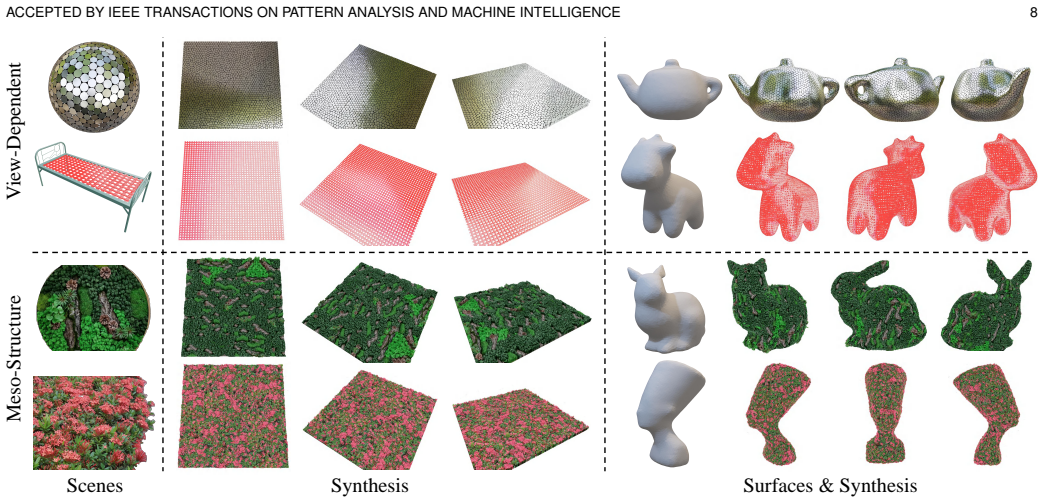
NeRF-Texture represents a textured scene as a smooth base mesh plus a NeRF texture: two hash-grid feature fields defined on the base mesh's surface, queried by the footpoint of each 3D sample, together with the sample's signed distance from the mesh. An MLP decoder turns these features into density, diffuse and specular Phong coefficients, glossiness, and the elevation and azimuth of a fine normal expressed in the local tangent frame; color is then computed with spherical-harmonic lighting. Synthesis is performed by extracting implicit patches of latent features on the base shape, then running the image-quilting approach of patch matching and minimum-cut stitching directly in latent space, with a clustering loss that makes latent distance correlate with reconstructed content similarity. The synthesized latent field can be mapped onto any new mesh, including curved surfaces via an atlas parameterization, and rendered in real time. The paper demonstrates applications on bark, durian, fabric, leaves, flowers, mirror balls, a metal bed, and curved targets such as a ring, a shark, and a tower.
Load-bearing premise
The load-bearing premise is that a real textured scene can be split cleanly into a smooth base shape plus latent features on that shape that carry all meso-structure and appearance, so the whole pipeline inherits the quality of the base shape extraction.
Editorial extensions
If this is right
- A single short video of a material can produce a reusable NeRF texture that is applied to many different shapes without re-training the model.
- Synthesized NeRF textures preserve meso-structure occlusion and view-dependent reflection at high viewing angles, where 2D image textures visibly break down.
- The method renders at around 84 FPS, making the synthesized textures practical for real-time applications rather than offline baking.
- The same latent patch-matching pipeline extends to arbitrary curved surfaces through atlas parameterization with a coarse-to-fine matching strategy.
Reading between the lines
- If the latent metric after clustering truly tracks content similarity, the clustering regularization could transfer to other neural fields that need patch-based editing, such as relightable or animatable radiance fields.
- A natural testable extension is to measure whether nearest-neighbor search in the clustered latent space returns patches whose rendered appearance matches human judgment, which would validate the metric-consistency argument directly.
- The representation effectively turns a 3D texture into a reusable asset with its own lighting decomposition, so a library of captured NeRF textures could be built and shared much like 2D texture libraries.
- Building on the paper's own suggestion, adding a generative completion model could extend the method to thin or semantically meaningful structures like railings and keycaps, where the current greedy patch matching is known to break continuity.
Signed reviews
Editorial analysis
A structured set of objections, weighed in public.
Referee Report
Summary. The paper presents NeRF-Texture, a method to capture, model, synthesize, and re-render textures with meso-structure (geometric detail) and view-dependent appearance from multi-view images. The scene is disentangled into a coarse base mesh and a latent feature field defined on that mesh; query points are parameterized by signed distance and footpoint, and a small MLP decodes density, shading coefficients, and fine normals. Texture synthesis is performed by implicit patch matching of latent features over a planar domain or curved surfaces, with a clustering regularizer to align latent-space and content-space metrics. Experiments include qualitative results on real-world captures, quantitative view synthesis on DTU, comparison with 2D textures via SIFID, comparison with NeRF-Tex, ablations, and a challenge analysis.
Significance. If the central claims hold, this is a useful and timely contribution to neural texture synthesis: it is among the first to treat meso-structure textures as neural radiance fields that can be captured from real images, synthesized, and mapped to new shapes, while preserving view-dependent effects. The paper provides a fairly detailed description of the representation and synthesis pipeline, and it is commendable that the authors include a challenge analysis (Sec. 5) that candidly identifies failure modes for narrow structures and complex topology. However, the quantitative support for key claims is thinner than the breadth of the results suggests: the SIFID comparison is reported without error bars, the clustering ablation is qualitative only, and the base-shape extraction assumption is not validated quantitatively. With additional experiments and clarifications, the contribution would be solid.
major comments (3)
- [Sec. 3.1.1 and Sec. 5.1] The base shape extraction procedure (Instant-NGP + Co-ACD + Laplacian smoothing/remeshing) is a generic heuristic with no principled scale-separation criterion. The signed distance s(x) and tangent frame Tc(xc) are defined relative to this base; if the extracted base is inaccurate (as the paper's own examples of truss and Lego cockpit in Sec. 5.1 show), the learned representation is biased and the decoder cannot transfer to new shapes. The paper does not quantify under what geometric conditions the disentanglement assumption holds, nor does it provide a diagnostic for detecting base-shape failure before synthesis. The challenge analysis lists failure cases but does not analyze the sensitivity of the representation to base-shape error. Please add a quantitative sensitivity study (e.g., perturbing the base mesh and measuring synthesis quality) and a discussion of the geometric properties required for the assumption to be valid.
- [Sec. 4.5 and Eq. (4)] The clustering loss Lclu is presented as a key contribution for improving patch matching, yet the ablation in Sec. 4.5 is purely qualitative: Fig. 17 shows PCA visualizations and a rendered comparison, but no quantitative metric. The claim that the clustering constraint 'reduces artifacts' is not substantiated with numbers. Please report a quantitative measure of synthesis quality with and without Lclu (e.g., SIFID on the synthesized textures, patch matching error, or a perceptual metric) across multiple textures, including error bars. This is load-bearing because the paper motivates Lclu as essential for matching performance.
- [Table 2 and Sec. 4.3] The SIFID comparison against 2D textures is the main quantitative evidence for the advantage of the NeRF-based representation, but Table 2 reports only a single average per elevation angle with no standard deviation, number of textures/scenes, or statistical test. The protocol for cropping ground-truth regions and selecting 'closest viewing directions' is not fully specified, making the comparison hard to reproduce or interpret. Please provide per-scene/per-texture results with error bars, and describe the ground-truth selection procedure in enough detail that the evaluation is reproducible. As written, the table does not convincingly support the claim that the NeRF-based representation is 'more realistic than 2D textures.'
minor comments (5)
- [Eq. (1)] The formula for the coarse normal n~c(x) is ambiguous: the second term (x - v1)/(w||x - v1||^2) appears inside the summation in the typeset equation, which would add it K times. Please place the term outside the summation or clarify the intended expression, and define W unambiguously.
- [Sec. 4.4] The comparison with NeRF-Tex is described only qualitatively, and the training data for NeRF-Tex is generated using the authors' own representation. Please provide more implementation details (e.g., bounding box size, number of views, lighting) so that the fairness of the comparison can be assessed, and consider reporting a quantitative metric.
- [Sec. 5.1] Figure references are out of order: the text mentions 'the second row of Fig. 21' before introducing Fig. 20, and the Lego example in Fig. 20 is referenced after Fig. 21. Please reorder the figures or the text so that the discussion matches the figure numbering.
- [Sec. 3.1.4] The claim that latent features are fetched in 'O(1) time complexity' is only true for the hash lookup itself; the overall pipeline includes KNN search and ray casting, which have higher complexity. Please qualify the statement to avoid overclaiming.
- [General] There are several typos and formatting issues, including 'Standord Bunny' (Sec. 4.1), 'F r e c h e t' (Sec. 4.3), and the malformed reference [4] ('Bao and Yang, Z. Junyi...'). A careful proofread is needed.
Circularity Check
No load-bearing circularity: the method's outputs are validated against external baselines and ground-truth crops, and the only self-citations are provenance or related-work pointers, not premises in the derivation.
full rationale
The paper does not present a derivation that reduces to its inputs. Its central procedure is an optimization: multi-view images are used to train a disentangled representation (coarse base mesh, hash-grid latent features, SDF, Phong/SH shading) with reconstruction, distortion, normal, and clustering losses (Sec. 3.3). The synthesized outputs are produced by patch matching and quilting of learned latent features (Sec. 3.2), a standard exemplar-based synthesis pipeline; the output is not a fitted quantity renamed as a prediction. Quantitative evaluation compares against external methods (NeRF, Instant-NGP, NeRF-Tex) and against ground-truth image crops using SIFID (Sec. 4.3), so the quality claims are not self-justified. The clustering loss (Eq. 4) is a regularizer whose effect is ablated in Sec. 4.5; it is not a parameter tuned to the evaluation metric. The only self-references are [8], the authors' own SIGGRAPH 2023 version, mentioned as provenance in Sec. 1, and [23], a related stylization paper; neither is invoked to justify an equation or to preclude alternative designs. Sec. 5.1 honestly documents failure modes (limited coarse extents and complex topology) that follow from the base-shape assumption; these are limitations, not circular reasoning. The score of 2 reflects only the presence of minor non-load-bearing self-citation in the manuscript; no circular step was found.
Assumptions & free parameters
free parameters (11)
- Loss weights lambda_1, lambda_2, lambda_3 =
1e-5, 1e-2, 1
- Patch resolution =
128x128
- kNN neighbor count K =
8
- Normal interpolation weight w =
0.01
- Clustering degrees of freedom kappa =
not reported
- Number of cluster centers =
not reported
- Patch overlap width =
not reported
- UV atlas resolution =
2048x2048
- Number of patch samples on curved surfaces =
8000
- Hash grid parameters (resolution, levels, feature dimension) =
not reported
- Number of training views =
150 to 300
assumptions (5)
- domain assumption A real scene with meso-structure can be decomposed into a smooth base shape and latent texture features attached to that base shape.
- domain assumption The rendering equation with Phong shading and spherical-harmonic lighting is sufficient to represent real-world appearance.
- ad hoc to paper The custom differentiable projection rule in Eq. (2) correctly propagates gradients for training.
- ad hoc to paper The clustering loss (Eq. 4) aligns latent-space distances with content-space distances, improving patch matching.
- domain assumption The base shape extracted via Instant-NGP and Co-ACD is a valid parameterization for any input texture.
Cite this review
Pith. "Pith review of NeRF-Texture: Synthesizing Neural Radiance Field Textures." pith.science (2026). https://pith.science/paper/YVD5SLAJ
@misc{pith2026241210004,
  author       = {Pith},
  title        = {Pith review of: NeRF-Texture: Synthesizing Neural Radiance Field Textures},
  year         = {2026},
  howpublished = {\url{https://pith.science/paper/YVD5SLAJ}},
  note         = {Machine review of arXiv:2412.10004}
}
read the original abstract
Texture synthesis is a fundamental problem in computer graphics that would benefit various applications. Existing methods are effective in handling 2D image textures. In contrast, many real-world textures contain meso-structure in the 3D geometry space, such as grass, leaves, and fabrics, which cannot be effectively modeled using only 2D image textures. We propose a novel texture synthesis method with Neural Radiance Fields (NeRF) to capture and synthesize textures from given multi-view images. In the proposed NeRF texture representation, a scene with fine geometric details is disentangled into the meso-structure textures and the underlying base shape. This allows textures with meso-structure to be effectively learned as latent features situated on the base shape, which are fed into a NeRF decoder trained simultaneously to represent the rich view-dependent appearance. Using this implicit representation, we can synthesize NeRF-based textures through patch matching of latent features. However, inconsistencies between the metrics of the reconstructed content space and the latent feature space may compromise the synthesis quality. To enhance matching performance, we further regularize the distribution of latent features by incorporating a clustering constraint. In addition to generating NeRF textures over a planar domain, our method can also synthesize NeRF textures over curved surfaces, which are practically useful. Experimental results and evaluations demonstrate the effectiveness of our approach.
Figures


Figures from the paper (18 more)




Reference graph
Works this paper leans on
-
[1]
NeRF-Tex: Neural reflectance field textures,
H. Baatz, J. Granskog, M. Papas, F. Rousselle, and J. Nov ´ak, “NeRF-Tex: Neural reflectance field textures,” in Comput. Graph. Forum, no. 6, 2022, pp. 287–301
2022
-
[2]
Rendering neural materials on curved surfaces,
A. Kuznetsov, X. Wang, K. Mullia, F. Luan, Z. Xu, M. Hasan, and R. Ramamoorthi, “Rendering neural materials on curved surfaces,” in ACM SIGGRAPH 2022 Conference Proceedings , 2022, pp. 1–9
2022
-
[3]
NeRF: Representing scenes as neural radiance fields for view synthesis,
B. Mildenhall, P . P . Srinivasan, M. Tancik, J. T. Barron, R. Ra- mamoorthi, and R. Ng, “NeRF: Representing scenes as neural radiance fields for view synthesis,” Communications of the ACM , vol. 65, no. 1, pp. 99–106, 2021
2021
-
[4]
NeuMesh: Learning disentangled neural mesh-based implicit field for geometry and texture editing,
Bao and Yang, Z. Junyi, B. Hujun, Z. Yinda, C. Zhaopeng, and Z. Guofeng, “NeuMesh: Learning disentangled neural mesh-based implicit field for geometry and texture editing,” inECCV, 2022, pp. 597–614
2022
-
[5]
NeuTex: Neural texture mapping for volumetric neural rendering,
F. Xiang, Z. Xu, M. Hasan, Y. Hold-Geoffroy, K. Sunkavalli, and H. Su, “NeuTex: Neural texture mapping for volumetric neural rendering,” in CVPR, 2021, pp. 7119–7128
2021
-
[6]
Instant neural graphics primitives with a multiresolution hash encoding,
T. M ¨uller, A. Evans, C. Schied, and A. Keller, “Instant neural graphics primitives with a multiresolution hash encoding,” ACM T rans. Graph., vol. 41, no. 4, pp. 1–15, 2022
work page 2022
-
[7]
Approximate convex decom- position for 3D meshes with collision-aware concavity and tree search,
X. Wei, M. Liu, Z. Ling, and H. Su, “Approximate convex decom- position for 3D meshes with collision-aware concavity and tree search,” ACM T rans. Graph., vol. 41, no. 4, pp. 1–18, 2022
work page 2022
-
[8]
NeRF- Texture: Texture synthesis with neural radiance fields,
Y.-H. Huang, Y.-P . Cao, Y.-K. Lai, Y. Shan, and L. Gao, “NeRF- Texture: Texture synthesis with neural radiance fields,” in ACM SIGGRAPH 2023 Conference Proceedings , 2023, pp. 1–10
work page 2023
Show all 85 references
-
[9]
Plenoxels: Radiance fields without neural net- works,
S. Fridovich-Keil, A. Yu, M. Tancik, Q. Chen, B. Recht, and A. Kanazawa, “Plenoxels: Radiance fields without neural net- works,” in CVPR, 2022, pp. 5501–5510
2022
-
[10]
Relu fields: The little non-linearity that could,
A. Karnewar, T. Ritschel, O. Wang, and N. Mitra, “Relu fields: The little non-linearity that could,” inACM SIGGRAPH 2022 Conference Proceedings, 2022, pp. 1–9
2022
-
[11]
NeRF++: Analyzing and improving neural radiance fields,
K. Zhang, G. Riegler, N. Snavely, and V . Koltun, “NeRF++: Analyzing and improving neural radiance fields,” arXiv preprint arXiv:2010.07492, 2020
2010 arXiv
-
[12]
Mip-NeRF 360: Unbounded anti-aliased neural radiance fields,
J. T. Barron, B. Mildenhall, D. Verbin, P . P . Srinivasan, and P . Hed- man, “Mip-NeRF 360: Unbounded anti-aliased neural radiance fields,” in CVPR, 2022, pp. 5470–5479
2022
-
[13]
Block-NeRF: Scalable large scene neural view synthesis,
M. Tancik, V . Casser, X. Yan, S. Pradhan, B. Mildenhall, P . P . Srini- vasan, J. T. Barron, and H. Kretzschmar, “Block-NeRF: Scalable large scene neural view synthesis,” in Proceedings of the IEEE/CVF Conference on Computer Vision and Pattern Recognition , 2022, pp. 8248–8258
2022
-
[14]
SurfelNeRF: Neural surfel radiance fields for online photorealistic reconstruction of indoor scenes,
Y. Gao, Y.-P . Cao, and Y. Shan, “SurfelNeRF: Neural surfel radiance fields for online photorealistic reconstruction of indoor scenes,” arXiv preprint arXiv:2304.08971 , 2023
2023 arXiv
-
[15]
DeVRF: Fast deformable voxel radiance fields for dynamic scenes,
J.-W. Liu, Y.-P . Cao, W. Mao, W. Zhang, D. J. Zhang, J. Keppo, Y. Shan, X. Qie, and M. Z. Shou, “DeVRF: Fast deformable voxel radiance fields for dynamic scenes,” in NeurIPS, 2022, pp. 36 762– 36 775
2022
-
[16]
NeuPhysics: Editable neural geometry and physics from monocular videos,
Y.-L. Qiao, A. Gao, and M. Lin, “NeuPhysics: Editable neural geometry and physics from monocular videos,” in NeurIPS, 2022, pp. 12 841–12 854
2022
-
[17]
NeRFPlayer: A streamable dynamic scene representa- tion with decomposed neural radiance fields,
L. Song, A. Chen, Z. Li, Z. Chen, L. Chen, J. Yuan, Y. Xu, and A. Geiger, “NeRFPlayer: A streamable dynamic scene representa- tion with decomposed neural radiance fields,”IEEE TVCG, vol. 29, no. 5, pp. 2732–2742, 2023
2023
-
[18]
NeRD: Neural reflectance decomposition from image collec- tions,
M. Boss, R. Braun, V . Jampani, J. T. Barron, C. Liu, and H. Lensch, “NeRD: Neural reflectance decomposition from image collec- tions,” in ICCV, 2021, pp. 12 684–12 694
2021
-
[19]
NeRV: Neural reflectance and visibility fields for relighting and view synthesis,
P . P . Srinivasan, B. Deng, X. Zhang, M. Tancik, B. Mildenhall, and J. T. Barron, “NeRV: Neural reflectance and visibility fields for relighting and view synthesis,” in CVPR, 2021, pp. 7495–7504
2021
-
[20]
NeROIC: Neural rendering of objects from online image collections,
Z. Kuang, K. Olszewski, M. Chai, Z. Huang, P . Achlioptas, and S. Tulyakov, “NeROIC: Neural rendering of objects from online image collections,” ACM T rans. Graph. , vol. 41, no. 4, pp. 1–12, 2022
2022
-
[21]
Extracting triangular 3D models, materi- als, and lighting from images,
J. Munkberg, J. Hasselgren, T. Shen, J. Gao, W. Chen, A. Evans, T. M¨uller, and S. Fidler, “Extracting triangular 3D models, materi- als, and lighting from images,” in CVPR, 2022, pp. 8280–8290
2022
-
[22]
ARF: Artistic radiance fields,
K. Zhang, N. Kolkin, S. Bi, F. Luan, Z. Xu, E. Shechtman, and N. Snavely, “ARF: Artistic radiance fields,” in ECCV, 2022, pp. 717–733
2022
-
[23]
Stylized- NeRF: consistent 3D scene stylization as stylized NeRF via 2D-3D mutual learning,
Y.-H. Huang, Y. He, Y.-J. Yuan, Y.-K. Lai, and L. Gao, “Stylized- NeRF: consistent 3D scene stylization as stylized NeRF via 2D-3D mutual learning,” in CVPR, 2022, pp. 18 342–18 352
2022
-
[24]
Unified implicit neural stylization,
Z. Fan, Y. Jiang, P . Wang, X. Gong, D. Xu, and Z. Wang, “Unified implicit neural stylization,” in ECCV, 2022, pp. 636–654
2022
-
[25]
Geometry- consistent neural shape representation with implicit displacement fields,
Y. Wang, L. Rahmann, and O. Sorkine-hornung, “Geometry- consistent neural shape representation with implicit displacement fields,” in ICLR, 2021
2021
-
[26]
NeRF synthesis with shading guidance,
C. Li, Y. Xin, G. Liu, X. Zeng, and L. Liu, “NeRF synthesis with shading guidance,” arXiv preprint arXiv:2306.11556 , 2023
2023 arXiv
-
[27]
Direct voxel grid optimiza- tion: Super-fast convergence for radiance fields reconstruction,
C. Sun, M. Sun, and H.-T. Chen, “Direct voxel grid optimiza- tion: Super-fast convergence for radiance fields reconstruction,” in CVPR, 2022, pp. 5459–5469
2022
-
[28]
State of the art in example-based texture synthesis,
L. Wei, S. Lefebvre, V . Kwatra, and G. Turk, “State of the art in example-based texture synthesis,” in Eurographics, 2009, pp. 93– 117
2009
-
[29]
Texture synthesis by non-parametric sampling,
A. A. Efros and T. K. Leung, “Texture synthesis by non-parametric sampling,” in ICCV, 1999, pp. 1033–1038
1999
-
[30]
Fast texture synthesis using tree- structured vector quantization,
L.-Y. Wei and M. Levoy, “Fast texture synthesis using tree- structured vector quantization,” in Proceedings of the 27th Annual Conference on Computer Graphics and Interactive T echniques, SIG- GRAPH, 2000, p. 479–488
2000
-
[31]
Real-time texture synthesis by patch-based sampling,
L. Liang, C. Liu, Y.-Q. Xu, B. Guo, and H.-Y. Shum, “Real-time texture synthesis by patch-based sampling,” ACM T rans. Graph., vol. 20, no. 3, p. 127–150, 2001
2001
-
[32]
Image quilting for texture syn- thesis and transfer,
A. A. Efros and W. T. Freeman, “Image quilting for texture syn- thesis and transfer,” in Proceedings of the 28th Annual Conference on Computer Graphics and Interactive T echniques, SIGGRAPH , 2001, p. 341–346
2001
-
[33]
Graphcut textures: Image and video synthesis using graph cuts,
V . Kwatra, A. Sch ¨odl, I. Essa, G. Turk, and A. Bobick, “Graphcut textures: Image and video synthesis using graph cuts,”ACM T rans. Graph., vol. 22, no. 3, p. 277–286, 2003
2003
-
[34]
PatchNet: A patch-based image representation for interactive library-driven image editing,
S.-M. Hu, F.-L. Zhang, M. Wang, R. R. Martin, and J. Wang, “PatchNet: A patch-based image representation for interactive library-driven image editing,” ACM T rans. Graph., vol. 32, no. 6, pp. 1–12, 2013
2013
-
[35]
Texture opti- mization for example-based synthesis,
V . Kwatra, I. Essa, A. Bobick, and N. Kwatra, “Texture opti- mization for example-based synthesis,” in Proceedings of the 32th Annual Conference on Computer Graphics and Interactive T echniques, SIGGRAPH, 2005, p. 795–802
2005
-
[36]
Texture synthesis using convolutional neural networks,
L. A. Gatys, A. S. Ecker, and M. Bethge, “Texture synthesis using convolutional neural networks,” in NeurIPS, 2015, pp. 262–270
2015
-
[37]
Very deep convolutional net- works for large-scale image recognition,
K. Simonyan and A. Zisserman, “Very deep convolutional net- works for large-scale image recognition,” in ICLR, 2015
2015
-
[38]
Tex- ture networks: Feed-forward synthesis of textures and stylized images,
D. Ulyanov, V . Lebedev, A. Vedaldi, and V . S. Lempitsky, “Tex- ture networks: Feed-forward synthesis of textures and stylized images,” in ICML, vol. 48, 2016, pp. 1349–1357
2016
-
[39]
Perceptual losses for real-time style transfer and super-resolution,
J. Johnson, A. Alahi, and L. Fei-Fei, “Perceptual losses for real-time style transfer and super-resolution,” in ECCV, 2016, pp. 694–711
2016
-
[40]
Texture synthesis with spatial generative adversarial networks,
N. Jetchev, U. Bergmann, and R. Vollgraf, “Texture synthesis with spatial generative adversarial networks,” in Workshop on Adversar- ial T raining, NeurIPS, 2016
2016
-
[41]
Precomputed real-time texture synthesis with markovian generative adversarial networks,
C. Li and M. Wand, “Precomputed real-time texture synthesis with markovian generative adversarial networks,” in ECCV, 2016, pp. 702–716
2016
-
[42]
Non-stationary texture synthesis by adversarial expansion,
Y. Zhou, Z. Zhu, X. Bai, D. Lischinski, D. Cohen-Or, and H. Huang, “Non-stationary texture synthesis by adversarial expansion,” ACM T rans. Graph., vol. 37, no. 4, pp. 1–13, 2018
2018
-
[43]
GramGAN: Deep 3d texture synthesis from 2d exemplars,
T. Portenier, S. A. Bigdeli, and O. Goksel, “GramGAN: Deep 3d texture synthesis from 2d exemplars,” in NeurIPS, 2020, pp. 6994– 7004
2020
-
[44]
Deep geomet- ric texture synthesis,
A. Hertz, R. Hanocka, R. Giryes, and D. Cohen-Or, “Deep geomet- ric texture synthesis,” ACM T rans. Graph., vol. 39, no. 4, pp. 1–11, 2020
2020
-
[45]
MeshCNN: A network with an edge,
R. Hanocka, A. Hertz, N. Fish, R. Giryes, S. Fleishman, and D. Cohen-Or, “MeshCNN: A network with an edge,” ACM T rans. Graph., vol. 38, no. 4, pp. 1–12, 2019
2019
-
[46]
Learning texture man- ifolds with the periodic spatial GAN,
U. Bergmann, N. Jetchev, and R. Vollgraf, “Learning texture man- ifolds with the periodic spatial GAN,” in ICML, 2017, p. 469–477
2017
-
[47]
Exemplar-based pattern synthesis with implicit periodic field network,
H. Chen, J. Liu, W. Chen, S. Liu, and Y. Zhao, “Exemplar-based pattern synthesis with implicit periodic field network,” in CVPR, 2022, pp. 3708–3717
2022
-
[48]
Marching cubes: A high resolu- tion 3D surface construction algorithm,
W. E. Lorensen and H. E. Cline, “Marching cubes: A high resolu- tion 3D surface construction algorithm,” in Proceedings of the 14th Annual Conference on Computer Graphics and Interactive T echniques, SIGGRAPH, 1987, p. 163–169. ACCEPTED BY IEEE TRANSACTIONS ON PATTERN ANAL YSI...
1987
-
[49]
Structure-from-motion revis- ited,
J. L. Sch ¨onberger and J.-M. Frahm, “Structure-from-motion revis- ited,” in CVPR, 2016, pp. 4104–4113
2016
-
[50]
Pixel- wise view selection for unstructured multi-view stereo,
J. L. Sch ¨onberger, E. Zheng, M. Pollefeys, and J.-M. Frahm, “Pixel- wise view selection for unstructured multi-view stereo,” in ECCV, 2016, pp. 501–518
2016
-
[51]
Robust watertight manifold surface generation method for ShapeNet models,
J. Huang, H. Su, and L. Guibas, “Robust watertight manifold surface generation method for ShapeNet models,” arXiv preprint arXiv:1802.01698, 2018
2018 arXiv
-
[52]
Improved Laplacian smoothing of noisy surface meshes,
J. Vollmer, R. Mencl, and H. Mueller, “Improved Laplacian smoothing of noisy surface meshes,” in Comput. Graph. Forum , vol. 18, no. 3, 1999, pp. 131–138
1999
-
[53]
A two-dimensional interpolation function for irregularly-spaced data,
D. Shepard, “A two-dimensional interpolation function for irregularly-spaced data,” in Proceedings of the 1968 23rd ACM national conference, 1968, pp. 517–524
1968
-
[54]
NeRFactor: Neural factorization of shape and reflectance under an unknown illumination,
X. Zhang, P . P . Srinivasan, B. Deng, P . Debevec, W. T. Freeman, and J. T. Barron, “NeRFactor: Neural factorization of shape and reflectance under an unknown illumination,” ACM T rans. Graph., vol. 40, no. 6, pp. 1–18, 2021
2021
-
[55]
BARF: Bundle- adjusting neural radiance fields,
C.-H. Lin, W.-C. Ma, A. Torralba, and S. Lucey, “BARF: Bundle- adjusting neural radiance fields,” in ICCV, 2021, pp. 5741–5751
2021
-
[56]
NeRF−−: Neural radiance fields without known camera parameters,
Z. Wang, S. Wu, W. Xie, M. Chen, and V . A. Prisacariu, “NeRF−−: Neural radiance fields without known camera parameters,” arXiv preprint arXiv:2102.07064, 2021
2021 arXiv
-
[57]
Tiny CUDA neural network framework,
T. M ¨uller, “Tiny CUDA neural network framework,” 2021, https://github.com/nvlabs/tiny-cuda-nn
2021
-
[58]
Fourier features let networks learn high frequency functions in low dimensional domains,
M. Tancik, P . P . Srinivasan, B. Mildenhall, S. Fridovich-Keil, N. Raghavan, U. Singhal, R. Ramamoorthi, J. T. Barron, and R. Ng, “Fourier features let networks learn high frequency functions in low dimensional domains,” in NeurIPS, 2020, pp. 7537–7547
2020
-
[59]
A signal-processing frame- work for inverse rendering,
R. Ramamoorthi and P . Hanrahan, “A signal-processing frame- work for inverse rendering,” in Proceedings of the 28th Annual Con- ference on Computer Graphics and Interactive T echniques, SIGGRAPH , 2001, p. 117–128
2001
-
[60]
Illumination for computer generated pictures,
B. T. Phong, “Illumination for computer generated pictures,” Communications of the ACM , vol. 18, no. 6, pp. 311–317, 1975
1975
-
[61]
Stochastic sampling in computer graphics,
R. L. Cook, “Stochastic sampling in computer graphics,” ACM T rans. Graph., vol. 5, no. 1, p. 51–72, 1986
1986
-
[62]
Texture synthesis on surfaces,
G. Turk, “Texture synthesis on surfaces,” in Proceedings of the 28th Annual Conference on Computer Graphics and Interactive T echniques, SIGGRAPH, 2001, p. 347–354
2001
-
[63]
Texture synthesis over arbitrary manifold surfaces,
L.-Y. Wei and M. Levoy, “Texture synthesis over arbitrary manifold surfaces,” in Proceedings of the 28th Annual Conference on Computer Graphics and Interactive T echniques, SIGGRAPH, 2001, p. 355–360
2001
-
[64]
Lapped textures,
E. Praun, A. Finkelstein, and H. Hoppe, “Lapped textures,” in Proceedings of the 27th Annual Conference on Computer Graphics and Interactive T echniques, SIGGRAPH, 2000, p. 465–470
2000
-
[65]
Hierarchical pattern map- ping,
C. Soler, M.-P . Cani, and A. Angelidis, “Hierarchical pattern map- ping,” in Proceedings of the 29th Annual Conference on Computer Graphics and Interactive T echniques, SIGGRAPH, 2002, p. 673–680
2002
-
[66]
Least squares con- formal maps for automatic texture atlas generation,
B. L ´evy, S. Petitjean, N. Ray, and J. Maillot, “Least squares con- formal maps for automatic texture atlas generation,” ACM T rans. Graph., vol. 21, no. 3, p. 362–371, 2002
2002
-
[67]
Texture mapping progressive meshes,
P . V . Sander, J. Snyder, S. J. Gortler, and H. Hoppe, “Texture mapping progressive meshes,” in Proceedings of the 28th Annual Conference on Computer Graphics and Interactive T echniques, SIG- GRAPH, 2001, pp. 409–416
2001
-
[68]
Vector field design on surfaces,
E. Zhang, K. Mischaikow, and G. Turk, “Vector field design on surfaces,” ACM T rans. Graph., vol. 25, no. 4, p. 1294–1326, 2006
2006
-
[69]
The vector heat method,
N. Sharp, Y. Soliman, and K. Crane, “The vector heat method,” ACM T rans. Graph., vol. 38, no. 3, pp. 1–19, 2019
2019
-
[70]
Unsupervised deep embed- ding for clustering analysis,
J. Xie, R. Girshick, and A. Farhadi, “Unsupervised deep embed- ding for clustering analysis,” in ICML, 2016, pp. 478–487
2016
-
[71]
Visualizing data using t-SNE,
L. Van der Maaten and G. Hinton, “Visualizing data using t-SNE,” Journal of Machine Learning Research , vol. 9, pp. 2579–2605, 2008
2008
-
[72]
On information and sufficiency,
S. Kullback and R. A. Leibler, “On information and sufficiency,” The annals of mathematical statistics , vol. 22, no. 1, pp. 79–86, 1951
1951
-
[73]
Adam: A method for stochastic optimiza- tion,
D. P . Kingma and J. Ba, “Adam: A method for stochastic optimiza- tion,” in ICLR, 2015
2015
-
[74]
Ref-nerf: Structured view-dependent appearance for neural radiance fields,
D. Verbin, P . Hedman, B. Mildenhall, T. Zickler, J. T. Barron, and P . P . Srinivasan, “Ref-nerf: Structured view-dependent appearance for neural radiance fields,” in CVPR, 2022, pp. 5481–5490
2022
-
[75]
Martin newell’s original teapot,
A. Torrence, “Martin newell’s original teapot,” in ACM SIG- GRAPH, 2006, pp. 29–es
2006
-
[76]
Robust fairing via confor- mal curvature flow,
K. Crane, U. Pinkall, and P . Schr ¨oder, “Robust fairing via confor- mal curvature flow,” ACM T rans. Graph., vol. 32, no. 4, pp. 1–10, 2013
2013
-
[77]
Zippered polygon meshes from range images,
G. Turk and M. Levoy, “Zippered polygon meshes from range images,” in ACM SIGGRAPH, 1994, pp. 311–318
1994
-
[78]
Large-scale data for multiple-view stereopsis,
H. Aanæs, R. R. Jensen, G. Vogiatzis, E. Tola, and A. B. Dahl, “Large-scale data for multiple-view stereopsis,” IJCV, vol. 120, no. 2, pp. 153–168, 2016
2016
-
[79]
Multiview neural surface reconstruction by disentan- gling geometry and appearance,
L. Yariv, Y. Kasten, D. Moran, M. Galun, M. Atzmon, R. Basri, and Y. Lipman, “Multiview neural surface reconstruction by disentan- gling geometry and appearance,” in NeurIPS, 2020, pp. 2492–2502
2020
-
[80]
SinGAN: Learning a generative model from a single natural image,
T. R. Shaham, T. Dekel, and T. Michaeli, “SinGAN: Learning a generative model from a single natural image,” in ICCV, 2019, pp. 4570–4580
2019
-
[81]
Fast fixed-radius nearest neighbors: Interactive million-particle fluids,
R. Hoetzlein, “Fast fixed-radius nearest neighbors: Interactive million-particle fluids,” in GPU T echnology Conference (GTC), 2014, pp. 1–25
2014
-
[82]
Introduction to bounding volume hierarchies,
H. J. Haverkort, “Introduction to bounding volume hierarchies,” in Part of the PhD Thesis, Utrecht University , 2004
2004
-
[83]
The r*-tree: An efficient and robust access method for points and rectangles,
N. Beckmann, H.-P . Kriegel, R. Schneider, and B. Seeger, “The r*-tree: An efficient and robust access method for points and rectangles,” in ACM SIGMOD, 1990, pp. 322–331
1990
-
[84]
A survey on bounding volume hierarchies for ray tracing,
D. Meister, S. Ogaki, C. Benthin, M. J. Doyle, M. Guthe, and J. Bittner, “A survey on bounding volume hierarchies for ray tracing,” in Comput. Graph. Forum , vol. 40, no. 2, 2021, pp. 683– 712
2021
-
[85]
Denoising diffusion probabilistic models,
J. Ho, A. Jain, and P . Abbeel, “Denoising diffusion probabilistic models,” in NeurIPS, 2020, pp. 6840–6851
2020
Reviewed August 11, 2026 · model on record in the stance chip above.
Discussion (0). Continue with ORCID to comment.