REVIEW 3 major objections 6 minor 50 references
Adapting Evidential Neural Networks to Test-Time Neighbor Fusion Improves Molecular Property Prediction
T0 review · 3 major / 6 minor · reviewed 2026-07-14 · grok-4.5
Pith's one-line read A trained evidential molecular model can refine its predictions at test time by fusing labels from property-relevant training neighbors, cutting error without any retraining.
desk verdict Solid, practical test-time refinement that turns evidential UQ into a usable Bayesian update; the 16-dataset gains look real and the failure modes are honestly reported. read the letter →
The pith
A machine-rendered reading of the paper's core claim, the machinery that carries it, and where it could break.
The reading
What carries the argument
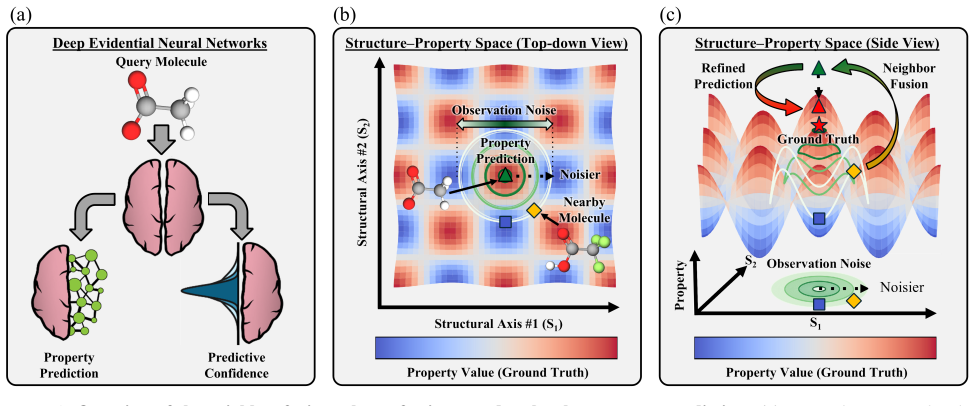
Neighbor fusion under an evidential noise model: the query’s epistemic uncertainty initializes a Gaussian prior, each neighbor is treated as a noisy observation whose noise floor is the query’s aleatoric uncertainty and whose excess noise grows with structural dissimilarity, and a Gaussian-process (or scalar Kalman) update fuses the labels; PG-EVIKAL inserts a learned property-distance re-ranker before that fusion.
What would settle it
On a dataset with dense structural coverage yet widespread activity cliffs, measure whether PG-EVIKAL still reduces test RMSE and improves PICP@90% relative to the evidential baseline; systematic degradation would falsify the claim that the noise model and property-guided selection remain valid when structural similarity no longer tracks property similarity.
Extended reading notes
Core claim
Evidential uncertainty decomposition supplies the prior variance and observation-noise parameters needed for a principled Bayesian update of a molecular property prediction, so that labels of similar training molecules can refine both the point estimate and its uncertainty at test time without retraining; learning a property-distance metric to select those neighbors (PG-EVIKAL) yields a median 19.4% RMSE reduction on 14 of 16 benchmarks and better calibration.
Load-bearing premise
Every selected neighbor is assumed to be a noisy measurement of the query’s true property whose noise rises only with structural dissimilarity, so that the local Gaussian observation model stays well-specified.
Editorial extensions
If this is right
- Practitioners can improve an already-deployed evidential model’s accuracy and calibration by querying the training set at inference, with no gradient steps or architecture changes.
- New assay batches can be absorbed online as neighbor observations, matching or beating full retraining on smooth structure–property landscapes when seed data are scarce.
- Neighbor selection quality, not the fusion algorithm itself, is the dominant bottleneck; property-supervised re-ranking is therefore the default upgrade over pure Tanimoto retrieval.
- A pre-computed QSAR smoothness ratio and the base model’s calibration together define an explicit domain of applicability that predicts when neighbor fusion will help.
Reading between the lines
- The same evidential-plus-neighbor pattern could be tried on other domains where a fixed training set of labeled examples remains available at inference (materials properties, protein–ligand affinities) without changing the core noise-model logic.
- If foundation-model embeddings replace fingerprints for both retrieval and the property-distance metric, denser neighborhoods may push more rough landscapes into the regime where fusion helps.
- The sequential-assay mode effectively turns a static model into a lightweight Bayesian updater, suggesting a middle path between pure active learning (retrain every cycle) and pure offline deployment.
Editorial analysis
A structured set of objections, weighed in public.
Referee Report
Summary. The paper proposes test-time neighbor fusion for molecular property prediction: a trained evidential network’s prediction is refined by fusing labels of similar training molecules, with aleatoric/epistemic uncertainty parameterizing a Bayesian update. Three methods are developed—EVIKAL (scalar Kalman), GP-EVIKAL (batch GP with Tanimoto covariance), and PG-EVIKAL (property-distance re-ranking via PropDist before the same GP)—and evaluated on 16 datasets against MC-Dropout, deep ensembles, and a plain Tanimoto GP. PG-EVIKAL reduces RMSE vs. the evidential baseline on 14/16 datasets (median ~19.4%), improves calibration on most, and supports sequential assay incorporation without retraining. A QSAR smoothness diagnostic and formal error decomposition (Theorem 1, Proposition 1) bound when fusion helps.
Significance. If the results hold, the work reframes evidential uncertainty as an actionable inference resource rather than only a calibration objective, and offers a practical, retraining-free refinement path for deployed molecular models and sequential assays. Strengths include a broad 16-dataset benchmark with five seeds, honest failure cases (FreeSolv sparsity, QM7 roughness, QM8/QM9 representation ceilings), released code/data/checkpoints, ablations on K/λ/C/σ_gate, and a falsifiable pre-deployment diagnostic (s and SNReff). The progression EVIKAL→GP-EVIKAL→PG-EVIKAL cleanly isolates selection quality as the main bottleneck. These are concrete, reproducible contributions of clear interest to molecular ML and uncertainty-aware screening.
major comments (3)
- Table 2 and §5.1 compare GP-EVIKAL at K=5 to PG-EVIKAL at K=50, so gains partly confound selection strategy with neighbor count. Appendix B.4/C.9 largely resolve this (GP is flat in K; PG at K=5 already helps; K=50 amplifies PropDist), but the main text and abstract should state the matched-K comparison explicitly and report median ΔRMSE for PG vs GP at fixed K=5 and K=50 so the headline 19.4% is not misread as pure selection gain.
- Appendix C.10 shows that simple averaging of PropDist-selected neighbors often beats fixed-mean PG-EVIKAL on RMSE when the evidential prior is poor, while a biased-mean GP closes that gap and retains calibrated intervals. This is load-bearing for the claim that the GP fusion (not only selection) is necessary. The main results/discussion should briefly surface this spectrum (fixed-mean GP / biased-mean GP / averaging), state when each is preferred, and clarify that the primary deliverable of fusion is the calibrated posterior, not always the best point RMSE.
- Eq. (4) and §3.2 set R_k = u_a^q + C(1−sim_k)^2 with C and σ_gate tuned per dataset (Table 3). Theorem 1’s optimality holds only under this local observation model; Proposition 1 correctly frames misspecification. For deployment claims (§6), please add a short sensitivity analysis or default protocol (e.g., validation-selected C/σ_gate ranges that transfer across related assays) so the free-parameter burden is quantified rather than left as per-dataset grid search alone.
minor comments (6)
- Abstract/intro median 19.4% should specify the baseline (evidential AttentiveFP) and that it is over the 14 improved datasets (or clarify if over all 16).
- Figure 3 vs Figure 8: main-text six-panel figure is clear; ensure axis units (z-scored vs physical) match Table 2’s normalization note to avoid unit confusion.
- Notation: u_a / u_e are variances in Eq. (1) but sometimes discussed as “uncertainty”; a one-line reminder that intervals use √u would help non-UQ readers.
- §3.5 empirical s<0.65 and PICP@90%≥0.70 thresholds are architecture-coupled (as noted); flag this earlier when first introducing the diagnostic so readers do not treat 0.65 as universal.
- Related work: a short contrast with conformal prediction and kNN-LM-style retrieval (already cited) on what the evidential noise model uniquely provides would sharpen novelty without lengthening much.
- Typos/style: occasional missing spaces after method names (e.g., “PG-EVIKALreduces”); standardize hyphenation of GP-EVIKAL/PG-EVIKAL throughout.
Circularity Check
No significant circularity: test-time neighbor fusion is evaluated on held-out labels; PropDist, s, and SNReff do not force the reported RMSE gains by construction.
full rationale
The central empirical claim (PG-EVIKAL reduces test RMSE vs. the evidential baseline on 14/16 datasets, median 19.4%, with improved calibration and sequential-assay utility) is not forced by definition or by a self-citation chain. The evidential prior (γ, ua, ue) is trained only on the training split; PropDist is trained once on training-set fingerprint–label pairs with no test labels (Eqs. 14–15, App. B.3); neighbor labels used at fusion are training (or previously assayed) labels by design of the method, not a leakage of the evaluation target. Hyperparameters C and σgate are tuned on validation and applied to held-out test sets (Table 3). Theorem 1 is a standard conditional Bayes-optimality result under a correctly specified local GP model; Proposition 1 then decomposes when misspecification hurts—neither equates the reported RMSE to a fitted constant. The noise model Rk = ua^q + C(1−simk)2 (Eq. 4) is an explicit modeling ansatz with C free, not a derivation that renames its inputs as predictions. The QSAR smoothness ratio s and SNReff (Eqs. 12–13, App. F) are pre-deployment diagnostics computed from training fingerprints/labels and validated against observed benefit; they explain when fusion helps rather than manufacturing the headline metric. The sole same-author citation (Gruich et al., 2023) only supplies a calibration definition and is not load-bearing for accuracy claims. Evaluation is against external baselines (MC-Dropout, deep ensembles, plain GP-Tanimoto) on 16 public datasets with released code and checkpoints. No equation reduces the claimed RMSE/calibration gains to their inputs by construction.
Assumptions & free parameters
free parameters (4)
- C (observation-noise scale) =
dataset-specific (Table 3)
- σ_gate (outlier gate threshold) =
dataset-specific (Table 3)
- K (number of neighbors) =
5 / 50
- λ (evidence regularizer) =
0.01
assumptions (4)
- domain assumption Normal-Inverse-Gamma prior yields closed-form aleatoric and epistemic variances from a single forward pass
- domain assumption Tanimoto similarity on ECFP4 fingerprints is a valid positive-definite kernel and a reasonable structural proxy
- ad hoc to paper Neighbor labels are noisy observations of the query property with noise R_k = u_a^q + C(1-sim)^2
- ad hoc to paper QSAR smoothness ratio s < 0.65 (for the chosen architecture) predicts when fusion helps
invented entities (2)
-
PropDist (property-distance MLP)
-
EVIKAL / GP-EVIKAL / PG-EVIKAL pipeline
independent evidence
Cite this review
Pith. "Pith review of Adapting Evidential Neural Networks to Test-Time Neighbor Fusion Improves Molecular Property Prediction." pith.science (2026). https://pith.science/paper/YVJ3UOOV
@misc{pith2026260711091,
  author       = {Pith},
  title        = {Pith review of: Adapting Evidential Neural Networks to Test-Time Neighbor Fusion Improves Molecular Property Prediction},
  year         = {2026},
  howpublished = {\url{https://pith.science/paper/YVJ3UOOV}},
  note         = {Machine review of arXiv:2607.11091}
}
read the original abstract
A trained molecular property model can be refined at test time by correcting each prediction with the measured labels of the most similar training molecules, a retraining-free procedure we call neighbor fusion; evidential neural networks make it principled by using their aleatoric and epistemic uncertainty to parameterize a Bayesian update. Our main contribution, PG-EVIKAL, learns a property-distance metric to re-rank structurally similar neighbors by their property relevance before fusion, building on EVIKAL (scalar Kalman filter) and GP-EVIKAL (Gaussian process variant handling correlated neighbors). Evaluated on 16 molecular datasets, PG-EVIKAL reduces RMSE relative to the evidential model baseline on 14 of them, with a median reduction of 19.4%, and improves calibration; in sequential-assay scenarios it further incorporates newly measured molecules, refining predictions as they arrive without retraining. This work demonstrates that evidential uncertainty decomposition is not merely a calibration objective but an actionable inference resource that enables test-time refinement of molecular property predictions.
Figures


Figures from the paper (8 more)


Reference graph
Works this paper leans on
-
[1]
Advances in Neural Information Processing Systems , volume =
Deep Evidential Regression , author =. Advances in Neural Information Processing Systems , volume =
-
[2]
Journal of Medicinal Chemistry , volume =
Pushing the Boundaries of Molecular Representation for Drug Discovery with the Graph Attention Mechanism , author =. Journal of Medicinal Chemistry , volume =
-
[3]
Wu, Zhenqin and Ramsundar, Bharath and Feinberg, Evan N and others , journal =
-
[4]
Scientific Data , volume =
Quantum Chemistry Structures and Properties of 134 Kilo Molecules , author =. Scientific Data , volume =
-
[5]
Electronic Spectra from
Ramakrishnan, Raghunathan and Hartmann, Mia and Tapavicza, Enrico and von Lilienfeld, O Anatole , journal =. Electronic Spectra from
-
[6]
970 Million Druglike Small Molecules for Virtual Screening in the Chemical Universe Database
Blum, Lorenz C and Reymond, Jean-Louis , journal =. 970 Million Druglike Small Molecules for Virtual Screening in the Chemical Universe Database
-
[7]
Gaulton, Anna and Bellis, Louisa J and Bento, A Patricia and Chambers, Jon and Davies, Mark and Hersey, Anne and Light, Yvonne and McGlinchey, Shaun and Michalovich, David and Al-Lazikani, Bissan and Overington, John P , journal =
-
[8]
Open-source
Mansouri, Kamel and Cariello, Neil F and Korotcov, Alexandru and Tkachenko, Valery and Grulke, Christopher M and Sprankle, Catherine S and Allen, David and Casey, Warren M and Kleinstreuer, Nicole C and Williams, Antony J , journal =. Open-source
Show all 50 references
-
[9]
Chemical Research in Toxicology , volume =
Quantitative Structure--Activity Relationship Modeling of Rat Acute Toxicity by Oral Exposure , author =. Chemical Research in Toxicology , volume =
-
[10]
Reinhold, William C and Sunshine, Margot and Liu, Han and Varma, Sudhir and Kohn, Kurt W and Morris, Joel and Doroshow, James and Pommier, Yves , journal =
-
[11]
Proceedings of the Neural Information Processing Systems Track on Datasets and Benchmarks , year =
Therapeutics Data Commons: Machine Learning Datasets and Tasks for Drug Discovery and Development , author =. Proceedings of the Neural Information Processing Systems Track on Datasets and Benchmarks , year =
-
[12]
Advances in Neural Information Processing Systems , volume =
What Uncertainties Do We Need in Bayesian Deep Learning for Computer Vision? , author =. Advances in Neural Information Processing Systems , volume =
-
[13]
Dropout as a
Gal, Yarin and Ghahramani, Zoubin , journal =. Dropout as a
-
[14]
Advances in Neural Information Processing Systems , volume =
Simple and Scalable Predictive Uncertainty Estimation Using Deep Ensembles , author =. Advances in Neural Information Processing Systems , volume =
-
[15]
Journal of Basic Engineering , volume =
A New Approach to Linear Filtering and Prediction Problems , author =. Journal of Basic Engineering , volume =
-
[16]
Journal of Chemical Information and Modeling , volume =
Extended-Connectivity Fingerprints , author =. Journal of Chemical Information and Modeling , volume =
-
[17]
The Properties of Known Drugs. 1. Molecular Frameworks , author =. Journal of Medicinal Chemistry , volume =
-
[18]
Journal of Chemical Information and Modeling , volume =
Evaluating Scalable Uncertainty Estimation Methods for Deep Learning-Based Molecular Property Prediction , author =. Journal of Chemical Information and Modeling , volume =
-
[19]
Chemical Science , volume =
Accelerating High-Throughput Virtual Screening Through Molecular Pool-Based Active Learning , author =. Chemical Science , volume =
-
[20]
Proceedings of the 35th International Conference on Machine Learning , pages =
Accurate Uncertainties for Deep Learning Using Calibrated Regression , author =. Proceedings of the 35th International Conference on Machine Learning , pages =
-
[21]
Foundations and Trends in Machine Learning , volume =
Conformal Prediction: A Gentle Introduction , author =. Foundations and Trends in Machine Learning , volume =
-
[22]
Generalization through Memorization:
Khandelwal, Urvashi and Levy, Omer and Jurafsky, Dan and Zettlemoyer, Luke and Lewis, Mike , booktitle =. Generalization through Memorization:
-
[23]
Landrum, Greg , year =
-
[24]
Proceedings of the 19th International Conference on Artificial Intelligence and Statistics , pages =
Deep Kernel Learning , author =. Proceedings of the 19th International Conference on Artificial Intelligence and Statistics , pages =. 2016 , organization =
2016
-
[25]
ACS Central Science , volume =
Evidential deep learning for guided molecular property prediction and discovery , author =. ACS Central Science , volume =. 2021 , publisher =
2021
-
[26]
Lopez, Steven A and Sanchez-Lengeling, Benjamin and de Goes Soares, Julio and Aspuru-Guzik, Al. The. Scientific Data , volume =
-
[27]
Physical Review Letters , volume =
Fast and Accurate Modeling of Molecular Atomization Energies with Machine Learning , author =. Physical Review Letters , volume =
-
[28]
Journal of Chemical Information and Modeling , volume =
Analyzing Learned Molecular Representations for Property Prediction , author =. Journal of Chemical Information and Modeling , volume =
-
[29]
Proceedings of the 34th International Conference on Machine Learning , pages =
Neural Message Passing for Quantum Chemistry , author =. Proceedings of the 34th International Conference on Machine Learning , pages =. 2017 , organization =
2017
-
[30]
The Journal of Chemical Physics , volume =
Sch. The Journal of Chemical Physics , volume =
-
[31]
Prediction Errors of Molecular Machine Learning Models Lower than Hybrid
Faber, Felix A and Hutchison, Luke and Huang, Bing and Gilmer, Justin and Schoenholz, Samuel S and Dahl, George E and Vinyals, Oriol and Kearnes, Steven and Riley, Patrick F and von Lilienfeld, O Anatole , journal =. Prediction Errors of Molecular Machine Learning Models Lower...
-
[32]
Nature Machine Intelligence , volume =
Large-Scale Chemical Language Representations Capture Molecular Structure and Properties , author =. Nature Machine Intelligence , volume =
-
[33]
Chithrananda, Seyone and Grand, Gabriel and Ramsundar, Bharath , year =
-
[34]
Journal of Chemical Information and Modeling , volume =
Uncertainty Quantification Using Neural Networks for Molecular Property Prediction , author =. Journal of Chemical Information and Modeling , volume =
-
[35]
Machine Learning: Science and Technology , volume =
Clarifying Trust of Materials Property Predictions Using Neural Networks with Distribution-Specific Uncertainty Quantification , author =. Machine Learning: Science and Technology , volume =
-
[36]
Information Fusion , volume =
A Review of Uncertainty Quantification in Deep Learning: Techniques, Applications and Challenges , author =. Information Fusion , volume =
-
[37]
Machine Learning , volume =
Aleatoric and Epistemic Uncertainty in Machine Learning: An Introduction to Concepts and Methods , author =. Machine Learning , volume =
-
[38]
Journal of the American Statistical Association , volume =
Strictly Proper Scoring Rules, Prediction, and Estimation , author =. Journal of the American Statistical Association , volume =
-
[39]
Drug Discovery Today , volume =
Active-Learning Strategies in Computer-Assisted Drug Discovery , author =. Drug Discovery Today , volume =
-
[40]
Active Learning Literature Survey , author =
-
[41]
Bajusz, D. Why Is. Journal of Cheminformatics , volume =
-
[42]
Neural Networks , volume =
Graph Kernels for Chemical Informatics , author =. Neural Networks , volume =
-
[43]
On Outliers and Activity Cliffs---Why
Maggiora, Gerald M , journal =. On Outliers and Activity Cliffs---Why
-
[44]
Journal of Medicinal Chemistry , volume =
Exploring Activity Cliffs in Medicinal Chemistry , author =. Journal of Medicinal Chemistry , volume =
-
[45]
Journal of Chemical Information and Modeling , volume =
Exposing the Limitations of Molecular Machine Learning with Activity Cliffs , author =. Journal of Chemical Information and Modeling , volume =
-
[46]
Economic Geology , volume =
Principles of Geostatistics , author =. Economic Geology , volume =. 1963 , publisher =
1963
-
[47]
1993 , publisher =
Statistics for Spatial Data , author =. 1993 , publisher =
1993
-
[48]
1999 , publisher =
Interpolation of Spatial Data: Some Theory for Kriging , author =. 1999 , publisher =
1999
-
[49]
2006 , publisher =
Gaussian Processes for Machine Learning , author =. 2006 , publisher =
2006
-
[50]
Billion-Scale Similarity Search with
Johnson, Jeff and Douze, Matthijs and J. Billion-Scale Similarity Search with. IEEE Transactions on Big Data , volume =. 2019 , publisher =
2019
Reviewed July 14, 2026 · model on record in the stance chip above.
Discussion (0). Sign in to comment.