REVIEW 2 major objections 3 minor 45 references
Local energy assignment for two interacting quantum thermal reservoirs
T0 review · 2 major / 3 minor · reviewed 2026-08-04 · deepseek-v4-flash
Pith's one-line read The paper argues that in a two-reservoir model where each side is a thermal harmonic-oscillator bath, three established definitions of internal energy, heat, and work disagree even in the weakly coupled dispersive regime, and that the minim
desk verdict A careful, analytically explicit comparison of three first-law definitions in a symmetric two-bath model; the dispersive-regime disagreement is solid, but the headline work peaks in the minimal-dissipation approach look like inversion artifacts and need scrutiny. read the letter →
The pith
A machine-rendered reading of the paper's core claim, the machinery that carries it, and where it could break.
The reading
What carries the argument
The argument runs through the time-local reduced generator L_t = dot(Phi_t) Phi_t^(-1), where Phi_t is the exact evolution matrix for the first moments of one oscillator ensemble. Extracting its anti-Hermitian part gives the renormalized Hamiltonian K_t=(L_t^dagger - L_t)/(2i), which defines the minimal-dissipation internal energy, heat, and work. The principle of minimal dissipation selects this K_t as the unique Hamiltonian part. In the homogeneous model, Phi_t is built from phase factors alpha_1(t) and alpha_2(t); their zeros at t=(2n+1)π/Γ cause the tan² divergences in work.
What would settle it
Compute the minimal-dissipation heat and work for the same homogeneous model with a small regularizing term that keeps Phi_t invertible (e.g., adding a tiny dephasing or broadening the single-frequency limit), and check whether the tan² peaks at t=(2n+1)π/Γ become finite; or measure the renormalized local energy of one oscillator ensemble at those times in an ultrastrong-coupling experiment and look for the predicted divergent work spikes.
Extended reading notes
Core claim
The central claim is that, in a fully autonomous model of two thermal oscillator ensembles interacting linearly, no agreement exists between the interaction, bare, and minimal-dissipation definitions of first-law quantities. Concretely, the variation of interaction energy is of the same order as the bare energy changes in the dispersive regime, so the bare and interaction definitions cannot be compatible; the minimal-dissipation definition also differs from both, and its heat reduces to the standard weak-coupling heat in that regime. In the ultrastrong regime the minimal-dissipation internal energy exhibits secondary peaks that diverge at times t=(2n+1)π/Γ, and the analytic expansion shows t
Load-bearing premise
The minimal-dissipation results assume the reduced evolution map Phi_t is invertible at every time; at t=(2n+1)π/Γ its factors vanish, and the unbounded work peaks come from that inversion, so if the non-invertibility is an artifact the main quantitative claim weakens.
Editorial extensions
If this is right
- Dispersive or weak-coupling conditions do not by themselves make interaction energy negligible; thermodynamic predictions depend on which first-law convention is chosen.
- The minimal-dissipation heat is the only one that reduces to the standard weak-coupling heat in the dispersive limit, making it a candidate for a consistent extension.
- The unbounded secondary peaks in ultrastrong coupling are work-like, so any attempt to extract work from these systems must contend with the chosen convention.
- No set of definitions conserves energy between the two reservoirs; reported heat and work flows carry convention-dependent offsets of order 20–50% of the energy exchange.
- The effective detuning set by collective eigenvalues, not the bare frequency difference, controls the direction and magnitude of energy flows.
Reading between the lines
- An extension the authors do not pursue: if the inversion singularity is an artifact, the unbounded peaks may be specific to the minimal-dissipation construction rather than physically realizable work, though the qualitative trend of growing peaks could survive in a regularized version with finite Phi_t.
- A direct experimental probe could measure the renormalized level shifts spectroscopically in the ultrastrong regime and compare them with K_t; observation of the predicted tan² peaks would turn a formal divergence into a testable signature.
- The result suggests that strong-coupling quantum thermal machines need an operational convention for "work" before efficiencies can be quoted, not just a Hamiltonian of the bare system.
- The homogeneous special case is fully soluble, so extending the same comparison to non-Gaussian couplings or few-mode finite systems would show whether the convention dependence is generic.
Editorial analysis
A structured set of objections, weighed in public.
Referee Report
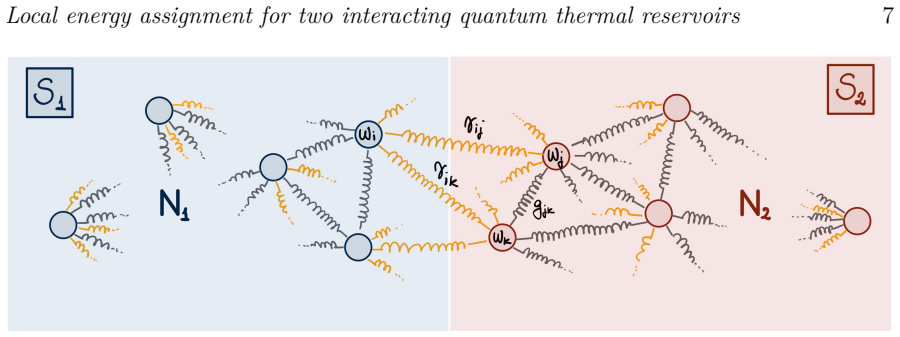
Summary. The manuscript compares three sets of definitions of internal energy, heat, and work for a closed bipartite system consisting of two large but finite sets of linearly coupled harmonic oscillators, each initially in a thermal state. The authors derive exact analytical expressions for a homogeneous-frequency model and use exact diagonalization for distributed frequencies. They report that the two common asymmetric definitions ("interaction" and "bare") disagree with each other and with the minimal-dissipation approach even in the dispersive regime, that minimal-dissipation internal energy develops secondary peaks in the ultrastrong regime which are traced to work contributions, and that none of the definitions satisfies an energy balance between the two subsystems.
Significance. If the claims hold, the paper makes a useful and nontrivial point: in a fully autonomous, symmetric two-reservoir setup, dispersive conditions do not by themselves select a unique thermodynamic weak-coupling limit, and the choice of energy assignment affects even qualitative features. The analytical solution in Appendix A is explicit and checkable; the numerical results state their parameters; and the comparison is not circular, since the minimal-dissipation quantities are computed from the exact reduced propagator rather than assumed. The main advertised new feature, however, the growth of work peaks with coupling, is entangled with a near-singular inversion of the reduced one-body propagator, and the paper does not currently separate that artifact from a physical signature.
major comments (2)
- [Sec. 4, Eq. (56)] Equation (56) as printed has a sign error. For x=1 it gives +(ν1−ν2)B[n1+G]=+ΔB[...], while the Appendix (A.58)–(A.59) and the expansion in Eq. (65) are consistent with ΔU_md1 = +ν1G − ΔB[n1+G] and ΔU_md2 = −ν2G + ΔB[n2−G]. The correct general form is ΔU_md_x = ν_xG_x − (ν_x−ν_\bar{x})B[n_x+G_x]. Since B(t)≤0, the printed sign reverses the stated dependence on the sign of Δ and would predict peaks where Fig. 3 shows dips. This is load-bearing: all subsequent qualitative statements about the sign and structure of minimal-dissipation energies inherit this error. It must be corrected.
- [Sec. 5.1.2, Eqs. (58), (65), (69)] The secondary-peak phenomenon is not separated from an inversion artifact of the minimal-dissipation construction. The peak term arises from B(t), whose denominator is Δ²+Γ²cos²(Ωt/2). For finite Δ≠0, at t=π/Γ the exact contribution to ΔU_md1 is ≈Γ²/(2Δ) after the sign correction, which grows without bound as Δ→0; at exactly Δ=0 the prefactor (ν1−ν2)=0 removes the term, so the limit is discontinuous. This is precisely the regime where the factors α1(t), α2(t) entering Φ_t vanish and Φ_t is not invertible. Because the abstract advertises peaks that are "virtually unbounded the deeper the ultrastrong regime," the paper should quantify this non-uniform limit, acknowledge that the peaks are properties of the chosen minimal-dissipation decomposition rather than of the underlying dynamics, and discuss whether they survive any physical regularization of the inversion.
minor comments (3)
- [Sec. 4.2, Eq. (62)] The expansion B(t) ≈ −(1/2)tan²(Ωt) appears to miss a half-angle: the exact B(t) in the ultrastrong limit behaves like −(1/2)tan²(Ωt/2), not tan²(Ωt). Please correct the argument.
- [Fig. 10 caption] The caption says "Energy (left), heat (middle) and work (left)"; the last should presumably be "work (right)".
- [Appendix A, Eq. (A.44)] The notation −Δ/(2|α(t)|²) could be misread as −Δ|α(t)|²/2. Parentheses would improve clarity.
Circularity Check
No significant circularity: exact analytical comparison; minimal-dissipation framework is adopted as a definition, not used as evidence.
full rationale
The paper's central comparison is not circular. The reduced propagator Phi_t, the generator L_t = dPhi_t/dt * Phi_t^-1, and the effective Hamiltonian K_t = (L_t^dagger - L_t)/(2i) are computed exactly from the microscopic model (Eqs. 32-37), and the three first-law sets are then evaluated from those expressions (Eqs. 39-49); no data-fitting or parameter adjustment enters. The analytical homogeneous limit (Eqs. 54-58) is a closed-form consequence of the diagonalization, not an ansatz tuned to produce the reported differences. The minimal-dissipation definitions are explicitly adopted from Ref. [16] (with the minimization condition also sourced to Ref. [36]), but the paper's claims are comparisons of definitions rather than an attempted proof of that framework, so the self-citation is not load-bearing. The unbounded work peaks follow from K_t through the inverse of Phi_t; whether those singularities are physical is a correctness/interpretation concern, not a circular reduction of the derivation to its inputs.
Assumptions & free parameters
assumptions (3)
- domain assumption The minimal-dissipation criterion (minimizing the dissipator superoperator) selects the physically correct renormalized Hamiltonian for each subsystem.
- standard math The two subsystems start in zero-mean thermal Gaussian states and the quadratic Hamiltonian preserves Gaussianity.
- domain assumption The other subsystem acts as a zero-mean Gaussian environment, so the reduced dynamics is fully captured by a time-local generator of the form Eq. (34).
Cite this review
Pith. "Pith review of Local energy assignment for two interacting quantum thermal reservoirs." pith.science (2026). https://pith.science/paper/YWB6ECLO
@misc{pith2026251006929,
  author       = {Pith},
  title        = {Pith review of: Local energy assignment for two interacting quantum thermal reservoirs},
  year         = {2026},
  howpublished = {\url{https://pith.science/paper/YWB6ECLO}},
  note         = {Machine review of arXiv:2510.06929}
}
read the original abstract
Understanding how to assign internal energy, heat, and work in quantum systems beyond weak coupling remains a central problem in quantum thermodynamics, particularly as the difference between competing definitions becomes increasingly relevant. We identify two common sets of definitions for first-law quantities that are used to describe the thermodynamics of quantum systems coupled to thermal environments. Both are conceptually non-symmetric, treating one part of the bipartition (the "system") differently from the other (the "bath"). We analyze these in a setting where such roles are not easily assigned - two large (but finite) sets of thermal harmonic oscillators interacting with each other. We further compare them with a third set of definitions based on a local, conceptually symmetric open-system approach ("minimal dissipation") and discuss their quantitative and structural differences. In particular, we observe that all three sets of definitions differ substantially even when the two subsystems are weakly coupled and far detuned, and that the minimal dissipation approach features distinct work peaks that increase with the coupling strength.
Figures


Figures from the paper (7 more)


Reference graph
Works this paper leans on
-
[1]
Adesso G, Anders J, Binder F, Correa L A and Gogolin C (eds) 2018Thermodynamics in the Quantum Regime: Fundamental Aspects and New Directions1st ed Fundamental Theories of Physics (Cham: Springer)
-
[2]
Deffner S and Campbell S 2019Quantum Thermodynamics: An introduction to the thermodynamics of quantum information2053-2571 (Morgan & Claypool Publishers)
-
[3]
Campbell S et al 2025 Roadmap on quantum thermodynamics (Preprint2504.20145)
arXiv 2025
-
[4]
Breuer H P and Petruccione F 2007The Theory of Open Quantum Systems(Oxford University Press)
-
[5]
Vacchini B 2024Open Quantum Systems(Springer Cham)
-
[6]
Alicki R 1979Journal of Physics A: Mathematical and General12L103
-
[7]
Kosloff R 2013Entropy152100–2128
-
[8]
Talkner P and Hänggi P 2020Rev. Mod. Phys.92(4) 041002
Show all 45 references
-
[9]
Potts P P 2024 Quantum thermodynamics (Preprint2406.19206)
2024 arXiv
-
[10]
Colla A and Breuer H P 2024Quantum Science and Technology10015047
-
[11]
AlipourS,BenattiF,BakhshinezhadF,AfsaryM,MarcantoniSandRezakhaniAT2016Scientific Reports635568
-
[12]
Rep.712447
Marcantoni S, Alipour S, Benatti F, Floreanini R and Rezakhani A T 2017Sci. Rep.712447
-
[13]
Popovic M, Vacchini B and Campbell S 2018Phys. Rev. A98(1) 012130
-
[14]
Strasberg P and Esposito M 2019Phys. Rev. E99(1) 012120
-
[15]
Rivas A 2020Phys. Rev. Lett.124(16) 160601
-
[16]
Colla A and Breuer H P 2022Phys. Rev. A105(5) 052216
-
[17]
Weimer H, Henrich M J, Rempp F, Schröder H and Mahler G 2008EPL (Europhysics Letters)83 30008
-
[18]
Alipour S, Rezakhani A T, Chenu A, del Campo A and Ala-Nissila T 2022Phys. Rev. A105(4) L040201
-
[19]
Elouard C and Lombard Latune C 2023PRX Quantum4(2) 020309
-
[20]
Seegebrecht A and Schilling T 2024Journal of Statistical Physics19134
-
[21]
Davoudi Z, Jarzynski C, Mueller N, Oruganti G, Powers C and Halpern N Y 2025 Work and heat exchanged during sudden quenches of strongly coupled quantum systems (Preprint2502.19418)
2025 arXiv
-
[22]
Picatoste I A, Colla A and Breuer H P 2025Phys. Rev. A112(2) 022210
-
[23]
Esposito M, Lindenberg K and Van den Broeck C 2010New Journal of Physics12013013
-
[24]
Landi G T and Paternostro M 2021Rev. Mod. Phys.93(3) 035008 Local energy assignment for two interacting quantum thermal reservoirs25
-
[25]
Rodrigues F L S, De Chiara G, Paternostro M and Landi G T 2019Phys. Rev. Lett.123(14) 140601
-
[26]
Popovic M, Mitchison M T, Strathearn A, Lovett B W, Goold J and Eastham P R 2021PRX Quantum2(2) 020338
-
[27]
Popovic M, Mitchison M T and Goold J 2023Proceedings of the Royal Society A47920230040
-
[28]
Pucci L, Esposito M and Peliti L 2013Journal of Statistical Mechanics: Theory and Experiment 2013P04005
-
[29]
Kato A and Tanimura Y 2016The Journal of Chemical Physics145224105
-
[30]
Colla A and Breuer H P 2021Phys. Rev. A104(5) 052408
-
[31]
Gribben D, Strathearn A, Fux G E, Kirton P and Lovett B W 2022Quantum6847
-
[32]
Albarelli F, Vacchini B and Smirne A 2024Quantum Science and Technology10015041
-
[33]
Breuer H P 2012J. Phys. B45154001
-
[34]
Hall M J W, Cresser J D, Li L and Andersson E 2014Phys. Rev. A89042120
-
[35]
Chruściński D 2022Physics Reports9921–85
-
[36]
Sorce J and Hayden P M 2022Journal of Physics A: Mathematical and Theoretical
-
[37]
Colla A, Hasse F, Palani D, Schaetz T, Breuer H P and Warring U 2025Nature Communications 162502
-
[38]
Albash T, Boixo S, Lidar D A and Zanardi P 2012New Journal of Physics14123016
-
[39]
Martinez E A and Paz J P 2013Phys. Rev. Lett.110(13) 130406
-
[40]
Esposito M, Ochoa M A and Galperin M 2015Phys. Rev. B92(23) 235440
-
[41]
Nicacio F and Semião F L 2016Journal of Physics A: Mathematical and Theoretical49375303 published 24 August 2016
2016
-
[42]
Leitch H, Piccione N, Bellomo B and De Chiara G 2022AVS Quantum Science4012001
-
[43]
Razzoli L, Carrega M, Cavaliere F, Benenti G and Sassetti M 2024Quantum Science and Technology9045032
-
[44]
Xiao H 2013Exact Master Equation for a Bosonic Many-Body System Coupled to a Bosonic Bath Master’s thesis University of Freiburg
-
[45]
Analytical derivation for homogeneous coupling and frequencies Here we show the derivation of the quantities reported in Sec
Neves L R and Brito F 2025Scientific Reports1533175 Appendix A. Analytical derivation for homogeneous coupling and frequencies Here we show the derivation of the quantities reported in Sec. 4. Let us first set some notation by defining the matrix JN1N2 = 1 1···1 1 1··...
Reviewed August 4, 2026 · model on record in the stance chip above.
Discussion (0). Continue with ORCID to comment.