REVIEW 3 major objections 4 minor 11 references
Linearized Analysis of Rastall Gravity
T0 review · 3 major / 4 minor · reviewed 2026-08-15 · deepseek-v4-flash
Pith's one-line read In linearized Rastall gravity, the metric for pressure-free matter is determined by two λ-dependent parameters and yields gravitoelectric and gravitomagnetic fields that a circular-orbit observer would measure as shifted from general…
desk verdict The central λ-dependent metric violates the gauge used to derive it, so the GEM results are not reliable—despite a well-written thesis. read the letter →
The pith
A machine-rendered reading of the paper's core claim, the machinery that carries it, and where it could break.
The reading
What carries the argument
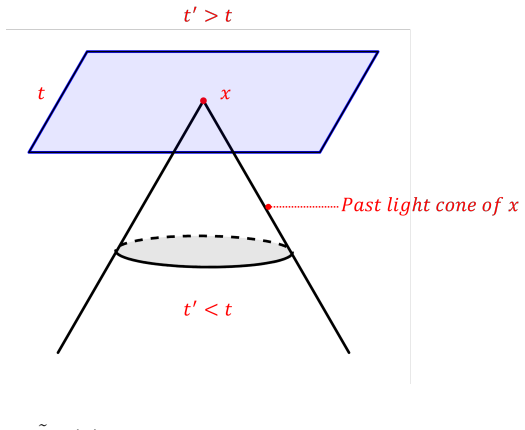
The machinery is the weak-field perturbation $h_{\mu\nu}$ together with the gauge-redefined combination $\tilde{h}_{\mu\nu} = h_{\mu\nu} - \frac{1-2\lambda}{2}\eta_{\mu\nu}h$, which turns the Rastall field equation into a flat-space wave equation whose source is the stress tensor. Solving that wave equation with a retarded Green's function gives the metric (2.51). The second piece is the Fermi normal coordinate system built along the observer's timelike geodesic, which converts the Riemann tensor components into the gravitoelectric and gravitomagnetic fields of a Lorentz-like force law $d^2X^i/d\tau^2 = (E_G)^i + 2 (V \times B_G)^i$.
What would settle it
Take the proposed dust source with $T_{00}=\rho c^2$, $T_{ij}=0$ and substitute the derived metric into the modified conservation law (1.6); for $\lambda\neq 0$ the left side vanishes while $\nabla_{\nu} R$ does not, so a direct check would show the metric is not a solution. Alternatively, a satellite experiment with a gyroscope error budget smaller than the predicted $\lambda$-dependent shift in the gravitomagnetic force could rule out any $\lambda$ above that threshold.
Extended reading notes
Core claim
The central claim is that linearized Rastall gravity for localized, pressure-free, shear-free matter yields the metric $ds^2=(1-\alpha\Phi)c^2dt^2 - 4A_i c dt dx^i - (1+\beta\Phi)\delta_{ij}dx^i dx^j$, where $\Phi$ is the Newtonian potential, $A_i$ is the gravitomagnetic vector potential, and $\alpha=2(1-6\lambda)/(1-4\lambda)$, $\beta=2(1-2\lambda)/(1-4\lambda)$. At $\lambda=0$ this is exactly the linearized Schwarzschild metric of general relativity. From this metric the paper computes the Riemann tensor on a circular orbit, transforms to an observer's Fermi normal coordinates, and derives the gravitoelectric field $\mathbf{E}_G$ and gravitomagnetic field $\mathbf{B}_G$ that the observer attributes to a nearby free particle. The explicit components show that both fields scale with $\alpha$ and $\beta$, so a measurement of orbital GEM forces would be sensitive to $\lambda$; the calculation also finds $\mathbf{B}_G$ perpendicular to the observer's velocity for this orbit.
Load-bearing premise
The load-bearing premise is that a static, pressure-free, shear-free dust source is an admissible stress tensor in Rastall gravity; the modified conservation law then requires the curvature scalar to be constant, but the derived metric gives a curvature scalar proportional to the density, so the premise fails for any nonzero $\lambda$.
Editorial extensions
If this is right
- At $\lambda=0$ all results reduce to linearized general relativity, so the metric and GEM forces agree with the Schwarzschild limit.
- The parameters $\alpha$ and $\beta$ multiply the Newtonian and spatial potentials, so any weak-field observable—light deflection, perihelion precession, GEM forces—acquires a fractional correction of order $\lambda$.
- A free-falling observer on a circular orbit measures the gravitomagnetic field perpendicular to the direction of motion, a signature that could be looked for with orbiting gyroscopes.
- Comparing the predicted force magnitudes with the Gravity Probe B error budget would place an experimental bound on $|\lambda|$.
Reading between the lines
- A consistency check the report does not carry out suggests the static dust source may be incompatible with Rastall's modified conservation law for $\lambda\neq 0$; if so, the metric would need to be rederived with a non-conserved source that satisfies Eq. (1.6).
- The perpendicularity of the gravitomagnetic field to the observer's motion is derived only for circular orbits; a natural extension would test whether the same orthogonality holds for eccentric orbits computed numerically.
- Because $\alpha$ and $\beta$ enter the metric at first order, the same linearized solution could be applied to light deflection and Shapiro time delay, giving independent solar-system constraints on $\lambda$ that do not require orbiting gyroscopes.
Signed reviews
Editorial analysis
A structured set of objections, weighed in public.
Referee Report
Summary. This manuscript, an undergraduate project report posted on arXiv, applies the linearized approximation to Rastall gravity. It derives the linearized field equation (2.19) under the harmonic-type gauge condition (2.16), solves it for a pressureless, shear-free source, and obtains the metric (2.51) with λ-dependent coefficients α and β, together with its spherically symmetric specialization (2.74). It then develops the Fermi normal coordinate formalism, derives the geodesic-deviation equation (3.76), and computes gravitoelectric and gravitomagnetic fields for an observer on a circular orbit, concluding that these fields depend on λ and could be used to bound the Rastall parameter. The presentation is self-contained and pedagogical.
Significance. If the central solution were valid, the paper would give a concrete, falsifiable prediction: λ-dependent gravitoelectric and gravitomagnetic forces for an orbiting observer, with reported shifts of order 100λ percent, opening a route to constraining Rastall's parameter with Gravity Probe B-type data. The Fermi normal coordinate review and the Green's function solution are careful and clearly presented, and the paper is transparent about its assumptions and limitations. However, the central solution is not a solution of the linearized Rastall equations, and the claimed exterior metric is not a vacuum solution; the phenomenological conclusions therefore do not follow. The paper's strength is its organization and clarity, not the validity of its main result.
major comments (3)
- [§2.2, Eqs. (2.43)-(2.45)] The metric perturbation reconstructed from h-tilde does not satisfy the gauge condition (2.16) that was used to reduce Eq. (2.8) to Eq. (2.17). For a static point source, h_{00} = -2(1-6λ)/(1-4λ)Φ and h_{ij} = -2(1-2λ)/(1-4λ)Φδ_{ij}, so h = 4Φ/(1-4λ) and ∂_i(h^{ij} - (1/2)η^{ij}h) = [4λ/(1-4λ)]∂^jΦ, which vanishes only for λ=0. Hence the step from Eq. (2.8) to Eq. (2.19) is invalid for the proposed solution, and the λ-dependent coefficients in Eq. (2.51) are not established.
- [§2.2, Eqs. (2.7) and (1.6)] The trace of Eq. (2.7) with T^{00}=ρc^2 requires R = -8πGρ/[c^2(1-4λ)] = 2∇^2Φ/(1-4λ), while substituting Eqs. (2.43)-(2.45) into Eq. (2.6) gives R = 2(1+2λ)/(1-4λ)∇^2Φ; the two agree only at λ=0. Equivalently, for the static dust source (2.33) the divergence of T^{μν} vanishes, so Eq. (1.6) forces R to be constant, contradicting R∝ρ. The source (2.33) is therefore not admissible in Rastall gravity for λ≠0.
- [§2.2 and §3.3, Eq. (2.74)] Even in the exterior region where T=0 and ∇^2Φ=0, the metric (2.74) does not solve the Rastall vacuum equations. Direct substitution gives R_{ij} = [-4λ/(1-4λ)]∂_i∂_jΦ, while the trace equation with T=0 forces R=0 and therefore R_{μν}=0; for λ≠0 the two disagree. The exterior of a static non-rotating body in Rastall gravity is the usual Schwarzschild solution, so the λ-dependent gravitoelectric and gravitomagnetic fields in Eqs. (3.141)-(3.145) cannot be attributed to that exterior, invalidating the Chapter 3 estimate of λ.
minor comments (4)
- [§2.2, Eq. (2.54)] The truncation of the multipole expansion in Eq. (2.54) is justified by weak-field validity, but the truncation actually requires r to be much larger than the source size; this condition should be stated separately.
- [§2.2 and §3.3] In Eq. (2.70) a new radial coordinate r-bar is introduced, but Chapter 3 (e.g., Eq. (3.80)) drops the bar and uses the same symbol r; this notational change should be flagged when the metric is reused.
- [§3.3, Eq. (3.116)] In Eq. (3.116), the relation between the spherical and cylindrical coordinates and the form of Φ in cylindrical variables should be written out explicitly; as printed, the reader must reconstruct this by hand to verify the vierbein components in Eqs. (3.127)-(3.130).
- [§3.3, after Eq. (3.151)] There are minor typographical issues: in the paragraph after Eq. (3.151), 'x2≡ϕ direction' is an abuse of notation, and the sentence after Eq. (3.168) uses 'R0i0i(τ)' with an implicit summation that has not been defined.
Circularity Check
No circularity found: the linearized Rastall metric and gravitoelectromagnetic fields are derived from the field equations with λ as an unmeasured theory parameter, not as a fitted or assumed input; the gauge inconsistency is a correctness issue, not circularity.
full rationale
The paper's derivation chain is self-contained and no load-bearing step reduces to its inputs. In Chapter 2, the Rastall field equations (2.7) are linearized with gμν = ημν + hμν, the gauge condition (2.16) is imposed, the wave equation (2.19) is solved via the retarded Green's function, and the metric (2.51) is obtained algebraically from the definition (2.18) of the modified perturbation. The coefficients α and β are rational functions of the theory parameter λ, which enters through the assumed field equations themselves; they are not fitted constants, and the λ-dependence of the final metric is a consequence of the starting equations rather than an input disguised as a prediction. The gravitoelectric and gravitomagnetic fields in Section 3.3 are defined from the Fermi-normal Riemann components via Eqs. (3.77) and (3.78), then computed from the curvature of the previously derived metric (3.80), so they are consequences of that metric rather than imposed by hand. The paper cites standard GR references and external experimental results, but none of these citations is a self-citation carrying the derivation, and no result is imported from the author's prior work. A consistency check shows that the reconstructed metric (2.43)–(2.45) does not satisfy the gauge condition (2.16) for λ ≠ 0, indicating a mathematical error in the solution procedure; however, that is a correctness or self-consistency problem, not circularity, because the derivation does not assume the final metric as an input. The central claim therefore has independent content and no circular reduction is present.
Assumptions & free parameters
free parameters (1)
- Rastall parameter λ
assumptions (4)
- domain assumption Rastall field equation (1.5) and modified conservation law (1.6) are the starting theory
- standard math Standard linearized GR machinery: weak-field expansion, harmonic gauge, retarded Green's function
- standard math Fermi normal coordinate metric and geodesic-deviation formulas in Chapter 3 are correct for the background metric
- ad hoc to paper A static, pressure-free dust source with T_ij=0 is admissible in Rastall gravity
Cite this review
Pith. "Pith review of Linearized Analysis of Rastall Gravity." pith.science (2026). https://pith.science/paper/YWCDJRUK
@misc{pith2026250505499,
  author       = {Pith},
  title        = {Pith review of: Linearized Analysis of Rastall Gravity},
  year         = {2026},
  howpublished = {\url{https://pith.science/paper/YWCDJRUK}},
  note         = {Machine review of arXiv:2505.05499}
}
read the original abstract
Rastall gravity is a generalization of the Einstein gravity in which the matter is not conserved in the presence of a non-constant spacetime curvature. In this report, we analyze Rastall gravity using the linearized formalism. The linearized metric for a localized matter without pressure and shear stress is obtained, and a spherically symmetric metric for a non-rotating mass is derived. A phenomenological consequence, known as the gravitoelectromagnetism, is subsequently discussed in detail, where it is shown that a free-falling observer will see the motion of a nearby free particle as being subject to a velocity-independent gravitoelectric force and a velocity-dependent gravitomagnetic force. An explicit calculation of the gravitoelectric and gravitomagnetic fields as seen by an observer moving in a circular orbit in a spherically symmetric gravitational field is presented, and it is shown that the resulting gravitomagnetic field is perpendicular to the observer's moving direction.
Figures


Figures from the paper (5 more)


Reference graph
Works this paper leans on
-
[1]
Rastall, Generalization of the Einstein Theory , Physical Review D 6 (1972) 3357
P. Rastall, Generalization of the Einstein Theory , Physical Review D 6 (1972) 3357
work page 1972
-
[2]
L. Lindblom and W. A. Hiscock, Criticism of some non-conservative gravi- tational theories , Journal of Physics A: Mathematical and General 15 (1982) 1827
work page 1982
-
[3]
L. D. Landau and E. M. Lifshitz, “Fluid Mechanics,” 2nd edition, Pergamon Press (1987)
work page 1987
-
[4]
A Van Itterbeek, Velocity and attenuation of sound at low temperatures , Progress in Low Temperature Physics Vol. 1 (ed C. J. Corter), New York: Interscience (1955)
work page 1955
-
[5]
A First Course in General Relativity,
B. F. Schutz, “A First Course in General Relativity,” 2nd edition, Cambridge University Press (2009)
work page 2009
-
[6]
J. D. Jackson, “Classical Electrodynamics,” 3rd edition, John Wiley & Son (1999)
work page 1999
-
[7]
Mashhoon, Gravitoelectromagnetism: A Brief Review , arXiv:gr-qc/0311030
B. Mashhoon, Gravitoelectromagnetism: A Brief Review , arXiv:gr-qc/0311030
-
[8]
B. Mashhoon, Beyond Gravitoelectromagnetism: Critical Speed in Gravitational Motion, International Journal of Modern PhysicsD 14 (2005) 2025, arXiv:astro- ph/0510002. 56
Show all 11 references
-
[9]
A Relativists Toolkit: The Mathematics of Black-Hole Mechanics,
E. Poisson, “A Relativists Toolkit: The Mathematics of Black-Hole Mechanics,” Cambridge University Press (2004)
2004
-
[10]
Satellite Orbits: Models, Methods and Applica- tions,
O. Montenbruck and E. Gill, “Satellite Orbits: Models, Methods and Applica- tions,” Springer (2000)
2000
-
[11]
C. W. F. Everitt et al., Gravity Probe B: Final Results of a Space Experiment to Test General Relativity , Physical Review Letters 106 (22) (2011) 221101, arXiv:1105.3456. 57
2011 arXiv
Reviewed August 15, 2026 · model on record in the stance chip above.
Discussion (0). Continue with ORCID to comment.