Gravothermal Collapse: Robust Against Baryonic Feedback
Pith reviewed 2026-06-28 20:56 UTC · model grok-4.3
The pith
Gravothermal collapse in high-concentration SIDM halos proceeds despite extremely strong baryonic feedback
A machine-rendered reading of the paper's core claim, the machinery that carries it, and where it could break.
Core claim
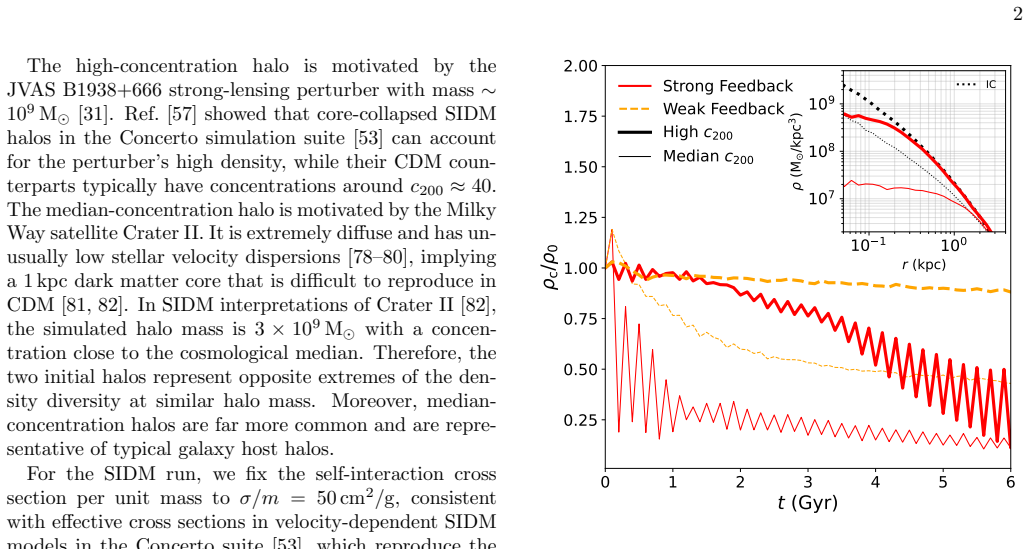
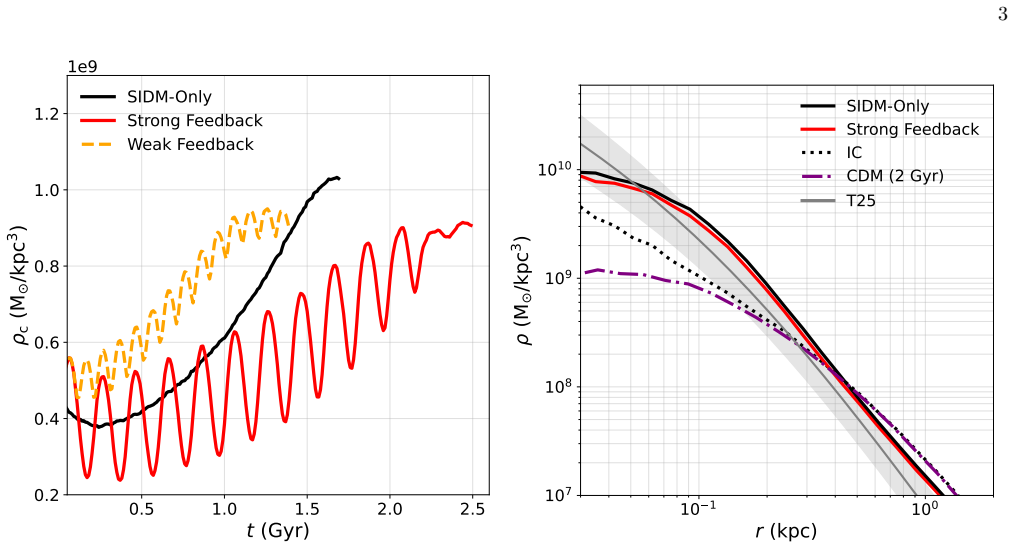
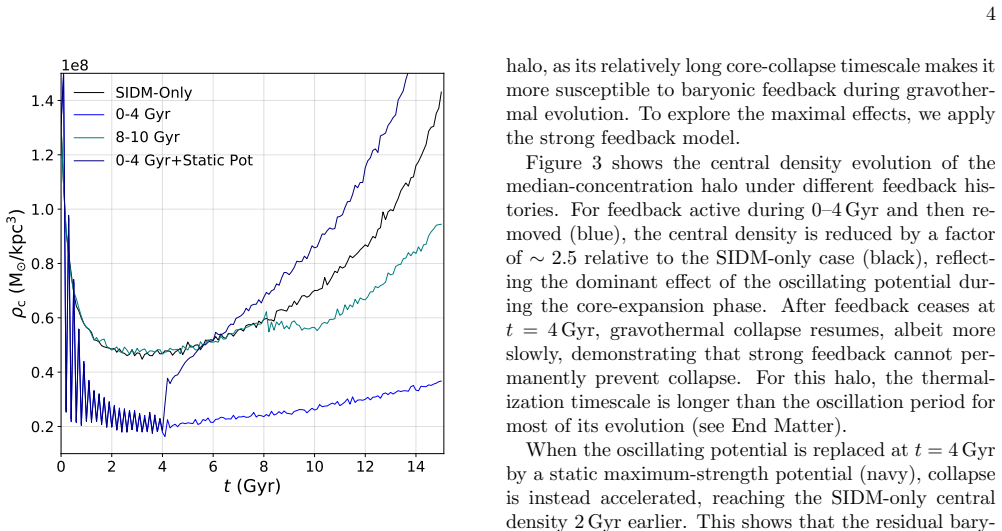
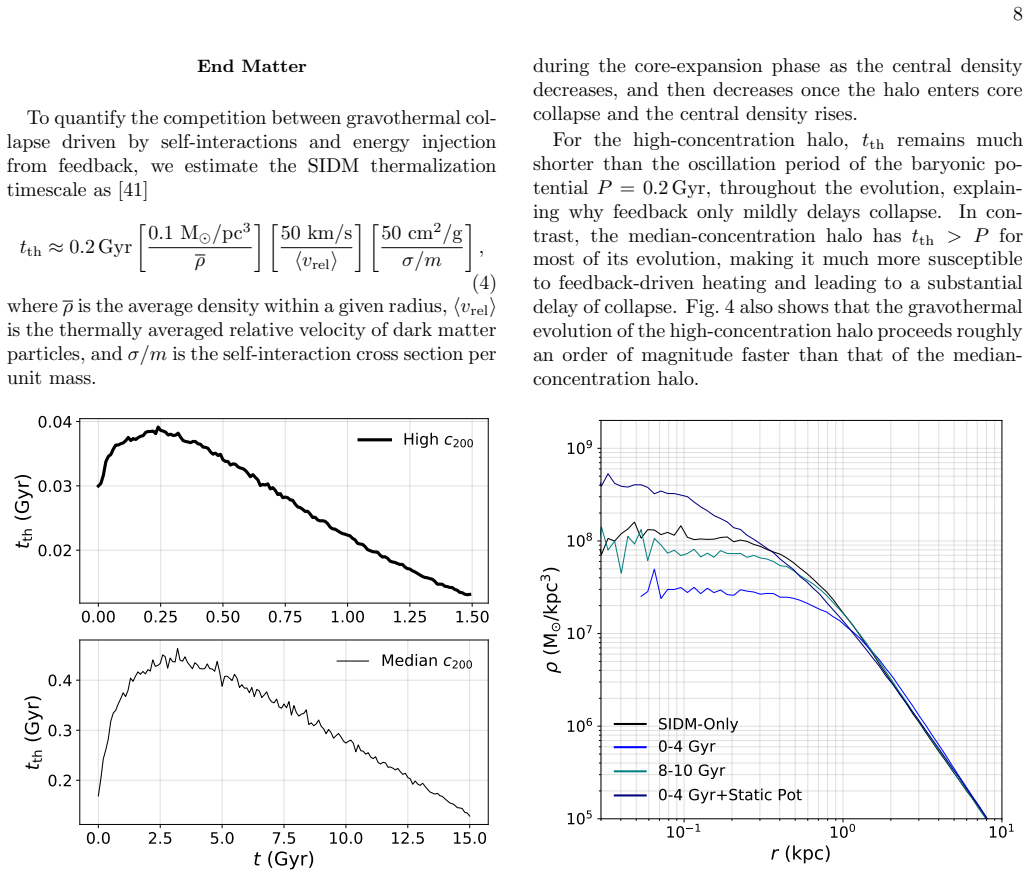
For high-concentration halos, where the SIDM thermalization timescale is short, gravothermal collapse is only mildly delayed and never stalled, even under extremely strong feedback. In contrast, the collapse of a median-concentration halo can be significantly delayed, but it resumes once feedback ceases. The final density profile of such halos depends sensitively on the episodic feedback history.
What carries the argument
The semi-analytical oscillating-potential model that reproduces the dynamical impact of episodic baryonic feedback on the dark matter distribution in N-body simulations.
Load-bearing premise
The semi-analytical oscillating-potential model faithfully reproduces the dynamical impact of episodic baryonic feedback on the dark matter distribution without requiring full hydrodynamical simulations.
What would settle it
A high-concentration halo observed with short thermalization time and strong ongoing baryonic feedback that shows no central density increase or stalled collapse would falsify the main claim.
Figures
read the original abstract
We perform a stress test of gravothermal collapse in self-interacting dark matter (SIDM) halos under baryonic feedback using a semi-analytical oscillating-potential model in controlled N-body simulations. For high-concentration halos, where the SIDM thermalization timescale is short, gravothermal collapse is only mildly delayed and never stalled, even under extremely strong feedback. In contrast, the collapse of a median-concentration halo can be significantly delayed, but it resumes once feedback ceases. The final density profile of such halos depends sensitively on the episodic feedback history, producing a broad diversity in central densities. These results strengthen the interpretation of dense compact perturbers identified in recent strong-lensing observations as core-collapsed SIDM halos.
Editorial analysis
A structured set of objections, weighed in public.
Referee Report
Summary. The paper uses controlled N-body simulations with a semi-analytical oscillating-potential model to stress-test gravothermal collapse in SIDM halos under episodic baryonic feedback. It reports that high-concentration halos experience only mild delay and no stalling even under strong feedback, while median-concentration halos can be significantly delayed but resume collapse once feedback stops, yielding diverse final central densities that support interpreting strong-lensing perturbers as core-collapsed SIDM halos.
Significance. If the oscillating-potential model is shown to be faithful, the results would strengthen the viability of SIDM explanations for dense compact objects in lensing data by demonstrating robustness of gravothermal collapse against realistic feedback, particularly in high-concentration systems where thermalization is rapid.
major comments (2)
- [Methods (oscillating-potential implementation)] Methods section describing the oscillating-potential model: the central claim that high-concentration halos experience only mild delay and never stall rests on this semi-analytical prescription faithfully capturing episodic feedback; however, no cross-validation metrics, sensitivity tests to oscillation parameters, or direct comparisons to full hydrodynamical runs are reported, leaving open the possibility that the model understates heating or angular-momentum transfer that could stall collapse.
- [Results (high-concentration vs. median-concentration cases)] Results on high- vs. median-concentration halos: quantitative statements such as 'mildly delayed' and 'never stalled' lack reported error bars, convergence tests with respect to particle number or time-stepping, or explicit comparison of thermalization timescales to feedback periods, which are load-bearing for distinguishing the two regimes.
minor comments (1)
- [Abstract] Abstract and introduction: the phrase 'extremely strong feedback' is used without a quantitative definition or reference to the specific potential amplitude or duty cycle employed in the runs.
Simulated Author's Rebuttal
We thank the referee for their detailed and constructive report. We address each major comment below and have revised the manuscript to incorporate additional tests, metrics, and clarifications as described.
read point-by-point responses
-
Referee: Methods section describing the oscillating-potential model: the central claim that high-concentration halos experience only mild delay and never stall rests on this semi-analytical prescription faithfully capturing episodic feedback; however, no cross-validation metrics, sensitivity tests to oscillation parameters, or direct comparisons to full hydrodynamical runs are reported, leaving open the possibility that the model understates heating or angular-momentum transfer that could stall collapse.
Authors: The oscillating-potential model is a controlled semi-analytical tool that imposes time-varying external potentials to mimic episodic baryonic feedback while retaining full N-body resolution of the SIDM dynamics. We acknowledge that the original submission did not report explicit cross-validation metrics or direct hydrodynamical comparisons. In the revised manuscript we will add a dedicated Methods subsection presenting sensitivity tests across oscillation amplitude, period, and duty cycle, together with quantitative metrics (e.g., fractional change in collapse time) and an explicit discussion of the model’s assumptions on heating and angular-momentum conservation. These additions will clarify the regime of applicability without claiming equivalence to full hydrodynamics. revision: yes
-
Referee: Results on high- vs. median-concentration halos: quantitative statements such as 'mildly delayed' and 'never stalled' lack reported error bars, convergence tests with respect to particle number or time-stepping, or explicit comparison of thermalization timescales to feedback periods, which are load-bearing for distinguishing the two regimes.
Authors: We agree that the quantitative claims would be strengthened by explicit uncertainty quantification and timescale comparisons. The revised Results section will include error bars derived from ensembles of runs, a new appendix demonstrating numerical convergence with particle number (10^5–10^6) and time-step criteria, and a direct comparison of the SIDM thermalization timescale (computed following the standard definition) against the feedback oscillation periods for both halo concentrations. These additions will make the distinction between the high- and median-concentration regimes quantitatively robust. revision: yes
Circularity Check
No significant circularity detected in derivation chain
full rationale
The provided abstract and methodology description present results as direct outputs from controlled N-body simulations employing a semi-analytical oscillating-potential model for baryonic feedback. No equations, fitted parameters, or self-citations are quoted that reduce the central claims (mild delay in high-concentration halos, sensitivity to feedback history) to inputs by construction. The outcomes are framed as simulation results benchmarked against external lensing observations, satisfying the criteria for a self-contained derivation without load-bearing reductions of the enumerated kinds.
Axiom & Free-Parameter Ledger
Reference graph
Works this paper leans on
-
[1]
repul- sive
to generate the initial condition for the halo. All sim- ulations included in this work have total 2×10 6 particles with a Plummer-equivalent softening lengthϵ= 10 pc following the suggestion in [88]. Feedback model–Motivated by previous studies [9, 89], we adopt a simple tunable model that can generate dark matter cores with controlled sizes. In our cont...
-
[2]
R. A. Flores and J. R. Primack, Astrophysical Journal 427, L1 (1994)
1994
-
[3]
Moore, Nature370, 629 (1994)
B. Moore, Nature370, 629 (1994)
1994
-
[4]
W. J. G. De Blok, S. S. McGaugh, and V. C. Rubin, Astronomical Journal122, 2396 (2001)
2001
-
[5]
G. Gentile, P. Salucci, U. Klein, D. Vergani, and P. Kalberla, Mon. Not. Roy. Astron. Soc.351, 903 (2004), arXiv:astro-ph/0403154
Pith/arXiv arXiv 2004
-
[6]
S.-H. Ohet al., Astron. J.149, 180 (2015), arXiv:1502.01281 [astro-ph.GA]
Pith/arXiv arXiv 2015
-
[7]
J. S. Bullock and M. Boylan-Kolchin, Annual Review of Astronomy and Astrophysics55, 343 (2017)
2017
-
[8]
J. F. Navarro, V. R. Eke, and C. S. Frenk, Mon. Not. Roy. Astron. Soc.283, L72 (1996), arXiv:astro- ph/9610187
arXiv 1996
-
[9]
Governatoet al., Nature463, 203 (2010), arXiv:0911.2237 [astro-ph.CO]
F. Governatoet al., Nature463, 203 (2010), arXiv:0911.2237 [astro-ph.CO]
Pith/arXiv arXiv 2010
-
[10]
A. Pontzen and F. Governato, Mon. Not. Roy. Astron. Soc.421, 3464 (2012), arXiv:1106.0499 [astro-ph.CO]
Pith/arXiv arXiv 2012
-
[11]
Di Cintio, C
A. Di Cintio, C. B. Brook, A. V. Macci` o, G. S. Stinson, A. Knebe, A. A. Dutton, and J. Wadsley, Monthly No- tices of the Royal Astronomical Society437, 415 (2014)
2014
-
[12]
J. I. Read, O. Agertz, and M. L. M. Collins, Mon. Not. Roy. Astron. Soc.459, 2573 (2016), arXiv:1508.04143 [astro-ph.GA]
Pith/arXiv arXiv 2016
-
[13]
T. K. Chan, D. Kereˇ s, J. O˜ norbe, P. F. Hop- kins, A. L. Muratov, C. A. Faucher-Gigu` ere, and E. Quataert, Mon. Not. Roy. Astron. Soc.454, 2981 (2015), arXiv:1507.02282 [astro-ph.GA]
Pith/arXiv arXiv 2015
-
[14]
E. D. Jahn, L. V. Sales, F. Marinacci, M. Vogels- berger, P. Torrey, J. Qi, A. Smith, H. Li, R. Kannan, J. D. Burger, and J. Zavala, MNRAS520, 461 (2023), arXiv:2110.00142 [astro-ph.GA]
arXiv 2023
-
[15]
A. Cruz, A. Brooks, M. Lisanti, A. H. G. Peter, R. Geda, T. Quinn, M. Tremmel, F. Munshi, B. Keller, and J. Wadsley, arXiv e-prints , arXiv:2510.11800 (2025), arXiv:2510.11800 [astro-ph.GA]
arXiv 2025
-
[16]
R. Kuzio de Naray, G. D. Martinez, J. S. Bullock, and M. Kaplinghat, Astrophys. J. Lett.710, L161 (2010), arXiv:0912.3518 [astro-ph.CO]
Pith/arXiv arXiv 2010
-
[17]
K. A. Omanet al., Mon. Not. Roy. Astron. Soc.452, 3650 (2015), arXiv:1504.01437 [astro-ph.GA]
Pith/arXiv arXiv 2015
-
[18]
J. I. Read, G. Iorio, O. Agertz, and F. Fraternali, Monthly Notices of the Royal Astronomical Society462, 3628 (2016)
2016
-
[19]
Kamada, M
A. Kamada, M. Kaplinghat, A. B. Pace, and H.-B. Yu, Physical Review Letters119, 111102 (2017)
2017
-
[20]
Creasey, O
P. Creasey, O. Sameie, L. V. Sales, H.-B. Yu, M. Vo- gelsberger, and J. Zavala, Monthly Notices of the Royal Astronomical Society468, 2283 (2017)
2017
-
[21]
T. Ren, A. Kwa, M. Kaplinghat, and H.-B. Yu, Phys. Rev. X9, 031020 (2019), arXiv:1808.05695 [astro- ph.GA]
arXiv 2019
-
[22]
M. Kaplinghat, T. Ren, and H.-B. Yu, JCAP06(06), 027, arXiv:1911.00544 [astro-ph.GA]
arXiv 1911
-
[23]
I. M. E. Santos-Santos, J. F. Navarro, A. Robertson, A. Ben´ ıtez-Llambay, K. A. Oman, M. R. Lovell, C. S. Frenk, A. D. Ludlow, A. Fattahi, and A. Ritz, Mon. Not. Roy. Astron. Soc.495, 58 (2020), arXiv:1911.09116 [astro-ph.GA]
arXiv 2020
-
[24]
Zentner, S
A. Zentner, S. Dandavate, O. Slone, and M. Lisanti, Journal of Cosmology and Astroparticle Physics2022 (7), 031
-
[25]
Z. Jia, F. Jiang, S. Li, R. Li, J. Wang, and L. Zhu, arXiv e-prints , arXiv:2601.17118 (2026), arXiv:2601.17118 [astro-ph.GA]
Pith/arXiv arXiv 2026
-
[26]
L. V. Sales, A. Wetzel, and A. Fattahi, Nature Astron. 6, 897 (2022), arXiv:2206.05295 [astro-ph.GA]
arXiv 2022
-
[27]
S. Vegetti, L. V. E. Koopmans, A. Bolton, T. Treu, and R. Gavazzi, MNRAS408, 1969 (2010), arXiv:0910.0760 [astro-ph.CO]
Pith/arXiv arXiv 1969
-
[28]
S. Vegetti, D. J. Lagattuta, J. P. McKean, M. W. Auger, C. D. Fassnacht, and L. V. E. Koopmans, Nature481, 341 (2012), arXiv:1201.3643 [astro-ph.CO]
Pith/arXiv arXiv 2012
-
[29]
A. C ¸ . S ¸eng¨ ul, C. Dvorkin, B. Ostdiek, and A. Tsang, Mon. Not. Roy. Astron. Soc.515, 4391 (2022), arXiv:2112.00749 [astro-ph.CO]
arXiv 2022
-
[30]
D. J. Ballard, W. J. R. Enzi, T. E. Collett, H. C. Turner, and R. J. Smith, Monthly Notices of the Royal Astro- nomical Society528, 7564 (2024)
2024
-
[31]
Q. E. Minor, ApJ981, 2 (2025), arXiv:2408.11090 [astro-ph.GA]
arXiv 2025
-
[32]
M. Tajalli, S. Vegetti, C. M. O’Riordan, S. D. M. White, C. D. Fassnacht, D. M. Powell, J. P. McKean, and G. Despali, Mon. Not. Roy. Astron. Soc.540, 564 (2025), arXiv:2505.07944 [astro-ph.CO]
arXiv 2025
-
[33]
D. M. Powell, J. P. McKean, S. Vegetti, C. Spingola, S. D. M. White, and C. D. Fassnacht, Nature Astron. 9, 1714 (2025), arXiv:2510.07382 [astro-ph.CO]
arXiv 2025
- [34]
-
[35]
J. Nibauer, A. Bonaca, A. M. Price-Whelan, D. N. Spergel, and J. E. Greene, arXiv e-prints , arXiv:2510.02247 (2025), arXiv:2510.02247 [astro- ph.GA]
Pith/arXiv arXiv 2025
-
[36]
J. Pe˜ narrubia, R. Errani, M. G. Walker, M. Gieles, and T. C. N. Boekholt, Mon. Not. Roy. Astron. Soc.533, 3263 (2024), arXiv:2404.19069 [astro-ph.GA]
arXiv 2024
-
[37]
Minor, S
Q. Minor, S. Gad-Nasr, M. Kaplinghat, and S. Vegetti, Monthly Notices of the Royal Astronomical Society507, 1662 (2021). 6
2021
-
[38]
W. J. R. Enzi, C. M. Krawczyk, D. J. Ballard, and T. E. Collett, Mon. Not. Roy. Astron. Soc.540, 247 (2025), arXiv:2411.08565 [astro-ph.CO]
arXiv 2025
-
[39]
G. Despali, F. M. Heinze, C. D. Fassnacht, S. Veg- etti, C. Spingola, R. Klessen, and M. Tajalli, Astron. Astrophys.699, A222 (2025), arXiv:2407.12910 [astro- ph.CO]
arXiv 2025
- [40]
-
[41]
S. Vegetti, S. D. M. White, J. P. McKean, D. M. Pow- ell, C. Spingola, D. Massari, G. Despali, and C. D. Fass- nacht, Nature Astron.10, 440 (2026), arXiv:2601.02466 [astro-ph.CO]
arXiv 2026
-
[42]
S. Tulin and H.-B. Yu, Phys. Rept.730, 1 (2018), arXiv:1705.02358 [hep-ph]
Pith/arXiv arXiv 2018
-
[43]
S. Adhikariet al., Rev. Mod. Phys.97, 045004 (2025), arXiv:2207.10638 [astro-ph.CO]
arXiv 2025
-
[44]
D. N. Spergel and P. J. Steinhardt, Phys. Rev. Lett.84, 3760 (2000), arXiv:astro-ph/9909386
Pith/arXiv arXiv 2000
-
[45]
S. Balberg, S. L. Shapiro, and S. Inagaki, Astrophys. J. 568, 475 (2002), arXiv:astro-ph/0110561
Pith/arXiv arXiv 2002
- [46]
-
[47]
O. Sameie, H.-B. Yu, L. V. Sales, M. Vogelsberger, and J. Zavala, Phys. Rev. Lett.124, 141102 (2020), arXiv:1904.07872 [astro-ph.GA]
arXiv 2020
-
[48]
Z. C. Zeng, A. H. G. Peter, X. Du, A. Benson, S. Kim, F. Jiang, F.-Y. Cyr-Racine, and M. Vogels- berger, Mon. Not. Roy. Astron. Soc.513, 4845 (2022), arXiv:2110.00259 [astro-ph.CO]
arXiv 2022
-
[49]
E. O. Nadler, D. Yang, and H.-B. Yu, Astrophys. J. Lett.958, L39 (2023), arXiv:2306.01830 [astro-ph.GA]
arXiv 2023
-
[50]
H. C. Turner, M. R. Lovell, J. Zavala, and M. Vogels- berger, Monthly Notices of the Royal Astronomical So- ciety505, 5327 (2021)
2021
-
[51]
C. A. Correa, M. Schaller, S. Ploeckinger, N. Anau Mon- tel, C. Weniger, and S. Ando, Mon. Not. Roy. Astron. Soc.517, 3045 (2022), arXiv:2206.11298 [astro-ph.GA]
arXiv 2022
-
[52]
D. Yang, E. O. Nadler, and H.-B. Yu, Astrophys. J.949, 67 (2023), arXiv:2211.13768 [astro-ph.GA]
arXiv 2023
-
[53]
M. S. Fischer, L. Kasselmann, M. Br¨ uggen, K. Dolag, F. Kahlhoefer, A. Ragagnin, A. Robertson, and K. Schmidt-Hoberg, Mon. Not. Roy. Astron. Soc.529, 2327 (2024), arXiv:2310.07750 [astro-ph.CO]
arXiv 2024
-
[54]
E. O. Nadler, D. Kong, D. Yang, and H.-B. Yu, As- trophys. J.991, 69 (2025), arXiv:2503.10748 [astro- ph.CO]
arXiv 2025
-
[55]
G. Despali, L. Moscardini, D. Nelson, A. Pillepich, V. Springel, and M. Vogelsberger, Astron. Astrophys. 697, A213 (2025), arXiv:2501.12439 [astro-ph.CO]
arXiv 2025
-
[56]
A. Engelhardt, F. Munshi, A. H. G. Peter, E. O. Nadler, A. Cruz, A. M. Brooks, Z. C. Zeng, T. R. Quinn, and B. Keith, arXiv e-prints , arXiv:2601.23264 (2026), arXiv:2601.23264 [astro-ph.GA]
Pith/arXiv arXiv 2026
-
[57]
Zhang, H.-B
X. Zhang, H.-B. Yu, D. Yang, and E. O. Nadler, Astro- physical Journal Letters978, L23 (2025)
2025
-
[58]
D. Kong, E. O. Nadler, and H.-B. Yu, arXiv e-prints , arXiv:2510.01491 (2025), arXiv:2510.01491 [astro- ph.CO]
arXiv 2025
-
[59]
Liet al., arXiv e-prints (2025), arXiv:2504.11800 [astro-ph.GA]
S. Liet al., arXiv e-prints (2025), arXiv:2504.11800 [astro-ph.GA]
arXiv 2025
-
[60]
M. G. Roberts, M. Kaplinghat, M. Valli, and H.-B. Yu, Phys. Rev. D111, 103041 (2025), arXiv:2407.15005 [astro-ph.GA]
arXiv 2025
-
[61]
D. Kong and H.-B. Yu, Phys. Dark Univ.48, 101939 (2025), arXiv:2501.06413 [astro-ph.GA]
arXiv 2025
- [62]
-
[63]
H. Nishikawa, K. K. Boddy, and M. Kaplinghat, Phys. Rev. D101, 063009 (2020), arXiv:1901.00499 [astro- ph.GA]
arXiv 2020
-
[64]
C. A. Correa, Mon. Not. Roy. Astron. Soc.503, 920 (2021), arXiv:2007.02958 [astro-ph.GA]
arXiv 2021
- [65]
-
[66]
M. S. Fischer and H.-B. Yu, arXiv e-prints , arXiv:2603.04508 (2026), arXiv:2603.04508 [astro- ph.CO]
arXiv 2026
-
[67]
S. Balberg and S. L. Shapiro, Phys. Rev. Lett.88, 101301 (2002), arXiv:astro-ph/0111176
Pith/arXiv arXiv 2002
-
[68]
J. Pollack, D. N. Spergel, and P. J. Steinhardt, As- trophys. J.804, 131 (2015), arXiv:1501.00017 [astro- ph.CO]
Pith/arXiv arXiv 2015
-
[69]
W.-X. Feng, H.-B. Yu, and Y.-M. Zhong, Astrophys. J. Lett.914, L26 (2021), arXiv:2010.15132 [astro-ph.CO]
arXiv 2021
-
[70]
W.-X. Feng, H.-B. Yu, and Y.-M. Zhong, JCAP05(05), 036, arXiv:2108.11967 [astro-ph.CO]
-
[71]
S. Gad-Nasr, K. K. Boddy, M. Kaplinghat, N. J. Outmezguine, and L. Sagunski, JCAP05(05), 131, arXiv:2312.09296 [astro-ph.GA]
- [72]
-
[73]
W.-X. Feng, H.-B. Yu, and Y.-M. Zhong, arXiv e-prints , arXiv:2506.17641 (2025), arXiv:2506.17641 [astro- ph.GA]
arXiv 2025
-
[74]
T. Shen, X. Shen, H. Xiao, M. Vogelsberger, and F. Jiang, arXiv e-prints , arXiv:2504.00075 (2025), arXiv:2504.00075 [astro-ph.GA]
arXiv 2025
-
[75]
M. G. Roberts, L. Braff, A. Garg, S. Profumo, and T. Jeltema, JCAP05(05), 003, arXiv:2507.03230 [astro-ph.GA]
-
[76]
H.-P. Gu, F. Jiang, X. Chen, and R. Li, Phys. Rev. D 113, 103038 (2026), arXiv:2601.17117 [astro-ph.CO]
Pith/arXiv arXiv 2026
-
[77]
B. Diemer and M. Joyce, Astrophys. J.871, 168 (2019), arXiv:1809.07326 [astro-ph.CO]
Pith/arXiv arXiv 2019
-
[78]
J. F. Navarro, C. S. Frenk, and S. D. M. White, Astro- phys. J.490, 493 (1997), arXiv:astro-ph/9611107
Pith/arXiv arXiv 1997
-
[79]
G. Torrealba, S. E. Koposov, V. Belokurov, and M. Ir- win, Mon. Not. Roy. Astron. Soc.459, 2370 (2016), arXiv:1601.07178
Pith/arXiv arXiv 2016
-
[80]
N. Caldwell, M. G. Walker, M. Mateo, E. W. Olszewski, S. Koposov, V. Belokurov, G. Torrealba, A. Geringer- Sameth, and C. I. Johnson, Astrophys. J.839, 20 (2017), arXiv:1612.06398 [astro-ph.GA]
Pith/arXiv arXiv 2017
discussion (0)
Sign in with ORCID, Apple, or X to comment. Anyone can read and Pith papers without signing in.