REVIEW 3 major objections 3 minor 34 references
Personalization, Personas, and Forecasting in Value Alignment
T0 review · 3 major / 3 minor · reviewed 2026-08-02 · deepseek-v4-flash
Pith's one-line read Asking LLMs to forecast beats role-play for cultural alignment
desk verdict Prompt framing clearly moves LLM value answers, but the headline "third-person wins" needs uncertainty bars before it is taken as established. read the letter →
The pith
A machine-rendered reading of the paper's core claim, the machinery that carries it, and where it could break.
The reading
What carries the argument
The benchmark architecture: 101 WVS-derived question units, four prompt conditions (language-only, user-country, persona-country, third-person), and 13 language-country slices. Scoring uses directional alignment, defined as baseline_gap minus response_gap, where each gap is a distance (Wasserstein for ordered answers, total variation for unordered) between a model response distribution and the matched human WVS distribution; shift magnitude is tracked separately so large shifts are not conflated with alignment. A parallel set of ten semantic axes captures the direction of movement on broad value dimensions. This design isolates the effect of framing from the effects of language and country.
What would settle it
Re-run the benchmark with an explicit personalization prompt (e.g., 'Please adapt your answer to my values as someone from {country}') and check whether it reaches or exceeds third-person forecasting alignment; if it does, the paper's ranking of modalities is an artifact of a weak prompt. Conversely, a model family for which third-person forecasting does not beat the language baseline on most slices would break the generality of the result.
Extended reading notes
Core claim
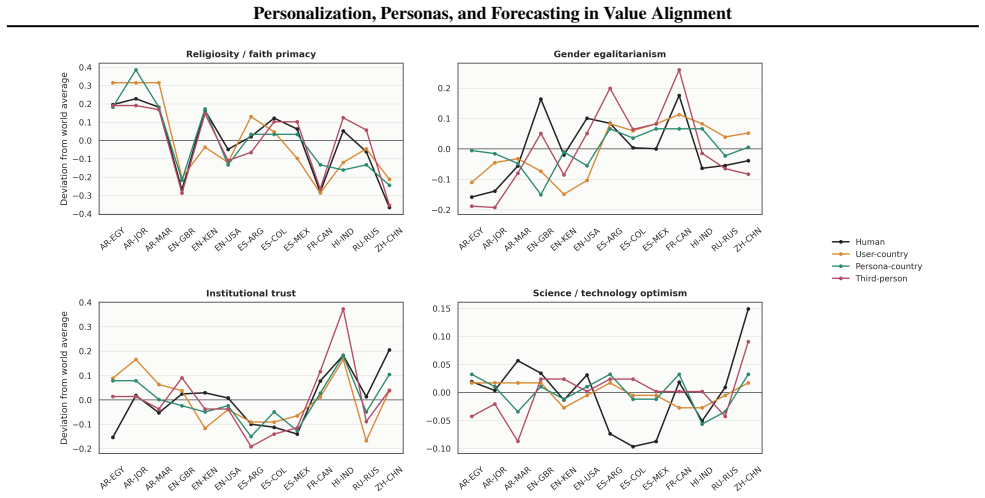
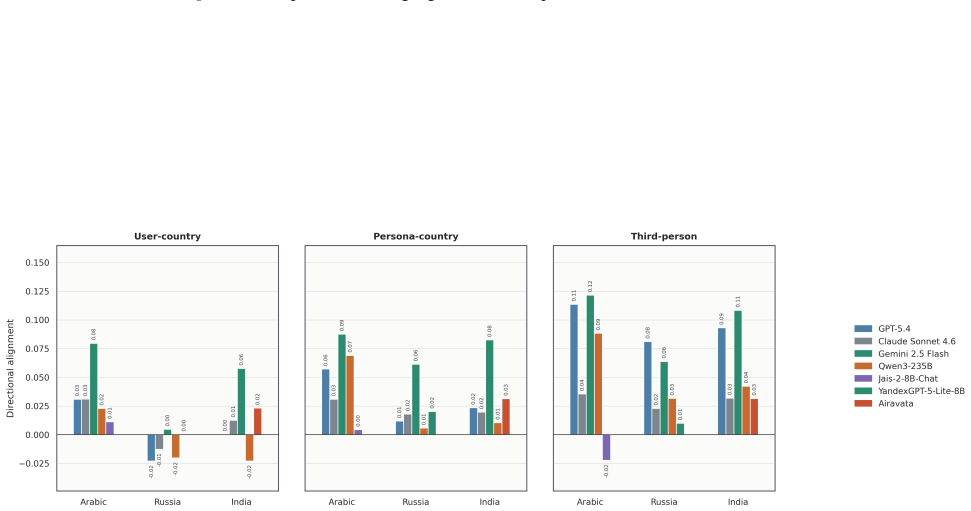
The central claim is that the three identity-conditioning modalities—personalization, persona, and forecasting—produce measurably different levels of alignment with human survey responses. Third-person forecasting yields the strongest directional alignment for three of the four hosted models (GPT-5.4, Claude Sonnet 4.6, Gemini 2.5 Flash, and Qwen3-235B); Claude's conditioned variants cluster tightly together. Country cues shift responses substantially, but the shift is not always toward the target: alignment gains concentrate on salient social values such as religiosity and gender roles, while institutional trust and democracy questions remain difficult. The paper treats this as evidence tha
Load-bearing premise
The claim that personalization is weaker or less stable rests on a one-sentence country cue ("I am from {country_name}") that the authors themselves note does not explicitly invite the model to personalize its answer.
Editorial extensions
If this is right
- Evaluations of cultural alignment should report which elicitation modality was used, since results differ by framing.
- Third-person forecasting is the most reliable prompt style among those tested for recovering country-level survey response distributions.
- Alignment gains are uneven: socially legible values (religiosity, gender roles, work/material values) improve, while institutional trust and democratic process questions remain poorly aligned.
- The choice between personalization, persona, and forecasting is a first-order methodological variable, not a cosmetic detail.
Reading between the lines
- If the framing effect persists across future models, then 'cultural alignment' as measured by surveys is partly an artifact of prompt construction; benchmarks should report a family of scores across modalities rather than a single number.
- A stronger personalization prompt (e.g., explicitly instructing the model to adapt to the user's values) might close the gap with forecasting; the paper's user-country prompt is weak by the authors' own admission, so the conclusion about personalization is provisional.
- The stubborn difficulty of institutional trust and democracy questions may indicate a lack of fine-grained institutional knowledge rather than a lack of value awareness; a testable extension would be to provide institutional context in the prompt and observe whether alignment improves.
- Because the paper takes a descriptive stance, a normative follow-up could examine when movement toward aggregate survey distributions is desirable (e.g., for simulation) versus harmful (e.g., reinforcing stereotypes).
Signed reviews
Editorial analysis
A structured set of objections, weighed in public.
Referee Report
Summary. The paper asks whether three common LLM identity-conditioning modalities—personalization (user-country), personas (persona-country), and forecasting (third-person)—are interchangeable when eliciting value judgments. Using 101 WVS-derived questions across 13 language-country slices, four hosted models, and three additional localized models, the authors compute language-only and country-conditioned responses and score them against matched WVS response distributions. The main empirical claims are that country cues shift answers substantially but not always toward human targets; third-person forecasting produces the strongest directional alignment for three of the four hosted models; and alignment gains concentrate on socially legible dimensions such as religiosity and gender roles, while institutional trust and democracy-related questions remain difficult. The paper concludes that prompt framing is a core methodological choice and that the three modalities should not be treated as equivalent.
Significance. If robust, this is a useful measurement contribution to cultural alignment evaluation. The design is large and internally consistent: 101 questions, 13 slices, 4 prompt conditions, 4 hosted models, and exactly 21,008 model-response rows. The scoring is deterministic, prompt templates are explicit in the appendix, and the inclusion of localized models is a sensible extra check. The paper also responsibly frames alignment as descriptive rather than normative. The central claim, however, rests on single aggregate numbers without uncertainty quantification or a treatment of missing-data biases. Since the empirical ranking of prompt modalities is the main result, the paper's contribution is contingent on strengthening the inference. The prompt-comparison question is important and the current study is a substantial first step, but the headline 'third-person strongest' claim is not yet established to the standard the paper's own conclusions require.
major comments (3)
- [§4.1, Fig. 2, Eq. (4)] The headline claim that third-person forecasting is strongest for three of four models is reported as single aggregate directional-alignment values with no confidence intervals, significance tests, or per-question variability. The decisive contrasts are small: Claude's three conditioned variants are 0.018/0.019/0.019 (effectively tied), and Gemini's third-person edge over persona is 0.016 with third-person coverage dropping to 79.0% versus 86.1% for persona. Fig. 3 also shows the aggregate ordering is not consistent at slice level: third-person beats persona in only 7 of 13 slices for Claude and 11 of 13 for Qwen. A paired bootstrap over question units (or slices) is needed to establish that third-person > persona is distinguishable from sampling noise; the per-question score matrix should be released or a sensitivity analysis reported.
- [§3.5, Fig. 2, Fig. 7] Directional alignment is computed on condition-specific scorable subsets, and the missingness is non-negligible for some conditions. For example, Gemini's coverage is 79.0% under third-person prompting versus 86.1% under persona; Fig. 7 shows refusals are concentrated in particular languages. Since directional alignment cannot be computed for refused questions, the aggregate may be biased if refusal correlates with question content. The paper should report a common-subset analysis (questions scored under all conditions) and a coverage-restricted sensitivity check, with refusals broken down by question category.
- [§3.3, Appendix B, Table 1] The user-country prompt ('I am from {country_name}.') is a single-sentence statement that does not explicitly ask the model to adapt its answer, as the authors acknowledge. The conclusion that personalization is 'weaker or less stable' than forecasting is one of the paper's central comparative claims, but it tests only this minimal proxy. It is possible that a more explicit personalization prompt (e.g., 'Tailor your answer to the user from {country_name}') would change the observed ordering. A manipulation check or an additional explicit personalization variant is needed before concluding that the personalization modality itself is weaker.
minor comments (3)
- [§3.6, Appendix D] The semantic-axis results rest on hand-coded item-to-axis mappings and hand-coded orientation of unordered responses. Thirteen of 101 questions are unmapped and 14 are mapped to multiple axes. The axis-level claims (e.g., religiosity is the easiest axis) should be accompanied by inter-coder reliability or a sensitivity analysis to alternative codings.
- [General] The paper does not discuss the possibility that WVS items or responses appear in the models' training data. Third-person forecasting might then reflect memorization rather than transferable cultural modeling. This does not invalidate the relative prompt comparison, but it should be acknowledged as a limitation.
- [Fig. 2] The figure mixes a table and a chart, and the baseline-gap column varies across prompt rows within a model even when the matched human distribution is the same (e.g., GPT-5.4 user/persona/third-person). This likely reflects different scorable subsets; please state explicitly that aggregates are computed on condition-specific subsets and, where possible, align the subsets for comparability.
Circularity Check
No significant circularity: alignment is scored against external WVS human distributions with no fitted parameters and no self-citation in the derivation chain.
full rationale
The paper is a measurement study rather than a derivation. The central quantities, baseline_gap and response_gap, are defined in Eqs. (1)-(2) as distances between raw model responses (B, R) and an externally sourced WVS human target H, with directional_alignment = baseline_gap - response_gap (Eq. 4). No parameter is fitted to H or to the model outputs; the headline ranking in Section 4.1 is an arithmetic comparison of these externally anchored scores. The only role of prior work is contextual (Section 2), and there are no self-citations that carry argumentative weight. Limitations the paper itself acknowledges—the user-country prompt 'does not explicitly invite the model to personalize its answer' (Section 3.3) and Gemini's lower third-person coverage (Section 4.1; Fig. 7)—are construct-validity and sampling concerns, not circular reductions: they do not make the measured alignment equal to its inputs by construction. The absence of confidence intervals or significance tests is a robustness/uncertainty issue, not circularity. Potential WVS contamination in model training is an external data concern, not an internal circularity in the scoring or aggregation steps. Therefore no circular step is present.
Assumptions & free parameters
free parameters (1)
- Semantic-axis hand coding
assumptions (5)
- domain assumption WVS weighted response distributions are a valid target for cultural value alignment.
- ad hoc to paper The four prompt templates in Appendix B operationalize the personalization, persona, and forecasting modalities.
- domain assumption Deterministic answer parsing and coverage filtering do not systematically bias cross-model or cross-condition comparisons.
- domain assumption Excluding self-evaluative and local-context questions is appropriate for all prompt conditions.
- standard math Wasserstein distance (ordered) and total variation distance (unordered) are appropriate and comparable for scoring.
Cite this review
Pith. "Pith review of Personalization, Personas, and Forecasting in Value Alignment." pith.science (2026). https://pith.science/paper/YXR4WZ5C
@misc{pith2026260724782,
  author       = {Pith},
  title        = {Pith review of: Personalization, Personas, and Forecasting in Value Alignment},
  year         = {2026},
  howpublished = {\url{https://pith.science/paper/YXR4WZ5C}},
  note         = {Machine review of arXiv:2607.24782}
}
read the original abstract
LLM behavior may be conditioned by human identity in several ways: they may be asked to adapt to users, role-play populations, or forecast how people would answer value-laden questions. We test whether these framings are interchangeable using the World Values Survey (WVS). We evaluate GPT-5.4, Claude Sonnet 4.6, Gemini 2.5 Flash, and Qwen3-235B on 101 WVS-derived questions across 13 language-country slices, comparing a language-only baseline with user-country, persona-country, and third-person prompts. Across 21,008 model-response rows, prompt framing is a first-order determinant of cultural alignment: country cues often shift answers substantially, but not all shifts move toward matched human response distributions. Third-person forecasting yields the strongest directional alignment for three of the four hosted models, while personalization and role-play are weaker or less stable. Alignment gains concentrate on salient value dimensions such as religiosity, gender roles, and work-oriented material values, whereas institutional trust and democracy-related questions remain difficult. These results show that prompt framing is not a cosmetic choice in cultural value elicitation; it changes both model behavior and measured alignment.
Figures


Figures from the paper (5 more)



Reference graph
Works this paper leans on
-
[1]
arXiv preprint arXiv:2311.04892 , year=
Bias runs deep: Implicit reasoning biases in persona-assigned llms , author=. arXiv preprint arXiv:2311.04892 , year=
-
[2]
Proceedings of the 40th International Conference on Machine Learning (PMLR) , volume =
Using Large Language Models to Simulate Multiple Humans and Replicate Human Subject Studies , author =. Proceedings of the 40th International Conference on Machine Learning (PMLR) , volume =. 2023 , note =
2023
-
[3]
2024 , url =
Generative Agent Simulations of 1,000 People , author =. 2024 , url =
2024
-
[4]
Proceedings of EMNLP 2024 , year =
Systematic Biases in LLM Simulations of Debates , author =. Proceedings of EMNLP 2024 , year =
2024
-
[5]
2023 , url =
Training Socially Aligned Language Models on Simulated Social Interactions , author =. 2023 , url =
2023
-
[6]
2023 , url =
ReviewerGPT? An Exploratory Study on Using Large Language Models for Paper Reviewing , author =. 2023 , url =
2023
-
[7]
2024 , url =
Social Science Meets LLMs: How Reliable Are Large Language Models in Social Simulations? , author =. 2024 , url =
2024
-
[8]
2025 , url =
MoralBench: Moral Evaluation of LLMs , author =. 2025 , url =
2025
Show all 34 references
-
[9]
2023 , note =
Using LLMs for Market Research , author =. 2023 , note =
2023
-
[10]
2023 , doi =
Large Language Models as Simulated Economic Agents: What Can We Learn from Homo Silicus? , author =. 2023 , doi =
2023
-
[11]
2024 , note =
Folk Economics in the Machine: LLMs and the Emergence of Mental Accounting , author =. 2024 , note =
2024
-
[12]
2024 , doi =
Automated Social Science: Language Models as Scientist and Subjects , author =. 2024 , doi =
2024
-
[13]
2023 , url =
Generative Social Choice , author =. 2023 , url =
2023
-
[14]
Proceedings of the 36th Annual ACM Symposium on User Interface Software and Technology (UIST ’23) , year =
Generative Agents: Interactive Simulacra of Human Behavior , author =. Proceedings of the 36th Annual ACM Symposium on User Interface Software and Technology (UIST ’23) , year =. doi:10.1145/3586183.3606763 , url =
-
[15]
2023 , url =
Towards Measuring the Representation of Subjective Global Opinions in Language Models , author =. 2023 , url =
2023
-
[16]
2024 , url =
Are Large Language Models Consistent over Value-laden Questions? , author =. 2024 , url =
2024
-
[17]
2025 , month =
Almost Half of Americans Say People Have Gotten Ruder Since the COVID-19 Pandemic , author =. 2025 , month =
2025
-
[18]
2023 , url =
Bias Runs Deep: Implicit Reasoning Biases in Persona-Assigned LLMs , author =. 2023 , url =
2023
-
[19]
Proceedings of the 2024 Conference on Empirical Methods in Natural Language Processing , pages=
The generation gap: Exploring age bias in the value systems of large language models , author=. Proceedings of the 2024 Conference on Empirical Methods in Natural Language Processing , pages=
2024
-
[20]
arXiv preprint arXiv:2510.00177 , year=
Personalized Reasoning: Just-In-Time Personalization and Why LLMs Fail At It , author=. arXiv preprint arXiv:2510.00177 , year=
-
[21]
Nature Machine Intelligence , pages=
Large language models that replace human participants can harmfully misportray and flatten identity groups , author=. Nature Machine Intelligence , pages=. 2025 , publisher=
2025
-
[22]
2024 , eprint=
Investigating Cultural Alignment of Large Language Models , author=. 2024 , eprint=
2024
-
[23]
2024 , eprint=
Self-Pluralising Culture Alignment for Large Language Models , author=. 2024 , eprint=
2024
-
[24]
2023 , eprint=
Assessing Cross-Cultural Alignment between ChatGPT and Human Societies: An Empirical Study , author=. 2023 , eprint=
2023
-
[25]
and Inglehart, R
Haerpfer, C. and Inglehart, R. and Moreno, A. and Welzel, C. and Kizilova, K. and Diez-Medrano, J. and Lagos, M. and Norris, P. and Ponarin, E. and Puranen, B. and others , editor =. World Values Survey: Round Seven -- Country-Pooled Datafile , year =. doi:10.14281/18241.1 , url =
-
[26]
2023 , eprint=
Jais and Jais-chat: Arabic-Centric Foundation and Instruction-Tuned Open Generative Large Language Models , author=. 2023 , eprint=
2023
-
[27]
2024 , eprint=
Airavata: Introducing Hindi Instruction-tuned LLM , author=. 2024 , eprint=
2024
-
[28]
2024 , eprint=
WorldValuesBench: A Large-Scale Benchmark Dataset for Multi-Cultural Value Awareness of Language Models , author=. 2024 , eprint=
2024
-
[29]
Cultural bias and cultural alignment of large language models , volume=
Tao, Yan and Viberg, Olga and Baker, Ryan S and Kizilcec, René F , editor=. Cultural bias and cultural alignment of large language models , volume=. PNAS Nexus , publisher=. doi:10.1093/pnasnexus/pgae346 , number=
-
[30]
2025 , eprint=
On the Alignment of Large Language Models with Global Human Opinion , author=. 2025 , eprint=
2025
-
[31]
Proceedings of the 40th International Conference on Machine Learning , series =
Whose Opinions Do Language Models Reflect? , author =. Proceedings of the 40th International Conference on Machine Learning , series =. 2023 , url =
2023
-
[32]
2026 , eprint =
When AI Speaks, Whose Values Does It Express? A Cross-Cultural Audit of Individualism--Collectivism Bias in Large Language Models , author =. 2026 , eprint =
2026
-
[33]
2026 , eprint =
Steering LLMs for Culturally Localized Generation , author =. 2026 , eprint =
2026
-
[34]
2025 , eprint =
The Prompt Makes the Person(a): A Systematic Evaluation of Sociodemographic Persona Prompting for Large Language Models , author =. 2025 , eprint =
2025
Reviewed August 2, 2026 · model on record in the stance chip above.
Discussion (0). Continue with ORCID to comment.