REVIEW 3 major objections 4 minor 25 references
Knowledge Distillation for Automated AI Tutor Evaluation
T0 review · 3 major / 4 minor · reviewed 2026-07-14 · grok-4.5
Pith's one-line read Distilling a frontier judge into an 8B model lifts AI-tutor evaluation scores by up to 22.63 points and ranks commercial tutors.
desk verdict Solid engineering paper that ships a usable 8B pedagogical judge and commercial rankings, but the big distillation gains and the Gemini-first ordering rest on unvalidated Claude synthetic labels. read the letter →
The pith
A machine-rendered reading of the paper's core claim, the machinery that carries it, and where it could break.
The reading
What carries the argument
FATE: four task-specific LoRA-tuned Llama 3.1 8B heads, each fine-tuned on the original 300 BEA dialogues plus 1,350 synthetic conversations whose labels were generated by Claude Opus 4.7 to rebalance the three-way Yes / To-Some-Extent / No distributions.
What would settle it
Have independent human experts re-label a held-out sample of the synthetic dialogues and measure whether FATE’s accuracy on those items still rises after distillation; a collapse or reversal of the reported gains would falsify the claim.
Extended reading notes
Core claim
Knowledge distillation from a frontier LLM into Llama 3.1 8B produces absolute gains of up to 22.63 percentage points on the four BEA pedagogical tracks, turning a data-starved specialized task into a usable automated evaluator that can rank commercial AI tutors.
Load-bearing premise
The synthetic labels produced by the frontier model are faithful enough to expert pedagogical judgment that training on them improves true evaluation skill rather than merely teaching the small model to imitate the frontier model’s own scoring habits.
Editorial analysis
A structured set of objections, weighed in public.
Referee Report
Summary. The paper introduces FATE, a Llama 3.1 8B-based evaluator fine-tuned for the four BEA 2025 Shared Task pedagogical dimensions (Mistake Identification, Mistake Location, Providing Guidance, Actionability). Starting from the 300-dialogue human-annotated BEA development set, the authors apply dialogue-shuffling augmentation and then knowledge distillation: Claude Opus 4.7 generates 1,350 synthetic conversations with 12,150 balanced tutor responses that are used as additional training labels. Table 1 reports large absolute gains (up to +22.63 pp lenient F1 on Mistake Identification). Four task-specific LoRA models are trained and then applied, without further human validation, to rank commercial tutors (Gemini 2.5 Flash 82.88 %, ChatGPT 5.5 Instant 80.75 %, DeepSeek V4 Flash 80.13 %, Claude Sonnet 4.6 74.00 %). The central claim is that distillation from a frontier LLM yields a lightweight, usable automated pedagogical evaluator.
Significance. If the distilled labels are faithful to expert pedagogical judgment, the work supplies a practical, low-cost 8B evaluator for a timely educational-NLP problem and a concrete demonstration that knowledge distillation can mitigate the scarcity of human pedagogical annotations. The public release of a specialized open evaluator and the commercial ranking would be immediately useful to institutions adopting AI tutors. The contribution is incremental rather than foundational: it specializes existing LLM-as-judge and distillation techniques to the BEA 2025 rubric, but does so on a real shared-task benchmark with clear engineering value.
major comments (3)
- [Section 3.3 / Table 1] Section 3.3 and Table 1: the reported gains of up to 22.63 pp rest entirely on synthetic labels produced by Claude Opus 4.7. The manuscript never reports Claude–human agreement on any held-out or synthetic examples, nor does it evaluate the distilled models on a pure human-labeled partition that is independent of the distillation data. Without that measurement it is impossible to distinguish genuine improvement in pedagogical evaluation from imitation of Claude’s scoring style.
- [Table 3 / Section 4.2] Table 3 and Section 4.2: FATE, trained on Claude Opus labels, is used to rank Claude Sonnet (among other commercial models). The resulting ordering (Gemini > ChatGPT > DeepSeek > Claude) therefore partly reflects stylistic proximity to the teacher model rather than an independent pedagogical construct. Human ratings of the same commercial responses, or at least an inter-annotator study on a subset, are required before the ranking can be treated as a reliable benchmark.
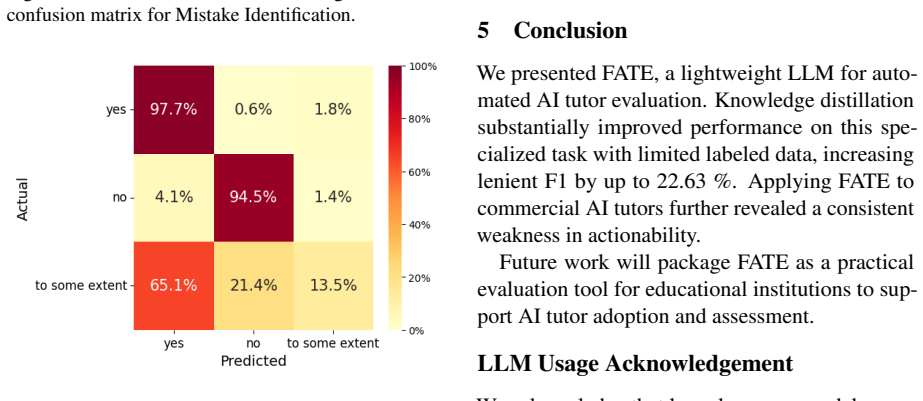
- [Figures 2–3 / Section 4.1] Figures 2–3 and the accompanying text: even after distillation the model continues to collapse the ambiguous “To Some Extent” class into “Yes” (65.1 % of ambiguous examples). Because the largest gains appear under the lenient metric that merges Yes and To Some Extent, the practical utility of FATE for fine-grained pedagogical diagnosis remains overstated relative to the strict three-way results.
minor comments (4)
- [Abstract / Table 3] Abstract and Table 3: model names appear inconsistent or non-standard (“ChatGPT 5.5 Instant”, “DeepSeek V4 Flash”, “Claude Sonnet 4.6”). Clarify exact model identifiers and access dates.
- [Table 1] Table 1 caption and body: “Lenient Acc.” and “Strict Acc.” are never formally defined in the main text; a short definition (or pointer to the BEA 2025 scoring protocol) would help readers.
- [Section 3.2] Section 3.2: the choice of four separate task-specific models versus a single multi-task model is stated without ablation; a brief comparison would strengthen the design rationale.
- [Abstract / References] Typographical slips: “perfomed” (abstract), duplicated Kochmar et al. 2025a/b entries in the reference list, and missing page numbers or DOIs for several arXiv citations.
Circularity Check
No circular derivation: KD gains and commercial rankings are empirical applications of a distilled classifier, not predictions forced by construction from their inputs.
full rationale
This is an empirical NLP/ML paper, not a first-principles derivation. The load-bearing chain is: (1) fine-tune Llama 3.1 8B on the human-annotated BEA 2025 development set (300 dialogues, four pedagogical labels); (2) expand training with synthetic dialogues and labels produced by Claude Opus 4.7; (3) report lenient/strict F1 and accuracy lifts on the BEA tracks (Table 1); (4) apply the resulting FATE models to score new commercial tutor responses (Table 3). None of the six circularity patterns applies. There is no self-definitional loop (labels and metrics are external BEA rubrics, not defined via FATE outputs). There is no fitted-parameter-renamed-as-prediction: the distillation labels are training supervision, and the reported numbers are held-out classification metrics or downstream application scores, not quantities algebraically fixed by a fit. There is no self-citation load-bearing uniqueness claim, no ansatz smuggled from the authors’ prior work, and no renaming of a known result. Methodological concerns (possible teacher-style imitation when ranking Claude Sonnet with a Claude-Opus-distilled judge; limited human validation of synthetic labels) are validity/bias issues, not circular reductions of a claimed prediction to its inputs. Against the paper’s own stated claims and equations, the derivation is self-contained and non-circular.
Assumptions & free parameters
free parameters (2)
- number of synthetic conversations =
1350
- label-balancing scheme (3 high / 3 average / 3 poor responses per dialogue) =
3/3/3
assumptions (3)
- ad hoc to paper Claude Opus 4.7’s judgments of Mistake Identification, Mistake Location, Guidance and Actionability are sufficiently aligned with expert human pedagogical judgment that they can serve as training targets.
- domain assumption The four BEA 2025 dimensions (MI, ML, PG, Actionability) with ternary labels adequately capture pedagogical quality of AI tutors.
- domain assumption Dialogue-shuffling augmentation preserves pedagogical meaning while improving generalization.
invented entities (1)
-
FATE (FLC AI Tutor Evaluator)
Cite this review
Pith. "Pith review of Knowledge Distillation for Automated AI Tutor Evaluation." pith.science (2026). https://pith.science/paper/YXSOK2DA
@misc{pith2026260710647,
  author       = {Pith},
  title        = {Pith review of: Knowledge Distillation for Automated AI Tutor Evaluation},
  year         = {2026},
  howpublished = {\url{https://pith.science/paper/YXSOK2DA}},
  note         = {Machine review of arXiv:2607.10647}
}
read the original abstract
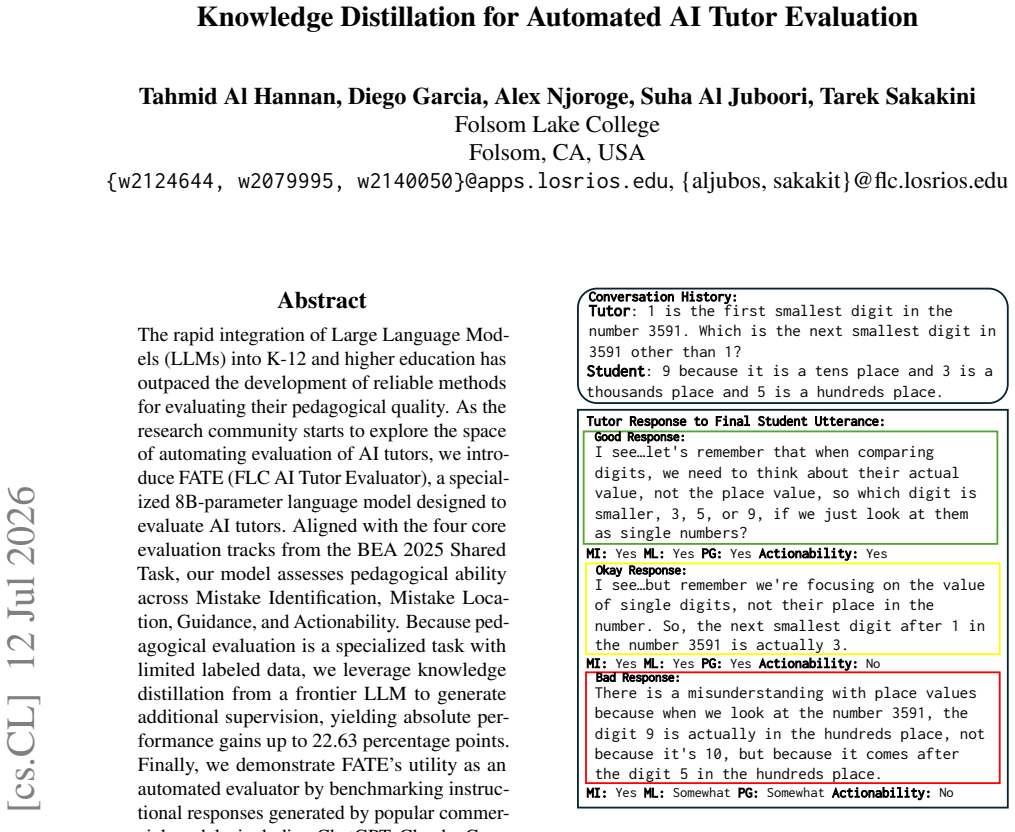
The rapid integration of Large Language Models (LLMs) into K-12 and higher education has outpaced the development of reliable methods for evaluating their pedagogical quality. As the research community starts to explore the space of automating evaluation of AI tutors, we introduce FATE (FLC AI Tutor Evaluator), a specialized 8B-parameter language model designed to evaluate AI tutors. Aligned with the four core evaluation tracks from the BEA 2025 Shared Task, our model assesses pedagogical ability across Mistake Identification, Mistake Location, Guidance, and Actionability. Because pedagogical evaluation is a specialized task with limited labeled data, we leverage knowledge distillation from a frontier LLM to generate additional supervision, yielding absolute performance gains up to 22.63 percentage points. Finally, we demonstrate FATE's utility as an automated evaluator by benchmarking instructional responses generated by popular commercial models, including ChatGPT, Claude, Gemini, and DeepSeek. On average, we have found that Gemini 2.5 Flash perfomed best (82.88%), then ChatGPT 5.5 Instant (80.75%), followed by DeepSeek V4 Flash (80.13%) and Claude Sonnet 4.6 (74.00%).
Figures

Reference graph
Works this paper leans on
-
[1]
Scalable training of
Andrew, Galen and Gao, Jianfeng , booktitle=. Scalable training of
-
[2]
Dan Gusfield , title =. 1997
1997
-
[3]
Tetreault , title =
Mohammad Sadegh Rasooli and Joel R. Tetreault , title =. Computing Research Repository , volume =. 2015 , url =
2015
-
[4]
A Framework for Learning Predictive Structures from Multiple Tasks and Unlabeled Data , Volume =
Ando, Rie Kubota and Zhang, Tong , Issn =. A Framework for Learning Predictive Structures from Multiple Tasks and Unlabeled Data , Volume =. Journal of Machine Learning Research , Month = dec, Numpages =
-
[5]
arXiv preprint arXiv:2507.10579 , year=
Findings of the bea 2025 shared task on pedagogical ability assessment of ai-powered tutors , author=. arXiv preprint arXiv:2507.10579 , year=
arXiv 2025
-
[6]
Artificial Intelligence and Student Usage in Online Learning: A Longitudinal Analysis of Usage Patterns, Achievement, and Perceptions in K-12 Virtual Education , author=
-
[7]
Proceedings of the 18th Workshop on Innovative Use of NLP for Building Educational Applications (BEA 2023) , pages=
The BEA 2023 shared task on generating AI teacher responses in educational dialogues , author=. Proceedings of the 18th Workshop on Innovative Use of NLP for Building Educational Applications (BEA 2023) , pages=
2023
-
[8]
AI in Education , volume=
STEM Undergraduates’ Perceptions of AI Chatbots: A Cross-Sectional Descriptive Survey , author=. AI in Education , volume=. 2025 , organization=
2025
Show all 25 references
-
[9]
arXiv preprint arXiv:2605.04131 , year=
A Dialogue-Based Framework for Correcting Multimodal Errors in AI-Assisted STEM Education , author=. arXiv preprint arXiv:2605.04131 , year=
-
[10]
Proceedings of the 20th Workshop on Innovative Use of NLP for Building Educational Applications , year=
BJTU at BEA 2025 Shared Task: Task-Aware Prompt Tuning and Data Augmentation for Evaluating AI Math Tutors , author=. Proceedings of the 20th Workshop on Innovative Use of NLP for Building Educational Applications , year=
2025
-
[11]
Proceedings of the 2020 CHI conference on human factors in computing systems , pages=
An interaction design for machine teaching to develop AI tutors , author=. Proceedings of the 2020 CHI conference on human factors in computing systems , pages=
2020
-
[12]
arXiv preprint arXiv:2510.02663 , year=
Tutorbench: A benchmark to assess tutoring capabilities of large language models , author=. arXiv preprint arXiv:2510.02663 , year=
-
[13]
Advances in neural information processing systems , volume=
Does knowledge distillation really work? , author=. Advances in neural information processing systems , volume=
-
[14]
Unifying AI tutor evaluation: An evaluation taxonomy for pedagogical ability assessment of LLM-powered AI tutors , author=. Proceedings of the 2025 Conference of the Nations of the Americas Chapter of the Association for Computational Linguistics: Human Language Technologies (...
2025
-
[15]
arXiv preprint arXiv:2411.17924 , year=
AI2T: Building trustable AI tutors by interactively teaching a self-aware learning agent , author=. arXiv preprint arXiv:2411.17924 , year=
-
[16]
International Conference on Artificial Intelligence in Education , pages=
Beyond final answers: Evaluating large language models for math tutoring , author=. International Conference on Artificial Intelligence in Education , pages=. 2025 , organization=
2025
-
[17]
arXiv preprint arXiv:2401.03238 , year=
Using large language models to assess tutors' performance in reacting to students making math errors , author=. arXiv preprint arXiv:2401.03238 , year=
-
[18]
Artificial Intelligence Review , year=
Simulation of teaching behaviours in intelligent tutoring systems: a review using large language models , author=. Artificial Intelligence Review , year=
-
[19]
Educational psychologist , volume=
The relative effectiveness of human tutoring, intelligent tutoring systems, and other tutoring systems , author=. Educational psychologist , volume=. 2011 , publisher=
2011
-
[20]
arXiv preprint arXiv:2205.07540 , year=
The AI teacher test: Measuring the pedagogical ability of blender and GPT-3 in educational dialogues , author=. arXiv preprint arXiv:2205.07540 , year=
-
[21]
Advances in neural information processing systems , volume=
Judging llm-as-a-judge with mt-bench and chatbot arena , author=. Advances in neural information processing systems , volume=
-
[22]
Proceedings of the 2023 conference on empirical methods in natural language processing , pages=
G-eval: NLG evaluation using gpt-4 with better human alignment , author=. Proceedings of the 2023 conference on empirical methods in natural language processing , pages=
2023
-
[23]
International Conference on Learning Representations , volume=
Prometheus: Inducing fine-grained evaluation capability in language models , author=. International Conference on Learning Representations , volume=
-
[24]
Proceedings of the 2024 Conference on Empirical Methods in Natural Language Processing , pages=
Prometheus 2: An open source language model specialized in evaluating other language models , author=. Proceedings of the 2024 Conference on Empirical Methods in Natural Language Processing , pages=
2024
-
[25]
International Conference on Artificial Intelligence in Education , pages=
Tutorgym: A testbed for evaluating ai agents as tutors and students , author=. International Conference on Artificial Intelligence in Education , pages=. 2025 , organization=
2025
Reviewed July 14, 2026 · model on record in the stance chip above.
Discussion (0). Sign in to comment.