REVIEW 3 major objections 4 minor 1 cited by
A Bernstein polynomial approach for the estimation of cumulative distribution functions in the presence of missing data
T0 review · 3 major / 4 minor · reviewed 2026-08-04 · deepseek-v4-flash
Pith's one-line read Bernstein smoothing of inverse-probability-weighted empirical CDFs yields monotone, [0,1]-valued estimates of the true distribution under missing-at-random, and estimating the propensities rather than knowing them reduces the variance.
desk verdict Sensible, clearly-written extension of Bernstein CDF smoothing to MAR/IPW data; the pseudo-estimator results look right, but the paper's key variance-reduction claim for the feasible estimator has a proof gap that needs fixing before acceptance. read the letter →
The pith
A machine-rendered reading of the paper's core claim, the machinery that carries it, and where it could break.
The reading
What carries the argument
The Bernstein operator B_m(φ)(y)=Σ_{k=0}^m φ(k/m) binom(m,k) y^k (1−y)^{m−k}—a binomial-weighted average against the empirical CDF—is the engine. It turns any step function on [0,1] into a smooth polynomial that stays monotone and within [0,1] and adapts to the boundaries. The bias expansion follows from the binomial variance identity Σ(k/m−y)^2 b_{m,k}(y)=y(1−y)/m; the variance reduction follows from a known double-sum expansion Σ_{k,ℓ}((k∧ℓ)/m−y)b_{m,k}b_{m,ℓ}= −m^{-1/2}√(y(1−y)/π)+o_y(m^{-1/2}). For the feasible estimator, a Taylor expansion of 1/π̂ around 1/π yields the correction C(y)=E[(1−π_1(X_1))/π_1(X_1) F_{Y_1|X_1}(y)^2].
What would settle it
Simulate or resample a finite-sample design where a covariate cell has positive probability p but, with non-negligible frequency, contains zero observed Y's (e.g., p ≈ n^{-1/2} with small n per cell). Under that design, check whether the feasible estimator's variance equals Var(F̃_{n,m}) − n^{-1}C(y) + o(n^{-1}) and whether n^{1/2}(F̂_{n,m} − F) is asymptotically normal. A systematic discrepancy would falsify the proof's claim.
Extended reading notes
Core claim
The paper claims that, under missing-at-random with a bounded response, the Bernstein-smoothed IPW empirical CDF, F̃_{n,m} = B_m(F̃_n), has pointwise bias m^{-1}B(y)+o(m^{-1}) and variance n^{-1}σ²(y)−n^{-1}m^{-1/2}V(y)+o(n^{-1}m^{-1/2}), where B(y)=½ y(1−y)f′(y). The feasible version F̂_{n,m}, which uses propensities estimated nonparametrically from discrete covariates, has the same leading bias but variance reduced by n^{-1}C(y) with C(y)≥0, so estimating the propensity improves efficiency. The optimal degree m scales as n^{2/3} in MSE and MISE, and both estimators are asymptotically normal. The estimators are genuine CDFs—monotone, [0,1]-valued, boundary-adaptive—and correct for MAR missi
Load-bearing premise
The variance-reduction proof expands 1/π̂ in an infinite Taylor series around 1/π and requires |π̂−π| < π in every covariate cell, but it never conditions on the event that a cell contains at least one observed response; if that event fails, the expansion is invalid and the claimed variance reduction is not proved.
Editorial extensions
If this is right
- The optimal degree m ∝ n^{2/3} yields an MISE improvement from n^{-1} to n^{-4/3} in the second-order term.
- Estimating propensities from discrete covariates never inflates the asymptotic variance: it removes n^{-1}C(y) with C(y)≥0.
- The asymptotic normality results justify pointwise confidence intervals for F(y) when the bias is negligible (n^{1/2}/m → 0).
- The leave-one-out LSCV selection rule, computable in O(m²+nm), provides a data-driven degree that performs well in simulations.
- The estimator is always a proper CDF, so it needs no monotonicity or boundary post-processing.
Reading between the lines
- Editorial inference: the variance reduction is proved for discrete X; for continuous covariates one would need additional smoothness and a stochastic equicontinuity condition, but the qualitative effect (estimation lowers variance) is likely to carry over.
- Editorial inference: the authors' advice to trim or stabilize extreme weights corresponds to the proof's need for π bounded away from 0; trimming should let the variance expansion hold with modified constants.
- Editorial inference: because the estimator is boundary-adaptive, it may yield quantile estimators near 0 and 1 with lower bias than kernel-based CDF estimators, an implication not tested here.
- Editorial inference: the proof's Taylor expansion of 1/π̂ is only valid when |π̂−π|<π; a careful reader will want to see the argument conditioned on non-empty cells before applying the variance formula to very small samples.
Signed reviews
Editorial analysis
A structured set of objections, weighed in public.
Referee Report
Summary. The paper proposes Bernstein-polynomial smoothing of the inverse-probability-weighted (IPW) empirical CDF for missing-at-random (MAR) data with discrete auxiliary covariates. Two estimators are studied: a pseudo estimator using known propensities and a feasible estimator with propensities estimated nonparametrically from cell proportions. The main theoretical claims are pointwise bias and variance expansions, optimal Bernstein degree m ~ n^{2/3} with respect to MSE/MISE, asymptotic normality, and — for the feasible estimator — an explicit variance reduction relative to the pseudo estimator by a nonnegative term n^{-1}C(y). A Monte Carlo study and an NHANES application illustrate finite-sample performance. The proofs are collected in Section 7. The central finding is Proposition 7, which asserts that estimating the propensities reduces the asymptotic variance.
Significance. If the proof gaps are repaired, the paper makes a useful contribution: it provides a shape-preserving, boundary-adaptive CDF estimator in a practically important missing-data setting, with explicit expansions and a theoretically grounded variance reduction for estimated propensities. The availability of reproducible code and the use of published combinatorial lemmas are strengths. The variance-reduction result is the most interesting finding, but it rests on a proof step that is currently insufficient as written. The paper is within the scope of the journal and would be of interest to researchers working on smoothing methods and missing-data inference.
major comments (3)
- [§7.2, Eqs. (7.15)–(7.17)] The proof of Proposition 7 bounds the first term on the right-hand side of (7.15), call it T1, by E[T1^2] ≪ n^{-1}, i.e., T1 = O_{L2}(n^{-1/2}), but then (7.16)–(7.17) absorb T1 into an O_{L2}(n^{-1}) remainder. A term of O_{L2}(n^{-1/2}) cannot be dropped from an O_{L2}(n^{-1}) representation. The displayed Cauchy–Schwarz bound does not exploit cancellation between the i and j indices, so it does not establish that Var(T1) = o(n^{-1}). A U-statistic-type projection is needed to decide whether T1 contributes to the leading variance. Without this, the claimed variance expansion Var( bF_{n,m}(y)) = Var( eF_{n,m}(y)) - n^{-1}C(y) + O(n^{-1}m^{-1}) is not established.
- [§7.2, Eqs. (7.9)–(7.10)] The infinite Taylor expansions of 1/\hatπ_i around 1/π_i and of 1/\hat p around 1/p are undefined on the event that a covariate cell has no observed response (or no observation at all). This event has exponentially small probability under Assumptions A1–A2, but the proofs of Propositions 6 and 7 never condition on its complement. The expansions and the bounds in (7.13)–(7.14) need to be stated conditional on the good event, with the bad event handled separately. This is a fixable but required step.
- [§7.2, Eq. (7.16)] The step 'by the law of large numbers in L2' that replaces the double-sum term by n^{-1}∑_i (δ_i - π_i)/π_i F_{Y_i|X_i}(k/m) b_{m,k}(y) is not shown. This replacement is the crux of the influence-function representation (7.17) and deserves a detailed justification, including the treatment of the diagonal, off-diagonal, and cell-specific terms. The current proof relies on an unstated projection argument.
minor comments (4)
- [Abstract / Section 4.3] The abstract (and the summary at the top of the file) state that 'for small to moderate sample sizes, the Bernstein-smoothed pseudo and feasible estimators outperform ... the integrated version of the IPW kernel density estimator', while the full-text abstract and Section 4.3 state that the feasible estimator outperforms at moderate to large n and that the pseudo Bernstein estimator is actually dominated by the I-IPW KDE at all sample sizes. Please harmonize these claims.
- [Eq. (7.15)] The notation π(X_i) is used interchangeably with π_i(X_i) in the same display. Please be consistent.
- [§4.2, Eq. (4.1)] The leave-one-out version bF^{(-i)}_{n,m} is computed using the full-sample weights cW_i rather than propensities estimated without the ith observation. This is an approximation to the true leave-one-out criterion; it would be helpful to state this explicitly or justify that the difference is asymptotically negligible.
- [§7.1, proof of Proposition 1] The second-order Taylor expansion writes the remainder as O(|k/m - y|^3), which formally requires F to be C^3 rather than the stated C^2. Under C^2 the remainder is o(|k/m - y|^2), which still yields the claimed o(m^{-1}) after summing against the binomial weights. Please adjust the wording or the assumption.
Circularity Check
No meaningful circularity: the main results are derived from explicit assumptions, and the only self-citation (Ouimet 2021) is an external, independent mathematical lemma rather than a target result by construction.
full rationale
The derivation chain is self-contained in the relevant sense. The pseudo-estimator bias and variance (Propositions 1 and 2) follow from Taylor expansions of F and F_{Y|X} together with binomial moment identities. The only non-elementary input is Lemma 4 of Ouimet (2021), an externally published asymptotic expansion for a sum of products of Bernstein basis functions. Although one of the present authors is the author of that lemma, the lemma is not fitted to this paper's data or to the paper's target quantities, and it does not assert the paper's conclusions; it is an independent mathematical fact used as a tool. The feasible-estimator variance reduction (Proposition 7) is derived, not assumed: Eq. (7.9) expands bF in terms of eF and a propensity-estimation correction; Eqs. (7.15)-(7.17) identify the leading correction as B_{n,m}; and Eq. (7.19) directly computes Var(bF) = Var(eF) - Var(B_{n,m}), with C(y) nonnegative because (1-π)/π >= 0 and the term is a squared conditional CDF. No fitted parameter is relabeled as a prediction, and the LSCV degree selection is a data-dependent choice not used in proving the asymptotic expansions. The skeptic's concern that an O_{L2}(n^{-1/2}) term is absorbed into an O_{L2}(n^{-1}) remainder in Proposition 7 is a proof-rigor issue about controlling a remainder term; it does not make the conclusion equal to an input by construction. Likewise, the unstated conditioning on the event that no cell is empty concerns the validity of a Taylor expansion of 1/hat(pi), not circular definition. There is therefore no 'prediction' that reduces to a fitted value, and no load-bearing self-citation chain.
Assumptions & free parameters
free parameters (3)
- Bernstein degree m =
selected by LSCV; asymptotic optimum ~ n^{2/3}
- LSCV grid defaults (m_min, m_cap, c) =
(1, 300, 3)
- Glucose rescaling bounds (a, b) =
(40, 460) mg/dL
assumptions (7)
- domain assumption Missing at random: δ is independent of Y conditional on X
- domain assumption Assumption A1: propensity scores bounded below by π_min > 0
- domain assumption Assumption A2: X has finite support with p_min > 0
- domain assumption Assumption A3: F is twice continuously differentiable on [0,1]
- domain assumption Assumption A4: F_{Y|X} is continuously differentiable on [0,1]
- standard math Lemma 4 of Ouimet (2021) on the covariance of Bernstein basis sums
- ad hoc to paper Taylor expansion of 1/\hatπ around 1/π with convergence of the infinite series
Cite this review
Pith. "Pith review of A Bernstein polynomial approach for the estimation of cumulative distribution functions in the presence of missing data." pith.science (2026). https://pith.science/paper/YXZ2N4A2
@misc{pith2026251007235,
  author       = {Pith},
  title        = {Pith review of: A Bernstein polynomial approach for the estimation of cumulative distribution functions in the presence of missing data},
  year         = {2026},
  howpublished = {\url{https://pith.science/paper/YXZ2N4A2}},
  note         = {Machine review of arXiv:2510.07235}
}
abstract
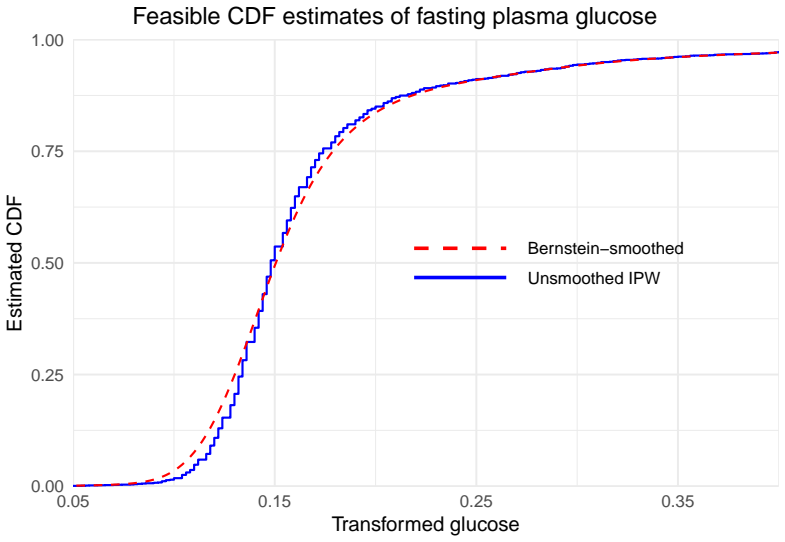
We study nonparametric estimation of univariate cumulative distribution functions (CDFs) pertaining to data missing at random. The proposed estimators smooth the inverse probability weighted (IPW) empirical CDF with the Bernstein operator, yielding monotone, $[0,1]$-valued curves that automatically adapt to bounded supports. We analyze two versions: a pseudo estimator that uses known propensities and a feasible estimator that uses propensities estimated nonparametrically from discrete auxiliary variables, the latter scenario being much more common in practice. For both, we derive pointwise bias and variance expansions, establish the optimal polynomial degree $m$ with respect to the mean integrated squared error, and prove the asymptotic normality. A key finding is that the feasible estimator has a smaller variance than the pseudo estimator by an explicit nonnegative correction term. We also develop an efficient degree selection procedure via least-squares cross-validation. Monte Carlo experiments show that, for small to moderate sample sizes, the Bernstein-smoothed pseudo and feasible estimators outperform their unsmoothed counterparts and the integrated version of the IPW kernel density estimator proposed by Dubnicka (2009), under certain models. A real-data application to fasting plasma glucose from the 2017-2018 NHANES survey illustrates the method in a practical setting. All code needed to reproduce our analyses is readily accessible on GitHub.
Figures
Forward citations
Cited by 1 Pith paper
-
Dirichlet kernel density estimation on the simplex with missing data
An inverse-probability-weighted Dirichlet kernel density estimator on the simplex is asymptotically normal under MAR missingness, with bias matching full-data Dirichlet KDE and variance inflated by a propensity factor.
Reference graph
Works this paper leans on
-
[1]
J., & Chaubey, Y
Babu, G. J., & Chaubey, Y. P. 2006. Smooth estimation of a distribution and density function on a hypercube using B ernstein polynomials for dependent random vectors. Statist. Probab. Lett. , 76 (9), 959--969. MR2270097 http://www.ams.org/mathscinet-getitem?mr=MR2270097
2006
-
[2]
J., Canty, A
Babu, G. J., Canty, A. J., & Chaubey, Y. P. 2002. Application of B ernstein polynomials for smooth estimation of a distribution and density function. J. Statist. Plann. Inference , 105 (2), 377--392. MR1910059 http://www.ams.org/mathscinet-getitem?mr=MR1910059
2002
-
[3]
Belalia, M., Bouezmarni, T., & Leblanc, A. 2017. Smooth conditional distribution estimators using B ernstein polynomials. Comput. Statist. Data Anal. , 111 , 166--182. MR3630225 http://www.ams.org/mathscinet-getitem?mr=MR3630225
2017
-
[4]
B ernstein, S. 1912. D\'emonstration du th\'eor\`eme de W eierstrass, fond\'ee sur le calcul des probabilit\'es. Commun. Soc. Math. Kharkow , 2 (13), 1--2
1912
-
[5]
Bustamante, J. 2017. Bernstein O perators and T heir P roperties . Birkh\" a user/Springer, Cham. MR3585481 http://www.ams.org/mathscinet-getitem?mr=MR3585481
2017
-
[6]
Cheng, M.-Y., & Peng, L. 2002. Regression modeling for nonparametric estimation of distribution and quantile functions. Statist. Sinica , 12 (4), 1043--1060. MR1379049 http://www.ams.org/mathscinet-getitem?mr=MR1379049
2002
-
[7]
E., & Chu, C
Cheng, P. E., & Chu, C. K. 1996. Kernel estimation of distribution functions and quantiles with missing data. Statist. Sinica , 6 (1), 63--78. MR1379049 http://www.ams.org/mathscinet-getitem?mr=MR1379049
1996
-
[8]
Ding, X., & Tang, N. 2018. Adjusted empirical likelihood estimation of distribution function and quantile with nonignorable missing data. J. Syst. Sci. Complex. , 31 (3), 820--840. MR3782668 http://www.ams.org/mathscinet-getitem?mr=MR3782668
2018
Show all 39 references
-
[9]
Dubnicka, S. R. 2009. Kernel density estimation with missing data and auxiliary variables. Aust. N. Z. J. Stat. , 51 (3), 247--270. MR2569798 http://www.ams.org/mathscinet-getitem?mr=MR2569798
2009
-
[10]
Endres, C., Ale, L., Gentleman, R., & Sarkar, D. 2025. nhanesA : NHANES D ata R etrieval . R package version 1.4. doi:10.32614/CRAN.package.nhanesA https://www.doi.org/10.32614/CRAN.package.nhanesA
2025 doi
-
[11]
u y\" u k, C ., & Ege Oru c , \
Erdo g an, M. S., Di s ib\" u y\" u k, C ., & Ege Oru c , \" O . 2019. An alternative distribution function estimation method using rational B ernstein polynomials. J. Comput. Appl. Math. , 353 , 232--242. MR3899096 http://www.ams.org/mathscinet-getitem?mr=MR3899096
2019
-
[12]
Gharbi, R., Jedidi, W., Khardani, S., & Ouimet, F. 2025. Bernstein CDF M issing D ata . GitHub repository available online at https://github.com/FredericOuimetMcGill https://github.com/FredericOuimetMcGill
2025
-
[13]
Hanebeck, A., & Klar, B. 2021. Smooth distribution function estimation for lifetime distributions using S zasz- M irakyan operators. Ann. Inst. Statist. Math. , 73 (6), 1229--1247. MR4330318 http://www.ams.org/mathscinet-getitem?mr=MR4330318
2021
-
[14]
G., & Thompson, D
Horvitz, D. G., & Thompson, D. J. 1952. A generalization of sampling without replacement from a finite universe. J. Amer. Statist. Assoc. , 47 , 663--685. MR53460 http://www.ams.org/mathscinet-getitem?mr=MR53460
1952
-
[15]
Jmaei, A., Slaoui, Y., & Dellagi, W. 2017. Recursive distribution estimator defined by stochastic approximation method using B ernstein polynomials. J. Nonparametr. Stat. , 29 (4), 792--805. MR3740720 http://www.ams.org/mathscinet-getitem?mr=MR3740720
2017
-
[16]
Khardani, S. 2024. A B ernstein polynomial approach to the estimation of a distribution function and quantiles under censorship model. Comm. Statist. Theory Methods , 53 (16), 5673--5686. MR4765928 http://www.ams.org/mathscinet-getitem?mr=MR4765928
2024
-
[17]
Lafaye de Micheaux, P., & Ouimet, F. 2021. A study of seven asymmetric kernels for the estimation of cumulative distribution functions. Mathematics , 9 (20), Paper No. 2605, 31 pp. doi:10.3390/math9202605 https://www.doi.org/10.3390/math9202605
2021 doi
-
[18]
Leblanc, A. 2012a. On estimating distribution functions using B ernstein polynomials. Ann. Inst. Statist. Math. , 64 (5), 919--943. MR2960952 http://www.ams.org/mathscinet-getitem?mr=MR2960952
-
[19]
Leblanc, A. 2012b. On the boundary properties of B ernstein polynomial estimators of density and distribution functions. J. Statist. Plann. Inference , 142 (10), 2762--2778. MR2925964 http://www.ams.org/mathscinet-getitem?mr=MR2925964
-
[20]
Little, R. J. A., & Rubin, D. B. 2002. Statistical A nalysis W ith M issing D ata . Second edn. Wiley Series in Probability and Statistics. Wiley-Interscience [John Wiley & Sons], Hoboken, NJ. MR1925014 http://www.ams.org/mathscinet-getitem?mr=MR1925014
2002
-
[21]
Mansouri, B., Rustin, A., & Allah Mombeni, H. 2023. Beta kernel estimator for a cumulative distribution function with bounded support. Journal of Sciences, Islamic Republic of Iran , 34(4) , 349--361. http://jsciences.ut.ac.ir http://jsciences.ut.ac.ir
2023
-
[22]
Nadaraya, E. A. 1964. Some new estimates for distribution functions. Teor. Verojatnost. i Primenen. , 9 , 550--554. MR166862 http://www.ams.org/mathscinet-getitem?mr=MR166862
1964
-
[23]
National Center for Health Statistics . 2020. 2017--2018 Demographics Data -- Continuous NHANES . Centers for Disease Control and Prevention (CDC). Data file: DEMO\_J; Date published: February 2020. https://wwwn.cdc.gov/nchs/nhanes/search/datapage.aspx?Component=Demographics&C...
2020
-
[24]
Olver, F. W. J., Lozier, D. W., Boisvert, R. F., & Clark, C. W. (eds). 2010. NIST H andbook of M athematical F unctions . Cambridge University Press. Available online at the NIST Digital Library of Mathematical Functions: https://dlmf.nist.gov https://dlmf.nist.gov
2010
-
[25]
Ouimet, F. 2021. Asymptotic properties of B ernstein estimators on the simplex. J. Multivariate Anal. , 185 , Paper No. 104784, 20 pp. MR4287788 http://www.ams.org/mathscinet-getitem?mr=MR4287788
2021
-
[26]
Parzen, E. 1962. On estimation of a probability density function and mode. Ann. Math. Statist. , 33 , 1065--1076. MR143282 http://www.ams.org/mathscinet-getitem?mr=MR143282
1962
-
[27]
R., & Rubin, D
Rosenbaum, P. R., & Rubin, D. B. 1983. The central role of the propensity score in observational studies for causal effects. Biometrika , 70 (1), 41--55. MR742974 http://www.ams.org/mathscinet-getitem?mr=MR742974
1983
-
[28]
Rosenblatt, M. 1956. Remarks on some nonparametric estimates of a density function. Ann. Math. Statist. , 27 , 832--837. MR742974 http://www.ams.org/mathscinet-getitem?mr=MR742974
1956
-
[29]
Rubin, D. B. 1976. Inference and missing data. Biometrika , 63 (3), 581--592. MR455196 http://www.ams.org/mathscinet-getitem?mr=MR455196
1976
-
[30]
Serfling, R. J. 1980. Approximation T heorems of M athematical S tatistics . Wiley Series in Probability and Mathematical Statistics. John Wiley & Sons, Inc., New York. MR0595165 http://www.ams.org/mathscinet-getitem?mr=MR0595165
1980
-
[31]
Silverman, B. W. 1986. Density E stimation for S tatistics and D ata A nalysis . Monographs on Statistics and Applied Probability. Chapman & Hall, London. MR848134 http://www.ams.org/mathscinet-getitem?mr=MR848134
1986
-
[32]
Slaoui, Y. 2022. Moderate deviation principles for nonparametric recursive distribution estimators using B ernstein polynomials. Rev. Mat. Complut. , 35 (1), 147--158. MR4365177 http://www.ams.org/mathscinet-getitem?mr=MR4365177
2022
-
[33]
Tenreiro, C. 2013. Boundary kernels for distribution function estimation. REVSTAT , 11 (2), 169--190. MR3072469 http://www.ams.org/mathscinet-getitem?mr=MR3072469
2013
-
[34]
Vitale, R. A. 1975. B ernstein polynomial approach to density function estimation. Pages 87--99 of: Statistical I nference and R elated T opics . Academic Press, New York. MR0397977 http://www.ams.org/mathscinet-getitem?mr=MR0397977
1975
-
[35]
P., & Jones, M
Wand, M. P., & Jones, M. C. 1995. Kernel S moothing . Monographs on Statistics and Applied Probability, vol. 60. Chapman and Hall, Ltd., London. MR1319818 http://www.ams.org/mathscinet-getitem?mr=MR1319818
1995
-
[36]
Wang, Q., & Qin, Y. 2010. Empirical likelihood confidence bands for distribution functions with missing responses. J. Statist. Plann. Inference , 140 (9), 2778--2789. MR2644095 http://www.ams.org/mathscinet-getitem?mr=MR2644095
2010
-
[37]
Uber die analytische Darstellung sogenanter willk\
Weierstra , K. 1885. \"Uber die analytische Darstellung sogenanter willk\"urlicher Functionen einer reelen Ver\"anderlichen. Verl. d. Kgl. Akad. d. Wiss. Berlin , 2 , 633--639
-
[38]
Xue, L., & Wang, J. 2010. Distribution function estimation by constrained polynomial spline regression. J. Nonparametr. Stat. , 22 (3-4), 443--457. MR2662606 http://www.ams.org/mathscinet-getitem?mr=MR2662606
2010
-
[39]
Zhang, S., Li, Z., & Zhang, Z. 2020. Estimating a Distribution Function at the Boundary. Austrian Journal of Statistics , 49 (1), 1--23. doi:10.17713/ajs.v49i1.801 https://www.doi.org/10.17713/ajs.v49i1.801
2020 doi
Reviewed August 4, 2026 · model on record in the stance chip above.
Discussion (0). Continue with ORCID to comment.