Photon anti-bunching in high harmonic generation
Pith reviewed 2026-06-27 00:47 UTC · model grok-4.3
The pith
High harmonic generation produces photons that anti-bunch in time.
A machine-rendered reading of the paper's core claim, the machinery that carries it, and where it could break.
Core claim
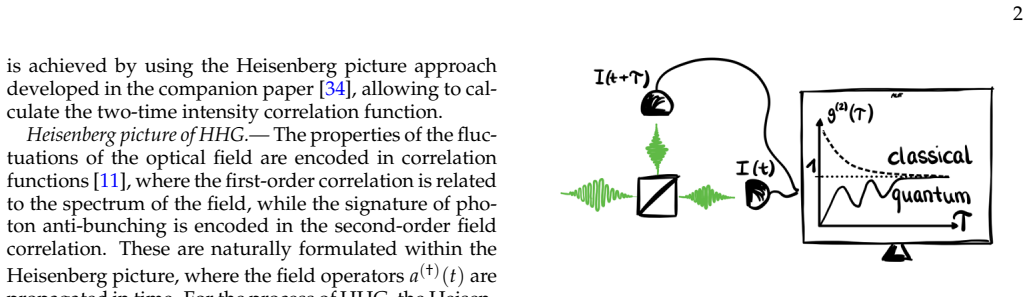
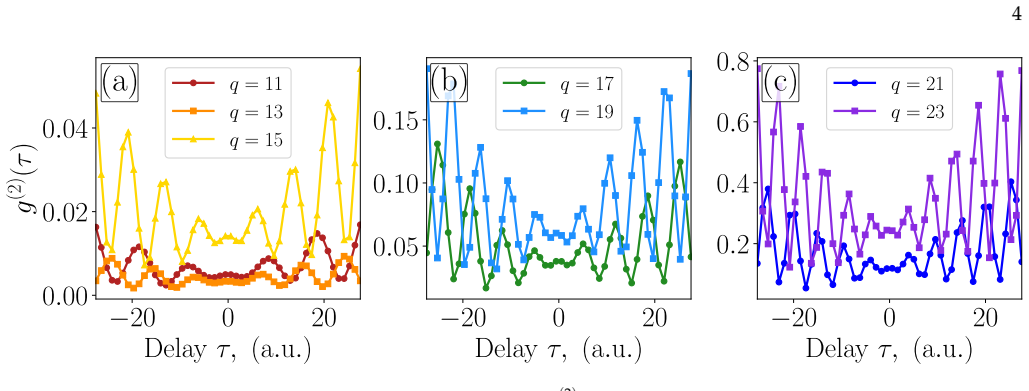
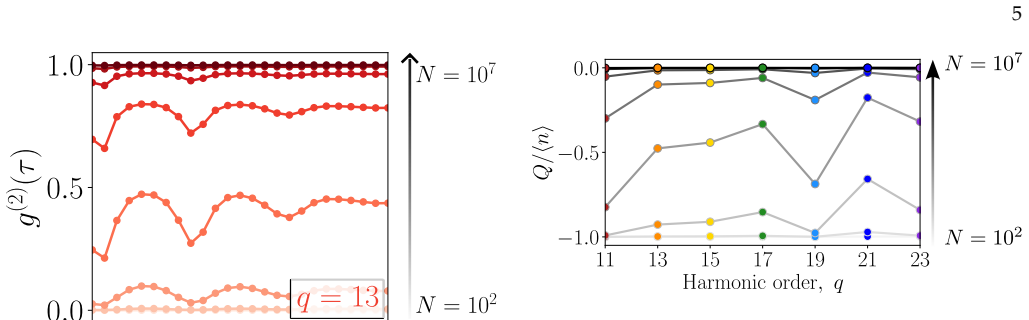
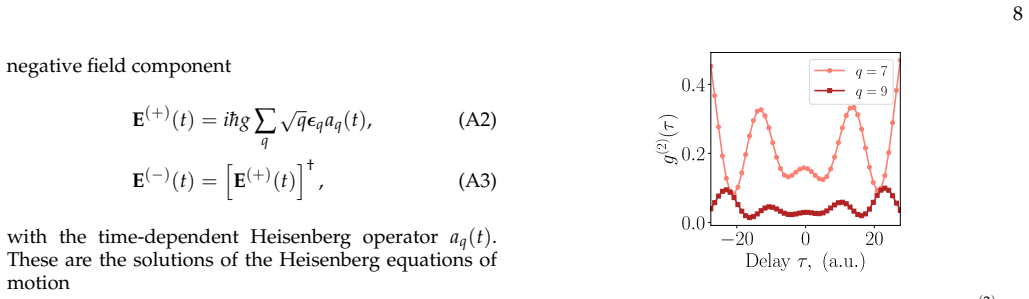
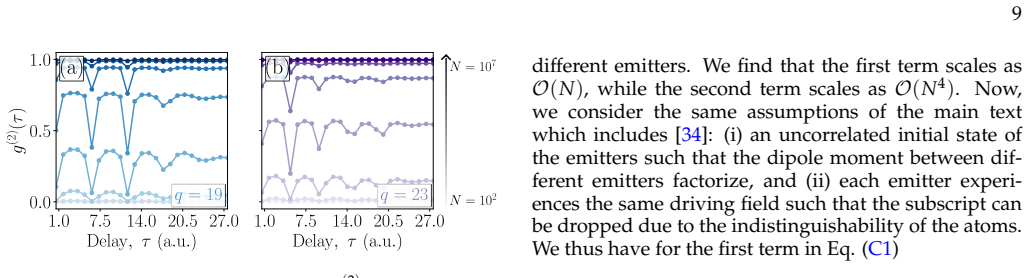
The key result of this work is the prediction of photon anti-bunching in the process of HHG, marking it the first theoretical discovery of non-classicality in the temporal correlations of HHG photons. While other non-classical signatures in HHG, such as sub-Poissonian statistics or squeezing, have been discussed for an ensemble of photons, the anti-bunching signature reported here is a signature of a single photon. This is achieved by using the recently developed Heisenberg picture approach for quantum optical HHG, revealing clear anti-bunching signatures in the intensity correlation function across the entire harmonic spectrum.
What carries the argument
The Heisenberg-picture treatment of quantum-optical HHG applied to the intensity correlation function g(2)( au).
If this is right
- Anti-bunching appears in the intensity correlation function for every harmonic order.
- The effect constitutes direct evidence that individual photons participate in the HHG process.
- The signature cannot be reproduced by any classical or semi-classical model of the driving field.
- The same Heisenberg-picture framework that yields anti-bunching can be used to compute higher-order photon correlations.
Where Pith is reading between the lines
- Laboratory detection of the predicted dip in g(2)( au) would establish HHG as a source of non-classical high-frequency light.
- The result raises the question whether anti-bunching persists when the driving field itself is prepared in a non-classical state.
- Extensions of the same correlation-function calculation could test for photon entanglement between different harmonics.
Load-bearing premise
The Heisenberg picture approach developed for quantum optical HHG is sufficient to capture single-photon temporal correlations without additional classical or ensemble approximations.
What would settle it
An experiment that measures the second-order intensity correlation function of the harmonic radiation and finds g(2)(0) greater than or equal to one for any harmonic order would falsify the anti-bunching prediction.
Figures
read the original abstract
Photon anti-bunching is the direct evidence for the existence of photons without having a classical counterpart. Unlike bunching of photons, which can have a semi-classical description, the effect of photon anti-bunching can only be understood with quantized electromagnetic fields. However, for the process of high harmonic generation (HHG), where many photons of the driving field are upconverted to a single photon of higher energy, there is yet no clear evidence for the presence of individual photon emission. The key result of this work is the prediction of photon anti-bunching in the process of HHG, marking it the first theoretical discovery of non-classicality in the temporal correlations of HHG photons. While other non-classical signatures in HHG, such as sub-Poissonian statistics or squeezing, have been discussed for an ensemble of photons, the anti-bunching signature reported here is a signature of a single photon. This is achieved by using the recently developed Heisenberg picture approach for quantum optical HHG, revealing clear anti-bunching signatures in the intensity correlation function across the entire harmonic spectrum.
Editorial analysis
A structured set of objections, weighed in public.
Referee Report
Summary. The manuscript claims to predict photon anti-bunching in high harmonic generation (HHG) using a recently developed Heisenberg-picture approach for quantum-optical HHG. This is presented as the first theoretical discovery of non-classicality in the temporal correlations of HHG photons, with the intensity correlation function exhibiting clear anti-bunching signatures across the entire harmonic spectrum, providing a single-photon signature distinct from prior ensemble-level non-classical effects such as sub-Poissonian statistics or squeezing.
Significance. If the result holds, the work would be significant for establishing a single-photon-level non-classical signature in HHG that has no semi-classical counterpart, thereby strengthening the case for fully quantized treatments of the process beyond ensemble averages.
major comments (1)
- [Abstract] Abstract: The central claim that the Heisenberg-picture treatment captures single-photon temporal correlations without additional classical or ensemble approximations is asserted but unsupported by any derivation, validation against a known single-photon source, or explicit demonstration that g^(2)(τ) remains non-classical when the driving field is treated fully quantum-mechanically. This leaves open the possibility that the reported anti-bunching is an artifact of implicit factorization or averaging.
Simulated Author's Rebuttal
We thank the referee for their comments. We address the major comment point by point below, providing clarification on the foundations of the Heisenberg-picture treatment while remaining open to strengthening the presentation where appropriate.
read point-by-point responses
-
Referee: [Abstract] Abstract: The central claim that the Heisenberg-picture treatment captures single-photon temporal correlations without additional classical or ensemble approximations is asserted but unsupported by any derivation, validation against a known single-photon source, or explicit demonstration that g^(2)(τ) remains non-classical when the driving field is treated fully quantum-mechanically. This leaves open the possibility that the reported anti-bunching is an artifact of implicit factorization or averaging.
Authors: The Heisenberg-picture approach begins from the fully quantized light-matter Hamiltonian for HHG and evolves the field operators in the Heisenberg picture, preserving the canonical commutation relations that enforce non-classical correlations. The intensity correlation function g^(2)(τ) is computed directly from these operators without factorization approximations or ensemble averaging over photon numbers; the anti-bunching signature follows from the single-photon character of the harmonic emission process. The driving field is initialized as a quantized coherent state whose quantum fluctuations are retained throughout the evolution. While the core derivation appears in the referenced prior work on the formalism, we acknowledge that an explicit validation against a canonical single-photon source (e.g., resonance fluorescence) would strengthen the manuscript and will add a short subsection demonstrating that the same framework recovers the expected g^(2)(0) < 1 for a two-level emitter. revision: partial
Circularity Check
No circularity; result obtained by applying external Heisenberg-picture method
full rationale
The paper obtains its central claim (anti-bunching signatures in the intensity correlation function across the HHG spectrum) by applying the recently developed Heisenberg picture approach for quantum optical HHG. No equations or steps in the provided text reduce the reported prediction to a fitted parameter, a self-definition, or a self-citation chain whose content is itself unverified within this manuscript. The cited approach functions as an independent computational framework whose outputs (the correlation function) are presented as new; nothing in the abstract or described derivation indicates that the anti-bunching result is equivalent to its inputs by construction. This is the normal, non-circular case of a method being used to compute a previously unexamined observable.
Axiom & Free-Parameter Ledger
Reference graph
Works this paper leans on
-
[1]
Einstein, ¨Uber einem die erzeugung und verwandlung des lichtes betreffenden heuristischen gesichtspunkt, An- nalen der physik4(1905)
A. Einstein, ¨Uber einem die erzeugung und verwandlung des lichtes betreffenden heuristischen gesichtspunkt, An- nalen der physik4(1905)
1905
-
[2]
W. E. Lamb Jr and M. O. Scully,The photoelectric effect with- out photons, Tech. Rep. (1968)
1968
-
[3]
D. F. Walls and G. J. Milburn,Quantum optics(Springer Science & Business Media, 2008)
2008
-
[4]
W. H. Louisell,Quantum statistical properties of radiation (John Wiley and Sons, Inc., New York, 1973)
1973
-
[5]
Haroche and J.-M
S. Haroche and J.-M. Raimond,Exploring the quantum: atoms, cavities, and photons(Oxford university press, 2006)
2006
-
[6]
M. O. Scully and M. S. Zubairy,Quantum optics(Cam- bridge university press, 1997)
1997
-
[7]
R. J. Glauber, Coherent and incoherent states of the radia- tion field, Phys. Rev.131, 2766 (1963)
1963
-
[8]
R. J. Glauber, The quantum theory of optical coherence, Phys. Rev.130, 2529 (1963)
1963
-
[9]
R. J. Glauber, Coherent and incoherent states of the radia- tion field, Physical Review131, 2766 (1963)
1963
-
[10]
R. J. Glauber, Photon correlations, Physical Review Let- ters10, 84 (1963)
1963
-
[11]
Mandel and E
L. Mandel and E. Wolf, Coherence properties of optical fields, Reviews of modern physics37, 231 (1965)
1965
-
[12]
Mandel and E
L. Mandel and E. Wolf,Optical coherence and quantum op- tics(Cambridge university press, 1995)
1995
-
[13]
Kimble and L
H. Kimble and L. Mandel, Theory of resonance fluores- cence, Physical Review A13, 2123 (1976)
1976
-
[14]
H. J. Kimble, M. Dagenais, and L. Mandel, Photon anti- bunching in resonance fluorescence, Physical Review Let- ters39, 691 (1977)
1977
-
[15]
W. M. Itano, J. Bergquist, and D. Wineland, Photon an- tibunching and sub-poissonian statistics from quantum jumps in one and two atoms, Physical Review A38, 559 (1988)
1988
-
[16]
Brabec and F
T. Brabec and F. Krausz, Intense few-cycle laser fields: Frontiers of nonlinear optics, Reviews of Modern Physics 72, 545 (2000)
2000
-
[17]
Krausz and M
F. Krausz and M. Ivanov, Attosecond physics, Reviews of Modern Physics81, 163 (2009)
2009
-
[18]
Lewenstein, P
M. Lewenstein, P . Balcou, M. Y. Ivanov, A. L’huillier, and P . B. Corkum, Theory of high-harmonic generation by low-frequency laser fields, Physical Review A49, 2117 (1994)
1994
-
[19]
Amini, J
K. Amini, J. Biegert, F. Calegari, A. Chac ´on, M. F. Ciap- pina, A. Dauphin, D. K. Efimov, C. F. de Morisson Faria, K. Giergiel, P . Gniewek,et al., Symphony on strong field approximation, Reports on Progress in Physics82, 116001 (2019)
2019
-
[20]
Lewenstein, M
M. Lewenstein, M. F. Ciappina, E. Pisanty, J. Rivera-Dean, P . Stammer, T. Lamprou, and P . Tzallas, Generation of op- tical schr ¨odinger cat states in intense laser–matter inter- actions, Nature Physics17, 1104 (2021)
2021
-
[21]
Gorlach, O
A. Gorlach, O. Neufeld, N. Rivera, O. Cohen, and I. Kaminer, The quantum-optical nature of high harmonic generation, Nat. Commun.11, 4598 (2020)
2020
-
[22]
P . Stammer, J. Rivera-Dean, P . Tzallas, M. F. Ciappina, and M. Lewenstein, Colloquium: Quantum optics of intense light–matter interaction, arXiv:2510.19045 (2025)
arXiv 2025
-
[23]
Cruz-Rodriguez, D
L. Cruz-Rodriguez, D. Dey, A. Freibert, and P . Stammer, Quantum phenomena in attosecond science, Nat. Rev. Phys.6, 691 (2024)
2024
-
[24]
Stammer, J
P . Stammer, J. Rivera-Dean, T. Lamprou, E. Pisanty, M. F. Ciappina, P . Tzallas, and M. Lewenstein, High photon number entangled states and coherent state superposition from the extreme ultraviolet to the far infrared, Physical Review Letters128, 123603 (2022)
2022
-
[25]
Stammer, Theory of entanglement and measurement in high-order harmonic generation, Physical Review A106, L050402 (2022)
P . Stammer, Theory of entanglement and measurement in high-order harmonic generation, Physical Review A106, L050402 (2022)
2022
-
[26]
S. Yi, N. D. Klimkin, G. G. Brown, O. Smirnova, S. Patchkovskii, I. Babushkin, and M. Ivanov, Generation of massively entangled bright states of light during har- monic generation in resonant media, Physical Review X 15, 011023 (2025)
2025
-
[27]
Stammer, J
P . Stammer, J. Rivera-Dean, A. S. Maxwell, T. Lam- prou, J. Arg ¨uello-Luengo, P . Tzallas, M. F. Ciappina, and 7 M. Lewenstein, Entanglement and squeezing of the opti- cal field modes in high harmonic generation, Phys. Rev. Lett.132, 143603 (2024)
2024
-
[28]
C. S. Lange, T. Hansen, and L. B. Madsen, Excitonic En- hancement of Squeezed Light in Quantum-Optical High- Harmonic Generation from a Mott Insulator, Phys. Rev. Lett.135, 043603 (2025)
2025
-
[29]
M. E. Tzur, M. Birk, A. Gorlach, I. Kaminer, M. Kr ¨uger, and O. Cohen, Generation of squeezed high-order har- monics, Physical Review Research6, 033079 (2024)
2024
-
[30]
Rivera-Dean, T
J. Rivera-Dean, T. Lamprou, E. Pisanty, P . Stammer, A. F. Ord´o˜nez, A. S. Maxwell, M. F. Ciappina, M. Lewenstein, and P . Tzallas, Strong laser fields and their power to gen- erate controllable high-photon-number coherent-state su- perpositions, Physical Review A105, 033714 (2022)
2022
-
[31]
Theidel, V
D. Theidel, V . Cotte, R. Sondenheimer, V . Shiriaeva, M. Froidevaux, V . Severin, A. Merdji-Larue, P . Mosel, S. Fr ¨ohlich, K.-A. Weber,et al., Evidence of the quantum optical nature of high-harmonic generation, PRX Quan- tum5, 040319 (2024)
2024
-
[32]
Lemieux, S
S. Lemieux, S. A. Jalil, D. N. Purschke, N. Boroumand, T. Hammond, D. Villeneuve, A. Naumov, T. Brabec, and G. Vampa, Photon bunching in high-harmonic emission controlled by quantum light, Nature Photonics , 1 (2025)
2025
-
[33]
X. T. Zou and L. Mandel, Photon-antibunching and sub- poissonian photon statistics, Phys. Rev. A41, 475 (1990)
1990
-
[34]
P . Stammer, J. Rivera-Dean, and M. Lewenstein, Theory of quantum optics and optical coherence in high harmonic generation, arXiv:2504.13287 (2025)
arXiv 2025
-
[35]
Sundaram and P
B. Sundaram and P . W. Milonni, High-order harmonic generation: simplified model and relevance of single- atom theories to experiment, Physical Review A41, 6571 (1990)
1990
-
[36]
Diestler, Harmonic generation: quantum- electrodynamical theory of the harmonic photon-number spectrum, Physical Review A—Atomic, Molecular, and Optical Physics78, 033814 (2008)
D. Diestler, Harmonic generation: quantum- electrodynamical theory of the harmonic photon-number spectrum, Physical Review A—Atomic, Molecular, and Optical Physics78, 033814 (2008)
2008
-
[37]
Stammer, J
P . Stammer, J. Rivera-Dean, A. Maxwell, T. Lamprou, A. Ord ´o˜nez, M. F. Ciappina, P . Tzallas, and M. Lewen- stein, Quantum electrodynamics of intense laser-matter interactions: a tool for quantum state engineering, PRX Quantum4, 010201 (2023)
2023
-
[38]
Wiener, Generalized harmonic analysis, Acta mathe- matica55, 117 (1930)
N. Wiener, Generalized harmonic analysis, Acta mathe- matica55, 117 (1930)
1930
-
[39]
Khintchine, Korrelationstheorie der station ¨aren stochastischen prozesse, Mathematische Annalen109, 604 (1934)
A. Khintchine, Korrelationstheorie der station ¨aren stochastischen prozesse, Mathematische Annalen109, 604 (1934)
1934
-
[40]
Stammer, Quantum stochastic analysis of non-linear driven light emission, arXiv:2508.09049 (2025)
P . Stammer, Quantum stochastic analysis of non-linear driven light emission, arXiv:2508.09049 (2025)
arXiv 2025
-
[41]
R. H. Brown and R. Q. Twiss, Correlation between pho- tons in two coherent beams of light, Nature177, 27 (1956)
1956
-
[42]
Mandel and E
L. Mandel and E. Wolf, Photon statistics and classical fields, Physical Review149, 1033 (1966)
1966
-
[43]
P . B. Corkum, Plasma perspective on strong field multi- photon ionization, Physical review letters71, 1994 (1993)
1994
-
[44]
Sali`eres, B
P . Sali`eres, B. Carr´e, L. Le D´eroff, F. Grasbon, G. G. Paulus, H. Walther, R. Kopold, W. Becker, D. B. Miloˇsevi´c, A. San- pera, and M. Lewenstein, Feynman’s Path-Integral Ap- proach for Intense-Laser-Atom Interactions, Science292, 902 (2001)
2001
-
[45]
H. J. Carmichael,Statistical Methods in Quantum Optics 1: Master Equations and Fokker-Planck Equations(Springer- Verlag, Heidelberg, 2013)
2013
-
[46]
Boitier, A
F. Boitier, A. Godard, E. Rosencher, and C. Fabre, Mea- suring photon bunching at ultrashort timescale by two- photon absorption in semiconductors, Nature Physics5, 267 (2009)
2009
-
[47]
Rivera-Dean, L
J. Rivera-Dean, L. Petrovic, M. Lewenstein, and P . Stam- mer, Attosecond quantum optical interferometry, Reports on Progress in Physics89, 047901 (2026)
2026
-
[48]
Lamprou, J
T. Lamprou, J. Rivera-Dean, P . Stammer, M. Lewenstein, and P . Tzallas, Nonlinear optics using intense optical co- herent state superpositions, Phys. Rev. Lett.134, 013601 (2025)
2025
-
[49]
M. E. Tzur, C. Mor, N. Yaffe, M. Birk, A. Rasputnyi, O. Kneller, I. Nisim, I. Kaminer, M. Kr¨uger, N. Dudovich, et al., Measuring and controlling the birth of quantum at- tosecond pulses, arXiv:2502.09427 (2025)
arXiv 2025
-
[50]
P . Stammer, J. Rivera-Dean, M. F. Ciappina, and M. Lewenstein, Weak measurement in strong laser field physics, arXiv:2508.09048 (2025)
arXiv 2025
-
[51]
Pizzi, A
A. Pizzi, A. Gorlach, N. Rivera, A. Nunnenkamp, and I. Kaminer, Light emission from strongly driven many- body systems, Nature Physics19, 551 (2023)
2023
-
[52]
Lewenstein and J
M. Lewenstein and J. Javanainen, Cooperative quantum jumps with two atoms, Physical review letters59, 1289 (1987)
1987
-
[53]
Mandel, Sub-poissonian photon statistics in resonance fluorescence, Optics letters4, 205 (1979)
L. Mandel, Sub-poissonian photon statistics in resonance fluorescence, Optics letters4, 205 (1979)
1979
-
[54]
Stammer, High harmonic generation from a Bose- Einstein condensate, arXiv:2509.19022 (2025)
P . Stammer, High harmonic generation from a Bose- Einstein condensate, arXiv:2509.19022 (2025)
arXiv 2025
-
[55]
Arg ¨uello-Luengo, J
J. Arg ¨uello-Luengo, J. Rivera-Dean, P . Stammer, A. S. Maxwell, D. M. Weld, M. F. Ciappina, and M. Lewenstein, Analog simulation of high-harmonic generation in atoms, PRX Quantum5, 010328 (2024)
2024
-
[56]
J. Arg ¨uello-Luengo, J. Rivera-Dean, P . Stammer, M. F. Ciappina, and M. Lewenstein, Quantum kramers- henneberger transformation, arXiv:2507.13006 (2025)
arXiv 2025
-
[57]
J. C. Bergquist, R. G. Hulet, W. M. Itano, and D. J. Wineland, Observation of quantum jumps in a single atom, Physical Review Letters57, 1699 (1986)
1986
-
[58]
Lewenstein, Quantum jump statistics for two-atom systems, IEEE journal of quantum electronics24, 1403 (2002)
M. Lewenstein, Quantum jump statistics for two-atom systems, IEEE journal of quantum electronics24, 1403 (2002). APPENDIX Appendix A: Details on the Heisenberg picture and first-order correlation function In this Appendix, we give a brief summary of the rel- evant results from the companion paper [34], where we have provided the Heisenberg picture of quan...
2002
discussion (0)
Sign in with ORCID, Apple, or X to comment. Anyone can read and Pith papers without signing in.