REVIEW 3 major objections 6 minor 1 cited by
What You Have is What You Track: Adaptive and Robust Multimodal Tracking
T0 review · 3 major / 6 minor · reviewed 2026-08-06 · deepseek-v4-flash
Pith's one-line read One tracker stays state-of-the-art even when video sensors drop frames.
desk verdict A promising heterogeneous-MoE tracker whose central equations don't type-check and whose headline gains aren't in the tables—send to reviewers but require major fixes. read the letter →
The pith
A machine-rendered reading of the paper's core claim, the machinery that carries it, and where it could break.
The reading
What carries the argument
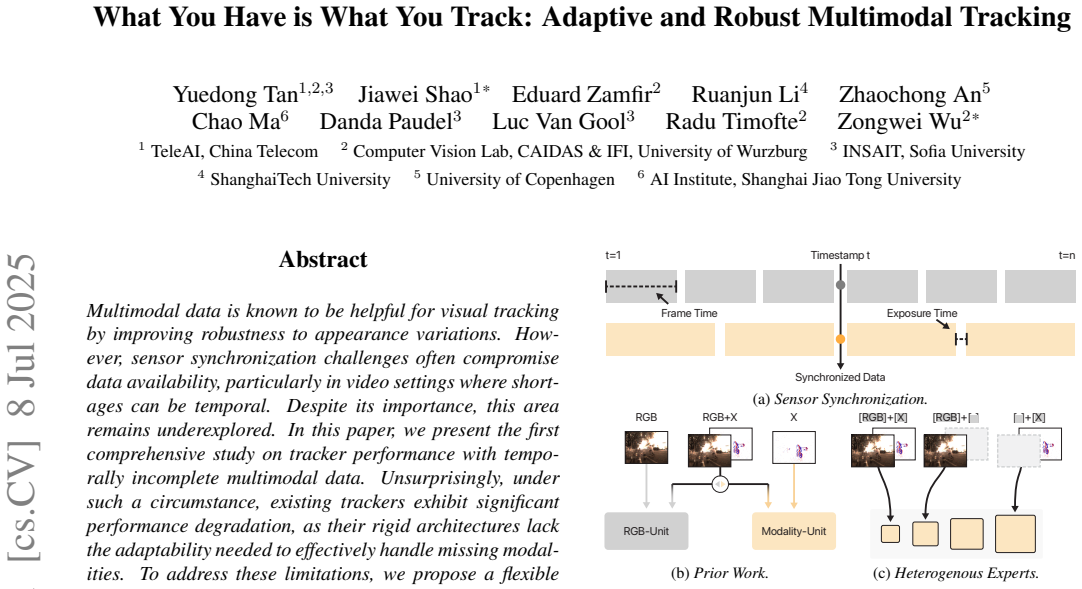
The load-bearing machinery is the Heterogeneous Mixture-of-Experts Fusion (HMoE-Fuse) module combined with a training-time video-level masking strategy. HMoE-Fuse routes whole video clips, rather than individual tokens, through a gating function that activates the top-$K$ experts ($K=2$) among experts with different hidden dimensions ($2d$ for $d \in \{2,\dots,D-1\}$), so the model can spend more capacity when whole modalities are absent and less when data is plentiful. The masking strategy, described in Algorithm 1, samples a search-region mask from five fixed patterns and, with probability $\alpha$, applies per-clip masks that keep at least one modality in every frame, enforcing temporal consistency while preserving spatial completeness within available frames. Switch-Transformer-style balance and importance auxiliary losses keep the heterogeneous experts from collapsing onto a single route.
What would settle it
Run FlexTrack and the strongest baselines on sequences recorded with genuine hardware sync failures, such as sporadic depth or thermal frame drops logged by the sensors, and compare precision and AUC with the numbers in Table 5. If FlexTrack's margin over STTrack and SUTrack shrinks toward its 2.6% complete-data margin, then the missing-modality advantage is tied to the synthetic mask distribution rather than to real dropout behavior.
Extended reading notes
Core claim
The paper claims that a single unified tracker, FlexTrack, can be trained once on RGB-thermal, RGB-depth, and RGB-event data and then serve both fully aligned videos and videos with temporally missing modalities, without adding parameters or branches for the missing case. On the complete benchmarks it reports state-of-the-art results, for example 77.3 precision on LasHeR, 81.4 precision on VisEvent, and an F-score of 67.0 on DepthTrack, and it reports that the lead over prior methods widens under missing-modality variants, reaching a 10.2% margin compared with 2.6% on complete data. The authors attribute the missing-data gains to the interaction of the heterogeneous mixture-of-experts fusion (HMoE-Fuse) module and the video-level masking strategy, which their ablations show contributes 3.8 and 6.5 precision points on the RGB-thermal and RGB-event missing benchmarks.
Load-bearing premise
The central assumption is that the synthetic masks used for training and evaluation, which drop one modality from some frames or clips while keeping at least one, represent how real sensors actually fail, so that the large reported margins under missing data would transfer to real synchronization failures.
Editorial extensions
If this is right
- If the reported results hold, a single model can replace separate complete-data and missing-data trackers, with no additional prompt parameters or modality-specific branches.
- Missing-modality robustness becomes a trainable property: the paper reports a 10.2% margin over prior state of the art under missing modalities, larger than the 2.6% margin on complete data.
- Adaptive expert selection implies a test-time compute trade-off: easy full-modality frames can be processed by smaller experts, while hard or incomplete frames get larger experts.
- The video-level masking recipe can act as a training-time augmentation for other multimodal trackers, improving missing-modality precision by 3.8 to 6.5 points in the paper's ablations.
Reading between the lines
- Editorial inference: the correlation between missing rate and expert size suggests a natural controller that sets expert budget from sensor-health metadata, turning robustness into an explicit compute-allocation problem.
- Editorial inference: the same video-level masking could apply to other video tasks that consume multimodal streams, such as action recognition or multi-object tracking, where intermittent sensor loss also breaks temporal continuity.
- Editorial inference: the missing-modality benchmarks are synthetic masks, so whether the large margins transfer to real hardware dropout patterns is not directly measured in the paper.
Editorial analysis
A structured set of objections, weighed in public.
Referee Report
Summary. The paper proposes FlexTrack, a multimodal visual tracker designed for scenarios where modalities (RGB plus depth, thermal, or event) are temporally incomplete. The two claimed contributions are a Heterogeneous Mixture-of-Experts fusion module (HMoE-Fuse) that dynamically adjusts computational complexity according to missing-data rates and scene difficulty, and a video-level masking training strategy that preserves temporal consistency and spatial completeness. The authors construct missing-modality variants of existing RGB-thermal, RGB-event, and RGB-depth datasets, report state-of-the-art results on both complete and missing settings, and claim gains of 2.6% on complete benchmarks and 10.2% under missing modalities. Code and benchmark are promised but not currently available.
Significance. Temporally incomplete multimodal data is a realistic and understudied problem in visual tracking, and the paper's motivation is strong. If the proposed architecture and training strategy perform as claimed, the unified treatment of complete and missing-modality tracking would be a useful step beyond prompt-based or modality-specific solutions. The paper also contains extensive comparisons across nine benchmarks and several ablations, which is a valuable empirical contribution. However, the significance is currently limited by two load-bearing issues: the central HMoE-Fuse equations are not dimensionally well-defined and cannot be implemented from the text, and the missing-modality evaluation protocol is author-generated, unreleased, and potentially aligned with the training masking distribution. These issues must be resolved before the reported state-of-the-art numbers can be attributed to the proposed mechanism.
major comments (3)
- [§3.2, Eqs. (1)–(5)] The central fusion mechanism is not well-defined as written. The dimensions of Tv, W1, W2, W3, W4, and the expert outputs En(Tv) are never specified; because the experts are said to have hidden dimension 2d with d varying over {2,...,D-1}, the sum in Eq. (1) is undefined unless every expert projects to a common output space. Moreover, with Tv ∈ R^{L×D} and W1, W2 ∈ R^{D×D}, Eq. (2) evaluates to (Tv W1)(Tv W2)^T ∈ R^{L×L}, an attention matrix rather than a token transformation; Eq. (3) then multiplies a token matrix by the transpose of that L×L matrix, which is undefined unless D=L. Since the promised code is not available, the HMoE-Fuse module cannot be implemented or checked from the paper as submitted, and this affects all results attributed to HMoE-Fuse, including Tables 5, 7, and 8.
- [§4.3 and Algorithm 1] The missing-modality evaluation is vulnerable to train/eval distribution matching. The missing-modality benchmarks are constructed by the authors and are not released, and the evaluation protocol is not specified: the paper does not state the missing-rate distribution, the random seed, or the exact mask-generation procedure used at test time. Since the training masks in Algorithm 1 (random patterns from Ms and Mvi, always keeping at least one modality per frame) closely resemble the author-generated missing patterns used in evaluation, the large missing-modality margins in Table 5 may partly reflect alignment between training and evaluation masking rather than transferable robustness. The 10.2% margin claim therefore needs a public benchmark with a fixed evaluation harness, a sensitivity analysis under mismatched training/evaluation missing statistics, or evaluation on real sensor dropout sequences.
- [§4.4 and Figure 4] The adaptive-complexity claim is supported only by qualitative visualization. The paper asserts that the model selects larger experts when the missing rate increases or the scene is more difficult, but it reports no quantitative analysis of expert selection, such as average gating weights, selected expert capacity as a function of missing rate, or routing statistics across videos. Without such measurements, the central claim that the tracker "dynamically activates computational units based on missing data rates" is not established; the gating behavior in Fig. 4 could reflect scene appearance or dataset-specific cues rather than an interpretable missing-modality-driven policy. The ablation in Table 8 varies the fixed expert size and does not test routing behavior, so it does not fill this gap.
minor comments (6)
- [Abstract and §1] The abstract and GitHub link in the paper are inconsistent: the abstract says the code and benchmark will be available "at here", while the full text gives a GitHub URL, and the repository is not currently accessible; since the method equations are incomplete, the promised code release is essential and should be made available before publication.
- [§4.2] The text says "despite training exclusively on the VisEvent [53], LasHeR [33], and VisEvent [53] datasets", which duplicates VisEvent and omits DepthTrack; this appears to be a typo that should be corrected to "VisEvent, LasHeR, and DepthTrack".
- [§4.2, Tables 2–4] Several table cross-references are mismatched: the text referring to Table 2 discusses LasHeR and RGBT234, but those results appear in Table 3, and the caption of Table 2 says "RGB-Event" while the table shows VisEvent; all table references and captions should be carefully checked.
- [§4.3, Table 5] The missing-modality benchmark names (DepthTrackmiss, LasHeRmiss, RGBT234miss, VisEventmiss) are introduced without a precise definition of how missing rates are sampled, and IPT [38] is not evaluated on DepthTrackmiss or VisEventmiss, which makes the comparison across datasets uneven; adding the missing protocol details and completing the baseline matrix would strengthen the evaluation.
- [Abstract and §1] The claim "first comprehensive study on tracker performance with temporally incomplete multimodal data" should be softened or supported with a more detailed comparison to IPT [38], which also addresses missing-modality RGBT tracking; the current wording overstates the novelty relative to the cited prior work.
- [§3.4] The loss weights are described as hyperparameters but there is no sensitivity analysis or justification for the chosen values; a brief sentence on how λ1...λ4 were selected would be helpful.
Circularity Check
No circularity: the paper's SOTA claims are evaluated on external benchmarks and its ablations are independent of the claimed conclusions.
full rationale
I walked the claimed derivation chain: FlexTrack's two main contributions, the Heterogeneous Mixture-of-Experts Fusion (HMoE-Fuse) and the video-level masking strategy, are defined independently of the reported results. The complete-modality SOTA numbers are measured against external benchmarks (VisEvent, LasHeR, RGBT234, DepthTrack, VOT-RGBD22), and the missing-modality numbers are compared against existing trackers on author-constructed variants. The missing-modality evaluation does share the 'at least one modality per frame' constraint with Algorithm 1's training masks, but the paper explicitly states this exclusion, making it a scoped benchmark-design choice rather than a derivation step that reduces to its own input. The adaptive-complexity discussion in Fig. 4 is a post-hoc interpretation of learned gating behavior, not a prediction forced by definition. No load-bearing self-citation or imported uniqueness theorem is used; citations to prior work by the same authors are standard baselines and do not carry the argument. The dimensional inconsistencies in Eqs. (2)-(5) and the absence of released code are correctness/reproducibility risks, not circularity, and thus do not raise the circularity score.
Assumptions & free parameters
free parameters (5)
- Top-K expert count K =
2
- Video-level masking threshold alpha =
not specified
- Expert hidden dimension set (2d, d in {2,...,D-1}) =
not specified (D and M not given)
- Training mask pattern sets (M_s and M_vi) =
five search-region patterns and three clip patterns
- Loss weights lambda_1..lambda_4 =
1, 5, 2, 1
assumptions (5)
- ad hoc to paper The matrix operations in Eqs. (1)-(5) are well-defined and implement a valid attention-plus-MoE layer.
- domain assumption Real sensor synchronization failures are well approximated by the synthetic missing patterns used in training and evaluation.
- domain assumption Auxiliary modalities depth, thermal, and event can be treated as a single unified X modality in a joint training pipeline.
- standard math Switch Transformer load-balancing losses prevent expert collapse in the heterogeneous, video-level routing setting.
- ad hoc to paper The gating function learns to route on missing-modality informativeness rather than only on scene appearance.
Cite this review
Pith. "Pith review of What You Have is What You Track: Adaptive and Robust Multimodal Tracking." pith.science (2026). https://pith.science/paper/YYJ7UUV6
@misc{pith2026250705899,
  author       = {Pith},
  title        = {Pith review of: What You Have is What You Track: Adaptive and Robust Multimodal Tracking},
  year         = {2026},
  howpublished = {\url{https://pith.science/paper/YYJ7UUV6}},
  note         = {Machine review of arXiv:2507.05899}
}
read the original abstract
Multimodal data is known to be helpful for visual tracking by improving robustness to appearance variations. However, sensor synchronization challenges often compromise data availability, particularly in video settings where shortages can be temporal. Despite its importance, this area remains underexplored. In this paper, we present the first comprehensive study on tracker performance with temporally incomplete multimodal data. Unsurprisingly, under such a circumstance, existing trackers exhibit significant performance degradation, as their rigid architectures lack the adaptability needed to effectively handle missing modalities. To address these limitations, we propose a flexible framework for robust multimodal tracking. We venture that a tracker should dynamically activate computational units based on missing data rates. This is achieved through a novel Heterogeneous Mixture-of-Experts fusion mechanism with adaptive complexity, coupled with a video-level masking strategy that ensures both temporal consistency and spatial completeness which is critical for effective video tracking. Surprisingly, our model not only adapts to varying missing rates but also adjusts to scene complexity. Extensive experiments show that our model achieves SOTA performance across 9 benchmarks, excelling in both conventional complete and missing modality settings. The code and benchmark will be publicly available at https://github.com/supertyd/FlexTrack/tree/main.
Figures


Figures from the paper (1 more)

Forward citations
Cited by 1 Pith paper
-
Models as Tools: An Agentic Coordination Framework for Unified Multimodal Visual Tracking
ACTrack coordinates a tracker, a segmentation model, and a VLM through event-triggered conflicts, reporting state-of-the-art RGB and multimodal tracking with 30% trainable parameters.
Reference graph
Works this paper leans on
-
[1]
Multimodal machine learning: A survey and tax- onomy
Tadas Baltru ˇsaitis, Chaitanya Ahuja, and Louis-Philippe Morency. Multimodal machine learning: A survey and tax- onomy. TPAMI, 41(2):423–443, 2018. 2
work page 2018
-
[2]
Learning discriminative model prediction for track- ing
Goutam Bhat, Martin Danelljan, Luc Van Gool, and Radu Timofte. Learning discriminative model prediction for track- ing. In ICCV, 2019. 6
work page 2019
-
[3]
Robust object modeling for visual tracking
Yidong Cai, Jie Liu, Jie Tang, and Gangshan Wu. Robust object modeling for visual tracking. In ICCV, 2023. 1
work page 2023
-
[4]
Xin Chen, Bin Yan, Jiawen Zhu, Dong Wang, Xiaoyun Yang, and Huchuan Lu. Transformer tracking. In CVPR, 2021. 5
work page 2021
-
[5]
Seqtrack: Sequence to sequence learning for visual ob- ject tracking
Xin Chen, Houwen Peng, Dong Wang, Huchuan Lu, and Han Hu. Seqtrack: Sequence to sequence learning for visual ob- ject tracking. In CVPR, 2023. 1, 2, 7
work page 2023
-
[6]
Sutrack: Towards simple and unified single object tracking
Xin Chen, Ben Kang, Wanting Geng, Jiawen Zhu, Yi Liu, Dong Wang, and Huchuan Lu. Sutrack: Towards simple and unified single object tracking. arXiv preprint arXiv:2412.19138, 2024. 2, 5, 6, 7
arXiv 2024
-
[7]
Siamban: Target-aware tracking with siamese box adaptive network
Zedu Chen, Bineng Zhong, Guorong Li, Shengping Zhang, Rongrong Ji, Zhenjun Tang, and Xianxian Li. Siamban: Target-aware tracking with siamese box adaptive network. TPAMI, 45(4):5158–5173, 2022. 5
work page 2022
-
[8]
Diffusion models in vision: A survey
Florinel-Alin Croitoru, Vlad Hondru, Radu Tudor Ionescu, and Mubarak Shah. Diffusion models in vision: A survey. TPAMI, 45(9):10850–10869, 2023. 2
work page 2023
Show all 75 references
-
[9]
Deepseekmoe: Towards ultimate expert specialization in mixture-of-experts language models
Damai Dai, Chengqi Deng, Chenggang Zhao, RX Xu, Huazuo Gao, Deli Chen, Jiashi Li, Wangding Zeng, Xingkai Yu, Y Wu, et al. Deepseekmoe: Towards ultimate expert specialization in mixture-of-experts language models. arXiv preprint arXiv:2401.06066, 2024. 2, 3, 7
2024 arXiv
-
[10]
High-performance long- term tracking with meta-updater
Kenan Dai, Yunhua Zhang, Dong Wang, Jianhua Li, Huchuan Lu, and Xiaoyun Yang. High-performance long- term tracking with meta-updater. In CVPR, 2020. 5, 6
2020
-
[11]
Atom: Accurate tracking by overlap max- imization
Martin Danelljan, Goutam Bhat, Fahad Shahbaz Khan, and Michael Felsberg. Atom: Accurate tracking by overlap max- imization. In CVPR, 2019. 5, 6
2019
-
[12]
Proba- bilistic regression for visual tracking
Martin Danelljan, Luc Van Gool, and Radu Timofte. Proba- bilistic regression for visual tracking. In CVPR, 2020. 5
2020
-
[13]
Lasot: A high-quality benchmark for large-scale single ob- ject tracking
Heng Fan, Liting Lin, Fan Yang, Peng Chu, Ge Deng, Sijia Yu, Hexin Bai, Yong Xu, Chunyuan Liao, and Haibin Ling. Lasot: A high-quality benchmark for large-scale single ob- ject tracking. In CVPR, 2019. 5
2019
-
[14]
Switch transformers: Scaling to trillion parameter models with sim- ple and efficient sparsity
William Fedus, Barret Zoph, and Noam Shazeer. Switch transformers: Scaling to trillion parameter models with sim- ple and efficient sparsity. JMLR, 23(120):1–39, 2022. 5
2022
-
[15]
Sparsett: Visual tracking with sparse transform- ers
Zhihong Fu, Zehua Fu, Qingjie Liu, Wenrui Cai, and Yun- hong Wang. Sparsett: Visual tracking with sparse transform- ers. In IJCAI, 2022. 1
2022
-
[16]
Aiatrack: Attention in attention for trans- former visual tracking
Shenyuan Gao, Chunluan Zhou, Chao Ma, Xinggang Wang, and Junsong Yuan. Aiatrack: Attention in attention for trans- former visual tracking. In ECCV. Springer, 2022. 2
2022
-
[17]
Deep adaptive fusion network for high perfor- mance RGBT tracking
Yuan Gao, Chenglong Li, Yabin Zhu, Jin Tang, Tao He, and Futian Wang. Deep adaptive fusion network for high perfor- mance RGBT tracking. In ICCVW, 2019. 6
2019
-
[18]
Generative adversarial networks
Ian Goodfellow, Jean Pouget-Abadie, Mehdi Mirza, Bing Xu, David Warde-Farley, Sherjil Ozair, Aaron Courville, and Yoshua Bengio. Generative adversarial networks. Commu- nications of the ACM, 63(11):139–144, 2020. 2
2020
-
[19]
Siamcar: Siamese fully convolutional classification and regression for visual tracking
Dongyan Guo, Jun Wang, Ying Cui, Zhenhua Wang, and Shengyong Chen. Siamcar: Siamese fully convolutional classification and regression for visual tracking. In CVPR,
-
[20]
Fusemoe: Mixture-of-experts transformers for flexi- modal fusion
Xing Han, Huy Nguyen, Carl Harris, Nhat Ho, and Suchi Saria. Fusemoe: Mixture-of-experts transformers for flexi- modal fusion. NeurIPS, 37:67850–67900, 2025. 2, 3
2025
-
[21]
Onetracker: Unifying visual object tracking with foundation models and efficient tuning
Lingyi Hong, Shilin Yan, Renrui Zhang, Wanyun Li, Xinyu Zhou, Pinxue Guo, Kaixun Jiang, Yiting Chen, Jinglun Li, Zhaoyu Chen, et al. Onetracker: Unifying visual object tracking with foundation models and efficient tuning. In CVPR, 2024. 2, 5, 6
2024
-
[22]
Sdstrack: Self-distillation symmetric adapter learning for multi-modal visual object tracking
Xiaojun Hou, Jiazheng Xing, Yijie Qian, Yaowei Guo, Shuo Xin, Junhao Chen, Kai Tang, Mengmeng Wang, Zhengkai Jiang, Liang Liu, et al. Sdstrack: Self-distillation symmetric adapter learning for multi-modal visual object tracking. In CVPR, 2024. 2, 5, 6, 7
2024
-
[23]
Exploiting multimodal spatial-temporal patterns for video object tracking
Xiantao Hu, Ying Tai, Xu Zhao, Chen Zhao, Zhenyu Zhang, Jun Li, Bineng Zhong, and Jian Yang. Exploiting multimodal spatial-temporal patterns for video object tracking. arXiv preprint arXiv:2412.15691, 2024. 2, 5, 6, 7
2024 arXiv
-
[24]
Got-10k: A large high-diversity benchmark for generic object tracking in the wild
Lianghua Huang, Xin Zhao, and Kaiqi Huang. Got-10k: A large high-diversity benchmark for generic object tracking in the wild. TPAMI, 43(5):1562–1577, 2019. 5
2019
-
[25]
Cola-diff: Conditional latent diffusion model for multi- modal mri synthesis
Lan Jiang, Ye Mao, Xiangfeng Wang, Xi Chen, and Chao Li. Cola-diff: Conditional latent diffusion model for multi- modal mri synthesis. In MICCAI, pages 398–408. Springer,
-
[26]
Exploring enhanced contextual infor- mation for video-level object tracking
Ben Kang, Xin Chen, Simiao Lai, Yang Liu, Yi Liu, and Dong Wang. Exploring enhanced contextual infor- mation for video-level object tracking. arXiv preprint arXiv:2412.11023, 2024. 5, 6, 7
2024 arXiv
-
[27]
The seventh visual object tracking VOT2019 challenge results
Matej Kristan, Jiri Matas, Ales Leonardis, Michael Fels- berg, Roman Pflugfelder, Joni-Kristian Kamarainen, Luka Cehovin Zajc, Ondrej Drbohlav, Alan Lukezic, Amanda Berg, et al. The seventh visual object tracking VOT2019 challenge results. In ICCVW, 2019. 6
2019
-
[28]
The eighth visual object tracking VOT2020 challenge results
Matej Kristan, Ale ˇs Leonardis, Ji ˇr´ı Matas, Michael Fels- berg, Roman Pflugfelder, Joni-Kristian K ¨am¨ar¨ainen, Martin Danelljan, Luka ˇCehovin Zajc, Alan Luke ˇziˇc, Ondrej Dr- bohlav, et al. The eighth visual object tracking VOT2020 challenge results. In ECCVW, 2020. 6
2020
-
[29]
The tenth visual object tracking vot2022 challenge re- sults
Matej Kristan, Ale ˇs Leonardis, Jiˇr´ı Matas, Michael Felsberg, Roman Pflugfelder, Joni-Kristian K ¨am¨ar¨ainen, Hyung Jin Chang, Martin Danelljan, Luka ˇCehovin Zajc, Alan Lukeˇziˇc, et al. The tenth visual object tracking vot2022 challenge re- sults. In ECCVW, 2023. 6
2023
-
[30]
Weighted sparse representation regularized graph learning for RGB-T object tracking
Chenglong Li, Nan Zhao, Yijuan Lu, Chengli Zhu, and Jin Tang. Weighted sparse representation regularized graph learning for RGB-T object tracking. In ACMMM, 2017. 6
2017
-
[31]
Rgb-t object tracking: Benchmark and baseline
Chenglong Li, Xinyan Liang, Yijuan Lu, Nan Zhao, and Jin Tang. Rgb-t object tracking: Benchmark and baseline. PR, 96:106977, 2019. 1, 2, 5, 6, 7
2019
-
[32]
Challenge-aware RGBT tracking
Chenglong Li, Lei Liu, Andong Lu, Qing Ji, and Jin Tang. Challenge-aware RGBT tracking. In ECCV, 2020. 6
2020
-
[33]
Lasher: A large-scale high- diversity benchmark for rgbt tracking
Chenglong Li, Wanlin Xue, Yaqing Jia, Zhichen Qu, Bin Luo, Jin Tang, and Dengdi Sun. Lasher: A large-scale high- diversity benchmark for rgbt tracking. TIP, 31:392–404,
-
[34]
Siambag: Band attention grouping-based siamese object tracking net- work for hyperspectral videos
Wei Li, Zengfu Hou, Jun Zhou, and Ran Tao. Siambag: Band attention grouping-based siamese object tracking net- work for hyperspectral videos. TGRS, 61:1–12, 2023. 2
2023
-
[35]
Swintrack: A simple and strong baseline for trans- former tracking
Liting Lin, Heng Fan, Zhipeng Zhang, Yong Xu, and Haibin Ling. Swintrack: A simple and strong baseline for trans- former tracking. NeurIPS, 35:16743–16754, 2022. 1, 2
2022
-
[36]
Microsoft coco: Common objects in context
Tsung-Yi Lin, Michael Maire, Serge Belongie, James Hays, Pietro Perona, Deva Ramanan, Piotr Doll´ar, and C Lawrence Zitnick. Microsoft coco: Common objects in context. In ECCV, 2014. 5
2014
-
[37]
Context-aware three-dimensional mean- shift with occlusion handling for robust object tracking in RGB-D videos
Ye Liu, Xiao-Yuan Jing, Jianhui Nie, Hao Gao, Jun Liu, and Guo-Ping Jiang. Context-aware three-dimensional mean- shift with occlusion handling for robust object tracking in RGB-D videos. TMM, pages 664–677, 2018. 6
2018
-
[38]
Modality-missing rgbt tracking: Invertible prompt learning and high-quality benchmarks
Andong Lu, Chenglong Li, Jiacong Zhao, Jin Tang, and Bin Luo. Modality-missing rgbt tracking: Invertible prompt learning and high-quality benchmarks. IJCV, pages 1–21,
-
[39]
Smil: Multimodal learning with severely missing modality
Mengmeng Ma, Jian Ren, Long Zhao, Sergey Tulyakov, Cathy Wu, and Xi Peng. Smil: Multimodal learning with severely missing modality. InAAAI, pages 2302–2310, 2021. 1, 2
2021
-
[40]
Are multimodal transformers robust to missing modality? In CVPR, pages 18177–18186, 2022
Mengmeng Ma, Jian Ren, Long Zhao, Davide Testuggine, and Xi Peng. Are multimodal transformers robust to missing modality? In CVPR, pages 18177–18186, 2022. 1, 2
2022
-
[41]
Learning target candidate association to keep track of what not to track
Christoph Mayer, Martin Danelljan, Danda Pani Paudel, and Luc Van Gool. Learning target candidate association to keep track of what not to track. In ICCV, 2021. 1
2021
-
[42]
Trackingnet: A large-scale dataset and benchmark for object tracking in the wild
Matthias Muller, Adel Bibi, Silvio Giancola, Salman Al- subaihi, and Bernard Ghanem. Trackingnet: A large-scale dataset and benchmark for object tracking in the wild. In ECCV, 2018. 5
2018
-
[43]
Learning multi-domain convolutional neural networks for visual tracking
Hyeonseob Nam and Bohyung Han. Learning multi-domain convolutional neural networks for visual tracking. In CVPR,
-
[44]
Dal: A deep depth- aware long-term tracker
Yanlin Qian, Song Yan, Alan Luke ˇziˇc, Matej Kristan, Joni- Kristian K ¨am¨ar¨ainen, and Ji ˇr´ı Matas. Dal: A deep depth- aware long-term tracker. In ICPR, 2021. 6
2021
-
[45]
Vital: Visual tracking via adversarial learning
Yibing Song, Chao Ma, Xiaohe Wu, Lijun Gong, Linchao Bao, Wangmeng Zuo, Chunhua Shen, Rynson WH Lau, and Ming-Hsuan Yang. Vital: Visual tracking via adversarial learning. In CVPR, 2018. 5
2018
-
[46]
Fast-itpn: Integrally pre- trained transformer pyramid network with token migration
Yunjie Tian, Lingxi Xie, Jihao Qiu, Jianbin Jiao, Yaowei Wang, Qi Tian, and Qixiang Ye. Fast-itpn: Integrally pre- trained transformer pyramid network with token migration. TPAMI, 2024. 5
2024
-
[47]
Videomae: Masked autoencoders are data-efficient learners for self-supervised video pre-training
Zhan Tong, Yibing Song, Jue Wang, and Limin Wang. Videomae: Masked autoencoders are data-efficient learners for self-supervised video pre-training. NeurIPS, 35:10078– 10093, 2022. 4, 7
2022
-
[48]
Paul V oigtlaender, Jonathon Luiten, Philip H. S. Torr, and Bastian Leibe. Siam R-CNN: Visual tracking by re- detection. In CVPR, 2020. 5
2020
-
[49]
Cross-modal pattern- propagation for rgb-t tracking
Chaoqun Wang, Chunyan Xu, Zhen Cui, Ling Zhou, Tong Zhang, Xiaoya Zhang, and Jian Yang. Cross-modal pattern- propagation for rgb-t tracking. In CVPR, 2020. 6
2020
-
[50]
Learnable cross- modal knowledge distillation for multi-modal learning with missing modality
Hu Wang, Congbo Ma, Jianpeng Zhang, Yuan Zhang, Jodie Avery, Louise Hull, and Gustavo Carneiro. Learnable cross- modal knowledge distillation for multi-modal learning with missing modality. In MICCAI, pages 216–226. Springer,
-
[51]
Qiang Wang, Li Zhang, Luca Bertinetto, Weiming Hu, and Philip H. S. Torr. Fast online object tracking and segmenta- tion: A unifying approach. In CVPR, 2019. 5
2019
-
[52]
Visev- ent: Reliable object tracking via collaboration of frame and event flows
Xiao Wang, Jianing Li, Lin Zhu, Zhipeng Zhang, Zhe Chen, Xin Li, Yaowei Wang, Yonghong Tian, and Feng Wu. Visev- ent: Reliable object tracking via collaboration of frame and event flows. IEEE Transactions on Cybernetics, 2023. 1
2023
-
[53]
Visev- ent: Reliable object tracking via collaboration of frame and event flows
Xiao Wang, Jianing Li, Lin Zhu, Zhipeng Zhang, Zhe Chen, Xin Li, Yaowei Wang, Yonghong Tian, and Feng Wu. Visev- ent: Reliable object tracking via collaboration of frame and event flows. TCYB, pages 1–14, 2023. 2, 5, 6, 7
2023
-
[54]
Event stream-based visual object tracking: A high-resolution benchmark dataset and a novel baseline
Xiao Wang, Shiao Wang, Chuanming Tang, Lin Zhu, Bo Jiang, Yonghong Tian, and Jin Tang. Event stream-based visual object tracking: A high-resolution benchmark dataset and a novel baseline. In CVPR, 2024. 1
2024
-
[55]
Autoregressive visual tracking
Xing Wei, Yifan Bai, Yongchao Zheng, Dahu Shi, and Yi- hong Gong. Autoregressive visual tracking. In CVPR, 2023. 1, 2
2023
-
[56]
Towards good practices for missing modality robust action recognition
Sangmin Woo, Sumin Lee, Yeonju Park, Muhammad Adi Nugroho, and Changick Kim. Towards good practices for missing modality robust action recognition. In AAAI, pages 2776–2784, 2023. 2
2023
-
[57]
Dropmae: Masked autoen- coders with spatial-attention dropout for tracking tasks
Qiangqiang Wu, Tianyu Yang, Ziquan Liu, Baoyuan Wu, Ying Shan, and Antoni B Chan. Dropmae: Masked autoen- coders with spatial-attention dropout for tracking tasks. In CVPR, 2023. 4
2023
-
[58]
Single-model and any-modality for video ob- ject tracking
Zongwei Wu, Jilai Zheng, Xiangxuan Ren, Florin-Alexandru Vasluianu, Chao Ma, Danda Pani Paudel, Luc Van Gool, and Radu Timofte. Single-model and any-modality for video ob- ject tracking. In CVPR, 2024. 2, 5, 6
2024
-
[59]
Attribute-based progressive fusion network for rgbt tracking
Yun Xiao, Mengmeng Yang, Chenglong Li, Lei Liu, and Jin Tang. Attribute-based progressive fusion network for rgbt tracking. In AAAI, 2022. 6
2022
-
[60]
Correlation-aware deep tracking
Fei Xie, Chunyu Wang, Guangting Wang, Yue Cao, Wankou Yang, and Wenjun Zeng. Correlation-aware deep tracking. In CVPR, 2022. 6
2022
-
[61]
Learning spatio-temporal transformer for vi- sual tracking
Bin Yan, Houwen Peng, Jianlong Fu, Dong Wang, and Huchuan Lu. Learning spatio-temporal transformer for vi- sual tracking. In ICCV, 2021. 5
2021
-
[62]
Depthtrack: Un- veiling the power of rgbd tracking
Song Yan, Jinyu Yang, Jani K ¨apyl¨a, Feng Zheng, Ale ˇs Leonardis, and Joni-Kristian K ¨am¨ar¨ainen. Depthtrack: Un- veiling the power of rgbd tracking. In ICCV, 2021. 1, 5, 6, 7
2021
-
[63]
Prompting for multi-modal tracking
Jinyu Yang, Zhe Li, Feng Zheng, Ales Leonardis, and Jingkuan Song. Prompting for multi-modal tracking. In ACMMM, 2022. 5, 6
2022
-
[64]
Joint feature learning and relation modeling for tracking: A one-stream framework
Botao Ye, Hong Chang, Bingpeng Ma, Shiguang Shan, and Xilin Chen. Joint feature learning and relation modeling for tracking: A one-stream framework. In ECCV, 2022. 2, 5, 6
2022
-
[65]
Flex-moe: Modeling arbitrary modality combination via the flexible mixture-of-experts
Sukwon Yun, Inyoung Choi, Jie Peng, Yangfan Wu, Jingx- uan Bao, Qiyiwen Zhang, Jiayi Xin, Qi Long, and Tianlong Chen. Flex-moe: Modeling arbitrary modality combination via the flexible mixture-of-experts. In NeurIPS. 2
-
[66]
Object tracking in RGB-T videos using modal-aware attention net- work and competitive learning
Hui Zhang, Lei Zhang, Li Zhuo, and Jing Zhang. Object tracking in RGB-T videos using modal-aware attention net- work and competitive learning. Sensors, page 393, 2020. 6
2020
-
[67]
Multi-modal fusion for end-to-end rgb-t tracking
Lichao Zhang, Martin Danelljan, Abel Gonzalez-Garcia, Joost Van De Weijer, and Fahad Shahbaz Khan. Multi-modal fusion for end-to-end rgb-t tracking. In ICCVW, 2019. 6
2019
-
[68]
Jointly modeling motion and appearance cues for robust RGB-T tracking
Pengyu Zhang, Jie Zhao, Chunjuan Bo, Dong Wang, Huchuan Lu, and Xiaoyun Yang. Jointly modeling motion and appearance cues for robust RGB-T tracking. TIP, pages 3335–3347, 2021. 6
2021
-
[69]
Visible-thermal uav tracking: A large-scale benchmark and new baseline
Pengyu Zhang, Jie Zhao, Dong Wang, Huchuan Lu, and Xiang Ruan. Visible-thermal uav tracking: A large-scale benchmark and new baseline. In CVPR, 2022. 6
2022
-
[70]
Missing modality imagination network for emotion recognition with uncertain missing modalities
Jinming Zhao, Ruichen Li, and Qin Jin. Missing modality imagination network for emotion recognition with uncertain missing modalities. In ACL, pages 2608–2618, 2021. 1, 2
2021
-
[71]
Visual prompt multi-modal tracking
Jiawen Zhu, Simiao Lai, Xin Chen, Dong Wang, and Huchuan Lu. Visual prompt multi-modal tracking. InCVPR,
-
[72]
Llama-moe: Building mixture-of-experts from llama with continual pre-training
Tong Zhu, Xiaoye Qu, Daize Dong, Jiacheng Ruan, Jingqi Tong, Conghui He, and Yu Cheng. Llama-moe: Building mixture-of-experts from llama with continual pre-training. arXiv preprint arXiv:2406.16554, 2024. 2
2024 arXiv
-
[73]
Rgbd1k: A large-scale dataset and benchmark for rgb-d object tracking
Xue-Feng Zhu, Tianyang Xu, Zhangyong Tang, Zucheng Wu, Haodong Liu, Xiao Yang, Xiao-Jun Wu, and Josef Kit- tler. Rgbd1k: A large-scale dataset and benchmark for rgb-d object tracking. In AAAI, 2023. 2, 6
2023
-
[74]
Dense feature aggregation and pruning for RGBT tracking
Yabin Zhu, Chenglong Li, Bin Luo, Jin Tang, and Xiao Wang. Dense feature aggregation and pruning for RGBT tracking. In ACMMM, 2019. 6
2019
-
[75]
Quality- aware feature aggregation network for robust RGBT track- ing
Yabin Zhu, Chenglong Li, Jin Tang, and Bin Luo. Quality- aware feature aggregation network for robust RGBT track- ing. TIV, pages 121–130, 2020. 6
2020
Reviewed August 6, 2026 · model on record in the stance chip above.
Discussion (0). Sign in to comment.