REVIEW 5 major objections 6 minor 21 references
Microscopic description of the fission process including intrinsic excitations. Part III: 240Pu fission dynamics along 1D asymmetric paths within the Schrodinger Collective Intrinsic Model
T0 review · 5 major / 6 minor · reviewed 2026-08-10 · deepseek-v4-flash
Pith's one-line read In 240Pu fission, intrinsic excitations carry 84% of the probability flux at scission, leaving the adiabatic collective channel with just under 16%.
desk verdict First dynamical SCIM result is a genuine step forward, but the 84.2% excited-flux headline is a finite-time, window-averaged number rather than a converged scission flux. read the letter →
The pith
A machine-rendered reading of the paper's core claim, the machinery that carries it, and where it could break.
The reading
What carries the argument
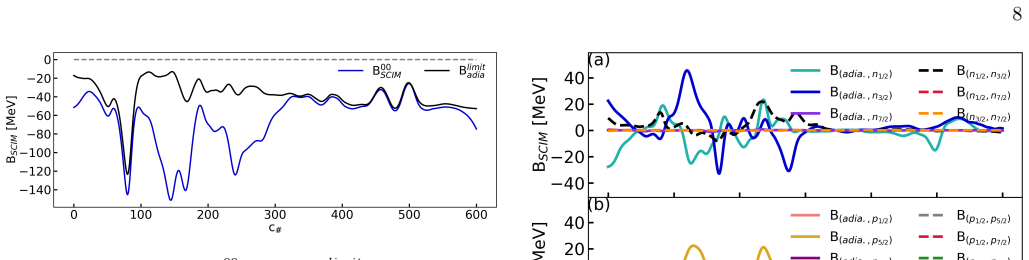
The load-bearing object is the SCIM collective-intrinsic Hamiltonian, $H_{\mathrm{SCIM}}(c_\#) = V_{\mathrm{SCIM}}(c_\#) + [D_{\mathrm{SCIM}}(c_\#)\,\partial/\partial c_\#]^{(1)} + [B_{\mathrm{SCIM}}(c_\#)\,\partial/\partial c_\#]^{(2)}$, whose collective potential, dissipative tensor, and inertia tensor are built from microscopic kernels of the Gogny D1S interaction by inverting the norm kernel through Symmetric Ordered Products of Operators truncated at second order. Two devices carry the argument. First, a Savitzky-Golay low-pass filter (cubic fits over a window of 131 points) smooths the kernel moments so that the second-order truncation is legitimate; the paper argues this is not merely numerical smoothing but a controlled low-frequency regularization consistent with the GOA, and indeed the SCIM adiabatic limit reproduces the exact GOA zero-point energies and masses, while GOA+Cranking and GOA+ATDHFB deviate qualitatively. Second, a continuity equation derived from the collective-intrinsic Schrödinger equation splits the probability current into a vanishing potential term, a dissipative term $J_D = -\frac{2i}{\hbar}\,\mathrm{Im}\sum_{ij} g_i D_{ij} g_j^*$, and an inertial term $J_B = -\frac{8i}{\hbar}\,\mathrm{Im}\sum_{ij} g_i B_{ij}\,\partial g_j^*/\partial c_\#$, so that the total scission flux becomes a sum of per-channel fluxes, each convertible into a yield $Y_i(c_s) = \phi_i(c_s)/\phi_{\mathrm{tot}}(c_s)$. That decomposition is what converts a single wave-packet propagation into the result that excited channels dominate the scission flux.
What would settle it
A computational falsifier is a basis-completeness study: enlarge the excitation set (more $\Omega$ values, additional two-quasiparticle states, or a second-generation selection) and recompute the scission yields; if the excited share drops well below 84% or the neutron/proton balance reverses, the central claim fails. An experimental falsifier is the energy balance: the computed TXE of 34.40 MeV sits about 4 MeV above the ~30 MeV estimate from measured neutron multiplicities and gamma emission for $^{239}\mathrm{Pu}(n_{\mathrm{th}},f)$, and a precise measurement of TKE and TXE distributions that excluded this discrepancy would indicate that the inferred 7.55 MeV intrinsic excitation energy is mis-estimated.
Extended reading notes
Core claim
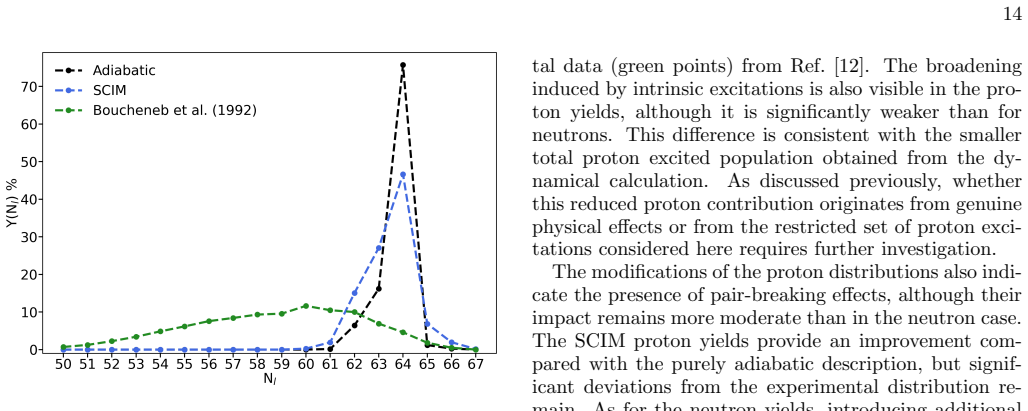
The central claim, stated in the abstract and quantified in Section IV.B, is that the excited states account for more than 80% of the total flux at scission — specifically 84.2% once the flux is averaged over the scission interval $445 \le c_\# \le 545$. The adiabatic channel contributes 15.8%, the neutron $\Omega = 1/2$ excitation 41.5%, the neutron $\Omega = 3/2$ excitation 20.3%, and the proton $\Omega = 5/2$ excitation 17.5%. The same channel-resolved flux analysis yields an averaged intrinsic excitation energy at scission of $E^*_s = 7.55$ MeV, a total excitation energy of $34.40$ MeV (some 4 MeV above the experimental estimate for the $^{239}\mathrm{Pu}(n_{\mathrm{th}},f)$ reaction), and a dissipation coefficient from saddle to scission of $\gamma^* \approx 0.045$ MeV per unit $c_\#$. Including the excitations broadens the predicted fragment neutron and proton distributions and enhances odd-fragment yields, consistent with the pair-breaking nature of the selected excitations; the results are consistent with available experimental data, though the restriction to a one-dimensional path leaves clear discrepancies.
Load-bearing premise
The whole argument rests on the completeness of the six selected variational excitations — three neutron and three proton configurations — as a stand-in for the intrinsic response; if other excited states carry significant flux or couple strongly near scission, the headline percentages, the neutron dominance, and the energy balance would all shift, a possibility the authors themselves leave open in Section IV.B.
Editorial extensions
If this is right
- A fission model restricted to the adiabatic collective channel captures only about one-sixth of the scission flux in 240Pu, so yield predictions from such models rest on the minority component — the paper's explanation for why adiabatic TDGCM systematically underestimates fragment-distribution widths.
- The SCIM inertia and potential in the adiabatic limit agree with the exact Gaussian Overlap Approximation, whereas cranking and ATDHFB inertias deviate substantially near the first barrier and along the descent; this indicates that non-local collective effects, not time-odd corrections, are the leading missing ingredient in standard inertia prescriptions.
- The continuity-equation flux decomposition provides a channel-resolved way to assign yields, fragment distributions, and excitation energy at scission, making each intrinsic configuration's contribution to final observables individually assessable.
- The scission energy balance closes at TXE $= 34.40$ MeV, TKE$_{\mathrm{int}} = 178.26$ MeV, and a pre-scission kinetic energy of 14.4% of TKE, and the TKE computed with the full interaction energy (not just Coulomb) lands close to the 181.24 MeV goal TKE extracted from the SCIM fragment distribution.
Reading between the lines
- A natural extension the paper leaves open is a convergence test: enrich the excitation set with more two-quasiparticle configurations (additional $\Omega$ values, or higher-lying neutron and proton states) and recompute the scission yields; this would settle whether the 84.2% excited share and the neutron dominance are physical or artifacts of the six selected excitations, a question the authors e
- If the excited share survives basis enrichment, the historical successes of adiabatic-only fission models at reproducing some observables would look partly coincidental, plausibly arising from compensation between missing excited flux and effective inertias — the same kind of compensation the paper identifies between ATDHFB masses and non-local effects.
- The approximately linear rise of intrinsic excitation energy from saddle to scission, about $4.5\times10^{-2}$ MeV per unit $c_\#$, invites a comparative study across nuclei and initial energies; a roughly universal slope would provide a cheap dissipative term for much lighter collective models.
- In a multidimensional SCIM, the broadening and odd-even staggering effects seen here along one dimension could be compared quantitatively against experimental yield and TKE maps, which is the direct test of whether intrinsic excitations are the missing ingredient in fragment-width predictions.
Editorial analysis
A structured set of objections, weighed in public.
Referee Report
Summary. This paper reports the first dynamical application of the Schrodinger Collective Intrinsic Model (SCIM) to 240Pu along a one-dimensional asymmetric fission path. It introduces a Savitzky-Golay regularization of the collective potential, inertia, and dissipative tensors; compares the adiabatic SCIM with the Gaussian Overlap Approximation (GOA); constructs and propagates a coupled collective-intrinsic wave packet with a Crank-Nicolson scheme and absorbing boundary conditions; derives channel-resolved probability fluxes from a continuity equation; and extracts excited yields, fragment distributions, and an energy balance at scission. The headline result is that excited channels carry 84.2% of the scission flux (adiabatic 15.8%), with neutron excitations dominant, and that including intrinsic excitations broadens fragment distributions and gives TXE = 34.40 MeV and TKE_int = 178.26 MeV.
Significance. If the 84.2% result is robust, the paper makes a significant contribution: it would indicate that adiabatic-only TDGCM calculations retain at most about 16% of the scission flux, and it would justify the SCIM program as a framework for including intrinsic excitations in fission dynamics. The paper contains genuine technical contributions, including the explicit probability-current decomposition in Appendix A, the coupled-channel dynamical propagation, and the first comparison of SCIM and exact GOA zero-point energies and inertias. The main excited-flux result is not obtained by fitting to the experimental data used for comparison, so it has independent grounding. The significance is conditional, however, on the convergence of the finite-time flux, on the representativeness of the six chosen variational excitations, and on the consistency of the scission-coordinate averaging used for the yields and fragment distributions.
major comments (5)
- [Sec. IV.B, Eqs. (29)-(38), Fig. 15] The paper defines the total flux as the infinite-time integral in Eq. (31), but all reported fluxes are evaluated after t_f = 7.90e-20 s using the finite-time definition in Eq. (29). At that time only 60.6% of the initial norm has been absorbed (Sec. IV.A.2) and the remaining 39.4% is still tunneling through the first barrier. The yields in Eq. (39) are therefore snapshot yields of the flux that crossed by t_f, not the converged asymptotic scission flux, and the 84.2% excited share may change with additional propagation time. Please show the convergence of phi_i(c_s) in t_f and report the late-time behavior, or rephrase the claim as a finite-time result.
- [Sec. IV.B, Eq. (39) and yields paragraph] The yields are obtained by averaging fluxes over the interval 445 <= c# <= 545, chosen because of strong fluctuations near scission. No sensitivity to the width or position of this window is reported, despite the strong local variations visible in Figs. 15 and 17. Please provide the window dependence of the channel yields and of the 84.2% excited fraction, or use an alternative definition less sensitive to arbitrary averaging.
- [Sec. IV.B and IV.C, Figs. 16-19] The central excited-flux result, the neutron/proton asymmetry, and the fragment broadening all rest on the assumption that the six selected variational excitations (three neutron, three proton) represent the intrinsic response. The authors explicitly flag in Sec. IV.B that the neutron dominance may be a selection effect, and a similar caveat is given for the proton yields in Sec. IV.C. Since E*_s = 7.55 MeV and the channel decomposition in Eq. (38) depend on this set, please add a sensitivity test with additional or alternative excited configurations, or at least quantify how much the excited flux changes when individual states (e.g., the weakly coupled neutron Omega = 7/2 state) are removed.
- [Eqs. (35)-(37) and Appendix A] As written, the currents J_D and J_B contain explicit factors of i multiplying Im(...), which would make J complex for real D and B. The fluxes in Eqs. (29) and (37) are real observables, so either D and B are purely imaginary by the SOPO convention, which should be stated, or the prefactors contain a typo. Please clarify the Hermiticity/SOPO conventions and verify the prefactors, since all yields are computed from these currents.
- [Sec. IV.B-C, Eqs. (39)-(41), Figs. 18-19] The channel yields Y_i used in the fragment distributions are averaged over 445 <= c# <= 545, but the fragment probabilities c_i^2(N_l,h) and c_i^2(Z_l,h) are evaluated at the single point c# = 495. Mixing window-averaged channel weights with single-point fragment probabilities is not justified in the text and may bias the broadening comparison with experiment. Please either evaluate both quantities at the same scission point(s) or explain the averaging prescription.
minor comments (6)
- [Abstract and Sec. IV.C] The phrase "we evaluate, the neutron and proton fragment distributions" contains a stray comma.
- [Eq. (28)] At c# = 600 the imaginary term evaluates to +3.8 i, since -5e-6*c#^2 + 0.1*c# - 62 = -3.8, which would anti-absorb rather than absorb probability; please check the sign convention of the absorbing potential.
- [Sec. II.A and II.C, Figs. 4-5] The SG filter is motivated as enforcing the same low-frequency character as the GOA, so the close SCIM-GOA agreement should be presented as a consistency check rather than an independent validation; a sensitivity scan in the filter window r would strengthen this claim.
- [Sec. IV.A.2] The statement "a time step Delta t = 6e-4 hbar" has incorrect units; the time step should be expressed in units such as hbar/MeV.
- [Eq. (21)] The expectation value appears to be written as sum_{c#} v(c#) H_SCIM v(c#) rather than sum_{c#} v*(c#) H_SCIM v(c#); please clarify that the basis states v_i are real.
- [Reference list] Reference [3] is the present manuscript and should be marked as "this work" rather than as a submitted article.
Circularity Check
Core excited-flux result is self-contained; only a partial SCIM-GOA validation-by-construction was found.
-
self definitional
[Section II.A (Savitzky-Golay regularization) and the SCIM-GOA comparison in Section II.C]
"The physical motivation behind the SG regularization is closely tied to the structure of the GOA... the GOA inherently acts as a low-frequency approximation of the collective dynamics. The SG regularization serves a closely analogous purpose within the SCIM framework. By filtering out rapid local oscillations in the kernel moments when evaluating their derivatives, it suppresses short-wavelength structures that cannot be consistently described within the second-order truncation underlying the SCIM formulation."
The SCIM-GOA agreement is presented as an independent validation ('The most remarkable result is the near-perfect agreement between the SCIM and exact GOA predictions. This agreement is non-trivial'). However, the SG filter was introduced specifically to remove the same short-wavelength, non-local variations that the GOA discards by its second-order expansion. The filtered SCIM ingredients are therefore constructed to live in the GOA-like low-frequency subspace, and the subsequent agreement largely reports that the filter does what it was designed to do.
full rationale
The headline result, that excited channels carry 84.2% of the scission flux, is obtained from the time propagation of the SCIM Hamiltonian with six explicitly chosen variational excitations; it is not fitted to the experimental data used later for comparison. The authors' own caveats about the limited set of excitations and about whether neutron dominance is physical or selection-driven are limitations, not circularity. Similarly, the finite-time evaluation of fluxes at t_f=7.90e-20 s, with only 60.6% of the norm absorbed, is a convergence/robustness concern rather than a circularity. The one genuine circularity is the SCIM-GOA consistency check: the Savitzky-Golay low-pass filter is justified as implementing exactly the low-frequency truncation that the GOA performs, and then the resulting agreement with GOA is offered as nontrivial support. That step is partly validation-by-construction, but it does not affect the central excited-flux claim, which stands on its own dynamical calculation. Overall circularity is therefore low, score 2.
Assumptions & free parameters
free parameters (6)
- SG filter window r =
131
- Absorbing potential coefficients in Eq. (28) =
a=-5e-6, b=0.1, c=-62
- Initial wave packet centroid and width =
Ebar_G=-1792.21 MeV, sigma_G=0.5 MeV
- Scission yield averaging window =
445 <= c# <= 545
- Scission coordinate for fragment distributions =
c# = 495
- Time step for Crank-Nicolson propagation =
6 x 10^-4 hbar
assumptions (7)
- domain assumption Second-order Symmetric Ordered Product truncation and norm-kernel inversion converge for the SCIM Hamiltonian.
- standard math The Gaussian Overlap Approximation form for the overlap kernel and second-order expansion of the reduced kernel h are valid.
- domain assumption The Gogny D1S effective interaction describes the relevant 240Pu fission configurations.
- domain assumption The Link, Drop, and Continuous Deflation protocols from Parts I and II yield continuous and regular asymmetric paths.
- ad hoc to paper The six variational excitations are representative of the intrinsic response.
- domain assumption The absorbing boundary removes outgoing probability without altering the physical flux.
- ad hoc to paper Scission can be represented by a single coordinate interval around c#=495.
Cite this review
Pith. "Pith review of Microscopic description of the fission process including intrinsic excitations. Part III: 240Pu fission dynamics along 1D asymmetric paths within the Schrodinger Collective Intrinsic Model." pith.science (2026). https://pith.science/paper/YYLGFJYR
@misc{pith2026260807137,
  author       = {Pith},
  title        = {Pith review of: Microscopic description of the fission process including intrinsic excitations. Part III: 240Pu fission dynamics along 1D asymmetric paths within the Schrodinger Collective Intrinsic Model},
  year         = {2026},
  howpublished = {\url{https://pith.science/paper/YYLGFJYR}},
  note         = {Machine review of arXiv:2608.07137}
}
read the original abstract
This last article of the trilogy focuses on the dynamical equation of the Schrodinger Collective-Intrinsic Model (SCIM). First, we motivate and discuss the need to regularize the adiabatic and excited dynamical ingredients entering the collective-intrinsic Hamiltonian, namely the collective potential, the collective inertia tensor, and the collective dissipative tensor. In particular, we introduce a Savitzky-Golay low-pass filter to remove numerical fluctuations incompatible with the second-order truncation in the Symmetric Ordered Product of Operators used to derive the SCIM equations. The diagonal and off-diagonal properties of the three dynamical ingredients are then analyzed along the asymmetric fission path in 240Pu. This study highlights the dominant role of neutron and proton excitation channels, especially in the second well and scission regions, whereas proton-neutron couplings remain essentially negligible. Furthermore, in the adiabatic limit of the SCIM, we perform a comparison with the GOA which reveals very close predictions. Second, we discuss the construction of the initial wave packet and the numerical resolution of the collective-intrinsic Schrodinger equation. Using a continuity equation, we derive the probability fluxes associated with the different components of the wave function, which provide direct access to the contribution of the different excitations to the final observables for the fission problem. The excited states are found to account for more than 80% of the total flux at scission. Finally, we evaluate, the neutron and proton fragment distributions as well as the energy balance, including the total kinetic and excitation energies. The obtained results are found to be consistent with available experimental data and demonstrate the importance of explicitly including intrinsic excitations in the description of fission dynamics.
Figures


Figures from the paper (14 more)






Reference graph
Works this paper leans on
-
[1]
Zero-point energies Rather than focusing on the collective potentials them- selves, we consider the associated zero-point energies (ZPE), which provide a more sensitive probe of the un- derlying collective dynamics. The ZPE associated with a given collective potentialVcan be defined as: ZP E(c#) =V(c #)−E HF B(c#),(14) whereE HF B corresponds to the total...
-
[2]
Inertial masses A similar analysis is performed for the collective masses M, which provide a more direct characterization of the collective dynamics. In the SCIM framework, the collec- tive mass is related to the inertia tensor through MSCIM (c#) =− 1 2BSCIM (c#) .(15) FIG. 5 shows the comparison between SCIM, exact GOA, GOA+Cranking, and GOA+ATDHFB resul...
-
[3]
Construction of the initial wave packet Two main strategies are commonly used in the lit- erature to construct the initial wave packet. The first consists in building a wave packet confined in an ex- trapolated ground-state potential well (see, for example, Ref. [8]), while the second additionally applies an ini- tial boost along the fission direction (se...
-
[4]
[8], this system is solved iteratively
Time propagation The collective-intrinsic Schr¨ odinger equation is solved using the Crank-Nicolson scheme, which leads to g(c#, t+ ∆t)−g(c #, t) ∆t =− iHSCIM (c#) 2ℏ ×[g(c #, t+ ∆t) +g(c#, t)].(24) This expression can be rewritten as the linear system (1 +i HSCIM (c#)∆t 2ℏ )g(c#, t+ ∆t) = (1−i HSCIM (c#)∆t 2ℏ )g(c#, t).(25) Following Ref. [8], this syste...
-
[5]
Derivation of the probability fluxes The probability flux through a given positionc s during a finite propagation timet f is defined as: ϕ(cs, tf ) = Z tf 0 dt dP(c # > cs) dt (t),(29) where P(c # > cs)(t) = Z 800 cs dc# X i |gi(c#, t)|2 (30) is the probability contained beyond the positionc s at timet. The quantityϕ(c s, tf ) represents the net probabili...
-
[6]
Flux analysis and excited yields In FIG. 15, we display the total probability flux (blue curve), together with its adiabatic (black curve) and excited (red curve) contributions. The excited contri- bution is defined as the sum of allϕ i withi >0. The fluxes are evaluated at the end of the propagation, t= 7.90×10 −20 s, for different values of the collecti...
-
[7]
P. Carpentier, N. Pillet, R. Bernard, L. Robledo, D. Lacroix, N. Dubray, D. Regnier, and W. Younes, Mi- croscopic description of fission process including intrin- sic excitations. Part I: 240Pu adiabatic and asymmetric fission path within the Schr¨ odinger Collective Intrinsic Model, submitted to Physical Review C (2026)
work page 2026
-
[8]
P. Carpentier, N. Pillet, R. Bernard, L. Robledo, D. Lacroix, N. Dubray, D. Regnier, and W. Younes, Mi- croscopic description of fission process including intrinsic excitations. Part II: 240Pu excited and asymmetric fission paths within the Schr¨ odinger Collective Intrinsic Model, submitted to Physical Review C (2026)
work page 2026
Show all 21 references
-
[9]
Carpentier, N
P. Carpentier, N. Pillet, R. Bernard, L. Robledo, D. Lacroix, N. Dubray, D. Regnier, and W. Younes, Mi- croscopic description of fission process including intrinsic excitations. Part III: 240Pu fission dynamics along 1D asymmetric paths within the Schr¨ odinger Collective In- ...
2026
-
[10]
Ring and P
P. Ring and P. Schuck,The Nuclear Many-Body Problem (Springer-Verlag, Berlin, Germany, 2000)
2000
-
[11]
Carpentier,Microscopic and dynamical descrip- tion of the fission process including intrinsic exci- tations, Ph.D
P. Carpentier,Microscopic and dynamical descrip- tion of the fission process including intrinsic exci- tations, Ph.D. thesis, Th` ese de doctorat, Universit´ e Paris-Saclay (2024), available athttps://theses.hal. science/tel-04761482v1
2024
-
[12]
Savitzky and M
A. Savitzky and M. J. E. Golay, Smoothing and differentiation of data by simplified least squares procedures., Analytical Chemistry36, 1627 (1964), https://doi.org/10.1021/ac60214a047
1964 doi
-
[13]
Younes, D
W. Younes, D. Gogny, and J.-F. Berger, The generator coordinate method (2019) pp. 79–173
2019
-
[14]
Goutte, J
H. Goutte, J. F. Berger, P. Casoli, and D. Gogny, Micro- scopic approach of fission dynamics applied to fragment kinetic energy and mass distributions in 238U, Phys. Rev. C71, 024316 (2005)
2005
-
[15]
Press, S
W. Press, S. Teukolsky, W. Vetterling, and B. Flan- nery,Numerical Recipes: The Art of Scientific Comput- ing(Cambridge University Press, Cambridge, 2007)
2007
-
[16]
D. S. N. Carjan and M. Rizea, Towards numerically solving the two-dimensional time-dependent schr¨ odinger equation for long-lived decaying states, Romanian Jour- nal of Physics47(2002)
2002
-
[17]
Regnier, N
D. Regnier, N. Dubray, N. Schunck, and M. Verri` ere, Fission fragment charge and mass distributions in 239Pu(n, f) in the adiabatic nuclear energy density func- tional theory, Phys. Rev. C93, 054611 (2016)
2016
-
[18]
Boucheneb, M
N. Boucheneb, M. Asghar, G. Barreau, T. Doan, B. Ler- oux, A. Sicre, P. Geltenbort, and A. Oed, A high- resolution multi-parametric study of 239pu(nth, f) with the cosi-fan-tutte spectrometer, Nuclear Physics A535, 77 (1991)
1991
-
[19]
Marini, J
P. Marini, J. Taieb, D. Neudecker, G. B´ elier, A. Chatil- lon, D. Etasse, B. Laurent, P. Morfouace, B. Moril- lon, M. Devlin, J. Gomez, R. Haight, K. Kelly, and J. O’Donnell, Energy dependence of prompt fissions neu- tron multiplicity in the 239pu(n,f) reaction, Physics Let- ...
2022
-
[20]
Caama˜ no and F
M. Caama˜ no and F. Farget, Energy balance and deforma- tion at scission in 240pu fission, Physics Letters B770, 72 (2017)
2017
-
[21]
Tanimura, D
Y. Tanimura, D. Lacroix, and S. Ayik, Microscopic phase-space exploration modeling of 258Fm spontaneous fission, Phys. Rev. Lett.118, 152501 (2017)
2017
Reviewed August 10, 2026 · model on record in the stance chip above.
Discussion (0). Continue with ORCID to comment.