Bridging Technical AI, Societal Impacts, and Workforce Competencies in AI Education
Pith reviewed 2026-06-26 13:15 UTC · model grok-4.3
The pith
AI education must link technical knowledge to societal impacts and workforce competencies for responsible action.
A machine-rendered reading of the paper's core claim, the machinery that carries it, and where it could break.
Core claim
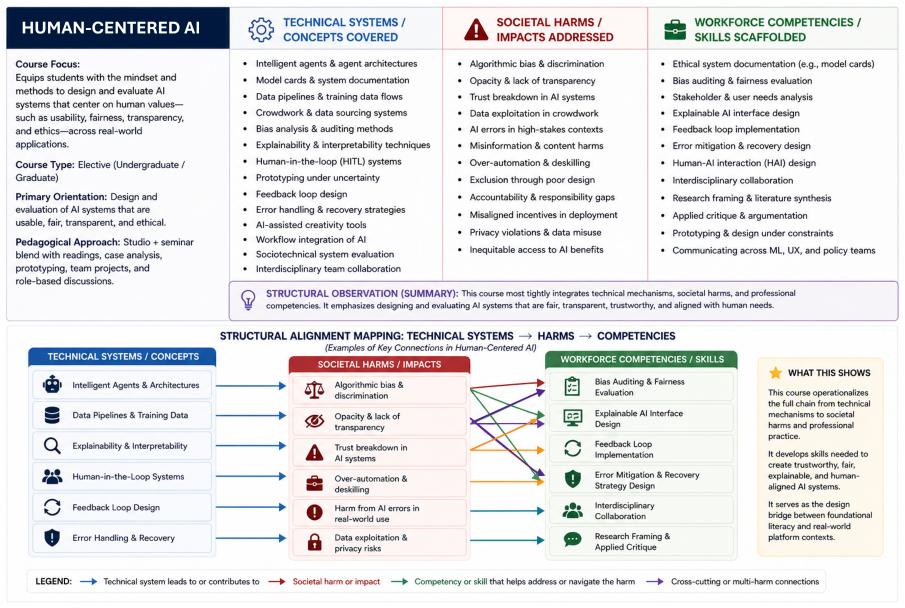
The central claim is that AI literacy cannot stop at awareness of AI concepts or harms; it must also include competencies for responsible action in AI-enabled contexts. This is shown through a curriculum mapping framework that links technical systems, societal harms, and workforce competencies, beginning with institutional courses and expanding through an external 335-course registry, with early findings from six courses indicating that technical coverage is often strong while societal harms are present but uneven and workforce competencies are rarely assessed.
What carries the argument
The curriculum mapping framework that links technical systems, societal harms, and workforce competencies by starting with institutional courses and expanding through an external course registry.
If this is right
- Technical coverage in AI courses tends to be strong.
- Societal harms appear in courses but are integrated unevenly.
- Workforce competencies receive little explicit assessment in the sampled courses.
- AI literacy requires building competencies for responsible action rather than stopping at awareness of concepts or harms.
Where Pith is reading between the lines
- Educators could apply the framework to redesign individual courses for tighter integration of the three areas.
- Expanding the mapping to the full registry might identify patterns that guide broader curriculum standards.
- The approach could connect to efforts that measure whether integrated teaching improves student decision-making in actual AI deployments.
- Policy discussions on AI education requirements might draw on the three-way linkage to define minimum competencies.
Load-bearing premise
The curriculum mapping framework and the sample of six courses provide a valid and generalizable picture of how technical, societal, and workforce elements are currently taught across AI education.
What would settle it
Mapping additional courses from the 335-course registry and finding consistent explicit assessment of workforce competencies or even integration of all three areas would undermine the reported gaps.
Figures
read the original abstract
As AI becomes embedded across everyday life and work, educators must help students connect technical knowledge with societal consequences and workplace responsibilities. Yet AI education often remains fragmented, with technical concepts, ethics, human-centered design, and workforce preparation taught separately. This work-in-progress presents a curriculum mapping framework that links technical systems, societal harms, and workforce competencies, beginning with institutional courses and expanding through an external 335-course registry. Early findings from six courses suggest that technical coverage is often strong, societal harms are present but unevenly integrated, and workforce competencies are rarely explicitly assessed. These findings speak to AI literacy efforts by showing that literacy cannot stop at awareness of AI concepts or harms; it must also include competencies for responsible action in AI-enabled contexts.
Editorial analysis
A structured set of objections, weighed in public.
Referee Report
Summary. The manuscript presents a curriculum mapping framework that connects technical AI systems, societal harms, and workforce competencies. It reports early findings from an initial mapping of six courses (with reference to an external 335-course registry), observing strong technical coverage, uneven integration of societal harms, and rare explicit assessment of workforce competencies. From these observations the authors conclude that AI literacy cannot be limited to awareness of concepts or harms but must also encompass competencies for responsible action in AI-enabled contexts.
Significance. If the framework proves robust and the reported distribution generalizes, the work could supply educators with a practical tool for reducing fragmentation in AI curricula and for designing courses that prepare students for professional responsibilities. The explicit linkage of workforce competencies to literacy definitions is a constructive contribution to the AI education literature.
major comments (2)
- [Abstract / early findings] Abstract and early-findings description: the reported distribution (strong technical coverage, uneven societal harms, rare workforce assessment) rests on a convenience sample of six courses; no selection criteria, stratification, or inter-rater reliability statistics are supplied, so the observation cannot yet be treated as representative of the broader AI education landscape referenced via the 335-course registry.
- [Abstract] The central claim that AI literacy must include responsible-action competencies is load-bearing on the finding that workforce elements are rarely assessed; because the six-course sample lacks documented methodology, the claim currently rests on a descriptive observation whose generalizability remains unverified.
minor comments (1)
- [Abstract] The abstract would benefit from a single sentence that explicitly separates the framework description from the empirical observations drawn from the six courses.
Simulated Author's Rebuttal
We thank the referee for these helpful comments on the preliminary character of our early findings. We agree that the current presentation would benefit from greater methodological transparency and will revise the manuscript accordingly while preserving the work-in-progress framing.
read point-by-point responses
-
Referee: [Abstract / early findings] Abstract and early-findings description: the reported distribution (strong technical coverage, uneven societal harms, rare workforce assessment) rests on a convenience sample of six courses; no selection criteria, stratification, or inter-rater reliability statistics are supplied, so the observation cannot yet be treated as representative of the broader AI education landscape referenced via the 335-course registry.
Authors: We accept this observation. The six courses constitute a convenience sample of syllabi and assessment materials readily available to the author team at our institution; we will add an explicit paragraph describing the selection process, the absence of stratification, and the collaborative (rather than multi-rater) mapping procedure. We will also state that inter-rater reliability metrics are not yet available and outline plans to compute them once the framework is applied to the larger registry. The text will continue to label these results as early findings rather than representative statistics. revision: yes
-
Referee: [Abstract] The central claim that AI literacy must include responsible-action competencies is load-bearing on the finding that workforce elements are rarely assessed; because the six-course sample lacks documented methodology, the claim currently rests on a descriptive observation whose generalizability remains unverified.
Authors: We agree that the claim's strength depends on the observed pattern and will revise the abstract and introduction to foreground that the workforce-competency gap is reported for the courses examined in this pilot. The broader argument is that the framework itself supplies a practical means for educators to close such gaps; we will rephrase to avoid implying that the six-course distribution already demonstrates a universal deficit. The work-in-progress status and the intended expansion to the 335-course registry will be stated more prominently. revision: partial
Circularity Check
No significant circularity; descriptive framework with no derivations or self-referential reductions
full rationale
The paper introduces a curriculum mapping framework and reports early descriptive findings from six courses without any equations, fitted parameters, predictions, or load-bearing self-citations. The central claim about AI literacy requiring responsible-action competencies follows directly from the observed distribution of technical, societal, and workforce elements in the mapped courses; this observation does not reduce to a prior input by construction, nor does the framework invoke uniqueness theorems or ansatzes from the authors' own prior work. The analysis remains self-contained as a qualitative mapping exercise.
Axiom & Free-Parameter Ledger
Reference graph
Works this paper leans on
-
[1]
O’Neil, Weapons of Math Destruction: How Big Data Increases Inequality and Threatens Democracy, Crown Publishing Group, New York, NY, USA, 2016
C. O’Neil, Weapons of Math Destruction: How Big Data Increases Inequality and Threatens Democracy, Crown Publishing Group, New York, NY, USA, 2016
2016
-
[2]
S. U. Noble, Algorithms of Oppression: How Search Engines Reinforce Racism, NYU Press, New York, 2018. URL: https://www.jstor.org/stable/j.ctt1pwt9w5
2018
-
[3]
Eubanks, Automating Inequality: How High-Tech Tools Profile, Police, and Punish the Poor, St
V. Eubanks, Automating Inequality: How High-Tech Tools Profile, Police, and Punish the Poor, St. Martin’s Press, New York, NY, 2018
2018
-
[4]
The global landscape of AI ethics guidelines
A. Jobin, M. Ienca, E. Vayena, The global landscape of ai ethics guidelines, Nature Machine Intelligence 1 (2019) 389–399. URL: https://doi.org/10.1038/s42256-019-0088-2. doi: 10.1038/ s42256-019-0088-2
-
[5]
B. Shneiderman, Human-centered artificial intelligence: Reliable, safe & trustworthy, International Journal of Human-Computer Interaction 36 (2020) 495–504. URL: https://doi.org/10.1080/10447318. 2020.1741118. doi:10.1080/10447318.2020.1741118
-
[6]
Q. Yang, N. Banovic, J. Zimmerman, Mapping machine learning advances from hci research to reveal starting places for design innovation, in: Proceedings of the 2018 CHI Conference on Human Factors in Computing Systems, CHI ’18, ACM, New York, NY, USA, 2018, pp. 1–11. URL: https://doi.org/10.1145/3173574.3173704. doi:10.1145/3173574.3173704
-
[7]
URL: https: //csed.acm.org/wp-content/uploads/2023/03/Version-Beta-v2.pdf, joint effort of ACM, IEEE-CS, and AAAI
The Joint Task Force on Computing Curricula, Computer Science Curricula 2023: Version Beta, Technical Report, Association for Computing Machinery (ACM), IEEE-Computer Society (IEEE- CS), and Association for the Advancement of Artificial Intelligence (AAAI), 2023. URL: https: //csed.acm.org/wp-content/uploads/2023/03/Version-Beta-v2.pdf, joint effort of AC...
2023
-
[8]
Amini, H
L. Amini, H. F. Korth, N. Patel, E. Peck, B. Zorn, Empowering the Future Workforce: Prioritizing Education for the AI-Accelerated Job Market, CRA Quadrennial Paper, Computing Research Associ- ation (CRA), 2024. URL: https://cra.org/wp-content/uploads/2025/02/2024-2025-CRA-Quad-Paper_ -Empowering-the-Future-Workforce-Prioritizing-Education-for-the-AI-Accel...
2024
-
[9]
C. Fiesler, N. Garrett, N. Beard, What do we teach when we teach tech ethics? a syllabi analysis, in: Proceedings of the 51st ACM Technical Symposium on Computer Science Education, SIGCSE ’20, Association for Computing Machinery, New York, NY, USA, 2020, p. 497–503. URL: https: //doi.org/10.1145/3328778.3366825. doi:10.1145/3328778.3366825
-
[10]
J. Saltz, M. Skirpan, C. Fiesler, M. Gorelick, T. Yeh, R. Heckman, N. Dewar, N. Beard, Integrating ethics within machine-learning courses, ACM Trans. Comput. Educ. 19 (2019). URL: https://doi. org/10.1145/3341164. doi:10.1145/3341164
-
[11]
A. D. Selbst, d. boyd, S. A. Friedler, S. Venkatasubramanian, J. Vertesi, Fairness and abstraction in sociotechnical systems, in: Proceedings of the 2019 Conference on Fairness, Accountability, and Transparency, FAT* ’19, Association for Computing Machinery, New York, NY, USA, 2019, p. 59–68. URL: https://doi.org/10.1145/3287560.3287598. doi:10.1145/32875...
-
[12]
Green, L
B. Green, L. Hu, The myth in the methodology: Towards a recontextualization of fairness in machine learning, in: Proceedings of the Machine Learning: The Debates Workshop at the 35th International Conference on Machine Learning (ICML), Stockholm, Sweden, 2018
2018
-
[13]
B. J. Grosz, D. G. Grant, K. Vredenburgh, J. Behrends, L. Hu, A. Simmons, J. Waldo, Embedded ethics: Integrating ethics across cs education, Commun. ACM 62 (2019) 54–61. URL: https: //doi.org/10.1145/3330794. doi:10.1145/3330794
-
[14]
Guidelines for Human-AI Interaction,
S. Amershi, D. Weld, M. Vorvoreanu, A. Fourney, B. Nushi, P. Collisson, J. Meek, B. Mahtab, J. Taylor, R. Williams, K. Lum, E. Horvitz, J. Teevan, Guidelines for human-ai interaction, in: Proceedings of the 2019 CHI Conference on Human Factors in Computing Systems, CHI ’19, Association for Computing Machinery, New York, NY, USA, 2019, p. 1–13. URL: https:...
-
[15]
Fiesler, Tech ethics curricula: A collection of syllabi, https://cfiesler.medium.com/ tech-ethics-curricula-a-collection-of-syllabi-3eedfb76be18, 2018
C. Fiesler, Tech ethics curricula: A collection of syllabi, https://cfiesler.medium.com/ tech-ethics-curricula-a-collection-of-syllabi-3eedfb76be18, 2018. Accessed: 2026-06-17
2018
discussion (0)
Sign in with ORCID, Apple, or X to comment. Anyone can read and Pith papers without signing in.