REVIEW 3 major objections 5 minor 2 cited by
Automating Equational Proofs in Dirac Notation
T0 review · 3 major / 5 minor · reviewed 2026-08-12 · deepseek-v4-flash
Pith's one-line read Dirac notation's first-order theory is decidable, and equations reduce to unique normal forms.
desk verdict A useful, honestly-scoped rewriting tool for Dirac notation whose abstract oversells the decision procedure: completeness is still a conjecture, and the paper itself supplies a valid identity the §7 algorithm cannot decide. read the letter →
The pith
A machine-rendered reading of the paper's core claim, the machinery that carries it, and where it could break.
The reading
What carries the argument
The load-bearing object is the many-sorted first-order theory DN with types S for scalars, K(sigma) and B(sigma) for kets and bras over a classical basis type sigma, and O(sigma,tau) for linear operators, together with the AC term-rewriting system R_DN. The theory's decidability rests on the basis-expansion identity that decomposes every ket, bra, and operator into complex combinations of basis elements; the rewrite system's work is to orient the linear-algebra equalities into rules that sort multiplications to the right, distribute tensor products, reduce inner products of basis kets to Kronecker deltas, and propagate adjoints and conjugates until a unique normal form modulo AC is reached. For the extended language DNE with big sums, the machinery adds sum-elimination by delta symbols, pushing symbols into sums, swapping and splitting index sets, and a final alpha-equivalence check by constrained AC-unification.
What would settle it
Find well-typed core-language terms e1 and e2 that are semantically equal but whose R_DN normal forms differ; the tool would report them unequal, disproving relative completeness. For the extended language, a concrete non-joinable pair or an infinite rewriting sequence in R_DNE would falsify the assumption that the stated algorithm is a decision procedure.
Extended reading notes
Core claim
The central claim is that Dirac notation has a decidable first-order theory and a practical equational proof procedure. The decidability argument embeds the many-sorted theory of kets, bras, operators, tensor products, inner and outer products, adjoints, scalars, and Kronecker deltas into the first-order theory of complex numbers: over a fixed finite basis, every state and operator is uniquely determined by complex coefficients, and quantifiers over them become quantifiers over complex numbers; decidability then follows from Tarski's theorem. The equational procedure is a term-rewriting system modulo associativity and commutativity with more than 150 rules, which the paper proves sound, terminating, locally confluent, and hence normalizing to a unique normal form, aided by automated termination and critical-pair tools and a mechanized soundness proof. The paper's Theorem 7.4 gives the one-way direction: same normal form implies semantic equality. The converse, relative completeness of the rewriter, is stated as Conjecture 7.5, with only a weaker completeness result relying on expansion over bases; for the extended language with big sums, termination and confluence of the rewriting rules are not proved.
Load-bearing premise
The load-bearing premise is that the rewrite system's normal forms are complete enough that every semantically valid equation of the core language reduces to the same normal form; the authors state this general direction as Conjecture 7.5, having proved only a weaker basis-expanded version.
Editorial extensions
If this is right
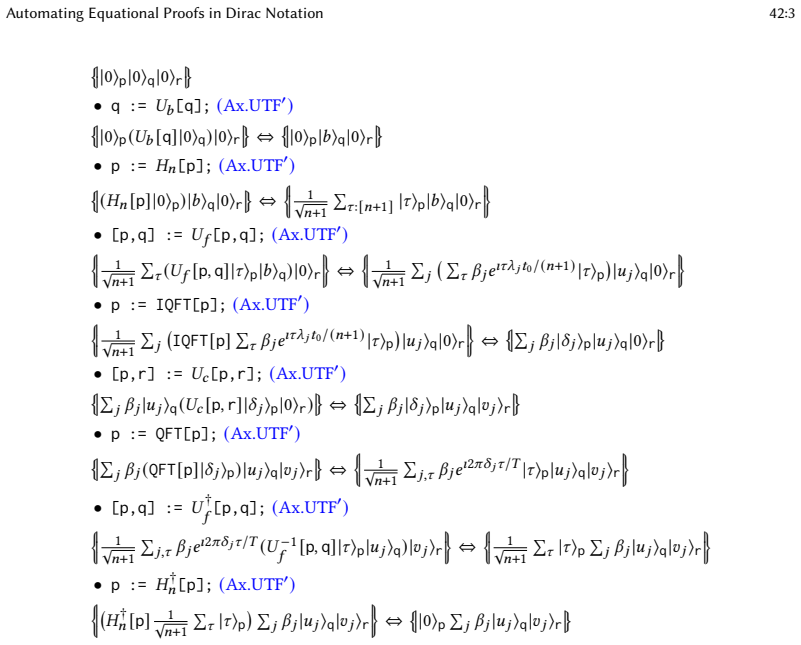
- Quantum program verifiers can replace long manual Dirac-notation proof snippets by calls to a normal-form checker, as demonstrated on the stepwise proof of the HHL algorithm.
- Equations with free variables, such as the maximally-entangled-state law (M tensor I)|Phi> = (I tensor M^T)|Phi> for arbitrary M, can be checked symbolically, which numerical matrix methods cannot do.
- A certificate of semantic equality is produced whenever two expressions have the same R_DN normal form, because every rewriting rule is sound for finite-dimensional Hilbert-space semantics.
- Widespread identities in linear algebra and super-operator theory, including traces, partial traces, Choi states, and adjoints, collapse to near-instant normal-form checks.
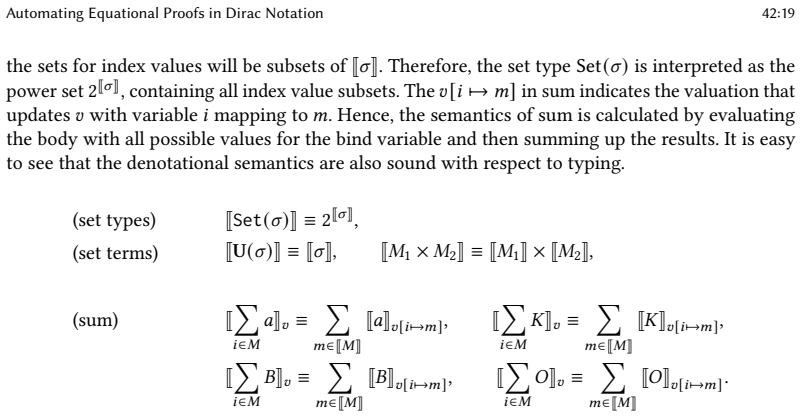
- Big-sum expressions such as entangled states over index sets and quantum while-loop approximations are handled by an extension with sum-index swapping and alpha-equivalence checking.
Reading between the lines
- If Conjecture 7.5 is settled positively, the core rewrite system becomes a genuine decision procedure for equality, upgrading its current sound-only status to complete.
- The decidability theorem is dimension-fixed: it concerns finite-dimensional Hilbert spaces of known dimension, so first-order reasoning about dimension-parametric or infinite-dimensional spaces remains out of scope for the decision procedure as stated.
- For the extended big-sum language, the absence of termination and confluence proofs means the algorithm should be read as a sound simplifier plus heuristic equality checker; a divergence sample would show it is not a decision procedure.
- The symbolic, variable-level nature of the equations makes the approach complementary to fast numerical circuit-verification tools, which cannot handle free variables and which the paper reports remain about three orders of magnitude faster on concrete quantum circuits.
Editorial analysis
A structured set of objections, weighed in public.
Referee Report
Summary. The paper develops a many-sorted first-order theory DN for Dirac notation—bras, kets, operators, scalars, tensor products, adjoints, and Kronecker deltas—and an extension DNE with finitely indexed sums. Its first main result is a proof that the first-order theory of DN is decidable for fixed finite-dimensional Hilbert spaces by reduction to the theory of complex numbers and Tarski's theorem (Theorem 6.2). Its second claimed result is an efficient decision procedure for equations based on an AC term-rewriting system R_DN, with soundness proved in Coq and termination/local confluence checked with AProVE and CiME2. The paper also defines an extended algorithm for DNE, implements the approach in a Mathematica package called DiracDec, and evaluates it on CoqQ lemmas, Palsberg-Yu examples, and parameterized quantum circuits. The body is honest about the main limitation: completeness of R_DN is left as Conjecture 7.5, and termination/confluence of R_DNE are explicitly not proved.
Significance. If the completeness conjecture and the DNE termination/confluence issues were resolved, this would be a substantial and useful contribution to automated reasoning for quantum programs. The strongest, most reliable parts of the paper are the machine-checked soundness proof for the rewrite rules, the decidability theorem under the fixed finite-dimensional restriction, the explicit identification of the delta-product obstruction to completeness, and the extensive empirical evaluation. As it stands, however, the advertised 'efficient decision' claim is conditional: the paper establishes a sound simplification engine and a decidability result, but not a proven decision procedure for the full language presented in the abstract.
major comments (3)
- [§7.2, Theorem 7.4 and Conjecture 7.5] The second headline claim of the paper is not a theorem. Theorem 7.4 proves only the soundness direction: identical R_DN normal forms imply semantic equality. The converse—semantic equality implies identical normal forms—is explicitly left open in Conjecture 7.5, and the paper itself observes that δ_{i,j}×δ_{i,k} and δ_{i,j}×δ_{j,k} have identical denotations but are both irreducible and not AC-equivalent under R_DN. Thus the §7 normal-form test cannot decide this valid equation unless an additional oracle for δ-product equivalence is supplied. The abstract's statement that 'validity of equations can be decided efficiently' is therefore unsupported by the present theorems. The claims should be reframed as a sound simplifier or heuristic, or the completeness theorem must be proved for a precisely delimited fragment.
- [§8, Definition 8.3 and text after Lemma 8.4] The extended-language algorithm is also not established as a decision procedure. Definition 8.3 prescribes rewriting to R_DNE normal forms, applying Sum-Expand once, rewriting again, and checking alpha-equivalence, but the paper explicitly says that termination and confluence of R_DNE are not proved. The algorithm additionally relies on the axioms (Sum-Swap) and (Alpha-Eq) outside the rewrite system, and no invariant is given to show that the one-pass expansion reaches a unique normal form. The evaluation in §10 demonstrates practical usefulness, but it does not compensate for the absence of a termination or completeness proof. The extended procedure should be presented as a heuristic, with the open termination and confluence conditions stated prominently.
- [Abstract and §6, Theorem 6.2] The decidability claim as stated in the abstract is overbroad. Theorem 6.2 is explicitly restricted to fixed finite-dimensional Hilbert spaces, and its proof relies on the basis-decomposition axioms of Definition 6.1 to reduce quantification over kets, bras, and operators to quantification over finitely many complex coefficients. The abstract instead says that 'the first-order theory of Dirac notation is decidable' without this restriction. Either the abstract should include the fixed finite-dimensional qualification, or the theorem should be extended to genuinely variable or infinite-dimensional spaces, which the paper does not do.
minor comments (5)
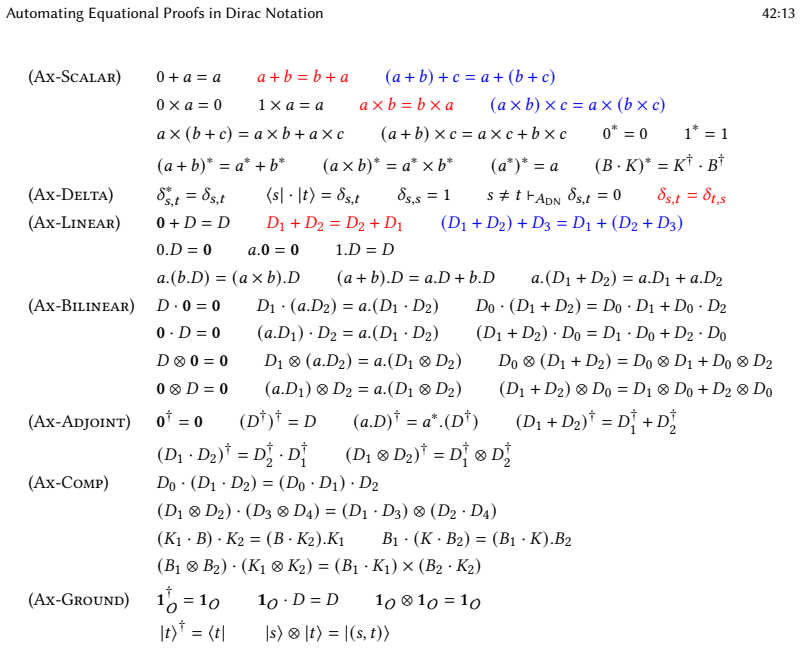
- [Figure 6, Ax-Adjoint] The displayed rule for the adjoint of addition is garbled: '(D1+D2)† = D† 1+D† 2' should be typeset as (D1+D2)† = D1† + D2†.
- [Appendices C and D] The same symbol R'_DN is used for two different systems: the untyped erasure of R_DN in Definition C.3 and the extended system with basis unification and expansion in Definition D.2. These should be renamed to avoid confusion.
- [Lemma D.8] In the scalar case of Lemma D.8, the proof writes 'J a1+a2 K > 0 = J e K', which is not meaningful for complex scalars. This should be replaced by a statement about nonzeroness or norm, especially because this lemma is part of the only attempted weak completeness proof.
- [Abstract and §10] The counts of examples are inconsistent: the abstract says 'more than 100 examples', Section 1 says 'more than 200 examples', and Section 10.1 reports 243 CoqQ examples. These numbers should be reconciled.
- [§7.2] The phrase 'syntactically complete' is used to mean the existence of unique normal forms, which is likely to be confused with the later 'relative completeness' conjecture. A different term, such as 'confluent and terminating', would be clearer.
Circularity Check
No circularity: the derivation chain is self-contained; the identified gaps are completeness overclaims, not circular derivations.
full rationale
The paper's mathematical results are not circular. The decidability reduction (Theorem 6.2) takes an arbitrary DN formula and reduces it to a formula in the first-order theory of complex numbers, whose decidability is imported from Tarski's theorem as an external benchmark; the reduction is a direct semantic argument using the basis decomposition axioms, not an encoding of the target claim. The rewrite system R_DN is proved sound in Coq against an explicit denotational semantics (Lemma 7.1), and termination and local confluence are established by the external tools AProVE and CiME2 (Lemmas 7.2-7.3); none of these steps assumes the equality problem it is meant to decide. The only substantial limitation is that completeness of the rewrite decision procedure is left open (Conjecture 7.5: 'we failed to prove the general theorem because it is difficult to express the normal form using an inductive language'), and the extended-language algorithm is explicitly not proved terminating or confluent ('we do not prove the confluence or termination of R_DNE'), so the abstract's claim that 'validity of equations can be decided efficiently' is stronger than what is proven. These are correctness/completeness caveats, not circular derivations: no parameter is fitted to data and then renamed as a prediction, and no load-bearing premise is justified solely by the authors' own prior work; CoqQ [75] is used as a formalization library whose soundness theorems are machine-checked, which counts as independent evidence under the review rules.
Assumptions & free parameters
assumptions (7)
- domain assumption Finite-dimensional Hilbert spaces are isomorphic to C^n; the theory DN is restricted to such spaces and the decidability proof fixes the dimensions.
- standard math Tarski's theorem: the first-order theory of real closed fields is decidable.
- standard math Newman's lemma: for a terminating abstract rewrite system, local confluence implies confluence.
- domain assumption The outputs of the automated tools AProVE (termination) and CiME2 (local confluence) are correct.
- ad hoc to paper Relative completeness of R_DN, stated as Conjecture 7.5.
- ad hoc to paper The extended rewrite system R_DNE is terminating and confluent enough for the algorithm of Definition 8.3 to produce a decision procedure.
- domain assumption The atomic basis signature is finite, avoiding problems of infinite-dimensional Hilbert spaces.
Cite this review
Pith. "Pith review of Automating Equational Proofs in Dirac Notation." pith.science (2026). https://pith.science/paper/YYT2YVHI
@misc{pith2026241111617,
  author       = {Pith},
  title        = {Pith review of: Automating Equational Proofs in Dirac Notation},
  year         = {2026},
  howpublished = {\url{https://pith.science/paper/YYT2YVHI}},
  note         = {Machine review of arXiv:2411.11617}
}
read the original abstract
Dirac notation is widely used in quantum physics and quantum programming languages to define, compute and reason about quantum states. This paper considers Dirac notation from the perspective of automated reasoning. We prove two main results: first, the first-order theory of Dirac notation is decidable, by a reduction to the theory of real closed fields and Tarski's theorem. Then, we prove that validity of equations can be decided efficiently, using term-rewriting techniques. We implement our equivalence checking algorithm in Mathematica, and showcase its efficiency across more than 100 examples from the literature.
Figures


Figures from the paper (11 more)






Forward citations
Cited by 2 Pith papers
-
An Effective Quantum Hoare Logic for Hybrid Quantum Programs with Unbounded Loops
Integer hybrid path-sums plus a sound Hoare logic enable semi-automated functional verification and expected-cost analysis of hybrid quantum programs with unbounded while loops.
-
Certified Misty-State Rewriting (A Question-and-Answer Guide)
Misty-state terms are assigned an unnormalized-amplitude semantics with scoped normalization, canonical normal forms, and branch-based measurement, so the notation's rewrites become exactly checkable.
Reference graph
Works this paper leans on
-
[1]
Samson Abramsky and Bob Coecke. 2004. A Categorical Semantics of Quantum Protocols. In 19th IEEE Symposium on Logic in Computer Science (LICS 2004), 14-17 July 2004, Turku, Finland, Proceedings . IEEE Computer Society, 415–425. https://doi.org/10.1109/LICS.2004.1319636
arXiv 2004
-
[2]
Matthew Amy. 2019. Towards Large-scale Functional Verification of Universal Quantum Circuits.Electronic Proceedings in Theoretical Computer Science 287 (Jan. 2019), 1–21. https://doi.org/10.4204/eptcs.287.1
-
[3]
Matthew Amy. 2023. Complete Equational Theories for the Sum-Over-Paths with Unbalanced Amplitudes. Electronic Proceedings in Theoretical Computer Science 384 (Aug. 2023), 127–141. https://doi.org/10.4204/eptcs.384.8
-
[4]
Pablo Arrighi and Gilles Dowek. 2005. A Computational Definition of the Notion of Vectorial Space. Electronic Notes in Theoretical Computer Science 117 (1 2005), 249–261. Issue SPEC. ISS.. https://doi.org/10.1016/J.ENTCS.2004.06.013
-
[5]
Pablo Arrighi and Gilles Dowek. 2017. Lineal: A linear-algebraic Lambda-calculus. Logical Methods in Computer Science Volume 13, Issue 1 (3 2017), 1–33. Issue 1. https://doi.org/10.23638/LMCS-13(1:8)2017
-
[6]
Thomas Arts and Jürgen Giesl. 2000. Termination of term rewriting using dependency pairs. Theoretical Computer Science 236 (4 2000), 133–178. Issue 1-2. https://doi.org/10.1016/S0304-3975(99)00207-8
-
[7]
Miriam Backens and Aleks Kissinger. 2018. ZH: A Complete Graphical Calculus for Quantum Computations Involving Classical Non-linearity. In Proceedings 15th International Conference on Quantum Physics and Logic, QPL 2018, Halifax, Canada, 3-7th June 2018 (EPTCS, Vol. 287) , Peter Selinger and Giulio Chiribella (Eds.). 23–42. https://doi.org/10.4204/ EPTCS.287.2
work page 2018
-
[8]
Gilles Barthe, Justin Hsu, Mingsheng Ying, Nengkun Yu, and Li Zhou. 2019. Relational Proofs for Quantum Programs. Proc. ACM Program. Lang. 4, POPL, Article 21 (December 2019), 29 pages. https://doi.org/10.1145/3371089
doi:10.1145/3371089 2019
Show all 79 references
-
[9]
Fabian Bauer-Marquart, Stefan Leue, and Christian Schilling. 2023. symQV: Automated Symbolic Verification of Quan- tum Programs. Lecture Notes in Computer Science (including subseries Lecture Notes in Artificial Intelligence and Lecture Notes in Bioinformatics) 14000 LNCS (202...
2023 doi
-
[10]
Dan Benanav, Deepak Kapur, and Paliath Narendran. 1987. Complexity of matching problems. Journal of Symbolic Computation 3, 1 (1987), 203–216. https://doi.org/10.1016/S0747-7171(87)80027-5
1987 doi
-
[11]
Yves Bertot, Georges Gonthier, Sidi Ould Biha, and Ioana Pasca. 2008. Canonical big operators. Lecture Notes in Computer Science (including subseries Lecture Notes in Artificial Intelligence and Lecture Notes in Bioinformatics) 5170 LNCS (2008), 86–101. https://doi.org/10.1007...
2008 doi
-
[12]
Frédéric Blanqui and Adam Koprowski. 2011. CoLoR: a Coq library on well-founded rewrite relations and its application to the automated verification of termination certificates. Math. Struct. Comput. Sci. 21, 4 (2011), 827–859. https://doi.org/10.1017/S0960129511000120
2011 doi
-
[13]
Anthony Bordg, Hanna Lachnitt, and Yijun He. 2020. Isabelle marries dirac: A library for quantum computation and quantum information. Archive of Formal Proofs (2020)
2020
-
[14]
Anthony Bordg, Hanna Lachnitt, and Yijun He. 2021. Certified quantum computation in Isabelle/HOL. Journal of Automated Reasoning 65, 5 (2021), 691–709. https://doi.org/10.1007/s10817-020-09584-7
2021 doi
-
[16]
Christophe Chareton, Sébastien Bardin, François Bobot, Valentin Perrelle, and Benoît Valiron. 2021. An Automated Deductive Verification Framework for Circuit-building Quantum Programs. In Programming Languages and Systems: 30th European Symposium on Programming, ESOP 2021, Hel...
2021
-
[17]
Christophe Chareton, Sébastien Bardin, Dong Ho Lee, Benoît Valiron, Renaud Vilmart, and Zhaowei Xu. 2023. Formal Methods for Quantum Algorithms. In Handbook of Formal Analysis and Verification in Cryptography . CRC Press, 319–422. https://cea.hal.science/cea-04479879
2023
-
[18]
Bob Coecke and Ross Duncan. 2008. Interacting Quantum Observables. In Automata, Languages and Programming, Luca Aceto, Ivan Damgård, Leslie Ann Goldberg, Magnús M. Halldórsson, Anna Ingólfsdóttir, and Igor Walukiewicz (Eds.). Springer Berlin Heidelberg, Berlin, Heidelberg, 298...
2008 doi
-
[19]
George E. Collins. 1976. Quantifier Elimination for Real Closed Fields by Cylindrical Algebraic Decomposition: a synopsis. SIGSAM Bull. 10, 1 (Feb. 1976), 10–12. https://doi.org/10.1145/1093390.1093393
1976
-
[20]
Évelyne Contejean, Pierre Courtieu, Julien Forest, Olivier Pons, and Xavier Urbain. 2011. Automated certified proofs with CiME3. Leibniz International Proceedings in Informatics, LIPIcs 10 (2011), 21–30. https://doi.org/10.4230/LIPICS. RTA.2011.21/-/STATS
2011 doi
-
[21]
Henzinger, and Andrey Kupriyanov
Przemyslaw Daca, Thomas A. Henzinger, and Andrey Kupriyanov. 2016. Array Folds Logic. In Computer Aided Verification - 28th International Conference, CA V 2016, Toronto, ON, Canada, July 17-23, 2016, Proceedings, Part II (Lecture Notes in Computer Science, Vol. 9780) , Swarat ...
2016 doi
-
[22]
Alejandro Díaz-Caro and Gilles Dowek. 2017. Typing Quantum Superpositions and Measurement. In Theory and Practice of Natural Computing , Carlos Martín-Vide, Roman Neruda, and Miguel A. Vega-Rodríguez (Eds.). Springer International Publishing, Cham, 281–293. https://doi.org/10....
2017 doi
-
[23]
Paul Adrien Maurice Dirac. 1939. A new notation for quantum mechanics. InMathematical proceedings of the Cambridge philosophical society, Vol. 35. Cambridge University Press, 416–418. https://doi.org/10.1017/S0305004100021162
1939 doi
-
[24]
Ross Duncan, Aleks Kissinger, Simon Perdrix, and John van de Wetering. 2020. Graph-theoretic Simplification of Quantum Circuits with the ZX-calculus. Quantum 4 (June 2020), 279. https://doi.org/10.22331/q-2020-06-04-279
2020 doi
-
[25]
Alejandro Díaz-Caro, Gilles Dowek, and Juan Pablo Rinaldi. 2019. Two linearities for quantum computing in the lambda calculus. Biosystems 186 (2019), 104012. https://doi.org/10.1016/j.biosystems.2019.104012 Selected papers from the International Conference on the Theory and Pr...
2019
-
[26]
Alejandro Díaz-Caro, Mauricio Guillermo, Alexandre Miquel, and Benoît Valiron. 2019. Realizability in the Unitary Sphere. In 2019 34th Annual ACM/IEEE Symposium on Logic in Computer Science (LICS) . 1–13. https://doi.org/10.1109/ LICS.2019.8785834
2019
-
[27]
ELLIE D’HONDT and PRAKASH PANANGADEN. 2006. Quantum weakest preconditions. Mathematical Structures in Computer Science 16, 3 (2006), 429–451. https://doi.org/10.1017/S0960129506005251
2006 doi
-
[28]
Mnacho Echenim and Mehdi Mhalla. 2024. A Formalization of the CHSH Inequality and Tsirelson’s Upper-bound in Isabelle/HOL. Journal of Automated Reasoning 68, 1 (2024), 2. https://doi.org/10.1007/s10817-023-09689-9
2024 doi
-
[29]
Yuan Feng and Sanjiang Li. 2023. Abstract interpretation, Hoare logic, and incorrectness logic for quantum programs. Information and Computation 294 (2023), 105077. https://doi.org/10.1016/j.ic.2023.105077
2023
-
[30]
Yuan Feng and Mingsheng Ying. 2021. Quantum Hoare Logic with Classical Variables. ACM Transactions on Quantum Computing 2, 4, Article 16 (Dec. 2021), 43 pages. https://doi.org/10.1145/3456877
2021 doi
-
[31]
Jürgen Giesl, Peter Schneider-Kamp, and René Thiemann. 2006. AProVE 1.2: Automatic termination proofs in the dependency pair framework. Lecture Notes in Computer Science (including subseries Lecture Notes in Artificial Intelligence and Lecture Notes in Bioinformatics) 4130 LNA...
2006 doi
-
[32]
Nicolas Granger. 1999. Stability, Simplicity and the Model Theory of Bilinear Forms . Ph. D. Dissertation. University of Manchester
1999
-
[33]
Alexander S Green, Peter LeFanu Lumsdaine, Neil J Ross, DalCa Peter Selinger, and Beno^ıtBeno^ıt Valiron. [n. d.]. Quipper: a scalable quantum programming language. dl.acm.org ([n. d.]). https://dl.acm.org/doi/abs/10.1145/2491956. 2462177
-
[34]
Harrow, Avinatan Hassidim, and Seth Lloyd
Aram W. Harrow, Avinatan Hassidim, and Seth Lloyd. 2009. Quantum Algorithm for Linear Systems of Equations. Phys. Rev. Lett. 103 (Oct 2009), 150502. Issue 15. https://doi.org/10.1103/PhysRevLett.103.150502
2009 doi
-
[35]
Masahito Hasegawa, Martin Hofmann, and Gordon D. Plotkin. 2008. Finite Dimensional Vector Spaces Are Complete for Traced Symmetric Monoidal Categories. In Pillars of Computer Science, Essays Dedicated to Boris (Boaz) Trakhtenbrot on the Occasion of His 85th Birthday (Lecture N...
2008 doi
-
[36]
Kesha Hietala, Sarah Marshall, Robert Rand, and Nikhil Swamy. [n. d.]. Q*: Implementing Quantum Separation Logic in F. ([n. d.])
-
[37]
Kesha Hietala, Robert Rand, Shih-Han Hung, Liyi Li, and Michael Hicks. 2021. Proving Quantum Programs Correct. In 12th International Conference on Interactive Theorem Proving (ITP 2021) (Leibniz International Proceedings in Informatics (LIPIcs), Vol. 193), Liron Cohen and Ceza...
2021 doi
-
[39]
Kesha Hietala, Robert Rand, Shih-Han Hung, Xiaodi Wu, and Michael Hicks. 2021. A verified optimizer for Quantum circuits. 5, POPL, Article 37 (jan 2021), 29 pages. https://doi.org/10.1145/3434318
2021 doi
-
[40]
Xin Hong, Wei-Jia Huang, Wei-Chen Chien, Yuan Feng, Min-Hsiu Hsieh, Sanjiang Li, and Mingsheng Ying. 2024. Equivalence Checking of Parameterised Quantum Circuits. (2024). arXiv:2404.18456 [quant-ph] https://arxiv.org/abs/ 2404.18456
2024 arXiv
-
[41]
Shih-Han Hung, Kesha Hietala, Shaopeng Zhu, Mingsheng Ying, Michael Hicks, and Xiaodi Wu. 2019. Quantitative robustness analysis of quantum programs. 3, POPL, Article 31 (jan 2019), 29 pages. https://doi.org/10.1145/3290344
2019 doi
-
[42]
Emmanuel Jeandel, Simon Perdrix, and Renaud Vilmart. 2018. A Complete Axiomatisation of the ZX-Calculus for Clifford+T Quantum Mechanics. In Proceedings of the 33rd Annual ACM/IEEE Symposium on Logic in Computer Science (Oxford, United Kingdom) (LICS ’18). Association for Comp...
2018
-
[43]
Aleks Kissinger and John van de Wetering. 2020. PyZX: Large Scale Automated Diagrammatic Reasoning. Electronic Proceedings in Theoretical Computer Science 318 (May 2020), 229–241. https://doi.org/10.4204/eptcs.318.14 Proc. ACM Program. Lang., Vol. 9, No. POPL, Article 42. Publ...
2020 doi
-
[44]
Ugo Dal Lago, Andrea Masini, and Margherita Zorzi. 2009. Confluence Results for a Quantum Lambda Calculus with Measurements. In Proceedings of the 6th International Workshop on Quantum Physics and Logic, QPL@MFPS 2009, Oxford, UK, April 8-9, 2009 (Electronic Notes in Theoretic...
2009 doi
-
[45]
Ugo Dal Lago, Andrea Masini, and Margherita Zorzi. 2009. On a measurement-free quantum lambda calculus with classical control. Math. Struct. Comput. Sci. 19, 2 (2009), 297–335. https://doi.org/10.1017/S096012950800741X
2009 doi
-
[46]
Xuan-Bach Le, Shang-Wei Lin, Jun Sun, and David Sanan. 2022. A Quantum Interpretation of Separating Conjunction for Local Reasoning of Quantum Programs Based on Separation Logic. Proc. ACM Program. Lang. 6, POPL, Article 36 (jan 2022), 27 pages. https://doi.org/10.1145/3498697
2022 doi
-
[47]
Adrian Lehmann, Ben Caldwell, and Robert Rand. 2022. VyZX : A Vision for Verifying the ZX Calculus. (2022). arXiv:2205.05781 [quant-ph] https://arxiv.org/abs/2205.05781
2022 arXiv
-
[49]
Marco Lewis, Sadegh Soudjani, and Paolo Zuliani. 2023. Formal Verification of Quantum Programs: Theory, Tools, and Challenges. 5, 1, Article 1 (dec 2023), 35 pages. https://doi.org/10.1145/3624483
2023 doi
-
[50]
Liyi Li, Mingwei Zhu, Rance Cleaveland, Alexander Nicolellis, Yi Lee, Le Chang, and Xiaodi Wu. 2024. Qafny: A Quantum-Program Verifier. (2024). arXiv:2211.06411 [quant-ph] https://arxiv.org/abs/2211.06411
2024 arXiv
-
[51]
Junyi Liu, Bohua Zhan, Shuling Wang, Shenggang Ying, Tao Liu, Yangjia Li, Mingsheng Ying, and Naijun Zhan. 2019. Formal Verification of Quantum Algorithms Using Quantum Hoare Logic. InComputer Aided Verification, Isil Dillig and Serdar Tasiran (Eds.). Springer International Pu...
2019 doi
-
[52]
Angus Macintyre and Alex J. Wilkie. 1996. On the Decidability of the Real Exponential Field. In Kreiseliana: About and Around Georg Kreisel, Piergiorgio Odifreddi (Ed.). A K Peters, 441–467
1996
-
[53]
Equivalence
M. H. A. Newman. 1942. On Theories with a Combinatorial Definition of "Equivalence". Annals of Mathematics 43, 2 (1942), 223–243. https://doi.org/10.2307/1968867
1942 doi
-
[54]
Nielsen and Isaac L
Michael A. Nielsen and Isaac L. Chuang. 2010. Quantum Computation and Quantum Information: 10th Anniversary Edition. Cambridge University Press. https://doi.org/10.1017/CBO9780511976667
2010 doi
-
[55]
Enno Ohlebusch. 2002. Advanced topics in term rewriting . Springer Science & Business Media. https://doi.org/10.1007/ 978-1-4757-3661-8
2002
-
[56]
Jens Palsberg and Nengkun Yu. 2024. Optimal implementation of quantum gates with two controls. Linear Algebra Appl. 694 (2024), 206–261. https://doi.org/10.1016/j.laa.2024.03.039
2024 doi
-
[57]
Jennifer Paykin, Robert Rand, and Steve Zdancewic. 2017. QWIRE: a core language for quantum circuits. ACM SIGPLAN Notices 52 (5 2017), 846–858. Issue 1. https://doi.org/10.1145/3093333.3009894
2017
-
[58]
Shaikh, Lia Yeh, Richie Yeung, and Bob Coecke
Boldizsár Poór, Quanlong Wang, Razin A. Shaikh, Lia Yeh, Richie Yeung, and Bob Coecke. 2023. Completeness for arbitrary finite dimensions of ZXW-calculus, a unifying calculus. In 2023 38th Annual ACM/IEEE Symposium on Logic in Computer Science (LICS) . 1–14. https://doi.org/10...
2023
-
[59]
Robert Rand, Jennifer Paykin, and Steve Zdancewic. 2017. QWIRE Practice: Formal Verification of Quantum Circuits in Coq. In Proceedings 14th International Conference on Quantum Physics and Logic, QPL 2017, Nijmegen, The Netherlands, 3-7 July 2017. (EPTCS, Vol. 266) , Bob Coeck...
2017 doi
-
[60]
Rodrigo Raya and Viktor Kuncak. 2024. On algebraic array theories. J. Log. Algebraic Methods Program. 136 (2024), 100906. https://doi.org/10.1016/J.JLAMP.2023.100906
2024
-
[61]
Peter Selinger. 2008. Finite Dimensional Hilbert Spaces are Complete for Dagger Compact Closed Categories (Extended Abstract). In Proceedings of the Joint 5th International Workshop on Quantum Physics and Logic and 4th Workshop on Developments in Computational Models, QPL/DCM@...
2008
-
[62]
Kartik Singhal, ROBERT Rand, and MATTHEW Amy. 2022. Beyond separation: Toward a specification language for modular reasoning about quantum programs. Programming Languages for Quantum Computing (PLanQC) 2022 Poster Abstract (2022)
2022
-
[63]
Robert Solovay, R. D. Arthan, and John Harrison. 2012. Some new results on decidability for elementary algebra and geometry. Ann. Pure Appl. Log. 163, 12 (2012), 1765–1802. https://doi.org/10.1016/J.APAL.2012.04.003
2012 doi
-
[65]
Alfred Tarski. 1998. A Decision Method for Elementary Algebra and Geometry. In Quantifier Elimination and Cylindrical Algebraic Decomposition, Bob F. Caviness and Jeremy R. Johnson (Eds.). Springer Vienna, Vienna, 24–84. https://doi.org/10.1007/978-3-7091-9459-1_3 Proc. ACM Pr...
1998 doi
-
[66]
The MathComp Analysis Development Team. 2022. MathComp-Analysis: Mathematical Components compliant Analysis Library. https://github.com/math-comp/analysis. Since 2017. Version 0.5.1
2022
-
[67]
Dominique Unruh. 2019. Quantum Hoare Logic with Ghost Variables. In 2019 34th Annual ACM/IEEE Symposium on Logic in Computer Science (LICS) . 1–13. https://doi.org/10.1109/LICS.2019.8785779
2019
-
[68]
Dominique Unruh. 2019. Quantum Relational Hoare Logic. Proc. ACM Program. Lang. 3, POPL, Article 33 (jan 2019), 31 pages. https://doi.org/10.1145/3290346
2019 doi
-
[69]
John van de Wetering. 2020. ZX-calculus for the working quantum computer scientist. arXiv:2012.13966 [quant-ph] https://arxiv.org/abs/2012.13966
2020 arXiv
-
[70]
Renaud Vilmart. 2023. Completeness of Sum-Over-Paths for Toffoli-Hadamard and the Dyadic Fragments of Quantum Computation. In 31st EACSL Annual Conference on Computer Science Logic, CSL 2023, February 13-16, 2023, Warsaw, Poland (LIPIcs, Vol. 252) , Bartek Klin and Elaine Pime...
2023 doi
-
[71]
Mingsheng Ying. 2012. Floyd–hoare logic for quantum programs. ACM Trans. Program. Lang. Syst. 33, 6, Article 19 (Jan. 2012), 49 pages. https://doi.org/10.1145/2049706.2049708
2012
-
[72]
Mingsheng Ying. 2016. Foundations of quantum programming . Morgan Kaufmann
2016
-
[73]
Nengkun Yu and Jens Palsberg. 2021. Quantum Abstract Interpretation. In Proceedings of the 42nd ACM SIGPLAN Inter- national Conference on Programming Language Design and Implementation (Virtual, Canada) (PLDI 2021). Association for Computing Machinery, New York, NY, USA, 542–5...
2021
-
[74]
Li Zhou, Gilles Barthe, Justin Hsu, Mingsheng Ying, and Nengkun Yu. 2021. A Quantum Interpretation of Bunched Logic & Quantum Separation Logic. In 2021 36th Annual ACM/IEEE Symposium on Logic in Computer Science (LICS) . 1–14. https://doi.org/10.1109/LICS52264.2021.9470673
2021
-
[75]
Li Zhou, Gilles Barthe, Pierre-Yves Strub, Junyi Liu, and Mingsheng Ying. 2023. CoqQ: Foundational Verification of Quantum Programs. Proc. ACM Program. Lang. 7, POPL, Article 29 (jan 2023), 33 pages. https://doi.org/10.1145/3571222
2023 doi
-
[76]
Li Zhou, Nengkun Yu, and Mingsheng Ying. 2019. An applied quantum Hoare logic. In Proceedings of the 40th ACM SIGPLAN Conference on Programming Language Design and Implementation (Phoenix, AZ, USA) (PLDI 2019). Association for Computing Machinery, New York, NY, USA, 1149–1162....
2019
-
[77]
These two properties suggest the syntactical completeness of our language, meaning that all terms will be rewritten into the unique normal form after finite steps by𝑅DN
⊲ (𝑂1·𝑂′ 1)⊗( 𝑂2·𝑂′ 2) (𝑂1⊗𝑂2)·(( 𝑂′ 1⊗𝑂′ 2)· 𝑂3) ⊲ ((𝑂1·𝑂′ 1)⊗( 𝑂2·𝑂′ 2))· 𝑂3 C Confluence and Termination of 𝑅DN In this section, we prove the confluence and termination of𝑅DN. These two properties suggest the syntactical completeness of our language, meaning that all terms ...
2025
-
[78]
Then, by Lemma C.7,𝑍1 =𝑍2, which finishes the confluence proof
Since the rewritings of𝑅DN preserve the types,𝑍1 and𝑍2 will have the same type as𝑋 . Then, by Lemma C.7,𝑍1 =𝑍2, which finishes the confluence proof. □ D Completeness of 𝑅DN Completeness of the rewriting system means that terms with equivalent denotational semantics will have t...
2025
-
[79]
Otherwise𝑛𝑓(𝑎1) is a summation, and we apply the propagation rules of conjugate on𝑎+𝑏 and𝑎×𝑏, so that we only need to consider whether∀𝑎∈ 𝑎×,𝑛𝑓(𝑎∗)∈ 𝑎×
If𝑛𝑓(𝑎1) = 0, we have the 0∗ ⊲ 0 rule. Otherwise𝑛𝑓(𝑎1) is a summation, and we apply the propagation rules of conjugate on𝑎+𝑏 and𝑎×𝑏, so that we only need to consider whether∀𝑎∈ 𝑎×,𝑛𝑓(𝑎∗)∈ 𝑎×. This is true by the following rules: (𝑎∗)∗ ⊲ 𝑎,𝛿∗ 𝑠,𝑡 ⊲ 𝛿𝑠,𝑡 , (𝐵·𝐾)∗ ⊲ 𝐾†·𝐵† and pro...
2025
-
[80]
They are semantically different because𝑎+ 1 = 1 will never be valid. Proc. ACM Program. Lang., Vol. 9, No. POPL, Article 42. Publication date: January 2025. 42:46 Yingte Xu, Gilles Barthe, and Li Zhou • 1+𝑎+ 1 and 1+𝑎+
2025
-
[81]
• 1+𝑎+ 1 and𝑎+ 1+𝑎+
Reduced to the Lemma D.7 case. • 1+𝑎+ 1 and𝑎+ 1+𝑎+
-
[82]
• 1+𝑎+ 1 and𝑎+ 2+𝑎+
Also because𝑎+ 2 = 1 will never be valid. • 1+𝑎+ 1 and𝑎+ 2+𝑎+
-
[83]
scalar rewrite system
By further case analysis on𝑎1,𝑎2 and𝑎3. • Other cases are similar. (b)𝑚 ≠𝑛, the analysis is similar. □ Concluding the results above, we have the weak completeness theorem. Theorem D.9. The extended term-rewriting system 𝑅DN is semantically complete. Proof. Combining Lemma D.5 ...
2025
Reviewed August 12, 2026 · model on record in the stance chip above.
Discussion (0). Continue with ORCID to comment.