REVIEW 2 major objections 5 minor 70 references
Integer hybrid path-sums give the first semi-automated static analysis that verifies hybrid quantum programs with unbounded loops and estimates their resource use.
Reviewed by Pith at T0; open to challenge. T0 means a machine referee read the full paper against a public rubric. the ladder, T0–T4 →
T0 review · grok-4.5
2026-07-10 05:33 UTC pith:USOOGZCM
load-bearing objection Solid formal-methods paper that actually ships a usable representation and tool sketch for resource analysis of hybrid quantum programs with unbounded loops; the invariant caveat is real but already owned by the authors. the 2 major comments →
An Effective Quantum Hoare Logic for Hybrid Quantum Programs with Unbounded Loops
The pith
A machine-rendered reading of the paper's core claim, the machinery that carries it, and where it could break.
Core claim
The paper establishes the first semi-automated static analysis that simultaneously performs effective functional verification and resource (termination or cost) estimation for hybrid quantum programs with unbounded while loops. The vehicle is integer hybrid path-sums (IHPS), which extend ordinary path-sums with integer variables, infinite binders and limits; these serve as the predicates of a sound non-branching Hoare logic whose While rule is discharged by a Collect invariant heuristic that yields a limiting IHPS from which termination probability and expected resource consumption follow.
What carries the argument
Integer hybrid path-sums (IHPS): symbolic sums that encode quantum superpositions, classical probabilistic branching, integer counters and iteration limits; they act as compact predicates in a non-branching quantum Hoare logic whose loop rule is made practical by the Collect heuristic.
Load-bearing premise
Useful closed-form loop invariants of the special Collect shape must exist and be supplied by the user for the programs of interest, even though both equivalence checking and Hoare-triple validity are undecidable in general.
What would settle it
Produce a hybrid quantum program with an unbounded while loop for which no Collect-shaped IHPS is a valid invariant, or for which the resource expectations derived from the limiting IHPS disagree with direct simulation on a small concrete instance; or exhibit a counter-example to the soundness of the logic or equational theory on a loop-free fragment.
If this is right
- Repeat-until-success patterns (unitary synthesis, Bernoulli factories, weak measurements) can have almost-sure termination and expected iteration counts extracted symbolically rather than by simulation.
- Nested hybrid loops whose outer success probability depends on the inner-loop iteration count become analyzable without computing hard real or complex limits by hand.
- Any resource of interest (T-gate count, multi-qubit gates, runtime) can be instrumented as a classical integer counter whose expectation is read from the limiting IHPS.
- Black-box unitaries outside the fixed gate set can be treated by axiomatic Hoare triples, so the method is not limited to Clifford+R_k.
- A complete static resource-analysis tool for hybrid quantum programs becomes a realistic engineering target once IHPS equivalence proofs are mechanized.
Where Pith is reading between the lines
- If Collect-style invariants prove reusable, the same technique could certify average-case gate counts for fault-tolerant state-preparation routines that rely on repeated measurement and post-selection.
- Mechanizing the remaining IHPS equivalence obligations (currently only float-checked) would turn the prototype into a practical companion for algorithm designers who must budget scarce hardware.
- Because full automation is blocked by undecidability, practical success will likely rest on libraries of domain-specific invariant templates rather than free-form discovery.
- The approach suggests a hybrid of classical probabilistic-program expectation transformers with path-sum fidelity, potentially importing automation techniques while retaining exact quantum branching structure.
Editorial analysis
A structured set of objections, weighed in public.
Referee Report
Summary. The paper introduces HQbricks∞ (hybrid programs with unbounded while loops and integer computation) and integer hybrid path-sums (IHPS) as a symbolic representation of CQ states. It defines a non-branching quantum Hoare logic over IHPS, an equational theory, and the Collect heuristic for loop invariants of a particular shape, from which almost-sure termination and expected resource costs can be read off. Soundness is proved relative to a denotational CQ-state semantics (Theorems 4.3–4.4, 5.1); adequacy holds on the loop-free fragment (Theorem 4.6). Undecidability of equivalence and triple validity is stated (Theorem 4.2). A Haskell prototype IHPSlib performs forward symbolic execution and floating-point semantic sanity checks on the resulting obligations. Case studies include RUS unitary synthesis, QBF, weak measurements, and a nested-loop example.
Significance. If the results hold, the work fills a genuine gap between compact path-sum style symbolic execution (previously limited to bounded/hybrid-but-not-unbounded programs) and quantum Hoare logics that support unbounded hybrid control but lack effective equational reasoning. The combination of functional postconditions with resource extraction (termination probability, expected iteration/gate counts) via a single IHPS invariant is practically useful for near-term hybrid algorithms. Explicit strengths include machine-checkable soundness relative to an independent density-operator semantics, an admissible Collect rule with a clear proof, a working semi-automated implementation, and non-trivial examples (including nested communicating loops). The paper is appropriately modest about incompleteness and Π⁰₁-hardness.
major comments (2)
- Central claim (Abstract; §1.2 contributions 4–5; §7): the work is presented as the first semi-automated solution combining functional verification and resource estimation. In §7 the tool only raises proof obligations and performs floating-point CQ sanity checks (tolerance 1e-15, free integers 0..100); full discharge of IHPS equivalences and invariant conservation is left to future work. Given Theorem 4.2 (Π⁰₁-hardness) and Theorem 4.6 (adequacy only loop-free), the manuscript should more sharply delimit what is currently automated versus what remains user-supplied, so that the “semi-automated / effective” claim is not overstated relative to the implemented artifact.
- §5, Theorem 5.1 (Collect): the heuristic produces invariants of a fixed one-sided branching shape. The paper correctly notes that closed-form invariants need not exist in general, yet the resource-analysis pipeline and all case studies rely on this shape. A short discussion of the class of programs for which Collect-shaped invariants are expected to exist (or a counter-example sketch where they fail) would make the scope of the resource-estimation claims more precise and load-bearing.
minor comments (5)
- §4.2: the equational theory is only sketched (inherited HQbricks rules plus a few limit rules). A compact table or appendix listing the full set of rules used by IHPSlib would improve reproducibility.
- §6.2 Nested: the example is explicitly ad-hoc. A sentence clarifying that it is a stress test of expressiveness rather than a realistic algorithm would help readers calibrate expectations.
- Notation: the distinction between addresses (typewriter) and path variables (italic) is useful but occasionally blurred in prose; a short reminder early in §3 would help.
- Fig. 5 derivation of Synth: several intermediate rewrites (CV, Phase-Elim, cosine simplification) are named but not formally justified in the main text; a pointer to the corresponding equational rules would aid checking.
- Typos / polish: “path-susm” (Def. 3.2), “Adeqacy” (Thm 4.6 title), occasional missing spaces around math. Minor but easy to clean.
Circularity Check
No significant circularity: formal construction with independent denotational soundness; HQbricks self-citation is representational inheritance, not a load-bearing definition of the new unbounded-loop results.
specific steps
-
self citation load bearing
[§1.2 Contributions (2); §3; §4.2; comparison paragraph after Def. 3.2]
"We further extend this formalism to integer HPS (IHPS), which include variables and constructs for handling integers. ... IHPS are an extension of the HPS from HQbricks for use in the analysis of unbounded loops. ... We enrich and adapt the equational theories from the HPS formalism introduced in HQbricks [18] to the IHPS formalism ... As for the rules inherited from the HPS formalism in HQbricks [18], we do not reprove them and refer the reader to that article for details."
HQbricks is prior work by overlapping authors (Chareton, Issa et al.). The present paper inherits the base hybrid path-sum representation and some equational rules without re-proving them. This is ordinary incremental research, not a circular definition of the new unbounded results (lim, Collect, resource extraction, soundness of While). The load-bearing soundness (Thm 4.4) is established directly against the independent CQ denotational semantics, so the self-citation is not load-bearing for the central claim.
full rationale
This is a self-contained formal-methods paper. The core claims (IHPS representation, non-branching Hoare logic of Fig. 4, soundness Thm 4.4 w.r.t. the independent CQ-state denotational semantics of Fig. 3, admissible Collect heuristic Thm 5.1, and IHPSlib) are derived by structural induction and equational rewriting; they do not reduce by construction to fitted parameters or to a self-defined quantity. The only self-citation of note is the inheritance of the HPS base (and some equational rules) from HQbricks [18] (overlapping authors). That citation supplies the bounded hybrid case; the present paper’s novelty (integer binders, lim, While rule, Collect, resource extraction via norms of limit IHPS, nested-loop example) is independent and proven relative to the new denotational semantics. Equivalence and triple validity are explicitly Π⁰₁-hard (Thm 4.2) and adequacy holds only for loop-free programs (Thm 4.6); the tool only performs floating-point sanity checks. These are incompleteness caveats, not circular reductions. No fitted-input-as-prediction, uniqueness-from-authors, ansatz-smuggling, or renaming-of-known-result patterns appear. Score 1 reflects one non-load-bearing self-citation of prior representation work.
Axiom & Free-Parameter Ledger
axioms (4)
- domain assumption Standard CQ-state denotational semantics of hybrid quantum programs (density operators, dephasing of classical registers, while as limit of filtered iterates).
- domain assumption Path-sum / hybrid path-sum equational theory fragments (interfere, algebraic, world-combination rules) remain sound when lifted to IHPS.
- domain assumption Clifford+R_k gate set is pseudo-universal and admits exact dyadic/constructible phase-norm terms in IHPS.
- ad hoc to paper Useful closed-form IHPS invariants of Collect shape exist for the target programs; remaining equivalences are checkable by user or future solvers.
invented entities (3)
-
Integer hybrid path-sums (IHPS)
no independent evidence
-
HQbricks∞ language
no independent evidence
-
IHPSlib semi-automated engine
no independent evidence
read the original abstract
While quantum hardware remains limited, hybrid quantum-classical algorithms with complex control structures, including unbounded loops, are emerging, posing new challenges for quantum program analysis, including the accurate estimation of the resource consumption of a given program. Meanwhile, precise analysis techniques such as symbolic execution have largely left out hybridization and unbounded recursion. On the other hand, current quantum Hoare logics that generally support them are lacking in expressiveness and miss out on efficient computational equational reasoning that could be implemented in a semi-automated tool. This leaves a gap awaiting to be filled. In this work, we answer this challenge with the first semi-automated static analysis solution combining effective functional verification and resource (termination or cost) estimation for hybrid quantum programs with unbounded loops. Towards that end, we introduce integer hybrid path-sums (IHPS), extending path-sums to handle unbounded while loops, as a representation of possible executions of a program. A generic strategy for determining termination and expected resource consumption via loop invariants is also proposed and illustrated on several examples. Finally, the solution is implemented as a semi-automatic Haskell program. This work is the first step toward the design of a complete static resource analysis tool for hybrid quantum programs, essential for the development of real-world quantum computing.
Figures




Reference graph
Works this paper leans on
-
[1]
Proceedings of the ACM on Programming Languages9(POPL), 923–953 (2025)
Abdulla, P.A., Chen, Y.G., Chen, Y.F., Holík, L., Lengál, O., Lin, J.A., Lo, F.Y., Tsai, W.L.: Verifying quantum circuits with level-synchronized tree automata. Proceedings of the ACM on Programming Languages9(POPL), 923–953 (2025)
work page 2025
-
[2]
Proceedings of the ACM on Programming Languages10(POPL), 2021–2050 (2026)
Abdulla, P.A., Chen, Y.F., Hečko, M., Holík, L., Lengál, O., Lin, J.A., Thinniyam, R.S.: Parameterized verification of quantum circuits. Proceedings of the ACM on Programming Languages10(POPL), 2021–2050 (2026)
work page 2021
-
[3]
Amy, M.: Towards large-scale functional verification of universal quantum circuits. In: Proceedings 15th International Conference on Quantum Physics and Logic, QPL 2018, Halifax, Canada, 3-7th June 2018. EPTCS, vol. 287, pp. 1–21 (2018). https://doi.org/10.4204/EPTCS.287.1
-
[4]
Complete Equational Theories for the Sum-Over-Paths with Unbalanced Amplitudes
Amy, M.: Complete equational theories for the sum-over-paths with unbalanced amplitudes. arXiv preprint arXiv:2306.16369 (2023)
work page internal anchor Pith review Pith/arXiv arXiv 2023
-
[5]
Amy, M., Lunderville, J.: Linear and non-linear relational analyses for quantum program optimization. Proc. ACM Program. Lang.9(POPL), 1072–1103 (2025). https://doi.org/10.1145/3704873
-
[6]
Quantum Science and Technology7(2), 025007 (2022)
Andrés-Martínez, P., Heunen, C.: Weakly measured while loops: peeking at quantum states. Quantum Science and Technology7(2), 025007 (2022)
work page 2022
-
[7]
Avanzini, M., Moser, G., Péchoux, R., Perdrix, S.: On the Hardness of Analyzing Quantum Programs Quantitatively, Lecture Notes in Computer Science, vol. 14577, pp. 31–58. Springer (2024). https://doi.org/10.1007/978-3-031-57267-8_2
-
[8]
Avanzini, M., Moser, G., Péchoux, R., Perdrix, S., Zamdzhiev, V.: Quantum expectation transformers for cost analysis. In: Baier, C., Fisman, D. (eds.) LICS. pp. 10:1–10:13. ACM (2022). https://doi.org/10.1145/3531130.3533332
-
[9]
Azure-Quantum-Content: What is the Azure Quantum Resource Estimator? (Jul 2024), https://learn.microsoft.com/en- us/azure/quantum/intro-to-resource-estimation
work page 2024
-
[10]
In: 2025 40th Annual ACM/IEEE Symposium on Logic in Computer Science (LICS)
Barthe, G., Gao, M., Wang, T., Zhou, L.: Complete quantum relational hoare logics from optimal transport duality. In: 2025 40th Annual ACM/IEEE Symposium on Logic in Computer Science (LICS). pp. 884–925. IEEE (2025)
work page 2025
- [11]
-
[12]
In: Chechik, M., Katoen, J.P., Leucker, M
Bauer-Marquart, F., Leue, S., Schilling, C.: symQV: Automated symbolic verification of quantum programs. In: Chechik, M., Katoen, J.P., Leucker, M. (eds.) Formal Methods. pp. 181–198. Springer International Publishing, Cham (2023)
work page 2023
-
[13]
International Journal of Theoretical Physics21(3), 177–201 (1982)
Benioff, P.A.: Quantum mechanical Hamiltonian models of discrete processes that erase their own histories: Application to Turing machines. International Journal of Theoretical Physics21(3), 177–201 (1982)
work page 1982
-
[14]
Assessing requirements to scale to practical quantum advantage
Beverland, M.E., Murali, P., Troyer, M., Svore, K.M., Hoefler, T., Kliuchnikov, V., Low, G.H., Soeken, M., Sundaram, A., Vaschillo, A.: Assessing requirements to scale to practical quantum advantage. arXiv preprint arXiv:2211.07629 (2022)
work page internal anchor Pith review Pith/arXiv arXiv 2022
-
[15]
Bocharov, A., Roetteler, M., Svore, K.M.: Efficient synthesis of universal repeat-until-success quantum circuits. Phys. Rev. Lett.114, 080502 (Feb 2015). https://doi.org/10.1103/PhysRevLett.114.080502, https://link.aps.org/doi/10.1103/ PhysRevLett.114.080502
-
[16]
Bournez, O., Garnier, F.: Proving positive almost-sure termination. In: RTA. pp. 323–337. Springer (2005)
work page 2005
-
[17]
Chareton, C., Bardin, S., Bobot, F., Perrelle, V., Valiron, B.: An automated deductive verification framework for circuit- building quantum programs. In: Yoshida, N. (ed.) ESOP 2021. Lecture Notes in Computer Science, vol. 12648, pp. 148–177. Springer (2021). https://doi.org/10.1007/978-3-030-72019-3_6
-
[18]
Proceedings of the ACM on Programming Languages10, 1687–1713 (6 2026)
Chareton, C., Issa, J., Nguyen, M., Blanco, N., Bardin, S.: Hybrid path-sums for hybrid quantum programs. Proceedings of the ACM on Programming Languages10, 1687–1713 (6 2026). https://doi.org/10.1145/3808314, https://doi.org/10. 1145/3808314
-
[19]
Chareton, C., Lee, D., Valiron, B., Vilmart, R., Bardin, S., Xu, Z.: Formal methods for quantum algorithms. In: Akleylek, S., Dundua, B. (eds.) Handbook of Formal Analysis and Verification in Cryptography, pp. 319–422. CRC Press (2023). https://doi.org/10.1201/9781003090052-7
-
[20]
Proceedings of the ACM on Programming Languages9(OOPSLA2), 2981–3007 (2025)
Cheng, F., Vangeepuram, S., Allard, H., Jafari, S.M.R., Potanin, A., Li, L.: Embedding quantum program ver- ification into dafny. Proceedings of the ACM on Programming Languages9(OOPSLA2), 2981–3007 (2025). https://doi.org/https://doi.org/10.1145/3763157
-
[21]
Coecke, B., Duncan, R.: Interacting quantum observables: categorical algebra and diagrammatics. New Journal of Physics13(4), 043016 (2011) An Effective Quantum Hoare Logic for Hybrid Quantum Programs with Unbounded Loops 27
work page 2011
-
[22]
In: International conference on theory and application of diagrams
Coecke, B., Kissinger, A.: Picturing quantum processes: A first course on quantum theory and diagrammatic reasoning. In: International conference on theory and application of diagrams. pp. 28–31. Springer (2018)
work page 2018
-
[23]
Colledan, A., Lago, U.D.: Circuit width estimation via effect typing and linear dependency. In: ESOP 2024. Lecture Notes in Computer Science, vol. 14577, pp. 3–30. Springer (2024). https://doi.org/10.1007/978-3-031-57267-8_1
-
[24]
Proceedings of the ACM on Programming Languages9(POPL), 1386–1416 (2025)
Colledan, A., Lago, U.D.: Flexible type-based resource estimation in quantum circuit description languages. Proceedings of the ACM on Programming Languages9(POPL), 1386–1416 (2025). https://doi.org/10.1145/3704883
-
[25]
Dave, K., Lemonnier, L., Péchoux, R., Zamdzhiev, V.: Combining quantum and classical control: syntax, semantics and adequacy. In: Abdulla, P.A., Kesner, D. (eds.) FoSSaCS 2025. Lecture Notes in Computer Science, vol. 15691, pp. 155–175. Springer (2025). https://doi.org/10.1007/978-3-031-90897-2_8
-
[26]
Proceedings of the Royal Society of London
Deutsch, D.E., Barenco, A., Ekert, A.: Universality in quantum computation. Proceedings of the Royal Society of London. Series A: Mathematical and Physical Sciences449(1937), 669–677 (1995)
work page 1937
-
[27]
ACM Transactions on Quantum Computing2(4), 1–43 (2021)
Feng, Y., Ying, M.: Quantum Hoare logic with classical variables. ACM Transactions on Quantum Computing2(4), 1–43 (2021)
work page 2021
-
[28]
Feynman, R.P.: Space-time approach to non-relativistic quantum mechanics. Rev. Mod. Phys.20, 367–387 (1948). https://doi.org/10.1103/RevModPhys.20.367
-
[29]
Zeitschrift für Physik75(9), 622–647 (1932)
Fock, V.: Konfigurationsraum und zweite Quantelung. Zeitschrift für Physik75(9), 622–647 (1932)
work page 1932
-
[30]
In: International Conference on Reversible Computation
Fu, P., Kishida, K., Ross, N.J., Selinger, P.: A tutorial introduction to quantum circuit programming in dependently typed Proto-Quipper. In: International Conference on Reversible Computation. pp. 153–168. Springer (2020)
work page 2020
-
[31]
de Gliniasty, G., Hilaire, P., Emeriau, P.E., Wein, S.C., Salavrakos, A., Mansfield, S.: A spin-optical quantum computing architecture. Quantum8, 1423 (2024)
work page 2024
-
[32]
Nature638(8052), 920–926 (2025)
Google Quantum AI and Collaborators: Quantum error correction below the surface code threshold. Nature638(8052), 920–926 (2025)
work page 2025
-
[33]
Hainry, E., Péchoux, R., Silva, M.: A programming language characterizing quantum polynomial time. In: FoSSaCS
-
[34]
Lecture Notes in Computer Science, vol. 13992, pp. 156–175. Springer (2023). https://doi.org/10.1007/978-3-031- 30829-1_8
-
[35]
Hainry, E., Péchoux, R., Silva, M.: Branch sequentialization in quantum polytime. In: Fernández, M. (ed.) FSCD 2025. LIPIcs, vol. 337, pp. 22:1–22:22. Schloss Dagstuhl - Leibniz-Zentrum für Informatik (2025). https://doi.org/10.4230/LIPICS.FSCD.2025.22
-
[36]
Hietala, K., Rand, R., Hung, S.H., Li, L., Hicks, M.: Proving Quantum Programs Correct. In: Cohen, L., Kaliszyk, C. (eds.) 12th International Conference on Interactive Theorem Proving (ITP 2021). Leibniz International Proceedings in Informatics (LIPIcs), vol. 193, pp. 21:1–21:19. Schloss Dagstuhl – Leibniz-Zentrum für Informatik, Dagstuhl, Germany (2021)....
-
[37]
Kaminski, B.L., Katoen, J.P., Matheja, C., Olmedo, F.: Weakest precondition reasoning for expected run–times of probabilistic programs. In: Thiemann, P. (ed.) Programming Languages and Systems. pp. 364–389. Springer Berlin Heidelberg, Berlin, Heidelberg (2016)
work page 2016
-
[38]
In: 38th European Conference on Object-Oriented Programming (ECOOP 2024)
Li, L., Zhu, M., Cleaveland, R., Nicolellis, A., Lee, Y., Chang, L., Wu, X.: Qafny: A quantum-program verifier. In: 38th European Conference on Object-Oriented Programming (ECOOP 2024). pp. 24–1. Schloss Dagstuhl–Leibniz-Zentrum für Informatik (2024). https://doi.org/https://doi.org/10.4230/LIPIcs.ECOOP.2024.24
-
[39]
Physical Review A—Atomic, Molecular, and Optical Physics73(1), 012304 (2006)
Lim, Y.L., Barrett, S.D., Beige, A., Kok, P., Kwek, L.C.: Repeat-until-success quantum computing using stationary and flying qubits. Physical Review A—Atomic, Molecular, and Optical Physics73(1), 012304 (2006)
work page 2006
-
[40]
Lim, Y.L., Beige, A., Kwek, L.C.: Repeat-until-success linear optics distributed quantum computing. Phys. Rev. Lett. 95, 030505 (Jul 2005). https://doi.org/10.1103/PhysRevLett.95.030505, https://link.aps.org/doi/10.1103/PhysRevLett.95. 030505
-
[41]
A Game of Surface Codes: Large-Scale Quantum Computing with Lattice Surgery
Litinski, D.: A game of surface codes: Large-scale quantum computing with lattice surgery. arXiv preprint arXiv:1808.02892 (Aug 2018). https://doi.org/10.22331/q-2019-03-05-128, http://arxiv.org/abs/1808.02892v3, quantum 3, 128 (2019)
work page internal anchor Pith review Pith/arXiv arXiv doi:10.22331/q-2019-03-05-128 2018
-
[42]
In: International conference on computer aided verification
Liu, J., Zhan, B., Wang, S., Ying, S., Liu, T., Li, Y., Ying, M., Zhan, N.: Formal verification of quantum algorithms using quantum hoare logic. In: International conference on computer aided verification. pp. 187–207. Springer (2019)
work page 2019
-
[43]
Liu, J., Zhou, L., Barthe, G., Ying, M.: Quantum weakest preconditions for reasoning about expected runtimes of quantum programs. In: Baier, C., Fisman, D. (eds.) LICS ’22: 37th Annual ACM/IEEE Symposium on Logic in Computer Science, Haifa, Israel, August 2 - 5, 2022. pp. 4:1–4:13. ACM (2022). https://doi.org/10.1145/3531130.3533327
-
[44]
Liu, J., Zhou, L., Barthe, G., Ying, M.: Quantum weakest preconditions for reasoning about expected runtimes of quantum programs. Journal of the ACM (5 2025). https://doi.org/10.1145/3734516, https://doi.org/10.1145/3734516
-
[45]
In: 2019 IEEE/ACM International Conference on Computer-Aided Design (ICCAD)
Meuli, G., Soeken, M., Campbell, E., Roetteler, M., de Micheli, G.: The role of multiplicative complexity in compiling low T-count oracle circuits. In: 2019 IEEE/ACM International Conference on Computer-Aided Design (ICCAD). pp. 1–8 (2019). https://doi.org/10.1109/ICCAD45719.2019.8942093 28 Jad Issa, Christophe Chareton, and Romain Péchoux
-
[46]
Classical simulation of quantum computation, the Gottesman-Knill theorem, and slightly beyond
Nest, M.: Classical simulation of quantum computation, the Gottesman-Knill theorem, and slightly beyond. arXiv preprint arXiv:0811.0898 (2008)
work page internal anchor Pith review Pith/arXiv arXiv 2008
-
[47]
In: International Conference on Computer Aided Verification
Novozhilov, S., Yang, M., Chen, M., Li, Z., Yin, J.: On the almost-sure termination of probabilistic counter programs. In: International Conference on Computer Aided Verification. pp. 82–104. Springer (2025)
work page 2025
-
[48]
Repeat-Until-Success: Non-deterministic decomposition of single-qubit unitaries
Paetznick, A., Svore, K.M.: Repeat-until-success: Non-deterministic decomposition of single-qubit unitaries. arXiv preprint arXiv:1311.1074 (2013)
work page internal anchor Pith review Pith/arXiv arXiv 2013
-
[49]
(Implicit Computational Complexity: past and future)
Péchoux, R.: Complexité implicite : bilan et perspectives. (Implicit Computational Complexity: past and future). Université de Lorraine (2020), https://tel.archives-ouvertes.fr/tel-02978986
work page 2020
-
[50]
In: Proceedings 35th Annual Symposium on Foundations of Computer Science
Shor, P.: Algorithms for quantum computation: discrete logarithms and factoring. In: Proceedings 35th Annual Symposium on Foundations of Computer Science. pp. 124–134 (1994). https://doi.org/10.1109/SFCS.1994.365700
-
[51]
Proceedings of the ACM on Programming Languages10(POPL), 444–475 (2026)
Su, B., Feng, Y., Ying, M., Zhou, L.: An expressive assertion language for quantum programs. Proceedings of the ACM on Programming Languages10(POPL), 444–475 (2026)
work page 2026
-
[52]
Proceedings of the ACM on Programming Languages3(POPL), 1–31 (2019)
Unruh, D.: Quantum relational Hoare logic. Proceedings of the ACM on Programming Languages3(POPL), 1–31 (2019)
work page 2019
-
[53]
Vandaele, V.: Lower T-count with faster algorithms. Quantum9, 1860 (Sep 2025). https://doi.org/10.22331/q-2025-09- 16-1860, https://doi.org/10.22331/q-2025-09-16-1860
-
[54]
Vilmart, R.: Rewriting and completeness of sum-over-paths in dyadic fragments of quantum computing. Log. Methods Comput. Sci.20(1) (2024). https://doi.org/10.46298/LMCS-20(1:20)2024
-
[55]
Voichick, F., Li, L., Rand, R., Hicks, M.: Qunity: A unified language for quantum and classical computing. Proc. ACM Program. Lang.7(POPL), 921–951 (2023). https://doi.org/10.1145/3571225
-
[56]
arXiv preprint arXiv:2601.13313 (2026)
Weilandt, E., Peham, T., Wille, R.: Synthesis of fault-tolerant state preparation circuits using steane-type error detection. arXiv preprint arXiv:2601.13313 (2026)
-
[57]
Cambridge university press (2013)
Wilde, M.: Quantum information theory. Cambridge university press (2013)
work page 2013
-
[58]
Automating Equational Proofs in Dirac Notation
Xu, Y., Barthe, G., Zhou, L.: Automating equational proofs in dirac notation. arXiv preprint arXiv:2411.11617 (2024). https://doi.org/https://doi.org/10.1145/3704878
work page internal anchor Pith review Pith/arXiv arXiv doi:10.1145/3704878 2024
-
[59]
Yamakami, T.: A schematic definition of quantum polynomial time computability. J. Symb. Log.85(4), 1546–1587 (2020). https://doi.org/10.1017/JSL.2020.45
-
[60]
ACM Transactions on Programming Languages and Systems (TOPLAS)33(6), 1–49 (2012)
Ying, M.: Floyd–hoare logic for quantum programs. ACM Transactions on Programming Languages and Systems (TOPLAS)33(6), 1–49 (2012)
work page 2012
-
[61]
Ying, M.: Foundations of quantum programming. Elsevier (2024). https://doi.org/10.1016/C2014-0-02660-3
-
[62]
A Practical Quantum Hoare Logic with Classical Variables, I
Ying, M.: A practical quantum Hoare logic with classical variables, I. CoRRabs/2412.09869(2024). https://doi.org/10.48550/ARXIV.2412.09869
work page internal anchor Pith review Pith/arXiv arXiv doi:10.48550/arxiv.2412.09869 2024
-
[63]
Proceedings of the ACM on Programming Languages10(PLDI), 928–952 (2026)
Yu, N., Palsberg, J., Reps, T.: Saqr-qc: a logic for scalable but approximate quantitative reasoning about quantum circuits. Proceedings of the ACM on Programming Languages10(PLDI), 928–952 (2026)
work page 2026
-
[64]
Proceedings of the ACM on Programming Languages10(PLDI), 200–225 (2026)
Yuan, C.: Cobble: Compiling block encodings for quantum computational linear algebra. Proceedings of the ACM on Programming Languages10(PLDI), 200–225 (2026)
work page 2026
-
[65]
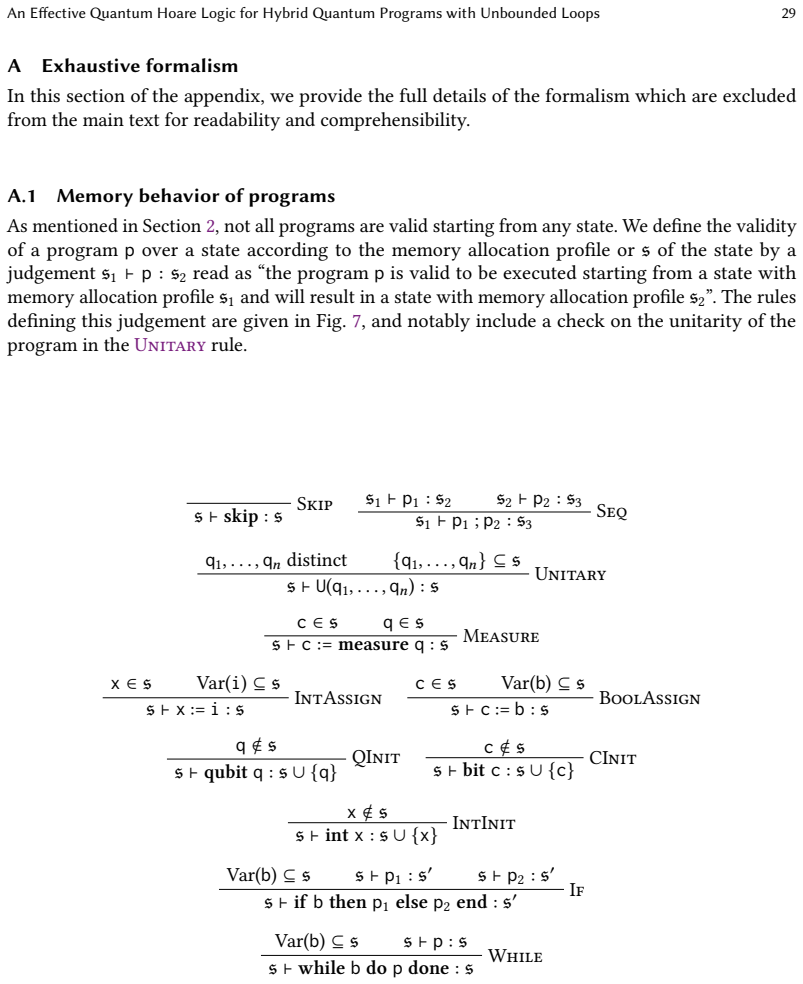
Zhou, L., Barthe, G., Strub, P., Liu, J., Ying, M.: CoqQ: Foundational verification of quantum programs. Proceedings of the ACM on Programming Languages7(POPL), 833–865 (2023). https://doi.org/10.1145/3571222 An Effective Quantum Hoare Logic for Hybrid Quantum Programs with Unbounded Loops 29 A Exhaustive formalism In this section of the appendix, we prov...
-
[66]
By induction on the second derivation, we have that𝔰(ℎ 2) =p 2(𝔰(ℎ′ 1))
= p1(𝔰(ℎ1)). By induction on the second derivation, we have that𝔰(ℎ 2) =p 2(𝔰(ℎ′ 1)). As such,𝔰(ℎ 2) =p 2(p1(𝔰(ℎ1))) =p(𝔰(ℎ 1)). (3)Eqiv : There exists ℎ′ 2 such that ℎ2 ≡ℎ ′ 2 and {ℎ1} p ℎ′ 2 . By induction, we have that 𝔰(ℎ′
-
[67]
=p(𝔰(ℎ 1)), andℎ 2 ≡ℎ ′ 2, we have that𝔰(ℎ 2) =𝔰(ℎ ′
-
[68]
=p(𝔰(ℎ 1)). (4)Unitary , Assignb, Assigni, and Measure: These programs don’t affect signatures, so 𝔰(ℎ2) =𝔰(ℎ 1) =p(𝔰(ℎ 1)) (5)QInit: We havep=qubitq, andℎ 2 =ℎ 1 ⊗ |0⟩q, so that𝔰(ℎ 2) =𝔰(ℎ 1)∪ {q}=p(𝔰(ℎ 1)). (6)CInit: Similar toQInit, we have𝔰(ℎ 2) =𝔰(ℎ 1)∪ {c}=p(𝔰(ℎ 1)). (7)IntInit: Similar toQInit, we have𝔰(ℎ 2) =𝔰(ℎ 1)∪ {x}=p(𝔰(ℎ 1)). (8)If: The deriv...
-
[69]
= p1(𝔰(b∗ℎ 1)) = p1(𝔰(ℎ1))and 𝔰(ℎ¬b 2 ) = p2(𝔰((1 ⊕ b)∗ℎ 1)) =p 2(𝔰(ℎ1)). As such,𝔰(ℎ 2) =𝔰(ℎ b
-
[70]
=𝔰(ℎ ¬b 2 ) =p 1(𝔰(ℎ1)) =p 2(𝔰(ℎ1)) =p(𝔰(ℎ 1)). (9)While : By the assumption that the rules are applied on valid program/ IHPS pairs only, p = whilebdop ′ done does not affect signatures and neither does p′, so by the inductive hypothesis, we have that𝔰(ℎ 2) =𝔰(ℎ 1) =p(𝔰(ℎ 1)). As for (ii), we use Theorem 4.4 to write: JpK (cq(ℎ1)) = cq(ℎ 2) JpK (cq(ℎ3)) ...
discussion (0)
Sign in with ORCID, Apple, or X to comment. Anyone can read and Pith papers without signing in.