REVIEW 3 major objections 5 minor 1 cited by
Axion-like particle limits from multi-messenger sources
T0 review · 3 major / 5 minor · reviewed 2026-08-15 · deepseek-v4-flash
Pith's one-line read Joint Fermi-LAT and IceCube data from NGC 1068 cap the axion–photon coupling at 7×10⁻¹¹ GeV⁻¹ for axion masses below 10⁻⁹ eV.
desk verdict A methodologically interesting but weak ALP limit from NGC 1068; the central number is credible but the propagation-environment mapping needs to be made explicit. read the letter →
The pith
A machine-rendered reading of the paper's core claim, the machinery that carries it, and where it could break.
The reading
What carries the argument
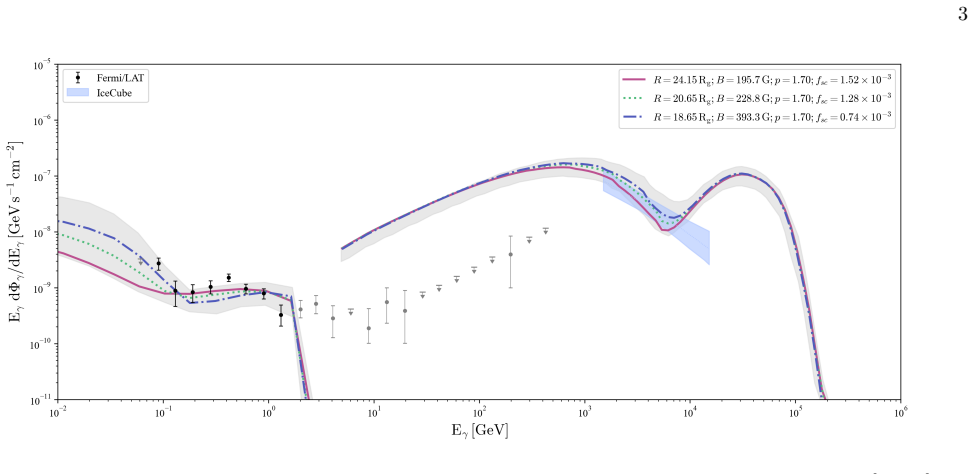
The load-bearing object is the ALP–photon mixing matrix that couples the two photon polarizations with the ALP field, integrated over a jet magnetic field that decreases as $B(r)=B_0(r/R_{\rm em})^{-1}$ and an electron density $n(r)=n_0(r/R_{\rm em})^{-2}$ across the emission region. The intrinsic spectrum entering the mixing calculation comes from a lepto-hadronic jet model whose four parameters—jet base radius, magnetization at the dissipation region, particle power-law index, and acceleration efficiency—are fit to Fermi-LAT data subject to the IceCube neutrino constraint, then marginalized over when deriving the ALP limit. The mixing matrix yields the photon survival probability as a function of energy, axion mass, and coupling, which is what converts the observed spectrum into a bound.
What would settle it
Measure NGC 1068's gamma-ray spectrum between 100 GeV and 1 TeV with percent-level precision: the predicted ALP survival probability for $g_{a\gamma}=7\times10^{-11}$ GeV$^{-1}$ would produce a specific energy-dependent attenuation, and its absence would falsify the claimed limit. A direct determination of the jet magnetic-field normalization from Faraday rotation or synchrotron self-absorption would test the input that sets the bound.
Extended reading notes
Core claim
The central claim is that ALP–photon oscillations in the magnetic field of the inner jet of NGC 1068 would over-attenuate its gamma-ray spectrum for couplings above $g_{a\gamma}\simeq7\times10^{-11}$ GeV$^{-1}$ when $m_a\lesssim10^{-9}$ eV, at 95% confidence. To reach this, the paper constructs a source model in which protons accelerated in the jet collide with corona particles, producing the gamma rays observed by Fermi-LAT and the neutrinos observed by IceCube; the model predicts 92 muon neutrino events, consistent with the reported $79^{+22}_{-20}$. This source model fixes the intrinsic spectrum, so the ALP search looks for extra energy-dependent attenuation of that spectrum. No significant ALP preference is found (best-fit at $1.02\sigma$), so the paper reports an upper limit rather than a detection.
Load-bearing premise
The limit rests on the assumed power-law radial profile of the jet magnetic field and its unstated normalization; if the true field inside the emission region differs, the coupling bound would shift.
Editorial extensions
If this is right
- ALPs with $m_a\lesssim10^{-9}$ eV and $g_{a\gamma}\gtrsim7\times10^{-11}$ GeV$^{-1}$ would erase the NGC 1068 gamma-ray flux, so the joint Fermi-LAT and IceCube data exclude them.
- The IceCube neutrino measurement is what breaks the degeneracy: the source model must simultaneously account for gamma rays and neutrinos, leaving no room to hide ALP attenuation in a reshaped intrinsic spectrum.
- A population of ten NGC 1068-like sources measured at 10% precision would push ALP limits from gamma-ray sources to the level of current best constraints, making multi-messenger galaxies a competitive probe.
- The absence of a significant ALP preference (best fit at $1.02\sigma$) means the result is a clean upper limit, not evidence for new physics.
Reading between the lines
- The same marginalization procedure could be applied to other neutrino-bright Seyferts such as NGC 7469 once their gamma-ray spectra are available; the paper only sketches this possibility.
- Because the conversion probability scales with $B^2$ and propagation length, an independent handle on the jet magnetic field from radio interferometry or spectral breaks would sharpen the limit considerably.
- Applying the same pipeline to the starburst component of NGC 1068 at higher energies, which the paper intentionally excludes, could probe heavier ALP masses and a different magnetic environment.
- If future Cherenkov telescopes see no spectral irregularities in NGC 1068, the combined dataset would push the bound below $10^{-11}$ GeV$^{-1}$, into the region where ALPs could account for dark matter.
Signed reviews
Editorial analysis
A structured set of objections, weighed in public.
Referee Report
Summary. The paper models the lepto-hadronic jet emission of the Seyfert galaxy NGC 1068, fitting the Fermi-LAT gamma-ray spectrum subject to an IceCube neutrino-band selection, and then uses the GammaALPs "Jet" model to compute ALP-photon conversion in the jet magnetic field. Marginalizing over four astrophysical jet parameters, it derives a 95% CL upper limit g_aγ <~ 7e-11 GeV^-1 for m_a <~ 1e-9 eV, and also presents projected limits for improved Fermi-LAT precision and for a population of ten NGC 1068-like sources. The paper is explicit that the best-fit ALP point is only 1.02 sigma and that the derived limits are weaker than existing astrophysical bounds, so the main claim is the demonstration that multi-messenger modeling can provide a new, complementary ALP probe.
Significance. If the result is robust, the paper makes a useful methodological contribution: it uses a concrete, physically motivated jet+corona model for NGC 1068, scans 10^6 parameter combinations, and marginalizes over four astrophysical nuisance parameters in the ALP limit, which is good practice. The paper also honestly reports that the best-fit ALP point is not significant and that the limits are weaker than existing constraints. However, the numerical value of the central limit is not reproducible from the manuscript as written, because the GammaALPs propagation environment (B0, n0, Rem) is never connected to the fitted HadJet parameters. Since the conversion probability scales roughly as (g_aγ B L)^2 in the perturbative regime, this missing mapping leaves an order-of-magnitude uncertainty in the derived coupling limit. The central claim is therefore defensible only after the propagation-environment mapping is specified and its uncertainty is propagated.
major comments (3)
- [Section III, Eqs. (9)-(10) and Table I] The GammaALPs Jet model requires the magnetic field profile B(r) = B0 (r/Rem)^-1 and electron density profile n(r) = n0 (r/Rem)^-2, but the paper never states how B0, n0, and Rem are fixed from the HadJet parameters (r0, sigma_f, pe, fsc) that were fitted to Fermi-LAT and IceCube data. Table I reports B = 196 G and n = 1.013e8 cm^-3 "at the dissipation region" for the best fit, but it does not say that these are the GammaALPs B0 and n0, and Rem is not given a numerical value anywhere. Because the ALP-photon conversion probability depends on (g_aγ B L)^2 in the perturbative regime, an unspecified normalization or propagation length translates directly into an unquantified shift of the derived limit, potentially by an order of magnitude. Please specify the exact mapping, state the value of Rem used, and either marginalize over the propagation-environment parameters or demonstrate explicitly that the limit is insensitive to them.
- [Section II.B and II.C] The IceCube neutrino data are used only as a hard selection: models are kept if their predicted neutrino flux falls inside the observed 79+22/-20 event band, but the neutrino information does not enter the chi-square in Eq. (3) or the profile likelihood in Sec. III.A. This discards information and can bias the selected region of astrophysical parameter space. The authors should either include a Poisson likelihood term for the IceCube event count in the profile likelihood or demonstrate that the final ALP limit is robust to the chosen band-cut criterion.
- [Section II.B] The Fermi-LAT fit uses only the first 8 of the 14 energy bins, with the stated motivation that higher-energy bins receive a starburst contribution that is not modeled. The best-fit SED and therefore the derived ALP limit depend on this post-hoc bin selection, yet no test of this dependence is shown. Please show how the limit changes with the number of included bins or include a starburst template, since this choice directly affects the baseline spectrum against which ALP attenuation is constrained.
minor comments (5)
- [Section III.B] The reported best-fit point has its units interchanged: it should read (m_a, g_aγ) = (2.2e-9 eV, 4.6e-10 GeV^-1), not (2.2e-9 GeV^-1, 4.6e-10 eV).
- [Section III.B and Fig. 3] The text attributes the Perseus Galaxy bound to reference [28], which is actually the MAGIC paper on NGC 1068; the Perseus bound appears to be reference [19]. Please correct the citation.
- [Section III.B, Eq. (13)] Equation (13) writes delta_i ~ N(0,1), while the surrounding text states that the perturbations have standard deviation sigma = 0.1; please use N(0, 0.1) or otherwise clarify the notation.
- [Section III, Eqs. (9)-(10)] The symbol Rem is introduced as the "emitting region" but is never related to zdiss = 5 Rg or to the corona radius Rcor = 50 Rg; a definition and numerical value would make the propagation calculation reproducible.
- [Table I] The row for pe contains a formatting artifact ("log(dn/dE)" over "log(dE)"); please define the power-law index cleanly, e.g., dn/dE ∝ E^-pe.
Circularity Check
No significant circularity: the ALP coupling is scanned and constrained by profile likelihood, while the astrophysical baseline is fitted and marginalized; the missing B0/n0/Rem mapping is a reproducibility caveat, not a circular reduction.
full rationale
I walked the derivation chain. Section II fits HadJet parameters (r0, sigma_f, p_e, f_sc) to Fermi-LAT data subject to the IceCube constraint; this is an empirical calibration of the astrophysical baseline, not a prediction of the ALP limit. Section III introduces the ALP-photon mixing Lagrangian and the GammaALPs Jet model; the coupling g_a-gamma is scanned, and the 95% CL limit is set via a likelihood-ratio test with Delta-chi^2 <= 2.71, marginalizing over theta_astro. The ALP coupling is not one of the fitted nuisance parameters, and the best-fit ALP point is only 1.02 sigma, so the limit is not forced by construction. The authors' self-citations to BHJet/HadJet (Refs. [51,52]) are used as an independently described and publicly available emission model, not as an unverified uniqueness theorem. The only notable gap is that the paper does not state how B0, n0, and R_em in Eqs. (9)-(10) are obtained from the fitted HadJet parameters (Table I reports B and n at the dissipation region but no mapping); this affects reproducibility and robustness, but it is an omitted assumption rather than a circular reduction in which an output is identical to an input. Therefore no circular step meets the evidentiary standard; score 0.
Assumptions & free parameters
free parameters (4)
- r0 =
24.15 Rg
- sigma_f =
0.02
- pe =
1.7
- fsc =
1.52e-3
assumptions (5)
- domain assumption BHJet/HadJet jet model assumptions: two identical jets, particle acceleration at a dissipation region, power-law spectra with index pe.
- domain assumption Corona parameters n=10^11 cm^-3, tau=0.5, radius 50 Rg taken from Murase (2022).
- ad hoc to paper The IceCube neutrino flux is used only as a hard selection (models inside the observed band), not as a likelihood term.
- ad hoc to paper GammaALPs Jet model: B(r)=B0(r/Rem)^-1 and n(r)=n0(r/Rem)^-2 with unspecified mapping to HadJet outputs.
- standard math EBL model of Dominguez et al. (2010) and Galactic magnetic field models of Pshirkov et al. (2011) and Jansson & Farrar (2012).
Cite this review
Pith. "Pith review of Axion-like particle limits from multi-messenger sources." pith.science (2026). https://pith.science/paper/YYUL5MYT
@misc{pith2026250614659,
  author       = {Pith},
  title        = {Pith review of: Axion-like particle limits from multi-messenger sources},
  year         = {2026},
  howpublished = {\url{https://pith.science/paper/YYUL5MYT}},
  note         = {Machine review of arXiv:2506.14659}
}
abstract
High-energy neutrino observation from the Seyfert galaxy NGC 1068 offers new insights into the non-thermal processes of active galactic nuclei. Simultaneous gamma-rays emitted by such sources can possibly oscillate into axion-like particles (ALPs) when propagating through astrophysical magnetic fields, potentially modifying the observed spectrum. To probe for ALP-induced signals, a robust understanding of the emission processes at the source is necessary. In this work, we perform a dedicated multi-messenger analysis by modeling a jet in the innermost vicinity of the central supermassive black hole of NGC 1068. We model in particular the neutrino and gamma-ray emission originating in lepto-hadronic collisions between jet accelerated particles and background particles from the corona, reproducing both the Fermi-LAT and IceCube data. These source models serve as a baseline for ALP searches, and we derive limits on the ALP-photon coupling by marginalizing over motivated ranges of astrophysical parameters. We find $g_{a\gamma} \lesssim 7 \times 10^{-11}$GeV$^{-1}$ for $m_a \lesssim 10^{-9}$ eV. These limits may be weaker than existing constraints, but they demonstrate the potential of multi-messenger observations to probe new physics. We conclude by discussing how additional upcoming multi-messenger sources and improved observational precision can enhance ALP sensitivity.
Figures


Forward citations
Cited by 1 Pith paper
-
Circular polarization effects induced by photon-axion mixing in astrophysical environments
The paper derives analytic circular-polarization signals from photon-axion mixing and uses the blazar S4 0954+65 optical circular-polarization limit to bound g_aγγ around 10^-12 to 10^-11 GeV^-1 for ultralight axion masses.
Reference graph
Works this paper leans on
-
[1]
R. D. Peccei and H. R. Quinn, CP Conservation in the Presence of Instantons, Phys. Rev. Lett.38, 1440 (1977)
1977
-
[2]
Weinberg, A New Light Boson?, Phys
S. Weinberg, A New Light Boson?, Phys. Rev. Lett.40, 223 (1978)
1978
-
[3]
Preskill, M
J. Preskill, M. B. Wise, and F. Wilczek, Cosmology of the Invisible Axion, Phys. Lett. B120, 127 (1983)
1983
-
[4]
D. J. Marsh, Axion cosmology, Physics Reports643, 1–79 (2016)
2016
-
[5]
A. Arvanitaki, S. Dimopoulos, S. Dubovsky, N. Kaloper, and J. March-Russell, String axiverse, Physical Review D81, 10.1103/physrevd.81.123530 (2010)
-
[6]
Raffelt and L
G. Raffelt and L. Stodolsky, Mixing of the photon with low-mass particles, Phys. Rev. D37, 1237 (1988)
1988
-
[7]
D. Hooper and P. D. Serpico, Detecting Axion-Like Par- ticles With Gamma Ray Telescopes, Phys. Rev. Lett.99, 231102 (2007), arXiv:0706.3203 [hep-ph]
arXiv 2007
-
[8]
C. S. Reynolds, M. C. David Marsh, H. R. Russell, A. C. Fabian, R. Smith, F. Tombesi, and S. Veilleux, Astro- physical limits on very light axion-like particles from chandra grating spectroscopy of ngc 1275, The Astro- physical Journal890, 59 (2020)
work page 2020
Show all 83 references
-
[9]
Sisk-Reyn´ es, J
J. Sisk-Reyn´ es, J. H. Matthews, C. S. Reynolds, H. R. Russell, R. N. Smith, and M. C. D. Marsh, New con- straints on light axion-like particles using chandra trans- mission grating spectroscopy of the powerful cluster- hosted quasar h1821+643, Monthly Notices of the Royal As...
2021
-
[10]
Jacobsen, T
S. Jacobsen, T. Linden, and K. Freese, Constraining axion-like particles with hawc observations of tev blazars (2022), arXiv:2203.04332 [hep-ph]
2022 arXiv
-
[11]
Abramowskiet al.(H.E.S.S.), Constraints on axion- like particles with H.E.S.S
A. Abramowskiet al.(H.E.S.S.), Constraints on axion- like particles with H.E.S.S. from the irregularity of the PKS 2155-304 energy spectrum, Phys. Rev. D88, 102003 (2013), arXiv:1311.3148 [astro-ph.HE]
2013 arXiv
-
[12]
Lecce, A
F. Lecce, A. Lella, G. Lucente, V. Vijayan, A. Bauswein, M. Giannotti, and A. Mirizzi, Probing axion-like particles with multimessenger observations of neutron star merg- ers (2025), arXiv:2504.02032 [hep-ph]
2025 arXiv
-
[13]
Diamond, D
M. Diamond, D. F. G. Fiorillo, G. Marques- Tavares, I. Tamborra, and E. Vitagliano, Multimes- senger Constraints on Radiatively Decaying Axions from GW170817, Phys. Rev. Lett.132, 101004 (2024), arXiv:2305.10327 [hep-ph]
2024 arXiv
-
[14]
Calore, P
F. Calore, P. Carenza, C. Eckner, T. Fischer, M. Gian- notti, J. Jaeckel, K. Kotake, T. Kuroda, A. Mirizzi, and F. Sivo, 3d template-based fermi -lat constraints on the diffuse supernova axion-like particle background, Physi- cal Review D105, 10.1103/physrevd.105.063028 (2022)
2022 doi
-
[15]
F. R. Cand´ on, S. Ganguly, M. Giannotti, T. Kumar, A. Lella, and F. Mescia, A fresh look at the diffuse alp background from supernova (2025), arXiv:2505.05567 [hep-ph]
2025 arXiv
-
[16]
Meyer, M
M. Meyer, M. Giannotti, A. Mirizzi, J. Conrad, and M. A. S´ anchez-Conde, Fermi Large Area Telescope as a Galactic Supernovae Axionscope, Phys. Rev. Lett.118, 011103 (2017), arXiv:1609.02350 [astro-ph.HE]
2017 arXiv
-
[17]
M. H. Chan, Constraining the axion-photon cou- pling using radio data of the bullet cluster (2021), arXiv:2109.11734 [astro-ph.CO]
2021 arXiv
-
[18]
Schlederer and G
M. Schlederer and G. Sigl, Constraining alp-photon cou- pling using galaxy clusters, Journal of Cosmology and Astroparticle Physics2016(01), 038–038
-
[19]
Abeet al.(MAGIC), Constraints on axion-like parti- cles with the Perseus Galaxy Cluster with MAGIC, Phys
H. Abeet al.(MAGIC), Constraints on axion-like parti- cles with the Perseus Galaxy Cluster with MAGIC, Phys. Dark Univ.44, 101425 (2024), arXiv:2401.07798 [astro- ph.HE]
2024
-
[20]
Simet, D
M. Simet, D. Hooper, and P. D. Serpico, The Milky Way as a Kiloparsec-Scale Axionscope, Phys. Rev. D77, 063001 (2008), arXiv:0712.2825 [astro-ph]
2008 arXiv
-
[21]
J. P. Conlon and F. V. Day, 3.55 kev photon lines from axion to photon conversion in the milky way and m31, Journal of Cosmology and Astroparticle Physics2014 (11), 033–033
-
[22]
Carenza, C
P. Carenza, C. Evoli, M. Giannotti, A. Mirizzi, and D. Montanino, Turbulent axion-photon conversions in the milky way, Physical Review D104, 10.1103/phys- revd.104.023003 (2021)
2021 doi
-
[23]
Eckner and F
C. Eckner and F. Calore, First constraints on axionlike particles from Galactic sub-PeV gamma rays, Phys. Rev. D106, 083020 (2022), arXiv:2204.12487 [astro-ph.HE]
2022 arXiv
-
[24]
Mastrototaro, P
L. Mastrototaro, P. Carenza, M. Chianese, D. F. G. Fio- rillo, G. Miele, A. Mirizzi, and D. Montanino, Constrain- ing axion-like particles with the diffuse gamma-ray flux measured by the Large High Altitude Air Shower Obser- vatory, Eur. Phys. J. C82, 1012 (2022), arXiv:2206.0...
2022 arXiv
-
[25]
M. G. Aartsenet al.(IceCube, Fermi-LAT, MAGIC, AG- ILE, ASAS-SN, HAWC, H.E.S.S., INTEGRAL, Kanata, Kiso, Kapteyn, Liverpool Telescope, Subaru, Swift NuS- TAR, VERITAS, VLA/17B-403), Multimessenger ob- servations of a flaring blazar coincident with high- energy neutrino IceCube...
2018 arXiv
-
[26]
M. G. Aartsenet al.(IceCube), Neutrino emission from the direction of the blazar TXS 0506+056 prior to the IceCube-170922A alert, Science361, 147 (2018), arXiv:1807.08794 [astro-ph.HE]
2018 arXiv
-
[27]
Abbasiet al.(IceCube), Evidence for neutrino emis- sion from the nearby active galaxy NGC 1068, Science 378, 538 (2022), arXiv:2211.09972 [astro-ph.HE]
R. Abbasiet al.(IceCube), Evidence for neutrino emis- sion from the nearby active galaxy NGC 1068, Science 378, 538 (2022), arXiv:2211.09972 [astro-ph.HE]
2022
-
[28]
V. A. Acciariet al.(MAGIC), Constraints on gamma- ray and neutrino emission from NGC 1068 with the MAGIC telescopes, Astrophys. J.883, 135 (2019), arXiv:1906.10954 [astro-ph.HE]
2019
-
[29]
Abdollahiet al.(Fermi-LAT),FermiLarge Area Tele- scope Fourth Source Catalog, Astrophys
S. Abdollahiet al.(Fermi-LAT),FermiLarge Area Tele- scope Fourth Source Catalog, Astrophys. J. Suppl.247, 33 (2020), arXiv:1902.10045 [astro-ph.HE]
2020 arXiv
-
[30]
Ajelloet al.(Fermi-LAT), The Fourth Catalog of Active Galactic Nuclei Detected by the Fermi Large Area Telescope, Astrophys
M. Ajelloet al.(Fermi-LAT), The Fourth Catalog of Active Galactic Nuclei Detected by the Fermi Large Area Telescope, Astrophys. J.892, 105 (2020), arXiv:1905.10771 [astro-ph.HE]. 8
2020 arXiv
-
[31]
Murase, S
K. Murase, S. S. Kimura, and P. Meszaros, Hidden Cores of Active Galactic Nuclei as the Origin of Medium- Energy Neutrinos: Critical Tests with the MeV Gamma- Ray Connection, Phys. Rev. Lett.125, 011101 (2020), arXiv:1904.04226 [astro-ph.HE]
2020 arXiv
-
[32]
Inoue, D
Y. Inoue, D. Khangulyan, and A. Doi, On the origin of high-energy neutrinos from ngc 1068: The role of non- thermal coronal activity, The Astrophysical Journal891, L33 (2020)
2020
-
[33]
Murase, Hidden Hearts of Neutrino Active Galaxies, Astrophys
K. Murase, Hidden Hearts of Neutrino Active Galaxies, Astrophys. J. Lett.941, L17 (2022), arXiv:2211.04460 [astro-ph.HE]
2022 arXiv
-
[34]
Blanco, D
C. Blanco, D. Hooper, T. Linden, and E. Pinetti, On the neutrino and gamma-ray emission from ngc 1068 (2023), arXiv:2307.03259 [astro-ph.HE]
2023 arXiv
-
[35]
D. F. G. Fiorillo, M. Petropoulou, L. Comisso, E. Peretti, and L. Sironi, TeV Neutrinos and Hard X-Rays from Relativistic Reconnection in the Corona of NGC 1068, Astrophys. J.961, L14 (2024), arXiv:2310.18254 [astro- ph.HE]
2024 arXiv
-
[36]
D. F. G. Fiorillo, L. Comisso, E. Peretti, M. Petropoulou, and L. Sironi, A magnetized strongly turbulent corona as the source of neutrinos from ngc 1068, The Astrophysical Journal974, 75 (2024)
2024
-
[37]
Padovaniet al., High-energy neutrinos from the vicin- ity of the supermassive black hole in NGC 1068, Nature Astron.8, 1077 (2024), arXiv:2405.20146 [astro-ph.HE]
P. Padovaniet al., High-energy neutrinos from the vicin- ity of the supermassive black hole in NGC 1068, Nature Astron.8, 1077 (2024), arXiv:2405.20146 [astro-ph.HE]
2024 arXiv
-
[38]
Eichmann, F
B. Eichmann, F. Oikonomou, S. Salvatore, R.-J. Dettmar, and J. Becker Tjus, Solving the Multimessen- ger Puzzle of the AGN-starburst Composite Galaxy NGC 1068, Astrophys. J.939, 43 (2022), arXiv:2207.00102 [astro-ph.HE]
2022 arXiv
-
[39]
A. B. Romeo and K. Fathi, What powers the starburst activity of NGC 1068? Star-driven gravitational instabil- ities caught in the act, Mon. Not. Roy. Astron. Soc.460, 2360 (2016), arXiv:1602.03049 [astro-ph.GA]
2016 arXiv
-
[40]
B. P. Pant, Constraining axionlike particles with invisible neutrino decay using the IceCube observations of NGC 1068, Phys. Rev. D109, 063002 (2024), arXiv:2311.14597 [astro-ph.HE]
2024 arXiv
-
[41]
Herrera, Plausible indication of gamma-ray absorp- tion by dark matter in ngc 1068 (2025), arXiv:2504.21560 [hep-ph]
G. Herrera, Plausible indication of gamma-ray absorp- tion by dark matter in ngc 1068 (2025), arXiv:2504.21560 [hep-ph]
2025
-
[42]
J. M. Cline and M. Puel, NGC 1068 constraints on neutrino-dark matter scattering, JCAP06, 004, arXiv:2301.08756 [hep-ph]
-
[43]
Neronov, D
A. Neronov, D. Savchenko, and D. Semikoz, Neutrino sig- nal from a population of seyfert galaxies, Physical Review Letters132, 10.1103/physrevlett.132.101002 (2024)
2024 doi
-
[44]
Abbasiet al.(IceCube), Search for Neutrino Emission from Hard X-Ray AGN with IceCube, Astrophys
R. Abbasiet al.(IceCube), Search for Neutrino Emission from Hard X-Ray AGN with IceCube, Astrophys. J.981, 131 (2025), arXiv:2406.06684 [astro-ph.HE]
2025
-
[45]
Sommani, A
G. Sommani, A. Franckowiak, M. Lincetto, and R.-J. Dettmar, Two 100 TeV Neutrinos Coincident with the Seyfert Galaxy NGC 7469, Astrophys. J.981, 103 (2025), arXiv:2403.03752 [astro-ph.HE]
2025 arXiv
-
[46]
M. G. Aartsenet al.(IceCube-Gen2), IceCube-Gen2: the window to the extreme Universe, J. Phys. G48, 060501 (2021), arXiv:2008.04323 [astro-ph.HE]
2021
-
[47]
Adrian-Martinezet al.(KM3Net), Letter of in- tent for KM3NeT 2.0, J
S. Adrian-Martinezet al.(KM3Net), Letter of in- tent for KM3NeT 2.0, J. Phys. G43, 084001 (2016), arXiv:1601.07459 [astro-ph.IM]
2016 arXiv
-
[48]
Agostiniet al.(P-ONE), The Pacific Ocean Neu- trino Experiment, Nature Astron.4, 913 (2020), arXiv:2005.09493 [astro-ph.HE]
M. Agostiniet al.(P-ONE), The Pacific Ocean Neu- trino Experiment, Nature Astron.4, 913 (2020), arXiv:2005.09493 [astro-ph.HE]
2020 arXiv
-
[49]
A. D. Avrorinet al.(Baikal-GVD), Neutrino Telescope in Lake Baikal: Present and Future, PoSICRC2019, 1011 (2020), arXiv:1908.05427 [astro-ph.HE]
2020 arXiv
-
[50]
Ackermannet al.(Fermi-LAT), GeV Observations of Star-forming Galaxies with the Fermi Large Area Tele- scope, Astrophys
M. Ackermannet al.(Fermi-LAT), GeV Observations of Star-forming Galaxies with the Fermi Large Area Tele- scope, Astrophys. J.755, 164 (2012), arXiv:1206.1346 [astro-ph.HE]
2012 arXiv
-
[51]
Lucchini, C
M. Lucchini, C. Ceccobello, S. Markoff, Y. Kini, A. Chhotray, R. M. T. Connors, P. Crumley, H. Falcke, D. Kantzas, and D. Maitra, Bhjet: a public multizone, steady state jet + thermal corona spectral model, MN- RAS517, 5853 (2022)
2022
-
[52]
Kantzas, S
D. Kantzas, S. Markoff, T. Beuchert, M. Lucchini, A. Chhotray, C. Ceccobello, A. J. Tetarenko, J. C. A. Miller-Jones, M. Bremer, J. A. Garcia, V. Grinberg, P. Uttley, and J. Wilms, A new lepto-hadronic model applied to the first simultaneous multiwavelength data set for Cygnus...
2021
-
[53]
Jokipii, Rate of energy gain and maximum energy in diffusive shock acceleration, ApJ313, 842 (1987)
J. Jokipii, Rate of energy gain and maximum energy in diffusive shock acceleration, ApJ313, 842 (1987)
1987
-
[54]
Kelner, F
S. Kelner, F. A. Aharonian, and V. Bugayov, Energy spectra of gamma rays, electrons, and neutrinos pro- duced at proton-proton interactions in the very high en- ergy regime, Physical Review D74, 034018 (2006)
2006
-
[55]
Kelner and F
S. Kelner and F. Aharonian, Energy spectra of gamma rays, electrons, and neutrinos produced at interactions of relativistic protons with low energy radiation, Physical Review D78, 034013 (2008)
2008
-
[56]
Woo and C
J.-H. Woo and C. M. Urry, AGN black hole masses and bolometric luminosities, Astrophys. J.579, 530 (2002), arXiv:astro-ph/0207249
2002 arXiv
-
[57]
Panessa, L
F. Panessa, L. Bassani, M. Cappi, M. Dadina, X. Bar- cons, F. J. Carrera, L. C. Ho, and K. Iwasawa, On the X-ray, optical emission line and black hole mass proper- ties of local Seyfert galaxies, Astron. Astrophys.455, 173 (2006), arXiv:astro-ph/0605236
2006 arXiv
-
[58]
Karavola, M
D. Karavola, M. Petropoulou, D. F. G. Fiorillo, L. Comisso, and L. Sironi, Neutrino and pair creation in reconnection-powered coronae of accreting black holes (2025), arXiv:2410.12638 [astro-ph.HE]
2025 arXiv
-
[59]
Ajello, K
M. Ajello, K. Murase, and A. McDaniel, Disentangling the Hadronic Components in NGC 1068, Astrophys. J. Lett.954, L49 (2023), arXiv:2307.02333 [astro-ph.HE]
2023 arXiv
-
[60]
J. J. Condon, Radio emission from normal galaxies, Ann. Rev. Astron. Astrophys.30, 575 (1992)
1992
-
[61]
Kantzas, S
D. Kantzas, S. Markoff, A. J. Cooper, D. Gaggero, M. Petropoulou, and P. De La Torre Luque, Possible con- tribution of X-ray binary jets to the Galactic cosmic ray and neutrino flux, MNRAS524, 1326 (2023)
2023
-
[62]
De Angelis, G
A. De Angelis, G. Galanti, and M. Roncadelli, Relevance of axion-like particles for very-high-energy astrophysics, Phys. Rev. D84, 105030 (2011), [Erratum: Phys.Rev.D 87, 109903 (2013)], arXiv:1106.1132 [astro-ph.HE]
2011 arXiv
-
[63]
Meyer, J
M. Meyer, J. Davies, and J. Kuhlmann, gammaALPs: An open-source python package for computing photon- axion-like-particle oscillations in astrophysical environ- ments, PoSICRC2021, 557 (2021), arXiv:2108.02061 [astro-ph.HE]
2021 arXiv
-
[64]
Dom´ ınguez, J
A. Dom´ ınguez, J. R. Primack, D. J. Rosario, F. Prada, R. C. Gilmore, S. M. Faber, D. C. Koo, R. S. Somerville, M. A. P´ erez-Torres, P. P´ erez-Gonz´ alez, J.-S. Huang, M. Davis, P. Guhathakurta, P. Barmby, C. J. Conselice, M. Lozano, J. A. Newman, and M. C. Cooper, Extra- 9...
2010
-
[65]
M. S. Pshirkov, P. G. Tinyakov, P. P. Kronberg, and K. J. Newton-McGee, Deriving the global structure of the galactic magnetic field from faraday rotation measures of extragalactic sources, The Astrophysical Journal738, 192 (2011)
2011
-
[66]
Jansson and G
R. Jansson and G. R. Farrar, A new model of the galac- tic magnetic field, The Astrophysical Journal757, 14 (2012)
2012
-
[67]
Horns, L
D. Horns, L. Maccione, M. Meyer, A. Mirizzi, D. Mon- tanino, and M. Roncadelli, Hardening of TeV gamma spectrum of AGNs in galaxy clusters by conversions of photons into axion-like particles, Phys. Rev. D86, 075024 (2012), arXiv:1207.0776 [astro-ph.HE]
2012 arXiv
-
[68]
S. S. Wilks, The Large-Sample Distribution of the Like- lihood Ratio for Testing Composite Hypotheses, Annals Math. Statist.9, 60 (1938)
1938
-
[69]
Li, J.-G
H.-J. Li, J.-G. Guo, X.-J. Bi, S.-J. Lin, and P.-F. Yin, Limits on axion-like particles from Mrk 421 with 4.5- year period observations by ARGO-YBJ and Fermi- LAT, Phys. Rev. D103, 083003 (2021), arXiv:2008.09464 [astro-ph.HE]
2021 arXiv
-
[70]
Ajelloet al.(Fermi-LAT), Search for Spectral Irreg- ularities due to Photon–Axionlike-Particle Oscillations with the Fermi Large Area Telescope, Phys
M. Ajelloet al.(Fermi-LAT), Search for Spectral Irreg- ularities due to Photon–Axionlike-Particle Oscillations with the Fermi Large Area Telescope, Phys. Rev. Lett. 116, 161101 (2016), arXiv:1603.06978 [astro-ph.HE]
2016 arXiv
-
[71]
Davies, M
J. Davies, M. Meyer, and G. Cotter, Constraints on ax- ionlike particles from a combined analysis of three flar- ing fermi flat-spectrum radio quasars, Phys. Rev. D107, 083027 (2023)
2023
-
[72]
Essiget al., Working Group Report: New Light Weakly Coupled Particles, inSnowmass 2013: Snowmass on the Mississippi(2013) arXiv:1311.0029 [hep-ph]
R. Essiget al., Working Group Report: New Light Weakly Coupled Particles, inSnowmass 2013: Snowmass on the Mississippi(2013) arXiv:1311.0029 [hep-ph]
2013 arXiv
-
[73]
Anastassopouloset al.(CAST), New CAST Limit on the Axion-Photon Interaction, Nature Phys.13, 584 (2017), arXiv:1705.02290 [hep-ex]
V. Anastassopouloset al.(CAST), New CAST Limit on the Axion-Photon Interaction, Nature Phys.13, 584 (2017), arXiv:1705.02290 [hep-ex]
2017 arXiv
-
[74]
O’Hare, cajohare/axionlimits: Axionlimits,https:// cajohare.github.io/AxionLimits/(2020)
C. O’Hare, cajohare/axionlimits: Axionlimits,https:// cajohare.github.io/AxionLimits/(2020)
2020
-
[75]
C. A. Manzari, Y. Park, B. R. Safdi, and I. Savoray, Su- pernova axions convert to gamma-rays in magnetic fields of progenitor stars, arXiv e-prints , arXiv:2405.19393 (2024), arXiv:2405.19393 [hep-ph]
2024
-
[76]
Dessert, D
C. Dessert, D. Dunsky, and B. R. Safdi, Upper limit on the axion-photon coupling from magnetic white dwarf polarization, Phys. Rev. D105, 103034 (2022), arXiv:2203.04319 [hep-ph]
2022 arXiv
-
[77]
Noordhuis, A
D. Noordhuis, A. Prabhu, S. J. Witte, A. Y. Chen, F. Cruz, and C. Weniger, Novel Constraints on Axions Produced in Pulsar Polar-Cap Cascades, Phys. Rev. Lett. 131, 111004 (2023), arXiv:2209.09917 [hep-ph]
2023 arXiv
-
[78]
Escudero, C
M. Escudero, C. K. Pooni, M. Fairbairn, D. Blas, X. Du, and D. J. E. Marsh, Axion star explosions: A new source for axion indirect detection, Phys. Rev. D109, 043018 (2024), arXiv:2302.10206 [hep-ph]
2024 arXiv
-
[79]
Betancourt Kamenetskaia, N
B. Betancourt Kamenetskaia, N. Fraija, and G. Herrera, Polarization measurements as a probe of axion-photon coupling: A study of GRB 221009A, Phys. Rev. D111, 115008 (2025), arXiv:2408.07352 [hep-ph]
2025 arXiv
-
[80]
Ning and B
O. Ning and B. R. Safdi, Leading Axion-Photon Sensitiv- ity with NuSTAR Observations of M82 and M87, Phys. Rev. Lett.134, 171003 (2025), arXiv:2404.14476 [hep- ph]
2025 arXiv
-
[81]
Caputoet al., All-sky Medium Energy Gamma-ray Observatory eXplorer mission concept, J
R. Caputoet al., All-sky Medium Energy Gamma-ray Observatory eXplorer mission concept, J. Astron. Telesc. Instrum. Syst.8, 044003 (2022), arXiv:2208.04990 [astro- ph.IM]
2022 arXiv
-
[82]
Tavaniet al.(e-ASTROGAM), Science with e- ASTROGAM: A space mission for MeV–GeV gamma- ray astrophysics, JHEAp19, 1 (2018), arXiv:1711.01265 [astro-ph.HE]
M. Tavaniet al.(e-ASTROGAM), Science with e- ASTROGAM: A space mission for MeV–GeV gamma- ray astrophysics, JHEAp19, 1 (2018), arXiv:1711.01265 [astro-ph.HE]
2018 arXiv
-
[83]
B. S. Acharyaet al.(CTA Consortium),Science with the Cherenkov Telescope Array(WSP, 2018) arXiv:1709.07997 [astro-ph.IM]
2018 arXiv
Reviewed August 15, 2026 · model on record in the stance chip above.
Discussion (0). Continue with ORCID to comment.