REVIEW 3 major objections 4 minor 46 references
The paper proves that any n hyperplanes in R^d give at most Θ(n^d) minimum-volume d-simplices, and some arrangements attain that order.
Reviewed by Pith at T0; open to challenge. T0 means a machine referee read the full paper against a public rubric. the ladder, T0–T4 →
For hyperplane arrangements in R^d, the maximum number of minimum-volume d-simplices is Θ_d(n^d), and the guaranteed subset with all-distinct simplex volumes is o(n) in every dimension.
T0 review reviewed 2026-08-03 challenge →
load-bearing objection Solid lower bound and D_d result, but the upper bound for m_d relies on an unproved configuration lemma; worth refereeing but needs a real fix. the 3 major comments →
Simplex volumes in hyperplane arrangements
The pith
A machine-rendered reading of the paper's core claim, the machinery that carries it, and where it could break.
The reading
Core claim
The paper's central theorem (Theorem 1.3) states that m_d(n), the largest number of minimum-positive-volume d-simplices determined by n hyperplanes in general position in R^d, is Θ_d(n^d). The upper bound is proved by fixing any d hyperplanes with a common point and considering the 2^d regions they cut out; in each region, a degree-d hypersurface parametrizes the hyperplanes that form a minimum-volume simplex with the fixed d. The proof asserts that at most a bounded number of the remaining arrangement hyperplanes can be tangent to that surface in a given region, so the total count is at most a constant times the number of d-subsets of the hyperplanes. The lower bound uses an explicit grid a
What carries the argument
The core object is an algebraic hypersurface C_R: after affine transforming d chosen hyperplanes to the coordinate planes x_i=0 and fixing a region R, the branch of ∏ x_i = constant is the set of points whose tangent hyperplanes form a d-simplex of exactly the minimum volume with the coordinate planes. Upper bounds for m_d(n) come from controlling tangencies of the arrangement's hyperplanes to these branches, using projective duality and a standard extremal bound for bipartite graphs with no large complete bipartite subgraph. The distinct-volume result uses a family of volume-preserving affine maps T_D that shift each hyperplane H_i to H_{i+1}; because T_D preserves volume, any (d+2)-term ar
Load-bearing premise
The upper-bound proof of Theorem 1.3 depends on an unproved geometric configuration assertion: for any two tangent hyperplanes to a fixed branch surface C_R and the arrangement they form with the d coordinate hyperplanes, the two guaranteed simplicial cells lie outside the smaller simplex and the larger simplex is the union of a half of the smaller one with a cell, forcing a volume contradiction.
What would settle it
Construct, for d=3, an arrangement of planes where two distinct tangent planes to the same branch of xyz=c produce tetrahedra of the same minimum volume with the coordinate planes in the same octant; such a pair would violate the configuration lemma and show that the current proof of the O(n^3) upper bound for m_3(n) is incomplete.
If this is right
- If m_d(n)=Θ(n^d), then the number of minimum-volume simplices is on the order of the number of d-subsets of hyperplanes, meaning each d-subset contributes only a bounded number of such simplices on average.
- The explicit grid-and-diagonal construction yields an arrangement with about d^2 n hyperplanes and d! n^d minimum-volume simplices, so the constant in the lower bound is explicit and independent of how the arrangement is chosen.
- The unit-volume count f_d(n) is now pinned between n^d and n^{d+1-d/(d^d+1)}, reducing the gap from a factor n to a factor n^{1-d/(d^d+1)}.
- The sublinear bound on D_d(n) means every arrangement of n hyperplanes contains a large subset (proportional to n) whose induced simplices cannot all have distinct volumes; this is the dual analogue of the known point-set phenomenon.
- Any improvement in upper bounds for arithmetic-progression-free sets in [n] immediately transfers to a better upper bound for D_d(n).
Where Pith is reading between the lines
- The upper-bound proof of m_d(n) relies on an unproved configuration assertion about how two tangent hyperplanes and the simplicial cells of the arrangement of d+2 hyperplanes are positioned; if that configuration fails, the O_d(n^d) bound for m_d(n) would still be plausible but would require a different proof.
- The volume-preserving shift construction suggests a geometric analogue of additive-combinatorial phenomena: arrangements with few repeated simplex volumes behave like sets of integers with few arithmetic progressions, hinting at deeper structure connecting extremal geometry and additive combinatorics.
- The grid-and-diagonal lower-bound construction for m_d(n) is explicit; testing small-dimensional variants computationally, especially in R^3, could reveal whether the d! constant is tight or whether more elaborate arrangements can exceed it.
- The maximum-volume tetrahedron lower bound M_3(n)>7n/6 indicates that the point-set linear bound for maximum-area triangles does not carry over to hyperplane duals, and suggests that the extremal rate for M_d(n) may be superlinear in higher dimensions.
Editorial analysis
A structured set of objections, weighed in public.
Referee Report
Summary. The paper introduces dual versions of Erdős-type extremal problems: instead of volumes determined by points, it studies volumes of d-simplices determined by hyperplane arrangements in R^d. The main results are Theorem 1.1 (an upper bound for the number of unit-volume d-simplices), Theorem 1.2 (an Ω_d(n^d) lower bound for the same quantity), Theorem 1.3 (the claimed Θ_d(n^d) bound for the number of minimum-volume d-simplices), Theorem 1.4 (a linear lower bound for maximum-volume tetrahedra in R^3), and Theorem 1.5 (upper bounds for the largest subset of hyperplanes all of whose induced d-simplices have distinct volumes, derived from bounds on arithmetic progressions). The central technical claim is Theorem 1.3, whose proof combines a tangent-hypersurface branch argument for the upper bound and a Coxeter–Freudenthal–Kuhn triangulation construction for the lower bound.
Significance. If correct, Theorem 1.3 would be the first determination, up to constant factors, of the number of minimum-volume d-simplices in hyperplane arrangements for every d, extending Damásdi et al.'s planar result in a natural way. Theorem 1.5 gives the first nontrivial upper bounds for the distinct-volume subset problem in this dual setting, connecting it to Szemerédi-type results via a clean construction. The paper also gives explicit, checkable constructions in Section 2 and Section 5, and it makes appropriate use of external theorems (Bézout, Kővári–Sós–Turán, Shannon, Green–Tao, Leng–Sah–Sawhney). However, the proofs of the two most significant results, Theorems 1.3 and 1.4, contain substantial unproved geometric assertions, and the lower-bound construction for Theorem 1.3 is not in general position. These issues must be addressed before the results can be considered established.
major comments (3)
- [§3, upper bound (pp. 8–9, paragraph beginning 'It turns out that an even simpler approach works...')] The d≥4 proof of the O_d(n^d) upper bound in Theorem 1.3 rests on an unproved configuration lemma. For two tangent hyperplanes T,T' to the same branch C_R, the manuscript asserts without proof that: (i) T' passes through the interior of the simplex τ determined by H_1,...,H_d,T; (ii) the two Shannon cells σ_1,σ_2 do not intersect τ; and (iii) τ' is the union of one half of τ and one of σ_1,σ_2. These are not consequences of Shannon's theorem, which only guarantees the existence of two simplicial cells in an arrangement of d+2 hyperplanes and says nothing about their position relative to τ. The step 'Therefore neither σ_1 nor σ_2 intersects τ' is especially unclear: a Shannon cell could be a proper subcell of one of the regions R_1,R_2 cut out by T' in τ. The 3D Claim 1 does not supply a proof for d≥4, and its own first sentence—'the interior of the face \tilde{T} of τ intersects T'—is al
- [§3, lower bound (CFK construction)] The lower-bound construction for m_d(n) is not in general position. It uses d(n+1) parallel hyperplanes x_i=k and C(d,2)(2n−1) hyperplanes x_p−x_q=t, which contain many parallel pairs and higher-order concurrencies. This violates the definition of general position given in Section 1. If m_d(n) is intended to be the maximum over general-position arrangements—as the upper-bound proof and the phrasing of Question 1 suggest—then this construction is inadmissible. A small perturbation to general position could destroy the exact equality of all d!·n^d CFK simplices, so a separate argument is needed to produce Ω_d(n^d) equal-volume minimum simplices in general position. Alternatively, the paper must explicitly define m_d(n) for arbitrary arrangements and adapt the upper-bound proof accordingly.
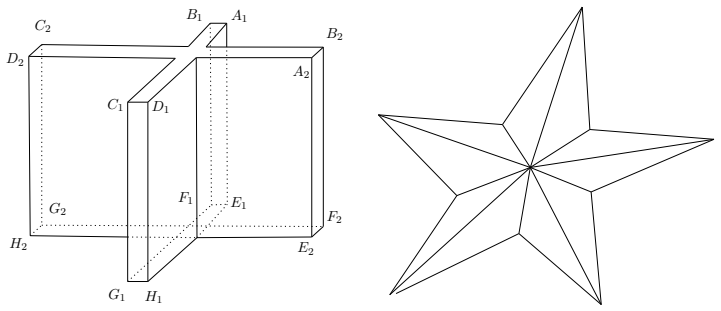
- [§4, Theorem 1.4] The proof of M_3(n)>7/6 n−O(1) is not a proof as written. Proposition 4.2 is justified only by a description of a figure ('rectangular boxes cross each other as shown in Figure 4'), and the existence of a 'star-shaped badge' arrangement with 6 planes and 5 maximum-volume tetrahedra is simply observed from Figure 5. No coordinates, volume computations, or verification that no other tetrahedra have larger volume are supplied. The gluing argument distinguishes cases 'one, three, or two planes' but does not prove that the required affine transformations and translations can actually be performed to realize those cases. Consequently, the claimed lower bound for M_3(n) is unsupported.
minor comments (4)
- [§5, Proposition 5.1] The proposition states D_d(n)<r_{d+2}(n), but the proof establishes only that every subfamily of size r_{d+2}(n)+1 contains two equal-volume d-simplices, which gives D_d(n)≤r_{d+2}(n). The strict inequality is not derived. The asymptotic upper bounds in Theorem 1.5 follow from the non-strict bound, so the statement should be corrected or a justification for strictness added.
- [§2, proof of Theorem 1.1] There is a typo: '2d connected branches in total' should be '2^d connected branches in total.' Also, the bipartite graph setup says 'vertex set H × P_d' but the intended bipartition is H ∪ P_d; please correct the notation.
- [§5, odd d construction] In the odd-dimensional case, the claim that the affine hulls H_i are hyperplanes of dimension d−1 and that the arrangement is in general position is stated only as 'one can verify.' A short proof or an explicit genericity argument should be included.
- [§3, 3D base case] The first sentence of the proof of Claim 1 ('the interior of the face \tilde{T} of τ intersects T′') is not proved; it may be derivable by a coordinate calculation from xyz=2V_0/9, but as written it is an unstated geometric fact. Since the higher-dimensional argument relies on an analogous but stronger 'clear' assertion, this base-case assumption deserves an explicit proof as well.
Circularity Check
No circularity: the central estimates are derived from external standards; the §3 upper-bound gap is an unproved geometric assertion, not a circular step.
full rationale
The derivation chain does not reduce any principal result to its own inputs. Theorem 1.1 uses an incidence bound built from Proposition 2.1, a Kővári–Sós–Turán argument, and Bézout’s inequality — all external and not fitted to the target. Theorem 1.2 uses the lower-bound construction for m_d(n) (CFK triangulation), but the implication “minimum-volume implies unit-volume after scaling” is a direct, non-circular implication. The lower bound of Theorem 1.3 is an explicit construction with the CFK triangulation; the upper bound attempts a geometric double-counting argument. The risky passage in §3 — “Then, τ′ can be expressed as the union of one of R1,R2 and one of σ1,σ2” — is a strong configuration assertion that is not proved, and the surrounding argument also asserts “Clearly, T′ must pass through the interior of τ” without proof. This is a genuine correctness gap in the upper-bound proof, not a circularity: the assertion does not presuppose the theorem, is not a fitted parameter renamed as a prediction, and is not imported from the author’s own prior work. Theorem 1.5 is a reduction to Green–Tao and Leng–Sah–Sawhney via Proposition 5.1, whose rotation/helix construction is independent of the conclusion. There are no load-bearing self-citations: references [9], [10], and [11] are to other authors, and no uniqueness theorem from the present authors is invoked. The manuscript’s own limitations (“We are not aware of any construction…”) are honest scope statements, not circular supports. Overall, the paper’s content is self-contained against external benchmarks; the detected issue is missing proof, for which circularity is not the appropriate verdict, so the honest finding is no significant circularity.
Axiom & Free-Parameter Ledger
axioms (6)
- standard math Higher-dimensional Bézout theorem: d degree-d hypersurfaces in R^d have at most d^d common points when the intersection is finite.
- standard math Kővári–Sós–Turán theorem for bipartite graphs with forbidden K_{s,t}.
- standard math Shannon's result: an arrangement of d+2 hyperplanes in general position has two d-simplicial cells.
- standard math Coxeter–Freudenthal–Kuhn (CFK) triangulation of the unit cube into d! congruent d-simplices of volume 1/d!.
- standard math Known upper bounds on r_k(n): Green–Tao for k=4 and Leng et al. for k≥4.
- standard math Affine transformations preserve hyperplane arrangements and multiply all d-volumes by a common constant.
Cite this review
Pith. "Pith review of Simplex volumes in hyperplane arrangements." pith.science (2026). https://pith.science/paper/YZDHUOQA
@misc{pith2026251212757,
  author       = {Pith},
  title        = {Pith review of: Simplex volumes in hyperplane arrangements},
  year         = {2026},
  howpublished = {\url{https://pith.science/paper/YZDHUOQA}},
  note         = {Machine review of arXiv:2512.12757}
}
abstract
We study the dual variants of the Erd\H{o}s's distinct distances and unit distance problems. Instead of considering distances determined by points, we consider simplex volumes determined by hyperplanes. We investigate: (1) the maximum number of unit $d$-volume $d$-simplices determined by an arrangement of $n$ hyperplanes in $\mathbb{R}^d$, (2) the maximum number of minimum/maximum $d$-volume $d$-simplices determined by an arrangement of $n$ hyperplanes in $\mathbb{R}^d$, and (3) the maximum number $D_d(n)$ such that any arrangement of $n$ hyperplanes in $\mathbb{R}^d$ in general position contains $D_d(n)$ hyperplanes forming $d$-simplices of distinct $d$-volumes.
Figures




Reference graph
Works this paper leans on
-
[1]
Bartholdi, J
N. Bartholdi, J. Blanc, and S. Loisel. On simple arrangements of lines and pseudo-lines inP 2 andR 2 with the maximum number of trian- gles.Surveys on Discrete and Computational Geometry, pages 105–116, 2008. 14
2008
-
[2]
P. Braß, G. Rote, and K. J. Swanepoel. Triangles of extremal area or perimeter in a finite planar point set.Discrete & Computational Geometry, 26(1):51–58, 2001
2001
-
[3]
F.R.K. Chung. The number of different distances determined by n points in the plane.Journal of Combinatorial Theory, Series A, 36(3):342–354, 1984
1984
-
[4]
Chung, E
F.R.K. Chung, E. Szemer´ edi, and W.T. Trotter. The number of dif- ferent distances determined by a set of points in the euclidean plane. Discrete & Computational Geometry, 7(1):1–11, 1992
1992
-
[5]
Clarkson, H
K.L. Clarkson, H. Edelsbrunner, L.J. Guibas, M. Sharir, and E. Welzl. Combinatorial complexity bounds for arrangements of curves and spheres.Discrete & Computational Geometry, 5(2):99–160, 1990
1990
-
[6]
Cl´ ement and J
G. Cl´ ement and J. Bader. Tighter upper bound for the number of Kobon triangles.Preprint, 6066, 2007. Preprint; available online
2007
-
[7]
Conlon, J
D. Conlon, J. Fox, W. Gasarch, D.G. Harris, D. Ulrich, and S. Zbarsky. Distinct volume subsets.SIAM Journal on Discrete Mathematics, 29(1):472–480, 2015
2015
-
[8]
H. S. M. Coxeter. Discrete groups generated by reflections.Annals of Mathematics, 35(3):588–621, 1934
1934
-
[9]
Dam´ asdi, L
G. Dam´ asdi, L. Mart ´ ınez-Sandoval, D. T. Nagy, and Z. L. Nagy. Trian- gle areas in line arrangements.Discrete Mathematics, 343(12):112105, 2020
2020
-
[10]
Dumitrescu, M
A. Dumitrescu, M. Sharir, and C. D. T´ oth. Extremal problems on tri- angle areas in two and three dimensions. InProceedings of the Twenty- Fourth Annual Symposium on Computational Geometry, pages 208– 217, 2008
2008
-
[11]
Dumitrescu and C.D
A. Dumitrescu and C.D. T´ oth. On the number of tetrahedra with minimum, unit, and distinct volumes in three-space.Combinatorics, Probability and Computing, 17(2):203–224, 2008
2008
-
[12]
P. Erd˝ os. On sets of distances ofnpoints.The American Mathematical Monthly, 53(5):248–250, 1946
1946
-
[13]
P. Erd˝ os. On the set of distances ofnpoints in euclidean space. Magyar Tudom´ anyos Akad´ emia Matematikai Kutat´ o Int´ ezet K¨ ozl¨ one, 5:165–169, 1960
1960
-
[14]
Erd˝ os and J
P. Erd˝ os and J. Pach. Variations on the theme of repeated distances. Combinatorica, 10(3):261–269, 1990. 15
1990
-
[15]
Erd˝ os and G
P. Erd˝ os and G. Purdy. Some extremal problems in geometry.Journal of Combinatorial Theory, Series A, 10(3):246–252, 1971
1971
-
[16]
Erd˝ os, G
P. Erd˝ os, G. Purdy, and E. G. Straus. On a problem in combinatorial geometry.Discrete Mathematics, 40(1):45–52, 1982
1982
-
[17]
Simplizialzerlegungen von beschr¨ ankter flachheit
Hans Freudenthal. Simplizialzerlegungen von beschr¨ ankter flachheit. Annals of Mathematics, 43(3):580–582, 1942
1942
-
[18]
Fujimura.The Tokyo Puzzles
K. Fujimura.The Tokyo Puzzles. Charles Scribner’s Sons, New York,
-
[19]
F¨ uredi and I
Z. F¨ uredi and I. Pal´ asti. Arrangements of lines with a large num- ber of triangles.Proceedings of the American Mathematical Society, 92(4):561–566, 1984
1984
-
[20]
W. T. Gowers. A new proof of Szemer´ edi’s theorem for arithmetic progressions of length four.Geometric & Functional Analysis (GAF A), 8(3):529–551, 1998
1998
-
[21]
W. T. Gowers. Arithmetic progressions in sparse sets.Current Devel- opments in Mathematics, 2000(1):149–196, 2000
2000
-
[22]
Green and T
B. Green and T. Tao. New bounds for Szemer´ edi’s theorem, ii: A new bound forr 4(n).Analytic Number Theory, pages 180–204, 2009
2009
-
[23]
Green and T
B. Green and T. Tao. New bounds for Szemer´ edi’s theorem. iii: A polylogarithmic bound forr 4(n).Mathematika, 63(3), 2017
2017
-
[24]
Gr¨ unbaum
B. Gr¨ unbaum. Arrangements and spreads. InCBMS Regional Confer- ence Series in Mathematics. 1972
1972
-
[25]
Guth and N
L. Guth and N. H. Katz. On the Erd˝ os distinct distances problem in the plane.Annals of Mathematics, pages 155–190, 2015
2015
-
[26]
Kaplan, J
H. Kaplan, J. Matouˇ sek, Z. Safernov´ a, and M. Sharir. Unit dis- tances in three dimensions.Combinatorics, Probability and Computing, 21(4):597–610, 2012
2012
-
[27]
N. H. Katz and G. Tardos. A new entropy inequality for the erdos distance problem.Contemporary Mathematics, 342:119–126, 2004
2004
-
[28]
H.W. Kuhn. Simplicial approximation of fixed points.Proceedings of the National Academy of Sciences, 61(4):1238–1242, 1968
1968
-
[29]
J. Leng, A. Sah, and M. Sawhney. Improved bounds for Szemer´ edi’s theorem.arXiv preprint arXiv:2402.17995, 2024
Pith/arXiv arXiv 2024
-
[30]
H. Lenz. Zur zerlegung von punktmengen in solche kleineren durchmessers.Archiv der Mathematik, 6(5):413–416, 1955. 16
1955
-
[31]
L. Moser. On the different distances determined by n points.The American Mathematical Monthly, 59(2):85–91, 1952
1952
-
[32]
Pach and G
J. Pach and G. Tardos. Forbidden paths and cycles in ordered graphs and matrices.Israel Journal of Mathematics, 155(1):359–380, 2006
2006
-
[33]
Pinchasi
R. Pinchasi. The minimum number of distinct areas of triangles de- termined by a set ofnpoints in the plane.SIAM Journal on Discrete Mathematics, 22(2):828–831, 2008
2008
-
[34]
O. E. Raz and M. Sharir. The number of unit-area triangles in the plane: Theme and variation.Combinatorica, 37(6):1221–1240, 2017
2017
-
[35]
R.W. Shannon. Simplicial cells in arrangements of hyperplanes.Ge- ometriae Dedicata, 8(2):179, 1979
1979
-
[36]
Sharir and J
M. Sharir and J. Zahl. Cutting algebraic curves into pseudo-segments and applications.Journal of Combinatorial Theory, Series A, 150:1–35, 2017
2017
-
[37]
Solymosi and C.D
J. Solymosi and C.D. T´ oth. Distinct distances in the plane.Discrete & Computational Geometry, 25(4):629–634, 2001
2001
-
[38]
Solymosi and V
J. Solymosi and V. H. V˜ u. Near optimal bounds for the Erd˝ os distinct distances problem in high dimensions.Combinatorica, 28(1):113–125, 2008
2008
-
[39]
Spencer, E
J. Spencer, E. Szemer´ edi, and W. T. Trotter. Unit distances in the euclidean plane. InGraph Theory and Combinatorics, pages 294–304. Academic Press, 1984
1984
-
[40]
Sz´ ekely
L.A. Sz´ ekely. Crossing numbers and hard erd os problems in discrete geometry.Combinatorics, Probability and Computing, 11:1–10, 1993
1993
-
[41]
Szemer´ edi
E. Szemer´ edi. On sets of integers containing nokelements in arithmetic progression.Acta Arithmetica, 27:199–245, 1975
1975
-
[42]
T. Tao. Bezout’s inequality. (post in blog ”what’s new”),
-
[43]
G. Tardos. On distinct sums and distinct distances.Advances in Math- ematics, 180(1):275–289, 2003
2003
-
[44]
J. Zahl. An improved bound on the number of point-surface incidences in three dimensions.Contributions to Discrete Mathematics, 8(1), 2013. 17 Appendix Proof of Proposition 3.1.It suffices to show that Kd(n)≤ n d+ 1 Kd−1(n−1) holds for alld≥3. Suppose there are two parallel hyperplanes in an arrange- ment. If we perturb one of them by slightly rotating it...
2013
-
[1978]
Translated from the Japanese by M. Gardner
-
[2011]
URL:https://terrytao.wordpress.com/2011/03/23/ bezouts-inequality/
2011
This paper was first reviewed by deepseek-v4-flash on August 3, 2026.
discussion (0)
Sign in with ORCID, Apple, or X to comment. Anyone can read and Pith papers without signing in.