REVIEW 3 major objections 4 minor 1 cited by
Configurational entropy and instability of tachyonic braneworld
T0 review · 3 major / 4 minor · reviewed 2026-08-14 · deepseek-v4-flash
Pith's one-line read For negative or zero bulk cosmological constant, the configurational entropy of a tachyonic braneworld has a global minimum at a critical expansion rate that the paper argues can determine the universe's accelerated and inflationary rates.
desk verdict The CE minimum is a numerical artifact: the paper's own densities make Sc(H) linear in H, so only the stability section has residual value. read the letter →
The pith
A machine-rendered reading of the paper's core claim, the machinery that carries it, and where it could break.
The reading
What carries the argument
The load-bearing object is the configurational entropy $S_c$ of the energy density $\rho(x)$: take the Fourier transform, form the modal fraction $F(k)=|\rho(k)|^2/\int |\rho(k)|^2\,d^d k$, normalize by its maximum to get $G(k)$, and compute $S_c=-\int G(k)\ln G(k)\,d^d k$. This quantity measures how spread out the momentum content is, and the paper locates its minimum as a function of $H$. The stability half of the paper uses the factorization of the scalar-perturbation equation into the supersymmetric form $\Pi^\dagger\Pi F=m^2F$, with the superpotential $J$ built from the background solution, where $A=e^{-2f}\varphi_0'^2/(1+e^{-2f}\varphi_0'^2)$ enters the perturbation equations; positivity of $1-A$ then guarantees the absence of unstable modes.
What would settle it
Recompute $S_c(H)$ for the same $\Lambda_5=-1$ model at $\lambda=0$, $0.5$, and $2$, and also under a constant rescaling of the coordinate $x$; then locate the minimum in $H$. If $H_c$ changes by more than numerical error, or if no minimum survives, the claimed selection of the expansion rate fails. The check is completed by scanning $H$ over a wider range, say $0.1$ to $10$, to confirm that $S_c(1.61)$ is the global minimum rather than a local dip.
Extended reading notes
Core claim
The paper's central discovery, stated on its own terms, is that configurational entropy applied to the energy density of a tachyonic braneworld behaves like a selector of the expansion rate. For $\Lambda_5<0$ and $\Lambda_5=0$, the numerically computed $S_c(H)$ falls to a global minimum at a critical value $H_c$, and the paper interprets that minimum as the configuration with least configurational energy, hence the predominant tachyonic state. Because conformal time is $\tau=-1/(aH)$ and the radiation- and matter-dominated scale factors are expressed through $\tau$, the paper concludes that the critical value $H_c$ can determine the accelerated rate of the universe and the cosmological inflation rate in those eras. For $\Lambda_5>0$ the numerical curve shows no local minimum, only a monotonic decrease. The paper also reports an exact tachyonic braneworld solution in a de Sitter bulk, and a stability analysis under scalar perturbations: the dS system is stable when $6H^2 > k_5^2\Lambda_5\varphi_0^2$, while the AdS and flat models are stable without restriction.
Load-bearing premise
The entire prediction rests on the assumption that the numerical minimum of $S_c(H)$ found at $\lambda=1$, $k_5=1$, $\Lambda_5=\pm1$ is a stable, global feature that does not shift or disappear when the free constant $\lambda$ or the coordinate convention is changed.
Editorial extensions
If this is right
- If the AdS and flat minima are robust, the tachyonic braneworld predicts a preferred expansion rate $H_c$ with no extra free parameter beyond the choice of bulk constants.
- The identification of the entropy minimum with the predominant state gives a selection principle for which brane configuration is realized dynamically.
- For a positive bulk cosmological constant, the absence of a minimum means this mechanism cannot select an expansion rate, so dS tachyonic braneworlds need a different selection criterion.
- The stability condition $6H^2>k_5^2\Lambda_5\varphi_0^2$ marks exactly when a de Sitter tachyonic braneworld survives scalar perturbations.
- Through the conformal-time relation $\tau=-1/(aH)$, the critical value $H_c$ feeds directly into the radiation- and matter-dominated evolution of the induced FRW metric.
Reading between the lines
- A natural next check, not performed in the paper, is whether $H_c$ stays fixed when the free constant $\lambda$ in Eqs. (2.18)-(2.19) is varied; if it moves, the claimed determination of cosmic acceleration is an artifact of setting $\lambda=1$.
- One could compute $S_c$ for the warp factor $f(x)$ instead of $\rho(x)$ to see whether the minimum is a property of the field configuration or of the observable chosen.
- If the entropy-minimum criterion holds, it suggests a broader diagnostic: configurational entropy minima could select preferred parameter values in other braneworld models with integration constants.
Signed reviews
Editorial analysis
A structured set of objections, weighed in public.
Referee Report
Summary. The paper studies a tachyonic braneworld model with a bulk cosmological constant, computing the configurational entropy (CE) of spatially localized energy-density profiles for negative, zero, and positive Λ5. For Λ5<0 and Λ5=0 it claims that the CE has a global minimum at a critical scale-factor rate Hc (Hc=1.61 for AdS and Hc=1.26 for flat space with the chosen parameters), and it argues that this critical value could determine the accelerated expansion rate and the inflation rate for radiation/matter domination. For Λ5>0 it reports an almost monotonic decrease of CE. The paper also analyzes scalar perturbations using supersymmetric quantum mechanics, concluding that the tachyonic braneworld is stable for Λ5≤0 and stable for Λ5>0 when 6H^2>k5^2 Λ5 φ0^2.
Significance. If the CE-minimum claim were correct, it would introduce a new selection principle for the expansion rate in tachyonic braneworlds, and the stability analysis would extend earlier results in the literature. The stability analysis is a standard application of supersymmetric quantum mechanics and appears internally coherent. However, the central CE claim is contradicted by a direct scaling argument for the energy densities in Eqs. (2.21) and (2.34), which forces Sc to be exactly linear in H. The paper provides machine-checkable analytic forms but no reproducible numerical code or convergence analysis, and the reported many-digit critical values are unsupported. The central physical prediction therefore does not survive scrutiny.
major comments (3)
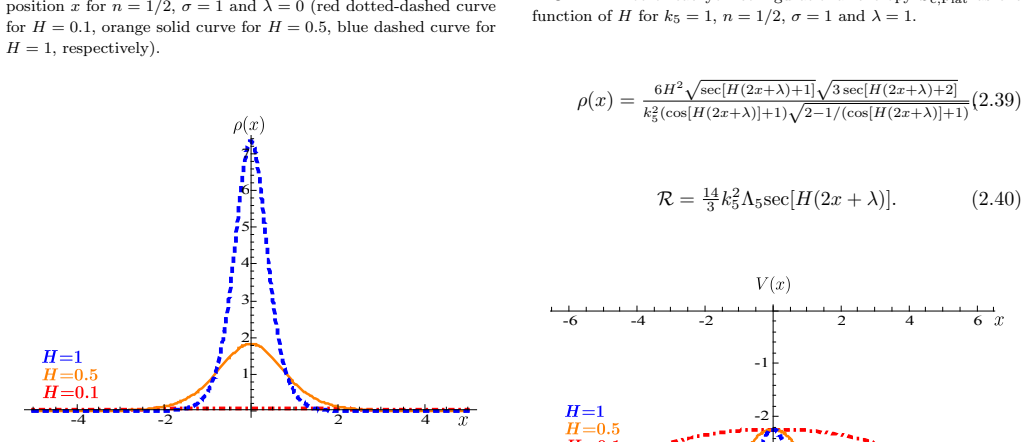
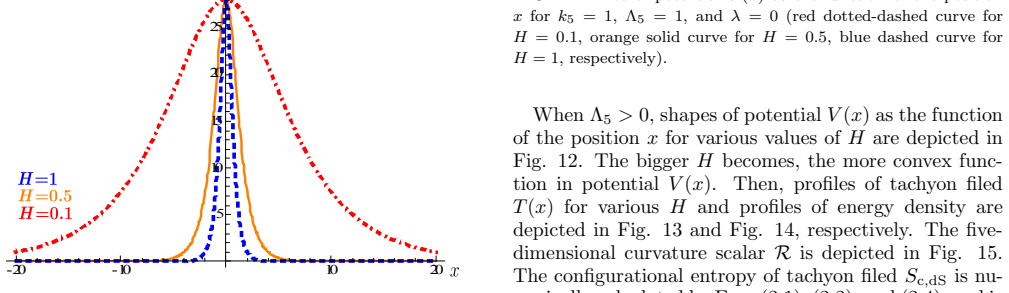
- [§II A–B, Eqs. (2.21) and (2.34)] The CE computation for the negative and zero cosmological constant cases is internally inconsistent with the scaling of the energy density. Both ρ(x) in Eq. (2.21) and Eq. (2.34) have the form ρ(x)=H^2 g(H(2x+λ)). For any such 1D profile, the modal fraction (2.2) satisfies F(k)=H^{-1} h(k/(2H)) with h(q)=|g_hat(q)|^2/∫|g_hat|^2 dq, and the normalized G(k)=F(k)/F_max equals h(k/(2H))/h_max independently of H. The CE in Eq. (2.4) is then Sc(H)=H × [−2∫ (h(q)/h_max) ln(h(q)/h_max) dq], i.e. exactly linear in H. A strictly linear Sc cannot have an interior global minimum at Hc=1.61 or Hc=1.26; the minimum would lie at H=0. The quoted values Sc,AdS=0.0160325 and Sc,Flat=0.013826 are therefore numerical artifacts, and the headline claim that Hc determines cosmic acceleration is unsupported.
- [§II A–B, Figs. 6 and 11] The numerical CE curves are presented without any grid spacing, integration cutoffs, sampling resolution, or convergence tests, yet the claimed minima are quoted to seven significant figures. Given the analytic scaling result above, these figures cannot be used to support a finite-H minimum. The authors should either provide reproducible numerical details or, preferably, correct the computation to reflect the exact linear H dependence implied by their own formulas.
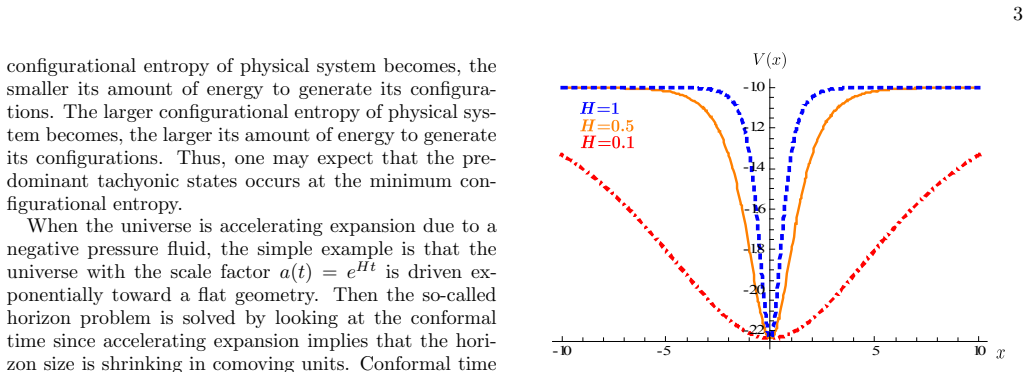
- [§II A, paragraph following Eq. (2.22)] The paper calls the minimum at Hc 'global' but plots CE only over the narrow window 0.5≤H≤2.5 for fixed k5=1, Λ5=−1, λ=1 (Fig. 6), and similarly for the flat case (Fig. 11). No demonstration is given that the minimum is global, nor is the dependence on the free integration constant λ and the other arbitrary constants addressed. In light of the scaling failure, this missing analysis cannot be fixed by adding more plots or parameter scans.
minor comments (4)
- [Throughout] There are several typographical errors: 'configurational entropy of tachyon filed' (should be 'field'), 'curvature sclar' (should be 'scalar'), and 'bulk cosmological constat' (should be 'constant'). These should be corrected.
- [Eq. (2.25)] The relation between conformal time and scale factor is written as τ=−1/(aH); for radiation and matter domination the standard results are a∝τ and a∝τ^2 respectively, but the displayed equations appear to substitute the conformal-time expression inside the proportionality, which is confusing and should be rewritten.
- [§III, paragraph after Eq. (3.16)] The sentence 'When Λ5=0, H and σ of 1−A are replaced by 6H and −k2 5Λ5 respectively' is not grammatical and its intended meaning is unclear; it should be rephrased to describe the substitution explicitly.
- [Fig. 6 and Fig. 11] The figures use an unusual and dense plotting of data points that obscures the curve shapes; the axis labels and legends should be clarified, and the window of H should be extended if the claim of a global minimum is to be visualized.
Circularity Check
No significant circularity: the configurational entropy minimum is computed from the action, not fitted or assumed.
full rationale
The paper's central computation is not circular. The energy densities (2.21), (2.34), and (2.39) are obtained by substituting the field-equation solutions into the action and are then used in the standard configurational-entropy definitions (2.1)-(2.4). The critical values Hc = 1.61 and 1.26 are numerical outputs of that calculation, not fitted inputs; the free constants k5 = 1, Lambda5 = ±1, lambda = 1, sigma = 1 are fixed for plotting and are not tuned to reproduce the reported minima. The cosmological interpretation that the CE minimum selects the expansion rate is an external physical heuristic, not a premise smuggled into the definition of the entropy. The stability analysis in Section III uses the cited exact solutions and perturbation equations from Refs. [14-16], which are not authored by the present paper's author, and the stability conclusion follows from an explicit positivity check of 1-A, not from assuming the desired result. The only self-citations, Refs. [26] and [28], are examples of configurational-entropy applications and are not load-bearing for the present derivation. Even if the reported finite-H minimum were numerically incorrect, that would be a correctness or reproducibility issue, not circularity, because no equation is used both as input and as the claimed output.
Assumptions & free parameters
free parameters (4)
- lambda (integration constant λ) =
1
- k5 (5D gravitational constant) =
1
- sigma (σ, flat-case constant) =
1
- Lambda5 magnitude =
±1
assumptions (4)
- ad hoc to paper The minimum of configurational entropy selects the physically predominant tachyonic state.
- domain assumption Supersymmetric factorization with positive 1-A guarantees scalar stability.
- domain assumption The 5D metric ansatz and tachyon matter action describe the braneworld.
- domain assumption The 4D mass definition m² = γ^{cd}∇_c∇_d - 2H² is the correct stability criterion.
Cite this review
Pith. "Pith review of Configurational entropy and instability of tachyonic braneworld." pith.science (2026). https://pith.science/paper/YZGO27BT
@misc{pith2026190806074,
  author       = {Pith},
  title        = {Pith review of: Configurational entropy and instability of tachyonic braneworld},
  year         = {2026},
  howpublished = {\url{https://pith.science/paper/YZGO27BT}},
  note         = {Machine review of arXiv:1908.06074}
}
read the original abstract
We consider tachyonic braneworld with a bulk cosmological constant and investigate a configurational entropy of various magnitudes of scale factor. It is found that for a bulk negative/zero cosmological constant, the configurational entropy has a global minimum when the magnitude of scale factor reaches the critical value. This result seems to have intriguing implications such that an accelerated rate of the universe and cosmological inflation rate for radiation/matter domination are able to be determined by such critical value. We also find that the configurational entropy almost monotonically decreases for a bulk positive cosmological constant as the magnitude of scale factor grows up. We find an exact solution of tachyonic braneworld in a bulk de Sitter space. It is shown that such system under scalar perturbations is stable for some constraint relation. Furthermore, we also find that tachyonic braneworld model with a bulk negative/zero cosmological constant is always stable under scalar perturbations.
Figures


Figures from the paper (11 more)




Forward citations
Cited by 1 Pith paper
-
Deformed AdS/QCD, mesonic mass spectra, and DCE: Still a margin for heavier resonances
Heavier meson masses are extrapolated from polynomial fits to entropy values of known resonances, with several matches to unconfirmed PDG states.
Reference graph
Works this paper leans on
-
[1]
Sen, JHEP 9808, 012 (1998) [hep-th/9805170]
A. Sen, JHEP 9808, 012 (1998) [hep-th/9805170]
arXiv 1998
-
[2]
Sen, JHEP 0204, 048 (2002) [hep-th/0203211]
A. Sen, JHEP 0204, 048 (2002) [hep-th/0203211]
arXiv 2002
-
[3]
For example, (i) taking H = 1√ 2, k5 = √ 6, Λ5 = 1, λ = 0, and ϕ0 = 1, in the case of [ (6H2 = 3) < (k2 5Λ5ϕ2 0 = 6) ] , 1−A is given as 1 1+2 cos( √ 2x). The value of the function is positive for √ 2(3n−1)π 3 <x< √ 2(3n+1)π 3 whereas it is negative for √ 2(3n+1)π 3 < x < √ 2(3n+2)π 3 8 -4 -2 2 4 -4 -2 2 4 FIG. 18. Plot of the magnitude of 1 −A as the fun...
- [4]
-
[5]
J. M. Cline, H. Firouzjahi and P. Martineau, JHEP0211, 041 (2002) [hep-th/0207156]
arXiv 2002
-
[6]
Especially, H increases, the configurational entropy reaches the minimum value ( Sc,AdS = 0.0160325) at a critical point (Hc = 1.61). In fact, the singular modes in momentum space broadly spread out and become plane waves with equally distributed modal. In addition through Fourier trans- forms, the corresponding modes in position space are sharply localize...
-
[7]
Sen, JHEP 0207, 065 (2002) [hep-th/0203265]
A. Sen, JHEP 0207, 065 (2002) [hep-th/0203265]
arXiv 2002
-
[8]
Caustic Formation in Tachyon Effective Field Theories
N. Barnaby, JHEP 0407, 025 (2004) [hep-th/0406120]
work page Pith review arXiv 2004
Show all 34 references
-
[9]
G. N. Felder, L. Kofman and A. Starobinsky, JHEP 0209, 026 (2002) [hep-th/0208019]
2002 arXiv
-
[10]
(2.1), (2.2), and (2.4), and is depicted in Fig
The configurational entropy of tachyon filedSc,Flat is numerically calculated by Eqs. (2.1), (2.2), and (2.4), and is depicted in Fig. 11. Especially, H grows up, the configurational entropy reaches the minimum value (Sc,Flat = 0.013826) at a critical point ( Hc = 1.26). Thus, as...
-
[11]
G. N. Felder and L. Kofman, Phys. Rev. D 70, 046004 (2004) [hep-th/0403073]
2004 arXiv
-
[12]
N. D. Lambert, H. Liu and J. M. Maldacena, JHEP 0703, 014 (2007) [hep-th/0303139]
2007 arXiv
-
[13]
Kluson, JHEP 0401, 019 (2004) [hep-th/0312086]
J. Kluson, JHEP 0401, 019 (2004) [hep-th/0312086]
2004 arXiv
-
[14]
C. j. Kim, Y. b. Kim and C. O. Lee, JHEP 0305, 020 (2003) [hep-th/0304180]]
2003 arXiv
-
[15]
C. Kim, Y. Kim, O. K. Kwon and C. O. Lee, JHEP0311, 034 (2003) [hep-th/0305092]
2003 arXiv
-
[16]
Sen, Phys
A. Sen, Phys. Rev. D 68, 106003 (2003) [hep- th/0305011]
2003
-
[17]
German, A
G. German, A. Herrera-Aguilar, D. Malagon-Morejon, R. R. Mora-Luna and R. da Rocha, JCAP 1302, 035 (2013) [arXiv:1210.0721 [hep-th]]
2013 arXiv
-
[18]
Barbosa-Cendejas, R
N. Barbosa-Cendejas, R. Cartas-Fuentevilla, A. Herrera- Aguilar, R. R. Mora-Luna and R. da Rocha, JCAP1801, no. 01, 005 (2018) doi:10.1088/1475-7516/2018/01/005 [arXiv:1709.09016 [hep-th]]
2018 arXiv
-
[19]
German, A
G. German, A. Herrera-Aguilar, A. M. Kuerten, D. Malagon-Morejon and R. da Rocha, JCAP 1601, no. 01, 047 (2016) doi:10.1088/1475-7516/2016/01/047 [arXiv:1508.03867 [hep-th]]
2016 arXiv
-
[20]
Gleiser and N
M. Gleiser and N. Stamatopoulos, Phys. Lett. B 713, 304 (2012) [arXiv:1111.5597 [hep-th]]
2012 arXiv
-
[21]
Gleiser and N
M. Gleiser and N. Stamatopoulos, Phys. Rev. D 86, 045004 (2012) [arXiv:1205.3061 [hep-th]]
2012 arXiv
-
[22]
A. E. Bernardini and R. da Rocha, Phys. Lett. B 762, 107 (2016) [arXiv:1605.00294 [hep-th]]
2016 arXiv
-
[23]
A. E. Bernardini, N. R. F. Braga and R. da Rocha, Phys. Lett. B 765, 81 (2017) [arXiv:1609.01258 [hep-th]]
2017 arXiv
-
[24]
Gleiser and D
M. Gleiser and D. Sowinski, Phys. Lett. B 727, 272 (2013) [arXiv:1307.0530 [hep-th]]
2013 arXiv
-
[25]
Gleiser and N
M. Gleiser and N. Graham, Phys. Rev. D 89, no. 8, 083502 (2014) [arXiv:1401.6225 [astro-ph.CO]]
2014 arXiv
-
[26]
Gleiser and N
M. Gleiser and N. Jiang, Phys. Rev. D 92, no. 4, 044046 (2015) [arXiv:1506.05722 [gr-qc]]
2015 arXiv
-
[27]
Casadio and R
R. Casadio and R. da Rocha, Phys. Lett. B 763, 434 (2016) [arXiv:1610.01572 [hep-th]]. 9
2016 arXiv
-
[28]
N. R. F. Braga and R. da Rocha, Phys. Lett. B 767 (2017) 386 [arXiv:1612.03289 [hep-th]]
2017 arXiv
-
[29]
C. O. Lee, Phys. Lett. B 772, 471 (2017) [arXiv:1705.09047 [gr-qc]]
2017 arXiv
-
[30]
Gleiser, M
M. Gleiser, M. Stephens and D. Sowinski, Phys. Rev. D 97, no. 9, 096007 (2018) [arXiv:1803.08550 [hep-th]]
2018 arXiv
-
[31]
C. O. Lee, Phys. Lett. B 790, 197 (2019) doi:10.1016/j.physletb.2019.01.026 [arXiv:1812.00343 [gr-qc]]
2019 arXiv
-
[32]
Giovannini, Phys
M. Giovannini, Phys. Rev. D 64, 064023 (2001) doi:10.1103/PhysRevD.64.064023 [hep-th/0106041]
2001 arXiv
-
[33]
Kobayashi, K
S. Kobayashi, K. Koyama and J. Soda, Phys. Rev. D 65, 064014 (2002) doi:10.1103/PhysRevD.65.064014 [hep-th/0107025]
2002 arXiv
-
[34]
Giovannini, Class
M. Giovannini, Class. Quant. Grav. 20, 1063 (2003) doi:10.1088/0264-9381/20/6/303 [gr-qc/0207116]
2003 arXiv
Reviewed August 14, 2026 · model on record in the stance chip above.
Discussion (0). Continue with ORCID to comment.