Thinking Inside the Box: Considerations for Putting Data Physicalization Workshops in a Box
Pith reviewed 2026-07-05 15:04 UTC · model glm-5.2
The pith
Workshops Without the Expert: Packaging Data Physicalization for Anyone
A machine-rendered reading of the paper's core claim, the machinery that carries it, and where it could break.
Core claim
The core discovery is that data physicalization workshops can be made independently runnable by non-experts when visualization knowledge is distributed across three layers: explicit materials (slides, guides, legends), procedural scaffolds (pre-workshop meetings, co-building activities), and embedded design decisions (pre-constructed encodings, material choices that preempt common failures). The paper validates this through two case studies where facilitators ran workshops without the research team, including one facilitator who had no prior exposure to the original workshops. Equally central is the discovery of what cannot be boxed: the translation of real-world social questions into datafY
What carries the argument
The three knowledge-transfer strategies: (1) transferring knowledge through pre-workshop meetings and detailed facilitator guides, (2) building knowledge by having future facilitators experience the workshop activities as participants first, and (3) embedding tacit visualization knowledge directly into the design of materials — such as pre-built legends that constrain encoding choices, bead-to-data mappings that simplify tokenization, and physical material selections that reduce common bottlenecks.
If this is right
- Visualization researchers could create a shared library of reusable data physicalization encoding templates, each abstracted for different topic domains, to address the gap the paper identifies in question formulation and visual encoding design.
- The workshop-in-a-box concept could be tested in non-community settings such as corporate training or formal education to determine whether the three knowledge-transfer strategies generalize beyond socially-driven organizations.
- The observation that process matters more than output — participants valued the collaborative act of creating data together over the final physicalization artifact — suggests visualization workshops could be reframed primarily as dialogue facilitation tools rather than data production tools.
- The finding that in-situ data collection by participants was unreliable raises the question of whether pre-collected or simulated datasets might serve workshop goals better than self-tracked personal data, trading authenticity for reliability.
Where Pith is reading between the lines
- If the hardest-to-box skill is translating social questions into datafiable form, then LLM-assisted question generation or structured question banks could serve as a partial substitute for visualization expertise — the paper itself gestures toward this but does not test it.
- The validation case studies succeeded partly because facilitators reused pre-built visual encodings rather than creating new ones; a facilitator facing a topic outside the template library might fail, suggesting the box's reach is currently narrower than the paper's framing implies.
- The observation that science center educators independently created new workshops by remixing elements from prior ones suggests that the box may function less as a fixed kit and more as a pattern language — once facilitators internalize the pattern, they can generate variants, though still within the encoding vocabulary they inherited.
Load-bearing premise
The paper assumes that its three knowledge-transfer strategies are sufficient to enable independent facilitation, but the validation case studies succeeded in part because facilitators reused pre-built visual encodings from the original workshops rather than creating their own. The concept's generalizability depends on whether reusable encoding templates can cover the range of topics non-expert facilitators will encounter — a condition the paper does not test.
What would settle it
If a non-expert facilitator, given only the boxed materials, attempted a data physicalization workshop on a topic requiring a novel visual encoding (not matching any pre-built template), and could not produce a working physicalization without researcher intervention, the core claim that workshops can be independently run would be bounded to template-matching cases.
Figures

read the original abstract
Visualization researchers utilize workshops both for applied research and to engage different populations with visualization-based activities. While there are many benefits to running visualization workshops, their utility and impact rely on the presence of a researcher who has deep knowledge about visualization theory and practice. In this work, we introduce workshop-in-a-box as a design concept intended to challenge the researcher-centric approach to data physicalization workshops. Through a design study with a socially innovative organization, we deployed several data physicalization workshops that our collaborator ran instead of us. Based on this experience, along with two accompanying case studies that validate the concept, we present material and procedural considerations for how to put data physicalization workshops into a box and the implications it has for extending visualization research outside the bounds of academia.
Editorial analysis
A structured set of objections, weighed in public.
Referee Report
Summary. This paper introduces 'workshop-in-a-box,' a design concept for packaging data physicalization workshops so that non-visualization experts can facilitate them independently. The authors describe three pilot workshops co-designed with a socially innovative organization (Stadsmission) in Sweden, distill three knowledge-transfer strategies (transferring, building, embedding), and present two validation case studies where facilitators ran workshops without the research team present. The paper is honest about its failures—Pilot 1's visualization activity largely failed, Pilot 3's data collection largely failed—and reflective about what could not be put 'in the box' (data encoding, data production). The manuscript is well-written, grounded in relevant literature, and provides deep links to workshop materials for traceability.
Significance. The paper addresses a genuine gap in the visualization workshop literature: existing work assumes a visualization researcher is present, and there is little guidance on designing for independent facilitation by non-experts. The three knowledge-transfer strategies are a useful contribution, and the honest reflection on what cannot be boxed (§7.1–7.2) is arguably more valuable than the strategies themselves. The deep links to workshop materials support reproducibility and scrutiny. The two validation case studies, while limited in scope (see major comments), demonstrate that the concept has real-world traction—particularly Case Study 2, where educators independently adapted and extended the workshop templates. The paper's positioning as a 'provocation' rather than a toolkit is appropriate and well-argued.
major comments (2)
- Abstract and §6 framing: The abstract states 'two accompanying case studies that validate the concept,' and §6 is titled 'Validation.' However, both case studies involve facilitators reusing visual encodings and activity structures designed by the research team. §7.1 explicitly acknowledges: 'This limits the reusability of the workshop-in-a-box to use cases that match or are closely related to those that surround the original context.' The validation evidence thus supports template-level reuse, not independent workshop design. The abstract's framing implies broader validation than the evidence supports. The authors should either (a) qualify the abstract's claim to match what was actually validated (i.e., reuse of pre-built encodings by non-expert facilitators), or (b) provide additional evidence of independent encoding design. Option (a) is feasible within revision; option (b) is likely,
- §6.1, Martin's role as validation facilitator: The paper presents Martin as a collaborator who received the workshop-in-a-box and then facilitated independently. However, §4 describes Martin as having co-designed all three pilot workshops with the research team over several months, including pre-workshop meetings, post-workshop feedback sessions, and iterative refinement. By the time of the Case Study 1 validation, Martin had undergone extensive training through co-design. The paper notes that Martin 'was very comfortable leading data physicalization activities' by the end of Pilot 3 (§4.3). This makes Martin closer to a trained facilitator than a naive one, and the colleague in Case Study 1 who ran the workshop received both the box and a meeting with Martin. The paper should more clearly distinguish between Martin's level of expertise and the colleague's, and acknowledge that the truly
minor comments (8)
- §1: The phrase 'we intr' appears to be a line-break artifact in the PDF; please verify the rendered text reads correctly.
- §4.1: The 'Data Selfie Materials Box' and similar boxes use up-arrow symbols (↑) before linked items. These are presumably deep links, but this is not explained until later. A brief note at the first occurrence would help readers.
- §5, Strategy #2: The recommendation to 'run the workshop with the future facilitator as a participant' is described, but it is unclear whether this was done for the validation case studies or only during the pilots. Clarify whether this strategy is a recommendation derived from the pilots or a practice also used in the validation.
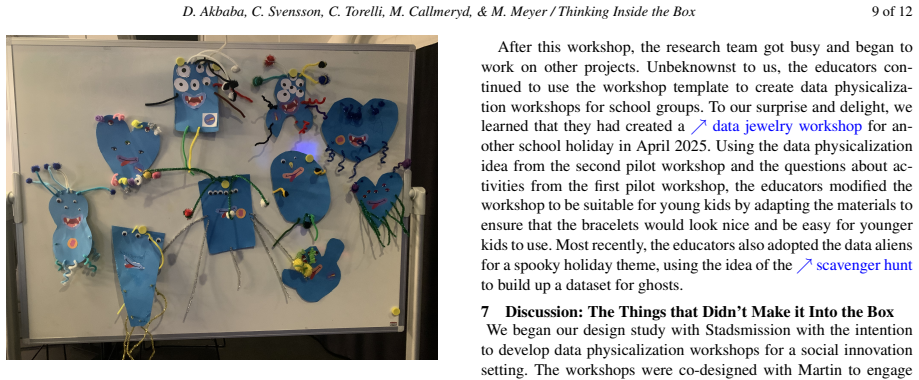
- §6.2: The paper states the educators 'continued to use the workshop template' and created new workshops (data jewelry, ghost-themed aliens). This is strong evidence of adoption, but the paper does not describe how the educators learned the original workshop—was it via the same three strategies? Briefly describe the onboarding process for the educators.
- §7.1: The suggestion to 'consider designing a series of LLM prompts' for physicalization activities is speculative and underdeveloped. Either expand briefly or remove.
- §8: The limitations section discusses generalizability to other contexts but does not address the validation evidence limitation (template reuse vs. independent design). Consider adding a sentence acknowledging this.
- References: Several citation keys have inconsistent capitalization (e.g., 'cKB24' with lowercase 'c'). Please standardize.
- Figure 4 caption: 'particapants' should be 'participants.'
Simulated Author's Rebuttal
We thank the referee for the careful reading and constructive feedback. Both major comments are well-taken and will be addressed in revision.
read point-by-point responses
-
Referee: Abstract and §6 framing: The abstract states 'two accompanying case studies that validate the concept,' and §6 is titled 'Validation.' However, both case studies involve facilitators reusing visual encodings and activity structures designed by the research team. §7.1 explicitly acknowledges: 'This limits the reusability of the workshop-in-a-box to use cases that match or are closely related to those that surround the original context.' The validation evidence thus supports template-level reuse, not independent workshop design. The authors should either (a) qualify the abstract's claim to match what was actually validated, or (b) provide additional evidence of independent encoding design.
Authors: The referee is correct. Our abstract overstates what the case studies demonstrate. As we acknowledge in §7.1, both validation case studies involved reuse of pre-built visual encodings and activity structures by non-expert facilitators—not independent encoding design by those facilitators. We will revise the abstract to accurately characterize the validation as evidence that non-expert facilitators can successfully reuse and adapt pre-built workshop templates, rather than implying broader validation of independent workshop design. We will also add a qualifying sentence at the start of §6 to set reader expectations accordingly. We are not in a position to provide additional evidence of independent encoding design within the revision timeframe, as this would require new workshops and data collection. We note, however, that the educators at Visualiseringscenter C did independently adapt and extend the workshop templates (e.g., creating a data jewelry workshop and a spooky-themed variant), which provides partial evidence of template-level adaptation—though not of independent encoding design from scratch. We will make sure this distinction is clear in the revised text. revision: yes
-
Referee: §6.1, Martin's role as validation facilitator: The paper presents Martin as a collaborator who received the workshop-in-a-box and then facilitated independently. However, §4 describes Martin as having co-designed all three pilot workshops with the research team over several months, including pre-workshop meetings, post-workshop feedback sessions, and iterative refinement. By the time of the Case Study 1 validation, Martin had undergone extensive training through co-design. The paper notes that Martin 'was very comfortable leading data physicalization activities' by the end of Pilot 3 (§4.3). This makes Martin closer to a trained facilitator than a naive one, and the colleague in Case Study 1 who ran the workshop received both the box and a meeting with Martin. The paper should more clearly distinguish between Martin's level of expertise and the colleague's, and acknowledge that the truly
Authors: The referee is right to flag this conflation. Martin is not a naive facilitator—he co-designed all three pilot workshops over several months and, as we note in §4.3, was 'very comfortable leading data physicalization activities' by the end of Pilot 3. Presenting his facilitation of the Wish Upon a Star workshop as validation of workshop-in-a-box without acknowledging his extensive prior training is misleading. We will revise §6.1 to explicitly distinguish three levels of facilitator expertise: (1) Martin, who received extensive training through co-design and is best understood as a trained facilitator; (2) the Stadsmission colleague, who received the box materials, a five-point overview, and one meeting with Martin but had not participated in the original pilot workshops; and (3) the educators at Visualiseringscenter C, who participated in a co-design process for the Data Aliens workshop but then independently created new workshops. We will clarify that the strongest evidence for workshop-in-a-box supporting independent facilitation comes from the Stadsmission colleague (Case Study 1) and the educators' subsequent adaptations (Case Study 2), not from Martin's facilitation. We will also acknowledge that the Stadsmission colleague did receive a meeting with Martin, which represents an additional procedural element beyond the box itself, and that we cannot fully separate the contribution of that meeting from the contribution of the box materials. revision: yes
Circularity Check
No significant circularity; self-citations are framing, not load-bearing
full rationale
This is an HCI design study / experience report, not a formal derivation chain. The paper introduces 'workshop-in-a-box' as a design provocation grounded in three pilot workshops, then validates with two case studies where facilitators ran workshops without the research team present. There are no equations, no fitted parameters renamed as predictions, no uniqueness theorems invoked, and no ansatz smuggled through self-citation. The self-citations present ([AKM25] Akbaba/Klein/Meyer for 'entanglements,' [ALC→23] Akbaba et al. for 'care-ful design study') provide epistemic framing for the research stance but are not load-bearing for the paper's central claim — the validation case studies stand on their own as empirical evidence regardless of whether one adopts the feminist/care-ethics framing. The reader's concern that validation case studies reuse pre-built visual encodings from the pilot workshops is a legitimate scope limitation, but the paper is transparent about it in §7.1: 'Datafying a problem in the world became a part of the workshop that we ultimately could not put in a box' and 'This limits the reusability of the workshop-in-a-box to use cases that match or are closely related to those that surround the original context.' This is honest scoping, not circular reasoning. The concept is validated for template-level reuse, which the paper acknowledges. Score of 1 reflects the presence of non-load-bearing self-citations for framing only.
Axiom & Free-Parameter Ledger
free parameters (3)
- Workshop topic selection =
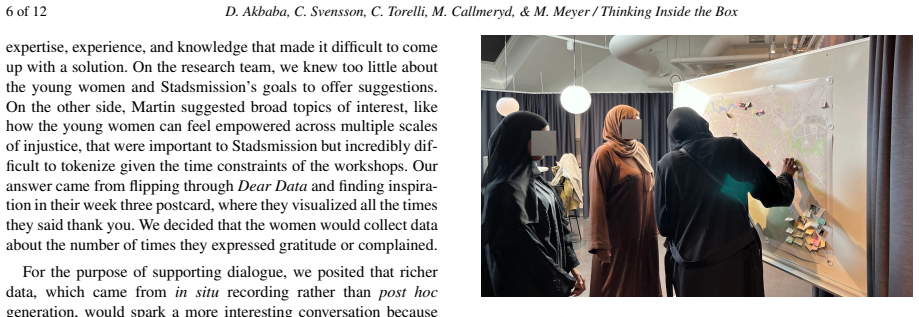
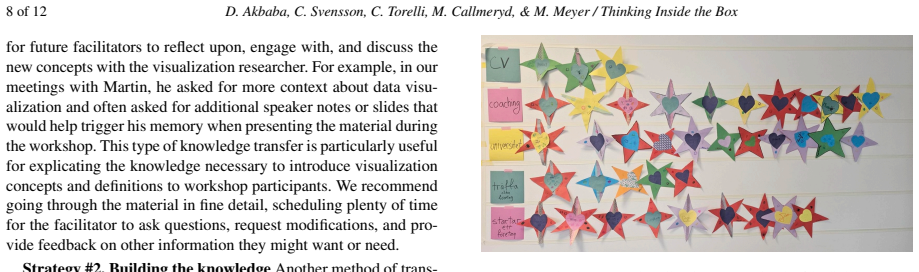
Gratitude/complaints (Pilot 2); city movement (Pilot 3); new year resolutions (Case 1); scavenger hunt (Case 2)
- Visual encoding design =
Beads for data jewelry; origami+washi tape for maps; stars for wishes
- Workshop duration =
3 hours per pilot workshop
axioms (3)
- domain assumption Data physicalization workshops have a lower barrier to entry than digital visualization methods for non-expert audiences.
- domain assumption Tacit knowledge transfer through the three strategies (transferring, building, embedding) is sufficient to enable independent facilitation of workshop mechanics.
- standard math The care-ful design study methodology [ALC→23] is an appropriate framework for conducting visualization research with community partners.
invented entities (1)
-
Workshop-in-a-box (design concept)
independent evidence
Reference graph
Works this paper leans on
-
[1]
Ö., BUURJ.: Data drawing and data tinkering
[AB23]A˘GÇAA. Ö., BUURJ.: Data drawing and data tinkering. InPro- ceedings of International Conference 2023 of the Design Research Soci- ety Special Interest Group on Experiential Knowledge (EKSIG)(2023), Design Research Society Milan, Italy, pp. 15–29.4 [AKM25]AKBABAD., KLEINL., MEYERM.: Entanglements for visu- alization: Changing research outcomes throu...
-
[2]
4 [dlB11]DE LABELLACASAM. P.: Matters of care in technoscience: Assembling neglected things.Social Studies of Science 41, 1 (2011), 85–106. PMID: 21553641.doi:10.1177/0306312710380301. 4 [EGP→21]ENSB., GOODWINS., PROUZEAUA., ANDERSONF., WANGF. Y., GRA TZLS., LUCARELLIZ., MOYLEB., SMILEYJ., DWYERT.: Uplift: A Tangible and Immersive Tabletop System for Casu...
-
[3]
2 [KGD→19]KERZNERE., GOODWINS., DYKESJ., JONESS., MEYER M.: A framework for creative visualization-opportunities workshops. IEEE Transactions on Visualization and Computer Graphics 25,1 (2019), 748–758.doi:10.1109/TVCG.2018.2865241.1,2 [KMGK25]KNOLLC., MÖLLERT., GREGORYK., KOESTENL.: The Gulf of Interpretation: From Chart to Message and Back Again. In Pro...
discussion (0)
Sign in with ORCID, Apple, or X to comment. Anyone can read and Pith papers without signing in.