Three-Body Earth-Moon Transfers with Different Departure/Arrival Orbital Altitudes: New Phenomenon and Diffusion Model-Augmented Construction
Pith reviewed 2026-06-29 02:51 UTC · model grok-4.3
The pith
Diffusion model trained on time-of-flight discontinuities augments grid search for Earth-Moon transfers at varying altitudes.
A machine-rendered reading of the paper's core claim, the machinery that carries it, and where it could break.
Core claim
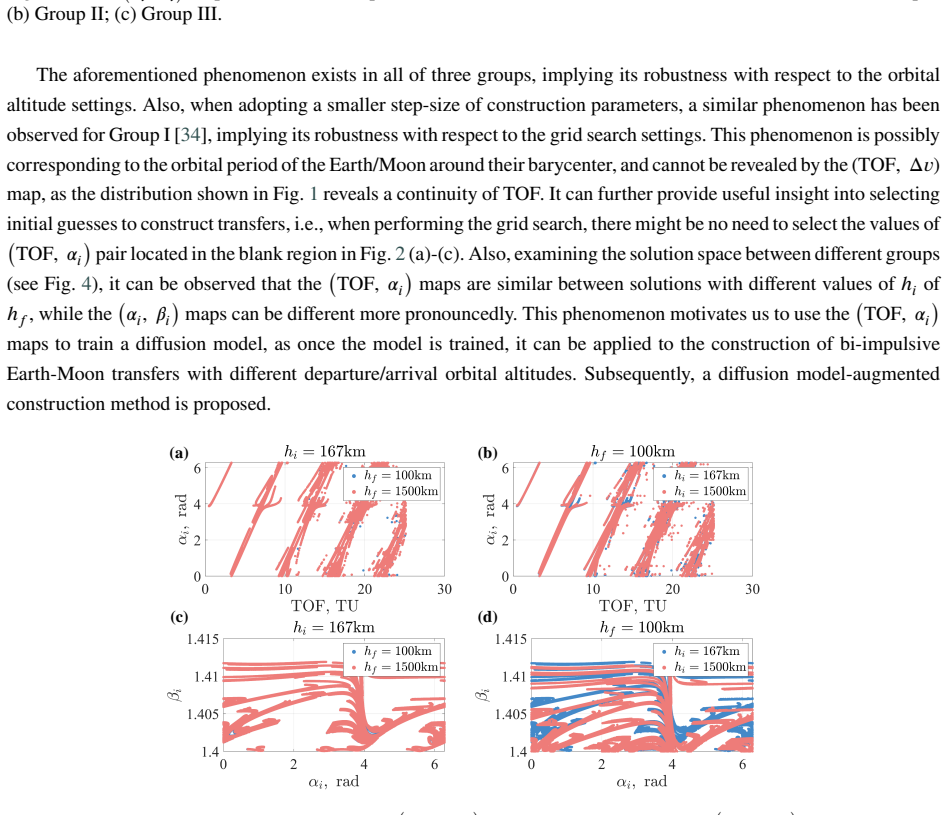
The discontinuous behavior of the time-of-flight distribution with respect to departure phase angle can be used to train a diffusion model that generates high-quality initial guesses, allowing efficient construction of transfers with different departure and arrival orbital altitudes via an augmented grid search method.
What carries the argument
A diffusion model trained on the observed discontinuous time-of-flight versus departure phase angle distribution, which generates initial guesses to augment the grid search process.
If this is right
- Transfers at new altitude pairs can be constructed without repeating the full grid search and correction process from scratch.
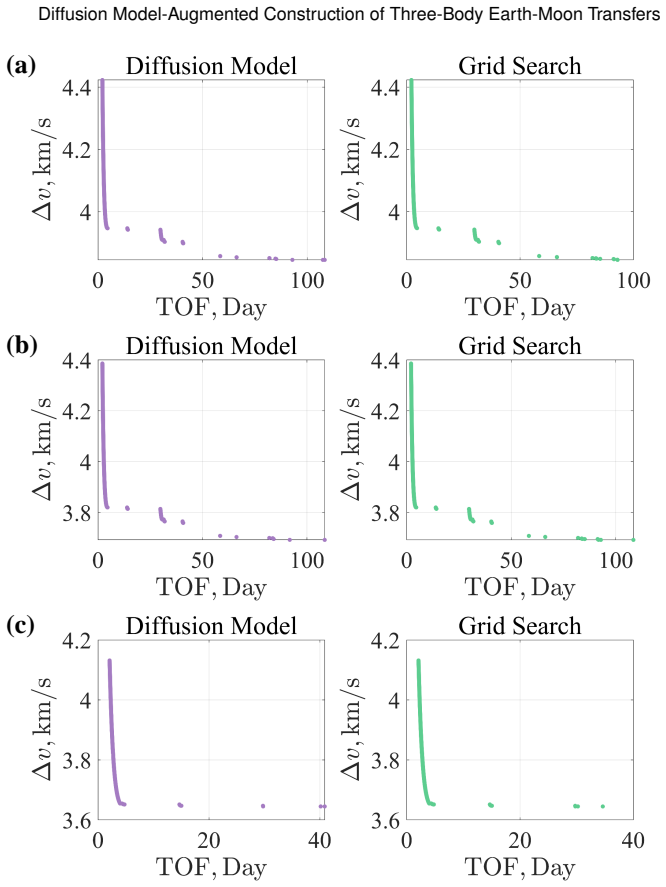
- The search convergence rate increases by 47.34-56.25 percent relative to traditional grid search.
- Wall-clock time is reduced by 39.39-40.52 percent relative to traditional grid search.
- The resulting transfers maintain transfer characteristics comparable to those obtained by repeated standard searches.
Where Pith is reading between the lines
- The same discontinuity-to-model pipeline could be applied to other three-body or multi-body trajectory families that exhibit phase-angle sensitivities.
- Real-time replanning for cislunar missions might become feasible if the trained model generalizes across wide altitude ranges without retraining.
- Hybrid methods that combine diffusion-based guess generation with direct optimization could extend the approach to continuous-thrust or low-thrust Earth-Moon transfers.
Load-bearing premise
The discontinuous time-of-flight behavior seen at one altitude set is representative enough that a model trained on it works well for transfers at substantially different altitudes.
What would settle it
Running the diffusion model-augmented search on a new set of departure and arrival altitudes and finding no improvement in convergence rate or computation time over standard grid search would falsify the utility of the approach.
Figures
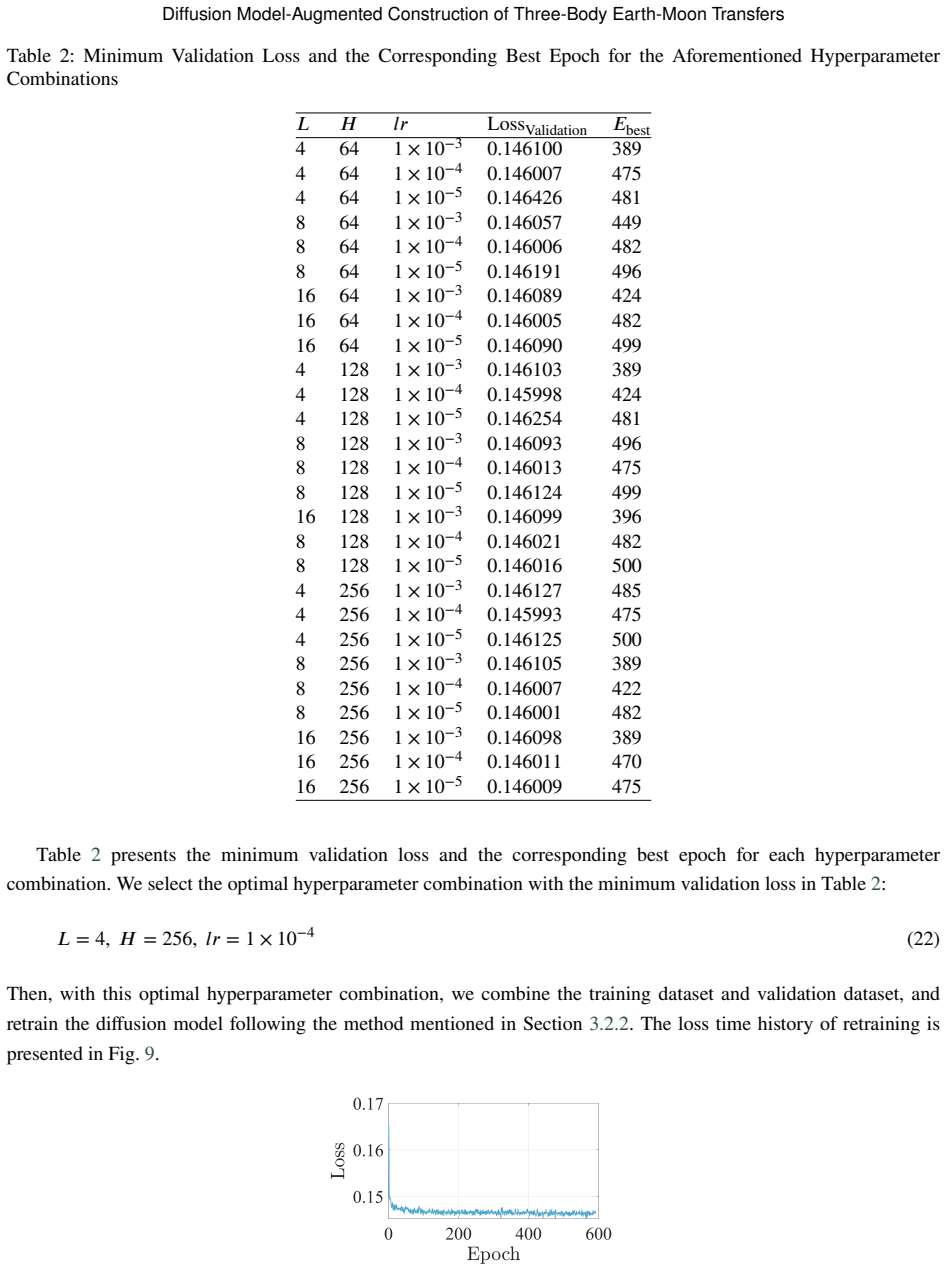
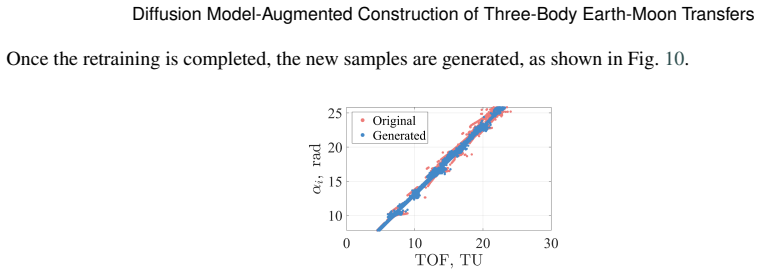
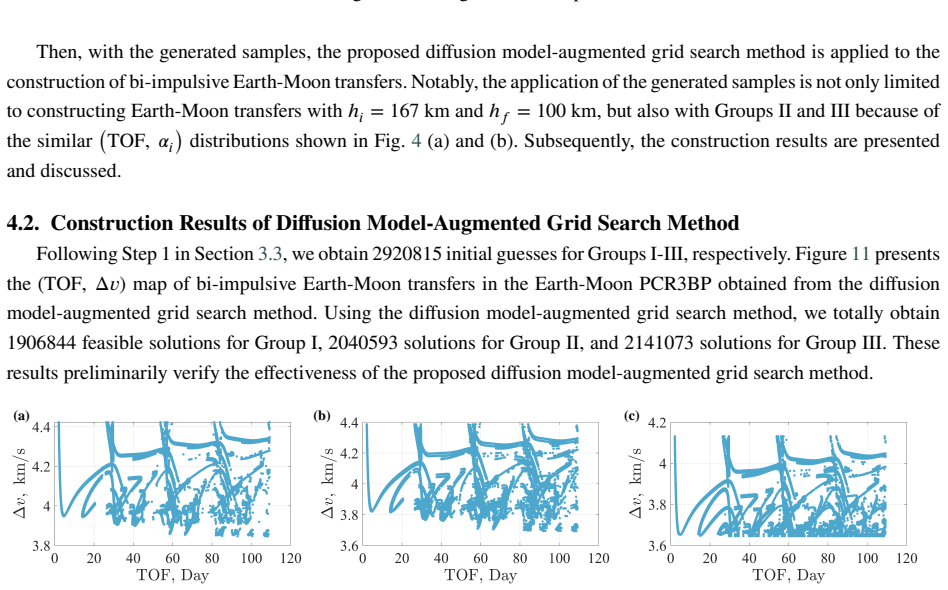
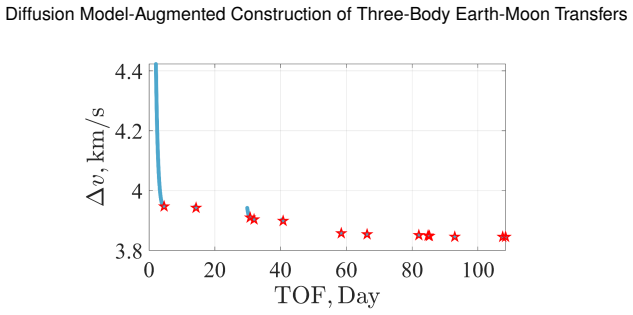
read the original abstract
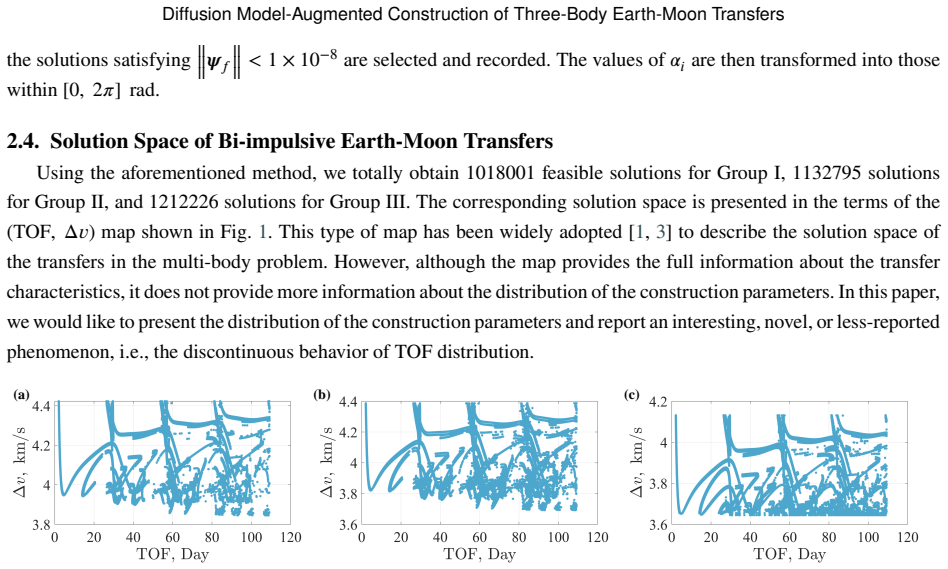
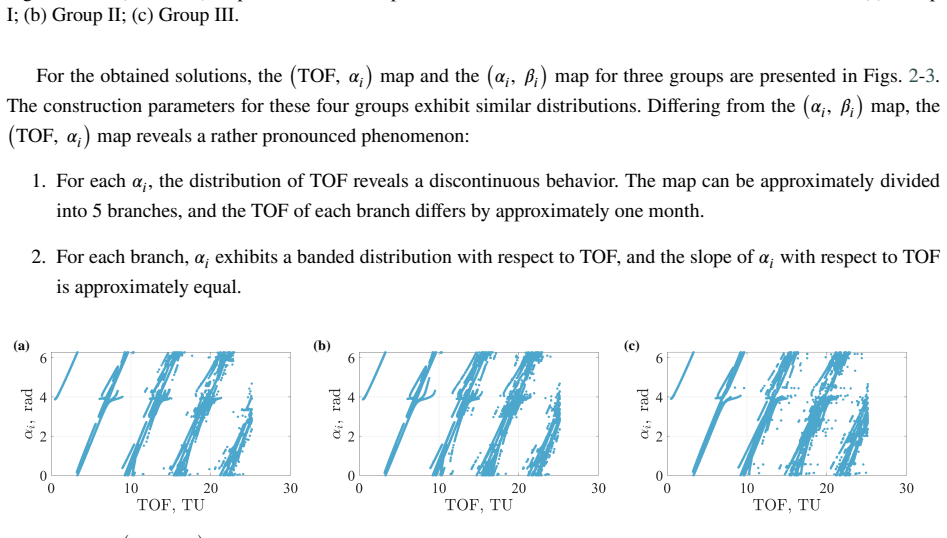
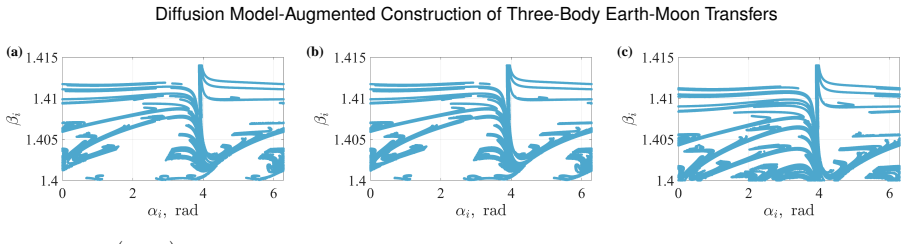
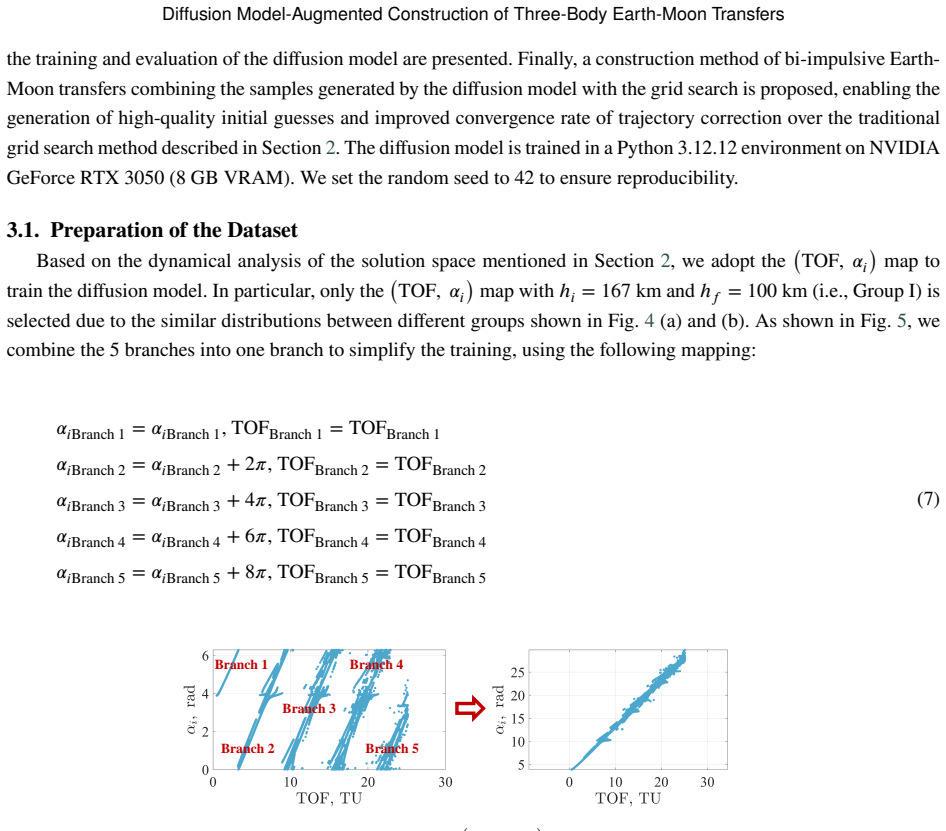
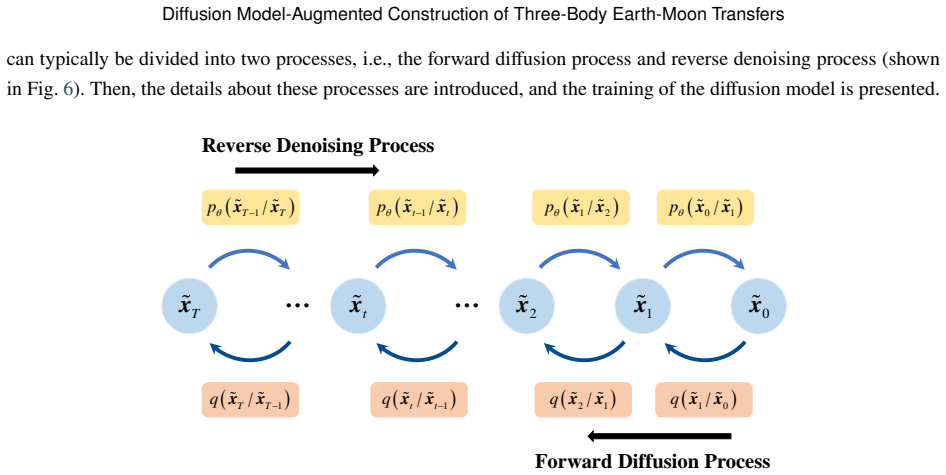
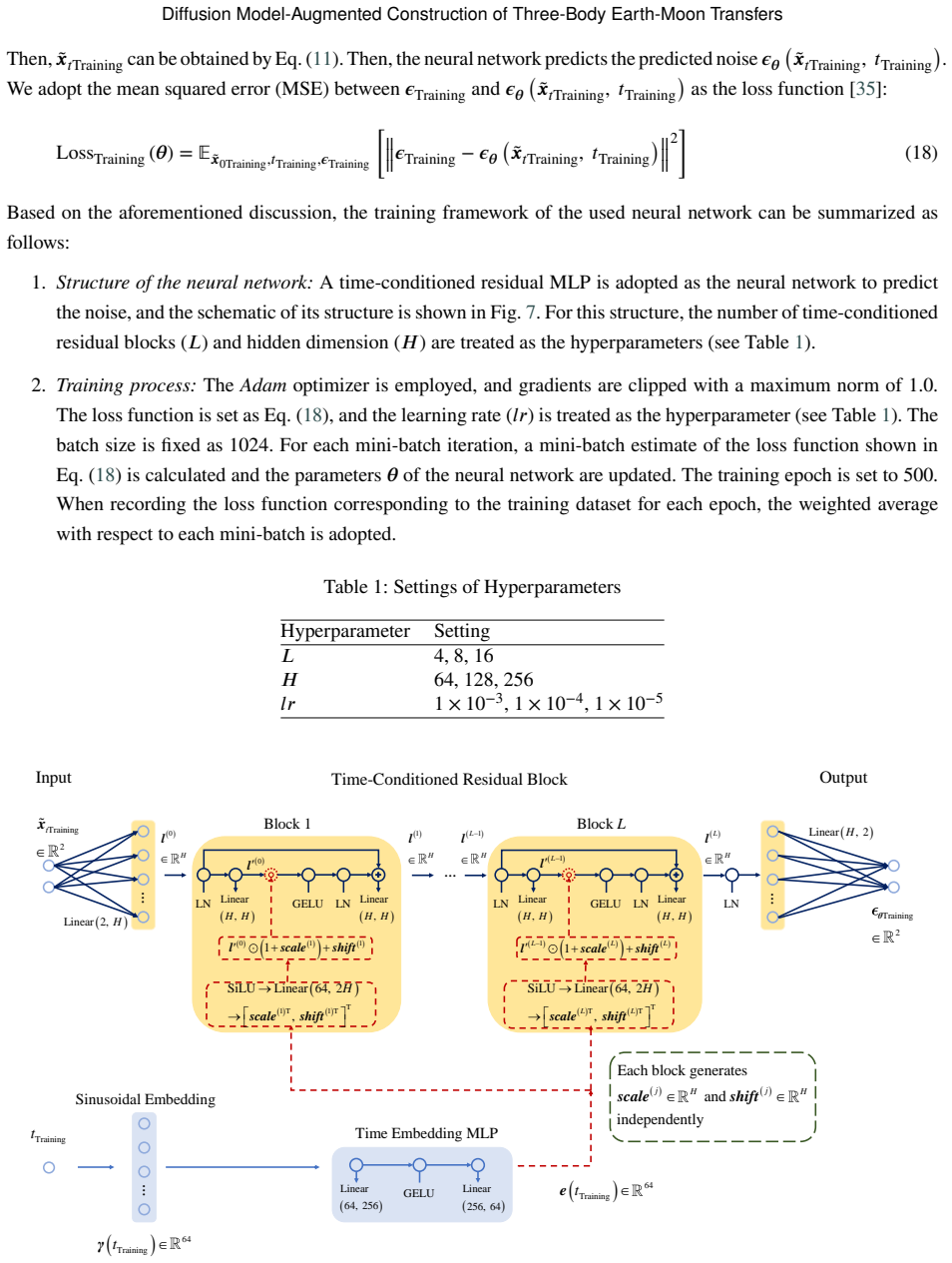
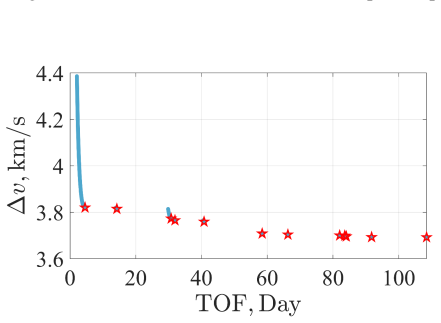
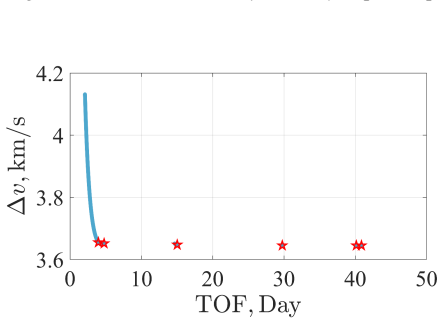
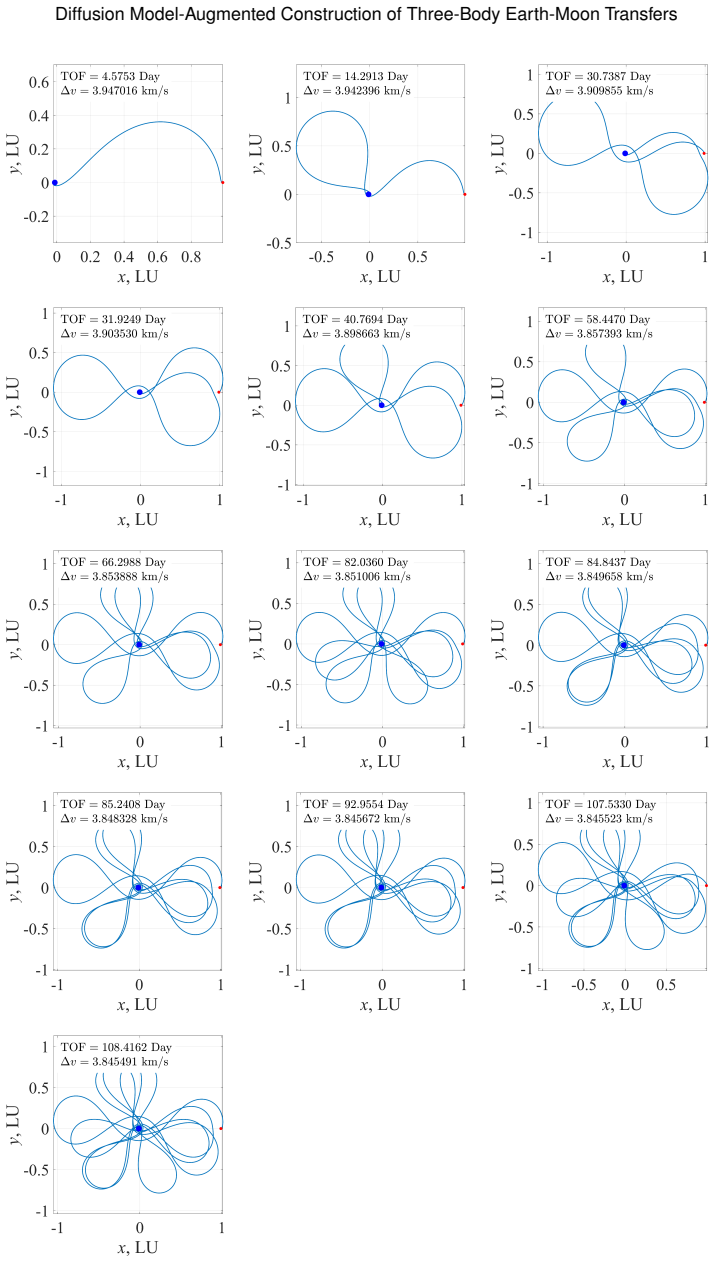
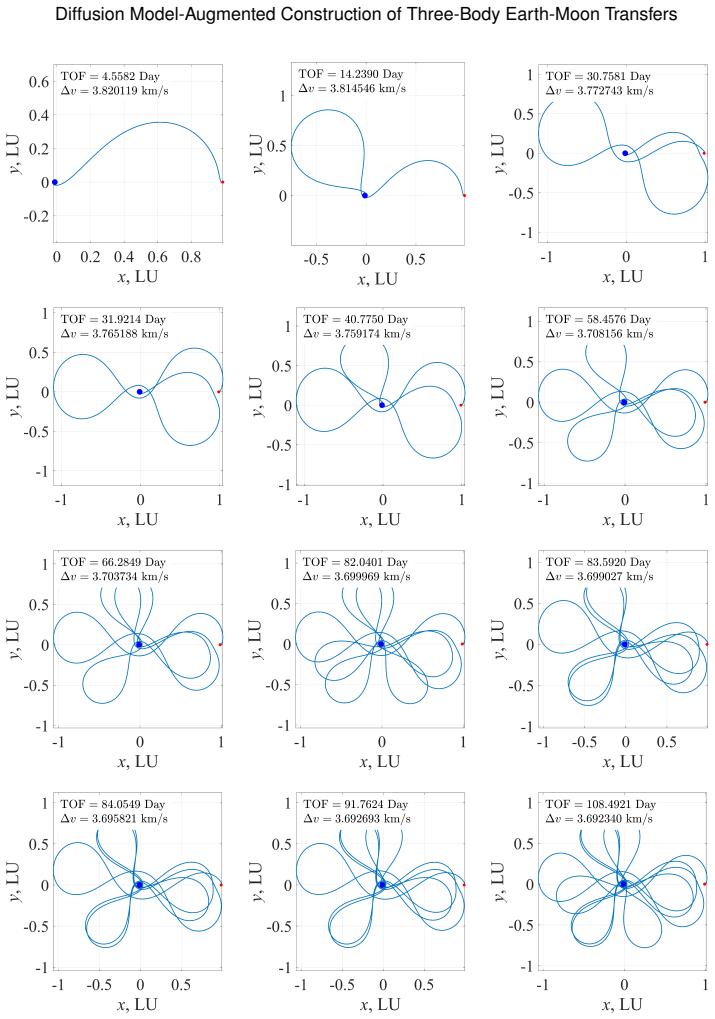
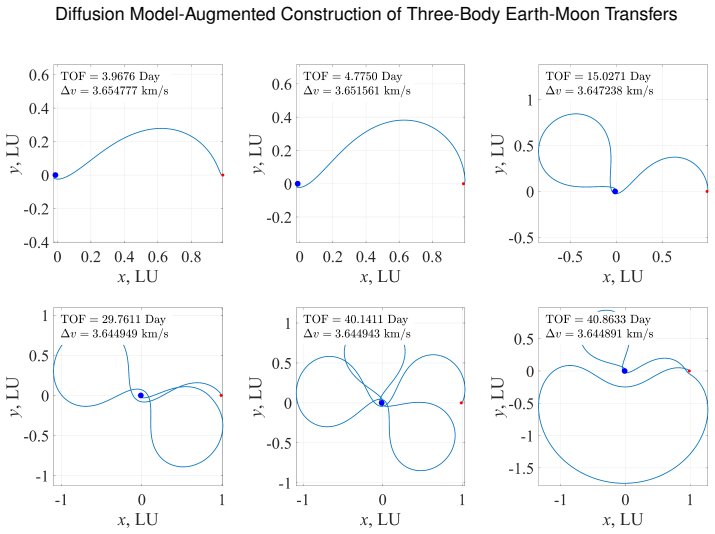
Construction of Earth-Moon transfers is the basis of missions to explore the Moon and cislunar space. The traditional grid search method suffers from a relatively low convergence rate and computational efficiency, mainly focusing on the distribution of transfer characteristic parameters. Moreover, when constructing transfers with different departure/arrival orbital altitudes, the process of grid search and trajectory correction should be repeated with a low convergence rate and computational efficiency. To address these limitations of the traditional grid search method, this paper is devoted to exploring an effective way to augment the grid search method. Bi-impulsive Earth-Moon transfers from a circular Earth parking orbit to a circular Moon target orbit in the Earth-Moon planar circular restricted three-body problem are considered in this paper. Firstly, the transfers are constructed, and the corresponding solution space is explored in terms of construction parameters, including departure phase angle at the Earth parking orbit, initial-to-circular velocity ratio, and time of flight. An interesting phenomenon about the discontinuous behavior of the time-of-flight distribution with respect to departure phase angle is identified. This phenomenon is further used to train a diffusion model, which aims to augment the traditional grid search method and generate high-quality initial guesses for transfers with different departure/arrival orbital altitudes. The construction results of the proposed method are presented and analyzed. The proposed diffusion model-augmented grid search method improves the convergence rate by 47.34-56.25% and saves the wall-clock time by 39.39-40.52% over the traditional grid search method relatively, while ensuring comparable transfer characteristics.
Editorial analysis
A structured set of objections, weighed in public.
Referee Report
Summary. The paper considers bi-impulsive Earth-Moon transfers in the planar circular restricted three-body problem from circular Earth parking orbits to circular Moon target orbits. It identifies a discontinuous dependence of time-of-flight on departure phase angle at one specific pair of orbital altitudes, trains a diffusion model on this behavior, and uses the model to supply initial guesses that augment a traditional grid-search procedure when the departure and arrival altitudes are changed. The abstract reports that the augmented method raises convergence rate by 47.34–56.25 % and reduces wall-clock time by 39.39–40.52 % relative to unaugmented grid search while preserving comparable transfer characteristics.
Significance. If the diffusion model generalizes the observed discontinuity across altitude pairs, the method would offer a concrete, reusable way to accelerate grid-based construction of three-body transfers. The reported speed-ups are empirical and therefore directly relevant to mission-design workflows that repeatedly solve similar problems at varying radii.
major comments (2)
- [Abstract] Abstract: the headline performance figures (47.34–56.25 % convergence improvement, 39.39–40.52 % wall-time reduction) are presented without error bars, without stating how many distinct altitude pairs were tested, and without indicating whether the diffusion model was trained or tuned on any of the reported test cases; these omissions make the central empirical claim impossible to assess for statistical reliability.
- [Abstract] Abstract: the diffusion model is trained exclusively on the discontinuous TOF-versus-phase-angle behavior observed at one Earth/Moon altitude pair and then applied to “different departure/arrival orbital altitudes,” yet no cross-validation, ablation, or structural analysis is supplied to show that the discontinuity persists or retains comparable geometry when the radii change; because this generalization is the load-bearing assumption for the claimed speed-ups, its absence undermines the transferability of the reported gains.
minor comments (1)
- The phrase “comparable transfer characteristics” is used without defining the quantitative metrics (e.g., Δv, TOF, or Jacobi constant) or tolerance thresholds employed for the comparison.
Simulated Author's Rebuttal
We thank the referee for the constructive comments on our manuscript. We address each major comment point by point below and will revise the manuscript accordingly to improve clarity and strengthen the empirical claims.
read point-by-point responses
-
Referee: [Abstract] Abstract: the headline performance figures (47.34–56.25 % convergence improvement, 39.39–40.52 % wall-time reduction) are presented without error bars, without stating how many distinct altitude pairs were tested, and without indicating whether the diffusion model was trained or tuned on any of the reported test cases; these omissions make the central empirical claim impossible to assess for statistical reliability.
Authors: We acknowledge the need for greater transparency in the abstract. The reported performance ranges are aggregated from experiments across multiple distinct altitude pairs (distinct from the single training pair), with the diffusion model trained exclusively on the identified discontinuous case at one altitude pair and applied without further tuning to the test cases. To address this, we will revise the abstract to explicitly state the number of altitude pairs tested, clarify the training/test separation, and include error bars or standard deviations from repeated runs where applicable. revision: yes
-
Referee: [Abstract] Abstract: the diffusion model is trained exclusively on the discontinuous TOF-versus-phase-angle behavior observed at one Earth/Moon altitude pair and then applied to “different departure/arrival orbital altitudes,” yet no cross-validation, ablation, or structural analysis is supplied to show that the discontinuity persists or retains comparable geometry when the radii change; because this generalization is the load-bearing assumption for the claimed speed-ups, its absence undermines the transferability of the reported gains.
Authors: The manuscript states that the model is trained on the discontinuity at one specific altitude pair and then used for different altitudes, with the results demonstrating successful augmentation and the reported speed-ups. We agree that additional evidence of generalization would strengthen the work. We will add a dedicated subsection providing structural analysis of the discontinuity across altitude variations, along with cross-validation results on held-out altitude pairs, to explicitly support transferability. revision: yes
Circularity Check
No significant circularity; empirical gains are externally measured
full rationale
The paper identifies a discontinuous TOF-vs-phase-angle pattern at one specific Earth/Moon altitude pair, trains a diffusion model on that data, and then reports measured convergence-rate and wall-time improvements when the model supplies initial guesses for transfers at different altitude pairs. These performance numbers are direct empirical comparisons against a baseline grid-search implementation; they are not algebraically or definitionally forced by any fitted parameter inside the diffusion model, nor do they reduce to a self-citation chain or an ansatz smuggled from prior work by the same authors. The derivation chain therefore remains self-contained against external computational benchmarks.
Axiom & Free-Parameter Ledger
axioms (1)
- domain assumption The planar circular restricted three-body problem accurately models the dominant dynamics for bi-impulsive Earth-Moon transfers.
Reference graph
Works this paper leans on
-
[1]
Topputo, On optimal two-impulse earth–moon transfers in a four-body model, Celest
F. Topputo, On optimal two-impulse earth–moon transfers in a four-body model, Celest. Mech. Dyn. Astron. 117 (2013) 279–313.doi: 10.1007/s10569-013-9513-8
-
[2]
doi:10.1016/j.actaastro.2017.02.002
Y.Qi,S.Xu,Optimalearth-moontransfersusinglunargravityassistintherestrictedfour-bodyproblem,ActaAstronaut.134(2017)106–120. doi:10.1016/j.actaastro.2017.02.002
-
[3]
K. Oshima, F. Topputo, T. Yanao, Low-energy transfers to the moon with long transfer time, Celest. Mech. Dyn. Astron. 131 (2019) 1–19. doi:10.1007/s10569-019-9883-7
-
[4]
J. Demeyer, P. Gurfil, Transfer to distant retrograde orbits using manifold theory, J. Guid. Control Dyn. 30 (5) (2007) 1261–1267.doi: 10.2514/1.24960
-
[5]
Y.Yin,M.Wang,Y.Shi,H.Zhang,Midcoursecorrectionofearth-moondistantretrogradeorbittransfertrajectoriesbasedonhigh-orderstate transition tensors, Astrodynamics 7 (3) (2023) 335–349.doi:10.1007/s42064-023-0162-8
-
[6]
M. Wang, C. Zhang, H. Zhang, Mechanism analysis of the dro low-energy transfer problem: An energy perspective, Astrodynamics 9 (2) (2025) 165–193.doi:10.1007/s42064-024-0215-7
-
[7]
G. Mingotti, P. Gurfil, Mixed low-thrust invariant-manifold transfers to distant prograde orbits around mars, J. Guid. Control Dyn. 33 (6) (2010) 1753–1764.doi:10.2514/1.49810
-
[8]
79 (2012) 20–32.doi:10.1016/j.actaastro.2012.04.022
G.Mingotti,F.Topputo,F.Bernelli-Zazzera,Transferstodistantperiodicorbitsaroundthemoonviatheirinvariantmanifolds,ActaAstronaut. 79 (2012) 20–32.doi:10.1016/j.actaastro.2012.04.022
-
[9]
J. S. Parker, R. L. Anderson, Low-energy lunar trajectory design, Vol. 12, John Wiley & Sons, 2014
2014
-
[10]
C. Du, O. L. Starinova, Y. Liu, Transfer between the planar lyapunov orbits around the earth-moon l2 point using low-thrust engine, Acta Astronaut. 201 (2022) 513–525.doi:10.1016/j.actaastro.2022.09.056
-
[11]
K. Oshima, A graph-based framework of low-energy transfer design, Acta Astronaut. 229 (2025) 644–661.doi:10.1016/j.actaastro. 2025.01.050
-
[12]
Z. Zhang, X. Hou, Transfer orbits to the earth–moon triangular libration points, Adv. Space Res. 55 (12) (2015) 2899–2913.doi: 10.1016/j.asr.2015.03.008
-
[13]
L. R. Capdevila, K. C. Howell, A transfer network linking earth, moon, and the triangular libration point regions in the earth-moon system, Adv. Space Res. 62 (7) (2018) 1826–1852.doi:10.1016/j.asr.2018.06.045
-
[14]
Y. Yin, Y. Shi, H. Zhang, A graph-based framework for robust low-energy transfer design in multi-body system, Acta Astronaut. 248 (2026) 449–467.doi:10.1016/j.actaastro.2026.06.018
-
[15]
R. H. Battin, An introduction to the mathematics and methods of astrodynamics, AIAA, 1999
1999
-
[16]
H. Pernicka, D. Scarberry, S. Marsh, T. Sweetser, A search for low delta-v earth-to-moon trajectories, in: Astrodynamics Conference, AIAA- 94-3772-CP, AIAA, Scottsdale, 1994, pp. 530–537.doi:10.2514/6.1994-3772
-
[17]
Q. Guo, H. Lei, Families of earth–moon trajectories with applications to transfers towards sun–earth libration point orbits, Astrophys. Space Sci. 364 (3) (2019) 43.doi:10.1007/s10509-019-3532-1
-
[18]
H. Jing, Z. Du, H. Li, H. Wang, J. He, C. Huo, Study on the reachable domain of earth–moon transfer orbits with terminal constraints in the cr3bp, Acta Astronaut. (2026).doi:10.1016/j.actaastro.2026.03.046
-
[19]
E. A. Belbruno, J. K. Miller, Sun-perturbed earth-to-moon transfers with ballistic capture, J. Guid. Control Dyn. 16 (4) (1993) 770–775. doi:10.2514/3.21079
-
[20]
C. Wang, W. Liu, Y. Gao, Low-energy earth–moon transfer autonomous guidance considering high-fidelity orbital dynamics, Astrodynamics 8 (4) (2024) 689–701.doi:10.1007/s42064-024-0211-y
-
[21]
C.T.Campana,F.Topputo,Ephemerisrefinementoflow-energyearth-moontransfersviaanastrodynamicmodelchain,ActaAstronaut.232 (2025) 271–282.doi:10.1016/j.actaastro.2025.03.010
-
[22]
W. S. Koon, M. W. Lo, J. E. Marsden, S. D. Ross, Low energy transfer to the moon, Celest. Mech. Dyn. Astron. 81 (1-2) (2001) 63–73. doi:10.1023/A:1013359120468
-
[23]
S. Fu, D. Wu, P. Shi, S. Gong, Four-body transit-orbit classification combining lagrangian coherent structures with data mining, J. Guid. Control Dyn. (2025) 1–20doi:10.2514/1.G008681. Shuyue Fu et al.:Preprint submitted to ElsevierPage 23 of 24 Diffusion Model-Augmented Construction of Three-Body Earth-Moon T ransfers
-
[24]
N. Hiraiwa, M. Bando, Y. Sato, S. Hokamoto, Design of low-energy transfers in cislunar space using sequences of lobe dynamics, Acta Astronaut. (2026).doi:10.1016/j.actaastro.2026.05.032
-
[25]
S. Fu, Z. Xu, D. Wu, S. Gong, Deep neural network-based high-precision identification of weak stability boundary structures, IEEE Trans. Aerosp. Electron. Syst. (2026).doi:10.1109/TAES.2026.3668754
-
[26]
K. Oshima, F. Topputo, S. Campagnola, T. Yanao, Analysis of medium-energy transfers to the moon, Celest. Mech. Dyn. Astron. 127 (3) (2017) 285–300.doi:10.1007/s10569-016-9727-7
-
[27]
Dutt, A review of low-energy transfers, Astrophys
P. Dutt, A review of low-energy transfers, Astrophys. Space Sci. 363 (12) (2018) 253.doi:10.1007/s10509-018-3461-4
-
[28]
C. T. Campana, F. Topputo, Clustering of earth-moon transfers in sun-perturbed environment, in: 2024 IEEE Congress on Evolutionary Computation (CEC), IEEE, 2024, pp. 1–8.doi:10.1109/CEC60901.2024.10611828
work page internal anchor Pith review Pith/arXiv arXiv doi:10.1109/cec60901.2024.10611828 2024
-
[29]
Pinelli, Neural network applications to bi-impulsive earth-moon transfers in a four-body model, Master’s thesis, Politecnico di Milano (2023)
A. Pinelli, Neural network applications to bi-impulsive earth-moon transfers in a four-body model, Master’s thesis, Politecnico di Milano (2023)
2023
-
[30]
W. Litteri, A. Francisco Gil, M. Vasile, V. Rodriguez-Fernandez, D. Camacho, Generation of periodic orbits in the restricted three-body problem with a variational autoencoder, Celest. Mech. Dyn. Astron. 138 (2026) 25.doi:10.1007/s10569-026-10299-x
-
[31]
L. Dinh, J. Sohl-Dickstein, S. Bengio, Density estimation using real nvp, arXiv preprint arXiv:1605.08803 (2016).doi:10.48550/arXiv. 1605.08803
work page internal anchor Pith review Pith/arXiv arXiv doi:10.48550/arxiv 2016
-
[32]
J.Graebner,R.Beeson,Globalsearchforoptimallowthrustspacecrafttrajectoriesusingdiffusionmodelsandtheindirectmethod,J.Astronaut. Sci. 72 (6) (2025) 62.doi:10.1007/s40295-025-00535-1
-
[33]
T.Presser,A.Dasgupta,D.Erwin,A.Oberai,Diffusionmodelsforgeneratingballisticspacecrafttrajectories,arXivpreprintarXiv:2405.11738 (2024).doi:10.48550/arXiv.2405.11738
-
[34]
S. Fu, D. Wu, S. Gong, Discontinuous behavior of time-of-flight distribution for bi-impulsive earth-moon transfers in the three-body model, arXiv preprint arXiv:2510.26567 (2025)
arXiv 2025
-
[35]
J. Ho, A. Jain, P. Abbeel, Denoising diffusion probabilistic models, in: H. Larochelle, M. Ranzato, R. Hadsell, M. Balcan, H. Lin (Eds.), Advances in Neural Information Processing Systems, Vol. 33, Curran Associates, Inc., 2020, pp. 6840–6851
2020
-
[36]
Vaswani, N
A. Vaswani, N. Shazeer, N. Parmar, J. Uszkoreit, L. Jones, A. N. Gomez, L. u. Kaiser, I. Polosukhin, Attention is all you need, in: I. Guyon, U. V. Luxburg, S. Bengio, H. Wallach, R. Fergus, S. Vishwanathan, R. Garnett (Eds.), Advances in Neural Information Processing Systems, Vol. 30, Curran Associates, Inc., 2017. CRediT authorship contribution statemen...
2017
discussion (0)
Sign in with ORCID, Apple, or X to comment. Anyone can read and Pith papers without signing in.