From Fundamental Dynamics to Applied Cryptography: Studies on the Quantum Speed Limit and Fully Passive Quantum Key Distribution
Pith reviewed 2026-05-20 12:42 UTC · model grok-4.3
The pith
Quantum speed limits bound the time for state evolution and fully passive QKD enables secure communication networks.
A machine-rendered reading of the paper's core claim, the machinery that carries it, and where it could break.
Core claim
By analyzing quantum dynamical models, the work derives insights into the quantum speed limit, and through design of passive optical setups, it achieves a fully passive quantum key distribution protocol suitable for secure networks.
What carries the argument
Quantum speed limit as the minimal evolution time between quantum states and fully passive QKD protocol using fixed passive components.
If this is right
- Quantum speed limits provide bounds useful for timing quantum operations.
- Passive QKD reduces hardware complexity in secure communication setups.
- Such protocols may enhance security by minimizing active intervention points.
- Fundamental limits from dynamics can guide the development of cryptographic applications.
Where Pith is reading between the lines
- The quantum speed limit results could be extended to time-dependent or open quantum systems for broader applicability.
- Practical tests of the passive QKD in real-world network conditions could validate its robustness.
- Similar passive approaches might be explored in other quantum information tasks like quantum teleportation.
Load-bearing premise
The central claims rest on the assumption that the studied dynamical models and passive optical setups accurately capture real-world quantum systems without significant unmodeled noise or implementation imperfections.
What would settle it
An experiment that shows the fully passive quantum key distribution protocol cannot maintain security against eavesdropping in the presence of typical channel losses would disprove the applied claim.
Figures





read the original abstract
This thesis studies two distinct frontiers of quantum information processing: the fundamental physical limits of dynamical evolution and the practical realization of secure quantum communication networks.
Editorial analysis
A structured set of objections, weighed in public.
Referee Report
Summary. This thesis examines two topics in quantum information processing: deriving insights or bounds on the quantum speed limit governing dynamical evolution under various models, and experimentally or theoretically realizing a fully passive quantum key distribution protocol that avoids active modulation for enhanced security in quantum networks.
Significance. If the central derivations and security proofs hold under the stated assumptions, the work strengthens the theoretical toolkit for quantum speed limits by connecting them to practical dynamical constraints and demonstrates a passive QKD implementation that could reduce implementation vulnerabilities in real-world secure communication systems. The dual focus bridges fundamental limits with applied cryptography, with potential impact on both theory and device design.
major comments (2)
- [Quantum Speed Limit chapter] The quantum speed limit analysis assumes closed-system unitary evolution without significant environmental coupling; the manuscript should explicitly derive or bound how the proposed limits degrade under Markovian or non-Markovian noise models, as this directly affects claims of fundamental applicability (see the dynamical evolution section).
- [Fully Passive QKD section] For the fully passive QKD protocol, the security analysis relies on ideal passive optical components and standard assumptions about photon statistics; a quantitative error analysis or simulation of realistic imperfections (e.g., detector dark counts, loss variations) is needed to support the claim of practical security, as this is load-bearing for the applied cryptography contribution.
minor comments (2)
- Notation for the speed limit bounds could be clarified with explicit comparison to existing Mandelstam-Tamm or Margolus-Levitin bounds in a dedicated table or equation set.
- The abstract would benefit from including one or two key quantitative results or bounds obtained in each part of the thesis.
Simulated Author's Rebuttal
We thank the referee for the careful review and constructive comments, which have helped us improve the clarity and scope of the thesis. We address each major comment point by point below, making revisions where they strengthen the presentation without altering the core contributions.
read point-by-point responses
-
Referee: [Quantum Speed Limit chapter] The quantum speed limit analysis assumes closed-system unitary evolution without significant environmental coupling; the manuscript should explicitly derive or bound how the proposed limits degrade under Markovian or non-Markovian noise models, as this directly affects claims of fundamental applicability (see the dynamical evolution section).
Authors: We agree that the primary derivations focus on closed unitary evolution to establish fundamental bounds, consistent with the chapter's emphasis on ideal dynamical constraints. To address the concern about applicability, the revised manuscript adds a subsection deriving an explicit upper bound on the speed limit under Markovian noise via the Lindblad equation, showing degradation linear in the decoherence strength. For non-Markovian cases we include a general inequality relating the limit to the memory kernel, illustrated with a specific example; full quantitative treatment for arbitrary kernels is model-dependent and noted as such. revision: yes
-
Referee: [Fully Passive QKD section] For the fully passive QKD protocol, the security analysis relies on ideal passive optical components and standard assumptions about photon statistics; a quantitative error analysis or simulation of realistic imperfections (e.g., detector dark counts, loss variations) is needed to support the claim of practical security, as this is load-bearing for the applied cryptography contribution.
Authors: The security proof is presented under standard ideal-component and Poissonian-source assumptions, as is conventional for theoretical QKD analyses. Following the suggestion, the revised manuscript incorporates a quantitative error analysis section with Monte Carlo simulations of detector dark counts (at 10^{-5} per ns) and fiber-loss variations (±3 dB). The results indicate that the asymptotic key rate remains positive for distances up to 40 km under these imperfections, with a detailed table of thresholds; this supports the practical-security claim while preserving the protocol's passive advantage. revision: yes
Circularity Check
No significant circularity in the derivation chain
full rationale
The manuscript presents studies on quantum speed limits for dynamical evolution and a fully passive QKD protocol. These rely on standard unitary evolution assumptions, ideal passive optical components, and established security analysis techniques from quantum information theory. No load-bearing steps reduce by construction to self-definitions, fitted inputs renamed as predictions, or chains of self-citations that lack independent verification. The models are explicitly stated with assumptions that do not presuppose the target results, rendering the derivation self-contained against external benchmarks and falsifiable outside the paper's fitted values.
Axiom & Free-Parameter Ledger
Lean theorems connected to this paper
-
IndisputableMonolith/Foundation/RealityFromDistinction.leanreality_from_one_distinction unclear?
unclearRelation between the paper passage and the cited Recognition theorem.
I derive a new family of QSLs based on representation-dependent weighted ℓp_w-seminorms... applicable to both closed and open system dynamics... spontaneous emission and high-fidelity quantum gates.
-
IndisputableMonolith/Foundation/ArithmeticFromLogic.leanLogicNat recovery and embed_strictMono unclear?
unclearRelation between the paper passage and the cited Recognition theorem.
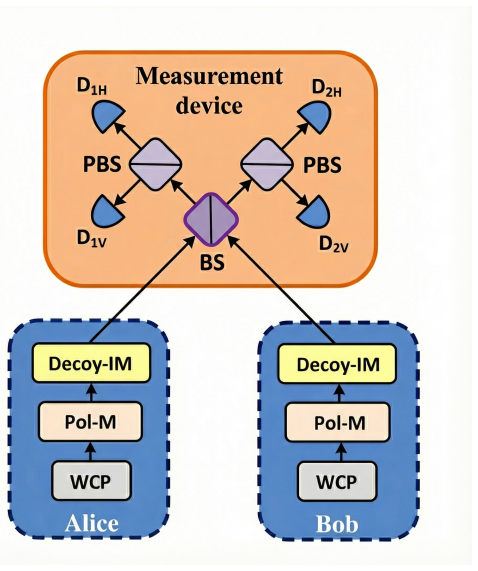
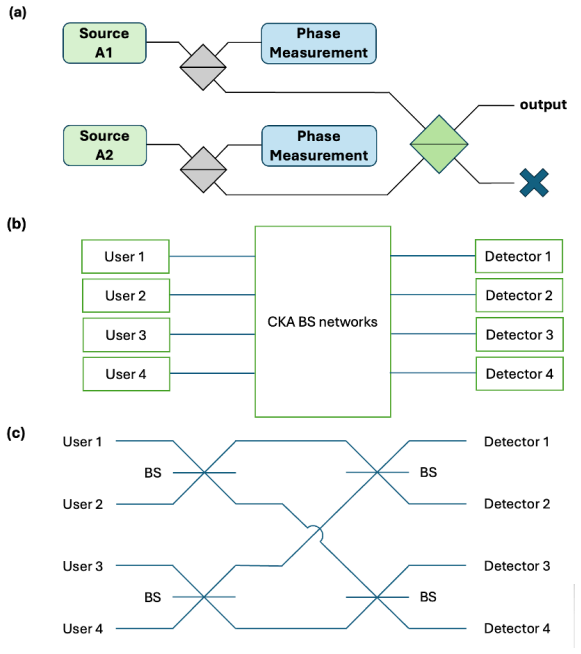
fully passive measurement-device-independent (MDI) QKD protocol... novel decoy-state analysis... secure communication over about 140 km
What do these tags mean?
- matches
- The paper's claim is directly supported by a theorem in the formal canon.
- supports
- The theorem supports part of the paper's argument, but the paper may add assumptions or extra steps.
- extends
- The paper goes beyond the formal theorem; the theorem is a base layer rather than the whole result.
- uses
- The paper appears to rely on the theorem as machinery.
- contradicts
- The paper's claim conflicts with a theorem or certificate in the canon.
- unclear
- Pith found a possible connection, but the passage is too broad, indirect, or ambiguous to say the theorem truly supports the claim.
Reference graph
Works this paper leans on
-
[1]
A Mathematical Theory of Communication
Claude E. Shannon. “A Mathematical Theory of Communication” . In: Bell System Technical Journal 27.3 (1948), pp. 379–423
work page 1948
-
[2]
Cramming More Components onto Integrated Cir- cuits
Gordon E. Moore. “Cramming More Components onto Integrated Cir- cuits” . In: Electronics 38.8 (1965), pp. 114–117
work page 1965
-
[3]
Design of Ion-Implanted MOSFET’s with Very Small Physical Dimensions
R. H. Dennard et al. “Design of Ion-Implanted MOSFET’s with Very Small Physical Dimensions” . In: IEEE Journal of Solid-State Circuits 9.5 (1974), pp. 256–268
work page 1974
-
[4]
Energy Dissipation and Transport in Nanoscale Devices
Eric Pop. “Energy Dissipation and Transport in Nanoscale Devices” . In: Nano Research 3.3 (2010), pp. 147–169
work page 2010
-
[5]
Physical Limits of Silicon Transistors and Circuits
Robert W. Keyes. “Physical Limits of Silicon Transistors and Circuits” . In: Reports on Progress in Physics 68.12 (2005), pp. 2701–2746
work page 2005
-
[6]
Simulating Physics with Computers
Richard P. Feynman. “Simulating Physics with Computers” . In: Inter- national Journal of Theoretical Physics 21.6–7 (1982), pp. 467–488
work page 1982
-
[7]
Yuri I. Manin. Computable and Noncomputable . In Russian. Moscow: Sovetskoye Radio, 1980
work page 1980
-
[8]
Paul Benioff. “The Computer as a Physical System: A Microscopic Quantum Mechanical Hamiltonian Model of Computers as Represented by Turing Machines” . In: Journal of Statistical Physics 22.5 (1980), pp. 563–591
work page 1980
-
[9]
R. Horodecki et al. “Quantum Entanglement” . In: Reviews of Modern Physics 81.2 (2009), pp. 865–942
work page 2009
-
[10]
Algorithms for Quantum Computation: Discrete Log- arithms and Factoring
Peter W. Shor. “Algorithms for Quantum Computation: Discrete Log- arithms and Factoring” . In: Proceedings of the 35th Annual Symposium on Foundations of Computer Science (FOCS) . IEEE, 1994, pp. 124– 134
work page 1994
-
[11]
A Fast Quantum Mechanical Algorithm for Database Search
Lov K. Grover. “A Fast Quantum Mechanical Algorithm for Database Search” . In:Proceedings of the 28th Annual ACM Symposium on Theory of Computing (STOC) . ACM, 1996, pp. 212–219
work page 1996
-
[12]
Michael A. Nielsen and Isaac L. Chuang. Quantum Computation and Quantum Information . 10th Anniversary Edition. Cambridge Univer- sity Press, 2010. 109
work page 2010
-
[13]
The Complexity of Quantum States and Transformations: From Quantum Money to Black Holes
Scott Aaronson. “The Complexity of Quantum States and Transfor- mations: From Quantum Money to Black Holes” . In: arXiv:1607.05256 (2016)
work page internal anchor Pith review Pith/arXiv arXiv 2016
-
[14]
Teleporting an Unknown Quantum State via Dual Classical and Einstein–Podolsky–Rosen Channels
Charles H. Bennett et al. “Teleporting an Unknown Quantum State via Dual Classical and Einstein–Podolsky–Rosen Channels” . In: Physical Review Letters 70.13 (1993), pp. 1895–1899
work page 1993
-
[15]
Quantum Repeaters: The Role of Imperfect Local Operations in Quantum Communication
H.-J. Briegel et al. “Quantum Repeaters: The Role of Imperfect Local Operations in Quantum Communication” . In: Physical Review Letters 81.26 (1998), pp. 5932–5935
work page 1998
-
[16]
H. J. Kimble. “The Quantum Internet” . In: Nature 453 (2008), pp. 1023– 1030
work page 2008
-
[17]
Quantum-Enhanced Mea- surements: Beating the Standard Quantum Limit
V. Giovannetti, S. Lloyd, and L. Maccone. “Quantum-Enhanced Mea- surements: Beating the Standard Quantum Limit” . In: Science 306 (5700 2004), pp. 1330–1336
work page 2004
-
[18]
Vittorio Giovannetti, Seth Lloyd, and Lorenzo Maccone. “Advances in Quantum Metrology” . In: Nature Photonics 5 (2011), pp. 222–229
work page 2011
-
[19]
Nicolas Brunner et al. “Bell nonlocality” . In: Rev. Mod. Phys. 86 (2014), pp. 419–478
work page 2014
-
[20]
The Quantum Technologies Roadmap: A European Perspective
Antonio Acín et al. “The Quantum Technologies Roadmap: A European Perspective” . In:New Journal of Physics 20.8 (2018), p. 080201
work page 2018
-
[21]
A Method for Obtaining Digital Signatures and Public-Key Cryptosystems
Ronald L. Rivest, Adi Shamir, and Leonard Adleman. “A Method for Obtaining Digital Signatures and Public-Key Cryptosystems” . In: Com- munications of the ACM 21.2 (1978), pp. 120–126
work page 1978
-
[22]
Quantum cryptography: Pub- lic key distribution and coin tossing
Charles H. Bennett and Gilles Brassard. “Quantum cryptography: Pub- lic key distribution and coin tossing” . In: Theoretical Computer Sci- ence 560 (2014). Theoretical Aspects of Quantum Cryptography – cel- ebrating 30 years of BB84, pp. 7–11. issn: 0304-3975. doi: https : / / doi . org / 10 . 1016 / j . tcs . 2014 . 05 . 025. url: https : / / www . scien...
work page 2014
-
[23]
Quantum cryptography based on Bell’s theorem
Artur K. Ekert. “Quantum cryptography based on Bell’s theorem” . In: Physical Review Letters 67 (1991), pp. 661–663
work page 1991
-
[24]
A Single Quantum Cannot be Cloned
W. K. Wootters and W. H. Zurek. “A Single Quantum Cannot be Cloned” . In: Nature 299 (1982), pp. 802–803
work page 1982
-
[25]
Nicolas Gisin et al. “Quantum Cryptography” . In: Reviews of Modern Physics 74.1 (2002), pp. 145–195. 110
work page 2002
-
[26]
The Security of Practical Quantum Key Distri- bution
Valerio Scarani et al. “The Security of Practical Quantum Key Distri- bution” . In: Reviews of Modern Physics 81.3 (2009), pp. 1301–1350
work page 2009
-
[27]
Secure Quantum Key Distribution
Hoi-Kwong Lo, Marcos Curty, and Kiyoshi Tamaki. “Secure Quantum Key Distribution” . In: Nature Photonics 8 (2014), pp. 595–604
work page 2014
-
[28]
Practical Challenges in Quantum Key Distribu- tion
Eleni Diamanti et al. “Practical Challenges in Quantum Key Distribu- tion” . In: npj Quantum Information 2 (2016), p. 16025
work page 2016
-
[29]
Secure quantum key distribution with realistic devices
Feihu Xu et al. “Secure quantum key distribution with realistic devices” . In: Reviews of Modern Physics 92 (2020), p. 025002
work page 2020
-
[30]
Satellite-to-Ground Quantum Key Distribution
Sheng-Kai Liao et al. “Satellite-to-Ground Quantum Key Distribution” . In: Nature 549 (2017), pp. 43–47
work page 2017
-
[31]
An Integrated Space-to-Ground Quantum Com- munication Network over 4,600 km
Yu-Ao Chen et al. “An Integrated Space-to-Ground Quantum Com- munication Network over 4,600 km” . In: Nature 589 (2021), pp. 214– 219
work page 2021
-
[32]
The uncertainty relation between energy and time in non-relativistic quantum mechanics
L. Mandelstam and I. Tamm. “The uncertainty relation between energy and time in non-relativistic quantum mechanics” . In: J. Phys. (USSR) 9 (1945), pp. 249–254
work page 1945
-
[33]
A Unitarity Bound on the Evolution of Nonstationary States
G. N. Fleming. “A Unitarity Bound on the Evolution of Nonstationary States” . In: Il Nuovo Cimento A 16.2 (1973), pp. 232–240
work page 1973
-
[34]
J. Anandan and Y. Aharonov. “Geometry of quantum evolution” . In: Phys. Rev. Lett. 65 (1990), p. 1697
work page 1990
-
[35]
Minimum Time for the Evolution to an Orthogonal Quantum State
Lev Vaidman. “Minimum Time for the Evolution to an Orthogonal Quantum State” . In:American Journal of Physics 60.2 (1992), pp. 182– 183
work page 1992
-
[36]
Armin Uhlmann. “An energy dispersion estimate” . In: Physics Letters A 161.4 (1992), pp. 329–331. issn: 0375-9601. doi: https://doi.org/ 10.1016/0375-9601(92)90555-Z
-
[37]
Generalized Geometric Quantum Speed Lim- its
Diego Paiva Pires et al. “Generalized Geometric Quantum Speed Lim- its” . In: Phys. Rev. X 6 (2 2016), p. 021031. doi: 10.1103/PhysRevX. 6.021031. url: https://link.aps.org/doi/10.1103/PhysRevX.6. 021031
-
[38]
Quantum speed limits: from Heisenberg’s uncertainty principle to optimal quantum control
S. Deffner and S. Campbell. “Quantum speed limits: from Heisenberg’s uncertainty principle to optimal quantum control” . In: J. Phys. A 50.45 (2017), p. 453001
work page 2017
-
[39]
Quantum Limits to Dynamical Evolution
Vittorio Giovannetti, Seth Lloyd, and Lorenzo Maccone. “Quantum Limits to Dynamical Evolution” . In: Physical Review A 67.5 (2003), p. 052109. 111
work page 2003
-
[40]
Optimal Adaptive Control for Quantum Metrology with Time-Dependent Hamiltonians
Shengshi Pang and Andrew N. Jordan. “Optimal Adaptive Control for Quantum Metrology with Time-Dependent Hamiltonians” . In: Nature Communications 8 (2017), p. 14695
work page 2017
-
[41]
Quantum thermodynamics of general quantum processes
Felix Binder et al. “Quantum thermodynamics of general quantum processes” . In: Phys. Rev. E 91 (3 2015), p. 032119. doi: 10 . 1103 / PhysRevE.91.032119 . url: https://link.aps.org/doi/10.1103/ PhysRevE.91.032119
work page 2015
-
[42]
Fully passive measurement- device-independent quantum key distribution
Jinjie Li, Wenyuan Wang, and Hoi-Kwong Lo. “Fully passive measurement- device-independent quantum key distribution” . In: Physical Review Ap- plied 21 (2024), p. 064056
work page 2024
-
[43]
Jinjie Li, Wenyuan Wang, and H. F. Chau. Fully Passive Quantum Conference Key Agreement. 2024. arXiv: 2407.15761 [quant-ph]
work page internal anchor Pith review Pith/arXiv arXiv 2024
- [44]
-
[45]
Jinjie Li and H. F. Chau. A New Quantum Speed Limit Based on Uni- tarily Invariant Norms . Contributed talk at the 25th Asian Quantum Information Science (AQIS) Conference. Held in 2025. 2025
work page 2025
-
[46]
H. F. Chau and Jinjie Li. “Quantum speed limits for open system dy- namics based on a representation-basis-dependent ℓp w-seminorm” . In: Phys. Rev. A 113 (4 2026), p. 042218. doi: 10.1103/trss-qhc8. url: https://link.aps.org/doi/10.1103/trss-qhc8
-
[47]
Communication Theory of Secrecy Systems
Claude E. Shannon. “Communication Theory of Secrecy Systems” . In: Bell System Technical Journal 28.4 (1949), pp. 656–715
work page 1949
-
[48]
Secret Key Agreement by Public Discussion from Common Information
Ueli M. Maurer. “Secret Key Agreement by Public Discussion from Common Information” . In: IEEE Transactions on Information Theory 39.3 (1993), pp. 733–742
work page 1993
-
[49]
Joan Daemen and Vincent Rijmen. AES Proposal: Rijndael . NIST, Gaithersburg, MD, 1999
work page 1999
-
[50]
Cipher Printing Telegraph Systems For Secret Wire and Radio Telegraphic Communications
G. S. Vernam. “Cipher Printing Telegraph Systems For Secret Wire and Radio Telegraphic Communications” . In: Transactions of the American Institute of Electrical Engineers XL V (1926), pp. 295–301. doi: 10 . 1109/T-AIEE.1926.5061224
-
[51]
Quantum Cryptography on Multiuser Optical Fibre Networks
P. D. Townsend. “Quantum Cryptography on Multiuser Optical Fibre Networks” . In:Nature 385 (1997), pp. 47–49. 112
work page 1997
-
[52]
New Hash Functions and Their Use in Authentication and Set Equality
Mark N. Wegman and J. Lawrence Carter. “New Hash Functions and Their Use in Authentication and Set Equality” . In: Journal of Computer and System Sciences 22.3 (1981), pp. 265–279
work page 1981
-
[53]
Experimental Quantum Cryptography
Charles H. Bennett et al. “Experimental Quantum Cryptography” . In: Journal of Cryptology 5.1 (1992), pp. 3–28
work page 1992
-
[54]
Simple Proof of Security of the BB84 Quantum Key Distribution Protocol
Peter W. Shor and John Preskill. “Simple Proof of Security of the BB84 Quantum Key Distribution Protocol” . In: Physical Review Letters 85.2 (2000), pp. 441–444
work page 2000
-
[55]
Secret-Key Reconciliation by Public Discussion
Gilles Brassard and Louis Salvail. “Secret-Key Reconciliation by Public Discussion” . In: Advances in Cryptology—EUROCRYPT ’93 . Vol. 765. Lecture Notes in Computer Science. Springer, 1993, pp. 410–423
work page 1993
-
[56]
Low-Density Parity-Check Codes
Robert G. Gallager. “Low-Density Parity-Check Codes” . PhD thesis. MIT, 1962
work page 1962
-
[57]
Privacy Amplification by Public Discussion
Charles H. Bennett, Gilles Brassard, and Jean-Marc Robert. “Privacy Amplification by Public Discussion” . In: SIAM Journal on Computing 17.2 (1988), pp. 210–229
work page 1988
-
[58]
Security of Quantum Key Distribution
Renato Renner. Security of Quantum Key Distribution . 2006. arXiv: quant - ph / 0512258 [quant-ph]. url: https : / / arxiv . org / abs / quant-ph/0512258
work page internal anchor Pith review Pith/arXiv arXiv 2006
-
[59]
Finite-key analysis for measurement-device-independent quantum key distribution
Marcos Curty et al. “Finite-key analysis for measurement-device-independent quantum key distribution” . In:Nature Communications 5 (2014), p. 3732
work page 2014
-
[60]
Fully Passive Quantum Key Distribution
Wenyuan Wang et al. “Fully Passive Quantum Key Distribution” . In: Physical Review Letters 130 (2023), p. 220801
work page 2023
-
[61]
Mathematical Foundations of Quantum Mechanics
John von Neumann. Mathematical Foundations of Quantum Mechanics. English translation: Princeton University Press (1955). Springer, 1932
work page 1955
-
[62]
Christian Weedbrook, Stefano Pirandola, et al. “Gaussian Quantum Information” . In: Reviews of Modern Physics 84.2 (2012), pp. 621–669
work page 2012
-
[63]
Pulsed Energy-Time Entangled Twin-Photon Source for Quantum Communication
J. Brendel et al. “Pulsed Energy-Time Entangled Twin-Photon Source for Quantum Communication” . In:Physical Review Letters 82.12 (1999), pp. 2594–2597
work page 1999
-
[64]
Quantum Cryptography Using Entangled Photons in Energy-Time Bell States
W. Tittel et al. “Quantum Cryptography Using Entangled Photons in Energy-Time Bell States” . In: Physical Review Letters 84.20 (2000), pp. 4737–4740
work page 2000
-
[65]
Quantum Key Distribution over 67 km with a Plug & Play System
D. Stucki et al. “Quantum Key Distribution over 67 km with a Plug & Play System” . In: New Journal of Physics 4 (2002), p. 41. 113
work page 2002
-
[66]
Decoy State Quantum Key Distribution
Hoi-Kwong Lo, Xiongfeng Ma, and Kai Chen. “Decoy State Quantum Key Distribution” . In: Physical Review Letters 94 (2005), p. 230504
work page 2005
-
[67]
Beating the Photon-Number-Splitting Attack in Prac- tical Quantum Cryptography
Xiang-Bin Wang. “Beating the Photon-Number-Splitting Attack in Prac- tical Quantum Cryptography” . In: Physical Review Letters 94 (2005), p. 230503
work page 2005
-
[68]
Quantum cryptography: theory and practice
Xiongfeng Ma. Quantum cryptography: theory and practice. 2008. arXiv: 0808.1385 [quant-ph] . url: https://arxiv.org/abs/0808.1385
work page internal anchor Pith review Pith/arXiv arXiv 2008
-
[69]
Felix Bloch. “Nuclear Induction” . In: Physical Review 70.7-8 (1946), pp. 460–474
work page 1946
-
[70]
Description of States in Quantum Mechanics by Density Matrix and Operator Techniques
Ugo Fano. “Description of States in Quantum Mechanics by Density Matrix and Operator Techniques” . In: Reviews of Modern Physics 29.1 (1957), pp. 74–93
work page 1957
-
[71]
Passive Decoy-State Quantum Key Distribution with Practical Light Sources
Marcos Curty et al. “Passive Decoy-State Quantum Key Distribution with Practical Light Sources” . In:Physical Review A 81.2 (2010), p. 022310
work page 2010
-
[72]
A fully passive transmitter for decoy-state quantum key distribution
Víctor Zapatero, Wenyuan Wang, and Marcos Curty. “A fully passive transmitter for decoy-state quantum key distribution” . In: Quantum Science and Technology 8.2 (2023), p. 025014. doi: 10 . 1088 / 2058 - 9565/acbc46
work page 2023
-
[73]
Proof-of-Principle Demonstration of Fully Passive Quantum Key Distribution
Chengqiu Hu et al. “Proof-of-Principle Demonstration of Fully Passive Quantum Key Distribution” . In: Physical Review Letters 131 (2023), p. 110801
work page 2023
-
[74]
Experimental Demonstration of Fully Passive Quan- tum Key Distribution
Feng-Yu Lu et al. “Experimental Demonstration of Fully Passive Quan- tum Key Distribution” . In:Physical Review Letters 131 (2023), p. 110802
work page 2023
-
[75]
Distillation of Secret Key and En- tanglement from Quantum States
Igor Devetak and Andreas Winter. “Distillation of Secret Key and En- tanglement from Quantum States” . In: Proceedings of the Royal Society A 461.2053 (2005), pp. 207–235
work page 2053
-
[76]
Tight Finite-Key Analysis for Quantum Cryptography
Marco Tomamichel et al. “Tight Finite-Key Analysis for Quantum Cryptography” . In:Nature Communications 3 (2012), p. 634
work page 2012
-
[77]
Concise security bounds for practical decoy- state quantum key distribution
Charles Ci Wen Lim et al. “Concise security bounds for practical decoy- state quantum key distribution” . In: Physical Review A 89 (2014)
work page 2014
-
[78]
Dennis Dieks. “Communication by EPR Devices” . In: Physics Letters A 92.6 (1982), pp. 271–272
work page 1982
-
[79]
Quantum Key Distribution with High Loss: To- ward Global Secure Communication
Won-Young Hwang. “Quantum Key Distribution with High Loss: To- ward Global Secure Communication” . In: Physical Review Letters 91.5 (2003), p. 057901. 114
work page 2003
-
[80]
Limitations on Practical Quantum Cryptogra- phy
Gilles Brassard et al. “Limitations on Practical Quantum Cryptogra- phy” . In:Physical Review Letters 85.6 (2000), pp. 1330–1333
work page 2000
discussion (0)
Sign in with ORCID, Apple, or X to comment. Anyone can read and Pith papers without signing in.