REVIEW 3 major objections 4 minor 62 references
Dynamic transition of the generalized Jaynes-Cummings model: multi-particles and inter-particle interaction effects
T0 review · 3 major / 4 minor · reviewed 2026-08-10 · deepseek-v4-flash
Pith's one-line read For N particles sharing a continuum boson bath, the critical coupling for the dynamical transition peaks at a finite N and then declines with further increases in N, and a ferromagnetic Ising interaction lowers this threshold while an…
desk verdict Plausible new result on the N-dependence of the dynamical transition in the generalized Jaynes-Cummings model, but the quantitative claim needs error bars and a convergence check for N≥2 before I'd trust the maximum. read the letter →
The pith
A machine-rendered reading of the paper's core claim, the machinery that carries it, and where it could break.
The reading
What carries the argument
The central object is the discrete dressed ground state $|D\rangle$ that emerges below the continuum band bottom in the $C=N$ subspace; the transition is defined by the vanishing of the gap $\Delta E = E_0 - E_1$ between the ground state and the lowest continuum state. The numerical machinery is the bosonic numerical renormalization group: the continuum bath with spectral function $J(\omega) \sim \omega^s$ is logarithmically discretized (parameter $\Lambda=1.1$) and mapped to a semi-infinite Wilson chain whose hopping amplitudes decay exponentially, and the low-energy states are obtained by iteratively adding chain sites while keeping $N_S=1000$ states per iteration up to $M=100$ sites. The discrete nature of a state is confirmed by checking that its overlap with the initial state converges to a nonzero value as the iteration number $M$ increases, while overlaps of continuum states shrink toward zero. The inter-particle term is the all-to-all Ising coupling $g\sum_{j<k}\sigma_j^z\sigma_k^z$, with $g<0$ ferromagnetic and $g>0$ anti-ferromagnetic.
What would settle it
Take the $N=2$, $s=1$, $g=0$ case with $\Delta=0.05$ and $\omega_c=1$, for which the paper reports $\alpha_c=0.0443$. Recompute the gap $\Delta E=E_0-E_1$ with a substantially finer discretization ($\Lambda\to1.01$ or smaller), more kept states, and longer chains, or with an independent non-perturbative method; if the linear fit to $\Delta E$ crosses zero at a value that differs from $0.0443$ by more than a few percent, or if $\Delta E$ remains finite and positive for $\alpha$ slightly below that value, the reported non-monotonic $\alpha_c(N)$ curve fails. A minimal version is to check whether the maximum in $\alpha_c(N)$ persists under this convergence test for $s=1/2$, $1$, and $2$.
Extended reading notes
Core claim
The paper establishes that the dressed-discrete-ground-state mechanism known for a single particle carries over to $N$ particles. Working in the conserved subspace $C=N$, where $C$ counts excited particles plus boson occupation, the authors show numerically that once $\alpha$ exceeds $\alpha_c$ the ground state separates from the bottom of the continuum band and becomes a discrete state; this discrete state is what makes $P_e(t)$ converge to a nonzero value at long times. They locate $\alpha_c$ by computing the gap $\Delta E = E_0 - E_1$ and linearly fitting it to zero, and find: for fixed $N$ and $g$, $\alpha_c$ increases with the spectral exponent $s$; for fixed $s$ and $g$, $\alpha_c$ exhibits a maximum at a finite $N$ and decreases with sufficiently large $N$; and $\alpha_c$ is suppressed by ferromagnetic ($g<0$) and enlarged by anti-ferromagnetic ($g>0$) Ising interaction. For $N=2$ an analytic strong-coupling limit is also derived, giving a three-state description with beating oscillations and a nonzero long-time average that agrees with the numerics at large $\alpha$.
Load-bearing premise
The results depend on the truncated numerical renormalization group calculation with logarithmic discretization $\Lambda=1.1$, $N_S=1000$ kept states, and $M=100$ chain sites locating the vanishing of the gap $\Delta E$ exactly at the true $\alpha_c$ for every $N$ and $g$, even though the convergence is benchmarked against the analytic solution only for $N=1$.
Editorial extensions
If this is right
- For every $N$ studied (up to $N=8$), a dynamical transition exists: below $\alpha_c$, $P_e(t)$ decays to zero; above it, a finite long-time value remains, caused by a discrete ground state.
- The critical coupling grows with the spectral exponent $s$ for fixed $N$ and $g$, so sub-Ohmic baths ($s=1/2$) localize the excitation at weaker coupling than Ohmic ($s=1$) or super-Ohmic ($s=2$) baths.
- For sufficiently large $N$, $\alpha_c$ decreases with $N$, and the paper's results suggest it approaches a finite limit as $N\to\infty$, implying a nonzero threshold even in the thermodynamic limit.
- A ferromagnetic Ising interaction reduces $\alpha_c$ for each $s$ studied, while an anti-ferromagnetic one increases it; in the CNOT-gate encoding where $\left|\uparrow\uparrow\right\rangle$ represents a logical state, a ferromagnetic interaction would make that state less dissipative.
- In the strong-coupling limit for $N=2$, the dynamics reduces to a three-state problem whose analytic solution shows beating oscillations and a nonzero long-time average, matching numerical results for large $\alpha$.
Reading between the lines
- An implication the authors leave implicit is that the apparent finite limit of $\alpha_c$ for large $N$ could be described by an effective collective or giant-spin degree of freedom coupled to the bath; computing the long-time plateau of $P_e(t)$ directly for $N\gg 1$ would test this picture.
- The competition argument in the paper (energy cost $N\Delta$ versus bath-dressing matrix elements growing like $e^{N\ln M}$) suggests a quantitative scaling prediction: the location of the finite-$N$ maximum in $\alpha_c$ should move to larger $N$ as $s$ increases, consistent with the paper's Fig. 4; a dedicated scaling collapse over a wider range of $s$ and $N$ would make this precise.
- Because the transition is a statement about $t\to\infty$, finite-time measurements can miss the plateau; a practical experimental marker would be the appearance of a non-decaying tail in $P_e(t)$ at times beyond the slowest bath timescale, rather than short-time exponential fits.
- The sign dependence of $g$ suggests a design rule for decoherence protection: ferromagnetic Ising couplings among qubits sharing a common bath should lower the threshold for persistent excitation, while anti-ferromagnetic couplings should be avoided; this is testable in current multi-qubit quantum simulators by measuring survival probability versus interaction sign.
Editorial analysis
A structured set of objections, weighed in public.
Referee Report
Summary. The paper studies the generalized Jaynes-Cummings model with N two-level particles coupled to a common bosonic continuum with spectral function J(ω) ~ ω^s, including an all-to-all Ising interaction. Using the numerical renormalization group (NRG), the authors compute eigenstates in the conserved C=N subspace, identify a dynamical transition in the excited-state probability Pe(t) as the emergence of a discrete ground state below the continuum, and extract the critical coupling α_c from a linear extrapolation of the gap ΔE=E0-E1. For N=1 they reproduce the analytic result α_c = sΔ/(2ω_c). For N≥2 they find that α_c first increases with N, reaches a maximum at a finite N, and then decreases; ferromagnetic (antiferromagnetic) Ising coupling reduces (increases) α_c. The α→∞ limit for N=2 is treated analytically and agrees with the NRG results for large α.
Significance. If the numerical extraction is reliable, the result provides a nontrivial extension of the single-particle dynamical transition to multi-particle and interacting systems, with practical implications for controlling decoherence and for CNOT gate operations. The paper includes a clear benchmark against the analytic N=1 solution, a physically motivated transition criterion, and an analytic large-coupling analysis for N=2. However, the central quantitative claim depends on the NRG results for N≥2, for which the convergence evidence is incomplete and the method of extracting α_c is not fully validated beyond N=1.
major comments (3)
- [Section III, paragraph starting "The calculated eigen-energies provide a way..." and Fig. 2] The confirmation that the ground state becomes discrete for N=2 is asserted with reference to Fig. 11, but Fig. 11 shows the overlap convergence for a single particle (N=1), not for N=2. The authors should provide analogous data for N≥2, for example |⟨ℓ=0|ψ_2(0)⟩|^2 versus iteration M and ΔE versus M for α just above α_c, to substantiate the discrete-state criterion used to extract α_c.
- [Section III and Appendix C (Fig. 13)] Convergence of the NRG parameters (Λ=1.1, NS=1000, M=100) is demonstrated only for N=1. For N≥2, the C=N subspace contains up to N bosons and the truncation may systematically shift E0 and E1 near threshold, where ΔE is small. No convergence study (e.g., α_c versus M, NS, or Λ for fixed N) is provided for N≥2. This is load-bearing because Fig. 4 and Table I are based on these extrapolated crossings; a systematic N-dependent bias of even a few times 10^{-3} in α_c, comparable to the spacing between adjacent points in Fig. 4 for s=1, could alter the claimed non-monotonic behavior and its dependence on g. Please provide convergence tests for at least N=2 and N=4 and report the resulting uncertainty in α_c.
- [Section III, paragraph on linear fit, and Fig. 12] The linear extrapolation of ΔE in α to locate α_c is assumed to hold for all N, but the near-threshold scaling of the gap for multi-particle bound states is not derived. For N=1 the method is benchmarked against the analytic result, but for N≥2 the linearity is not demonstrated. The authors should report the fit ranges, the number of points used, and a fit-quality measure for the crossings underlying Fig. 4, or alternatively test a nonlinear (e.g., square-root) form for ΔE near α_c. Without this, the extrapolation error in α_c is uncontrolled and could be comparable to the spacing between data points in Fig. 4.
minor comments (4)
- [Introduction, first paragraph of Section I] The phrase "we access the effects" should read "we assess the effects".
- [Title and text throughout] The construction "multi-particles" is nonstandard; "multi-particle" is the conventional adjective form (as in "multi-qubit" used later).
- [Section III, paragraph on the g-dependence of α_c] The Wigner-Weisskopf argument that Pe(t,g1)<Pe(t,g2) for g1>g2 and the subsequent conclusion about α_c are heuristic; a more direct derivation or numerical test of the ordering of Pe(t) curves would strengthen the explanation.
- [Section III, paragraph on the maximum of α_c] The explanation of the non-monotonic dependence of α_c on N (competition between NΔ and the number of matrix elements ~e^{N ln M}) is qualitative. While not a blocking issue, the authors might quantify this argument or support it with additional numerical checks.
Circularity Check
No significant circularity: the central claim is a numerical computation benchmarked against an independent analytic solution, with no fitted parameter recycled as a prediction.
full rationale
The paper's central result, the dependence of the critical coupling on N and on the Ising interaction strength g, is obtained by direct numerical diagonalization of the truncated Wilson-chain Hamiltonian via the numerical renormalization group (Section III and Appendix B). The critical coupling is located from the gap between the ground state and the first excited state in the conserved C = N subspace, which is an independently computed spectral quantity, not a quantity that is defined in terms of the claimed αc(N,g) dependence. For N = 1 the same gap-based procedure is validated against the analytic result αc = sΔ/2ωc (Section III and Appendix C), and that analytic result is used as a benchmark rather than as an input fitted to the target data. The Wigner-Weisskopf and α→∞ arguments are explanatory heuristics, not ingredients used to determine the reported αc values. The linear extrapolation of ΔE to zero is an operational procedure whose validity could be questioned as a numerical approximation, but it is not circular: the fitted line is not constructed from the final αc values. The only self-citation by one of the authors (Ref. [45], Zhang and Yu) is a general statement about different coupling forms leading to different dynamics; it is not load-bearing for the central claim. The NRG method itself is cited to Ref. [55], an independent methodological reference, and the implementation is checked against the analytic single-particle solution. Therefore the derivation chain is self-contained with respect to the predicted quantities, and no circular reduction is present.
Assumptions & free parameters
assumptions (4)
- domain assumption The boson bath spectral function has the power-law form J(ω) = 2πα ω^s / ω_c^(s-1) for 0 < ω < ω_c, with s > 0, and zero otherwise.
- domain assumption The dynamics remain in the subspace with conserved excitation number C = N, because the initial state has all particles excited and the bath empty.
- standard math The NRG logarithmic discretization and truncation to the lowest NS=1000 states per iteration accurately reproduces the low-energy physics of the continuum model.
- domain assumption The survival probability Pe(t) for t→∞ is governed by the discrete ground state emerging below the continuum; all other states interfere destructively.
Cite this review
Pith. "Pith review of Dynamic transition of the generalized Jaynes-Cummings model: multi-particles and inter-particle interaction effects." pith.science (2026). https://pith.science/paper/Z2P6ZU3I
@misc{pith2026241220648,
  author       = {Pith},
  title        = {Pith review of: Dynamic transition of the generalized Jaynes-Cummings model: multi-particles and inter-particle interaction effects},
  year         = {2026},
  howpublished = {\url{https://pith.science/paper/Z2P6ZU3I}},
  note         = {Machine review of arXiv:2412.20648}
}
abstract
How environments affect dynamics of quantum systems remains a central question in understanding transitions between quantum and classical phenomena and optimizing quantum technologies. A paradigm model to address the above question is the generalized Jaynes-Cummings model, in which a two-level particle is coupled to its environment modeled by a continuum boson modes. Previous analytic solution shows that, starting from the initial state that the particle is in its excited state and the boson modes in their vacuum state, the time evolution of the probability that the particle occupies the excited state exhibits a dynamic transition as the system-environment coupling varies; when the coupling is weak, the probability decays to zero monotonically, while a finite weight of the particle is localized in the excited state when the coupling is sufficiently strong. Here, we study the dynamic transition for the case that $N$ particles are initially excited with the boson modes in their vacuum state. In particular, we access the effects of an all to all Ising type interaction we introduce between the particles. Our calculation is carried out by the non-perturbative time-dependent numerical renormalization group method. We find that the critical coupling for the transition decreases with $N$, and is suppressed (enlarged) by the anti-ferromagnetic (ferromagnetic) Ising interaction. Our results enrich understanding on environmental effects on interacting quantum systems.
Figures


Figures from the paper (8 more)



Reference graph
Works this paper leans on
-
[1]
Thus, for α → 0, the domain |ω − ∆| ≲ J(∆) dominates the contribution to Eq
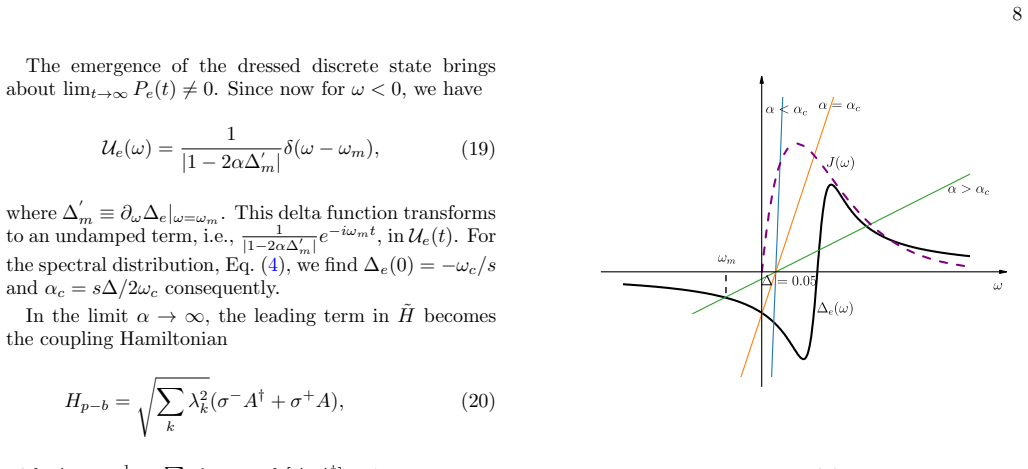
Figure 5 shows the curve ∆ e(ω) together with the straight line (ω −∆)/2α of various α and correspondingly their intersections at frequency denoted by ωm, which is smaller than ∆. Thus, for α → 0, the domain |ω − ∆| ≲ J(∆) dominates the contribution to Eq. (12), and one can approximate Ue(ω) = 1 π J(∆) [ω−∆−2α∆e(∆)]2+J 2(∆) as a Lorentzian, and obtain Pe(...
-
[2]
(24) Starting from the initial state |ψ(0)⟩ = |e⟩ ⊗ |0⟩ and as- suming Eq
(23) We calculate E±,0 to order ∼ α0 and obtain E± = ⟨±| ˜H|±⟩ = ± sX µ λ2µ + P ν ˜ωνλ2 ν 2 P µ λ2µ = ± s 2α (s + 1)ωc + (s + 1)ωc 2(s + 2) . (24) Starting from the initial state |ψ(0)⟩ = |e⟩ ⊗ |0⟩ and as- suming Eq. (4) for J(ω), we can work out Pe(t) = 1 4 e−iE+t + e−iE−t 2 = cos2 r 2α s + 1ωct ! . (25) The qualitative difference in Pe(t) between the sm...
- [3]
-
[4]
C. L. Degen, F. Reinhard, and P. Cappellaro, Rev. Mod. 11 02550750.010.11 02550750.1 1 025500.00.20.40.60.81.0 0.00.10.20.30.40.50.0 0.5 1.0 (a) (c) (d) (b) FIG. 8: Time evolution of Pe(t) for one single particle coupled to the boson bath. The symbols represent our numerical results. The lines are generated from Eq. (13). For α below the critical value αc...
work page 2017
-
[5]
Pezz` e, A
L. Pezz` e, A. Smerzi, M. K. Oberthaler, R. Schmied, and P. Treutlein, Rev. Mod. Phys. 90, 035005 (2018)
2018
- [6]
-
[7]
V. Dobrovitski, H. De Raedt, M. Katsnelson, and B. Har- mon, Phys. Rev. Lett. 90, 210401 (2003)
work page 2003
- [8]
Show all 62 references
-
[9]
Hanson, V
R. Hanson, V. Dobrovitski, A. Feiguin, O. Gywat, and D. Awschalom, Science 320, 352 (2008)
2008
-
[10]
P. P. Orth, D. Roosen, W. Hofstetter, and K. Le Hur, Phys. Rev. B 82, 144423 (2010)
2010
-
[11]
Strathearn, P
A. Strathearn, P. Kirton, D. Kilda, J. Keeling, and B. W. Lovett, Nat. Commun. 9, 3322 (2018)
2018
-
[12]
G. D. Filippis, A. D. Candia, A. Mishchenko, L. M. Cangemi, A. Nocera, P. A. Mishchenko, M. Sassetti, R. Fazio, N. Nagaosa, and V. Cataudella, Phys. Rev. B 104, L060410 (2021)
2021
-
[13]
A. J. Leggett, S. Chakravarty, A. T. Dorsey, M. P. Fisher, A. Garg, and W. Zwerger, Rev. Mod. Phys. 59, 1 (1987)
1987
-
[14]
Weiss, Quantum dissipative systems(World Scientific, 2012)
U. Weiss, Quantum dissipative systems(World Scientific, 2012)
2012
-
[15]
Weiss, H
U. Weiss, H. Grabert, P. H¨ anggi, and P. Riseborough, Phys. Rev. B 35, 9535 (1987)
1987
-
[16]
Jelic and F
V. Jelic and F. Marsiglio, Eur. J. Phys. 33, 1651 (2012)
2012
-
[17]
Bulla, N
R. Bulla, N. H. Tong, and M. Vojta, Phys. Rev. Lett. 91, 170601 (2003)
2003
-
[18]
F. B. Anders, R. Bulla, and M. Vojta, Phys. Rev. Lett. 98, 210402 (2007)
2007
-
[19]
Otterpohl, P
F. Otterpohl, P. Nalbach, and M. Thorwart, Phys. Rev. Lett. 129, 120406 (2022)
2022
-
[20]
H. P. Breuer and F. Petruccione, The theory of open quantum systems (Oxford University Press, USA, 2002)
2002
-
[21]
Ingold, in Coherent Evolution in Noisy Environ- ments (Springer, 2002), pp
G.-L. Ingold, in Coherent Evolution in Noisy Environ- ments (Springer, 2002), pp. 1–53
2002
-
[22]
W. H. Zurek, Rev. Mod. Phys. 75, 715 (2003). 12 0 .0150 .0200 .0250 .030- 0.030- 0.025- 0.020 FIG. 9: Numerical results of the lowest eleven eigen-energies Eℓ of a single particle coupled to the boson bath, with s = 1 and ∆ = 0.05. 4 05 06 07 08 0- 0.02- 0.010 .00 FIG. 10: Var...
2003
-
[23]
Kapral, J
R. Kapral, J. Phys.: Condens. Matter 27, 073201 (2015)
2015
-
[24]
De La Torre, D
A. De La Torre, D. M. Kennes, M. Claassen, S. Gerber, J. W. McIver, and M. A. Sentef, Rev. Mod. Phys. 93, 041002 (2021)
2021
-
[25]
Z. Cai, R. Babbush, S. C. Benjamin, S. Endo, W. J. Huggins, Y. Li, J. R. McClean, and T. E. O’Brien, Rev. Mod. Phys. 95, 045005 (2023)
2023
-
[26]
Hangleiter and J
D. Hangleiter and J. Eisert, Rev. Mod. Phys. 95, 035001 (2023)
2023
-
[27]
Schuster and N
T. Schuster and N. Y. Yao, Phys. Rev. Lett. 131, 160402 (2023). 0 1 2 3 4 5 6 7 8 0.00.20.40.60.8 /s32 /s32 FIG. 11: Variation of the overlap |⟨ψ1(0)|ℓ⟩|2 for the lowest nine eigen-states |ℓ⟩ of a single particle coupled to the boson bath with the iteration times M . The calcu...
2023
-
[28]
Dub´ e and P
M. Dub´ e and P. Stamp, Int. J. Mod. Phys. B 12, 1191 (1998)
1998
-
[29]
Governale, M
M. Governale, M. Grifoni, and G. Sch¨ on, Chem. Phys. 268, 273 (2001)
2001
-
[30]
Thorwart and P
M. Thorwart and P. H¨ anggi, Phys. Rev. A 65, 012309 (2001)
2001
-
[31]
Garst, S
M. Garst, S. Kehrein, T. Pruschke, A. Rosch, and M. Vo- 13 1 .11 .21 .31 .41 .51 .6-0.030- 0.028- 0.026 0 2 004 006 008 001 000-0.02650-0.02648-0.02646-0.02644-0.02642-0.02640 0 2 04 06 08 01 00-0.0266- 0.0264- 0.0262- 0.0260- 0.0258 FIG. 13: Convergence of E0 with the logarit...
2004
-
[32]
N¨ agele, G
P. N¨ agele, G. Campagnano, and U. Weiss, New J. Phys. 10, 115010 (2008)
2008
-
[33]
N¨ agele and U
P. N¨ agele and U. Weiss, Physica E42, 622 (2010)
2010
-
[34]
D. P. McCutcheon, A. Nazir, S. Bose, and A. J. Fisher, Phys. Rev. B 81, 235321 (2010)
2010
-
[35]
Bonart, Phys
J. Bonart, Phys. Rev. B 88, 125139 (2013)
2013
-
[36]
Vorrath, T
T. Vorrath, T. Brandes, and B. Kramer, Chem. Phys. 296, 295 (2004)
2004
-
[37]
Vorrath and T
T. Vorrath and T. Brandes, Phys. Rev. Lett. 95, 070402 (2005)
2005
-
[38]
F. B. Anders, New J. Phys. 10, 115007 (2008)
2008
-
[39]
Winter and H
A. Winter and H. Rieger, Phys. Rev. B 90, 224401 (2014)
2014
-
[40]
Werner, M
P. Werner, M. Troyer, and S. Sachdev, J. Phys. Soc. Jpn. 74, 67 (2005)
2005
-
[41]
L. F. Cugliandolo, G. S. Lozano, and H. Lozza, Phys. Rev. B 71, 224421 (2005)
2005
-
[42]
Schehr and H
G. Schehr and H. Rieger, Phys. Rev. Lett. 96, 227201 (2006)
2006
-
[43]
Schehr and H
G. Schehr and H. Rieger, J. Stat. Mech. 2008, P04012 (2008)
2008
-
[44]
J. A. Hoyos and T. Vojta, Phys. Rev. Lett. 100, 240601 (2008)
2008
-
[45]
J. A. Hoyos and T. Vojta, Phys. Rev. B 85, 174403 (2012)
2012
-
[46]
De Filippis, A
G. De Filippis, A. De Candia, L. Cangemi, M. Sassetti, R. Fazio, and V. Cataudella, Phys. Rev. B 101, 180408 (2020)
2020
-
[47]
Zhang and Z
P. Zhang and Z. Yu, Phys. Rev. Lett.130, 250401 (2023)
2023
-
[48]
Pfeifer, Phys
P. Pfeifer, Phys. Rev. A 26, 701 (1982)
1982
-
[49]
Cohen-Tannoudji, J
C. Cohen-Tannoudji, J. Dupont-Roc, and G. Grynberg, Atom-photon interactions: basic processes and applica- tions (John Wiley & Sons, 1998)
1998
-
[50]
Bahrami and A
M. Bahrami and A. Bassi, Phys. Rev. A 84, 062115 (2011)
2011
-
[51]
Taher Ghahramani and A
F. Taher Ghahramani and A. Shafiee, Phys. Rev. A 88, 032504 (2013)
2013
-
[52]
John and T
S. John and T. Quang, Phys. Rev. A 50, 1764 (1994)
1994
-
[53]
Florescu and S
M. Florescu and S. John, Phys. Rev. A64, 033801 (2001)
2001
-
[54]
Burgess and M
A. Burgess and M. Florescu, Phys. Rev. A 105, 062207 (2022)
2022
-
[55]
N. D. Mermin, Quantum computer science: An introduc- tion (Cambridge University Press, 2007)
2007
-
[56]
F. B. Anders and A. Schiller, Phys. Rev. B 74, 245113 (2006)
2006
-
[57]
Bulla, H
R. Bulla, H. J. Lee, N. H. Tong, and M. Vojta, Phys. Rev. B 71, 045122 (2005)
2005
-
[58]
C. Wang, N. Li, J. Xie, C. Ding, Z. Ji, L. Xiao, S. Jia, B. Yan, Y. Hu, and Y. Zhao, Phys. Rev. Lett. 132, 253401 (2024)
2024
-
[59]
Blatt and C
R. Blatt and C. F. Roos, Nat. Phys. 8, 277 (2012)
2012
-
[60]
Graham, M
T. Graham, M. Kwon, B. Grinkemeyer, Z. Marra, X. Jiang, M. Lichtman, Y. Sun, M. Ebert, and M. Saffman, Phys. Rev. Lett. 123, 230501 (2019)
2019
-
[61]
I. S. Madjarov, J. P. Covey, A. L. Shaw, J. Choi, A. Kale, A. Cooper, H. Pichler, V. Schkolnik, J. R. Williams, and M. Endres, Nat. Phys. 16, 857 (2020)
2020
-
[62]
Graham, Y
T. Graham, Y. Song, J. Scott, C. Poole, L. Phuttitarn, K. Jooya, P. Eichler, X. Jiang, A. Marra, B. Grinke- meyer, et al., Nature 604, 457 (2022)
2022
Reviewed August 10, 2026 · model on record in the stance chip above.
Discussion (0). Continue with ORCID to comment.