Dimers and discrete breathers in Bose-Einstein condensates in a quasi-periodic potential
Pith reviewed 2026-05-23 23:06 UTC · model grok-4.3
The pith
A reduced discrete nonlinear model without linear hopping supports stable breathers in a Bose-Einstein condensate placed in a quasi-periodic potential.
A machine-rendered reading of the paper's core claim, the machinery that carries it, and where it could break.
Core claim
Although the conventional tight-binding approximation does not apply, the condensate dynamics can still be reduced to a discrete model restricted to modes below the mobility edge. In that lattice, solutions and their time evolution are governed solely by nonlinear interactions. Families of nonlinear modes, including those without a linear limit, are constructed; the dimers among them correspond to breather solutions of the continuous Gross-Pitaevskii equation. The breathers are stable for negative scattering lengths, and localization together with stable propagation is also found for positive scattering lengths at relatively weak and moderate nonlinearities.
What carries the argument
The reduced discrete nonlinear lattice model that accounts only for modes below the mobility edge, in which all dynamics arise from nonlinear interactions alone.
If this is right
- Breather solutions exist and remain stable in the absence of any linear hopping term.
- Stable localized propagation occurs for both attractive and (weakly) repulsive interactions.
- Nonlinear modes without a linear counterpart appear as part of the solution families.
- The reduction to the discrete model remains valid across a range of incommensurate lattice amplitudes.
Where Pith is reading between the lines
- The same reduction technique might apply to other incommensurate or quasi-periodic potentials beyond the two-lattice case studied here.
- Experimental preparation of stable breathers could be attempted in attractive condensates where the predicted stability window is largest.
- The absence of linear hopping isolates the role of nonlinearity, offering a clean test bed for studying purely nonlinear transport in aperiodic media.
Load-bearing premise
The condensate description can still be reduced to a discrete model that accounts for the modes below the mobility edge even when the conventional tight-binding approximation fails.
What would settle it
Direct numerical integration of the full Gross-Pitaevskii equation with the quasi-periodic potential that shows the constructed breather solutions become unstable for negative scattering lengths would falsify the central claim.
Figures
read the original abstract
A quasi-one-dimensional Bose-Einstein condensate loaded into a quasi-periodic potential created by two sub-lattices of comparable amplitudes and incommensurate periods is considered. Although the conventional tight-binding approximation is not applicable in this setting, the description can still be reduced to a discrete model that accounts for the modes below the mobility edge. In the respective discrete lattice, where no linear hopping exists, solutions and their dynamics are governed solely by nonlinear interactions. Families of nonlinear modes, including those with no linear limit, are described with a special focus on dimers, which correspond to breather solutions of the Gross-Pitaevskii equation with a quasi-periodic potential. The breathers are found to be stable for negative scattering lengths. Localization and stable propagation of breathers are also observed for positive scattering lengths at relatively weak and moderate nonlinearities.
Editorial analysis
A structured set of objections, weighed in public.
Referee Report
Summary. The paper considers a quasi-1D Bose-Einstein condensate in a quasi-periodic potential formed by two incommensurate sublattices of comparable strength. Although standard tight-binding is inapplicable, the authors claim a reduction to a discrete nonlinear lattice model is possible for modes below the mobility edge, in which linear hopping vanishes and dynamics are governed solely by nonlinearity. They analyze families of nonlinear modes (including those without linear limit), with emphasis on dimers interpreted as breathers of the underlying continuous Gross-Pitaevskii equation, reporting stability for negative scattering lengths and localization with stable propagation for positive scattering lengths at weak-to-moderate nonlinearities.
Significance. If the reduction step is rigorously justified, the work would provide a concrete route to studying purely nonlinear localized modes and breathers in quasi-periodic settings where conventional discrete approximations fail. This could be relevant for understanding interaction-induced localization beyond the linear mobility edge and for designing experiments with incommensurate optical lattices.
major comments (2)
- [section describing the reduction to the discrete model (likely §2 or §3)] The reduction to a discrete model with vanishing linear hopping for sub-mobility-edge modes is the load-bearing step for all subsequent claims about dimers and breathers. The manuscript must supply the explicit projection procedure, the choice of basis functions, the truncation criterion, and quantitative error bounds (e.g., residual linear coupling strength) showing that the continuous GPE dynamics are faithfully captured by the purely nonlinear discrete system. Without these, the reported stability for negative scattering lengths and the localization results for positive scattering lengths cannot be trusted to hold in the original continuous model.
- [section on stability analysis of breathers/dimers] Stability of the breathers is asserted for negative scattering lengths, yet the abstract and any corresponding section provide no derivation details, linearization procedure, or numerical evidence (e.g., eigenvalue spectra or long-time simulations) establishing how stability was established. This information is required to assess whether the stability conclusion survives the continuous-to-discrete mapping.
minor comments (1)
- Clarify the precise definition of the mobility edge used to select the retained modes and state the numerical parameters (lattice amplitudes, incommensurability ratio) employed throughout the figures.
Simulated Author's Rebuttal
We thank the referee for the detailed and constructive report. The two major comments identify areas where additional technical detail is needed to strengthen the manuscript. We address each point below and will revise the manuscript to incorporate the requested information.
read point-by-point responses
-
Referee: The reduction to a discrete model with vanishing linear hopping for sub-mobility-edge modes is the load-bearing step. The manuscript must supply the explicit projection procedure, the choice of basis functions, the truncation criterion, and quantitative error bounds (e.g., residual linear coupling strength) showing that the continuous GPE dynamics are faithfully captured by the purely nonlinear discrete system.
Authors: We agree that the reduction step requires more explicit documentation. The revised manuscript will include a new subsection that specifies the projection onto the localized eigenmodes below the mobility edge, the precise choice of basis functions, the truncation criterion employed, and quantitative estimates of the residual linear coupling strength between retained and discarded modes. These additions will provide the error bounds needed to justify that the discrete model accurately represents the relevant continuous dynamics. revision: yes
-
Referee: Stability of the breathers is asserted for negative scattering lengths, yet the abstract and any corresponding section provide no derivation details, linearization procedure, or numerical evidence (e.g., eigenvalue spectra or long-time simulations) establishing how stability was established.
Authors: The stability statements rest on direct numerical integration of the discrete equations showing persistent localization without growth of perturbations. To address the request, the revision will add the linearization procedure around the dimer solutions, representative eigenvalue spectra confirming the absence of positive real parts, and extended long-time simulation results. The enhanced description of the reduction will also clarify how these stability properties translate to the underlying continuous Gross-Pitaevskii equation. revision: yes
Circularity Check
No circularity; reduction to discrete model is an explicit assumption, not a self-referential derivation
full rationale
The paper introduces the reduction from the continuous Gross-Pitaevskii equation in a quasi-periodic potential to a discrete nonlinear lattice (with no linear hopping) as a modeling assumption that accounts for modes below the mobility edge. All subsequent results on dimers, breathers, and their stability for negative/positive scattering lengths are obtained by direct analysis within this assumed discrete model using standard nonlinear lattice techniques. No equations, parameters, or central claims are shown to reduce to their own inputs by construction, no fitted inputs are relabeled as predictions, and no load-bearing steps rely on self-citations or imported uniqueness theorems. The derivation chain remains self-contained relative to the stated GPE framework and the explicit assumption.
Axiom & Free-Parameter Ledger
axioms (1)
- domain assumption The system can be reduced to a discrete model accounting for modes below the mobility edge even though tight-binding does not apply.
Lean theorems connected to this paper
-
IndisputableMonolith/Cost/FunctionalEquation.leanwashburn_uniqueness_aczel echoes?
echoesECHOES: this paper passage has the same mathematical shape or conceptual pattern as the Recognition theorem, but is not a direct formal dependency.
In the respective discrete lattice, where no linear hopping exists, solutions and their dynamics are governed solely by nonlinear interactions.
What do these tags mean?
- matches
- The paper's claim is directly supported by a theorem in the formal canon.
- supports
- The theorem supports part of the paper's argument, but the paper may add assumptions or extra steps.
- extends
- The paper goes beyond the formal theorem; the theorem is a base layer rather than the whole result.
- uses
- The paper appears to rely on the theorem as machinery.
- contradicts
- The paper's claim conflicts with a theorem or certificate in the canon.
- unclear
- Pith found a possible connection, but the passage is too broad, indirect, or ambiguous to say the theorem truly supports the claim.
Reference graph
Works this paper leans on
-
[1]
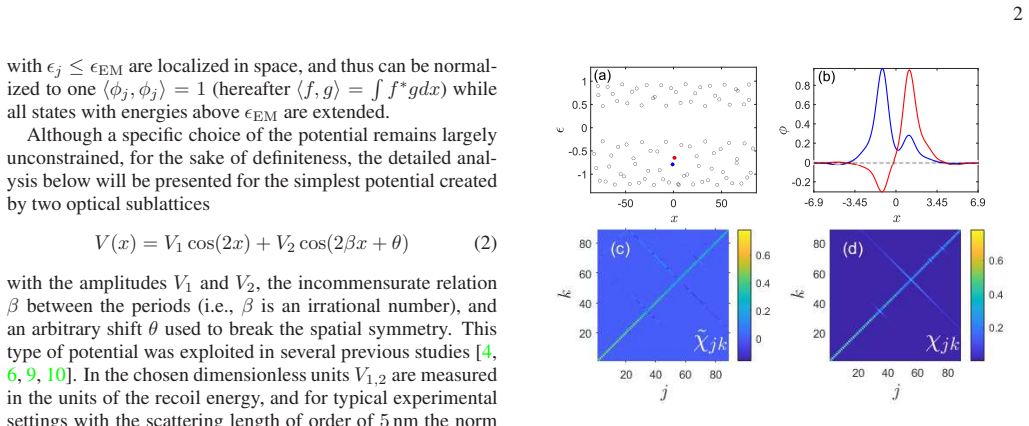
below]. In Fig. 1 (a) one observes that the localized modes are dis- tributed nearly homogeneously along the condensate and ove r the energy axis except one large ”gap” (note that although th e spectrum is discrete now, the periodic boundary conditions allow one to connect it with the band-gap spectrum of the respective approximant considered on the whole...
-
[2]
This imposes constraints on possible quasi-linear states, obtained in the limit N → 0
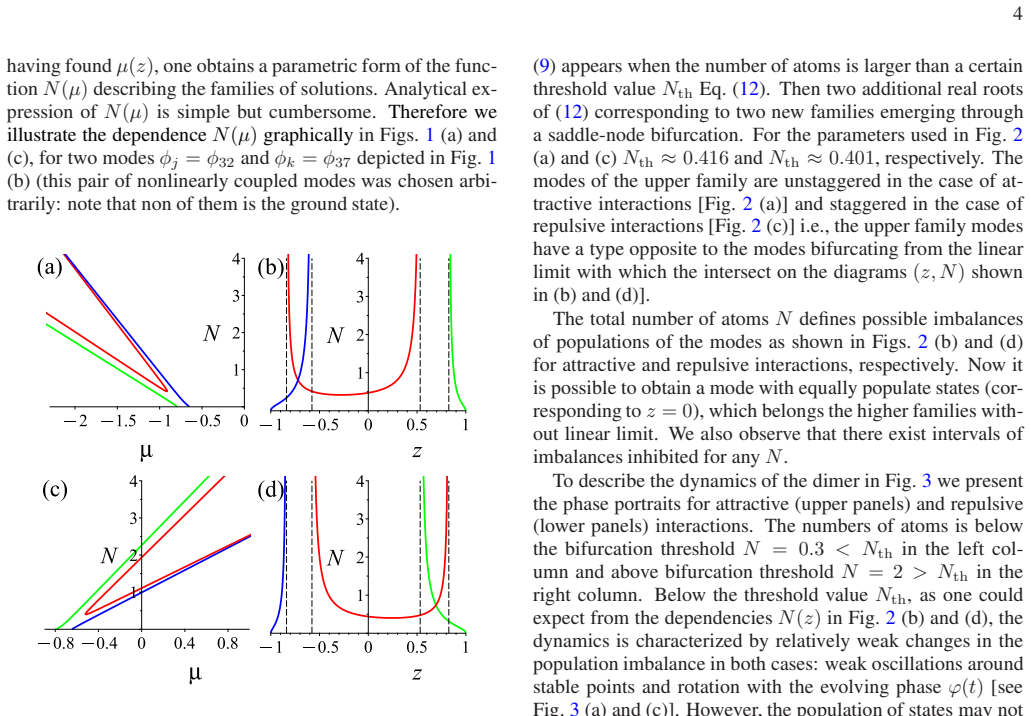
has only nonlinear dispersion lacking the lin- ear one. This imposes constraints on possible quasi-linear states, obtained in the limit N → 0. Indeed, in the limit of negligible nonlinearity, absence of interactions prohibi ts ther- malization of the lattice. This means that for a stationary s tate 3 in the limit N → 0 the chemical potential µ must approa...
-
[3]
[and in ( 3)] indicate the energy level, rather than spatial ordering of the modes, unlike in the conventional AA our DNLS models, where the index stands for the lattice sites. III. NONLINEAR DIMER The simplest approximate solution of (
-
[4]
A dimer corresponds to the choice of only two excited states
is a monomer, when only one, say j-th, mode is excited aj = √ N with the chemical potentialµ j(N ) = ǫj +Nχ j. A dimer corresponds to the choice of only two excited states. The particular relevance of such a reduced model for the lattice (
-
[5]
stems from the results shown in Fig. 1 (c),(d), where nearly for each arbitrarily chosen state, say j-th one, non-negligible nonlinear coupling can be found only for one (or a very few) other sites, say k-state. Thus, either |˜χ jk|or |˜χ kj | coefficients are much larger than other nonlinear hop- ping integrals. Having chosen two nonlinearly coupled stat ...
-
[6]
is reduced to a dimer. Like other dimer models studied previously [ 10, 22– 24], the dimer considered here is conveniently described by the ansatz aj = √ N (1 +z) 2 ei(θ− ϕ)/2, a k = √ N (1 − z) 2 ei(θ+ϕ)/2 (6) where z(τ) is the population imbalance, 2ϕ (τ) is the phase mismatch, and θ(τ) is a global rotating phase, as well as, the re-scaled timeτ =Nχ jkt...
-
[7]
and (9) with (5) written for two modes, and has the form θ = ∫ τ 0 (η+z2 − η−z − 2η+√ 1 − z2 cosϕ − 2 cos2ϕ − ξ−z ) dτ′ (11) [it is set θ(0) = 0 ]. Thus, unlike in most previous dimer models, the dimer described here features a global phase tha t varies over time. Since this phase does not affect the popula - tions and superfluid currents, it will not be c...
-
[8]
with the initial conditions constructed based on the dimer solution : Ψ(x, 0) = √ N (1 +z0) 2 ψ j(x) +eiϕ0 √ N (1 − z0) 2 ψ k(x). (14) Herez0 andϕ 0 are the initial imbalance of atomic population and phase mismatch of the states, respectively. In the parti c- ular examples below, j = 32 and k = 37 . In all numerical results reported below, a noise perturb...
-
[9]
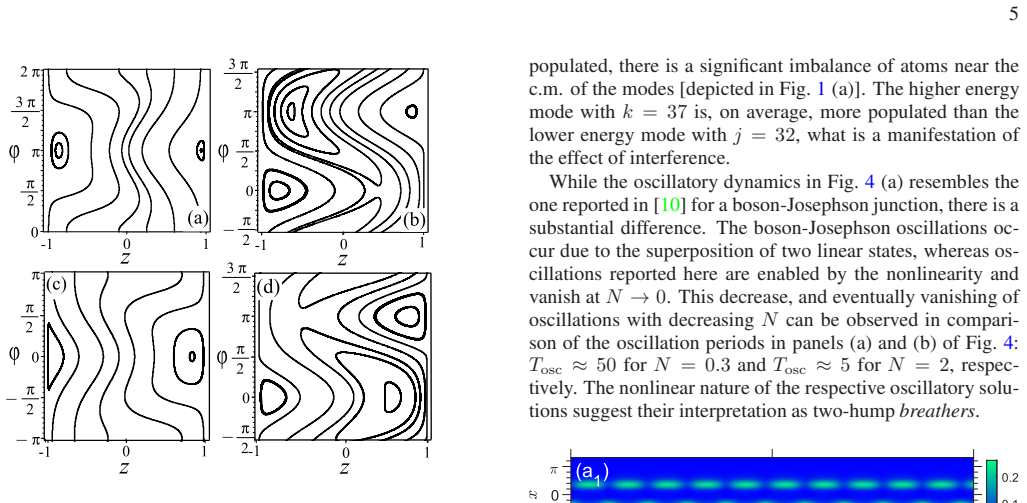
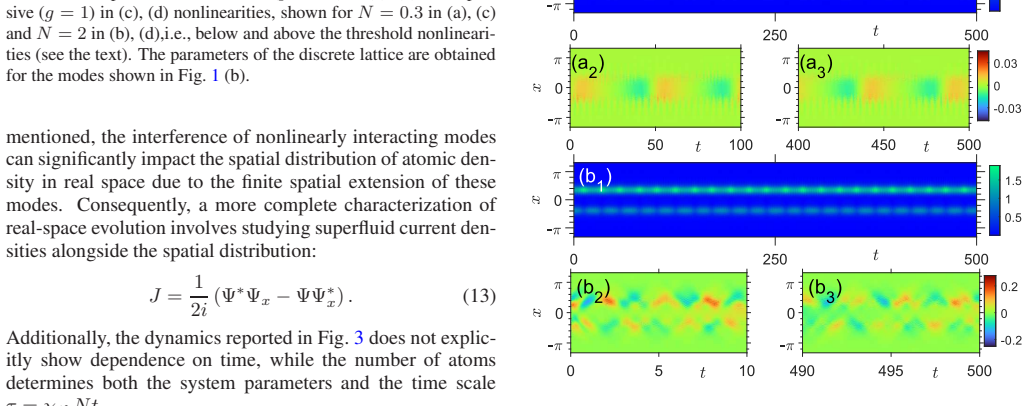
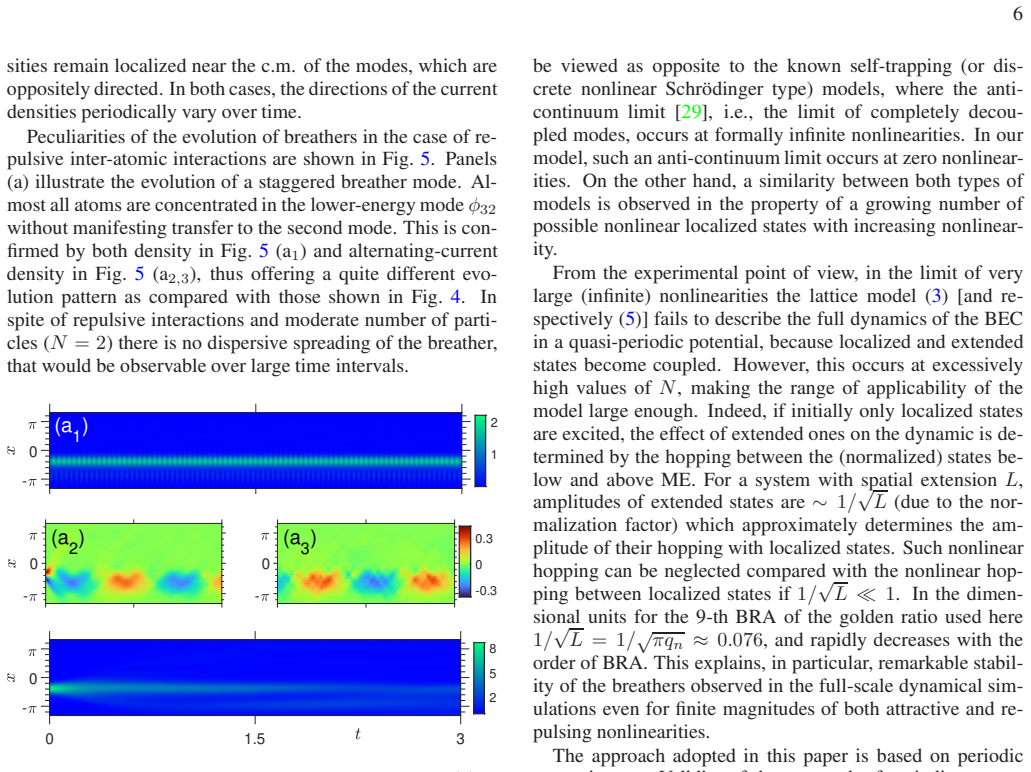
416 the initial condition corresponds to the hyperbolic fixed point in Fig. 3 (b). The instability of dynamical system ( 8), (9) leads to excitation of a stable two-hump breather. The highe r energy mode remains more populated at any time. The evolution of the breathers is accompanied by alternat- ing superfluid currents, as shown in panels in panels (a 2,3...
-
[10]
Panels (a) illustrate the evolution of a staggered breather mode. A l- most all atoms are concentrated in the lower-energy mode φ 32 without manifesting transfer to the second mode. This is con - firmed by both density in Fig. 5 (a1) and alternating-current density in Fig. 5 (a2,3), thus offering a quite different evo- lution pattern as compared with those...
-
[11]
7886, ϕ (0) = π and N = 2 [see Fig 2 (d)] is shown in panels (a). Panels with indices 1, 2 and 3 show the long-time ( T = 500 ) evo- lution of the density ρ(x, t ), currents at the initial and final stages of evolution, respectively. (b) Evolution of the same initial wavepacket but for N = 8 . In both cases N = 2 and the system parameters the same as in Fi...
-
[12]
[and re- spectively (5)] fails to describe the full dynamics of the BEC in a quasi-periodic potential, because localized and exten ded states become coupled. However, this occurs at excessively high values of N , making the range of applicability of the model large enough. Indeed, if initially only localized sta tes are excited, the effect of extended one...
- [13]
-
[14]
J. B. Reeves, B. Gadway, T. Bergeman, I. Danshita, and D. Schneble, Superfluid Bloch dynamics in an incommensurate optical lattice, New J. Phys. 16, 065011 (2014)
work page 2014
-
[15]
H. P . L¨ uschen, S. Scherg, T. Kohlert, M. Schreiber, P . Bordia, X. Li, S. Das Sarma, and I. Bloch, Single-Particle Mobility Edg e in a One-Dimensional Quasiperiodic Optical Lattice, Phys. Rev. Lett. 120, 160404 (2018)
work page 2018
-
[16]
R. B. Diener, G. A. Georgakis, J. Zhong, M. Raizen, and Q. Niu, Transition between extended and localized states in a o ne- dimensional incommensurate optical lattice, Phys. Rev. A 64, 033416 (2001)
work page 2001
-
[17]
H. Sakaguchi and B. A. Malomed, Gap solitons in quasiperi odic optical lattices, Phys. Rev. E 74, 026601 (2006)
work page 2006
-
[18]
Modugno, Exponential localization in one-dimension al quasi-periodic optical lattices, New J
M. Modugno, Exponential localization in one-dimension al quasi-periodic optical lattices, New J. Phys. 11 033023 (2009)
work page 2009
-
[19]
S. K. Adhikari and L. Salasnich, Localization of a Bose- Einstein condensate in a bichromatic optical lattice, Phys . Rev. A 80, 023606 2009
work page 2009
-
[20]
J. Biddle and S. Das Sarma, Predicted Mobility Edges in On e- Dimensional Incommensurate Optical Lattices: An Exactly Solvable Model of Anderson Localization, Phys. Rev. Lett.104, 070601 (2010)
work page 2010
-
[21]
H. Yao, H. Khoudli, L. Bresque, and L. Sanchez-Palencia, Critical Behavior and Fractality in Shallow One-Dimension al Quasiperiodic Potentials, Phys. Rev. Lett. 123, 070405 (2019)
work page 2019
-
[22]
H. C. Prates, D. A. Zezyulin, and V . V . Konotop, Bose-Einstein condensates in quasiperiodic lattices: Bosonic Josephson junc- tion, self-trapping, and multimode dynamics, Phys. Rev. Re - search 4, 033219 (2022)
work page 2022
-
[23]
J. Fr¨ ohlich, T. Spencer, and P . Wittwer, Localization for a Class of One Dimensional Quasi-Periodic Schr¨ odinger Oper - ators, Commun. Math. Phys. 132, 5 (1990)
work page 1990
-
[24]
Surace Jr., The Schr ¨dinger equation with a quasi-periodic potential, Trans
S. Surace Jr., The Schr ¨dinger equation with a quasi-periodic potential, Trans. Amer. Math. Soc 320, 321 (1990)
work page 1990
-
[25]
Mott, The mobility edge since 1967, J
N. Mott, The mobility edge since 1967, J. Phys. C. 20, 3075 (1987)
work page 1967
-
[26]
C. Li, F. Ye, Y . V . Kartashov, V . V . Konotop, and X. Chen, Localization-delocalization transition in spin-or bit- coupled Bose-Einstein condensate, Sci. Rep. 6, 31700 (2016)
work page 2016
-
[27]
S. Aubry and G. Andr´ e, Analyticity breaking and Anders on lo- calization in incommensurate lattices, Ann. Isr. Phys. Soc . 3, 133 (1980)
work page 1980
-
[28]
N. W. Ashcroft, N. D. Mermin, Solid State Physics (Holt, Rine- hart and Winston, 1976)
work page 1976
-
[29]
H. C. Prates and V . V . Konotop, Bloch-Landau-Zener osci lla- tions in a quasi-periodic potential, Phys. Rev. Res. 6, L022011 (2024)
work page 2024
-
[30]
J. C. Eilbeck, P .S. Lomdahl, and A. C. Scott, The discret e self- trapping equation, Physica D 16, 318 (1985)
work page 1985
-
[31]
V . M. Kenkre and D. K. Campbell, Self-trapping on a dimer : Time-dependent solutions of a discrete nonlinear Schr¨ odi nger equation, Phys. Rev. B, 34, 4959 (1986)
work page 1986
-
[32]
A. C. Scott, A Non-Resonant Discrete Self-Trapping Sys tem Phys. Scripta 42, 14 (1990)
work page 1990
-
[33]
G. P . Dynamical domains of a nondegenerate nonlinear di mer. Phys. Lett. A 173, 381 (1993)
work page 1993
- [34]
-
[35]
S. Raghavan, A. Smerzi, S. Fantoni, and S. R. Shenoy, Coh erent oscillations between two weakly coupled Bose-Einstein con - densates: Josephson effects, π oscillations, and macroscopic quantum self-trapping, Phys. Rev. A 59(1), 620 (1999)
work page 1999
-
[36]
J. Garnier and F. Kh. Abdullaev, Symmetry breaking induced by random fluctuations for Bose-Einstein condensates in a doub le- well trap, Phys. Rev. A, 71, 033603 (2005)
work page 2005
-
[37]
G. Theocharis, P . G. Kevrekidis, D. J. Frantzeskakis, a nd P . Schmelcher, Symmetry breaking in symmetric and asymmetric double-well potentials, Phys. Rev. E 74, 056608 (2006)
work page 2006
-
[38]
S. Ostlund, R. Pandit, D. Rand H. J. Schellnhuber, and E. D. Siggia, One-Dimensional Schr¨ odinger Equation with an Al- most Periodic Potential, Phys. Rev. Lett 50, 1873 (1983)
work page 1983
-
[39]
A. Ya. Khinchin, Continued Fractions (Dover Publicati ons, 1964)
work page 1964
-
[40]
D. A. Zezyulin and V . V . Konotop, Localization of ultrac old atoms in Zeeman lattices with incommensurate spin-orbit co u- pling, Phys. Rev. A 105, 063323 (2022)
work page 2022
-
[41]
R.S. MacKay and S. Aubry, Proof of existence of breather s for time-reversible or Hamiltonian networks of weakly coupled os- cillators, Nonlinearity 7, 1623 (1994)
work page 1994
-
[42]
K. Henderson, C. Ryu, C. MacCormick, and M G Boshier, Experimental demonstration of painting arbitrary and dyna mic potentials for Bose–Einstein condensates, New J. Phys., 11, 043030 (2009)
work page 2009
- [43]
-
[44]
H. Saito and M. Ueda, Emergence of Bloch Bands in a Rotati ng Bose-Einstein Condensate, Phys. Rev. Lett. 93, 220402 (2004)
work page 2004
-
[45]
Z. Meng, L. Wang, W. Han, F. Liu, K. Wen, C. Gao, P . Wang, C. Chin, and J. Zhang, Atomic Bose–Einstein condensate in twisted-bilayer optical lattices, Nature, 615, 231 (2023)
work page 2023
-
[46]
J. Hou, H. Hu, K. Sun, and C. Zhang, Superfluid-Quasicrys tal in a Bose-Einstein Condensate, Phys. Rev. Lett. 120, 060407 (2018)
work page 2018
- [47]
-
[48]
Q Fu, Q., P . Wang, C. Huang, Y . V . Kartashov, L. Torner, V . V . Konotop, and F. Ye, Optical soliton formation controlled by angle twisting in photonic moir´ e lattices. Nat. Photon. 14, 663 (2020)
work page 2020
discussion (0)
Sign in with ORCID, Apple, or X to comment. Anyone can read and Pith papers without signing in.