REVIEW 3 major objections 6 minor 31 references
MetaDSE: A Few-shot Meta-learning Framework for Cross-workload CPU Design Space Exploration
T0 review · 3 major / 6 minor · reviewed 2026-08-16 · deepseek-v4-flash
Pith's one-line read MetaDSE reframes cross-workload CPU design-space exploration as a few-shot meta-learning problem.
desk verdict Real IPC gains from MAML in cross-workload DSE, but the WAM mechanism is under-specified and the power results are overclaimed. read the letter →
The pith
A machine-rendered reading of the paper's core claim, the machinery that carries it, and where it could break.
The reading
What carries the argument
The machinery is two-stage. In pre-training, MAML runs an inner loop that fine-tunes the surrogate on each workload's support set and an outer loop that updates the shared initialization using the meta-gradient, thereby learning an initialization that supports rapid adaptation. In adaptation, the workload-adaptive architectural mask (WAM) is built from attention weights of the transformer's last self-attention layer, aggregated over many source workloads to identify frequently recurring parameter interactions; the mask is then attached to the self-attention operator, set learnable, and fine-tuned on the target's support set, filtering out irrelevant interactions while preserving the architectural relationships that transfer.
What would settle it
Run a controlled ablation in which a mask of the same size and learnability is initialized randomly, rather than from source attention weights, and fine-tuned on the same target support set; if its RMSE matches MetaDSE, WAM is not transferring architectural knowledge. Alternatively, freeze the WAM mask after pre-training so it receives no gradient updates on the target support set, and check whether the 27% improvement remains.
Extended reading notes
Core claim
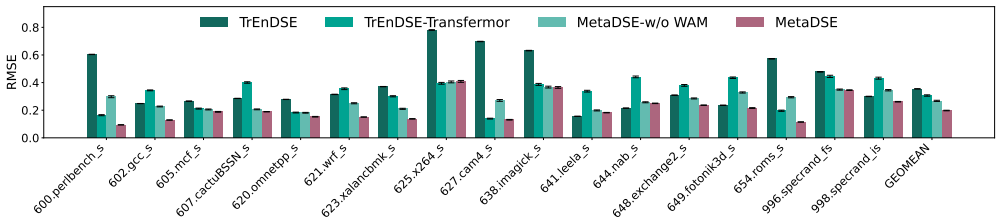
The paper's central claim is that the two main weaknesses of cross-workload DSE, overfitting during pre-training and reliance on workload similarity during adaptation, can be addressed by reframing it as few-shot meta-learning. MAML pre-training learns an initialization tailored to fast per-workload adaptation, and WAM adaptation transfers knowledge at the level of architectural parameter interactions rather than workload similarity. As reported, MetaDSE outperforms TrEnDSE across SPEC CPU 2017 workloads: the per-workload geometric mean RMSE drops by 44.3%, and on the five-workload averaged results it achieves instructions-per-cycle (IPC) RMSE of 0.2204 versus 0.3270 and power RMSE of 0.3969 versus 0.3990, with corresponding improvements in MAPE and explained variance.
Load-bearing premise
The method's load-bearing premise is that a mask built from last-layer attention weights on source workloads captures transferable architectural structure, rather than serving as extra parameters that simply absorb information from the target's few samples; if that premise fails, WAM's reported gain is just additional fine-tuning capacity.
Editorial extensions
If this is right
- New workloads can be characterized with as few as five simulated configurations, because the meta-learned initialization is designed for quick adaptation.
- Workload-similarity metrics such as Wasserstein distance become unnecessary, since the method transfers through architectural structure rather than assuming similar workloads.
- A transformer surrogate pre-trained this way beats tree-ensemble transfer baselines on both IPC and power prediction.
- Aligning the pre-training support size with the adaptation support size gives the best transfer performance, according to the sensitivity experiments.
- The WAM ablation indicates that masking irrelevant parameter interactions is a measurable source of accuracy improvement, not merely a side effect of a larger model.
Reading between the lines
- If WAM's 27% gain persists when the mask is held fixed after pre-training and not tuned on target samples, that would confirm it captures transferable architectural structure; if not, the gain is target-specific fitting.
- A control experiment that learns a same-size mask from random initialization on the target support set, with the same parameter budget, would isolate how much of WAM's benefit comes from transferable structure versus extra fine-tuning capacity.
- The meta-learning formulation could naturally extend to multi-objective design space exploration beyond IPC and power, such as area or timing, though this paper demonstrates only IPC and power on SPEC CPU 2017.
- The architectural mask idea suggests a test across design spaces: WAM masks learned on one microarchitecture should transfer to a different microarchitecture if they truly capture architectural parameter interactions.
Signed reviews
Editorial analysis
A structured set of objections, weighed in public.
Referee Report
Summary. The paper proposes MetaDSE, a two-stage framework for cross-workload CPU design space exploration: a MAML-based pre-training stage that treats each workload as a task and learns a good transformer-surrogate initialization, and a downstream adaptation stage that uses a novel Workload-adaptive Architectural Mask (WAM) built from attention weights of the last self-attention layer. The paper evaluates MetaDSE on SPEC CPU 2017 against TrEnDSE and other transfer-learning baselines, reporting that MetaDSE reduces prediction error by 44.3% relative to TrEnDSE and that WAM contributes a 27% error reduction. The abstract and introduction present these numbers as the main empirical contributions, alongside an open-source release.
Significance. The core idea of reframing cross-workload CPU DSE as a few-shot meta-learning problem is well motivated and potentially valuable: if the central IPC result holds, the framework reduces the simulation burden for new workloads in a way that is not tied to a workload-similarity assumption. The evaluation on held-out SPEC CPU 2017 workloads is an appropriate external test, and the IPC results in Table II and Fig. 5 provide genuine evidence for the IPC claim. The open-source release is a concrete strength, although I could not verify the artifact during review. The significance is currently undermined by two load-bearing problems: the headline 44.3% reduction is not supported across metrics, and the WAM mechanism is not specified or controlled well enough to support the paper's central novelty claim.
major comments (3)
- [Section VI.A, Table II, Fig. 5] The abstract and contribution statement claim a 44.3% reduction in prediction errors compared with TrEnDSE, but the data in Table II do not support that number as a general claim. For IPC, Table II shows RMSE decreasing from 0.3270 to 0.2204, which is a 32.6% reduction, not 44.3%; the 44.3% figure appears to be the geometric mean of per-workload IPC RMSE in Fig. 5. For power, Table II shows RMSE decreasing from 0.3990 to 0.3969, an improvement of about 0.5%, while explained variance (EV) drops from 0.5711 to 0.3189. This directly contradicts the text in Section VI.A that MetaDSE "consistently outperforms TrEnDSE and other baselines across all evaluated workloads" and achieves "higher EV scores" on power. The claims should be scoped to IPC geomean RMSE, and the power results should be reported honestly, with an explanation of why WAM adaptation degrades power EV.
- [Section IV.C, Algorithm 2] The WAM mechanism is the paper's main novelty, but the algorithm as written does not establish the claimed 27% benefit. Algorithm 2 line 2 sets M to a learnable state, yet the only update rule in the adaptation loop (line 9) updates theta* only and never updates M. If M is frozen during adaptation, the name "workload-adaptive" is unsupported; if M is instead updated on the target support set, the update rule is missing. Furthermore, the comparison between MetaDSE and MetaDSE-w/o-WAM does not control for additional parameter capacity: the 27% improvement could come from fitting extra mask parameters to the target support set rather than from transferable architectural structure. The paper needs (a) a precise description of how attention weights from source workloads are aggregated into M, (b) an explicit update rule for M during adaptation or a clear statement that M is fixed, and (c) a capacity-matched control, such as a random fixed mask or a mask learned only from target data with the same number of parameters.
- [Section V, Section VI.A] The evaluation-protocol description is not sufficiently precise to judge whether the results are externally valid. The text says the data were split by "iteratively and randomly designated seven datasets for training, five for validation, and five for testing," but it does not specify which workloads belong to each split, whether the five workloads in Table II are the test workloads, or how the random iterations were generated and aggregated. This matters because Section IV.A states that a meta-validation step is used to select the optimal pre-trained parameters; if the test workloads influence that selection through the random iteration process, the held-out claim is weakened. Please clarify the split protocol, report per-split results, and state whether any model-selection decisions used test-workload information.
minor comments (6)
- [Section II.B] Reference [20] is cited twice in the same sentence, and the sentence structure makes the citation ambiguous.
- [Fig. 5] The legend label "TrEnDSE-Transfermor" is misspelled and should be "TrEnDSE-Transformer".
- [Algorithm 2] Line 2 uses "M.required grad = True"; this should be "M.requires_grad_(True)" or equivalent PyTorch syntax, and the line should indicate whether M is updated in the inner loop.
- [Section V, Eq. (2)] The MAPE formula uses both y_i and y_i^real without defining their relationship to the notation in Eq. (1); please align the notation.
- [Table III] The row labeled "Baseline" is never defined in the text; it should be explicitly identified (e.g., TrEnDSE) so the comparison is reproducible.
- [Fig. 2] The colorbar label reads "Wasserstein Distance" while the title reads "Workload Similarity"; since a larger Wasserstein distance means lower similarity, the axis semantics should be clarified or inverted to avoid confusion.
Circularity Check
No significant circularity; the central evaluation is external and held-out, though the WAM ablation is confounded and the 44.3% headline is IPC-geomean only.
full rationale
The paper's central claim is an empirical comparison on held-out SPEC CPU 2017 workloads. MetaDSE is meta-trained on source workloads and evaluated on query sets of target workloads; no fitted value is reused as the prediction target, so the headline IPC reduction is not circular. The transformer surrogate is inspired by an earlier same-group paper [7], but that citation is not load-bearing for the meta-learning or WAM comparison. The WAM mechanism is the only place where a circularity concern could arise: the mask M is derived from the pre-trained model's attention weights and then declared learnable, while Algorithm 2's inner loop updates only theta*. If M is actually fine-tuned on the target support set, the 27% gain attributed to 'inherent architectural properties' is confounded by additional learnable capacity and lacks a capacity-matched control. That is a methodological and ablation-control problem, not a by-construction reduction: query-set evaluation remains external to the fitted parameters. Similarly, the 44.3% figure is only the geometric mean IPC RMSE in Fig. 5; Table II's averaged power numbers are far weaker, but this is a reporting discrepancy rather than circularity. No equation in the paper defines a claimed output in terms of its own input, and no load-bearing result rests on a self-citation chain.
Assumptions & free parameters
free parameters (2)
- WAM mask M =
learned on target support set via gradient descent
- Meta-learning hyperparameters (alpha, beta, inner steps) =
alpha=1e-5, beta=1e-4, 5 inner steps, 10 adaptation steps
assumptions (3)
- domain assumption Attention weights from the last self-attention layer encode pairwise interactions among architectural parameters that transfer across workloads.
- domain assumption The 7/5/5 split of SPEC CPU 2017 workloads yields a valid task distribution for MAML and generalizes to the five test workloads.
- domain assumption The transformer-based predictor from AttentionDSE (citation [7]) is an appropriate, accurate surrogate for CPU DSE.
invented entities (1)
-
Workload-adaptive architectural mask (WAM)
Cite this review
Pith. "Pith review of MetaDSE: A Few-shot Meta-learning Framework for Cross-workload CPU Design Space Exploration." pith.science (2026). https://pith.science/paper/Z3BTKEOY
@misc{pith2026250413568,
  author       = {Pith},
  title        = {Pith review of: MetaDSE: A Few-shot Meta-learning Framework for Cross-workload CPU Design Space Exploration},
  year         = {2026},
  howpublished = {\url{https://pith.science/paper/Z3BTKEOY}},
  note         = {Machine review of arXiv:2504.13568}
}
read the original abstract
Cross-workload design space exploration (DSE) is crucial in CPU architecture design. Existing DSE methods typically employ the transfer learning technique to leverage knowledge from source workloads, aiming to minimize the requirement of target workload simulation. However, these methods struggle with overfitting, data ambiguity, and workload dissimilarity. To address these challenges, we reframe the cross-workload CPU DSE task as a few-shot meta-learning problem and further introduce MetaDSE. By leveraging model agnostic meta-learning, MetaDSE swiftly adapts to new target workloads, greatly enhancing the efficiency of cross-workload CPU DSE. Additionally, MetaDSE introduces a novel knowledge transfer method called the workload-adaptive architectural mask algorithm, which uncovers the inherent properties of the architecture. Experiments on SPEC CPU 2017 demonstrate that MetaDSE significantly reduces prediction error by 44.3\% compared to the state-of-the-art. MetaDSE is open-sourced and available at this \href{https://anonymous.4open.science/r/Meta_DSE-02F8}{anonymous GitHub.}
Figures


Figures from the paper (2 more)

Reference graph
Works this paper leans on
-
[1]
Illustrative design space studies with microarchitectural regression models,
B. C. Lee and D. M. Brooks, “Illustrative design space studies with microarchitectural regression models,” in 2007 IEEE 13th International Symposium on High Performance Computer Architecture , pp. 340–351, IEEE, 2007
work page 2007
-
[2]
A. Deshwal, S. Belakaria, G. Bhat, J. R. Doppa, and P. P. Pande, “Learn- ing pareto-frontier resource management policies for heterogeneous socs: An information-theoretic approach,” in 2021 58th ACM/IEEE Design Automation Conference (DAC) , pp. 607–612, IEEE, 2021
work page 2021
-
[3]
Efficient design space exploration via statistical sampling and adaboost learning,
D. Li, S. Yao, Y .-H. Liu, S. Wang, and X.-H. Sun, “Efficient design space exploration via statistical sampling and adaboost learning,” in Proceedings of the 53rd Annual Design Automation Conference , pp. 1–6, 2016
work page 2016
-
[4]
D. Wang, M. Yan, Y . Teng, D. Han, X. Ye, and D. Fan, “A high-accurate multi-objective ensemble exploration framework for design space of cpu microarchitecture,” in Proceedings of the Great Lakes Symposium on VLSI 2023 , GLSVLSI ’23, (New York, NY , USA), p. 379–383, Association for Computing Machinery, 2023
work page 2023
-
[5]
A correlation-based design space exploration methodology for multi-processor systems-on-chip,
G. Mariani, A. Brankovic, G. Palermo, J. Jovic, V . Zaccaria, and C. Silvano, “A correlation-based design space exploration methodology for multi-processor systems-on-chip,” in Proceedings of the 47th Design Automation Conference, DAC ’10, (New York, NY , USA), p. 120–125, Association for Computing Machinery, 2010
work page 2010
-
[6]
An expected hypervolume improvement algorithm for architectural exploration of embedded processors,
H. Wang, J. Shi, and Z. Zhu, “An expected hypervolume improvement algorithm for architectural exploration of embedded processors,” in Proceedings of the 53rd Annual Design Automation Conference , pp. 1–6, 2016
work page 2016
-
[7]
Multi-objective optimization in cpu design space exploration: Attention is all you need,
R. Xue, H. Wu, M. Yan, Z. Xiao, X. Ye, and D. Fan, “Multi-objective optimization in cpu design space exploration: Attention is all you need,” 2024
work page 2024
-
[8]
H. Fan, Y . Wang, S. Li, T. Liang, and W. Zhang, “Explainable fuzzy neural network with multi-fidelity reinforcement learning for micro- architecture design space exploration,” in Proceedings of the 61st ACM/IEEE Design Automation Conference , pp. 1–6, 2024
work page 2024
Show all 31 references
-
[9]
A high-accurate multi-objective exploration framework for design space of cpu,
D. Wang, M. Yan, X. Liu, M. Zou, T. Liu, W. Li, X. Ye, and D. Fan, “A high-accurate multi-objective exploration framework for design space of cpu,” in 2023 60th ACM/IEEE Design Automation Conference (DAC) , pp. 1–6, 2023
2023
-
[10]
Boom-explorer: Risc-v boom microarchitecture design space exploration framework,
C. Bai, Q. Sun, J. Zhai, Y . Ma, B. Yu, and M. D. Wong, “Boom-explorer: Risc-v boom microarchitecture design space exploration framework,” in 2021 IEEE/ACM International Conference On Computer Aided Design (ICCAD), pp. 1–9, IEEE, 2021
2021
-
[11]
Boom- explorer: Risc-v boom microarchitecture design space exploration,
C. Bai, Q. Sun, J. Zhai, Y . Ma, B. Yu, and M. D. Wong, “Boom- explorer: Risc-v boom microarchitecture design space exploration,” ACM Transactions on Design Automation of Electronic Systems , vol. 29, no. 1, pp. 1–23, 2023
2023
-
[12]
A transfer learning framework for high-accurate cross-workload design space exploration of cpu,
D. Wang, M. Yan, Y . Teng, D. Han, H. Dang, X. Ye, and D. Fan, “A transfer learning framework for high-accurate cross-workload design space exploration of cpu,” in 2023 IEEE/ACM International Conference on Computer Aided Design (ICCAD) , pp. 1–9, 2023
2023
-
[13]
Efficient design space exploration by knowledge transfer,
D. Li, S. Wang, S. Yao, Y .-H. Liu, Y . Cheng, and X.-H. Sun, “Efficient design space exploration by knowledge transfer,” in 2016 Interna- tional Conference on Hardware/Software Codesign and System Synthesis (CODES+ISSS), pp. 1–10, 2016
2016
-
[14]
Cross-program design space exploration by ensemble transfer learning,
D. Li, S. Yao, S. Wang, and Y . Wang, “Cross-program design space exploration by ensemble transfer learning,” in 2017 IEEE/ACM Interna- tional Conference on Computer-Aided Design (ICCAD) , pp. 201–208, 2017
2017
-
[15]
Using predic- tivemodeling for cross-program design space exploration in multicore systems,
S. Khan, P. Xekalakis, J. Cavazos, and M. Cintra, “Using predic- tivemodeling for cross-program design space exploration in multicore systems,” in 16th International Conference on Parallel Architecture and Compilation Techniques (PACT 2007) , pp. 327–338, 2007
2007
-
[16]
Microarchitectural design space exploration made fast,
Q. Guo, T. Chen, Y . Chen, L. Li, and W. Hu, “Microarchitectural design space exploration made fast,” Microprocessors and Microsystems, vol. 37, no. 1, pp. 41–51, 2013
2013
-
[17]
Generative and multi-phase learning for computer systems optimization,
Y . Ding, N. Mishra, and H. Hoffmann, “Generative and multi-phase learning for computer systems optimization,” in Proceedings of the 46th International Symposium on Computer Architecture , pp. 39–52, 2019
2019
-
[18]
An empirical architecture- centric approach to microarchitectural design space exploration,
C. Dubach, T. M. Jones, and M. F. O’Boyle, “An empirical architecture- centric approach to microarchitectural design space exploration,” IEEE Transactions on Computers , vol. 60, no. 10, pp. 1445–1458, 2010
2010
-
[19]
Model-agnostic meta-learning for fast adaptation of deep networks,
C. Finn, P. Abbeel, and S. Levine, “Model-agnostic meta-learning for fast adaptation of deep networks,” in International conference on machine learning , pp. 1126–1135, PMLR, 2017
2017
-
[20]
Meta-learning for semi-supervised few- shot classification,
M. Ren, E. Triantafillou, S. Ravi, J. Snell, K. Swersky, J. B. Tenenbaum, H. Larochelle, and R. S. Zemel, “Meta-learning for semi-supervised few- shot classification,” arXiv preprint arXiv:1803.00676 , 2018
2018 arXiv
-
[21]
Meta-transfer learning for few-shot learning,
Q. Sun, Y . Liu, T.-S. Chua, and B. Schiele, “Meta-transfer learning for few-shot learning,” in Proceedings of the IEEE/CVF conference on computer vision and pattern recognition , pp. 403–412, 2019
2019
-
[22]
Transfer learning,
L. Torrey and J. Shavlik, “Transfer learning,” in Handbook of research on machine learning applications and trends: algorithms, methods, and techniques, pp. 242–264, IGI global, 2010
2010
-
[23]
A survey on transfer learning,
S. J. Pan and Q. Yang, “A survey on transfer learning,” IEEE Trans- actions on knowledge and data engineering , vol. 22, no. 10, pp. 1345– 1359, 2009
2009
-
[24]
Gaussian mixture models.,
D. A. Reynolds et al. , “Gaussian mixture models.,” Encyclopedia of biometrics, vol. 741, no. 659-663, 2009
2009
-
[25]
Calculation of the wasserstein distance between probabil- ity distributions on the line,
S. Vallender, “Calculation of the wasserstein distance between probabil- ity distributions on the line,” Theory of Probability & Its Applications , vol. 18, no. 4, pp. 784–786, 1974
1974
-
[26]
A closer look at few-shot classification again,
X. Luo, H. Wu, J. Zhang, L. Gao, J. Xu, and J. Song, “A closer look at few-shot classification again,” in International Conference on Machine Learning, pp. 23103–23123, PMLR, 2023
2023
-
[27]
Effective and efficient few-shot fine-tuning for vision transformers,
J. Yang, H. Wu, J. Zhang, L. Gao, and J. Song, “Effective and efficient few-shot fine-tuning for vision transformers,” in 2024 IEEE International Conference on Multimedia and Expo (ICME) , pp. 1–6, IEEE, 2024
2024
-
[28]
The gem5 simulator,
N. Binkert, B. Beckmann, G. Black, S. K. Reinhardt, A. Saidi, A. Basu, J. Hestness, D. R. Hower, T. Krishna, S. Sardashti, R. Sen, K. Sewell, M. Shoaib, N. Vaish, M. D. Hill, and D. A. Wood, “The gem5 simulator,” SIGARCH Comput. Archit. News , vol. 39, p. 1–7, aug 2011
2011
-
[29]
Mcpat: An integrated power, area, and timing modeling framework for multicore and manycore architectures,
S. Li, J. H. Ahn, R. D. Strong, J. B. Brockman, D. M. Tullsen, and N. P. Jouppi, “Mcpat: An integrated power, area, and timing modeling framework for multicore and manycore architectures,” in Proceedings of the 42nd annual ieee/acm international symposium on microarchitecture,...
2009
-
[30]
Spec cpu 2017
Standard Performance Evaluation Corporation, “Spec cpu 2017.” https: //www.spec.org/cpu2017/, 2022
2017
-
[31]
Simpoint 3.0: Faster and more flexible program phase analysis,
G. Hamerly, E. Perelman, J. Lau, and B. Calder, “Simpoint 3.0: Faster and more flexible program phase analysis,” Journal of Instruction Level Parallelism, vol. 7, no. 4, pp. 1–28, 2005
2005
Reviewed August 16, 2026 · model on record in the stance chip above.
Discussion (0). Continue with ORCID to comment.