MOSAIC: Modality-Specific Adaptation for Incremental Continual Learning in Parkinson's Disease Gait Assessment
Reviewed by Pith T0 review T1 audit T2 compute T3 formal T4 kernel 2026-06-27 06:47 UTCgrok-4.3pith:Z4LECRGZrecord.jsonopen to challenge →
The pith
MOSAIC enables incremental addition of gait sensors for Parkinson's assessment by fixing toxic distillation, statistical shifts, and lost plasticity.
A machine-rendered reading of the paper's core claim, the machinery that carries it, and where it could break.
Core claim
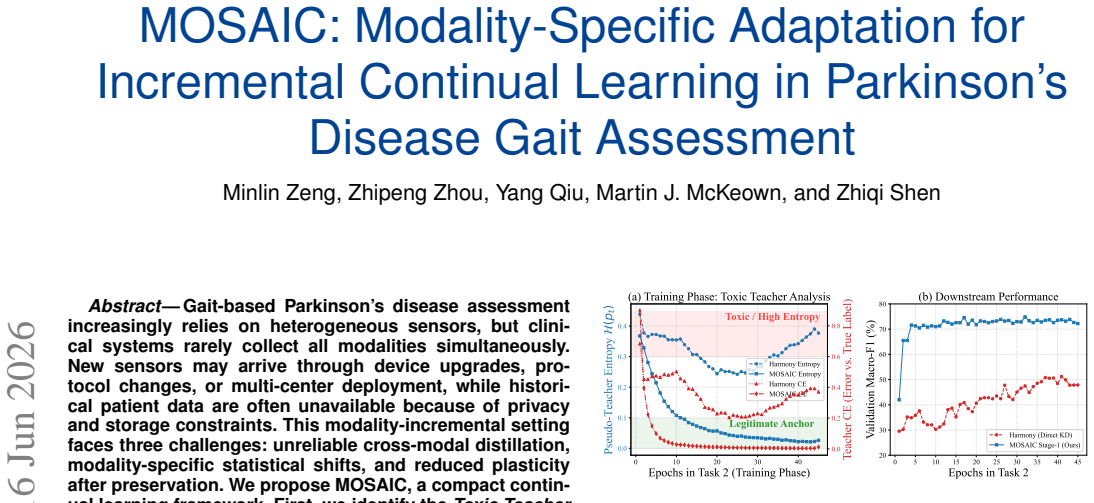
MOSAIC identifies a Toxic Teacher effect in which distillation from an old model destabilizes new-modality representations, then counters it with a modality-specific warm-up phase, a statistics-decoupled MSBN backbone that keeps sensor statistics separate while sharing semantics, and a curriculum-guided repulsive objective that restores plasticity without erasing prior knowledge; the resulting system raises final performance and lowers forgetting on incremental multimodal Parkinson's gait tasks.
What carries the argument
The three-part MOSAIC mechanism: Modality-Specific Warm-Up before distillation, statistics-decoupled MSBN architecture, and curriculum-guided repulsive objective for plasticity recovery.
Load-bearing premise
The fixes for the toxic teacher, statistical mismatch, and plasticity loss will continue to work when entirely new sensor types appear in real clinical deployments outside the three tested datasets.
What would settle it
Run the same incremental protocol on a held-out fourth Parkinson's gait dataset that introduces a sensor type absent from the original three and check whether accuracy gains and forgetting reduction remain comparable to the reported results.
Figures


read the original abstract
Gait-based Parkinson's disease assessment increasingly relies on heterogeneous sensors, but clinical systems rarely collect all modalities simultaneously. New sensors may arrive through device upgrades, protocol changes, or multi-center deployment, while historical patient data are often unavailable because of privacy and storage constraints. This modality-incremental setting faces three challenges: unreliable cross-modal distillation, modality-specific statistical shifts, and reduced plasticity after preservation. We propose MOSAIC, a compact continual learning framework. First, we identify the Toxic Teacher phenomenon and introduce Modality-Specific Warm-Up to stabilize newly learned modality representations before distillation. Second, we propose a statistics-decoupled MSBN architecture that isolates sensor statistics while maintaining a shared semantic backbone. Third, we design a curriculum-guided repulsive objective for Plasticity Recovery, preserving legacy knowledge while recovering modality-specific capacity. Experiments on three multimodal Parkinson's gait datasets show that MOSAIC improves final performance and mitigates forgetting. Project code is available at: https://github.com/minlinzeng/MOSAIC_Modality-Specific-Adaptation-for-Incremental-Continual-Learning-in-PD-Gait-Assessment.git
Editorial analysis
A structured set of objections, weighed in public.
Referee Report
Summary. The manuscript proposes MOSAIC, a compact continual learning framework for the modality-incremental setting in Parkinson's disease gait assessment. It identifies the Toxic Teacher phenomenon and introduces three components: Modality-Specific Warm-Up to stabilize new modality representations before distillation, a statistics-decoupled MSBN architecture to isolate sensor statistics while sharing a semantic backbone, and a curriculum-guided repulsive objective for plasticity recovery. The central claim, supported by experiments on three multimodal Parkinson's gait datasets, is that MOSAIC improves final performance and mitigates forgetting; project code is provided.
Significance. If the results hold, the work addresses a practically relevant problem in clinical multimodal sensing where new modalities arrive over time without access to prior patient data due to privacy constraints. The explicit identification of modality-specific challenges and the release of code for reproducibility are strengths that could support adoption in medical continual-learning applications.
minor comments (1)
- [Abstract] Abstract: the claim of improved performance is stated without any quantitative metrics, baselines, dataset sizes, or error bars; including at least the key performance numbers and a brief comparison table would strengthen the summary.
Simulated Author's Rebuttal
We thank the referee for the positive summary of our work on MOSAIC for modality-incremental continual learning in Parkinson's disease gait assessment and for recommending minor revision. The report correctly captures the identification of the Toxic Teacher phenomenon and the three proposed components. No major comments are provided in the report.
Circularity Check
No significant circularity detected
full rationale
The paper presents an empirical continual learning framework (MOSAIC) consisting of three proposed components—Modality-Specific Warm-Up, statistics-decoupled MSBN, and curriculum-guided repulsive objective—validated through experiments on three multimodal Parkinson's gait datasets. No mathematical derivations, equations, or predictions are described that reduce to fitted parameters by construction, self-definitional loops, or load-bearing self-citations. The central claims rest on experimental results rather than any internal reduction of outputs to inputs, making the derivation chain self-contained against external benchmarks.
Axiom & Free-Parameter Ledger
axioms (1)
- standard math Standard assumptions of neural network optimization and continual learning hold for the proposed components.
Reference graph
Works this paper leans on
-
[1]
Tackling parkinson’s disease as a global challenge,
R. Bhidayasiri, L. V . Kalia, and B. R. Bloem, “Tackling parkinson’s disease as a global challenge,” pp. 1277–1280, 2023
2023
-
[2]
The parkinson pandemic—a call to action,
E. R. Dorsey and B. R. Bloem, “The parkinson pandemic—a call to action,”JAMA neurology, vol. 75, no. 1, pp. 9–10, 2018
2018
-
[3]
Towards re- laxed multimodal inputs for gait-based parkinson’s disease assessment,
M. Zeng, Z. Zhou, Y . Qiu, M. J. McKeown, and Z. Shen, “Towards re- laxed multimodal inputs for gait-based parkinson’s disease assessment,” arXiv preprint arXiv:2510.15748, 2025
-
[4]
A survey of artificial intelligence in gait-based neurodegenerative disease diagnosis,
H. Rao, M. Zeng, X. Zhao, and C. Miao, “A survey of artificial intelligence in gait-based neurodegenerative disease diagnosis,”Neuro- computing, vol. 626, p. 129533, 2025
2025
-
[5]
Harmony: A unified framework for modality incremental learning,
Y . Song, X. Yang, D. Jiang, Y . Wang, and C. Xu, “Harmony: A unified framework for modality incremental learning,”arXiv preprint arXiv:2504.13218, 2025
-
[6]
Breaking data silos in parkinson’s disease diagnosis: An adaptive federated learning approach for privacy-preserving facial expression analysis,
M. Pang, H. Xu, Z. Huang, Y . Zhou, W. Huang, and B. Wang, “Breaking data silos in parkinson’s disease diagnosis: An adaptive federated learning approach for privacy-preserving facial expression analysis,” in Proceedings of the AAAI Conference on Artificial Intelligence, vol. 39, no. 13, 2025, pp. 14 352–14 360
2025
-
[7]
Continual self-supervised learning: Towards universal multi-modal medical data representation learning,
Y . Ye, Y . Xie, J. Zhang, Z. Chen, Q. Wu, and Y . Xia, “Continual self-supervised learning: Towards universal multi-modal medical data representation learning,” inProceedings of the IEEE/CVF Conference on Computer Vision and Pattern Recognition, 2024, pp. 11 114–11 124
2024
-
[8]
Confusion mixup regularized multimodal fusion network for contin- ual egocentric activity recognition,
H. Wang, S. Zhou, Q. Wu, H. Li, F. Meng, L. Xu, and H. Qiu, “Confusion mixup regularized multimodal fusion network for contin- ual egocentric activity recognition,” inProceedings of the IEEE/CVF International Conference on Computer Vision, 2023, pp. 3560–3569
2023
-
[9]
Modality- incremental learning with disjoint relevance mapping networks for image-based semantic segmentation,
N. Hegde, S. Muralidhara, R. Schuster, and D. Stricker, “Modality- incremental learning with disjoint relevance mapping networks for image-based semantic segmentation,” in2025 IEEE/CVF Winter Con- ference on Applications of Computer Vision (WACV). IEEE, 2025, pp. 5540–5549
2025
-
[10]
Learning without isolation: Pathway protection for continual learning,
Z. Chen, A. Wuerkaixi, S. Cui, H. Li, D. Li, J. Zhang, B. Han, G. Niu, H. Liu, Y . Yanget al., “Learning without isolation: Pathway protection for continual learning,” inForty-second International Conference on Machine Learning, 2025
2025
-
[11]
Contrastive regularization over lora for multimodal biomedical image incremental learning,
H. Zhang, Y . Liang, H. Kuang, L. Cen, Z. Qu, Y . Cen, M. Zeng, and S. Kan, “Contrastive regularization over lora for multimodal biomedical image incremental learning,” inProceedings of the 33rd ACM Interna- tional Conference on Multimedia, 2025, pp. 7500–7509
2025
-
[12]
Continual retinal vision- language pre-training upon incremental imaging modalities,
Y . Yao, R. Wu, Y . Zhou, and T. Zhou, “Continual retinal vision- language pre-training upon incremental imaging modalities,” inInterna- tional Conference on Medical Image Computing and Computer-Assisted Intervention. Springer, 2025, pp. 111–121
2025
-
[13]
Harmi: Human activity recognition via multi-modality incremental learning,
X. Zhang, H. Yu, Y . Yang, J. Gu, Y . Li, F. Zhuang, D. Yu, and Z. Ren, “Harmi: Human activity recognition via multi-modality incremental learning,”IEEE Journal of Biomedical and Health Informatics, vol. 26, no. 3, pp. 939–951, 2021
2021
-
[14]
Artificial intelligence- enabled detection and assessment of parkinson’s disease using multi- modal data: A survey,
A. Zhao, Y . Liu, X. Yu, X. Xing, and H. Zhou, “Artificial intelligence- enabled detection and assessment of parkinson’s disease using multi- modal data: A survey,”Information Fusion, p. 103175, 2025
2025
-
[15]
Multimodal gait recognition for neurodegenerative diseases,
A. Zhao, J. Li, J. Dong, L. Qi, Q. Zhang, N. Li, X. Wang, and H. Zhou, “Multimodal gait recognition for neurodegenerative diseases,”IEEE transactions on cybernetics, vol. 52, no. 9, pp. 9439–9453, 2021
2021
-
[16]
Graph fusion network-based multimodal learning for freezing of gait detection,
K. Hu, Z. Wang, K. A. E. Martens, M. Hagenbuchner, M. Bennamoun, A. C. Tsoi, and S. J. Lewis, “Graph fusion network-based multimodal learning for freezing of gait detection,”IEEE Transactions on Neural Networks and Learning Systems, vol. 34, no. 3, pp. 1588–1600, 2021
2021
-
[17]
Multi-modal gait recognition via effective spatial- temporal feature fusion,
Y . Cui and Y . Kang, “Multi-modal gait recognition via effective spatial- temporal feature fusion,” inProceedings of the IEEE/CVF Conference on Computer Vision and Pattern Recognition, 2023, pp. 17 949–17 957
2023
-
[18]
Exploring tradeoffs through mode connectivity for multi-task learning,
Z. Zhou, Z. Meng, P. Wu, P. Zhao, and C. Miao, “Exploring tradeoffs through mode connectivity for multi-task learning,”Advances in Neural Information Processing Systems, vol. 38, pp. 81 268–81 285, 2026
2026
-
[19]
Injecting imbalance sensitivity for multi-task learning,
Z. Zhou, L. Liu, P. Zhao, and W. Gong, “Injecting imbalance sensitivity for multi-task learning,”arXiv preprint arXiv:2503.08006, 2025
-
[20]
Continual Learning for VLMs: A Survey and Taxonomy Beyond Forgetting
Y . Liu, Q. Hong, L. Huang, A. Gomez-Villa, D. Goswami, X. Liu, J. van de Weijer, and Y . Tian, “Continual learning for vlms: A survey and taxonomy beyond forgetting,”arXiv preprint arXiv:2508.04227, 2025
work page internal anchor Pith review Pith/arXiv arXiv 2025
-
[21]
Mind the gap: Understanding the modality gap in multi-modal contrastive representation learning,
V . W. Liang, Y . Zhang, Y . Kwon, S. Yeung, and J. Y . Zou, “Mind the gap: Understanding the modality gap in multi-modal contrastive representation learning,”Advances in Neural Information Processing Systems, vol. 35, pp. 17 612–17 625, 2022
2022
-
[22]
Continual optimization with symmetry teleportation for multi-task learning,
Z. Zhou, Z. Meng, P. Wu, P. Zhao, and C. Miao, “Continual optimization with symmetry teleportation for multi-task learning,”Advances in Neural Information Processing Systems, vol. 38, pp. 171 209–171 230, 2026
2026
-
[23]
Delve into the Applicability of Advanced Optimizers for Multi-Task Learning
Z. Zhou, L. Cao, P. Wu, P. Zhao, and C. Miao, “Delve into the applicability of advanced optimizers for multi-task learning,”arXiv preprint arXiv:2604.08939, 2026
work page internal anchor Pith review Pith/arXiv arXiv 2026
-
[24]
Batch normalization: Accelerating deep network training by reducing internal covariate shift,
S. Ioffe and C. Szegedy, “Batch normalization: Accelerating deep network training by reducing internal covariate shift,” inInternational conference on machine learning. pmlr, 2015, pp. 448–456
2015
-
[25]
Overcoming catastrophic forgetting in neural networks,
J. Kirkpatrick, R. Pascanu, N. Rabinowitz, J. Veness, G. Desjardins, A. A. Rusu, K. Milan, J. Quan, T. Ramalho, A. Grabska-Barwinska et al., “Overcoming catastrophic forgetting in neural networks,”Pro- ceedings of the national academy of sciences, vol. 114, no. 13, pp. 3521–3526, 2017
2017
-
[26]
Learning without forgetting,
Z. Li and D. Hoiem, “Learning without forgetting,”IEEE transactions on pattern analysis and machine intelligence, vol. 40, no. 12, pp. 2935– 2947, 2017
2017
-
[27]
Gradient episodic memory for continual learning,
D. Lopez-Paz and M. Ranzato, “Gradient episodic memory for continual learning,”Advances in neural information processing systems, vol. 30, 2017
2017
-
[28]
Mea- suring catastrophic forgetting in neural networks,
R. Kemker, M. McClure, A. Abitino, T. Hayes, and C. Kanan, “Mea- suring catastrophic forgetting in neural networks,” inProceedings of the AAAI conference on artificial intelligence, vol. 32, no. 1, 2018
2018
-
[29]
Wearables for gait in parkinson’s disease and age- matched controls,
K. Kontsonet al., “Wearables for gait in parkinson’s disease and age- matched controls,”Synapse by SAGE Bionetworks, 2024
2024
-
[30]
A public data set of walk- ing full-body kinematics and kinetics in individuals with parkinson’s disease,
T. K. F. Shida, T. M. Costa, C. E. N. de Oliveira, R. de Castro Treza, S. M. Hondo, E. Los Angeles, C. Bernardo, L. dos Santos de Oliveira, M. de Jesus Carvalho, and D. B. Coelho, “A public data set of walk- ing full-body kinematics and kinetics in individuals with parkinson’s disease,”Frontiers in Neuroscience, vol. 17, p. 992585, 2023
2023
-
[31]
A public data set of videos, inertial measurement unit, and clinical scales of freezing of gait in individuals with parkinson’s disease during a turning-in-place task,
C. Ribeiro De Souza, R. Miao, J. ´Avila De Oliveira, A. Cristina De Lima-Pardini, D. Fragoso De Campos, C. Silva-Batista, L. Teixeira, S. Shokur, B. Mohamed, and D. B. Coelho, “A public data set of videos, inertial measurement unit, and clinical scales of freezing of gait in individuals with parkinson’s disease during a turning-in-place task,” Frontiers i...
2022
-
[32]
Order-robust class incremental learning: Graph-driven dynamic similarity grouping,
G. Lai, Y . Li, X. Wang, J. Zhang, T. Li, and X. Yang, “Order-robust class incremental learning: Graph-driven dynamic similarity grouping,” inProceedings of the IEEE/CVF Conference on Computer Vision and Pattern Recognition (CVPR), 2025, pp. 4894–4904
2025
discussion (0)
Sign in with ORCID, Apple, or X to comment. Anyone can read and Pith papers without signing in.