REVIEW 3 major objections 5 minor 27 references
Characterizing signal encoding and transmission in class I and class II neurons via ordinal time-series analysis
T0 review · 3 major / 5 minor · reviewed 2026-08-14 · deepseek-v4-flash
Pith's one-line read Weak signals leave class- and coupling-dependent fingerprints in spike-interval patterns.
desk verdict A solid, re-implementable simulation study whose comparative encoding results hold up, but whose transmission conclusions overstate a similarity proxy. read the letter →
The pith
A machine-rendered reading of the paper's core claim, the machinery that carries it, and where it could break.
The reading
What carries the argument
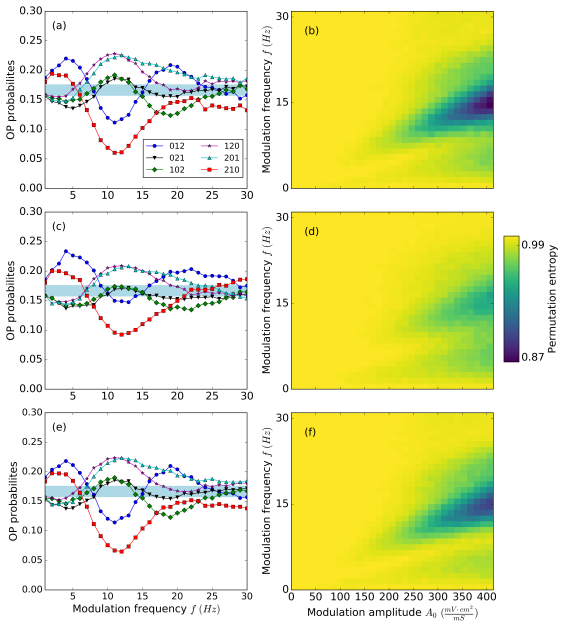
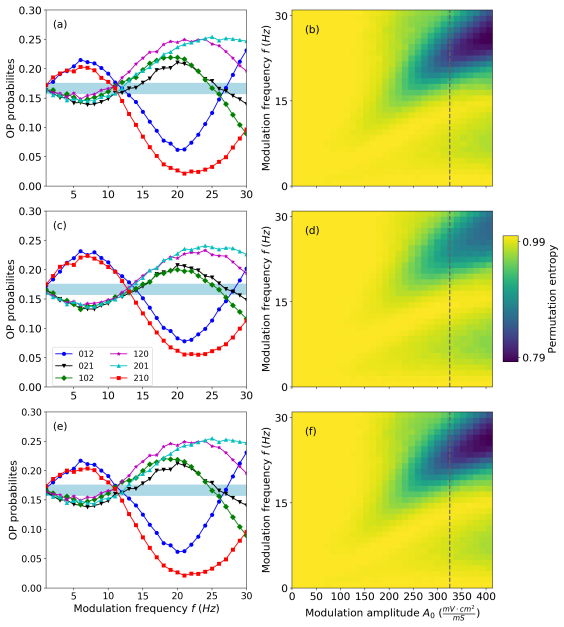
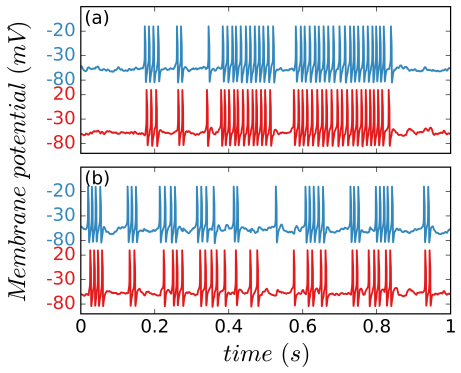
The operative tool is ordinal time-series analysis applied to inter-spike intervals. Each ISI is compared with the two that follow it (embedding dimension $L=3$), producing one of $3! = 6$ ordinal patterns; the paper tracks pattern probabilities and the permutation entropy $H$, normalized so $H=1$ means all patterns are equally likely and smaller $H$ means that preferred spike-timing orders stand out. This symbolic reduction is what lets the authors quantify encoding (the spread and stability of pattern probabilities as amplitude and frequency vary) and transmission (how closely the follower neuron's pattern probabilities and entropy match the sender's). A key supporting observation is a resonance: the probability of pattern 210 dips when the firing rate is near twice the modulation frequency, for both neuron classes and both coupling types.
What would settle it
Run the same coupled Morris-Lecar simulations and compute the mutual information between the sinusoidal input and the follower neuron's spike train (or decode the signal from the follower's ISIs) at the parameter combinations flagged as best transmission, such as electrical coupling at $f = 20$ Hz for class II. If the follower's ordinal probabilities match the sender's but mutual information is at chance level, the paper's transmission measure would be shown to be a synchrony artifact rather than information transfer.
Extended reading notes
Core claim
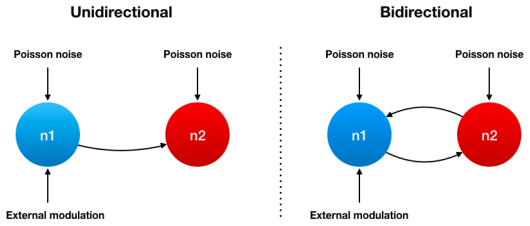
The paper's central discovery is that ordinal-pattern statistics of inter-spike-interval sequences carry frequency- and amplitude-specific information about a weak periodic input, and that encoding and transmission do not go together. In unidirectionally coupled neurons, class I neurons resolve low signal frequencies better and class II neurons resolve high frequencies better. Electrical coupling, by synchronizing the two neurons, transmits the symbolic pattern statistics almost unchanged to the follower neuron for both classes, whereas unidirectional chemical coupling transmits only in the class II case. With bidirectional chemical coupling, the pair behaves as a single processing unit: class I neurons can encode a wider range of frequencies than either neuron alone, but the follower no longer reproduces the sender's patterns, so transmission in the authors' sense fails. The same signal features are therefore not simultaneously optimized; the better transmission route (electrical) and the better encoding route (bidirectional chemical, class I) are different.
Load-bearing premise
The paper treats a follower neuron as transmitting the signal when its ordinal-pattern probabilities and permutation entropy match the sender's, without any decoding step or mutual-information measure that would show the signal can be recovered from the follower's spike train.
Editorial extensions
If this is right
- Class I and class II neurons are complementary rather than redundant encoders: slow signals are best read from class I spike trains, fast signals from class II, so a population containing both classes could cover a wider frequency band.
- Electrical (gap-junction) coupling is the reliable transmission channel in these simulations because it forces the follower neuron's ordinal statistics to match the sender's, making diffusive coupling a candidate substrate for carrying periodic stimulus features across a network.
- Bidirectional chemical coupling does not transmit the signal in the symbolic sense, but it expands the encoding range of class I neurons; mutually coupled pairs may act as a single encoding unit rather than a sender-receiver link.
- The encoding resonance at firing rate equal to twice the signal frequency gives a concrete prediction: a neuron's preferred symbolic pattern should respond non-monotonically to changes in baseline firing rate, with strongest ordering near the resonance.
Reading between the lines
- Beyond the paper, the transmission ranking could be re-tested with mutual information between the stimulus and the follower's spike train, since similar ordinal statistics do not by themselves guarantee that the signal is recoverable.
- Beyond the paper, the predicted frequency split (class I better at slow, class II at fast) could be tested by driving regular-spiking and fast-spiking neurons in vitro with sinusoidal currents and applying ordinal analysis to the recorded spike trains.
- Beyond the paper, because ordinal patterns of length three ignore interval durations, combining pattern frequencies with ISI averages would likely separate amplitude encoding from frequency encoding more sharply.
Signed reviews
Editorial analysis
A structured set of objections, weighed in public.
Referee Report
Summary. This paper applies ordinal time-series analysis (ordinal pattern probabilities and permutation entropy) to inter-spike-interval sequences from Morris-Lecar neurons of class I and class II excitability, coupled electrically or chemically, in unidirectional and bidirectional configurations. A weak sinusoidal modulation is applied to one neuron, and the authors study how the signal's amplitude and frequency are encoded in the driven neuron's spike statistics and how these statistics are reflected in the un-driven neuron. The paper reports that the encoding is robust across model variants, reproducing a resonance when the firing rate is twice the signal frequency, and it claims that the best 'transmission' of the signal, defined as similarity of ordinal-pattern statistics between the two neurons, is achieved with electrical coupling, with a class-specific performance for chemical coupling. The conclusions are framed in terms of specific class/coupling combinations allowing 'more effective encoding, or more effective transmission' depending on signal frequency.
Significance. If the operational definition of transmission is accepted, the paper offers a systematic comparison of two excitability classes and two coupling types using a simple symbolic measure, with parameter tables in Appendix A that are sufficiently detailed for re-implementation. The reproduction of the previously reported resonance effect in a different neuron model is a genuine strength, as is the internal consistency of the simulations. However, the central claim about 'more effective transmission' rests entirely on an unvalidated proxy that equates statistical similarity of ordinal patterns with recoverable signal information; this proxy needs to be justified or the claims need to be substantially qualified before the results can be taken as supporting the abstract's conclusions.
major comments (3)
- [Section IV C and Section V] The paper defines information transmission as similarity between the sender's and receiver's ordinal-pattern probabilities and permutation entropy, but no decoding or mutual-information measure is used. A receiver can share the sender's symbol margins or entropy without the signal being decodable from its spike train, so the conclusion that specific class/coupling combinations allow 'more effective transmission of the signal' is not supported by the evidence as presented. The phrase 'in terms of the information defined in this study' in Section IV C flags this gap, but the abstract and conclusions do not carry the same caveat. Please either validate the proxy (for example, by showing that OP similarity tracks mutual information between the stimulus and the receiver's ISI sequence, or by demonstrating that the signal can be decoded from the receiver's spikes) or explicitly restrict the claims to 'similarity of ordinal statistics' and revise the title, abstract, and conclusions accordingly.
- [Section IV C, Figs. 4-5, and Section V] The comparisons of ordinal-pattern probabilities and permutation entropy between sender and receiver are based on point estimates with no error bars, confidence intervals, or statistical tests of equality. The binomial test described in Section III tests whether the probabilities deviate from a uniform distribution; it is not a test of equality between two distributions. Consequently, statements such as 'nearly the same probabilities' (Section V) and the class-specific transmission claims for chemical coupling are not quantitatively supported. Please provide uncertainty quantification or a suitable statistical test for the similarity comparisons.
- [Section V, class II chemical unidirectional case] The conclusion that information is transmitted 'only if the neurons are of class II' for chemical unidirectional coupling is based on a qualitative comparison of entropy maps (Figs. 5(b) and 5(d)), yet Section IV C itself states that the receiver's entropy is higher than the sender's for both classes. Since permutation entropy alone measures orderliness, not transmitted signal information, this specific claim is not established by the presented evidence. Either provide a more direct measure of transmitted information for this case or rephrase the conclusion to describe the observed entropy similarity rather than information transmission.
minor comments (5)
- [Section IV B] The word 'Plato' should be 'plateau' in the sentence describing the receiver neuron's entropy behavior.
- [Section V] The verb 'codify' should be 'encode' in the sentence about the two coupled neurons as a single unit.
- [Appendix A] The text uses 'Class 1' and 'Class 2' in one sentence while the rest of the paper uses 'class I' and 'class II'; please standardize the notation.
- [References] Reference 23 lists the year as 2016 for a paper in Phys. Rev. E 79, but that volume corresponds to 2009; please correct the date. Also, Reference 24 abbreviates 'Comput Biol Med' as 'Compt Biol Med'; please fix the journal title.
- [Equation (1)] The subscript for the fast conductance appears as 'g f ast' with a space; please correct the typo to 'g_fast'.
Circularity Check
No significant circularity: the numerical results are self-contained simulations using standard methods; prior self-citations serve only as benchmarks and are independently reproduced.
full rationale
The paper's central claims are comparative observations computed directly from Morris-Lecar simulations. Ordinal pattern probabilities and permutation entropies are defined from the simulated ISI sequences (Section III), and the class I/II distinction comes from a standard published model (Prescott 2008), not from any quantity the paper aims to predict. The same-group prior work (Refs. 8 and 15) is used to motivate the ordinal-analysis approach and as a benchmark; the resonant effect reported there is explicitly reproduced in Fig. 3 for the Morris-Lecar model, so the citation is not load-bearing. No fitted parameter is renamed as a prediction: conductances are normalized for comparability and g_A is fit only to establish the stated 1:1 locking regime, which is an input condition rather than an output claim. The operational definition in Section IV C, that transmission is considered when the post-synaptic neuron copies the pre-synaptic ordinal-pattern behavior, is a stated interpretive criterion rather than a hidden circular derivation; the paper's contribution is the numerical comparison across excitability classes and coupling types, and those comparisons are not entailed by the definition alone. One may question whether symbol-statistic similarity is a valid proxy for recoverable signal information, but that is an assumption/validity issue, not a circularity of the derivation chain. Therefore no circular step meeting the evidentiary standard is present.
Assumptions & free parameters
free parameters (4)
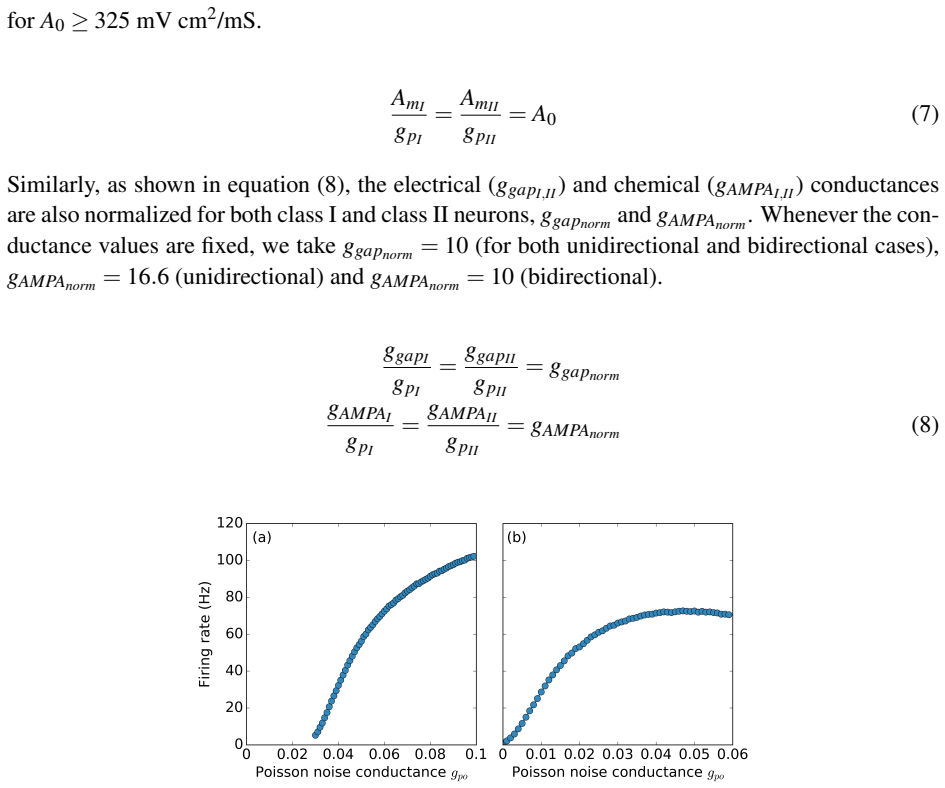
- Poisson noise conductances g_pI, g_pII =
0.03 and 0.19 mS/cm2
- Normalized modulation amplitude A0 =
250 mV cm2/mS fixed; swept 0 to 400
- Normalized electrical coupling conductance g_gap_norm =
10
- Normalized chemical coupling conductance g_AMPA_norm =
16.6 (unidirectional), 10 (bidirectional)
assumptions (4)
- domain assumption Morris-Lecar model with the given Prescott parameters realizes class I (beta_m = -12 mV) and class II (beta_m = 0 mV) excitability as characterized by the f-I curves in Appendix A.
- domain assumption Poisson shot noise plus a subthreshold sinusoidal current is an adequate representation of background synaptic input and a weak periodic stimulus.
- domain assumption L=3 ordinal-pattern probabilities and permutation entropy quantify the amount of signal-related order in ISI sequences.
- ad hoc to paper Conductance normalization and 1:1 phase locking are the correct basis for comparing class I and class II neurons and coupling types.
Cite this review
Pith. "Pith review of Characterizing signal encoding and transmission in class I and class II neurons via ordinal time-series analysis." pith.science (2026). https://pith.science/paper/Z4VQYXJC
@misc{pith2026190801548,
  author       = {Pith},
  title        = {Pith review of: Characterizing signal encoding and transmission in class I and class II neurons via ordinal time-series analysis},
  year         = {2026},
  howpublished = {\url{https://pith.science/paper/Z4VQYXJC}},
  note         = {Machine review of arXiv:1908.01548}
}
read the original abstract
Neurons encode and transmit information in spike sequences. However, despite the effort devoted to quantify their information content, little progress has been made in this regard. Here we use a nonlinear method of time-series analysis (known as ordinal analysis) to compare the statistics of spike sequences generated by applying an input signal to the neuronal model of Morris-Lecar. In particular we consider two different regimes for the neurons which lead to two classes of excitability: class I, where the frequency-current curve is continuous and class II, where the frequency-current curve is discontinuous. By applying ordinal analysis to sequences of inter-spike-intervals (ISIs) our goals are (1) to investigate if different neuron types can generate spike sequences which have similar symbolic properties; (2) to get deeper understanding on the effects that electrical (diffusive) and excitatory chemical (i.e., excitatory synapse) couplings have; and (3) to compare, when a small--amplitude periodic signal is applied to one of the neurons, how the signal features (amplitude and frequency) are encoded and transmitted in the generated ISI sequences for both class I and class II type neurons and electrical or chemical couplings. We find that depending on the frequency, specific combinations of neuron/class and coupling-type allow a more effective encoding, or a more effective transmission of the signal.
Figures

Figures from the paper (10 more)



Reference graph
Works this paper leans on
-
[1]
author Thorpe, S. , author Delorme, A. & author Rullen, R. V. journal title Spike-based strategies for rapid processing . Neural Networks volume 14 , pages 715 -- 725 ( year 2001 )
work page 2001
-
[2]
journal title Olfactory network dynamics and the coding of multidimensional signals
author Laurent, G. journal title Olfactory network dynamics and the coding of multidimensional signals . Nature Rev. Neurosci. volume 3 , pages 884--895 ( year 2002 )
work page 2002
-
[3]
author Huxter, J. , author Burgess, N. & author O'Keefe, J. journal title Independent rate and temporal coding in hippocampal pyramidal cells . Nature volume 425 , pages 828--832 ( year 2003 )
work page 2003
-
[4]
author Segev, R. , author Baruchi, I. , author Hulata, E. & author Ben-Jacob, E. journal title Hidden neuronal correlations in cultured networks . Phys. Rev. Lett. volume 92 , pages 118102 ( year 2004 )
work page 2004
-
[5]
author Laudanski, J. , author Coombes, S. , author Palmer, A. R. & author Sumner, C. J. journal title Mode-locked spike trains in responses of ventral cochlear nucleus chopper and onset neurons to periodic stimuli . J Neurophysiol. volume 103 , pages 1226--1237 ( year 2010 )
work page 2010
-
[6]
Quiroga, Q., et. al. Nature, 453, 1102, 2005
work page 2005
-
[7]
Stein, R. B. , Gossen E. R. Jones K. E. Neuronal variability: noise or part of the signal? Nature Reviews Neuroscience, 6, 389-397 (2005)
work page 2005
-
[8]
author Reinoso, J. A. , author Torrent, M. C. & author Masoller, C. journal title Emergence of spike correlations in periodically forced excitable systems . Phys. Rev. E volume 94 , pages 032218 ( year 2016 )
work page 2016
Show all 27 references
-
[9]
journal title Mathematical models of threshold phenomena in the nerve membrane
author FitzHugh, R. journal title Mathematical models of threshold phenomena in the nerve membrane . The bulletin of mathematical biophysics volume 17 , issue 4 , pages 257 -- 278 ( year 1955 )
1955
-
[10]
journal title Impulses and physiological states in theoretical models of nerve membrane
author FitzHugh, R. journal title Impulses and physiological states in theoretical models of nerve membrane . Biophysical journal volume 1 , issue 6 , pages 445 -- 66 ( year 1961 )
1961
-
[11]
and Chialvo, D
Longtin, A. and Chialvo, D. R. Phys. Rev. Lett. 81, 4012, 1998
1998
-
[12]
author Rosso, O. A. & author Masoller, C. journal title Detecting and quantifying stochastic and coherence resonances via information-theory complexity measurements . Phys. Rev. E volume 79 , pages 040106 ( year 2009 )
2009
-
[13]
Permutation complexity in dynamical systems: Ordinal patterns, permutation entropy and all that (Springer, 2010)
Amigo, J.M. Permutation complexity in dynamical systems: Ordinal patterns, permutation entropy and all that (Springer, 2010)
2010
-
[14]
Zanin, M., Zunino, L., Rosso, O. A. Papo, D. Permutation entropy and its main biomedical and econophysics applications: a review. Entropy 14, 1553 - 1577 (2012)
2012
-
[15]
& author Masoller, C
author Masoliver, M. & author Masoller, C. journal title Sub-threshold signal encoding in coupled FitzHugh-Nagumo neurons . Sci. Reports volume 8 , pages 8276 ( year 2018 )
2018
-
[16]
Morris, C., Lecar, H. (1981). Voltage oscillations in the barnacle giant muscle fiber. Biophysical Journal, 35(1), 193–213
1981
-
[17]
M., Dynamical Systems in Neuroscience: The Geometry of Excitability and Bursting The MIT Press, Cambridge, Massachusetts, London, England, 2010
Izhikevich, E. M., Dynamical Systems in Neuroscience: The Geometry of Excitability and Bursting The MIT Press, Cambridge, Massachusetts, London, England, 2010
2010
-
[18]
A., De Koninck, Y., Sejnowski, T
Prescott, S. A., De Koninck, Y., Sejnowski, T. J. (2008) Biophysical basis for three distinct dynamical mechanisms of action potential initiation. PLoS Computational Biology, 4(10)
2008
-
[19]
Tsumoto, K., Kitajima, H., Yoshinaga, T., Aihara, K., Kawakami, H. (2006). Bifurcations in Morris-Lecar neuron model. Neurocomputing, 69(4–6), 293–316
2006
-
[20]
Liu, C., Liu, X., Liu, S. (2014). Bifurcation analysis of a Morris - Lecar neuron model. Biological Cybernetics, 108(1), 75 - 84
2014
-
[21]
& author Pompe, B
author Bandt, C. & author Pompe, B. journal title Permutation entropy: A natural complexity measure for time series . Phys. Rev. Lett. volume 88 , pages 174102 ( year 2002 )
2002
-
[22]
author Reinoso, J. A. , author Torrent, M. C. & author Masoller, C. journal title Analysis of noise-induced temporal correlations in neuronal spike sequences . The Eur. Phys. J. Special Top volume 225 , pages 2689 - 2696 ( year 2016 )
2016
-
[23]
author Rosso, O. A. , & author Masoller, C. journal title Detecting and quantifying stochastic and coherence resonances via information-theory complexity measurements. . Phys. Rev. E volume 79 , pages 040106 ( year 2016 )
2016
-
[24]
Classifying cardiac biosignals using ordinal pattern statistics and symbolic dynamics
Parlitz U, Berg S, Luther S, Schirdewan A, Kurths J and Wessel N. Classifying cardiac biosignals using ordinal pattern statistics and symbolic dynamics. Compt Biol Med. 2012;42:319
2012
-
[25]
Detecting dynamical changes in time series using the permutation entropy
Cao Y, Tung Ww, Gao JB, Protopopescu VA, Hively LM. Detecting dynamical changes in time series using the permutation entropy. Phys Rev E. 2004;70:046217
2004
-
[26]
Distinguishing Noise from Chaos
Rosso OA, Larrondo HA, Martin MT, Plastino A, Fuentes MA. Distinguishing Noise from Chaos. Phys Rev Lett. 2007;99:154102
2007
-
[27]
Phys Rev Lett
Aragoneses, A., Carpi, L., Tarasov, N., Churkin, D.V., Torrent, M.C and Masoller C., Unveiling Temporal Correlations Characteristic of a Phase Transition in the Output Intensity of a Fiber Laser. Phys Rev Lett. 2016;116:033902
2016
Reviewed August 14, 2026 · model on record in the stance chip above.
Discussion (0). Continue with ORCID to comment.