REVIEW 3 major objections 7 minor 1 cited by
Dynamical Gaseous Rings in Global Simulations of Protoplanetary Disk Formation
T0 review · 3 major / 7 minor · reviewed 2026-08-14 · deepseek-v4-flash
Pith's one-line read Dead zones in layered protoplanetary disks are not passive bottlenecks but dynamical factories of dense gaseous rings that trap dust, migrate inward, and erupt in FUor-like accretion events.
desk verdict Solid global simulations of dead-zone ring formation with a clean fiducial comparison, but the headline result rides on the least favorable residual viscosity setting and the authors never bracket it. read the letter →
The pith
A machine-rendered reading of the paper's core claim, the machinery that carries it, and where it could break.
The reading
What carries the argument
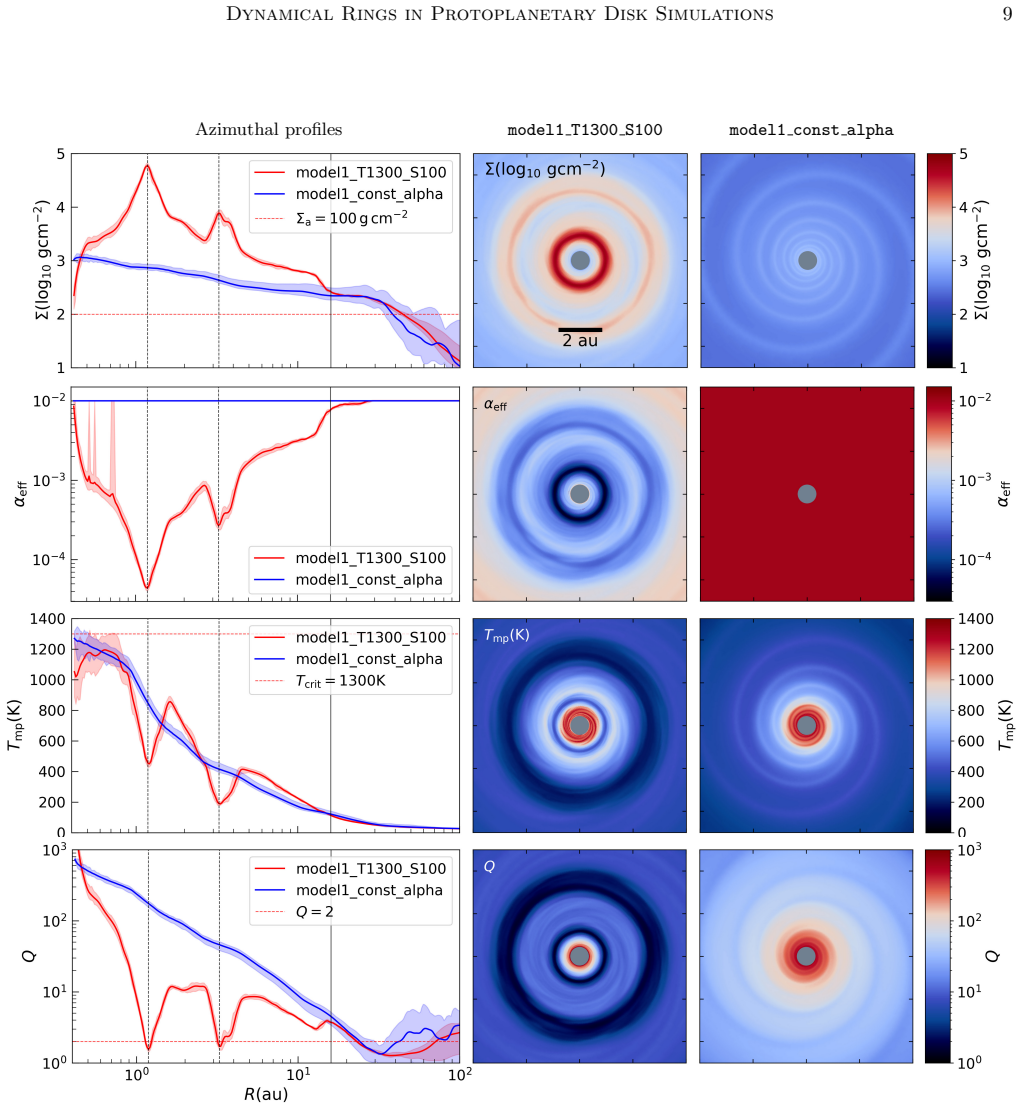
The central object is the effective viscosity parameter $\alpha_{\rm eff} = (\Sigma_a \alpha_a + \Sigma_d \alpha_d)/\Sigma$, with $\alpha_a = 0.01$, residual dead-zone viscosity $\alpha_d = \min(10^{-5},\ \alpha_a \Sigma_a/\Sigma_d)$, and thermal MRI activation when the midplane temperature exceeds $T_{\rm crit}$. The key mechanism is the viscous torque, which has a component proportional to the negative gradient of the kinematic viscosity; at the sharp inner edge of the dead zone this torque piles up gas instead of letting it flow inward. The pileup increases surface density and lowers $\alpha_{\rm eff}$, which steepens the viscosity gradient and strengthens the pileup, producing a positive feedback that builds and maintains the rings.
What would settle it
Run the same simulation with the MRI-on switch smoothed over a finite temperature or density range and with the residual dead-zone viscosity raised from $10^{-5}$ to $10^{-3}$: if the dense axisymmetric rings no longer form, the sharp viscosity transition is the load-bearing element. Observational complement: sub-au millimeter continuum imaging of a nearby T Tauri disk that resolves inside a few au should show a compact bright ring or gap with the predicted dust-trap contrast if the rings are generic; a smooth, featureless inner disk would argue against the mechanism.
Extended reading notes
Core claim
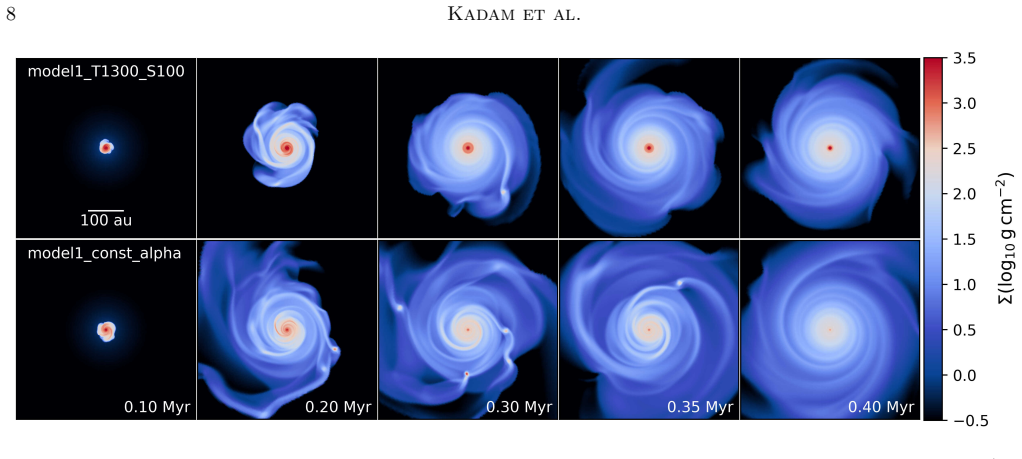
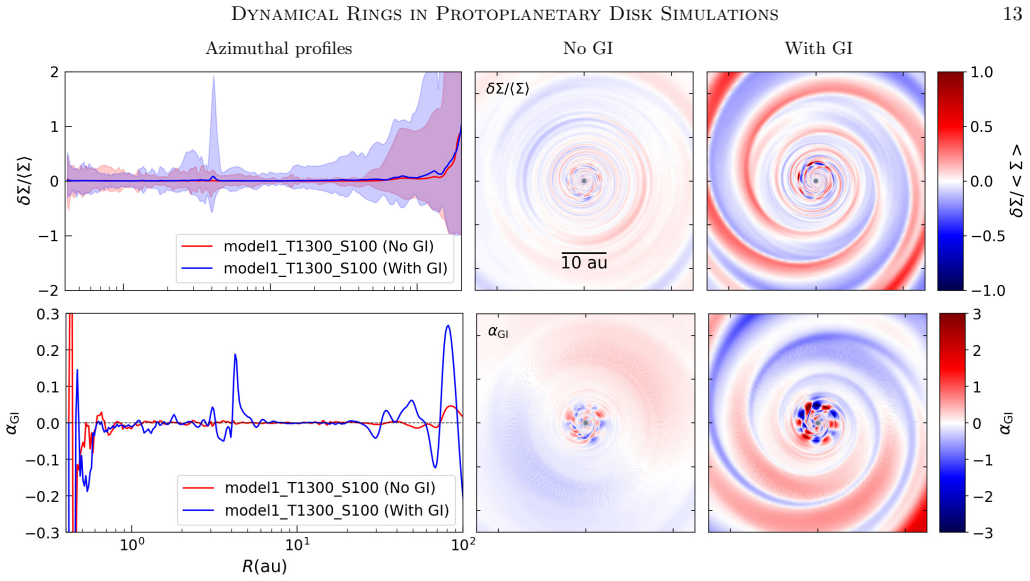
The paper's central claim is that the dead zone of a magnetically layered protoplanetary disk is not a uniform, quiescent region but a self-organizing system of gaseous rings. With canonical parameters (MRI-active surface layer column density $\Sigma_a = 100$ g cm$^{-2}$ and activation temperature $T_{\rm crit}=1300$ K), the dead zone extends to about 15 au, and the inner few au host multiple axisymmetric rings with surface densities up to two orders of magnitude higher and effective viscosities about two orders of magnitude lower than a fully MRI-active disk. The rings form through a positive feedback: viscous torques with a component proportional to the negative gradient of kinematic viscosity push gas into low-viscosity regions, which raises surface density and lowers $\alpha_{\rm eff}$, steepening the gradient further. The rings migrate inward, become gravitationally unstable, generate spiral waves and short-lived vortices, and terminate when the midplane temperature crosses $T_{\rm crit}$, triggering an MRI event that rapidly accretes the ring onto the star in an FUor-like outburst. Within the rings, dust faces fragmentation barriers of centimeters to meters, occasionally approaching 100 m, in contrast to a few millimeters in a fully MRI-active disk.
Load-bearing premise
The rings grow from a sharp jump in gas viscosity between the magnetically active surface layers and the dead midplane, so if real dead zones have smoother transitions or a higher residual viscosity, the rings would be weaker or absent.
Editorial extensions
If this is right
- Layered protoplanetary disks generically develop long-lived, axisymmetric gaseous rings inside a few au, whereas fully MRI-active disks with constant $\alpha$ do not.
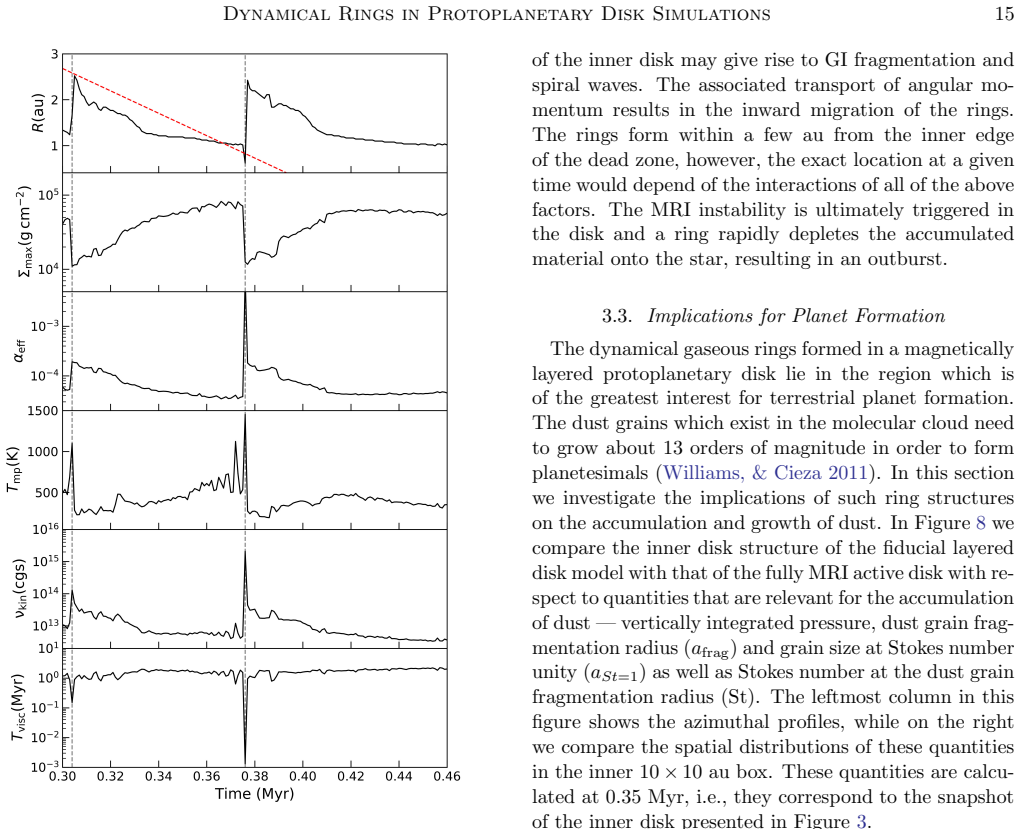
- The rings migrate inward at tens of au per Myr and end in MRI-triggered accretion episodes, providing a mechanistic route to FUor-like outbursts with intervals of roughly tens of thousands of years.
- Ring pressure maxima raise the local dust fragmentation barrier from millimeter sizes to centimeter-meter sizes, occasionally reaching about 100 m, making the inner few au a favorable site for dust trapping and rapid planetesimal growth.
- The inner-disk structure is highly sensitive to active-layer thickness and initial cloud core mass: a tenfold thinner active layer widens the dead zone to roughly 78 au and slows ring evolution, while a lower-mass core yields a short-lived ring phase without MRI-triggered outbursts.
- Because large bodies decouple from the gas, planetesimals that form in the rings may survive the MRI-triggered dispersal of the gaseous ring, so the rings can assist planet formation despite their short gas lifetime.
Reading between the lines
- The paper does not say this, but the same positive-feedback mechanism should operate at any sharp radial viscosity drop in a Keplerian disk, so opacity or dust-sublimation transitions could produce similar rings even without MRI layering.
- An outside inference from the ring lifetimes: gas-only runs give ring lifetimes of only a few percent of the roughly 1 Myr viscous timescale before MRI erupts, so whether dust actually reaches planetesimal sizes depends on whether growth beats about $10^4$ yr, a question the paper leaves for future dust evolution models.
- If the ring phase shortens with decreasing stellar mass, as the lower-core-mass run suggests, then low-mass stars should show both weaker inner-disk dust trapping and less frequent FUor-like accretion, a statistical prediction that young stellar cluster surveys could test.
- A direct numerical check of the mechanism would replace the step-function MRI activation with a smooth, microphysically motivated transition and raise the residual dead-zone viscosity from $10^{-5}$ to $10^{-3}$; if the dense rings disappear, the sharp viscosity jump is what carries the claim.
Signed reviews
Editorial analysis
A structured set of objections, weighed in public.
Referee Report
Summary. This paper presents global thin-disk hydrodynamic simulations of protoplanetary disk formation starting from collapsing cloud cores, with a magnetically layered disk model implemented as an adaptive α_eff (Equations 5–8). The authors compare a fiducial layered model (model1 T1300 S100) with a constant-α fully MRI-active model, and explore variations in Tcrit, Σ_a, and core mass (10 models total). The main reported result is that the layered models develop a dead zone (inner ~15 au in the fiducial case) inside which long-lived, axisymmetric, high-surface-density gaseous rings form via viscous torques at sharp viscosity transitions. The rings migrate inward, occasionally become gravitationally unstable, and their MRI-triggered destruction bursts resemble FUor outbursts. The paper also argues that pressure maxima in the rings can trap dust and increase the fragmentation barrier.
Significance. If the result holds, it provides a plausible and observationally relevant mechanism for gaseous ring formation in the innermost few au of protoplanetary disks, linking layered accretion, episodic outbursts, and dust trapping. The paper's strengths are its self-consistent collapse initial conditions, the smallest inner sink cell (0.4 au) used in such global simulations, the explicit comparison between layered and constant-α disks, and the candid discussion of model limitations (dust evolution, vortex resolution, sparse event statistics). The ring formation mechanism is not imposed by hand; it emerges from the viscous evolution of the layered-α prescription, and no parameter is fitted to reproduce rings. However, the central claim of ubiquitous rings rests on the assumed low residual dead-zone viscosity (α_rd = 10^-5), which is the most favorable value in the range cited by the paper, and the model dependence on that parameter is not explored.
major comments (3)
- [§2.1, Eq. (8); §3.4] All layered-disk models set α_rd = 10^-5, which is the lowest (most favorable) end of the residual-viscosity range cited in Section 2.1 (10^-3 to 10^-5, based on Okuzumi & Hirose 2011). Since α_eff ≈ α_rd in the ring interiors where Σ ≫ Σ_a, and since the ring-forming torque in Section 3.2 is said to scale with the gradient of kinematic viscosity, the reported two-order-of-magnitude contrast in Σ and α_eff is expected to shrink to about one order of magnitude or less if α_rd = 10^-4 or 10^-3, respectively. Section 3.4 varies Tcrit and Σ_a but never α_rd, so the claim that rings form ubiquitously in layered disks is not bracketed by the paper's own stated uncertainty range. I request either simulations with α_rd = 10^-4 and 10^-3, or a quantitative argument (e.g., a scaling analysis of the ring amplitude with α_a/α_rd) explaining why the conclusion survives over the stated range.
- [§3.1, Figure 3] The dead zone is defined as the region where α_eff falls below 80% of α_a = 0.01, with the justification that 'below this threshold ... surface density started to diverge.' This threshold is arbitrary, and the quantitative dead-zone extents quoted in the paper (≈16 au for the fiducial model, ≈78 au for Σ_a = 10 g cm^-2, ≈3.3 au for the low-mass model; Section 3.4 and Figures 9–12) will shift if the threshold is changed. Since these extents are used as the basis for parameter-dependence conclusions (e.g., 'five times larger' and 'five times smaller'), the definition should be made more robust—for example, by quoting the radius where the surface-density profile first diverges from the constant-α model, or by showing the sensitivity of the extent to the chosen threshold.
- [§3.2, Figure 7] The migration rate of about −25 au/Myr and the mean outburst interval of about 38,000 yr are derived from only two ring-discontinuity events (at approximately 0.305 and 0.375 Myr), one of which was not directly sampled in the output (the text notes that the 0.305 Myr event was not caught). The first panel of Figure 7 also shows that the ring's trajectory is highly nonlinear. The reported 'average' quantities therefore carry a large, unquantified uncertainty; the text should either provide an error estimate, extend the time baseline with more events, or explicitly soften the quantitative claims in the abstract and conclusion.
minor comments (7)
- [§3.4, Figure 9] The model shown in green for the low-mass case is called 'model2 T1500 S100' in the text and figure, but Table 1 and the surrounding text refer to 'model2 T1300 S100' (which is also the subject of Figure 12); please harmonize the model naming.
- [§2.2] The abstract states 'the smallest possible inner computational boundary,' but the text more precisely says 'the smallest sink cell used in global collapse simulations'; please rephrase the abstract to avoid overstatement.
- [§2.1, Eq. (4)] The viscous stress tensor uses 'e' for the unit tensor, which can be confused with the internal energy density e in Eq. (3); please use a distinct symbol or explicitly note the difference.
- [§3.1, Figures 3 and 8] The vertical lines marking the two rings at 1.2 and 3.2 au are described in the text but are not labeled in the figure captions; adding explicit labels or a legend would improve readability.
- [§3.2] The explanation that the inner dead-zone boundary undergoes a sharp transition while the outer boundary is smooth is intuitive but would benefit from an explicit expression for the ∝ −dν/dr component of the viscous torque, which is invoked but not written out.
- [§3.3] The dust-trapping analysis uses a single snapshot, and the text already acknowledges that the rings have short lifetimes; the abstract's statement that dust 'could be trapped' should be qualified as 'while the rings exist,' since the ring lifetime may be much shorter than the dust growth timescale.
- [Abstract and Conclusion] The word 'ubiquitously' is used for the ring-formation claim, but the conclusion rests on 8 layered-disk models with a specific, narrow parameter choice; consider replacing 'ubiquitously' with 'in all models explored here' to match the actual scope.
Circularity Check
No significant circularity: the gaseous rings are emergent outcomes of the adopted layered viscosity prescription, not fitted parameters or definitional artifacts.
full rationale
The paper's central claim is that magnetically layered disks form long-lived gaseous rings in the inner dead zone. This claim is not equivalent to its inputs by construction. The layered viscosity ansatz (Equations 5-8) is adopted from external literature (Bae et al. 2014; Okuzumi & Hirose 2011), with parameters such as alpha_a = 0.01, alpha_rd = 10^-5, Tcrit, and Sigma_a fixed before the simulations; none of these parameters is fitted to reproduce rings or outbursts. The rings emerge from integrating the full thin-disk hydrodynamics (Equations 1-4), and the reported surface-density enhancements, inward migration, MRI-triggered accretion events, vortices, and gravitational-instability spiral activity are time-dependent outputs that are not contained in the viscosity formula alone. The dead-zone definition (alpha_eff < 80% of alpha_a) and ring identification (local surface-density maximum) are diagnostic conventions, not circular definitions of the predicted phenomenon. The only self-citations (e.g., the inflow-outflow boundary condition from Vorobyov et al. 2018 and initial-condition choices from Vorobyov & Basu 2010) support the numerical methodology rather than the ring-formation result. The choice of alpha_rd = 10^-5, at the low end of the paper's stated 10^-3-10^-5 range, is a legitimate robustness concern because the paper varies Tcrit and Sigma_a but not alpha_rd; however, a missing sensitivity test is not circularity. The ring-forming viscous torque is a genuine dynamical consequence of the assumed viscosity contrast, not a renamed fit or an input disguised as a prediction.
Assumptions & free parameters
free parameters (7)
- alpha_a (active layer viscosity) =
0.01
- alpha_rd floor (dead zone residual viscosity) =
10^-5
- Tcrit (MRI triggering temperature) =
1300 K and 1500 K
- Sigma_a (active layer column density) =
100 and 10 g cm^-2
- M_gas (initial cloud core mass) =
1.152 and 0.346 Msun
- beta (rotational to gravitational energy ratio) =
1.36 x 10^-3
- r_sc (inner sink cell radius) =
0.4 au
assumptions (6)
- domain assumption Thin-disk approximation: vertical integration of hydrodynamics with local hydrostatic equilibrium
- domain assumption Shakura-Sunyaev alpha viscosity prescription
- domain assumption Magnetically layered disk structure with active layer column Sigma_a and midplane temperature threshold Tcrit
- domain assumption Analytical vertical radiative transfer for cooling and heating (Dong et al. 2016) with Semenov et al. (2003) opacities
- domain assumption Initial cloud core profiles from Basu (1997) with uniform rotation parameter beta
- standard math Ideal gas equation of state with gamma=7/5
Cite this review
Pith. "Pith review of Dynamical Gaseous Rings in Global Simulations of Protoplanetary Disk Formation." pith.science (2026). https://pith.science/paper/Z4W6GKWP
@misc{pith2026190802515,
  author       = {Pith},
  title        = {Pith review of: Dynamical Gaseous Rings in Global Simulations of Protoplanetary Disk Formation},
  year         = {2026},
  howpublished = {\url{https://pith.science/paper/Z4W6GKWP}},
  note         = {Machine review of arXiv:1908.02515}
}
abstract
Global numerical simulations of protoplanetary disk formation and evolution were conducted in thin-disk limit, where the model included magnetically layered disk structure, a self-consistent treatment for the infall from cloud core as well as the smallest possible inner computational boundary. We compared the evolution of a layered disk with a fully magnetically active disk. We also studied how the evolution depends on the parameters of the layered disk model - the MRI triggering temperature and active layer thickness - as well as the mass of the prestellar cloud core. With the canonical values of parameters a dead zone formed within the inner $\approx$ 15 au region of the magnetically layered disk. The dead zone was not a uniform structure and long-lived, axisymmetric, gaseous rings ubiquitously formed within this region due to the action of viscous torques. The rings showed a remarkable contrast in the disk environment as compared to a fully magnetically active disk and were characterized by high surface density and low effective viscosity. Multiple gaseous rings could form simultaneously in the dead zone region which were highly dynamical and showed complex, time-dependent behavior such as inward migration, vortices, gravitational instability and large-scale spiral waves. An increase in MRI triggering temperature had only marginal effects, while changes in active layer thickness as well as the initial cloud core mass had significant effects on the structure and evolution of the inner disk. Dust with large fragmentation barrier could be trapped in the rings, which may play a key role in planet formation.
Figures

Figures from the paper (8 more)




Forward citations
Cited by 1 Pith paper
-
Gravitoviscous protoplanetary disks with a dust component. II. Spatial distribution and growth of dust in a clumpy disk
Simulations show that dust in gravitationally fragmenting protoplanetary disks grows to decimeter sizes and concentrates into dense clump centers, which may seed giant planet formation.
Reference graph
Works this paper leans on
-
[1]
ALMA Partnership, Brogan, C. L., P´ erez, L. M., et al. 2015, ApJ, 808, L3. Armitage, P. J., Livio, M., & Pringle, J. E. 2001, MNRAS, 324,
work page 2015
-
[5]
Courant R., Friedrichs K., Lewy H., 1928, Mathematische Annalen, 100,
work page 1928
-
[8]
B., Hubickyj, O., Bodenheimer, P., et al
Pollack, J. B., Hubickyj, O., Bodenheimer, P., et al. 1996, Icarus, 124,
work page 1996
- [27]
- [30]
- [32]
- [52]
- [53]
Show all 46 references
-
[61]
2017, ApJ, 845,
Bai, X.-N. 2017, ApJ, 845,
2017
-
[62]
L., Polyachenko, E
Polyachenko, V. L., Polyachenko, E. V., & Strel’Nikov, A. V. 1997, Astronomy Letters, 23, 483 Pringle, J. E., 1981, ARA&A, 19,
1997
-
[67]
2018, ApJ, 868,
Yang, C.-C., Mac Low, M.-M., & Johansen, A. 2018, ApJ, 868,
2018
-
[69]
I., & Basu, S
Vorobyov, E. I., & Basu, S. 2009, MNRAS, 393,
2009
-
[75]
Bai, X.-N., & Stone, J. M. 2013, ApJ, 767,
2013
-
[137]
Rafikov, R. R. 2005, ApJL, 621, L69 Reg´ aly, Z., & Vorobyov, E. 2017, MNRAS, 471,
2005
-
[141]
M., Evans, N
Dunham, M. M., Evans, N. J., Terebey, S., et al. 2010, ApJ, 710,
2010
-
[156]
Dong, R., Vorobyov, E., Pavlyuchenkov, Y., Chiang, E., & Liu, H. B. 2016, ApJ, 823,
2016
-
[189]
2009, ApJ, 701,
Zhu, Z., Hartmann, L., Gammie, C., et al. 2009, ApJ, 701,
2009
-
[207]
1998, ApJ, 495,
Hartmann, L., Calvet, N., Gullbring, E., et al. 1998, ApJ, 495,
1998
-
[238]
Chatterjee, S., & Tan, J. C. 2014, ApJ, 780,
2014
-
[240]
A., Aikawa, Y., Blake, G
Bergin, E. A., Aikawa, Y., Blake, G. A., et al. 2007, Protostars and Planets V,
2007
-
[350]
Goldreich, P., & Ward, W. R. 1973, ApJ, 183,
1973
-
[355]
1999, ApJ, 523,
Godon, P., & Livio, M. 1999, ApJ, 523,
1999
-
[385]
F., Gammie, C
Hawley, J. F., Gammie, C. F., & Balbus, S. A. 1995, ApJ, 440,
1995
-
[396]
P., Dzyurkevich, N., et al
Flock, M., Ruge, J. P., Dzyurkevich, N., et al. 2015, A&A, 574, A68. Frank, J., King, A., & Raine, D. J. 2002, Accretion Power in Astrophysics. Gammie, C. F. 1996, ApJ, 457,
2015
-
[411]
1983, Progress of Theoretical Physics, 69,
Umebayashi, T. 1983, Progress of Theoretical Physics, 69,
1983
-
[459]
Yorke H.W., & Bodenheimer P., 2008, in Massive Star Formation: Observations 80 Confront Theory, eds. H. Beuther, H. Linz, T. Henning (San Francisco: ASP), 81 ASP Conf. Ser. 387,
2008
-
[470]
M., & Vorobyov, E
Dunham, M. M., & Vorobyov, E. I. 2012, ApJ, 747,
2012
-
[480]
1981, Publications of the Astronomical Society of Japan, 33,
Umebayashi, T., & Nakano, T. 1981, Publications of the Astronomical Society of Japan, 33,
1981
-
[565]
2011, ApJ, 742, 65 Padovani, M., & Galli, D
Okuzumi, S., & Hirose, S. 2011, ApJ, 742, 65 Padovani, M., & Galli, D. 2011, A&A, 530, A109. Perez-Becker, D., & Chiang, E. 2011, ApJ, 735,
2011
-
[611]
I., & Sunyaev, R
Shakura, N. I., & Sunyaev, R. A. 1973, A&A, 24, 337 Spitzer, L., & Tomasko, M. G. 1968, ApJ, 152,
1973
-
[617]
2009, ApJ, 690,
Dynamical Rings in Protoplanetary Disk Simulations 23 Umebayashi, T., & Nakano, T. 2009, ApJ, 690,
2009
-
[620]
F., et al
Zhu, Z., Hartmann, L., Gammie, C. F., et al. 2010, ApJ, 713, 1134
2010
-
[705]
Bae, J., Hartmann, L., Zhu, Z., & Nelson, R. P. 2014, ApJ, 795,
2014
-
[729]
J., Fromang, S., Gammie, C., et al
Turner, N. J., Fromang, S., Gammie, C., et al. 2014, Protostars and Planets VI,
2014
-
[742]
J., Ilee, J
Haworth, T. J., Ilee, J. D., Forgan, D. H., et al. 2016, Publications of the Astronomical Society of Australia, 33, e053. Hohl, F. 1971, ApJ, 168, 343 Igea, J., & Glassgold, A. E. 1999, ApJ, 518,
2016
-
[751]
P., & Brauer, F
Birnstiel, T., Dullemond, C. P., & Brauer, F. 2010, A&A, 513, A79. Birnstiel, T., Klahr, H., & Ercolano, B. 2012, A&A, 539, A148. Boss, A. P. 1997, Science, 276,
2010
-
[805]
2009, A&A, 497,
Lyra, W., Johansen, A., Zsom, A., et al. 2009, A&A, 497,
2009
-
[822]
I., & Basu, S
Vorobyov, E. I., & Basu, S. 2010, ApJ, 719,
2010
-
[848]
2019, A&A, 622, A147
Kobus, J., Wolf, S., & Brunngr¨ aber, R. 2019, A&A, 622, A147. Lesur, G., Kunz, M. W., & Fromang, S. 2014, A&A, 566, A56. Lodato, G., & Rice, W. K. M. 2005, MNRAS, 358, 1489 Lovelace, R. V. E., Li, H., Colgate, S. A., et al. 1999, ApJ, 513,
2019
-
[869]
G., Lubow, S
Martin, R. G., Lubow, S. H., Livio, M., et al. 2012, MNRAS, 423,
2012
-
[971]
J., Sano, T., & Dziourkevitch, N
Turner, N. J., Sano, T., & Dziourkevitch, N. 2007, ApJ, 659,
2007
-
[1051]
M., & S´ andor, Z
Guilera, O. M., & S´ andor, Z. 2017, A&A, 604, A10. Hartmann, L., & Kenyon, S. J. 1996, Annual Review of Astronomy and Astrophysics, 34,
2017
-
[1836]
L., McKinnon, M., Ott, J., et al
Carilli, C. L., McKinnon, M., Ott, J., et al. 2015, arXiv e-prints , arXiv:1510.06438. Caselli, P., Benson, P. J., Myers, P. C., et al. 2002, ApJ, 572,
2015 arXiv
-
[1896]
I., & Pavlyuchenkov, Ya
Vorobyov, E. I., & Pavlyuchenkov, Ya. N. 2017, A&A, 606, A5 Vorobyov, E. I., Akimkin, V., Stoyanovskaya, O., Pavlyuchenkov, Y., & Liu, H. B. 2018, A&A, 614, A98. Vorobyov et al., 2019, A&A, submitted. Williams, J. P., & Cieza, L. A. 2011, Annual Review of Astronomy and Astroph...
2017
-
[2204]
P., Flock, M., Wolf, S., et al
Ruge, J. P., Flock, M., Wolf, S., et al. 2016, A&A, 590, A17. Semenov, D., Henning, T., Helling, C., Ilgner, M., & Sedlmayr, E. 2003, A&A, 410,
2016
-
[2718]
F., & Ostriker, E
McKee, C. F., & Ostriker, E. C. 2007, Annual Review of Astronomy and Astrophysics, 45,
2007
Reviewed August 14, 2026 · model on record in the stance chip above.
Discussion (0). Continue with ORCID to comment.