REVIEW 4 major objections 6 minor 44 references
GrokAlign: Geometric Characterisation and Acceleration of Grokking
T0 review · 4 major / 6 minor · reviewed 2026-08-07 · deepseek-v4-flash
Pith's one-line read Grokking happens when a network's Jacobians align with the training data, and a Jacobian-norm regularizer called GrokAlign makes that happen far sooner.
desk verdict Solid practical contribution, but the causal story overreaches; the paper is worth reviewing with major revisions. read the letter →
The pith
A machine-rendered reading of the paper's core claim, the machinery that carries it, and where it could break.
The reading
What carries the argument
The load-bearing object is the Jacobian matrix $J_x(f)$ of the network at an input, together with the alignment condition $J_x(f) = c x^\top$. The paper proves that this aligned form is the constrained optimum of the training loss (Theorem 2) and, under the low-rank bias of training, the optimally robust rank-one local map (Theorem 3). The tractable proxy is the centroid $\mu_x = (J_x(f))^\top \mathbf{1}$, which for continuous piecewise affine networks is the centroid of the linear region containing $x$ and can be computed with a single Jacobian-vector product; its dynamics connect to the neural tangent kernel through $\partial_t \langle x, \mu_x \rangle = \frac{\eta}{m} \sum_p \Theta(x, x_p) m_{x_p}$. GrokAlign is the training-side mechanism: it adds the average Frobenius norm of the training-point Jacobians to the loss, enforcing the constraint that makes alignment the optimum.
What would settle it
Train a network in a grokking regime while measuring the effective rank of its training-point Jacobians, for example the fraction of Jacobian variance explained by the first principal component. If test accuracy and robustness emerge while that fraction stays far below one, or if holding Jacobian norms low without allowing rank collapse prevents grokking, the low-rank assumption is violated and the claimed causal mechanism is not doing the work.
Extended reading notes
Core claim
The central claim is that Jacobian alignment is the cause of grokking. For a continuous piecewise affine network with zero bias, minimizing cross-entropy or mean-squared error under the constraint $\|J_{x_p}(f)\|_F^2 \le \alpha$ forces the Jacobian at every training point to be aligned, $J_{x_p}(f) = c x_p^\top$ (Theorem 2). Among rank-one local maps, $A = c x^\top$ with the largest entry of $c$ at the true class maximizes the $\ell_2$ perturbation needed to flip the prediction, so aligned low-rank Jacobians are optimally robust (Theorem 3). Since training dynamics are biased toward low-rank weight matrices, and hence low-rank Jacobians, the delayed emergence of generalization and robustness is the delayed emergence of this alignment. GrokAlign appends the average Frobenius norm of training Jacobians to the loss to force the constraint directly; experimentally it induces robustness on CIFAR10, inhibits grokking when the norm is held high, and reaches the grokked state much faster than weight decay on MNIST. The centroid $\mu_x = (J_x(f))^\top \mathbf{1}$, equal to the sum of the Jacobian rows, is a Jacobian-vector-product-computable proxy: Jacobian alignment implies centroid alignment, and centroid alignment tracks feature learning through its neural-tangent-kernel dynamics.
Load-bearing premise
The load-bearing premise is that deep-network training dynamics push Jacobians toward low rank. If that rank-minimization bias gives way---if a network groks while its training-point Jacobians stay high-rank---then the optimal-robustness theorem no longer connects to training and Jacobian alignment is not the cause.
Editorial extensions
If this is right
- Under the paper's MNIST cross-entropy grokking setup, GrokAlign reaches 85% test accuracy about 7.6 times sooner in steps and about 6.4 times sooner in wall-clock time than the weight-decay baseline; with mean-squared error the speed-ups are about 1.7 times and 1.5 times.
- Since aligned low-rank Jacobians are optimally robust, delayed robustness is part of the same grokked state; GrokAlign-induced alignment yields robustness on a CIFAR10 convolutional network where weight-decay training loses robustness.
- Centroid alignment, computable from a single Jacobian-vector product, identifies the memorization, generalization, and robustification phases of training and signals when further training will no longer help.
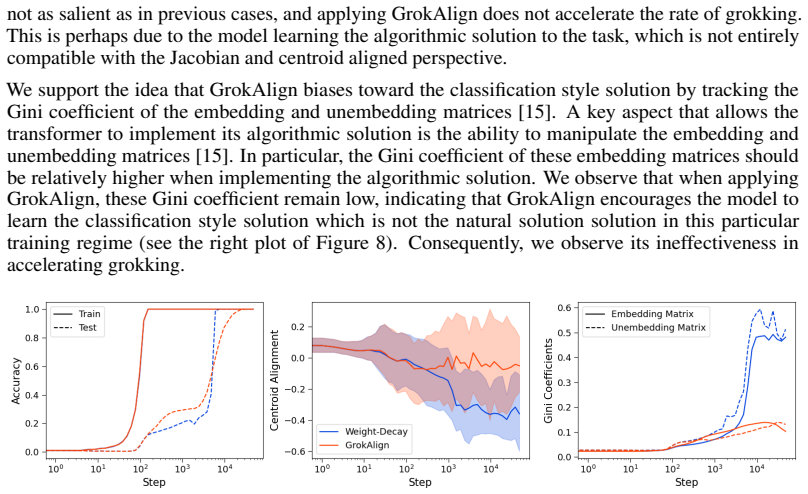
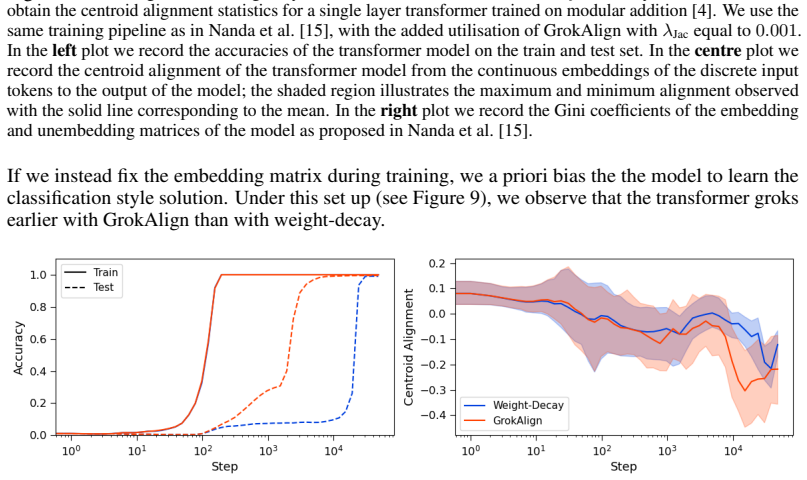
- By maintaining Jacobian norms at a high level, GrokAlign can inhibit grokking, and on modular addition it biases a transformer toward a classification-style solution rather than the algorithm it would otherwise implement.
- Compared with a gradient-amplification baseline and adversarial training, GrokAlign is the only tested method that both accelerates grokking and aligns the Jacobian, closing the gap between speed and robustness.
Reading between the lines
- Editorial inference: grokking onset should be predictable from the centroid geometry of early training; scaling the output to shrink centroid norms while keeping the neural tangent kernel dynamic may accelerate grokking without explicit regularization.
- Editorial inference: the centroid/NTK identity supplies a scalable diagnostic for feature learning, since centroids cost one Jacobian-vector product and can be monitored in architectures where full Jacobians are too expensive.
- Editorial inference: if Jacobian alignment is the cause, then explicit low-rank parameterizations combined with GrokAlign should reduce or remove the generalization lag; this is a direct test of the rank-bias premise.
- Editorial inference: the transformer experiment suggests the alignment account fits classification-style grokking better than algorithmic grokking; tasks that admit both solution types should show intermediate dynamics and could arbitrate between the two mechanisms.
Editorial analysis
A structured set of objections, weighed in public.
Referee Report
Summary. The paper proposes that grokking — delayed generalization and delayed robustness in deep networks — is caused by the alignment of the network's Jacobian matrices with the training data. It introduces GrokAlign, a Jacobian-norm regularizer, and centroid alignment, a cheaper proxy based on the sum of Jacobian rows. The theoretical core is Theorem 2, which states that a continuous piecewise affine network minimizing cross-entropy or MSE under a Frobenius-norm constraint on the Jacobian at training points is Jacobian-aligned, and Theorem 3, which states that among rank-one Jacobians the aligned one is optimally robust to ℓ2 perturbations. The paper then argues that because training dynamics bias Jacobians toward low rank, Jacobian alignment is the cause of grokking. Empirically, GrokAlign accelerates grokking on an MNIST setup, induces robustness on CIFAR-10, and can inhibit grokking by keeping Jacobian norms high; centroid alignment is shown to track feature learning and robustness onset. A transformer experiment on modular addition, however, shows that GrokAlign does not accelerate grokking in that setting.
Significance. If the central claim were established, the paper would unify delayed generalization and delayed robustness under a single geometric mechanism and provide a practical, interpretable regularizer for accelerating grokking. The paper has genuine strengths: it ships code and a companion webpage, proposes a tractable monitoring metric (centroid alignment) with an explicit connection to the neural tangent kernel, and reports large speedups on a standard MNIST grokking benchmark (Table 1). The KKT derivation in Appendix E is a coherent characterization of a constrained optimum. However, the causal claim in Section 5 is substantially stronger than what the theory and experiments support. The main gap is the bridge from static constrained optima to training dynamics, which rests on an explicitly acknowledged but unproven low-rank bias assumption. In addition, the paper's own transformer experiment contradicts the universal version of the causal claim. These issues are fixable by reframing the contribution as a sufficient-condition characterization for classification-style tasks under an explicit low-rank hypothesis, but they are load-bearing for the paper's main conclusion.
major comments (4)
- [Section 4.3 / Figure 8] The transformer experiment on modular addition is an internal disconfirmation of the universal causal claim. Section 5 states that 'Jacobian alignment is the cause for grokking,' which implies that enforcing alignment should accelerate grokking wherever grokking occurs. Yet Figure 8 shows that applying GrokAlign does not accelerate grokking on a canonical benchmark, and the authors attribute this to the model learning an algorithmic solution that is 'not entirely compatible with the Jacobian and centroid aligned perspective.' The paper should either restrict the causal claim to classification-style tasks, or provide a mechanism explaining why algorithmic grokking is outside the scope. As written, the central claim is contradicted by the paper's own evidence.
- [Section 2 / Limitations] The bridge from Theorems 2 and 3 to training dynamics is an unproven assumption. Theorem 2 characterizes the minimizer of a loss under an explicit Jacobian-norm constraint, and Theorem 3 characterizes robustness among rank-one Jacobians; neither theorem describes the training trajectory. The paper's conclusion that 'the cause of grokking is the alignment of the deep network's Jacobian matrices' depends on the claim that 'deep network training dynamics bias toward low rank weight matrices... and thus low rank Jacobians.' This is acknowledged in the Limitations as a dependency of 'some of our reasoning.' Because the low-rank bias is the only link between the static theorems and actual training, the causal conclusion does not follow without it. The paper should state the low-rank bias as an explicit conditional hypothesis and present the results as a sufficient-condition characterization rather than a cause.
- [Appendix E, Theorem 2] The proof of Theorem 2 solves for a specific ansatz (rows equal to a x_p for the correct class and b x_p for incorrect classes) under an equality constraint on the Jacobian norm. The theorem statement asserts that a network minimizing the loss under the constraints 'is Jacobian-aligned,' but the proof does not establish uniqueness or that every global minimizer has this form. It also assumes zero bias, which is stated but not reflected in the theorem's main text (B_{ω_{x_p}} = 0 appears only in the proof context). The statement should be qualified as 'there exists a minimizer of this form' unless global optimality and uniqueness are proven, and the zero-bias assumption should be explicit in the theorem statement in the main text.
- [Section 4.3 / Table 1] The empirical evidence for accelerating grokking is limited to a single MNIST setup, and the cross-entropy baseline row reports no absolute steps or time, only the placeholder '–', which makes the 7.56× speedup difficult to verify against the raw data. Given that Figure 8 shows no acceleration on modular addition, the paper's 'Accelerating Grokking' claim should be qualified as applying to the studied classification-style settings, and the authors should provide the underlying baseline numbers or a pointer to the code artifact for direct reproduction.
minor comments (6)
- [Section 2] There is a typo in 'the the cause of grokking' in the contributions paragraph; also 'the the' appears in Section 4.3 ('the natural solution solution').
- [Appendix E] The word 'Lagrange' is misspelled as 'Langrange' twice in the proof of Theorem 2.
- [Theorem 2] The constraint bound α is used in the theorem and proof but is not defined in the main text; please define α as the allowed Frobenius-norm bound before the theorem statement.
- [Appendix E, MSE proof] In the mean-squared-error proof, the vector e_i is introduced as a standard basis vector of R^d, but the output space is R^C; this notation should be corrected (e_{y_p} ∈ R^C).
- [Figure 7] The constrained case uses a target Jacobian norm of 5.0; the choice of this value and its sensitivity should be reported, as it is a free parameter of the experiment.
- [References] Reference [31] contains a typo: 'Meural Information Processing Systems' should be 'Neural Information Processing Systems.'
Circularity Check
No significant circularity: the core derivations are self-contained; the causal 'cause' claim overreaches but does not reduce to its inputs by construction.
full rationale
The paper's central theoretical chain is not circular. Theorem 2 solves a constrained convex optimization problem via KKT conditions and identifies the minimizer's Jacobian form; Theorem 3 is an independent Cauchy-Schwarz robustness bound; Theorem 9 is an analytical neural-tangent-kernel/centroid identity. GrokAlign is the direct enforcement of Theorem 2's norm constraint, so observing alignment under GrokAlign is a consequence of the theorem, not a fitted parameter renamed as a prediction, and the reported acceleration (Table 1) and monitoring claims are empirical and falsifiable. The main caveat is the Section 5 causal statement ('Jacobian alignment is the cause for grokking'): it relies on the low-rank-bias assumption, which the Limitations section explicitly acknowledges, and Figure 8 shows GrokAlign does not accelerate the modular-addition transformer, an internal disconfirmation of the universal causal claim. Those are evidentiary and scope problems, not circular reductions: no equation or fitted quantity is equivalent to its input by construction. Self-citations ([3], [7]) supply background geometry and region-migration interpretation but are not load-bearing for the core derivation.
Assumptions & free parameters
free parameters (2)
- lambda_Jac (GrokAlign regularization weight) =
0.001, 0.0001, 1.0 depending on experiment
- Target Jacobian norm 5.0 in the constrained case of Figure 7 =
5.0
assumptions (4)
- domain assumption Deep network training dynamics bias Jacobians toward low rank
- domain assumption Zero bias in the network (B = 0)
- standard math Continuous piecewise affine network representation
- standard math Convexity of the constrained loss and sufficiency of KKT conditions
Cite this review
Pith. "Pith review of GrokAlign: Geometric Characterisation and Acceleration of Grokking." pith.science (2026). https://pith.science/paper/Z5APCI36
@misc{pith2026250612284,
  author       = {Pith},
  title        = {Pith review of: GrokAlign: Geometric Characterisation and Acceleration of Grokking},
  year         = {2026},
  howpublished = {\url{https://pith.science/paper/Z5APCI36}},
  note         = {Machine review of arXiv:2506.12284}
}
read the original abstract
A key challenge for the machine learning community is to understand and accelerate the training dynamics of deep networks that lead to delayed generalisation and emergent robustness to input perturbations, also known as grokking. Prior work has associated phenomena like delayed generalisation with the transition of a deep network from a linear to a feature learning regime, and emergent robustness with changes to the network's functional geometry, in particular the arrangement of the so-called linear regions in deep networks employing continuous piecewise affine nonlinearities. Here, we explain how grokking is realised in the Jacobian of a deep network and demonstrate that aligning a network's Jacobians with the training data (in the sense of cosine similarity) ensures grokking under a low-rank Jacobian assumption. Our results provide a strong theoretical motivation for the use of Jacobian regularisation in optimizing deep networks -- a method we introduce as GrokAlign -- which we show empirically to induce grokking much sooner than more conventional regularizers like weight decay. Moreover, we introduce centroid alignment as a tractable and interpretable simplification of Jacobian alignment that effectively identifies and tracks the stages of deep network training dynamics. Accompanying webpage (https://thomaswalker1.github.io/blog/grokalign.html) and code (https://github.com/ThomasWalker1/grokalign).
Figures


Figures from the paper (8 more)




Reference graph
Works this paper leans on
-
[1]
Lecun, L
Y . Lecun, L. Bottou, Y . Bengio, and P. Haffner. Gradient-based learning applied to document recognition. Proceedings of the IEEE, 86(11):2278–2324, 1998
1998
-
[2]
SplineCam: Exact Visualization and Characterization of Deep Network Geometry and Decision Boundaries
Ahmed Imtiaz Humayun, Randall Balestriero, Guha Balakrishnan, and Richard Baraniuk. SplineCam: Exact Visualization and Characterization of Deep Network Geometry and Decision Boundaries. In Proceedings of the IEEE/CVF Conference on Computer Vision and Pattern Recognition, June 2023
work page 2023
-
[3]
Randall Balestriero, Romain Cosentino, B. Aazhang, and Richard Baraniuk. The Geometry of Deep Networks: Power Diagram Subdivision. In Neural Information Processing Systems, May 2019
work page 2019
-
[4]
Grokking: Gen- eralization Beyond Overfitting on Small Algorithmic Datasets, January 2022
Alethea Power, Yuri Burda, Harri Edwards, Igor Babuschkin, and Vedant Misra. Grokking: Gen- eralization Beyond Overfitting on Small Algorithmic Datasets, January 2022. arXiv:2201.02177
arXiv 2022
-
[5]
Loss landscape geometry reveals stagewise development of transformers
George Wang, Matthew Farrugia-Roberts, Jesse Hoogland, Liam Carroll, Susan Wei, and Daniel Murfet. Loss landscape geometry reveals stagewise development of transformers. In High-dimensional Learning Dynamics 2024: The Emergence of Structure and Reasoning, June 2024
work page 2024
-
[6]
Ziming Liu, Eric J. Michaud, and Max Tegmark. Omnigrok: Grokking Beyond Algorithmic Data. In The Eleventh International Conference on Learning Representations, September 2022
work page 2022
-
[7]
Deep Networks Always Grok and Here is Why
Ahmed Imtiaz Humayun, Randall Balestriero, and Richard Baraniuk. Deep Networks Always Grok and Here is Why. In High-dimensional Learning Dynamics 2024: The Emergence of Structure and Reasoning, June 2024
work page 2024
-
[8]
Robustness may be at odds with accuracy
Dimitris Tsipras, Shibani Santurkar, Logan Engstrom, Alexander Turner, and Aleksander Madry. Robustness may be at odds with accuracy. In International Conference on Learning Representations, 2019
work page 2019
Show all 44 references
-
[9]
Theoretically Principled Trade-off between Robustness and Accuracy
Hongyang Zhang, Yaodong Yu, Jiantao Jiao, Eric Xing, Laurent El Ghaoui, and Michael Jordan. Theoretically Principled Trade-off between Robustness and Accuracy. In Proceedings of the 36th International Conference on Machine Learning, May 2019
2019
-
[10]
Lee, and Wei Hu
Kaifeng Lyu, Jikai Jin, Zhiyuan Li, Simon Shaolei Du, Jason D. Lee, and Wei Hu. Dichotomy of Early and Late Phase Implicit Biases Can Provably Induce Grokking. In The Twelfth International Conference on Learning Representations, January 2024
2024
-
[11]
Grokking as a First Order Phase Transition in Two Layer Networks
Noa Rubin, Inbar Seroussi, and Zohar Ringel. Grokking as a First Order Phase Transition in Two Layer Networks. In The Twelfth International Conference on Learning Representations, January 2024
2024
-
[12]
Gershman, and Cengiz Pehlevan
Tanishq Kumar, Blake Bordelon, Samuel J. Gershman, and Cengiz Pehlevan. Grokking as the transition from lazy to rich training dynamics. In The Twelfth International Conference on Learning Representations, January 2024
2024
-
[13]
Neural tangent kernel: convergence and generalization in neural networks
Arthur Jacot, Franck Gabriel, and Clément Hongler. Neural tangent kernel: convergence and generalization in neural networks. In Proceedings of the 32nd International Conference on Neural Information Processing Systems, 2018
2018
-
[14]
Separation of scales and a thermodynamic description of feature learning in some CNNs
Inbar Seroussi, Gadi Naveh, and Zohar Ringel. Separation of scales and a thermodynamic description of feature learning in some CNNs. Nature Communications, 14(1):908, February 2023
2023
-
[15]
Progress measures for grokking via mechanistic interpretability
Neel Nanda, Lawrence Chan, Tom Lieberum, Jess Smith, and Jacob Steinhardt. Progress measures for grokking via mechanistic interpretability. InThe Eleventh International Conference on Learning Representations, September 2022
2022
-
[16]
Explaining grokking through circuit efficiency, September 2023
Vikrant Varma, Rohin Shah, Zachary Kenton, János Kramár, and Ramana Kumar. Explaining grokking through circuit efficiency, September 2023. arXiv:2309.02390. 12
2023 arXiv
-
[17]
Contractive auto- encoders: explicit invariance during feature extraction
Salah Rifai, Pascal Vincent, Xavier Muller, Xavier Glorot, and Yoshua Bengio. Contractive auto- encoders: explicit invariance during feature extraction. In Proceedings of the 28th International Conference on Machine Learning, 2011
2011
-
[18]
Improving DNN Robustness to Adversarial Attacks Using Jacobian Regularization
Daniel Jakubovitz and Raja Giryes. Improving DNN Robustness to Adversarial Attacks Using Jacobian Regularization. In ECCV, September 2018
2018
-
[19]
Roberts, and Sho Yaida
Judy Hoffman, Daniel A. Roberts, and Sho Yaida. Robust Learning with Jacobian Regularization, August 2019. arXiv:1908.02729
2019 arXiv
-
[20]
On the Connection Between Adversarial Robustness and Saliency Map Interpretability
Christian Etmann, Sebastian Lunz, Peter Maass, and Carola Schoenlieb. On the Connection Between Adversarial Robustness and Saliency Map Interpretability. In Proceedings of the 36th International Conference on Machine Learning, May 2019
2019
-
[21]
Jacobian adversarially regularized networks for robustness
Alvin Chan, Yi Tay, Yew Soon Ong, and Jie Fu. Jacobian adversarially regularized networks for robustness. In International Conference on Learning Representations, 2020
2020
-
[22]
Training invariances and the low-rank phenomenon: beyond linear networks
Thien Le and Stefanie Jegelka. Training invariances and the low-rank phenomenon: beyond linear networks. In International Conference on Learning Representations, 2022
2022
-
[23]
The low-rank simplicity bias in deep networks
Minyoung Huh, Hossein Mobahi, Richard Zhang, Brian Cheung, Pulkit Agrawal, and Phillip Isola. The low-rank simplicity bias in deep networks. Transactions on Machine Learning Research, 2023
2023
-
[24]
Implicit Regularization Towards Rank Minimization in ReLU Networks
Nadav Timor, Gal Vardi, and Ohad Shamir. Implicit Regularization Towards Rank Minimization in ReLU Networks. In Proceedings of The 34th International Conference on Algorithmic Learning Theory, February 2023
2023
-
[25]
Rank minimization, alignment and weight decay in neural networks
David Yunis, Kumar Kshitij Patel, Samuel Wheeler, Pedro Henrique Pamplona Savarese, Gal Vardi, Jonathan Frankle, Karen Livescu, Michael Maire, and Matthew Walter. Rank minimization, alignment and weight decay in neural networks. In High-dimensional learning dynamics 2024: The ...
2024
-
[26]
Siegel, Aparna Gupte, and Tomaso A
Tomer Galanti, Zachary S. Siegel, Aparna Gupte, and Tomaso A. Poggio. SGD with Weight Decay Secretly Minimizes the Ranks of Your Neural Networks. In The Second Conference on Parsimony and Learning (Proceedings Track), March 2025
2025
-
[27]
Fast Jacobian-Vector Product for Deep Networks, April 2021
Randall Balestriero and Richard Baraniuk. Fast Jacobian-Vector Product for Deep Networks, April 2021. arXiv:2104.00219
2021 arXiv
-
[28]
A Spline Theory of Deep Learning
Randall Balestriero and Richard Baraniuk. A Spline Theory of Deep Learning. In Proceedings of the 35th International Conference on Machine Learning. PMLR, July 2018
2018
-
[29]
Decoupled weight decay regularization
Ilya Loshchilov and Frank Hutter. Decoupled weight decay regularization. In International Conference on Learning Representations, 2019
2019
-
[30]
Gu and Luca Rigazio
S. Gu and Luca Rigazio. Towards Deep Neural Network Architectures Robust to Adversarial Examples. CoRR, December 2014
2014
-
[31]
A closer look at accuracy vs
Yao-Yuan Yang, Cyrus Rashtchian, Hongyang Zhang, Ruslan Salakhutdinov, and Kamalika Chaudhuri. A closer look at accuracy vs. robustness. In Proceedings of the 34th International Conference on Meural Information Processing Systems, 2020
2020
-
[32]
Grokfast: Accelerated Grokking by Amplifying Slow Gradients, June 2024
Jaerin Lee, Bong Gyun Kang, Kihoon Kim, and Kyoung Mu Lee. Grokfast: Accelerated Grokking by Amplifying Slow Gradients, June 2024. arXiv:2405.20233
2024 arXiv
-
[33]
On Lazy Training in Differentiable Programming
Lénaïc Chizat, Edouard Oyallon, and Francis Bach. On Lazy Training in Differentiable Programming. In Advances in Neural Information Processing Systems, 2019
2019
-
[34]
Lee, Edward Moroshko, Pedro Savarese, Itay Golan, Daniel Soudry, and Nathan Srebro
Blake Woodworth, Suriya Gunasekar, Jason D. Lee, Edward Moroshko, Pedro Savarese, Itay Golan, Daniel Soudry, and Nathan Srebro. Kernel and rich regimes in overparametrized models. In Proceedings of Thirty Third Conference on Learning Theory, July 2020. 13
2020
-
[35]
Lee, Nathan Srebro, and Daniel Soudry
Edward Moroshko, Blake Woodworth, Suriya Gunasekar, Jason D. Lee, Nathan Srebro, and Daniel Soudry. Implicit bias in deep linear classification: Initialization scale vs training accuracy. Advances in Neural Information Processing Systems, 2020
2020
-
[36]
Let me grok for you: Accelerating grokking via embedding transfer from a weaker model
Zhiwei Xu, Zhiyu Ni, Yixin Wang, and Wei Hu. Let me grok for you: Accelerating grokking via embedding transfer from a weaker model. In The Thirteenth International Conference on Learning Representations, 2025
2025
-
[37]
Learning multiple layers of features from tiny images
Alex Krizhevsky and Geoffrey Hinton. Learning multiple layers of features from tiny images. Technical report, Technical report, University of Toronto / University of Toronto, Toronto, Ontario, 2009
2009
-
[38]
Reliable evaluation of adversarial robustness with an ensemble of diverse parameter-free attacks
Francesco Croce and Matthias Hein. Reliable evaluation of adversarial robustness with an ensemble of diverse parameter-free attacks. In Proceedings of the 37th International Conference on Machine Learning, 2020
2020
-
[39]
Understanding Grokking Through A Robustness Viewpoint, February 2024
Zhiquan Tan and Weiran Huang. Understanding Grokking Through A Robustness Viewpoint, February 2024. arXiv:2311.06597
2024 arXiv
-
[40]
Attention is All you Need
Ashish Vaswani, Noam Shazeer, Niki Parmar, Jakob Uszkoreit, Llion Jones, Aidan N Gomez, Lukasz Kaiser, and Illia Polosukhin. Attention is All you Need. In Advances in Neural Information Processing Systems, 2017
2017
-
[41]
Wide Neural Networks of Any Depth Evolve as Linear Models Under Gradient Descent
Jaehoon Lee, Lechao Xiao, Samuel Schoenholz, Yasaman Bahri, Roman Novak, Jascha Sohl- Dickstein, and Jeffrey Pennington. Wide Neural Networks of Any Depth Evolve as Linear Models Under Gradient Descent. In Advances in Neural Information Processing Systems, 2019
2019
-
[42]
Disentangling feature and lazy training in deep neural networks
Mario Geiger, Stefano Spigler, Arthur Jacot, and Matthieu Wyart. Disentangling feature and lazy training in deep neural networks. Journal of Statistical Mechanics: Theory and Experiment, November 2020. 14 A Centroid Dynamics of Vector-Output Deep Networks Consider the case of ...
2020
-
[43]
Under the assumptions, the output of the neural network at xp is Aωxp xp
In the instance of the cross-entropy loss function, ℓp := ℓ (f (xp) , yp) = − log exp [f (xp)]yp PC c=1 exp [f (xp)]c . Under the assumptions, the output of the neural network at xp is Aωxp xp. The cross entropy loss of the deep network on D is LCE = 1 m mX p=1 ℓp 17 w...
-
[44]
Under the assumptions, the output of the deep network at xp is Aωxp xp
In the instance of the mean-squared error, ℓp := ℓ (f (xp) , yp) = f (xp) − eyp 2 2 , where we use ei ∈ Rd to denote the ith standard basis vector. Under the assumptions, the output of the deep network at xp is Aωxp xp. The mean squared error loss of the deep network on D is L...
Reviewed August 7, 2026 · model on record in the stance chip above.
Discussion (0). Continue with ORCID to comment.