Embedding Linear Equality Constraints in Probabilistic Neural Networks for Dynamic Modelling
Pith reviewed 2026-06-26 14:26 UTC · model grok-4.3
The pith
A probabilistic neural network framework can enforce linear equality constraints like mass balances within a tolerance while capturing aleatoric uncertainty in dynamic chemical process models.
A machine-rendered reading of the paper's core claim, the machinery that carries it, and where it could break.
Core claim
The central claim is that embedding linear equality constraints into a probabilistic neural network allows the model to guarantee satisfaction of those constraints within a given tolerance while still representing aleatoric uncertainty, yielding improved accuracy, better-calibrated uncertainty estimates, and stronger constraint adherence on reduced datasets together with competitive performance and faster training on large datasets.
What carries the argument
The probabilistic neural network framework that embeds linear equality constraints (such as mass balances) to enforce them within tolerance while modeling aleatoric uncertainty.
If this is right
- Dynamic models of chemical processes can be trained reliably on smaller datasets without post-hoc correction for constraint violations.
- Training time reductions on large datasets enable faster iteration when scaling models to industrial process data.
- Uncertainty estimates become more trustworthy because constraint violations no longer contaminate the predictive distribution.
- The same embedding technique can be applied to other linear equality constraints beyond mass balances in reactor systems.
Where Pith is reading between the lines
- The approach may reduce the engineering effort needed to retrofit constraint satisfaction into existing neural-network pipelines for process control.
- It could support online model adaptation in settings where new measurements arrive continuously but physical laws must still hold.
- Extending the tolerance parameter might allow explicit trade-offs between strict physical fidelity and flexibility to fit noisy observations.
Load-bearing premise
The method can guarantee that linear equality constraints remain satisfied within the stated tolerance even as the network learns to represent uncertainty from the data.
What would settle it
A hold-out test set from a batch reactor where the model's predicted concentrations violate the mass-balance equations by more than the allowed tolerance on a majority of samples.
Figures
read the original abstract
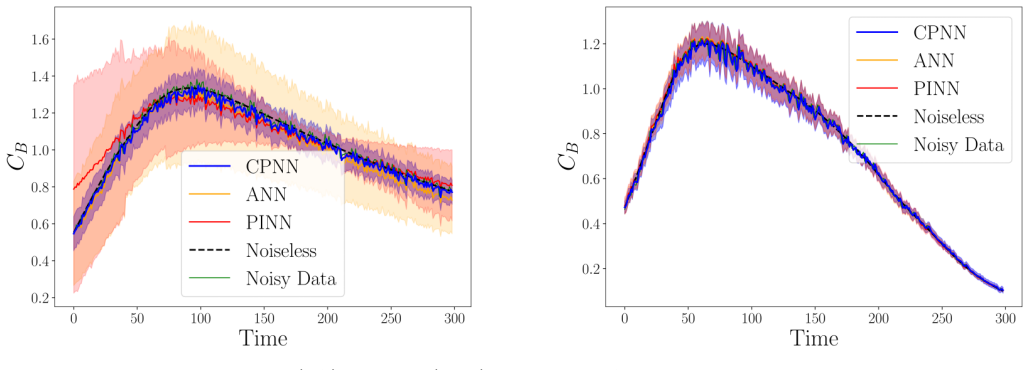
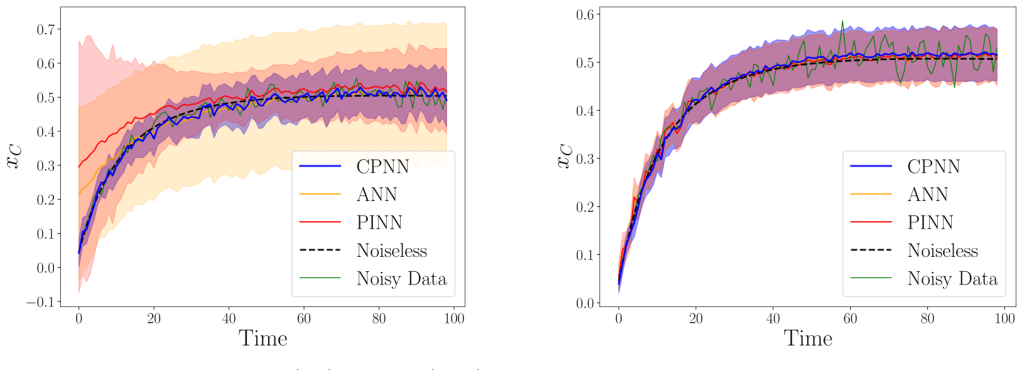
Machine learning models are increasingly used to model chemical process systems, yet they often lack principled uncertainty quantification and mechanisms to enforce physical constraints. We propose a probabilistic neural network framework that guarantees satisfaction of linear equality constraints within a given tolerance, while capturing aleatoric uncertainty. Compared to state-of-the-art methods, our formulation demonstrates improved predictive accuracy, uncertainty calibration, and adherence to constraints on reduced data. It also demonstrates competitive performance, but with significantly faster training times when evaluated on large data regimes. We evaluated this on two batch reactor case studies, enforcing mass balances.
Editorial analysis
A structured set of objections, weighed in public.
Referee Report
Summary. The paper proposes a probabilistic neural network framework that embeds linear equality constraints (e.g., mass balances) to guarantee satisfaction within a tolerance while capturing aleatoric uncertainty. It is evaluated on two batch reactor case studies and claims improved predictive accuracy, uncertainty calibration, and constraint adherence on reduced data, plus competitive performance with significantly faster training on large data regimes compared to state-of-the-art methods.
Significance. If the guarantees and empirical gains hold, the work could be significant for chemical process modeling, where enforcing physical constraints in probabilistic dynamic models is valuable, especially in data-scarce regimes.
major comments (1)
- [Method and Experiments sections (constraint embedding and rollout evaluation)] The central claim requires constraint satisfaction during dynamic modelling. The enforcement mechanism (projection or reparameterization on per-step means) is described, but the manuscript does not demonstrate that accumulated integration error and variance propagation keep violations within tolerance over multi-step rollouts in the batch reactor simulations. This is load-bearing for the dynamic-modelling results and the reduced-data adherence claim.
minor comments (1)
- [Abstract] The abstract states 'within a given tolerance' without specifying the numerical value or selection procedure; this detail should appear in the main text with the relevant equation or algorithm.
Simulated Author's Rebuttal
We thank the referee for the constructive feedback. We address the major comment below and will revise the manuscript to strengthen the dynamic modeling claims.
read point-by-point responses
-
Referee: [Method and Experiments sections (constraint embedding and rollout evaluation)] The central claim requires constraint satisfaction during dynamic modelling. The enforcement mechanism (projection or reparameterization on per-step means) is described, but the manuscript does not demonstrate that accumulated integration error and variance propagation keep violations within tolerance over multi-step rollouts in the batch reactor simulations. This is load-bearing for the dynamic-modelling results and the reduced-data adherence claim.
Authors: We agree that explicit verification of constraint adherence over multi-step rollouts is essential to support the central claims. The current manuscript focuses on per-step enforcement but does not include rollout-specific analysis of accumulated errors. In the revised version we will add a dedicated subsection (with plots and tables) quantifying constraint violation norms over the full rollout horizon for both batch reactor case studies, under full-data and reduced-data regimes. This will directly address integration error and variance propagation. revision: yes
Circularity Check
No significant circularity; derivation self-contained via architecture and empirical validation
full rationale
The paper proposes a probabilistic neural network architecture to embed linear equality constraints while modeling aleatoric uncertainty, evaluated empirically on batch reactor case studies for predictive accuracy, calibration, and constraint adherence. No load-bearing step reduces by construction to its inputs: the constraint enforcement mechanism (via projection or reparameterization) is an explicit architectural choice independent of the target metrics, and performance claims rest on comparisons to baselines rather than self-referential fitting or self-citation chains. The central claim of improved adherence on reduced data is falsifiable via the reported experiments and does not rely on renaming known results or smuggling ansatzes through citations. This is the common case of an independent modeling contribution.
Axiom & Free-Parameter Ledger
Reference graph
Works this paper leans on
-
[1]
Proceedings of the 25th
Optuna: A Next-generation Hyperparameter Optimization Framework , author=. Proceedings of the 25th
-
[2]
2019 , optpublisher =
Paszke, Adam and Gross, Sam and Massa, Francisco and Lerer, Adam and Bradbury, James and Chanan, Gregory and Killeen, Trevor and Lin, Zeming and Gimelshein, Natalia and Antiga, Luca and Desmaison, Alban and Kopf, Andreas and Yang, Edward and DeVito, Zachary and Raison, Martin and Tejani, Alykhan and Chilamkurthy, Sasank and Steiner, Benoit and Fang, Lu an...
2019
-
[3]
Learning with Embedded Linear Equality Constraints via Variational Bayesian Inference
Marsh, Matthew and Chachuat, Beno. Learning with. doi:10.48550/ARXIV.2604.24911 , urldate =
work page internal anchor Pith review Pith/arXiv arXiv doi:10.48550/arxiv.2604.24911
-
[4]
Zico , year = 2019, month = dec, number =
Agrawal, Akshay and Amos, Brandon and Barratt, Shane and Boyd, Stephen and Diamond, Steven and Kolter, J. Zico , year = 2019, month = dec, number =. Differentiable Convex Optimization Layers , booktitle =
2019
-
[5]
Comparative
Ahmed, Akhil and. Comparative. Industrial & Engineering Chemistry Research , volume =
-
[6]
arXiv , keywords =:2211.01340 , primaryclass =
Balestriero, Randall and LeCun, Yann , year = 2023, month = mar, note =. arXiv , keywords =:2211.01340 , primaryclass =
arXiv 2023
-
[7]
Computers & Chemical Engineering , volume =
Physics-Informed Neural Networks with Hard Linear Equality Constraints , author =. Computers & Chemical Engineering , volume =
-
[8]
and Rolnick, David and Kolter, J
Donti, Priya L. and Rolnick, David and Kolter, J. Zico , year = 2021, month = apr, note =. arXiv , keywords =:2104.12225 , primaryclass =
arXiv 2021
-
[9]
Gawlikowski, Jakob and Tassi, Cedrique Rovile Njieutcheu and Ali, Mohsin and Lee, Jongseok and Humt, Matthias and Feng, Jianxiang and Kruspe, Anna and Triebel, Rudolph and Jung, Peter and Roscher, Ribana and Shahzad, Muhammad and Yang, Wen and Bamler, Richard and Zhu, Xiao Xiang , year = 2022, month = jan, note =. A. arXiv , keywords =:2107.03342 , primaryclass =
arXiv 2022
-
[10]
Gonzalez, Camilo and Asadi, Houshyar and Kooijman, Lars and Lim, Chee Peng , year = 2024, month = dec, note =. Neural. arXiv , keywords =:2309.02668 , primaryclass =
arXiv 2024
-
[11]
and Alizadeh, Shima and Gupta, Gaurav and Mahoney, Michael W
Hansen, Derek and Maddix, Danielle C. and Alizadeh, Shima and Gupta, Gaurav and Mahoney, Michael W. , year = 2023, month = jul, pages =. Learning. Proceedings of the 40th
2023
-
[12]
Iftakher, Ashfaq and Golder, Rahul and Hasan, M. M. Faruque , year = 2025, month = jul, note =. Physics-. arXiv , keywords =:2507.08124 , primaryclass =
arXiv 2025
-
[13]
Effective
Immer, Alexander and Palumbo, Emanuele and Marx, Alexander and Vogt, Julia , year = 2023, month = dec, journal =. Effective
2023
-
[14]
, year = 2025, month = feb, note =
Lastrucci, Giacomo and Schweidtmann, Artur M. , year = 2025, month = feb, note =. arXiv , keywords =:2502.06774 , primaryclass =
Pith/arXiv arXiv 2025
-
[15]
and Damarla, Seshu Kumar and Kim, Jong Woo and Tulsyan, Aditya and Amjad, Faraz and Wang, Kai and Chachuat, Benoit and Lee, Jong Min and Huang, Biao and Bhushan Gopaluni, R
Lawrence, Nathan P. and Damarla, Seshu Kumar and Kim, Jong Woo and Tulsyan, Aditya and Amjad, Faraz and Wang, Kai and Chachuat, Benoit and Lee, Jong Min and Huang, Biao and Bhushan Gopaluni, R. , year = 2024, month = apr, journal =. Machine Learning for Industrial Sensing and Control:
2024
-
[16]
and Perdikaris, P
Raissi, M. and Perdikaris, P. and Karniadakis, G. E. , year = 2019, month = feb, journal =. Physics-Informed Neural Networks:
2019
-
[17]
, year = 2023, month = may, note =
Runje, Davor and Shankaranarayana, Sharath M. , year = 2023, month = may, note =. Constrained. arXiv , keywords =:2205.11775 , primaryclass =
arXiv 2023
-
[18]
Seitzer, Maximilian and Tavakoli, Arash and Antic, Dimitrije and Martius, Georg , year = 2022, month = apr, note =. On the. arXiv , keywords =:2203.09168 , primaryclass =
arXiv 2022
-
[19]
and Hutter, Marco , year = 2023, month = jul, note =
Tordesillas, Jesus and How, Jonathan P. and Hutter, Marco , year = 2023, month = jul, note =. arXiv , keywords =:2307.08336 , primaryclass =
Pith/arXiv arXiv 2023
-
[20]
and Ma, Ruijun and Mahoney, Michael W
Utkarsh, Utkarsh and Maddix, Danielle C. and Ma, Ruijun and Mahoney, Michael W. and Wang, Yuyang , year = 2025, month = jun, note =. End-to-. arXiv , keywords =:2506.07003 , primaryclass =
arXiv 2025
-
[21]
Computer Aided Chemical Engineering , author =
On the. Computer Aided Chemical Engineering , author =
discussion (0)
Sign in with ORCID, Apple, or X to comment. Anyone can read and Pith papers without signing in.