REVIEW 2 major objections 5 minor 13 references
Nonlinear optics in 2D materials: from classical to quantum
T0 review · 2 major / 5 minor · reviewed 2026-08-12 · deepseek-v4-flash
Pith's one-line read 2D materials can power nonlinear optics, from lasers to quantum light
desk verdict A comprehensive, up-to-date review of 2D nonlinear optics that is honest about current efficiency limits but overreaches slightly in its 'transformative' framing. read the letter →
The pith
A machine-rendered reading of the paper's core claim, the machinery that carries it, and where it could break.
The reading
What carries the argument
The central object is the nonlinear susceptibility tensor $\chi^{(n)}$, carried through the paper by three 2D-specific levers: symmetry, resonance, and thickness. Each stacking order or twist angle fixes which tensor components survive, enabling control of second-harmonic generation and polarization selection rules; excitonic and polaritonic states enhance the susceptibilities and provide gate-tunable response; and because the sample is far thinner than the coherence length, phase mismatch barely develops, so quasi-phase matching can be restored by flipping the nonlinear coefficient through 60-degree twists across layers. The review treats twist-stacked multilayers as the 2D analogue of periodically poled crystals, and treats cavity-embedded and moiré-confined excitons as the route to quantum nonlinearity.
What would settle it
Measure the second-harmonic or photon-pair conversion efficiency of a phase-pure 3R transition metal dichalcogenide multilayer grown by a CMOS-compatible process on a silicon substrate at telecom wavelengths; if the efficiency fails to grow with thickness even with periodic twist stacking, or if the coincidence-to-accidental ratio of the generated pairs remains orders of magnitude below what bulk periodically poled crystals achieve in an integrated geometry, then the central claim that these materials can replace bulk nonlinear crystals in real devices is contradicted.
Extended reading notes
Core claim
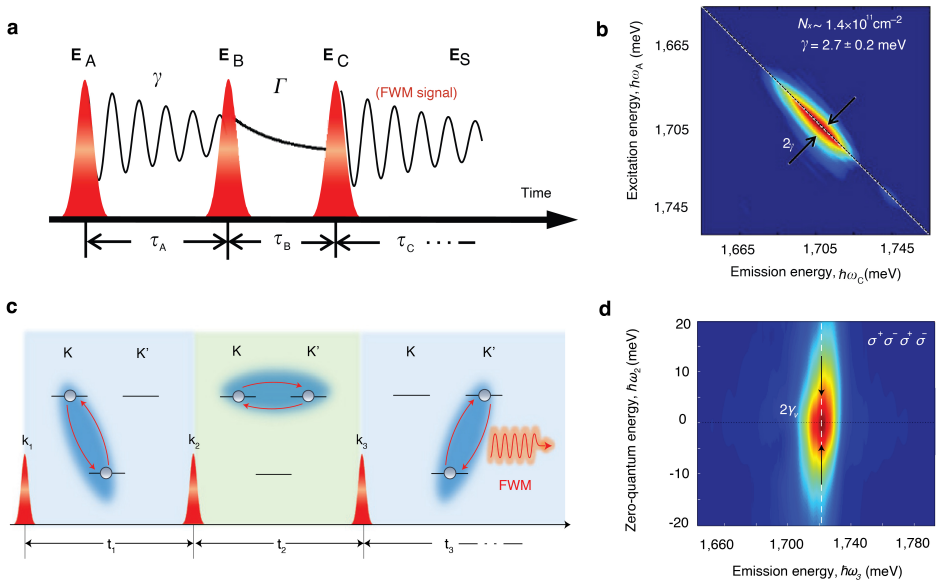
The central claim is that the same atomically thin materials can host the full range of nonlinear optical responses because three properties combine in one platform: controllable crystal symmetry (including twist-defined stacking), strong excitonic resonances with large oscillator strength, and a propagation length so short that chromatic dispersion cannot accumulate. The review documents how these properties enable symmetry-controlled second-harmonic generation, resonantly enhanced and electrically tunable nonlinearities, twist-engineered quasi-phase matching that mimics periodic poling, optical parametric amplification in monolayers, and photon-pair generation in 3R-stacked transition metal dichalcogenides. In the few-photon regime, it argues that exciton-exciton, exciton-polariton, and moiré-confined interactions can bring nonlinearity to the level where a single photon changes the optical response, opening the route to photon blockade and single-photon switches.
Load-bearing premise
The load-bearing premise is that high-quality, phase-pure 2D films and deterministic twisted heterostructures can be manufactured at scale on the substrates that real devices use, such as silicon; the paper itself flags this as an open challenge, and if direct growth on non-lattice-matched substrates remains impractical, the transformative device impact described will not materialize.
Editorial extensions
If this is right
- Symmetry control by stacking and twist angle becomes a practical design tool, letting second-harmonic intensity and polarization be set by growth or assembly rather than by choosing a new bulk crystal.
- Twist-based quasi-phase matching in 3R-stacked transition metal dichalcogenide multilayers can bring frequency-conversion efficiency into the range of conventional periodically poled crystals while the device stays 10–100 times thinner.
- Ultrathin 2D sources can generate polarization-entangled photon pairs in the telecom band, with a route to higher efficiency through longer propagation lengths and quasi-phase matching.
- Cavity-embedded and moiré-confined excitons can push exciton nonlinearities toward the single-photon level, potentially enabling photon blockade and single-photon switches.
- Electrically gated 2D materials offer in-situ tunable nonlinear susceptibilities, allowing dynamic control of frequency conversion and optical modulation in the same device.
Reading between the lines
- If the fabrication goals are met, the economic consequence would be a shift in nonlinear photonics from centimeter-scale crystals toward chip-scale layered stacks, because the same growth and transfer methods used in microelectronics integrate directly with photonic circuits.
- The twist-angle degree of freedom that provides quasi-phase matching also suggests a testable extension: automated search over twist sequences to optimize arbitrary nonlinear transfer functions, not just second-harmonic growth.
- Moiré-confined excitons with large interaction strengths could let photon blockade be observed at higher temperatures than in conventional quantum dots, since confinement is set by superlattice geometry rather than by etched nanostructure quality.
- The paper's emphasis on virtual-exciton interactions implies that pump-probe measurements of AC Stark shifts at low detuning could serve as a quantitative, non-invasive probe of exciton-exciton interaction strengths in a wide range of 2D heterostructures.
Signed reviews
Editorial analysis
A structured set of objections, weighed in public.
Referee Report
Summary. The paper is a broad review of nonlinear optics in two-dimensional materials, covering second- and third-order processes, high-harmonic generation, few-photon nonlinearities, and an outlook on devices and quantum technologies. It argues that 2D materials' symmetry control, excitonic resonances, relaxed phase matching in the few-layer limit, and integrability into photonic circuits give them transformative potential for next-generation classical and quantum photonics.
Significance. If its claims are appropriately calibrated, the review is a useful and timely synthesis of a fast-moving field. It compiles recent results (including 2024--2025 preprints), organizes them by nonlinear order and application, and offers a clear map of mechanisms such as twist-based quasi-phase matching and moir\'e-exciton nonlinearities. The quantitative efficiency comparisons, however, are the weakest link: the reported device-level results are orders of magnitude below conventional platforms, and the review's own Section 7 concedes major fabrication barriers. The paper is a candidate for acceptance after revision, provided the central 'transformative' claim is rebalanced against these acknowledged limitations.
major comments (2)
- [Abstract and Section 7] The central claim of the review---that 2D materials 'have the potential to transform the landscape of next-generation photonic and quantum technologies' (Abstract) and that the outlook is 'overwhelmingly positive' (Section 7)---is not supported by the quantitative results reported elsewhere in the same manuscript. Section 3.1.4 reports SHG efficiencies of ~10^-7 in MoS2 and ~10^-10 in on-resonance WSe2 under GW/cm^2 pumping, compared with a few percent for a 600-nm LiNbO3 film at similar pump intensity, and Section 3.1.7 reports an SPDC CAR of ~638 that the authors themselves describe as 'still low compared with that in conventional nonlinear crystals such as BBO or PPLN.' Section 7 then concedes that direct growth of phase-pure films on non-lattice-matched substrates in a CMOS-compatible process 'demands significant effort' and that current moir\'e/twisted heterostructure fabrication results in 'large variations.' In view of these numbers, the conclusion should be reframed as conditional on specific scaling milestones (e.g., wafer-scale, phase-pure quasi-phase-matched stacks), and the efficiency gap with conventional materials should be presented as an open challenge rather than implied to have been resolved.
- [Section 3.1.4] The claim that with quasi-phase matching 'a conversion frequency comparable to PPLN and BBO can be achieved in periodic polled 3R-MoS2' is ambiguous: it does not state whether the comparison is experimental or theoretical, nor which metric (SHG conversion efficiency, photon-pair generation rate, or brightness) is being compared. The later SPDC results in Section 3.1.7 (CAR ~638, 'still low compared with that in conventional nonlinear crystals such as BBO or PPLN') suggest that, at least for down-conversion, the performance is not yet comparable. Please specify the basis for the comparison, the experimental status (demonstrated vs. projected), and the conditions required (number of periods, phase purity, loss), so that readers can evaluate the claim rather than reading it as an established equivalence.
minor comments (5)
- [Table 1] Table 1 is difficult to use because the column entries are run together (e.g., the MoSe2 row lists '50 298 7800297 37298 810 775 780' with no clear separation between susceptibility, wavelength, and thickness). Please reformat the table with explicit column separators and consistent units.
- [Section 2.2] Section 2.2 contains the typo 'at such the back end-of-line (BEOL) processing stage'; it should read 'at the back-end-of-line.'
- [Section 4.1.1] The THG efficiency of monolayer MoS2 is reported twice in Section 4.1.1 with different references (ref 188 and ref 185); please merge the duplicated statement and cite the original measurement once.
- [References] Reference 246 is a self-archived arXiv preprint by the authors; since it is cited as an example of quantum-confined excitons, please indicate its status or replace it with a peer-reviewed source if one exists.
- [Sections 2.2, 3.1.4, and 7] Section 2.2 states that the atomic thickness 'inherently satisfies phase-matching conditions,' but Sections 3.1.4 and 7 explain that phase matching becomes critical once layers are stacked to enhance efficiency. Please add a sentence clarifying that relaxed phase matching applies in the few-layer limit and that thicker engineered stacks reintroduce phase-matching constraints.
Circularity Check
No significant circularity: this is a survey whose claims are supported by external experimental literature, and the few author self-citations are not load-bearing.
full rationale
This paper is a review, not a derivation. Its statements about 2D-material nonlinearities, phase matching, SPDC, and device prospects are all attributed to external experimental and theoretical reports. The only self-citations are refs. 50 and 246 (the authors' own work on Fermi-polaron nonlinearity and electrostatically confined excitons), and these are used as ordinary literature citations within topical discussions; the review's central conclusions do not depend on accepting those specific papers as the sole evidence. No fitted parameter is presented as a prediction, no quantity is defined in terms of the result it is supposed to establish, and no uniqueness or existence theorem from the authors' prior work is invoked to force a conclusion. The paper explicitly acknowledges outstanding fabrication and scalability challenges in Section 7, which further supports that its outlook claims are conditional rather than derived by construction from its own inputs. Under the stated rules, a self-contained review with no derivation chain that reduces to its inputs should receive score 0.
Assumptions & free parameters
assumptions (2)
- domain assumption The standard perturbative expansion of polarization in powers of the electric field (Eq. 1) remains valid for 2D materials, including at the few-photon level.
- domain assumption The published experimental results summarized in the review are correct and representative.
Cite this review
Pith. "Pith review of Nonlinear optics in 2D materials: from classical to quantum." pith.science (2026). https://pith.science/paper/Z6ACMZ5K
@misc{pith2026241112905,
  author       = {Pith},
  title        = {Pith review of: Nonlinear optics in 2D materials: from classical to quantum},
  year         = {2026},
  howpublished = {\url{https://pith.science/paper/Z6ACMZ5K}},
  note         = {Machine review of arXiv:2411.12905}
}
read the original abstract
Nonlinear optics has long been a cornerstone of modern photonic technology, enabling a wide array of applications, from frequency conversion to the generation of ultrafast light pulses. Recent breakthroughs in two-dimensional (2D) materials have opened a frontier in this field, offering new opportunities for both classical and quantum nonlinear optics. These atomically thin materials exhibit strong light-matter interactions and large nonlinear responses, thanks to their tunable lattice symmetries, strong resonance effects, and highly engineerable band structures. In this paper, we explore the potential that 2D materials bring to nonlinear optics, covering topics from classical nonlinear optics to nonlinearities at the few-photon level. We delve into how these materials enable possibilities, such as symmetry control, phase matching, and integration into photonic circuits. The fusion of 2D materials with nonlinear optics provides insights into the fundamental behaviors of elementary excitations such as electrons, excitons, and photons in low dimensional systems and has the potential to transform the landscape of next-generation photonic and quantum technologies.
Figures


Figures from the paper (1 more)

Reference graph
Works this paper leans on
-
[25]
Parodi, V. et al. Nonlinear Optical Microscopy: From Fundamentals to Applications in Live Bioimaging. Front. Bioeng. Biotechnol. 8, (2020). 26. Sultanov, V. et al. Tunable entangled photon-pair generation in a liquid crystal. Nature 631, 294–299 (2024). 27. Dorfman, K. E., Schlawin, F. & Mukamel, S. Nonlinear optical signals and spectroscopy with quantum ...
work page 2020
-
[48]
Wang, G. et al. Colloquium : Excitons in atomically thin transition metal dichalcogenides. Rev. Mod. Phys. 90, 021001 (2018). 49. Wilson, N. P., Yao, W., Shan, J. & Xu, X. Excitons and emergent quantum phenomena in stacked 2D semiconductors. Nature 599, 383–392 (2021). 50. Gu, L. et al. Giant optical nonlinearity of Fermi polarons in atomically thin semic...
work page 2018
-
[72]
Manzeli, S., Ovchinnikov, D., Pasquier, D., Yazyev, O. V. & Kis, A. 2D transition metal dichalcogenides. Nat. Rev. Mater. 2, 17033 (2017). 73. Splendiani, A. et al. Emerging photoluminescence in monolayer MoS2. Nano Lett. 10, 1271–1275 (2010). 74. Mak, K. F., Lee, C., Hone, J., Shan, J. & Heinz, T. F. Atomically thin MoS₂: a new direct-gap semiconductor. ...
work page 2017
-
[94]
Xu, X. et al. Towards compact phase-matched and waveguided nonlinear optics in atomically layered semiconductors. Nat. Photonics 16, 698–706 (2022). 95. Ciattoni, A., Marini, A., Rizza, C. & Conti, C. Phase-matching-free parametric oscillators based on two-dimensional semiconductors. Light Sci. Appl. 7, 5 (2018). 96. You, J. W., Bongu, S. R., Bao, Q. & Pa...
work page 2022
-
[116]
Shen, Y. R. Surface properties probed by second-harmonic and sum-frequency generation. Nature 337, 519–525 (1989). 117. Fan, X. et al. Broken Symmetry Induced Strong Nonlinear Optical Effects in Spiral WS 2 Nanosheets. ACS Nano 11, 4892–4898 (2017). 118. Malard, L. M., Alencar, T. V., Barboza, A. P. M., Mak, K. F. & de Paula, A. M. Observation of intense ...
work page 1989
-
[137]
Bloembergen, N., Chang, R. K., Jha, S. S. & Lee, C. H. Optical second-harmonic generation in reflection from media with inversion symmetry. Phys. Rev. 174, 813–822 (1968). 138. Yao, K. et al. Enhanced tunable second harmonic generation from twistable interfaces and vertical superlattices in boron nitride homostructures. Sci. Adv. 7, eabe8691 (2021). 139. ...
work page 1968
-
[160]
Ni, Z. et al. Direct imaging of antiferromagnetic domains and anomalous layer-dependent mirror symmetry breaking in atomically thin MnPS_{3}. Phys. Rev. Lett. 127, 187201 (2021). 161. Ni, Z. et al. Imaging the Néel vector switching in the monolayer antiferromagnet MnPSe3 with strain-controlled Ising order. Nat. Nanotechnol. 16, 782–787 (2021). 162. Yariv,...
arXiv 2021
-
[183]
Hu, G. et al. Coherent steering of nonlinear chiral valley photons with a synthetic Au–WS2 metasurface. Nat. Photonics 13, 467–472 (2019). 184. Wang, Z. et al. Two-dimensional materials for tunable and nonlinear metaoptics. Adv. Photonics 6, (2024). 185. Jia, L. et al. Third-order optical nonlinearities of 2D materials at telecommunications wavelengths. M...
work page 2019
Show all 13 references
-
[205]
Huang, D. et al. Quantum dynamics of attractive and repulsive polarons in a doped MoSe2 monolayer. Phys. Rev. X. 13, 011029 (2023). 206.Hao, K. et al. Direct measurement of exciton valley coherence in monolayer WSe2. Nat. Phys. 12, 677–682 (2016). 207. Ma, C. et al. Recent pro...
2023
-
[229]
A., Hood, C
Turchette, Q. A., Hood, C. J., Lange, W., Mabuchi, H. & Kimble, H. J. Measurement of conditional phase shifts for quantum logic. Phys. Rev. Lett. 75, 4710–4713 (1995). 230. Volz, T. et al. Ultrafast all-optical switching by single photons. Nat. Photonics 6, 605–609 (2012). 231...
1995 arXiv
-
[251]
Kobayashi, Y. et al. Floquet engineering of strongly driven excitons in monolayer tungsten disulfide. Nat. Phys. 19, 171–176 (2023). 252. Yong, C.-K. et al. Valley-dependent exciton fine structure and Autler-Townes doublets from Berry phases in monolayer MoSe2. Nat. Mater. 18,...
2023 arXiv
-
[274]
Delteil, A. et al. Towards polariton blockade of confined exciton-polaritons. Nat. Mater. 18, 219–222 (2019). 275. Moody, G., Chang, L., Steiner, T. J. & Bowers, J. E. Chip-scale nonlinear photonics for quantum light generation. AVS Quantum Sci. 2, 041702 (2020). 276. Elshaari...
2019
-
[295]
Frisenda, R. et al. Recent progress in the assembly of nanodevices and van der Waals heterostructures by deterministic placement of 2D materials. Chem. Soc. Rev. 47, 53–68 (2018). 296. Le, C. T. et al. Nonlinear optical characteristics of monolayer MoSe2. Ann. Phys. 528, 551–5...
2018
Reviewed August 12, 2026 · model on record in the stance chip above.
Discussion (0). Continue with ORCID to comment.