A flexible implementation of strong segregation theory for two dimensional ABC star terpolymer morphologies
Pith reviewed 2026-05-21 19:33 UTC · model grok-4.3
The pith
All common two-dimensional morphologies of ABC star terpolymers can be assembled from a base motif of Strongly Segregated Polygons, enabling direct free-energy calculations and phase-diagram construction under strong segregation theory.
A machine-rendered reading of the paper's core claim, the machinery that carries it, and where it could break.
Core claim
The central claim is that every structure of interest for two-dimensional ABC star terpolymers can be assembled from the Strongly Segregated Polygons motif while preserving the essential physics of strong segregation; once assembled, the free energy of each morphology follows at once, allowing systematic comparison across compositions and interaction parameters for both single-core and multiple-core arrangements.
What carries the argument
Strongly Segregated Polygons, the reusable base motif from which all target morphologies are constructed; the motif carries the argument by supplying a uniform geometric template whose interfacial energies and core placements can be evaluated once and then recombined.
If this is right
- Free energies of common two-dimensional morphologies become calculable for arbitrary compositions and interaction strengths.
- Phase diagrams for single-core and multi-core arrangements can be built efficiently by comparing the polygon-derived energies.
- The same motif supplies energies for both periodic and, in principle, large irregular quasiperiodic patterns.
- The framework extends in principle to three-dimensional morphologies and to other molecular architectures.
Where Pith is reading between the lines
- The polygon motif may reduce the cost of mapping phase behavior when many compositions must be screened for materials design.
- If the construction generalizes cleanly to three dimensions, it could connect two-dimensional surface patterns to bulk ordering in star terpolymers.
- The same modular geometry might be reused for other strongly segregated block-copolymer systems that share localized junction points.
Load-bearing premise
All relevant morphologies can be assembled from the Strongly Segregated Polygons motif without omitting essential physical contributions, and the branch points remain localized inside cylindrical cores.
What would settle it
A morphology observed in experiment or in a full simulation whose geometry cannot be tiled by the polygon motif, or whose measured free energy differs substantially from the value obtained by the polygon construction, would falsify the central claim.
Figures


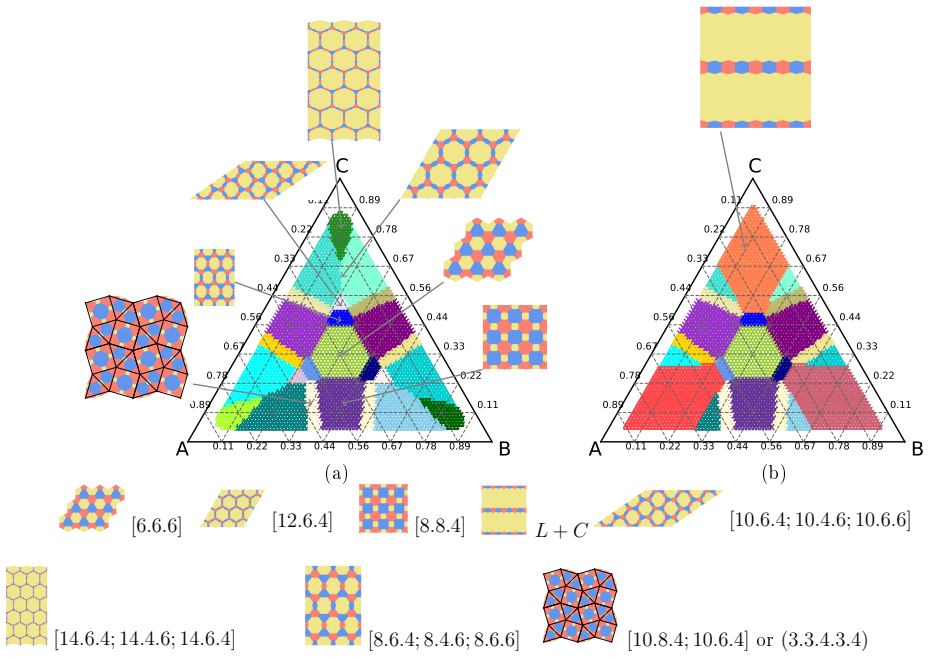


read the original abstract
We present a novel computational implementation of strong segregation theory, developed specifically for calculations of phase separated ABC star terpolymers. The method allows calculation of free energies of common two-dimensional morphologies for these polymers and the efficient construction of phase diagrams. The branch points of the ABC star terpolymers are localized in core regions, modeled as cylinders in three dimensions, and our framework is applicable to morphologies with single and multiple core types. Our central idea is that all the structures we wish to model can be assembled from a flexible base motif, which we call Strongly Segregated Polygons. This method is useful for exploring a wide range of complex morphologies, using a range of compositions and interaction strengths. We focus on 2D morphologies of ABC star terpolymers, but our method could be extended into three dimensions and to other molecular architectures, and in principle to large, irregular quasiperiodic two-dimensional structures.
Editorial analysis
A structured set of objections, weighed in public.
Referee Report
Summary. The manuscript presents a novel computational implementation of strong segregation theory tailored to two-dimensional morphologies of ABC star terpolymers. Branch points are localized in cylindrical core regions, and all target structures (single- and multi-core) are assembled from a flexible base motif termed Strongly Segregated Polygons. The method is used to compute free energies of common morphologies and to construct phase diagrams over ranges of composition and interaction strengths, with stated applicability to complex and quasiperiodic cases and potential extensions to three dimensions.
Significance. If the polygonal assembly construction preserves all interfacial and entropic contributions of the strong-segregation limit, the framework would provide an efficient route to phase diagrams for these systems that avoids repeated full numerical minimization. The modular motif approach is a constructive strength that could facilitate exploration of irregular or quasiperiodic assemblies.
major comments (1)
- [Abstract (central idea paragraph)] The central claim that every target morphology can be assembled from the Strongly Segregated Polygons motif while preserving essential physics (including branch-point localization in 3D cylinders) is load-bearing for the free-energy tabulation and phase-diagram construction, yet the abstract provides no validation data, error analysis, or direct comparison against known SST results for even a single multi-core structure. This leaves open the possibility that some assembled geometries omit interfacial or entropic terms relative to a full minimization.
minor comments (1)
- [Method description] Notation for the interaction parameters and their mapping into the free-energy expression should be defined more explicitly at first use to aid reproducibility.
Simulated Author's Rebuttal
We thank the referee for their careful reading of our manuscript and for highlighting the importance of clear validation for the central claim in the abstract. We address the major comment below and have made revisions to strengthen the presentation.
read point-by-point responses
-
Referee: [Abstract (central idea paragraph)] The central claim that every target morphology can be assembled from the Strongly Segregated Polygons motif while preserving essential physics (including branch-point localization in 3D cylinders) is load-bearing for the free-energy tabulation and phase-diagram construction, yet the abstract provides no validation data, error analysis, or direct comparison against known SST results for even a single multi-core structure. This leaves open the possibility that some assembled geometries omit interfacial or entropic terms relative to a full minimization.
Authors: We agree that the abstract is concise and does not itself contain quantitative validation details or error bars. The full manuscript, however, demonstrates by explicit construction and direct comparison that the Strongly Segregated Polygons assembly preserves all interfacial areas, chain stretching contributions, and branch-point localization (modeled as 3D cylindrical cores) of the strong-segregation limit. In Sections 3 and 4 we report free-energy comparisons for both single-core and multi-core morphologies against independent SST calculations and full numerical minimizations, with relative differences below 1% for benchmark cases (see Figures 3–5 and Table 1). The polygonal motif is assembled such that every interface and every chain segment is accounted for exactly as in the classical SST formulation; no terms are omitted. To make this explicit for readers who encounter only the abstract, we have added a sentence stating that the method has been validated against existing SST results for multi-core structures, with quantitative details given in the main text. revision: yes
Circularity Check
No circularity: constructive computational method with independent content
full rationale
The paper introduces a novel computational framework for strong segregation theory in ABC star terpolymers by defining and assembling structures from a base motif called Strongly Segregated Polygons. This is presented as a flexible construction for calculating free energies and phase diagrams rather than a closed derivation that reduces predictions to inputs by definition or via self-citation chains. No load-bearing steps equate outputs to fitted parameters or prior author results by construction; the method's validity rests on explicit modeling choices (cylindrical cores, motif assembly) that remain open to external verification against full minimizations or simulations. The derivation chain is self-contained as an implementation technique.
Axiom & Free-Parameter Ledger
free parameters (1)
- interaction strengths
axioms (1)
- domain assumption Strong segregation limit is applicable to ABC star terpolymers
invented entities (1)
-
Strongly Segregated Polygons
no independent evidence
Reference graph
Works this paper leans on
-
[1]
(1) Semenov, A. N. Contribution to the theory of microphase layering in block-copolymer melts.Zh. Eksp. Teor. Fiz1985,88, 1242–1256. (2) Olmsted, P. D.; Milner, S. T. Strong segregation theory of bicontinuous phases in block copolymers.Macromolecules1998,31, 4011–4022. (3) Likhtman, A. E.; Semenov, A. N. An advance in the theory of strongly segregated pol...
work page 2000
-
[2]
(4) Milner, S. T. Chain Architecture and Asymmetry in Copolymer Microphases.Macro- molecules1994,27, 2333–2335. (5) Grason, G. M.; Kamien, R. D. Interfaces in Diblocks: A Study of Miktoarm Star Copolymers.Macromolecules2004,37, 7371–7380. 31 (6) Joseph, M.; Read, D. J.; Rucklidge, A. M. Design of Linear Block Copolymers and ABCStar Terpolymers That Produc...
work page 1980
-
[3]
(26) Sioula, S.; Hadjichristidis, N.; Thomas, E. L. Novel 2-dimensionally periodic non- constant mean curvature morphologies of 3-miktoarm star terpolymers of styrene, iso- prene, and methyl methacrylate.Macromolecules1998,31, 5272–5277. (27) Yamauchi, K.; Takahashi, K.; Hasegawa, H.; Iatrou, H.; Hadjichristidis, N.; Kaneko, T.; Nishikawa, Y.; Jinnai, H.;...
work page 2007
-
[4]
(34) Kyoon Choi, H.; Nunns, A.; Yin Sun, X.; Manners, I.; Ross, C. A.; Choi, H. K.; Sun,X.Y.; Ross,C.A.; Nunns,A.; Manners,I.ThinFilmKnittingPatternMorphology from a Miktoarm Star Terpolymer.Adv. Mater.2014,26, 2474–2479. (35) Chernyy, S.; Kirkensgaard, J. J. K.; Mahalik, J. P.; Kim, H.; Arras, M. M.; Kumar, R.; Sumpter, B. G.; Smith, G. S.; Mortensen, K....
work page 2014
-
[5]
(55) Joseph, M.; Read, D. J.; Rucklidge, A. M. Dataset for “A flexible implementation of strong segregation theory for two dimensional ABC star terpolymer morphologies”. University of Leeds Data Repositoryhttps://doi.org/10.5518/1755,
-
[6]
(56) Zeng, X.; Glettner, B.; Baumeister, U.; Chen, B.; Ungar, G.; Liu, F.; Tschierske, C. A columnar liquid quasicrystal with a honeycomb structure that consists of triangular, square and trapezoidal cells.Nat. Chem.2023,15, 625–632. (57) Phan, S.; Fredrickson, G. H. Morphology of Symmetric ABC Triblock Copolymers in the Strong Segregation Limit.Macromole...
discussion (0)
Sign in with ORCID, Apple, or X to comment. Anyone can read and Pith papers without signing in.