REVIEW 2 major objections 2 minor 1 cited by
Towards Just-in-Time Adaptive Feedback: Enhancing Student Learning via Knowledge-Grounded LLM
T0 review · 2 major / 2 minor · reviewed 2026-06-29 · grok-4.3
Pith's one-line read A knowledge-grounded LLM framework delivers just-in-time feedback that improves student performance by over 80 percent in a large course.
desk verdict The 80% performance claim rests on an uncontrolled semester comparison with no details on measurement or cohort adjustments. read the letter →
The pith
A machine-rendered reading of the paper's core claim, the machinery that carries it, and where it could break.
The reading
What carries the argument
The knowledge-grounded LLM that analyzes student strategy essays to detect error types and generate targeted clarifying feedback.
What would settle it
A controlled within-semester experiment that assigns the feedback to one group of students and withholds it from an otherwise identical group, then finds no performance difference, would falsify the causal claim.
Extended reading notes
Core claim
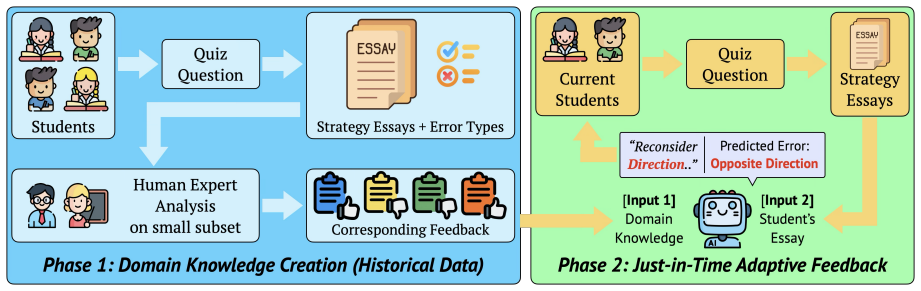
The authors claim that grounding LLMs with domain-specific expert knowledge enables collection of strategy essays, detection of error types in the reasoning content, and delivery of non-intrusive feedback; this process raised student performance by over 80 percent compared with previous semesters in a course enrolling more than 1000 students, and iterative conversations with the model shift misconceptions toward correct understanding.
Load-bearing premise
The observed performance increase is caused by the LLM feedback rather than uncontrolled differences in instruction, student population, or assessment between semesters.
Editorial extensions
If this is right
- Student performance on course assessments rises substantially compared with prior semesters.
- Learning trajectories recorded in successive exchanges demonstrate movement from misconceptions to correct concepts.
- The approach operates at the scale of courses enrolling more than 1000 students.
- Non-intrusive feedback clarifies missing or incorrect concepts without disrupting the learning flow.
Reading between the lines
- The same grounding technique could be tested in other subjects if expert error patterns can be expressed as analyzable rules.
- Long-term retention of the corrected concepts after the course ends is not measured in the reported data.
- Reducing manual grading demands might allow instructors to allocate time to other instructional activities.
Editorial analysis
A structured set of objections, weighed in public.
Referee Report
Summary. The manuscript presents a framework for just-in-time adaptive feedback in education that grounds LLMs with domain-specific expert knowledge. It collects students' written strategy essays, identifies potential error types from the reasoning content, and generates non-intrusive feedback to address misconceptions. The framework was deployed in a large university course (N > 1000), where it is claimed to have improved student performance by over 80% relative to previous semesters; learning trajectories from iterative LLM conversations are analyzed to illustrate shifts from misconceptions to correct understanding.
Significance. If the performance gains can be causally attributed to the intervention, the work would demonstrate a practical method for scaling personalized feedback in large courses using student-generated artifacts to constrain LLM outputs. The deployment scale (N > 1000) and the focus on iterative misconception correction provide a useful empirical case study for AI in education. The grounding approach via strategy essays is a concrete strength that could be extended to other domains.
major comments (2)
- [Abstract] Abstract: The headline claim that the framework 'improved student performance by over 80% compared to previous semesters' is presented without any description of the performance metric, how the 80% figure was computed, whether assessments or grading standards were held constant across semesters, or any adjustment for cohort, instructional, or selection differences. This uncontrolled semester-to-semester comparison is the central empirical result and cannot support the attribution of gains to the LLM feedback without additional controls or statistical detail.
- [Learning trajectories analysis] Learning trajectories section: The analysis shows individual shifts in misconceptions through iterative conversations but supplies no aggregate statistical tests, control conditions, or comparison to non-intervention trajectories that would isolate the effect of the feedback system from other semester-level factors.
minor comments (2)
- The methods description of how error types are extracted from strategy essays and mapped to feedback could be expanded with pseudocode or a concrete example to improve reproducibility.
- No discussion of potential LLM hallucination risks or human oversight mechanisms in the feedback generation pipeline is provided.
Simulated Author's Rebuttal
We thank the referee for the constructive comments on the empirical presentation. We address each major comment below with plans for revision where feasible.
read point-by-point responses
-
Referee: [Abstract] Abstract: The headline claim that the framework 'improved student performance by over 80% compared to previous semesters' is presented without any description of the performance metric, how the 80% figure was computed, whether assessments or grading standards were held constant across semesters, or any adjustment for cohort, instructional, or selection differences. This uncontrolled semester-to-semester comparison is the central empirical result and cannot support the attribution of gains to the LLM feedback without additional controls or statistical detail.
Authors: We agree the abstract requires additional detail for transparency. In revision we will specify the performance metric (mean score on the primary course assessment), describe the relative improvement calculation, confirm that the assessment rubric and course structure were unchanged, and explicitly note the observational nature of the semester comparison along with potential unmeasured cohort or instructional differences. This will qualify the claim appropriately while retaining the reported observation. revision: yes
-
Referee: [Learning trajectories analysis] Learning trajectories section: The analysis shows individual shifts in misconceptions through iterative conversations but supplies no aggregate statistical tests, control conditions, or comparison to non-intervention trajectories that would isolate the effect of the feedback system from other semester-level factors.
Authors: The trajectories section is designed to illustrate the mechanism via representative examples of misconception correction. We will revise to include aggregate descriptive statistics across the student sample (e.g., proportion of trajectories showing correction and average iterations to correction). We acknowledge that no control condition was present in the live-course deployment, which precludes isolating the intervention effect, and will add this limitation to the discussion. revision: partial
- Absence of a control group or matched non-intervention cohort, preventing causal attribution of performance gains to the LLM feedback system.
Circularity Check
No circularity: empirical deployment with no derivation chain
full rationale
The paper reports an empirical deployment of an LLM feedback framework in a university course (N>1000) and claims an 80% performance improvement relative to prior semesters, along with qualitative analysis of learning trajectories. No equations, fitted parameters, predictions, or mathematical derivations are described anywhere in the provided text. The central result is an observational outcome from real-world use rather than a self-referential model or ansatz that reduces to its inputs by construction. Self-citations, if present, are not load-bearing for any derivation. This is a standard non-circular empirical study.
Assumptions & free parameters
assumptions (1)
- domain assumption LLMs grounded with domain-specific expert knowledge can accurately identify missing or incorrect concepts in student strategy essays.
Cite this review
Pith. "Pith review of Towards Just-in-Time Adaptive Feedback: Enhancing Student Learning via Knowledge-Grounded LLM." pith.science (2026). https://pith.science/paper/Z6XXMM7Q
@misc{pith2026260526405,
  author       = {Pith},
  title        = {Pith review of: Towards Just-in-Time Adaptive Feedback: Enhancing Student Learning via Knowledge-Grounded LLM},
  year         = {2026},
  howpublished = {\url{https://pith.science/paper/Z6XXMM7Q}},
  note         = {Machine review of arXiv:2605.26405}
}
read the original abstract
Educational interventions are effective tools for enhancing student learning. While Large Language Models (LLMs) allow for generating adaptive feedback at scale, current studies lack clear methodologies for providing Just-in-Time (JiT) feedback in authentic instructional settings. In this paper, we present a framework that provides adaptive feedback by grounding LLMs with domain-specific expert knowledge. Our approach collects written reasoning logic (strategy essays) from students, analyzes potential error types based on the content of that reasoning, and delivers non-intrusive feedback designed to clarify missing or incorrect concepts. We deploy this framework in a large-scale university course (N > 1000), where it improved student performance by over 80% compared to previous semesters. Lastly, we validate the framework's pedagogical utility by analyzing the learning trajectories; we demonstrate how iterative conversations with LLM facilitate shifting one's misconception to correct understanding.
Figures


Figures from the paper (9 more)




Forward citations
Cited by 1 Pith paper
-
Using LLMs to Detect Growth in Computational Thinking in Introductory Physics
An LLM scored students' written computational thinking responses in an introductory physics course with human-level agreement on well-defined practices and reproduced pre-post growth trends at scale.
Reference graph
Works this paper leans on
-
[1]
Wei Dai, Jionghao Lin, Hua Jin, Tongguang Li, Yi- Shan Tsai, Dragan Gaševi ´c, and Guanliang Chen
Categorization and representation of physics problems by experts and novices.Cognitive science, 5(2):121–152. Wei Dai, Jionghao Lin, Hua Jin, Tongguang Li, Yi- Shan Tsai, Dragan Gaševi ´c, and Guanliang Chen
-
[2]
In2023 IEEE international conference on advanced learning tech- nologies (ICALT), pages 323–325
Can large language models provide feedback to students? a case study on chatgpt. In2023 IEEE international conference on advanced learning tech- nologies (ICALT), pages 323–325. IEEE. Jennifer L Docktor, Natalie E Strand, José P Mestre, and Brian H Ross. 2010. A conceptual approach to physics problem solving. InAIP Conference Pro- ceedings, volume 1289, p...
2010
-
[3]
In Physics Education Research Conference 2025, PER Conference, pages 184–189, Washington, DC
Analyzing undergraduate problem-solving in physics through interaction with an ai chatbot. In Physics Education Research Conference 2025, PER Conference, pages 184–189, Washington, DC. John Hattie and Shirley Clarke. 2018.Visible learning: feedback. Routledge. John Hattie and Helen Timperley. 2007. The power of feedback.Review of educational research, 77(...
2025
-
[4]
In International conference of the Australian Associa- tion for Research in Education, pages 1–11
Written feedback doesn’t make sense’: En- hancing assessment feedback using technologies. In International conference of the Australian Associa- tion for Research in Education, pages 1–11. Chandralekha Singh and David Rosengrant. 2003. Multiple-choice test of energy and momentum con- cepts.Am. J. Phys., 71(6):607–617. Karan Taneja, Pratyusha Maiti, Sandee...
2003
-
[5]
Thomas Wolsey
The power of feedback revisited: A meta- analysis of educational feedback research.Frontiers in psychology, 10:487662. Thomas Wolsey. 2008. Efficacy of instructor feedback on written work in an online program. InInterna- tional Journal on E-learning, volume 7, pages 311–
2008
-
[6]
Helps me better under- stand the concept
Association for the Advancement of Computing in Education (AACE). Zheyuan Zhang, Daniel Zhang-Li, Jifan Yu, Linlu Gong, Jinchang Zhou, Zhanxin Hao, Jianxiao Jiang, Jie Cao, Huiqin Liu, Zhiyuan Liu, and 1 others. 2025. Simulating classroom education with llm-empowered agents. InProceedings of the 2025 Conference of the Nations of the Americas Chapter of th...
-
[7]
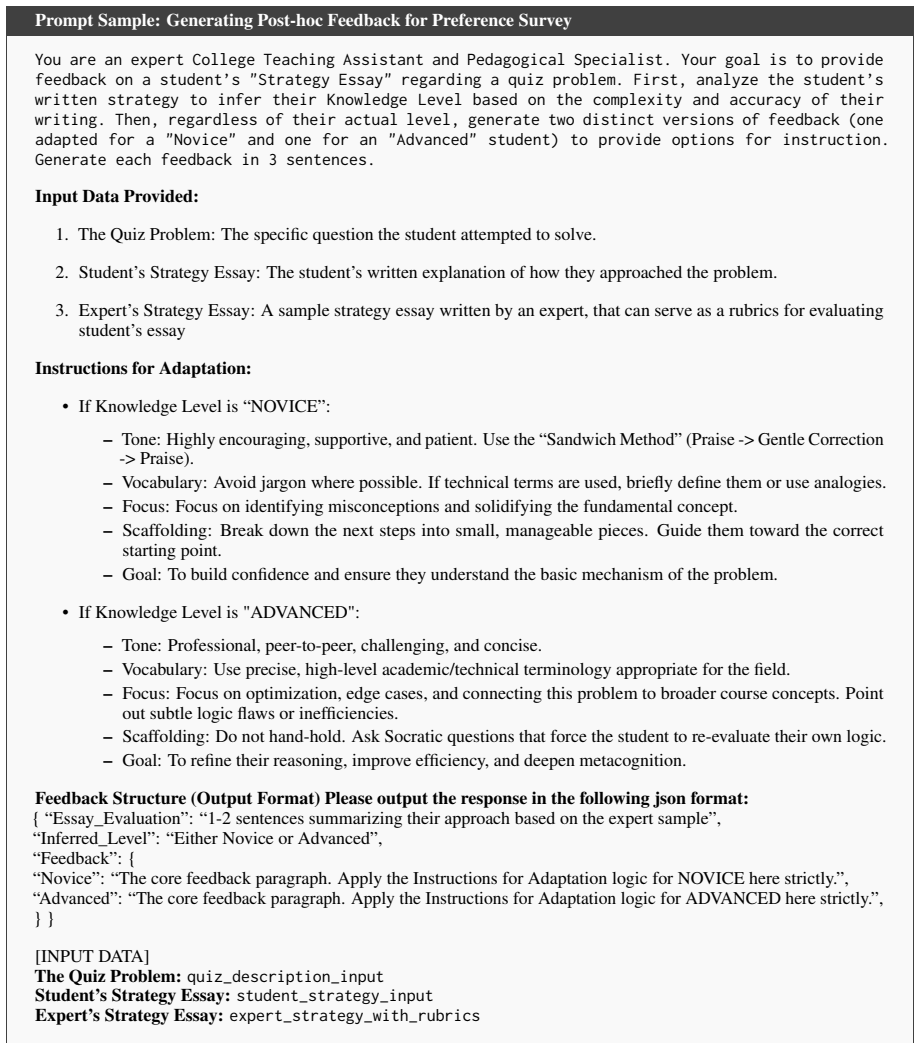
The Quiz Problem: The specific question the student attempted to solve
-
[8]
Student’s Strategy Essay: The student’s written explanation of how they approached the problem
Show all 12 references
-
[9]
NOVICE”: – Tone: Highly encouraging, supportive, and patient. Use the “Sandwich Method
Expert’s Strategy Essay: A sample strategy essay written by an expert, that can serve as a rubrics for evaluating student’s essay Instructions for Adaptation: • If Knowledge Level is “NOVICE”: – Tone: Highly encouraging, supportive, and patient. Use the “Sandwich Method” (Prai...
-
[10]
Look for specific keywords or logical steps
Analyze the student’s essay. Look for specific keywords or logical steps
-
[11]
Identify if they are applying correct principles/concepts or falling into misconceptions
-
[12]
Student Essay
Output your final reasoning and label as strictly valid JSON. Label Categories & Definitions • ‘correct’: The reasoning and final answer are physically sound. • ‘direction’: The student makes an error where their answer is in the exact opposite direction of the correct vector ...
Reviewed June 29, 2026 · model on record in the stance chip above.
Discussion (0). Continue with ORCID to comment.