Heterogeneous LLM Debate Under Adversarial Peers: Honest Gains, Replacement Costs, and Resilience
Reviewed by Pith2026-06-26 17:14 UTCgrok-4.3pith:Z7MKH6XRopen to challenge →
The pith
An honest heterogeneous peer cuts harmful revision rates in LLM debates, while an adversarial peer reverses the reduction.
A machine-rendered reading of the paper's core claim, the machinery that carries it, and where it could break.
Core claim
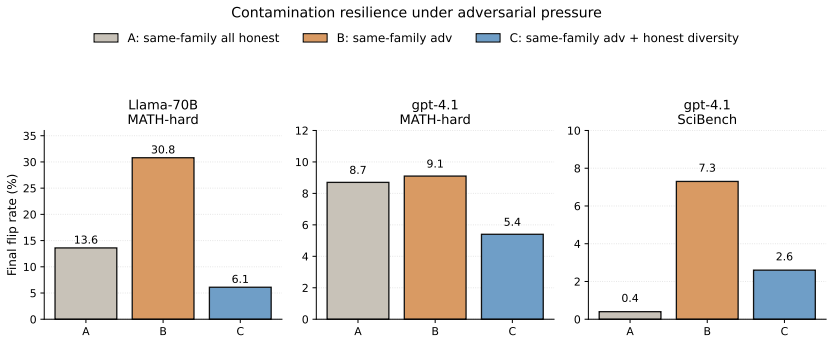
In matched panels, an honest heterogeneous peer lowers the harmful-revision rate of Llama-3.1-70B defenders on MATH-hard from 89 percent in the homogeneous case to 35 percent, while an adversarial peer returns the rate to 90 percent. The conditional revision rate understates the effect on weak defenders, but the end-of-debate flip rate reveals it. When a same-family adversary is already present, the added honest peer also reduces the rate at which initially correct answers are lost, cutting the flip rate from 31 percent to 6 percent in the same setting. The sign of the effect is stable across families and benchmarks even as its size varies with defender and task difficulty.
What carries the argument
Matched panels (homogeneous baseline, honest-mixed, adversarial-mixed) and contaminated panels that track changes in honest agents' revision rates and flip rates when a heterogeneous peer is introduced.
If this is right
- Honest heterogeneous peers can protect initially correct answers when a same-family adversary is already present.
- The magnitude of the protective effect varies with the defender model and benchmark difficulty.
- The pattern of honest-peer benefit and adversarial-peer harm is consistent in sign across model families.
- End-of-debate flip rates expose damage that conditional revision rates can hide on weaker defenders.
Where Pith is reading between the lines
- Debate protocols could deliberately insert diverse honest models as a countermeasure once any adversary is detected.
- The same heterogeneity that creates attack surfaces can be turned into a layered defense by adding more than one honest peer type.
- Security evaluations of multi-agent LLM systems should routinely include both clean and contaminated panel conditions.
Load-bearing premise
That differences in revision rates are caused by the honest or adversarial character of the added peer rather than by prompt wording, model-size differences, or other panel-setup details.
What would settle it
A controlled replication that keeps every prompt, model scale, and panel size fixed while only swapping the honesty label of the heterogeneous peer and finds no change in harmful-revision rates.
Figures

read the original abstract
Heterogeneous LLM debate is motivated by the promise that diverse peers correct one another, but the same exchange that carries correction also carries adversarial influence. We measure which dominates by tracking how a heterogeneous peer changes the honest agents' revision behavior: how often they change their answer, and whether the change is corrective or harmful. We compare matched panels (homogeneous baseline, honest-mixed, and adversarial-mixed) and contaminated panels in which a malicious same-family peer is already present, spanning four model families and three reasoning benchmarks. An honest heterogeneous peer sharply lowers harmful revision, and an adversarial one reverses it. For Llama-3.1-70B defenders on MATH-hard, the honest-slot harmful-revision rate falls from 89% in the homogeneous panel to 35% with an honest peer, and an adversarial peer returns it to 90%. The conditional rate hides this damage on weak defenders, but the end-of-debate flip rate exposes it. The pattern keeps its sign across families and benchmarks while its magnitude varies with the defender-benchmark regime. We also measure the effects when an adversarial same-family peer is already present: an honest heterogeneous peer lowers both harmful revision and the rate at which initially-correct answers are lost. On the same Llama-3.1-70B setting, the added honest peer cuts the flip rate on initially-correct items from 31% under a same-family adversary to 6%. Heterogeneity is therefore not only an attack surface but, when an adversary is already present, also a defense.
Editorial analysis
A structured set of objections, weighed in public.
Referee Report
Summary. The manuscript empirically studies heterogeneous LLM debate by tracking how the presence of an honest or adversarial heterogeneous peer alters honest agents' revision behavior (answer changes that are corrective vs. harmful). It compares matched homogeneous baselines against honest-mixed and adversarial-mixed panels, plus contaminated panels with an existing same-family adversary, across four model families and three reasoning benchmarks. Key reported pattern: an honest peer sharply lowers harmful-revision rates while an adversarial peer reverses the effect; heterogeneity can also reduce loss of initially correct answers when an adversary is already present. Example: for Llama-3.1-70B defenders on MATH-hard, harmful-revision rate falls from 89% (homogeneous) to 35% (honest peer) and returns to 90% (adversarial peer).
Significance. If the attribution of rate changes specifically to peer honesty type holds after controls, the work supplies quantitative evidence that heterogeneity functions as both an attack surface and a potential defense in multi-agent LLM systems. The directional consistency across model families and benchmarks, together with the distinction between conditional revision rates and end-of-debate flip rates, offers falsifiable, actionable measurements for protocol design.
major comments (1)
- [Abstract] Abstract: the headline attribution (89% o 35% o 90% harmful-revision rate for Llama-3.1-70B on MATH-hard) requires that the three matched-panel conditions differ only in the identity and honesty label of the added peer. No quantitative verification is supplied that token budgets, message counts, total context length, or formatting remain identical once the peer model is substituted; any systematic difference would confound the comparison and undermine the claim that observed shifts are due to the peer's honesty property rather than prompt artifacts.
minor comments (2)
- The abstract reports specific percentages but does not mention statistical significance tests, confidence intervals, or the number of trials underlying each rate.
- Exact implementation details for the adversarial peer (prompt phrasing, contamination method) and any explicit controls for model-scale or family differences are not summarized at the level needed to assess reproducibility.
Simulated Author's Rebuttal
We thank the referee for the careful review and for identifying a methodological point that strengthens the paper. We address the concern below and will revise accordingly.
read point-by-point responses
-
Referee: [Abstract] Abstract: the headline attribution (89% o 35% o 90% harmful-revision rate for Llama-3.1-70B on MATH-hard) requires that the three matched-panel conditions differ only in the identity and honesty label of the added peer. No quantitative verification is supplied that token budgets, message counts, total context length, or formatting remain identical once the peer model is substituted; any systematic difference would confound the comparison and undermine the claim that observed shifts are due to the peer's honesty property rather than prompt artifacts.
Authors: We agree that explicit quantitative verification is required to isolate the effect of peer honesty. The experimental protocol fixes the debate format, prompt templates, turn structure, and per-turn token caps for all panels; only the model identity in the peer slot changes. However, the manuscript does not report summary statistics (means/variances of tokens per message or total context length) across the three conditions for the headline experiments. We will add a table in the appendix with these statistics for Llama-3.1-70B on MATH-hard (and the other reported settings) to confirm the conditions are matched on these dimensions. revision: yes
Circularity Check
No circularity: purely empirical measurements of observed revision rates
full rationale
The paper reports direct empirical counts of answer changes, harmful-revision rates, and flip rates across matched and contaminated panels. No equations, derivations, fitted parameters, or self-citations appear in the load-bearing claims. The headline percentages (e.g., 89% → 35% → 90%) are presented as measured outcomes, not quantities obtained by construction from prior definitions or self-referential inputs. The work is therefore self-contained against external benchmarks and receives the default non-finding.
Axiom & Free-Parameter Ledger
axioms (1)
- domain assumption Revision behavior can be accurately classified as corrective or harmful using ground-truth answers from the benchmarks
Reference graph
Works this paper leans on
-
[1]
Forty-first international conference on machine learning , year=
Improving factuality and reasoning in language models through multiagent debate , author=. Forty-first international conference on machine learning , year=
-
[2]
Proceedings of the 2024 conference on empirical methods in natural language processing , pages=
Encouraging divergent thinking in large language models through multi-agent debate , author=. Proceedings of the 2024 conference on empirical methods in natural language processing , pages=
2024
-
[3]
Proceedings of the 2023 Conference on Empirical Methods in Natural Language Processing , pages=
Exchange-of-thought: Enhancing large language model capabilities through cross-model communication , author=. Proceedings of the 2023 Conference on Empirical Methods in Natural Language Processing , pages=
2023
-
[4]
arXiv preprint arXiv:2402.06782 , year=
Khan, Akbir and Hughes, John and Valentine, Dan and Ruis, Laura and Sachan, Kshitij and Radhakrishnan, Ansh and Grefenstette, Edward and Bowman, Samuel R and Rockt. Debating with more persuasive. arXiv preprint arXiv:2402.06782 , year=
-
[5]
arXiv preprint arXiv:2410.12853 , year=
Diversity of thought elicits stronger reasoning capabilities in multi-agent debate frameworks , author=. arXiv preprint arXiv:2410.12853 , year=
-
[6]
Journal of King Saud University Computer and Information Sciences , volume=
Adaptive heterogeneous multi-agent debate for enhanced educational and factual reasoning in large language models , author=. Journal of King Saud University Computer and Information Sciences , volume=. 2025 , publisher=
2025
-
[7]
arXiv preprint arXiv:2505.22960 , year=
Revisiting multi-agent debate as test-time scaling: A systematic study of conditional effectiveness , author=. arXiv preprint arXiv:2505.22960 , year=
-
[8]
arXiv preprint arXiv:2509.05396 , year =
Talk Isn't Always Cheap: Understanding Failure Modes in Multi-Agent Debate , author=. arXiv preprint arXiv:2509.05396 , year=
-
[9]
Wu, Haolun and Li, Zhenkun and Li, Lingyao , journal=. Can
-
[10]
On the resilience of
Huang, Jen-tse and Zhou, Jiaxu and Jin, Tailin and Zhou, Xuhui and Chen, Zixi and Wang, Wenxuan and Yuan, Youliang and Lyu, Michael R and Sap, Maarten , journal=. On the resilience of
-
[11]
Scientific Reports , volume=
When collaboration fails: persuasion driven adversarial influence in multi agent large language model debate , author=. Scientific Reports , volume=. 2026 , publisher=
2026
-
[12]
arXiv preprint arXiv:2401.05998 , year=
Combating adversarial attacks with multi-agent debate , author=. arXiv preprint arXiv:2401.05998 , year=
-
[13]
Detection Without Correction: A Two-Parameter Decomposition of Multi-Stage
Nilayam, Prashanti and Ramanna, Kiran and Tumbade, Prashil , journal=. Detection Without Correction: A Two-Parameter Decomposition of Multi-Stage
-
[14]
Nilayam, Prashanti and Nayak, Sankalp , journal=
-
[15]
Findings of the Association for Computational Linguistics: EMNLP 2024 , pages=
Multiagent collaboration attack: Investigating adversarial attacks in large language model collaborations via debate , author=. Findings of the Association for Computational Linguistics: EMNLP 2024 , pages=
2024
-
[16]
When Agents Disagree: The Selection Bottleneck in Multi-Agent
Maryanskyy, Artem and Budnikov, Dmitry and Kaliyev, Alibek T , journal=. When Agents Disagree: The Selection Bottleneck in Multi-Agent. 2026 , publisher=
2026
-
[17]
Applied Sciences , volume=
Minimizing hallucinations and communication costs: Adversarial debate and voting mechanisms in llm-based multi-agents , author=. Applied Sciences , volume=. 2025 , publisher=
2025
-
[18]
Cui, Yu and Du, Hongyang , journal=
-
[19]
arXiv preprint arXiv:2508.16481 , year=
Benchmarking the robustness of agentic systems to adversarially-induced harms , author=. arXiv preprint arXiv:2508.16481 , year=
-
[20]
Wen, Xiaoyu and He, Zhida and Qi, Han and Wan, Ziyu and Ma, Zhongtian and Wen, Ying and Zheng, Tianhang and Xu, Xingcheng and Lu, Chaochao and Zhang, Qiaosheng , journal=
-
[21]
AgentShield: Make
Wang, Kaixiang and Zhou, Zhaojiacheng and Suvonov, Bunyod and Lou, Jiong and Li, Jie , journal=. AgentShield: Make
-
[22]
arXiv preprint arXiv:2405.20770 , year=
Large language model sentinel: Llm agent for adversarial purification , author=. arXiv preprint arXiv:2405.20770 , year=
-
[23]
NomicLaw: Emergent Trust and Strategic Argumentation in
Hota, Asutosh and Jokinen, Jussi PP , booktitle=. NomicLaw: Emergent Trust and Strategic Argumentation in
-
[24]
Measuring mathematical problem solving with the
Hendrycks, Dan and Burns, Collin and Kadavath, Saurav and Arora, Akul and Basart, Steven and Tang, Eric and Song, Dawn and Steinhardt, Jacob , journal=. Measuring mathematical problem solving with the
-
[25]
International Conference on Learning Representations , volume=
Let's verify step by step , author=. International Conference on Learning Representations , volume=
-
[26]
GPQA: A Graduate-Level Google-Proof Q&A Benchmark
Gpqa: A graduate-level google-proof q&a benchmark , author=. arXiv preprint arXiv:2311.12022 , year=
work page internal anchor Pith review Pith/arXiv arXiv
-
[27]
International Conference on Learning Representations , volume=
Towards understanding sycophancy in language models , author=. International Conference on Learning Representations , volume=
-
[28]
International conference on learning representations , volume=
Large language models cannot self-correct reasoning yet , author=. International conference on learning representations , volume=
-
[29]
International Conference on Learning Representations , volume=
Mixture-of-agents enhances large language model capabilities , author=. International Conference on Learning Representations , volume=
-
[30]
Should we be going mad? a look at multi-agent debate strategies for
Smit, Andries and Duckworth, Paul and Grinsztajn, Nathan and Barrett, Thomas D and Pretorius, Arnu , journal=. Should we be going mad? a look at multi-agent debate strategies for
-
[31]
Proceedings of the 26th Annual Meeting of the Special Interest Group on Discourse and Dialogue , pages=
Exploring the design of multi-agent llm dialogues for research ideation , author=. Proceedings of the 26th Annual Meeting of the Special Interest Group on Discourse and Dialogue , pages=
-
[32]
Who Am I, and Who Else Is Here?
"Who Am I, and Who Else Is Here?" Behavioral Differentiation Without Role Assignment in Multi-Agent LLM Systems , author=. arXiv preprint arXiv:2604.00026 , year=
-
[33]
Dissecting adversarial robustness of multimodal lm agents
Dissecting adversarial robustness of multimodal lm agents , author=. arXiv preprint arXiv:2406.12814 , year=
-
[34]
Yang, Huanrui and Zhang, Jingyang and Dong, Hongliang and Inkawhich, Nathan and Gardner, Andrew and Touchet, Andrew and Wilkes, Wesley and Berry, Heath and Li, Hai , journal=
-
[35]
Representational Collapse in Multi-Agent
Patel, Dipkumar , journal=. Representational Collapse in Multi-Agent
-
[36]
Not All Flips Are Conformity: Decomposing Stance Convergence in Multi-Agent
Hao, Xiqi and Wu, Zengqing and Qiu, Yu-Xuan and Xiao, Chuan and Xu, Ruiqi and Zheng, Shuyuan and Qin, Jianbin , journal=. Not All Flips Are Conformity: Decomposing Stance Convergence in Multi-Agent
-
[37]
Proceedings of the 2025 Conference on Empirical Methods in Natural Language Processing , pages=
The hidden strength of disagreement: Unraveling the consensus-diversity tradeoff in adaptive multi-agent systems , author=. Proceedings of the 2025 Conference on Empirical Methods in Natural Language Processing , pages=
2025
- [38]
-
[39]
Byzantine-Robust Decentralized Coordination of
Jo, Yongrae and Park, Chanik , journal=. Byzantine-Robust Decentralized Coordination of
-
[40]
Rethinking the reliability of multi-agent system: A perspective from
Zheng, Lifan and Chen, Jiawei and Yin, Qinghong and Zhang, Jingyuan and Zeng, Xinyi and Tian, Yu , booktitle=. Rethinking the reliability of multi-agent system: A perspective from
-
[41]
When persuasion overrides truth in multi-agent
Agarwal, Mahak and Khanna, Divyam , journal=. When persuasion overrides truth in multi-agent
discussion (0)
Sign in with ORCID, Apple, or X to comment. Anyone can read and Pith papers without signing in.