REVIEW 3 major objections 5 minor 63 references
Quantum-memory-assisted on-demand microwave-optical transduction
T0 review · 3 major / 5 minor · reviewed 2026-08-04 · deepseek-v4-flash
Pith's one-line read A single Rydberg ensemble can store a microwave pulse and later emit it as an optical photon on demand, with over 90% area-normalized storage efficiency and a noise-equivalent temperature of 26 K.
desk verdict Genuine first demonstration of on-demand microwave-to-optical transduction with an integrated Rydberg memory, but the headline '>90% efficiency' is an area-normalized cross-section, not a mode-matched end-to-end conversion efficiency. read the letter →
The pith
A machine-rendered reading of the paper's core claim, the machinery that carries it, and where it could break.
The reading
What carries the argument
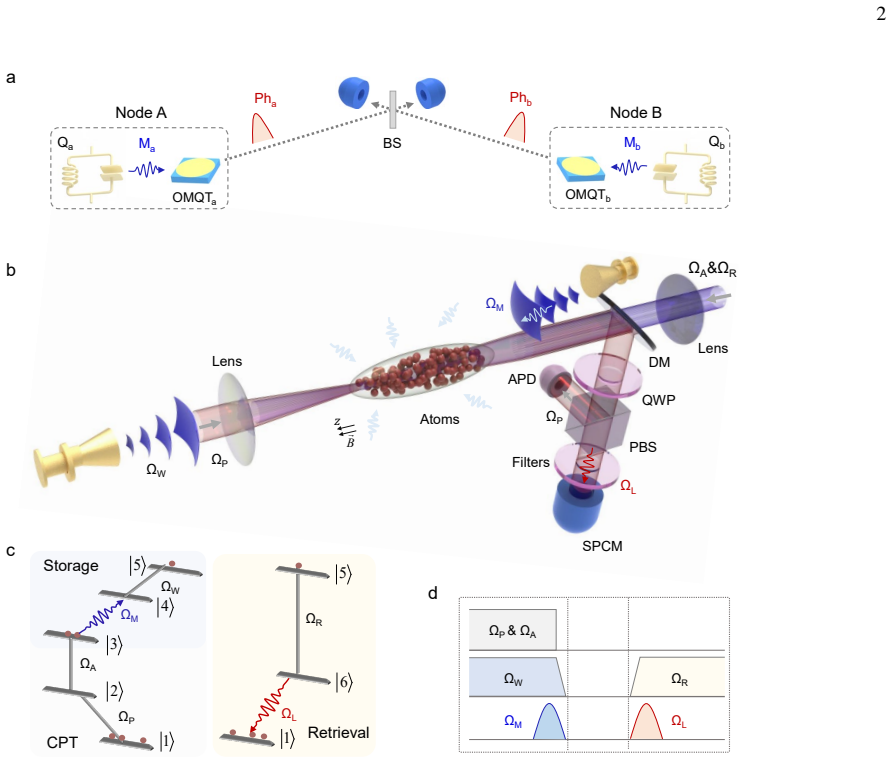
The carrying mechanism is cascaded electromagnetically induced transparency in a five-level Rydberg system: a write field maps a microwave pulse into a long-lived collective Rydberg spin wave, and a read field retrieves it as an optical photon. The key identity is the area-normalized storage efficiency η ≈ η0 exp(−2γ51 td), with η0 = 1/sqrt((1+αM/dM)(1+αL/dL)), where dM ~ 7.5×10^5 is the microwave optical depth and γ51 = sqrt(N̄)γ0 describes Rydberg dephasing from van der Waals interactions in a mean-field model. A receiving area SM of mean radius 66 µm sets the normalization in Eq. (5), and the paper argues this is equivalent to a flux-density efficiency when SM equals the effective beam ar
What would settle it
Measure the total converted optical photons per total input microwave photons for a defined free-space mode matched to the antenna and the full atomic ensemble (for example, a plane-wave mode covering the 4×4×20 mm cloud), rather than normalizing to the 66-µm-radius overlap area. If the mode-matched end-to-end efficiency is substantially below the reported ~90%, the headline area-normalized efficiency does not represent the conversion efficiency a real quantum link would experience.
Extended reading notes
Core claim
The central claim is that an EIT-based Rydberg ensemble can perform on-demand microwave-to-optical transduction with integrated quantum memory, reaching an area-normalized storage efficiency above 90% at the single-photon level. In the experiment, a 37.5-GHz microwave pulse is directed onto a cigar-shaped 87Rb cloud, slowed by cascaded EIT, and mapped into a collective spin-wave excitation in a Rydberg state when the write field is switched off; after a controllable delay, a read field converts the excitation into an optical photon at 780 nm. The efficiency is governed by an expression of the form η ≃ η0 exp(−2γ51 td), with η0 near unity because the microwave transition has an optical depth
Load-bearing premise
The load-bearing premise is that the area-normalized storage efficiency, defined against a 66-µm-radius receiving area for a 7.9-mm-wavelength microwave field, is a meaningful measure of transduction efficiency; the paper itself acknowledges that this small receiving solid angle introduces significant mode-matching losses for free-space signal photons, but it does not quantify those losses.
Editorial extensions
If this is right
- At the demonstrated parameters, a single node can store an incoming microwave photon and release it as an optical photon after a chosen delay, providing the synchronization that Bell-state measurements between distant nodes require.
- Because the microwave transition's optical depth is orders of magnitude larger than typical optical transitions, the area-normalized efficiency can approach unity without an impedance-matched cavity, unlike direct transduction schemes.
- At room temperature the dominant noise is thermal microwave photons about 0.109 per pulse, but at temperatures below 4 K it drops below 10^-3 per pulse, making the device suitable for cryogenic superconducting-qubit environments.
- The storage time at the no-cloning threshold (η = 50%) is about 0.56 µs, limited by Rydberg spin-wave dephasing; transferring the excitation to a hyperfine clock state is proposed as a route to second-scale storage.
- The transducer operates at single-photon input levels near N̄ = 0.1 with resolvable signal, whereas direct free-space Rydberg transduction at ambient temperature typically requires much larger photon numbers.
Reading between the lines
- The reported >90% efficiency is area-normalized to a 66-µm-radius receiving region, far smaller than the 7.9-mm microwave wavelength; a fair comparison with cavity-based transducers would require a mode-matched end-to-end measurement that includes the antenna-to-ensemble coupling loss, which the paper notes but does not quantify.
- The measured sqrt(N̄) scaling of dephasing implies the transducer is most efficient for true single photons; injecting multi-photon coherent pulses degrades efficiency, so the device naturally favors single-photon quantum applications over classical microwave detection.
- The same storage-retrieval architecture could be recast as a temporal-mode converter: shaping the read field should allow the retrieved optical pulse to be produced with an arbitrary temporal envelope, adding flexibility for quantum-network synchronization beyond what the paper explicitly tests.
- Because only paraxial thermal photons within a tiny solid angle are stored efficiently, the low noise-equivalent temperature partly reflects the same geometric rejection that limits signal collection; cryogenic operation would separate these two effects.
Signed reviews
Editorial analysis
A structured set of objections, weighed in public.
Referee Report
Summary. The manuscript reports a Rydberg-ensemble device that combines a quantum memory with microwave-to-optical transduction: a 37.5 GHz microwave pulse is stored as a collective Rydberg excitation via cascaded EIT and, after a programmable delay, retrieved as an optical photon. In a cold 87Rb ensemble the authors measure an area-normalized storage efficiency (ASE) greater than 90% in the single-photon regime, a bandwidth of 2.1 MHz, a 50%-efficiency storage time of about 0.56 microsecond, and a noise-equivalent temperature of 26 K under cavity-free conditions. The paper also presents an EIT-based Maxwell-Bloch model, a mean-field model of Rydberg dephasing, and a thermal-background-noise analysis. The central experimental result is the ASE itself, while the mode-matching interpretation of that ASE is the main point of concern.
Significance. If the ASE metric is accepted as the relevant figure of merit, this is an important proof-of-principle: an on-demand microwave-to-optical transducer with integrated memory, in a cavity-free Rydberg ensemble, with single-photon-level input. The experimental strengths are real: the ASE is obtained by direct photon counting, the g(2) data are compared with a no-free-parameter theory, the noise budget is decomposed into thermal, stray, and dark contributions, and the observed thermal noise count is reproduced by a thermal-radiation model. The limitations concern the mode-matching content of the headline efficiency: ASE is an area-normalized local conversion efficiency, not a mode-matched end-to-end transduction efficiency, and the manuscript does not quantify the mode overlap that would be needed for the proposed quantum-repeater application.
major comments (3)
- [Methods — 'Area-normalized storage efficiency (ASE)', Eq. (5), and Supplementary Sec. SVI] The central metric in Eq. (5) is not an end-to-end conversion efficiency. N_M = I_M S_M/(hbar omega_M) counts flux through the chosen aperture S_M ~ pi(66 um)^2, while the microwave wavelength is 7.9 mm. S_M is roughly 4x10^3 times smaller than lambda_M^2, and the Rayleigh range of a 66-um waist at 37.5 GHz is only ~1.7 um, far shorter than the 20-mm ensemble. For a plane-wave input, eta_ASE scales with the bookkeeping area S_M, so the 90% figure is an aperture-dependent local efficiency, not the probability that an incident photon in a realistic source mode is converted. The paper itself concedes that the small MW-reception solid angle 'introduces significant mode-matching losses for free-space signal photons' but does not quantify those losses. Supplementary Sec. SVI, Eq. (S45), only proves equivalence to another area-normalized intensity ratio under S_I = S_M; it does not compute the
- [Fig. 3c and Eq. (4)] The agreement with theory is used as a validation, but eta0 and gamma0 are both free parameters fitted from the same ASE-versus-N data. With no reported uncertainties, the statement that the fitted gamma0/2pi = 12.8 kHz is 'close to' the mean-field value 10.8 kHz is not an independent test of the model. In addition, the main text uses gamma51/2pi = 10.8 kHz to obtain eta ~ 0.92, whereas Supplementary Sec. SI uses gamma51/2pi = 12.8 kHz to obtain eta_t ~ 0.9; the relation between these two theoretical estimates should be clarified. Please report parameter uncertainties, show the theoretical curve with an uncertainty band, and, if possible, test the predicted gamma51 proportional to sqrt(N) scaling directly. This is needed to support the 'minimal single-photon-level dephasing' claim, although the direct ASE measurement at N = 0.1 is not affected.
- [Supplementary Sec. SIV and Methods, ASE paragraph] The thermal-noise agreement is presented as 'strong independent evidence' that ASE is a reliable metric, but Eq. (S35) takes eta_max equal to eta0 from the ASE analysis. The match to 0.109 noise photons per pulse is therefore a consistency check, not an independent validation. Either compute the thermal-noise contribution from independently measured parameters, with eta_max obtained from the Maxwell-Bloch model before fitting to the ASE data, or explicitly label the comparison as a consistency check.
minor comments (5)
- [Reference list] The main-text citation 'Ref. 6' in the Methods and Supplementary sections refers to a free-space Rydberg converter, but the bibliography entry for [6] is given as 'Arquer et al., Semiconductor quantum dots'. Please correct the reference numbering.
- [Methods and Results] The noise-equivalent temperature T_NE = 26 K is stated without a definition or formula. Please provide the relation between the measured thermal noise count and T_NE.
- [Fig. 2c] The Gaussian and exponential fits give different zero-time efficiencies (82% vs. 93%) and different 50%-efficiency storage times. Please state which fit is used for the headline 'storage time of 0.56 microseconds' and justify the choice.
- [Eq. (2) and preceding text] The factors eta_s and eta_c are stated to approach unity but are not derived. A short derivation or quantitative values for the present parameters would strengthen the theoretical connection between Eq. (2) and the full Maxwell-Bloch model.
- [Supplementary Sec. SIII] The label 'parameter-free' for the mean-field dephasing prediction is overstated: the calculation uses a short-range cutoff at the blockade radius R_B, a measured pumping linewidth to set R_B, and a mean vdW coefficient C_35. Please qualify this language.
Circularity Check
Minor circularity in thermal-noise validation; central transduction claims are independent measurements.
-
fitted input called prediction
[Supplementary Section IV (Thermal background radiation); Methods, 'Area-normalized storage efficiency' paragraph]
"where ηmax is the peak SE and can be considered equivalent to η0 in Eq.(2) in the main text. We find that the thermal noise count ¯nth ≈ 0.08 (0.109) for ηmax = 91% (93%). This theoretical result agrees with the observed thermal noise count (0.109 per pulse)."
The 'theoretical' thermal-noise count is computed by inserting ηmax, which is not an independent fixed value but the experimentally fitted peak ASE (the exponential fit in Fig. 2c gives A=0.93; Eq. 4 is fit with η0=88%). The observed noise count 0.109 is then presented as 'strong independent evidence' for the ASE metric, but the agreement is partly built in because the predicted number uses the same fitted efficiency as an input. This is a fitted input renamed as a prediction, though it does not affect the directly measured ASE, bandwidth, storage time, or g(2) results.
full rationale
The headline claims are based on direct experimental measurements: ASE versus storage time (Fig. 2c), bandwidth versus detuning (Fig. 3a), and photon-correlation measurements (Fig. 3b). These are not derived by fitting a parameter and then predicting the same quantity. The Maxwell-Bloch calculation in Eq. (2) and SI Section I uses independently characterized OD, Rabi frequencies, and delay times, and the mean-field prediction γ0/2π = 10.8 kHz in SI Section III is parameter-free with respect to the fitted γ0/2π = 12.8 kHz, providing genuine external support. The one identifiable circular step is the thermal-noise consistency check in SI Section IV: the predicted thermal photon count uses ηmax equal to the fitted ASE, so the agreement with the observed 0.109 count is not an independent confirmation. The area-normalized definition in Eq. (5) is explicitly labeled as such, and the paper concedes that the small MW-reception solid angle introduces significant mode-matching losses for free-space signal photons; this is a metric limitation rather than a hidden circular derivation. Overall, the central transduction claim retains independent experimental content, and the circularity is localized and non-load-bearing.
Assumptions & free parameters
free parameters (4)
- eta0 (intrinsic ASE) =
0.88
- gamma0 (single-photon Rydberg dephasing rate) =
2 pi x 12.8 kHz
- tau_coh (ASE decay coherence time) =
0.9 microseconds (Gaussian fit)
- eta_max (peak ASE used in thermal-noise model) =
0.91 and 0.93
assumptions (6)
- domain assumption First-order Maxwell-Bloch equations with slowly varying envelope and weak-excitation perturbation describe MW storage and optical retrieval (SI Eqs. S4-S8).
- domain assumption Atoms remain in the coherent-population-trapping dark state during storage, with zero-order coherences given by SI Eqs. S1-S3 and negligible population in state |4>.
- domain assumption EIT-based memory efficiency under optimal control depends only on optical depth, applied separately to the MW and optical legs (Gorshkov optimal storage scaling).
- domain assumption Rydberg dephasing is described by a mean-field model with a blockade-radius cutoff, giving gamma51 = sqrt(N) gamma0 and gamma0/2 pi = 10.8 kHz.
- domain assumption The incident MW field is a plane wave over the atomic ensemble and the effective receiving area is SM, equivalent to the optical beam area SI.
- domain assumption Only paraxial background radiation within a tiny solid angle is efficiently stored in the needle-shaped medium, and the thermal-noise geometry is modeled with a 66-micrometer radius and 20 mm length.
Cite this review
Pith. "Pith review of Quantum-memory-assisted on-demand microwave-optical transduction." pith.science (2026). https://pith.science/paper/ZA2STCRC
@misc{pith2026250918834,
  author       = {Pith},
  title        = {Pith review of: Quantum-memory-assisted on-demand microwave-optical transduction},
  year         = {2026},
  howpublished = {\url{https://pith.science/paper/ZA2STCRC}},
  note         = {Machine review of arXiv:2509.18834}
}
read the original abstract
Microwave-optical transducers and quantum memories are essential for quantum repeaters enabling a quantum internet. Despite advances in both technologies, integrating these functionalities remains challenging. Here, we theoretically propose and experimentally demonstrate an on-demand microwave-optical quantum transducer based on a Rydberg ensemble. Using cascaded electromagnetically induced transparency, we store microwave photons in a highly excited collective state and convert them into optical photons during retrieval. Leveraging an optical depth of millions for microwave photons and minimal single-photon-level dephasing, our transducer achieves around 90\% area-normalized storage efficiency, 2.3 MHz bandwidth, and noise-equivalent temperature of 26 K under cavity-free conditions. Furthermore, our system is cryogenically compatible and extendable for high single-photon conversion efficiency without requiring optical cavity coupling. These findings advance practical on-demand quantum interfaces with broad applications across atomic and solid-state platforms.
Figures


Reference graph
Works this paper leans on
-
[1]
Entangling mechanical motion with microwave fields
Palomaki TA, Teufel JD, Simmonds RW, Lehnert KW. Entangling mechanical motion with microwave fields. Science 342, 710 (2013)
2013
-
[2]
Kimble, H. J. The quantum internet. Nature 453, 1023-1030 (2008)
2008
-
[3]
Quantum internet: A vision for the road ahead
Wehner, S., Elkouss, D., Hanson, R. Quantum internet: A vision for the road ahead. Science 362, eaam9288 (2018)
2018
-
[4]
Clarke, J., Wilhelm, F. K. Superconducting quantum bits. Nature 453, 1031 (2008)
2008
-
[5]
H., Schoelkopf, R
Devoret, M. H., Schoelkopf, R. J. Superconducting circuits for quantum information: an outlook. Science 339, 1169 (2013)
2013
-
[6]
Pompili, M. et al. Realization of a multinode quantum network of remote solid-state qubits. Science 372, 259-264(2021)
2021
-
[7]
Arquer, F. P. G. D. et al. Semiconductor quantum dots: Technological progress and future challenges. Science 373, eaaz8541 (2021)
2021
-
[8]
Coherent conversion between microwave and optical photons-an overview of physical implementations
Lambert, N.J., Rueda, A., Sedlmeir, F., Schwefel, H.G.L. Coherent conversion between microwave and optical photons-an overview of physical implementations. Adv. Quantum Technol. 3, 1900077 (2020)
2020
Show all 63 references
-
[9]
Lauk, N. et al. Perspectives on quantum transduction. Quantum Sci. Technol. 5, 020501 (2020)
2020
-
[10]
L., Jiang, L., Tang, H
Han, X., Fu, W., Zou, C. L., Jiang, L., Tang, H. Microwave-optical quantum frequency conversion, Optica 8, 1050 (2021)
2021
-
[11]
Xiang, Z. L. et al. Hybrid quantum circuits: Superconducting circuits interacting with other quantum systems. Rev. Mod. Phys. 85, 623 (2013)
2013
-
[12]
M., Lukin, M
Duan, L. M., Lukin, M. D., Cirac, J. I., Zoller, P. Long-distance quantum communication with atomic ensembles and linear optics. Nature 414, 413 (2001)
2001
-
[13]
Quantum repeaters based on atomic ensembles and linear optics
Sangouard, N., Simon, C., DeRiedmatten, H., Gisin, N. Quantum repeaters based on atomic ensembles and linear optics. Rev. Mod. Phys. 83, 33 (2011)
2011
-
[14]
Kok, P. et al. Linear optical quantum computing with photonic qubits. Rev. Mod. Phys. 79, 135 (2007)
2007
-
[15]
Wu, H. et al. Storage of multiple coherent microwave excitations in an electron spin ensemble. Phys. Rev. Lett. 105, 140503 (2010)
2010
-
[16]
Optical quantum memory
Lvovsky, A., Sanders, B., Tittel, W. Optical quantum memory. Nat. Photon. 3, 706C714 (2009)
2009
-
[17]
D., Cleland, A
Bochmann, J., Vainsencher, A., Awschalom, D. D., Cleland, A. N. Nanomechanical coupling between microwave and optical photons. Nat. Phys. 9, 712-716 (2013)
2013
-
[18]
Andrews, R. W. et al. Bidirectional and efficient conversion between microwave and optical light. Nat. Phys. 10, 321-326 (2014)
2014
-
[19]
Higginbotham, A. et al. Harnessing electro-optic correlations in an efficient mechanical converter. Nat. Phys. 14, 1038-1042 (2018)
2018
-
[20]
Microwave-to-optics conversion using a mechanical oscillator in its quantum ground state
Forsch, M., Stockill, R., Wallucks, A., Marinkovi, I., Grblacher, S. Microwave-to-optics conversion using a mechanical oscillator in its quantum ground state. Nat. Phys. 16, 69-74 (2019)
2019
-
[21]
Han, J. et al. Coherent microwave-to-optical conversion via six-wave mixing in Rydberg atoms. Phys. Rev. Lett. 120, 093201 (2018)
2018
-
[22]
Vogt, T. et al. Efficient microwave-to-optical conversion using Rydberg atoms. Phys. Rev. A 99, 023832 (2019)
2019
-
[23]
Tu, HT. et al. High-efficiency coherent microwave-to-optics conversion via off-resonant scattering. Nat. Photon. 16, 291 (2022)
2022
-
[24]
Kumar, A. et al. Quantum-enabled millimetre wave to optical transduction using neutral atoms. Nature 615, 614 (2023)
2023
-
[25]
Borowka, S., Pylypenko, U., Mazelanik, M. P. M. Continuous wideband microwave-to-optical converter based on room-temperature Rydberg atoms. Nat. Photon. 18, 32C38 (2024)
2024
-
[26]
Rueda, A. et al. Efficient microwave to optical photon conversion: an electro-optical realization. Optica 3, 597-604 (2016)
2016
-
[27]
L., Cheng, R., Guo, X., Han, X
Fan, L., Zou, C. L., Cheng, R., Guo, X., Han, X. Superconducting cavity electro-optics: A platform for coherent photon conversion between superconducting and photonic circuits. Sci. Adv. 4, eaar4994 (2018)
2018
-
[28]
A., Chen, Y
Williamson, L. A., Chen, Y. H., Longdell, J. J. Magneto-optic modulator with unit quantum efficiency. Phys. Rev. Lett. 113, 203601 (2014)
2014
-
[29]
Remote Entanglement of Superconducting Qubits via Solid-State Spin Quantum Memories
Kurokawa, H., Yamamoto, M., Sekiguchi, Y., Kosaka, H. Remote Entanglement of Superconducting Qubits via Solid-State Spin Quantum Memories. Phys. Rev. Applied 18, 064039 (2022)
2022
-
[30]
Towards realizing a quantum memory for a superconducting qubit: storage and retrieval of quantum states
Saito, S., Zhu, X., Robert Amsuss, Matsuzaki, Y., Semba, K. Towards realizing a quantum memory for a superconducting qubit: storage and retrieval of quantum states. Phys. Rev. Lett. 111, 107008 (2013)
2013
-
[31]
Quantum memory for microwave photons in an inhomogeneously broadened spin ensemble
Julsgaard, B., Grezes, C., Bertet, P., Molmer, K. Quantum memory for microwave photons in an inhomogeneously broadened spin ensemble. Phys. Rev. Lett. 110, 250503 (2013)
2013
-
[32]
Zhang, X., Zou, CL., Zhu, N. et al. Magnon dark modes and gradient memory. Nat. Commun. 6, 8914 (2015)
2015
-
[33]
Ranjan, V. et al. Multimode storage of quantum microwave fields in electron spins over 100 ms. Phys. Rev. Lett. 125, 210505 (2020)
2020
-
[34]
Yin. Y. et al. Catch and release of microwave photon states. Phys. Rev. Lett. 110, 107001(2013)
2013
-
[35]
Wenner. J. et al. Catching time-reversed microwave coherent state photons with 99.4\
-
[36]
Flurin. E. et al. Superconducting quantum node for entanglement and storage of microwave radiation. Phys. Rev. Lett. 114, 090503(2015)
2015
-
[37]
Reagor. M. et al. Quantum memory with millisecond coherence in circuit QED. Phys. Rev. B. 94, 014506 (2016)
2016
-
[38]
Pfaff, W. et al. Controlled release of multiphoton quantum states from a microwave cavity memory. Nat Phys. 13, 882 (2017)
2017
-
[39]
Bao. Z. et al. On-demand storage and retrieval of microwave photons using a superconducting multiresonator quantum memory. Phys. Rev. Lett. 127, 010503 (2021)
2021
-
[40]
A., Harlow, J
Palomaki, T. A., Harlow, J. W., Teufel, J. D., Simmonds, R. W., Lehnert, K. W. Coherent state transfer between itinerant microwave fields and a mechanical oscillator. Nature 495, 210 (2013)
2013
-
[41]
Liu, Y. et al. Coherent memory for microwave photons based on long-lived mechanical excitations. npj Quantum Inf. 9, 80 (2023)
2023
-
[42]
Hsiao.Y.-F. et al. Highly efficient coherent optical memory based on electromagnetically induced transparency. Phys. Rev. Lett. 120, 183602 (2018)
2018
-
[43]
Wang, Y. et al. Efficient quantum memory for single-photon polarization qubits. Nat. Photon. 13, 346 (2019)
2019
-
[44]
New physics from the polarized light of the cosmic microwave background
Komatsu, E. New physics from the polarized light of the cosmic microwave background. Nat. Rev. Phys. 4, 452 - 469 (2022)
2022
-
[45]
Schlossberger, N., Prajapati, N., Berweger, S. et al. Rydberg states of alkali atoms in atomic vapour as SI-traceable field probes and communications receivers. Nat. Rev. Phys. 6, 606 - 620 (2024)
2024
-
[46]
V., Andre, A., Fleischhauer, M., Sorensen, A
Gorshkov, A. V., Andre, A., Fleischhauer, M., Sorensen, A. S., Lukin, M. D. Universal Approach to optimal photon storage in atomic media. Phys. Rev. Lett. 98, 123601 (2007)
2007
-
[47]
Petrosyan, D. et al. Microwave to optical conversion with atoms on a superconducting chip. New J. Phys. 21, 073033 (2020)
2020
-
[48]
Quantum memory with strong and controllable Rydberg-level interactions
Li, L., Kuzmich, A. Quantum memory with strong and controllable Rydberg-level interactions. Nat. Commun. 7, 13618 (2016)
2016
-
[49]
Distante. E. et al. Storage enhanced nonlinearities in a cold atomic Rydberg ensemble. Phys. Rev. Lett. 117, 113001 (2016)
2016
-
[50]
Distante, E. et al. Storing single photons emitted by a quantum memory on a highly excited Rydberg state. Nat. Commun. 8, 14072 (2017)
2017
-
[51]
Wei, Y.C. et al. Broadband coherent optical memory based on electromagnetically induced transparency. Phys. Rev. A 102, 063720 (2020)
2020
-
[52]
Kiffner, M. et al. Two-way interconversion of millimeter-wave and optical fields in Rydberg gases. New J. Phys. 18, 093030 (2016)
2016
-
[53]
Kaiser, M. et al. Cavity driven Rabi oscillations between Rydberg states of atoms trapped on a superconducting atom chip. Phys. Rev. Research 4, 013207(2022)
2022
-
[54]
Axline, C.J. et al. On-demand quantum state transfer and entanglement between remote microwave cavity memories. Nature Phys 14, 705C710 (2018)
2018
-
[55]
Landra, A. et al. Design of an experimental platform for hybridization of atomic and superconducting quantum systems. Phys. Rev. A 99, 053421 (2019)
2019
-
[56]
Liao. K.Y. et al. Microwave electrometry via electromagnetically induced absorption in cold Rydberg atoms. Phys. Rev. A 101, 053432 (2020)
2020
-
[57]
D., Adams, C
S ibali\' c , N., N., Pritchard, J. D., Adams, C. S., Weatherill, K. J. ARC: An open-source library for calculating properties of alkali Rydberg atoms. Comput. Phys. Comm. 220 319-331 (2017)
2017
-
[58]
Liao, KY. et al. Microwave electrometry via electromagnetically induced absorption in cold Rydberg atoms. Phys. Rev. A 101, 053432 (2020)
2020
-
[59]
T., and Li, W., Spectral shift and dephasing of electromagnetically induced transparency in an interacting Rydberg gas
Han, J., Vogt. T., and Li, W., Spectral shift and dephasing of electromagnetically induced transparency in an interacting Rydberg gas. Phys. Rev. A 94, 043806 (2016)
2016
-
[60]
J., Sibalic, N., Potvliege, R
Robertson, E. J., Sibalic, N., Potvliege, R. M., Jones, M. P. A. ARC 3.0: An expanded Python toolbox for atomic physics calculations. Computer Physics Communications 261. 107814 (2021)
2021
-
[61]
Tu, H. et al. Approaching the standard quantum limit of a Rydberg-atom microwave electrometer. Sci. Adv. 10, eads0683 (2024)
2024
-
[62]
Borowka, S., Parniak, M., Pylypenko, U., Mazelanik, M., Continuous wideband microwave-to-optical converter based on room-temperature Rydberg atoms. Nat. Photon. 18, 32 (2024)
2024
-
[63]
Tu, H. et al. High-efficiency coherent microwave-to-optics conversion via off-resonant scattering. Nat. Photon. 16, 291 (2022)
2022
Reviewed August 4, 2026 · model on record in the stance chip above.
Discussion (0). Continue with ORCID to comment.