REVIEW 3 major objections 4 minor 254 references
Out-of-time-order correlation in the quantum Ising Floquet spin system and magnonic crystals
T0 review · 3 major / 4 minor · reviewed 2026-08-15 · deepseek-v4-flash
Pith's one-line read The long-time averaged longitudinal OTOC is an order parameter for the four phases of a kicked transverse-field Ising chain, and randomized OTOC equals operator entanglement entropy.
desk verdict Solid OTOC analysis in the Floquet Ising chapters, but the quantum information diode is built on an ad hoc suppression rate that does not survive contact with the model. read the letter →
The pith
A machine-rendered reading of the paper's core claim, the machinery that carries it, and where it could break.
The reading
What carries the argument
The object carrying the argument is the out-of-time-order correlator $C^{l,m}(n)=1-\Re F^{l,m}(n)$ with $F^{l,m}(n)=\langle \sigma^l(n)\sigma^m\sigma^l(n)\sigma^m\rangle$, evaluated on polarized product states. The Floquet operator $\hat U=e^{-i\tau_1 H_{xx}}e^{-i\tau_0 H_z}$ supplies discrete-time Heisenberg evolution; the Jordan-Wigner transformation maps the integrable case to free fermions and yields the exact TMOTOC formula. For phase detection the load-bearing quantity is the long-time average $\overline{F^{l,l}_x}$, whose zero/nonzero value tracks the paramagnetic/ferromagnetic distinction. For the entanglement bridge, the GUE average of the four-point correlator uses the swap identity $\overline{\hat W\otimes\hat W}=\hat S$ to obtain $\overline C(n)=d^2 E_l[\hat U(n)]$. For the diode, the Dzyaloshinskii–Moriya term makes the magnon dispersion direction-dependent, $\omega(\pm D,k)=\omega(k)\pm D\sin(ka)$, so Bragg-matched right movers are damped by gate magnons while left movers are not, producing asymmetric left/right OTOCs.
What would settle it
Measure the left and right OTOC time integrals on a grooved YIG film as the electric field is varied: if $R(D)=\int C_R dt / \int C_L dt$ does not fall exponentially with $D=E_y g_{ME}$, or if reversing the field does not swap $C_L$ and $C_R$, the diode claim is falsified; a direct numerical simulation of the full spin Hamiltonian of Eq. (5.2), with no suppression interpolation, would also settle it.
Extended reading notes
Core claim
In the paper's own terms, the central discovery is a phase-detection scheme: starting from a polarized product state, the time-averaged longitudinal OTOC $\overline{F^{l,l}_x}$ stays zero in the $0$-paramagnetic and $0\pi$-paramagnetic regions and takes a positive value in the $0$-ferromagnetic and $\pi$-ferromagnetic regions, with finite-size critical lines tending to the known diagonal phase boundaries; the transverse OTOC always oscillates around a positive value and cannot serve this role, although it is exactly solvable. The exact solution shows that the transverse commutator departs from unity after a number of kicks equal to the separation between observables, with revival time and light-cone speed read off analytically. With block observables, the OTOC grows as a power law in both integrable and nonintegrable chains, and saturation to the random-matrix value is exponential; with GUE-random observables the averaged OTOC is exactly the operator entanglement entropy of the propagator. For the diode, nonreciprocal magnons produced by the Dzyaloshinskii–Moriya interaction make the left and right OTOCs different, and the ratio of their time integrals defines a rectification coefficient $R(D)$ that decreases with the electric-field-controlled DMI strength.
Load-bearing premise
The rectification curve of the proposed diode is built on the assumption that suppression of right-moving magnons by gate magnons follows $\zeta(D)\approx e^{-D/5}$ and that the Holstein-Primakoff Hamiltonian truncated at quadratic order describes the YIG device at low magnon density; if either fails, the electric-field dependence of the rectification coefficient changes.
Editorial extensions
If this is right
- The time-averaged longitudinal OTOC gives an experimentally accessible dynamical order parameter for the four Floquet phases, requiring only polarized-state initialization and local spin measurements rather than full spectroscopy.
- The exact TMOTOC formula reduces the computational cost of the transverse correlator to $O(N^3)$, so light-cone speeds, revival times, and phase boundaries can be studied at system sizes beyond exact diagonalization.
- Exponential saturation of block-operator OTOC to random-matrix values provides a dynamical signature of quantum chaos in driven spin chains even when early-time growth is only power law.
- Because the GUE-averaged OTOC equals operator entanglement entropy, a measurement of randomized-observable OTOC is a measurement of the propagator's bipartite operator entanglement.
- An electrically controlled YIG magnonic crystal should rectify quantum information flow, with rectification coefficient $R(D)$ tunable through the magnetoelectric coupling.
Reading between the lines
- If the LMOTOC time-average is a genuine order parameter, the same construction should identify drive-induced transitions in other Floquet spin chains, including interacting or disordered ones, where the four-fold phase structure is not known in advance.
- The equality of GUE-averaged OTOC and operator entanglement entropy is a kinematic identity for any bipartite unitary; the paper's numerical saturation curves suggest that randomized OTOC protocols could be used to measure operator entanglement growth in quantum simulators.
- The diode's rectification curve rests on an interpolated suppression $\zeta(D)\approx e^{-D/5}$; a microscopic four-magnon scattering calculation would replace that interpolation and would predict the optimal groove spacing, gate density, and field range for maximal rectification.
- The asymmetry in left/right OTOC growth times implies a directional butterfly velocity $v_g^+-v_g^-\approx 2D$; measuring that velocity difference in spin-wave experiments would connect the quantum-information diode to the nonreciprocal magnon literature.
Signed reviews
Editorial analysis
A structured set of objections, weighed in public.
Referee Report
Summary. The manuscript studies out-of-time-order correlators (OTOCs) in periodically kicked Ising spin chains and in a square-lattice Heisenberg model with Dzyaloshinskii-Moriya interaction. Chapter 2 derives an exact analytical expression for the transverse-magnetization OTOC via the Jordan-Wigner transformation, compares it with exact diagonalization, and proposes the long-time averaged longitudinal-magnetization OTOC as an order parameter for the four Floquet phases. Chapter 3 characterizes the characteristic, dynamic, and near-saturation regimes of transverse and longitudinal magnetization OTOCs in integrable and nonintegrable Floquet systems, reporting power-law growth with separation-dependent exponents. Chapter 4 introduces block-spin and random block observables, shows power-law growth for the former and exponential saturation for the latter, and derives an identity between the GUE-averaged OTOC and the operator entanglement entropy. Chapter 5 proposes a quantum information diode based on YIG magnonic crystals, using left and right OTOCs to quantify asymmetric quantum information currents and an effective electric-field-controlled DMI term to tune the rectification coefficient R(D).
Significance. If the claims hold, the work would strengthen the case for OTOCs as a structurally reliable diagnostic of Floquet phase structure, provide a clean bridge between OTOCs and operator entanglement, and suggest a design principle for directional magnonic quantum information transport. Strengths of the manuscript include the exact analytical TMOTOC formula cross-checked against exact diagonalization in Fig. 2.2, the compact O(L^3) scaling of that formula, the explicit derivation of the GUE-averaged OTOC/operator-entanglement identity in Sec. 4.2.3, and the systematic numerical separation of characteristic, dynamic, and saturation regimes in Chapter 3. The QID proposal in Chapter 5 is experimentally motivated and clearly described. However, the quantitative rectification result in Chapter 5 is not derived from the microscopic Hamiltonian, and the phase-structure extrapolation in Chapter 2 rests on quite small system sizes; these issues need to be addressed before the central claims can be considered fully supported.
major comments (3)
- [Sec. 5.2.4 and Fig. 5.3] The central quantitative result of the QID chapter, the rectification curve R(D), is not derived from the microscopic model. Section 5.2.2 diagonalizes Eq. (5.2) through a Holstein-Primakoff transformation truncated at quadratic order, yielding the noninteracting magnon Hamiltonian of Eq. (5.4). In such a quadratic model the four-magnon scattering process invoked in Sec. 5.2.1 is absent, yet the suppression rate is inserted by hand in Sec. 5.2.4 as ζ(D)≈e^{-D/5}. This means both the magnitude and the D-dependence of R(D) in Fig. 5.3 are properties of an assumed damping law rather than predictions of the model. In addition, the interpolation is internally inconsistent with the stated D=0 limit: Sec. 5.2.1 defines the suppression rate as ξ(D)=1−n_D^+/n_D^-, for which zero suppression corresponds to ξ=0, but Eq. (5.3) of Sec. 5.2.4 gives ζ(0)=1, i.e., maximal suppression at zero DMI. This contradicts the text immediately below, which states that D=0 gives no rectification, R=1. Please either derive ζ from a microscopic scattering calculation or explicitly reframe Sec. 5.2.4 as a phenomenological model and include a sensitivity analysis of R(D).
- [Sec. 2.7, Figs. 2.7 and 2.8] The load-bearing claim that the long-time averaged LMOTOC can serve as an order parameter for the four Floquet phases is established numerically only for N=6, 8, and 10 in Fig. 2.7, with the finite-size scaling in Fig. 2.8 based on four system sizes and yielding 1/ν=0.8314±0.1122 from a log-log fit. At N=10 the critical lines are still visibly far from the diagonal thermodynamic-limit lines, and no data collapse is presented. The extrapolation to N→∞ is plausible but not quantitatively established. Please provide a data-collapse analysis, additional system sizes, or an independent check, including for the open-chain case where the approach to the diagonal is claimed to be slower.
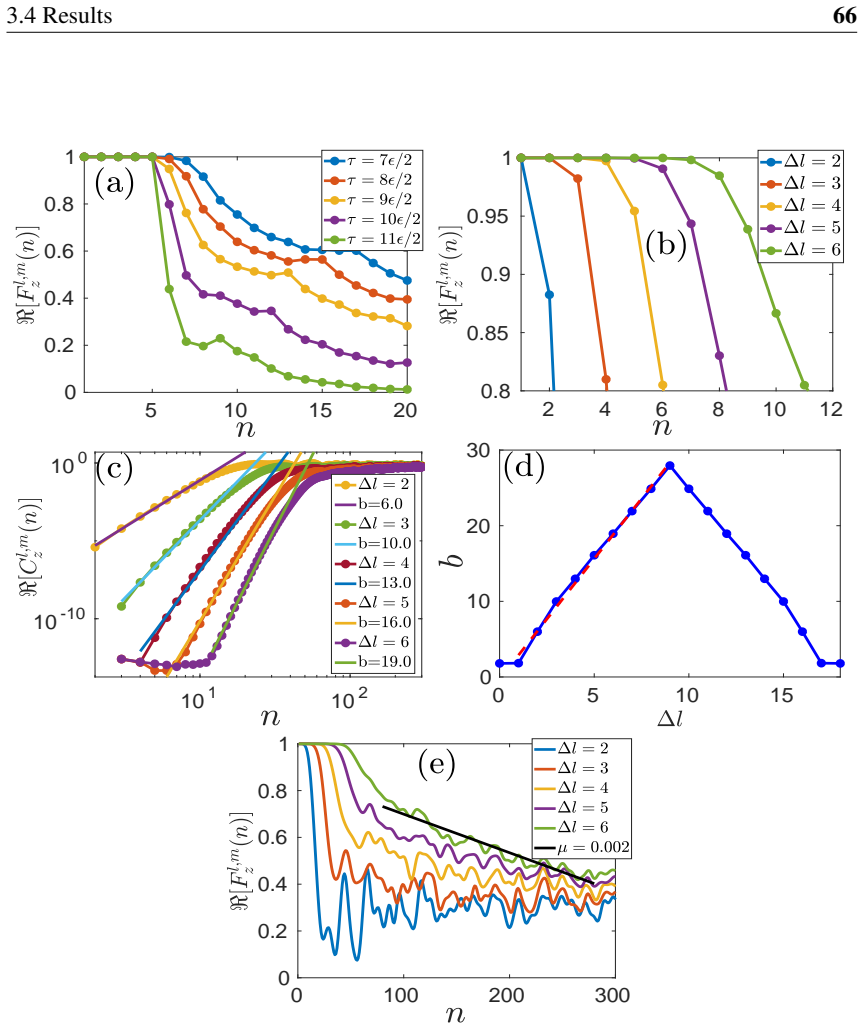
- [Sec. 3.4, Eqs. (3.16)-(3.21)] The power-law exponent formulas b(Δl) are presented as quantitative characterization of the dynamic regime, but they are fits to N=18 data with fitted constants κ, bmax, b0, and λ, without confidence intervals, fitting ranges, or collapse tests. In particular, the distinction between the triangular form of Eq. (3.16) and the quadratic form of Eq. (3.20) is based on a small number of data points in Fig. 3.6(d). Please report the fitting procedure, error bars, and a stability check with respect to the fitting interval, or soften the claims accordingly.
minor comments (4)
- [Sec. 5.2.1 vs. Sec. 5.2.4] The notation for the suppression rate changes from ξ in Sec. 5.2.1 to ζ in Sec. 5.2.4 and Fig. 5.2(c); please unify the notation and explicitly define the D=0 limits of both ξ and ζ.
- [Fig. 2.4 caption] The caption labels both panels as "F^l,l_x(n)"; one of the panels is presumably F^l,l_z(n) based on the surrounding text.
- [Sec. 5.2.3, text near Eq. (5.7)] The notation ωs(±D,k±_s) mixes a two-dimensional wave vector with the one-dimensional dispersion written in terms of kx, and the statement that m0 ranges from 1 to N is followed by the specific choice m0=N; please make the summation over m0 explicit.
- [Throughout] The manuscript is formatted as a PhD thesis and contains institutional front matter and declarations; for journal review, the arXiv submission should be reformatted into a standard article structure with consolidated references.
Circularity Check
The QID rectification curve is built on a hand-inserted ζ(D)=e^{-D/5}, so the field-controlled diode rectification reduces by construction; the OTOC phase-structure and operator-entanglement claims are self-contained.
full rationale
The long-time-averaged LMOTOC order parameter in Chapter 2 is a numerical observable computed from the Floquet map Eq. (2.1) and compared with the known phase diagram; the TMOTOC formula is derived via Jordan-Wigner (Appendix A), so it is self-contained. Chapter 4's identity between the GUE-averaged OTOC and operator entanglement entropy is a mathematical derivation from the definitions of C2, C4 and the Schmidt decomposition (Eqs. (4.8)-(4.10)); it is not a renamed empirical pattern. Chapter 3's power-law exponents and saturation slopes are descriptive fits to the same numerical OTOC data they summarize, but the paper does not use them to predict independent quantities, so they do not constitute circular derivation. The circular step is localized to Chapter 5: the rectification coefficient R(D) is computed from an interpolated ζ(D)≈e^{-D/5}, and with D=E_y g_ME the field-dependence of the diode is exactly the assumed damping law. This makes the central QID claim partially circular. I also note the D=0 inconsistency (ζ(0)=1 versus the stated R=1) as a correctness concern, but the circularity verdict rests on the explicit free-parameter status of ζ. Score 6 reflects partial circularity in one of the thesis's three central claims; the OTOC phase-structure and operator-entanglement results remain independent.
Assumptions & free parameters
free parameters (4)
- Power-law exponent constants (kappa, bmax, b0, lambda) =
kappa=3.2, bmax between 24 and 32.9, b0 between 1.7 and 1.9, lambda=2.8
- Saturation decay slopes mu =
mu=0.002, 10^-5, 0.14, 0.77, 0.85 in different sections
- Suppression rate zeta(D) =
zeta(D) approximately e^{-D/5}
- Finite-size critical exponent 1/nu =
0.8314 +/- 0.1122
assumptions (5)
- standard math The kicked transverse-field Ising model at hx=0 maps via the Jordan-Wigner transformation to noninteracting fermions.
- domain assumption Trace over the full Hilbert space can be replaced by expectation values in a small number of Haar-random states for finite N.
- domain assumption The 2D DMI magnet with electric-field-induced polarization is accurately described by a Holstein-Primakoff boson Hamiltonian truncated at quadratic order.
- domain assumption Fully polarized initial states reproduce random-state or trace behavior of OTOCs in all three regimes: characteristic, dynamic, and saturation.
- standard math Spectral statistics after unfolding distinguish integrable (Poisson) and chaotic (Wigner-Dyson) phases.
invented entities (1)
-
Quantum information diode (QID)
Cite this review
Pith. "Pith review of Out-of-time-order correlation in the quantum Ising Floquet spin system and magnonic crystals." pith.science (2026). https://pith.science/paper/ZARVZM3O
@misc{pith2026250507550,
  author       = {Pith},
  title        = {Pith review of: Out-of-time-order correlation in the quantum Ising Floquet spin system and magnonic crystals},
  year         = {2026},
  howpublished = {\url{https://pith.science/paper/ZARVZM3O}},
  note         = {Machine review of arXiv:2505.07550}
}
read the original abstract
In recent times out-of-time-order correlators (OTOC) have been established as a tool to understand butterfly effects, quantum information scrambling, and many-body localization. They can also be useful in determining different phases of quantum critical systems. OTOCs can identify the quantum chaos within a system undergoing time evolution; and therefore, they can distinguish between chaotic and regular dynamics. This motivates us to study OTOCs in integrable and nonintegrable periodically kicked quantum spin models. A periodically kicked quantum Ising spin system, known as the quantum Ising Floquet system, is a variant of the transverse Ising model. In place of constant transverse magnetic fields in the transverse Ising system, time-periodic fields are applied in the form of delta pulses in the quantum Ising Floquet spin system. It provides very interesting and peculiar dynamics separate from that of the transverse Ising system.
Figures


Figures from the paper (32 more)




Reference graph
Works this paper leans on
-
[1]
Measures and applications of quantum correlations
Adesso, G., Bromley, T. R. & Cianciaruso, M. “Measures and applications of quantum correlations”. Journal of Physics A: Mathematical and Theoretical 49, 473001 (2016)
2016
-
[2]
Text book of correlations and regression
Sharma, A. K. “Text book of correlations and regression” (Discovery Publishing House, 2005)
2005
-
[3]
Mixed-state entanglement and quantum error correction
Bennett, C. H., DiVincenzo, D. P., Smolin, J. A. & Wootters, W. K. “Mixed-state entanglement and quantum error correction”. Phys. Rev. A 54, 3824 (1996)
1996
-
[4]
Concentrating partial entanglement by local operations
Bennett, C. H., Bernstein, H. J., Popescu, S. & Schumacher, B. “Concentrating partial entanglement by local operations”. Phys. Rev. A 53, 2046 (1996)
1996
-
[5]
Classical, quantum and total correlations
Henderson, L. & Vedral, V . “Classical, quantum and total correlations”.Journal of physics A: mathematical and general 34, 6899 (2001)
2001
-
[6]
The mathematical theory of communication
Shannon, C. & Weaver, W. “The mathematical theory of communication” (Univ. of Illinois Press, Urbana., 1949)
1949
-
[7]
Quantum computation and quantum information
Nielsen, M. A. & Chuang, I. “Quantum computation and quantum information” (American Association of Physics Teachers, 2002)
2002
-
[8]
Fractional statistics and the butterfly effect
Gu, Y . & Qi, X.-L. “Fractional statistics and the butterfly effect”.Journal of High Energy Physics 08, 129 (2016)
2016
Show all 254 references
-
[9]
Temperature dependence of the butterfly effect in a classical many-body system
Bilitewski, T., Bhattacharjee, S. & Moessner, R. “Temperature dependence of the butterfly effect in a classical many-body system”. Phys. Rev. Lett. 121, 250602 (2018)
2018
-
[10]
Light-cone spreading of perturbations and the butterfly effect in a classical spin chain
Das, A. et al. “Light-cone spreading of perturbations and the butterfly effect in a classical spin chain”. Phys. Rev. Lett. 121, 024101 (2018)
2018
-
[11]
Out-of-time-order correlation for many- body localization
Fan, R., Zhang, P., Shen, H. & Zhai, H. “Out-of-time-order correlation for many- body localization”. Science Bulletin 62, 707 (2017)
2017
-
[12]
Out-of-time-ordered correlators in many-body localized systems
Huang, Y ., Zhang, Y .-L. & Chen, X. “Out-of-time-ordered correlators in many-body localized systems”. Annalen der Physik 529, 1600318 (2017)
2017
-
[13]
Signature of chaos and delocalization in a periodically driven many-body system: An out-of-time-order-correlation study
Ray, S., Sinha, S. & Sengupta, K. “Signature of chaos and delocalization in a periodically driven many-body system: An out-of-time-order-correlation study”. Phys. Rev. A 98, 053631 (2018). REFERENCES 111
2018
-
[14]
Chaos in quantum channels
Hosur, P., Qi, X.-L., Roberts, D. A. & Yoshida, B. “Chaos in quantum channels”. Journal of High Energy Phys. 02, 004 (2016)
2016
-
[15]
Holographic butterfly effect at quantum critical points
Ling, Y ., Liu, P. & Wu, J.-P. “Holographic butterfly effect at quantum critical points”. Journal of High Energy Physics 10, 025 (2017)
2017
-
[16]
Interferometric approach to probing fast scrambling
Yao, N. Y .et al. “Interferometric approach to probing fast scrambling”. arXiv preprint arXiv:1607.01801 (2016)
2016 arXiv
-
[17]
Measurement of many-body chaos using a quantum clock
Zhu, G., Hafezi, M. & Grover, T. “Measurement of many-body chaos using a quantum clock”. Phys. Rev. A 94, 062329 (2016)
2016
-
[18]
Measuring the scram- bling of quantum information
Swingle, B., Bentsen, G., Schleier-Smith, M. & Hayden, P. “Measuring the scram- bling of quantum information”. Phys. Rev. A 94, 040302 (2016)
2016
-
[19]
Quasiclassical method in the theory of supercon- ductivity
Larkin, A. & Ovchinnikov, Y . N. “Quasiclassical method in the theory of supercon- ductivity”. Sov Phys JETP 28, 1200 (1969)
1969
-
[20]
Scrambling and quantum feedback in a nanomechanical system
Singh, A., Sachan, K., Chotorlishvili, L., Vipin, V . & Mishra, S. K. “Scrambling and quantum feedback in a nanomechanical system”. The European Phys. Journal D 76, 1–12 (2022)
2022
-
[21]
Hidden correlations in the Hawking radiation and thermal noise, talk at Breakthrough Prize Symposium
Kitaev, A. “Hidden correlations in the Hawking radiation and thermal noise, talk at Breakthrough Prize Symposium”. San Francisco USA (2014)
2014
-
[22]
Stringy effects in scrambling
Shenker, S. H. & Stanford, D. “Stringy effects in scrambling”. Journal of High Energy Phys. 05, 132 (2015)
2015
-
[23]
Quantum Coherence in Mesoscopic Systems
Haake, F. “Quantum Coherence in Mesoscopic Systems” (Springer, 1991)
1991
-
[24]
Lyapunov exponent and out-of- time-ordered correlator’s growth rate in a chaotic system
Rozenbaum, E. B., Ganeshan, S. & Galitski, V . “Lyapunov exponent and out-of- time-ordered correlator’s growth rate in a chaotic system”. Phys. Rev. Lett. 118, 086801 (2017)
2017
-
[25]
Out-of-time-order correlation and detec- tion of phase structure in Floquet transverse Ising spin system
Shukla, R. K., Naik, G. K. & Mishra, S. K. “Out-of-time-order correlation and detec- tion of phase structure in Floquet transverse Ising spin system”. EPL (Europhysics Lett.) 132, 47003 (2021)
2021
-
[26]
Chaos signatures in the short and long time behavior of the out-of-time ordered correlator
García-Mata, I., Saraceno, M., Jalabert, R. A., Roncaglia, A. J. & Wisniacki, D. A. “Chaos signatures in the short and long time behavior of the out-of-time ordered correlator”. Phys. Rev. Lett. 121, 210601 (2018)
2018
-
[27]
Early-time exponential instabilities in nonchaotic quantum systems
Rozenbaum, E. B., Bunimovich, L. A. & Galitski, V . “Early-time exponential instabilities in nonchaotic quantum systems”. Phys. Rev. Lett. 125, 014101 (2020)
2020
-
[28]
Chaos and Fractals: The Mathematics Behind the Computer Graphics: The Mathematics Behind the Computer Graphics
Devaney, R. L. et al. “Chaos and Fractals: The Mathematics Behind the Computer Graphics: The Mathematics Behind the Computer Graphics” , vol. 1 (American Mathematical Soc., 1989)
1989
-
[29]
Man’s Rage for Chaos. Biology, Behavior, and the Arts by Morse Peckham
Weeks, D. “Man’s Rage for Chaos. Biology, Behavior, and the Arts by Morse Peckham”. The Journal of Aesthetics and Art Criticism 25, 470–470 (1967). REFERENCES 112
1967
-
[30]
Simple mathematical models with complicated dynamics
Robert, M. “Simple mathematical models with complicated dynamics”. Nature 261, 459–467 (1976)
1976
-
[31]
Chaos and nonlinear dynamics: an introduction for scientists and engineers
Hilborn, R. C. et al. “Chaos and nonlinear dynamics: an introduction for scientists and engineers” (Oxford University Press on Demand, 2000)
2000
-
[32]
The Transition to Chaos
REICHL, L. “The Transition to Chaos” (Springer-Verlag, New York, 1992)
1992
-
[33]
Chaos and stability of the solar system
Malhotra, R., Holman, M. & Ito, T. “Chaos and stability of the solar system”. Proceedings of the National Academy of Sciences 98, 12342–12343 (2001)
2001
-
[34]
Self-organized biological dynamics and nonlinear control: toward understanding complexity, chaos and emergent function in living systems
Walleczek, J. “Self-organized biological dynamics and nonlinear control: toward understanding complexity, chaos and emergent function in living systems” (Cam- bridge University Press, 2006)
2006
-
[35]
Regular and chaotic dynamics
Lichtenberg, A. J. & Lieberman, M. A. “Regular and chaotic dynamics”, vol. 38 (Springer Science & Business Media, 2013)
2013
-
[36]
Chaos in dynamical systems
Ott, E. “Chaos in dynamical systems” (Cambridge university press, 2002)
2002
-
[37]
Nonlinear dynamics and chaos: with applications to physics, biology, chemistry, and engineering
Strogatz, S. H. “Nonlinear dynamics and chaos: with applications to physics, biology, chemistry, and engineering” (CRC press, 2018)
2018
-
[38]
Nonlinear dynamics and chaos
Thompson, J. M. T., Stewart, H. B. & Turner, R. “Nonlinear dynamics and chaos”. Computers in Physics 4, 562–563 (1990)
1990
-
[39]
Scrambling and entanglement spreading in long-range spin chains
Pappalardi, S. et al. “Scrambling and entanglement spreading in long-range spin chains”. Phys. Rev. B 98, 134303 (2018)
2018
-
[40]
Validity of many-body approximation methods for a solvable model:(I). Exact solutions and perturbation theory
Lipkin, H. J., Meshkov, N. & Glick, A. “Validity of many-body approximation methods for a solvable model:(I). Exact solutions and perturbation theory”. Nuclear Physics 62, 188–198 (1965)
1965
-
[41]
Nonlinear atom interferometer surpasses classical precision limit
Gross, C., Zibold, T., Nicklas, E., Esteve, J. & Oberthaler, M. K. “Nonlinear atom interferometer surpasses classical precision limit”. Nature 464, 1165–1169 (2010)
2010
-
[42]
Classical bifurcation at the transition from Rabi to Josephson dynamics
Zibold, T., Nicklas, E., Gross, C. & Oberthaler, M. K. “Classical bifurcation at the transition from Rabi to Josephson dynamics”. Phys. Rev. Lett. 105, 204101 (2010)
2010
-
[43]
Classical bifurcation in a quadrupolar NMR system
Araujo-Ferreira, A. et al. “Classical bifurcation in a quadrupolar NMR system”. Phys. Rev. A 87, 053605 (2013)
2013
-
[44]
Physical versus mathematical billiards: From regular dynamics to chaos and back
Bunimovich, L. “Physical versus mathematical billiards: From regular dynamics to chaos and back”. Chaos: An Interdisciplinary Journal of Nonlinear Science 29, 091105 (2019)
2019
-
[45]
Condition of stochasticity in quantum nonlinear systems
Berman, G. P. & Zaslavsky, G. M. “Condition of stochasticity in quantum nonlinear systems”. Physica A: Statistical Mechanics and its Applications 91, 450–460 (1978)
1978
-
[46]
Quantal lyapunov exponent
Toda, M. & Ikeda, K. “Quantal lyapunov exponent”. Physics Lett. A 124, 165–169 (1987). REFERENCES 113
1987
-
[47]
Modern quantum mechanics, revised edition
Sakurai, J. J. & Commins, E. D. “Modern quantum mechanics, revised edition” (American Association of Physics Teachers, 1995)
1995
-
[48]
History of the Lenz-Ising model
Brush, S. G. “History of the Lenz-Ising model”. Reviews of modern physics 39, 883 (1967)
1967
-
[49]
Quantum Ising phases and transitions in transverse Ising models
Chakrabarti, B. K., Dutta, A. & Sen, P. “Quantum Ising phases and transitions in transverse Ising models”, vol. 41 (Springer Science & Business Media, 2008)
2008
-
[50]
Detecting equilibrium and dynamical quantum phase transitions in Ising chains via out-of-time-ordered correlators
Heyl, M., Pollmann, F. & Dóra, B. “Detecting equilibrium and dynamical quantum phase transitions in Ising chains via out-of-time-ordered correlators”. Phys. Rev. Lett. 121, 016801 (2018)
2018
-
[51]
Local entanglement and quantum phase transition in a one-dimensional transverse field Ising model
Su, S.-Q., Song, J.-L. & Gu, S.-J. “Local entanglement and quantum phase transition in a one-dimensional transverse field Ising model”. Phys. Rev. A 74, 032308 (2006)
2006
-
[52]
Quantum phase transition of the one-dimensional transverse-field compass model
Sun, K.-W. & Chen, Q.-H. “Quantum phase transition of the one-dimensional transverse-field compass model”. Phys. Rev. B 80, 174417 (2009)
2009
-
[53]
Integrable floquet dynamics
Gritsev, V ., Polkovnikov, A.et al. “Integrable floquet dynamics”. SciPost Phys 2, 021 (2017)
2017
-
[54]
Multipartite entanglement in a one- dimensional time-dependent Ising model
Lakshminarayan, A. & Subrahmanyam, V . “Multipartite entanglement in a one- dimensional time-dependent Ising model”. Phys. Rev. A 71, 062334 (2005)
2005
-
[55]
Controlled generation of genuine mul- tipartite entanglement in Floquet Ising spin models
Naik, G. K., Singh, R. & Mishra, S. K. “Controlled generation of genuine mul- tipartite entanglement in Floquet Ising spin models”. Phys. Rev. A 99, 032321 (2019)
2019
-
[56]
A thermodynamic theory of “weak
Dzyaloshinsky, I. “A thermodynamic theory of “weak” ferromagnetism of antiferro- magnetics”. Journal of physics and chemistry of solids 4, 241–255 (1958)
1958
-
[57]
Anisotropic superexchange interaction and weak ferromagnetism
Moriya, T. “Anisotropic superexchange interaction and weak ferromagnetism”. Phys. Rev. 120, 91 (1960)
1960
-
[58]
Out-of-time-ordered correlators in a quantum Ising chain
Lin, C.-J. & Motrunich, O. I. “Out-of-time-ordered correlators in a quantum Ising chain”. Phys. Rev. B 97, 144304 (2018)
2018
-
[59]
Accessing scrambling using matrix product operators
Xu, S. & Swingle, B. “Accessing scrambling using matrix product operators”. Nature Physics 16, 199–204 (2020)
2020
-
[60]
Locality, quantum fluctuations, and scrambling
Xu, S. & Swingle, B. “Locality, quantum fluctuations, and scrambling”. Phys. Rev. X 9, 031048 (2019)
2019
-
[61]
Weak quantum chaos
Kukuljan, I., Grozdanov, S. & Prosen, T. “Weak quantum chaos”. Phys. Rev. B 96, 060301 (2017)
2017
-
[62]
Gauging classical and quantum integrability through out-of-time-ordered correlators
Fortes, E. M., García-Mata, I., Jalabert, R. A. & Wisniacki, D. A. “ Gauging classical and quantum integrability through out-of-time-ordered correlators”. Phys. Rev. E 100, 042201 (2019)
2019
-
[63]
Lyapunov growth in quantum spin chains
Craps, B., De Clerck, M., Janssens, D., Luyten, V . & Rabideau, C. “Lyapunov growth in quantum spin chains”. Phys. Rev. B 101, 174313 (2020). REFERENCES 114
2020
-
[64]
Entanglement entropy and out-of-time-order correlator in the long-range Aubry–André–Harper model
Roy, N. & Sharma, A. “Entanglement entropy and out-of-time-order correlator in the long-range Aubry–André–Harper model”. Journal of Physics: Condensed Matter 33, 334001 (2021)
2021
-
[65]
Similar early growth of out-of-time-ordered correlators in quantum chaotic and integrable ising chains
Yan, H., Wang, J.-Z. & Wang, W.-G. “Similar early growth of out-of-time-ordered correlators in quantum chaotic and integrable ising chains”. Communications in Theoretical Phys. 71, 1359 (2019)
2019
-
[66]
Out-of-time-order correlators in the one-dimensional XY model
Bao, J.-H. & Zhang, C.-Y . “Out-of-time-order correlators in the one-dimensional XY model”. Communications in Theoretical Phys. 72, 085103 (2020)
2020
-
[67]
Out-of-time-ordered density correlators in Luttinger liquids
Dóra, B. & Moessner, R. “Out-of-time-ordered density correlators in Luttinger liquids”. Phys. Rev. Lett. 119, 026802 (2017)
2017
-
[68]
Out-of-time ordered correlators and entanglement growth in the random-field XX spin chain
Riddell, J. & Sørensen, E. S. “Out-of-time ordered correlators and entanglement growth in the random-field XX spin chain”. Phys. Rev. B 99, 054205 (2019)
2019
-
[69]
Typical growth behavior of the out-of-time-ordered commutator in many-body localized systems
Lee, J., Kim, D. & Kim, D.-H. “Typical growth behavior of the out-of-time-ordered commutator in many-body localized systems”. Phys. Rev. B 99, 184202 (2019)
2019
-
[70]
Numerical study of fermion and boson models with infinite-range random interactions
Fu, W. & Sachdev, S. “ Numerical study of fermion and boson models with infinite-range random interactions”. Phys. Rev. B 94, 035135 (2016)
2016
-
[71]
Level clustering in the regular spectrum
Berry, M. V . & Tabor, M. “Level clustering in the regular spectrum”.Proceedings of the Royal Society of London. A. Mathematical and Physical Sciences 356, 375–394 (1977)
1977
-
[72]
Characterization of chaotic quantum spectra and universality of level fluctuation laws
Bohigas, O., Giannoni, M.-J. & Schmit, C. “Characterization of chaotic quantum spectra and universality of level fluctuation laws”. Phys. Rev. Lett. 52, 1 (1984)
1984
-
[73]
Regular and irregular semiclassical wavefunctions
Berry, M. V . “Regular and irregular semiclassical wavefunctions”. Journal of Physics A: Mathematical and General 10, 2083 (1977)
1977
-
[74]
Quantum statistical mechanics in a closed system
Deutsch, J. M. “Quantum statistical mechanics in a closed system”. Phys. Rev. A 43, 2046 (1991)
1991
-
[75]
Chaos and quantum thermalization
Srednicki, M. “Chaos and quantum thermalization”. Phys. Rev. e 50, 888 (1994)
1994
-
[76]
From quantum chaos and eigenstate thermalization to statistical mechanics and thermodynamics
D’Alessio, L., Kafri, Y ., Polkovnikov, A. & Rigol, M. “From quantum chaos and eigenstate thermalization to statistical mechanics and thermodynamics”. Advances in Physics 65, 239–362 (2016)
2016
-
[77]
Random matrices
Mehta, M. L. “Random matrices”. 3rd ed. (Academic Press, Cambridge, MA, 2004)
2004
-
[78]
Angular focusing, squeezing, and rainbow formation in a strongly driven quantum rotor
Averbukh, I. S. & Arvieu, R. “Angular focusing, squeezing, and rainbow formation in a strongly driven quantum rotor”. Phys. Rev. Lett. 87, 163601 (2001)
2001
-
[79]
Spin wave wells in nonellipsoidal micrometer size magnetic elements
Jorzick, J. et al. “Spin wave wells in nonellipsoidal micrometer size magnetic elements”. Phys. Rev. Lett. 88, 047204 (2002)
2002
-
[80]
Lateral quantization of spin waves in micron size magnetic wires
Mathieu, C. et al. “Lateral quantization of spin waves in micron size magnetic wires”. Phys. Rev. Lett. 81, 3968 (1998). REFERENCES 115
1998
-
[81]
Spin-wave interference in microscopic rings
Podbielski, J., Giesen, F. & Grundler, D. “Spin-wave interference in microscopic rings”. Phys. Rev. Lett. 96, 167207 (2006)
2006
-
[82]
Frequency-dependent reflection of spin waves from a magnetic inhomogeneity induced by a surface direct current
Neumann, T., Serga, A., Hillebrands, B. & Kostylev, M. “Frequency-dependent reflection of spin waves from a magnetic inhomogeneity induced by a surface direct current”. Applied Physics Lett. 94, 042503 (2009)
2009
-
[83]
YIG magnonics
Serga, A., Chumak, A. & Hillebrands, B. “YIG magnonics”. Journal of Physics D: Applied Physics 43, 264002 (2010)
2010
-
[84]
Structure and ferrimagnetism of yttrium and rare-earth–iron garnets
Geller, S. & Gilleo, M. “Structure and ferrimagnetism of yttrium and rare-earth–iron garnets”. Acta Crystallographica 10, 239–239 (1957)
1957
-
[85]
Scattering of backward spin waves in a one-dimensional magnonic crystal
Chumak, A., Serga, A., Hillebrands, B. & Kostylev, M. “Scattering of backward spin waves in a one-dimensional magnonic crystal”. Applied Physics Lett. 93, 022508 (2008)
2008
-
[86]
A current- controlled, dynamic magnonic crystal
Chumak, A., Neumann, T., Serga, A., Hillebrands, B. & Kostylev, M. “A current- controlled, dynamic magnonic crystal”. Journal of Physics D: Applied Physics 42, 205005 (2009)
2009
-
[87]
Spectrum and reflection of spin waves in magnonic crystals with different interface profiles
Tkachenko, V ., Kruglyak, V . & Kuchko, A. “Spectrum and reflection of spin waves in magnonic crystals with different interface profiles”. Phys. Rev. B 81, 024425 (2010)
2010
-
[88]
Design and optimization of one-dimensional ferrite-film based magnonic crystals
Chumak, A., Serga, A., Wolff, S., Hillebrands, B. & Kostylev, M. “Design and optimization of one-dimensional ferrite-film based magnonic crystals”. Journal of Applied Physics 105, 083906 (2009)
2009
-
[89]
Magnon transistor for all-magnon data processing
Chumak, A. V ., Serga, A. A. & Hillebrands, B. “Magnon transistor for all-magnon data processing”. Nature communications 5, 1–8 (2014)
2014
-
[90]
Magnetization oscillations and waves
Gurevich, A. G. & Melkov, G. A. “Magnetization oscillations and waves” (CRC press, 1996)
1996
-
[91]
Scrambling and thermalization in a diffusive quantum many-body system
Bohrdt, A., Mendl, C. B., Endres, M. & Knap, M. “Scrambling and thermalization in a diffusive quantum many-body system”. New Journal of Physics 19, 063001 (2017)
2017
-
[92]
Seeing scrambled spins
Swingle, B. & Yao, N. Y . “Seeing scrambled spins”. Physics 10, 82 (2017)
2017
-
[93]
Quantum Simulation: Probing information scrambling
Schleier-Smith, M. “Quantum Simulation: Probing information scrambling”.Nature Physics 13, 724–726 (2017)
2017
-
[94]
Hierarchy of information scrambling, thermalization, and hydrodynamic flow in graphene
Klug, M. J., Scheurer, M. S. & Schmalian, J. “Hierarchy of information scrambling, thermalization, and hydrodynamic flow in graphene”. Phys. Rev. B 98, 045102 (2018)
2018
-
[95]
Operator Spreading and the Emergence of Dissipative Hydrodynamics under Unitary Evolution with Conservation Laws
Khemani, V ., Vishwanath, A. & Huse, D. A. “Operator Spreading and the Emergence of Dissipative Hydrodynamics under Unitary Evolution with Conservation Laws”. Phys. Rev. X 8, 031057 (2018). REFERENCES 116
2018
-
[96]
Scrambling in the Dicke model
Alavirad, Y . & Lavasani, A. “Scrambling in the Dicke model”. Phys. Rev. A 99, 043602 (2019)
2019
-
[97]
A bound on chaos
Maldacena, J., Shenker, S. H. & Stanford, D. “A bound on chaos”. Journal of High Energy Phys. 08, 106 (2016)
2016
-
[98]
Black holes and the butterfly effect
Shenker, S. H. & Stanford, D. “Black holes and the butterfly effect”. Journal of High Energy Physics 03, 067 (2014)
2014
-
[99]
Localized shocks
Roberts, D. A., Stanford, D. & Susskind, L. “Localized shocks”. Journal of High Energy Phys. 03, 051 (2015)
2015
-
[100]
Measuring out-of-time-order correlations and multiple quantum spectra in a trapped-ion quantum magnet
Gärttner, M. et al. “Measuring out-of-time-order correlations and multiple quantum spectra in a trapped-ion quantum magnet”. Nature Physics 13, 781–786 (2017)
2017
-
[101]
Measuring out-of-time-order correlators on a nuclear magnetic reso- nance quantum simulator
Li, J. et al. “Measuring out-of-time-order correlators on a nuclear magnetic reso- nance quantum simulator”. Phys. Rev. X 7, 031011 (2017)
2017
-
[102]
Out-of-time-order correlation at a quantum phase transition
Shen, H., Zhang, P., Fan, R. & Zhai, H. “Out-of-time-order correlation at a quantum phase transition”. Phys. Rev. B 96, 054503 (2017)
2017
-
[103]
Out-of-Time-Order Correla- tors and Quantum Phase Transitions in the Rabi and Dicke Models
Sun, Z.-H., Cai, J.-Q., Tang, Q.-C., Hu, Y . & Fan, H. “Out-of-Time-Order Correla- tors and Quantum Phase Transitions in the Rabi and Dicke Models”. Annalen der Physik 532, 1900270 (2020)
2020
-
[104]
Dynamical Quantum Phase Transitions in the Transverse-Field Ising Model
Heyl, M., Polkovnikov, A. & Kehrein, S. “Dynamical Quantum Phase Transitions in the Transverse-Field Ising Model”. Phys. Rev. Lett. 110, 135704 (2013)
2013
-
[105]
Entanglement spectrum of a topological phase in one dimension
Pollmann, F., Turner, A. M., Berg, E. & Oshikawa, M. “Entanglement spectrum of a topological phase in one dimension”. Phys. Rev. B 81, 064439 (2010)
2010
-
[106]
Phase structure of one-dimensional interacting Floquet systems. I. Abelian symmetry-protected topological phases
V on Keyserlingk, C. W. & Sondhi, S. L. “Phase structure of one-dimensional interacting Floquet systems. I. Abelian symmetry-protected topological phases”. Phys. Rev. B 93, 245145 (2016)
2016
-
[107]
Floquet generation of Majorana end modes and topological invariants
Thakurathi, M., Patel, A. A., Sen, D. & Dutta, A. “Floquet generation of Majorana end modes and topological invariants”. Phys. Rev. B 88, 155133 (2013)
2013
-
[108]
Topological phases of one-dimensional fermions: An entanglement point of view
Turner, A. M., Pollmann, F. & Berg, E. “Topological phases of one-dimensional fermions: An entanglement point of view”. Phys. Rev. B 83, 075102 (2011)
2011
-
[109]
Phase structure of one-dimensional interacting Floquet systems. II. Symmetry-broken phases
V on Keyserlingk, C. W. & Sondhi, S. L. “Phase structure of one-dimensional interacting Floquet systems. II. Symmetry-broken phases”. Phys. Rev. B 93, 245146 (2016)
2016
-
[110]
Topological characterization of quantum phase transitions in a spin-1/2 model
Feng, X.-Y ., Zhang, G.-M. & Xiang, T. “Topological characterization of quantum phase transitions in a spin-1/2 model”. Phys. Rev. Lett. 98, 087204 (2007)
2007
-
[111]
Nonequilibrium quantum phase transitions in the Ising model
Bastidas, V . M., Emary, C., Schaller, G. & Brandes, T. “Nonequilibrium quantum phase transitions in the Ising model”. Phys. Rev. A 86, 063627 (2012)
2012
-
[112]
Majorana Fermions in Equilibrium and in Driven Cold-Atom Quantum Wires
Jiang, L. et al. “Majorana Fermions in Equilibrium and in Driven Cold-Atom Quantum Wires”. Phys. Rev. Lett. 106, 220402 (2011). REFERENCES 117
2011
-
[113]
Topological phases of fermions in one dimension
Fidkowski, L. & Kitaev, A. “Topological phases of fermions in one dimension”. Phys. Rev. B 83, 075103 (2011)
2011
-
[114]
Phase structure of driven quantum systems
Khemani, V ., Lazarides, A., Moessner, R. & Sondhi, S. L. “Phase structure of driven quantum systems”. Phys. Rev. Lett. 116, 250401 (2016)
2016
-
[115]
Majorana edge modes in the Kitaev model
Thakurathi, M., Sengupta, K. & Sen, D. “Majorana edge modes in the Kitaev model”. Phys. Rev. B 89, 235434 (2014)
2014
-
[116]
Particle-time duality in the kicked Ising spin chain
Akila, M., Waltner, D., Gutkin, B. & Guhr, T. “Particle-time duality in the kicked Ising spin chain”. Journal of Phys A 49, 375101 (2016)
2016
-
[117]
Floquet supersymmetry
Iadecola, T. & Hsieh, T. H. “Floquet supersymmetry”. Phys. Rev. Lett. 120, 210603 (2018)
2018
-
[118]
Eigenstate phase transitions and the emergence of universal dynamics in highly excited states
Parameswaran, S. A., Potter, A. C. & Vasseur, R. “Eigenstate phase transitions and the emergence of universal dynamics in highly excited states”. Annalen der Physik 529, 1600302 (2017)
2017
-
[119]
A floquet model for the many-body localization transition
Zhang, L., Khemani, V . & Huse, D. A. “A floquet model for the many-body localization transition”. Phys. Rev. B 94, 224202 (2016)
2016
-
[120]
Spectral form factor as an OTOC averaged over the Heisenberg group
de Mello Koch, R., Huang, J.-H., Ma, C.-T. & Van Zyl, H. J. “Spectral form factor as an OTOC averaged over the Heisenberg group”. Physics Lett. B 795, 183–187 (2019)
2019
-
[121]
2D CFT partition functions at late times
Dyer, E. & Gur-Ari, G. “2D CFT partition functions at late times”. Journal of High Energy Physics 2017, 75 (2017)
2017
-
[122]
Dynamic phase transition, universality, and finite-size scaling in the two-dimensional kinetic Ising model in an oscillating field
Korniss, G., White, C., Rikvold, P. & Novotny, M. “Dynamic phase transition, universality, and finite-size scaling in the two-dimensional kinetic Ising model in an oscillating field”. Phys. Rev. E 63, 016120 (2000)
2000
-
[123]
Experimental Realization of Floquet PT -Symmetric Systems
Chitsazi, M., Li, H., Ellis, F. M. & Kottos, T. “Experimental Realization of Floquet PT -Symmetric Systems”. Phys. Rev. Lett. 119, 093901 (2017)
2017
-
[124]
Chaos in Classical and Quantum Mechanics Springer-Verlag
Gutzwiller, M. C. “Chaos in Classical and Quantum Mechanics Springer-Verlag”. New York (1990)
1990
-
[125]
Many-body chaos at weak coupling
Stanford, D. “Many-body chaos at weak coupling”. Journal of High Energy Phys. 10, 009 (2016)
2016
-
[126]
Microscopic model of quantum butterfly effect: out-of-time-order correlators and traveling combustion waves
Aleiner, I. L., Faoro, L. & Ioffe, L. B. “Microscopic model of quantum butterfly effect: out-of-time-order correlators and traveling combustion waves”. Annals of Phys. 375, 378–406 (2016)
2016
-
[127]
Lieb-Robinson bound and the butterfly effect in quantum field theories
Roberts, D. A. & Swingle, B. “Lieb-Robinson bound and the butterfly effect in quantum field theories”. Phys. Rev. Lett. 117, 091602 (2016)
2016
-
[128]
Exploring localization in nuclear spin chains
Wei, K. X., Ramanathan, C. & Cappellaro, P. “Exploring localization in nuclear spin chains”. Phys. Rev. Lett. 120, 070501 (2018). REFERENCES 118
2018
-
[129]
Analysis of the buildup of spatiotemporal correlations and their bounds outside of the light cone
Abeling, N., Cevolani, L. & Kehrein, S. “Analysis of the buildup of spatiotemporal correlations and their bounds outside of the light cone”. SciPost Physics 5, 052 (2018)
2018
-
[130]
Detection of quantum phases via out-of-time- order correlators
Da˘g, C. B., Sun, K. & Duan, L.-M. “Detection of quantum phases via out-of-time- order correlators”. Phys. Rev. Lett. 123, 140602 (2019)
2019
-
[131]
Black hole scrambling from hydrody- namics
Grozdanov, S., Schalm, K. & Scopelliti, V . “Black hole scrambling from hydrody- namics”. Phys. Rev. Lett. 120, 231601 (2018)
2018
-
[132]
Detecting the out-of-time-order correlations of dynamical quantum phase transitions in a solid-state quantum simulator
Chen, B. et al. “Detecting the out-of-time-order correlations of dynamical quantum phase transitions in a solid-state quantum simulator”. Applied Phys. Lett. 116, 194002 (2020)
2020
-
[133]
Thermodynamics of quantum information scrambling
Campisi, M. & Goold, J. “Thermodynamics of quantum information scrambling”. Phys. Rev. E 95, 062127 (2017)
2017
-
[134]
Jarzynski-like equality for the out-of-time-ordered correlator
Halpern, N. Y . “Jarzynski-like equality for the out-of-time-ordered correlator”. Phys. Rev. A 95, 012120 (2017)
2017
-
[135]
Verified quantum information scrambling
Landsman, K. A. et al. “Verified quantum information scrambling”. Nature 567, 61–65 (2019)
2019
-
[136]
Quantum information scrambling in a trapped-ion quantum simulator with tunable range interactions
Joshi, M. K. et al. “Quantum information scrambling in a trapped-ion quantum simulator with tunable range interactions”. Phys. Rev. Lett. 124, 240505 (2020)
2020
-
[137]
Exploring quantum signatures of chaos on a Floquet synthetic lattice
Meier, E. J., An, F. A., Gadway, B.et al. “Exploring quantum signatures of chaos on a Floquet synthetic lattice”. Phys. Rev. A 100, 013623 (2019)
2019
-
[138]
Localization of interacting fermions at high temper- ature
Oganesyan, V . & Huse, D. A. “Localization of interacting fermions at high temper- ature”. Phys. Rev. B 75, 155111 (2007)
2007
-
[139]
Universal dynamics and renormalization in many-body- localized systems
Altman, E. & V osk, R. “Universal dynamics and renormalization in many-body- localized systems”. Annu. Rev. Condens. Matter Phys. 6, 383–409 (2015)
2015
-
[140]
Many-body localization and thermalization in quantum statistical mechanics
Nandkishore, R. & Huse, D. A. “Many-body localization and thermalization in quantum statistical mechanics”. Annu. Rev. Condens. Matter Phys. 6, 15–38 (2015)
2015
-
[141]
Absence of diffusion in certain random lattices
Anderson, P. W. “Absence of diffusion in certain random lattices”. Phys. Rev. 109, 1492 (1958)
1958
-
[142]
Lecture Notes in Physics
Casati, G., Chirikov, B., Izrailev, F. & Ford, J. “Lecture Notes in Physics” (1979)
1979
-
[143]
Research concerning the theory of non-linear resonance and stochasticity
Chirikov, B. V . “Research concerning the theory of non-linear resonance and stochasticity”. Tech. Rep., CM-P00100691 (1971)
1971
-
[144]
Dynamic stability of a pendulum with an oscillating point of suspension
Kapitza, P. et al. “Dynamic stability of a pendulum with an oscillating point of suspension”. Journal of experimental and theoretical Phys. 21, 588–597 (1951)
1951
-
[145]
Effective Hamiltonians for periodically driven systems
Rahav, S., Gilary, I. & Fishman, S. “Effective Hamiltonians for periodically driven systems”. Phys. Rev. A 68, 013820 (2003). REFERENCES 119
2003
-
[146]
Time Independent Description of Rapidly Oscillating Potentials
Rahav, S., Gilary, I. & Fishman, S. “Time Independent Description of Rapidly Oscillating Potentials”. Phys. Rev. Lett. 91, 110404 (2003)
2003
-
[147]
Mechanics (reprinted)
Landau, L. & Lifshitz, E. “Mechanics (reprinted)”. Course of theoretical physics (2007)
2007
-
[148]
Observation of a discrete time crystal
Zhang, J. et al. “Observation of a discrete time crystal”. Nature 543, 217–220 (2017)
2017
-
[149]
Floquet time crystal in the Lipkin-Meshkov-Glick model
Russomanno, A., Iemini, F., Dalmonte, M. & Fazio, R. “Floquet time crystal in the Lipkin-Meshkov-Glick model”. Phys. Rev. B 95, 214307 (2017)
2017
-
[150]
Realization of an anomalous Floquet topological system with ultracold atoms
Wintersperger, K. et al. “Realization of an anomalous Floquet topological system with ultracold atoms”. Nature Physics 16, 1058–1063 (2020)
2020
-
[151]
Symmetry analysis of anomalous Floquet topological phases
Zhu, W., Chong, Y . D. & Gong, J. “Symmetry analysis of anomalous Floquet topological phases”. Phys. Rev. B 104, L020302 (2021)
2021
-
[152]
Periodically Driven Quantum Systems: Effective Hamiltonians and Engineered Gauge Fields
Goldman, N. & Dalibard, J. “Periodically Driven Quantum Systems: Effective Hamiltonians and Engineered Gauge Fields”. Phys. Rev. X 4, 031027 (2014)
2014
-
[153]
Quantum Delta-Kicked Rotor: Experimental Observation of Decoherence
Ammann, H., Gray, R., Shvarchuck, I. & Christensen, N. “Quantum Delta-Kicked Rotor: Experimental Observation of Decoherence”. Phys. Rev. Lett. 80, 4111–4115 (1998)
1998
-
[154]
Quantum Enhancement of Momentum Diffusion in the Delta-Kicked Rotor
d’Arcy, M. B., Godun, R. M., Oberthaler, M. K., Cassettari, D. & Summy, G. S. “Quantum Enhancement of Momentum Diffusion in the Delta-Kicked Rotor”. Phys. Rev. Lett. 87, 074102 (2001)
2001
-
[155]
Many-body energy localization transition in periodically driven systems
D’Alessio, L. & Polkovnikov, A. “Many-body energy localization transition in periodically driven systems”. Annals of Phys. 333, 19–33 (2013)
2013
-
[156]
Long-time behavior of isolated periodically driven interacting lattice systems
D’Alessio, L. & Rigol, M. “Long-time behavior of isolated periodically driven interacting lattice systems”. Phys. Rev. X 4, 041048 (2014)
2014
-
[157]
Protocol using kicked Ising dynamics for generating states with maximal multipartite entanglement
Mishra, S. K., Lakshminarayan, A. & Subrahmanyam, V . “Protocol using kicked Ising dynamics for generating states with maximal multipartite entanglement”.Phys. Rev. A 91, 022318 (2015). 1408.1677:
2015 arXiv
-
[158]
Resonance and generation of random states in a quenched Ising model
Mishra, S. K. & Lakshminarayan, A. “Resonance and generation of random states in a quenched Ising model”. EPL (Europhysics Lett.) 105, 10002 (2014)
2014
-
[159]
Long time dynamics following a quench in an integrable quantum spin chain: Local versus nonlocal operators and effective thermal behavior
Rossini, D., Suzuki, S., Mussardo, G., Santoro, G. E. & Silva, A. “Long time dynamics following a quench in an integrable quantum spin chain: Local versus nonlocal operators and effective thermal behavior”. Phys. Rev. B 82, 144302 (2010)
2010
-
[160]
Quench dynamics and relaxation in isolated integrable quantum spin chains
Essler, F. H. & Fagotti, M. “Quench dynamics and relaxation in isolated integrable quantum spin chains”. Journal of Statistical Mechanics: Theory and Experiment 2016, 064002 (2016)
2016
-
[161]
Periodic Steady Regime and Inter- ference in a Periodically Driven Quantum System
Russomanno, A., Silva, A. & Santoro, G. E. “Periodic Steady Regime and Inter- ference in a Periodically Driven Quantum System”. Phys. Rev. Lett. 109, 257201 (2012). REFERENCES 120
2012
-
[162]
Linear response as a singular limit for a periodically driven closed quantum system
Russomanno, n., Silva, A. & Santoro, G. E. “Linear response as a singular limit for a periodically driven closed quantum system”. Journal of Statistical Mechanics: Theory and Experiment 2013, P09012 (2013)
2013
-
[163]
Suppression of inelastic electron-electron scattering in anderson insulators
Ovadyahu, Z. “Suppression of inelastic electron-electron scattering in anderson insulators”. Phys. Rev. Lett. 108, 156602 (2012)
2012
-
[164]
Ultrafast optical switching to a metallic state by photoinduced Mott transition in a halogen-bridged nickel-chain compound
Iwai, S. et al. “Ultrafast optical switching to a metallic state by photoinduced Mott transition in a halogen-bridged nickel-chain compound”. Phys. Rev. Lett. 91, 057401 (2003)
2003
-
[165]
Optically induced coherent transport far above T c in underdoped YBa 2 Cu 3 O 6+ δ
Kaiser, S. et al. “Optically induced coherent transport far above T c in underdoped YBa 2 Cu 3 O 6+ δ”. Phys. Rev. B 89, 184516 (2014)
2014
-
[166]
Out-of-time-order correlations and Floquet dynamical quantum phase transition
Zamani, S., Jafari, R. & Langari, A. “Out-of-time-order correlations and Floquet dynamical quantum phase transition”. arXiv preprint arXiv:2201.09842 (2022)
2022 arXiv
-
[167]
Exact time-correlation functions of quantum ising chain in a kicking transversal magnetic fieldspectral analysis of the adjoint propagator in heisenberg picture
Prosen, T. “Exact time-correlation functions of quantum ising chain in a kicking transversal magnetic fieldspectral analysis of the adjoint propagator in heisenberg picture”. Progress of Theoretical Physics Supplement 139, 191–203 (2000)
2000
-
[168]
General relation between quantum ergodicity and fidelity of quantum dynamics
Prosen, T. c. v. “General relation between quantum ergodicity and fidelity of quantum dynamics”. Phys. Rev. E 65, 036208 (2002)
2002
-
[169]
Quantum Phase Transitions
Sachdev, S. “Quantum Phase Transitions” (Cambridge University Press, 2011), 2 edn
2011
-
[170]
Dynamical stochasticity in classical and quantum mechanics
Chirikov, B. V ., Izrailev, F. & Shepelyansky, D. “Dynamical stochasticity in classical and quantum mechanics”. Sov. Scient. Rev. C 2, 209–267 (1981)
1981
-
[171]
Chaos, quantum recurrences, and Anderson localization
Fishman, S., Grempel, D. & Prange, R. “Chaos, quantum recurrences, and Anderson localization”. Phys. Rev. Lett. 49, 509 (1982)
1982
-
[172]
Dynamical stability of a pendulum when its point of suspension vibrates, and Pendulum with a vibrating suspension
Kapitza, P. L. “Dynamical stability of a pendulum when its point of suspension vibrates, and Pendulum with a vibrating suspension”. Collected papers of PL Kapitza 2, 714–737 (1965)
1965
-
[173]
The parametrically forced pendulum: A case study in 1 1/2 degree of freedom
Broer, H., Hoveijn, I., Van Noort, M., Simó, C. & Vegter, G. “The parametrically forced pendulum: A case study in 1 1/2 degree of freedom”. Journal of Dynamics and Differential Equations 16, 897–947 (2004)
2004
-
[174]
Simulating Floquet topological phases in static systems
Franca, S., Hassler, F. & Fulga, I. C. “Simulating Floquet topological phases in static systems”. SciPost Physics Core 4, 007 (2021)
2021
-
[175]
Observation of discrete time-crystalline order in a disordered dipolar many-body system
Choi, S. et al. “Observation of discrete time-crystalline order in a disordered dipolar many-body system”. Nature 543, 221–225 (2017)
2017
-
[176]
Quantum kicked rotor and its variants: Chaos, localization and beyond
M.S. Santhanam, J. B. K., Sanku Paul. “Quantum kicked rotor and its variants: Chaos, localization and beyond”. Physics Reports 956, 1–87 (2022)
2022
-
[177]
Colloquium: Nonequi- librium dynamics of closed interacting quantum systems
Polkovnikov, A., Sengupta, K., Silva, A. & Vengalattore, M. “Colloquium: Nonequi- librium dynamics of closed interacting quantum systems”. Rev. Mod. Phys. 83, 863–883 (2011). REFERENCES 121
2011
-
[178]
Theory of Quantum Annealing of an Ising Spin Glass
Santoro, G. E. “Theory of Quantum Annealing of an Ising Spin Glass”. Science 295, 2427–2430 (2002)
2002
-
[179]
Universal level statistics of the out-of-time-ordered operator
Rozenbaum, E. B., Ganeshan, S. & Galitski, V . “Universal level statistics of the out-of-time-ordered operator”. Phys. Rev. B 100, 035112 (2019)
2019
-
[180]
Scrambling in strongly chaotic weakly coupled bipartite systems: Universality beyond the Ehrenfest timescale
Prakash, R. & Lakshminarayan, A. “Scrambling in strongly chaotic weakly coupled bipartite systems: Universality beyond the Ehrenfest timescale”. Phys. Rev. B 101, 121108 (2020)
2020
-
[181]
Quantum operator growth bounds for kicked tops and semiclassical spin chains
Yin, C. & Lucas, A. “Quantum operator growth bounds for kicked tops and semiclassical spin chains”. Phys. Rev. A 103, 042414 (2021)
2021
-
[182]
Out-of-time-ordered correlators and the Loschmidt echo in the quantum kicked top: how low can we go?
Sreeram, P., Madhok, V . & Lakshminarayan, A. “Out-of-time-ordered correlators and the Loschmidt echo in the quantum kicked top: how low can we go?” Journal of Physics D: Applied Physics 54, 274004 (2021)
2021
-
[183]
Out-of-time-ordered correlator in the quantum bakers map and truncated unitary matrices
Lakshminarayan, A. “Out-of-time-ordered correlator in the quantum bakers map and truncated unitary matrices”. Phys. Rev. E 99, 012201 (2019)
2019
-
[184]
Many-body quantum interference and the saturation of out-of-time-order correlators
Rammensee, J., Urbina, J. D. & Richter, K. “Many-body quantum interference and the saturation of out-of-time-order correlators”. Phys. Rev. Lett. 121, 124101 (2018)
2018
-
[185]
BROTOCs and Quantum Information Scrambling at Finite Temperature
Anand, N. & Zanardi, P. “BROTOCs and Quantum Information Scrambling at Finite Temperature”. arXiv preprint arXiv:2111.07086 (2021)
2021 arXiv
-
[186]
Entangling power of time-evolution operators in integrable and nonintegrable many-body systems
Pal, R. & Lakshminarayan, A. “Entangling power of time-evolution operators in integrable and nonintegrable many-body systems”. Phys. Rev. B 98, 174304 (2018)
2018
-
[187]
Entanglement, avoided crossings, and quantum chaos in an Ising model with a tilted magnetic field
Karthik, J., Sharma, A. & Lakshminarayan, A. “Entanglement, avoided crossings, and quantum chaos in an Ising model with a tilted magnetic field”. Phys. Rev. A 75, 022304 (2007)
2007
-
[188]
Measuring the distance between quantum many-body wave functions
Chen, X., Zhou, T. & Xu, C. “Measuring the distance between quantum many-body wave functions”. Journal of Statistical Mechanics: Theory and Experiment 2018, 073101 (2018)
2018
-
[189]
Ruelle resonances in kicked quantum spin chain
Prosen, T. “Ruelle resonances in kicked quantum spin chain”. Physica D: Nonlinear Phenomena 187, 244–252 (2004)
2004
-
[190]
Floquet time crystals
Else, D. V ., Bauer, B. & Nayak, C. “Floquet time crystals”. Phys. Rev. Lett. 117, 090402 (2016)
2016
-
[191]
Multiple shocks
Shenker, S. H. & Stanford, D. “ Multiple shocks”. Journal of High Energy Physics 12, 046 (2014)
2014
-
[192]
An apologia for firewalls
Almheiri, A., Marolf, D., Polchinski, J., Stanford, D. & Sully, J. “An apologia for firewalls”. Journal of High Energy Physics 09, 018 (2013)
2013
-
[193]
Diagnosing chaos using four-point functions in two-dimensional conformal field theory
Roberts, D. A. & Stanford, D. “Diagnosing chaos using four-point functions in two-dimensional conformal field theory”. Phys. Rev. Lett. 115, 131603 (2015). REFERENCES 122
2015
-
[194]
Information scrambling over bipartitions: Equilibration, entropy production, and typicality
Styliaris, G., Anand, N. & Zanardi, P. “Information scrambling over bipartitions: Equilibration, entropy production, and typicality”. Phys. Rev. Lett. 126, 030601 (2021)
2021
-
[195]
Quantum entanglement of unitary operators on bipartite systems
Wang, X. & Zanardi, P. “Quantum entanglement of unitary operators on bipartite systems”. Phys. Rev. A 66, 044303 (2002)
2002
-
[196]
Entanglement as a signature of quantum chaos
Wang, X., Ghose, S., Sanders, B. C. & Hu, B. “Entanglement as a signature of quantum chaos”. Phys. Rev. E 70, 016217 (2004)
2004
-
[197]
Out-of-time ordered correlators, complexity, and entropy in bipartite systems
Bergamasco, P. D., Carlo, G. G. & Rivas, A. M. F. “Out-of-time ordered correlators, complexity, and entropy in bipartite systems”. Phys. Rev. Research 1, 033044 (2019)
2019
-
[198]
Acoustic Diode: Rectification of Acoustic Energy Flux in One-Dimensional Systems
Liang, B., Yuan, B. & Cheng, J.-c. “Acoustic Diode: Rectification of Acoustic Energy Flux in One-Dimensional Systems”. Phys. Rev. Lett. 103, 104301 (2009)
2009
-
[199]
An acoustic rectifier
Liang, B., Guo, X., Tu, J., Zhang, D. & Cheng, J. C. “An acoustic rectifier”. Nature materials 9, 989–992 (2010)
2010
-
[200]
Tunable Unidirectional Sound Propagation through a Sonic-Crystal- Based Acoustic Diode
Li, X.-F. et al. “Tunable Unidirectional Sound Propagation through a Sonic-Crystal- Based Acoustic Diode”. Phys. Rev. Lett. 106, 084301 (2011)
2011
-
[201]
Sound and heat revolutions in phononics
Maldovan, M. “Sound and heat revolutions in phononics”. Nature 503, 209–217 (2013)
2013
-
[202]
Predicted rectification and negative differential spin Seebeck effect at magnetic interfaces
Ren, J. “Predicted rectification and negative differential spin Seebeck effect at magnetic interfaces”. Phys. Rev. B 88, 220406 (2013)
2013
-
[203]
Heat Conduction in Chains of Nonlinear Oscillators
Lepri, S., Livi, R. & Politi, A. “Heat Conduction in Chains of Nonlinear Oscillators”. Phys. Rev. Lett. 78, 1896–1899 (1997)
1997
-
[204]
Thermal transistor utilizing gas-liquid transition
Komatsu, T. S. & Ito, N. “Thermal transistor utilizing gas-liquid transition”. Phys. Rev. E 83, 012104 (2011)
2011
-
[205]
Thermal Transport Measurements of Individual Multiwalled Nanotubes
Kim, P., Shi, L., Majumdar, A. & McEuen, P. L. “Thermal Transport Measurements of Individual Multiwalled Nanotubes”. Phys. Rev. Lett. 87, 215502 (2001)
2001
-
[206]
An oxide thermal rectifier
Kobayashi, W., Teraoka, Y . & Terasaki, I. “An oxide thermal rectifier”. Applied Physics Lett. 95, 171905 (2009)
2009
-
[207]
Interface thermal resistance between dissimilar anhar- monic lattices
Li, B., Lan, J. & Wang, L. “Interface thermal resistance between dissimilar anhar- monic lattices”. Phys. Rev. Lett. 95, 104302 (2005)
2005
-
[208]
Controlling the energy flow in nonlinear lattices: a model for a thermal rectifier
Terraneo, M., Peyrard, M. & Casati, G. “Controlling the energy flow in nonlinear lattices: a model for a thermal rectifier”. Phys. Rev. Lett. 88, 094302 (2002)
2002
-
[209]
Thermal diode: Rectification of heat flux
Li, B., Wang, L. & Casati, G. “Thermal diode: Rectification of heat flux”. Phys. Rev. Lett. 93, 184301 (2004)
2004
-
[210]
Colloquium: Phononics: Manipulating heat flow with electronic analogs and beyond
Li, N. et al. “Colloquium: Phononics: Manipulating heat flow with electronic analogs and beyond”. Rev. Mod. Phys. 84, 1045–1066 (2012). REFERENCES 123
2012
-
[211]
Electro- magnetically controlled multiferroic thermal diode
Chotorlishvili, L., Etesami, S., Berakdar, J., Khomeriki, R. & Ren, J. “Electro- magnetically controlled multiferroic thermal diode”. Phys. Rev. B 92, 134424 (2015)
2015
-
[212]
Spin waves in periodic magnetic struc- tures—magnonic crystals
Nikitov, S., Tailhades, P. & Tsai, C. “Spin waves in periodic magnetic struc- tures—magnonic crystals”. Journal of Magnetism and Magnetic Materials 236, 320–330 (2001)
2001
-
[213]
Damping of spin waves in a real magnonic crystal
Kruglyak, V . & Kuchko, A. “Damping of spin waves in a real magnonic crystal”. Journal of magnetism and magnetic materials 272, 302–303 (2004)
2004
-
[214]
Observation of frequency band gaps in a one-dimensional nanos- tructured magnonic crystal
Wang, Z. et al. “Observation of frequency band gaps in a one-dimensional nanos- tructured magnonic crystal”. Applied Physics Lett. 94, 083112 (2009)
2009
-
[215]
Brillouin light scattering studies of planar metallic magnonic crystals
Gubbiotti, G. et al. “Brillouin light scattering studies of planar metallic magnonic crystals”. Journal of Physics D: Applied Physics 43, 264003 (2010)
2010
-
[216]
Multifunctional nonlinear magnonic devices for microwave signal processing
Ustinov, A. B., Drozdovskii, A. V . & Kalinikos, B. A. “Multifunctional nonlinear magnonic devices for microwave signal processing”. Applied physics Lett. 96, 142513 (2010)
2010
-
[217]
Nonreciprocal spin Seebeck effect in antiferromagnets
Takashima, R., Shiomi, Y . & Motome, Y . “Nonreciprocal spin Seebeck effect in antiferromagnets”. Phys. Rev. B 98, 020401 (2018)
2018
-
[218]
Nonreciprocal magnons due to symmetric anisotropic exchange interaction in honeycomb antiferromagnets
Matsumoto, T. & Hayami, S. “Nonreciprocal magnons due to symmetric anisotropic exchange interaction in honeycomb antiferromagnets”. Phys. Rev. B 101, 224419 (2020)
2020
-
[219]
Spin Seebeck effect in the polar antiferromagnet α- Cu 2 V 2 O 7
Shiomi, Y .et al. “Spin Seebeck effect in the polar antiferromagnet α- Cu 2 V 2 O 7”. Phys. Rev. B 96, 180414 (2017)
2017
-
[220]
Electric field controlled spin waveguide phase shifter in YIG
Wang, X.-g., Chotorlishvili, L., Guo, G.-h. & Berakdar, J. “Electric field controlled spin waveguide phase shifter in YIG”. Journal of Applied Physics 124, 073903 (2018)
2018
-
[221]
Spin current and magnetoelectric effect in noncollinear magnets
Katsura, H., Nagaosa, N. & Balatsky, A. V . “Spin current and magnetoelectric effect in noncollinear magnets”. Phys. Rev. Lett. 95, 057205 (2005)
2005
-
[222]
Ferroelectricity in spiral magnets
Mostovoy, M. “Ferroelectricity in spiral magnets”. Phys. Rev. Lett. 96, 067601 (2006)
2006
-
[223]
Multiferroics: progress and prospects in thin films
Ramesh, R. & Spaldin, N. A. “Multiferroics: progress and prospects in thin films”. Nanoscience And Technology: A Collection of Reviews from Nature Journals 20–28 (2010)
2010
-
[224]
Towards a magnetoelectric memory
Bibes, M. & Barthélémy, A. “Towards a magnetoelectric memory”.Nature materials 7, 425–426 (2008)
2008
-
[225]
Revival of the magnetoelectric effect
Fiebig, M. “Revival of the magnetoelectric effect”. Journal of physics D: applied physics 38, R123R152 (2005)
2005
-
[226]
Multiferroic phases of Eu1−xYxMnO3
Hemberger, J. et al. “Multiferroic phases of Eu1−xYxMnO3”. Phys. Rev. B 75, 035118 (2007). REFERENCES 124
2007
-
[227]
Structural secrets of multiferroic interfaces
Meyerheim, H. et al. “Structural secrets of multiferroic interfaces”. Phys. Rev. Lett. 106, 087203 (2011)
2011
-
[228]
Multiferroics: a magnetic twist for ferroelectricity
Cheong, S.-W. & Mostovoy, M. “Multiferroics: a magnetic twist for ferroelectricity”. Nature materials 6, 13–20 (2007)
2007
-
[229]
Information transfer by vector spin chirality in finite magnetic chains
Menzel, M. et al. “Information transfer by vector spin chirality in finite magnetic chains”. Phys. Rev. Lett. 108, 197204 (2012)
2012
-
[230]
Electric control of spin currents and spin-wave logic
Liu, T. & Vignale, G. “Electric control of spin currents and spin-wave logic”. Phys. Rev. Lett. 106, 247203 (2011)
2011
-
[231]
Enhancement of entanglement transfer in a spin chain by phase-shift control
Maruyama, K., Iitaka, T. & Nori, F. “Enhancement of entanglement transfer in a spin chain by phase-shift control”. Phys. Rev. A 75, 012325 (2007)
2007
-
[232]
Chiral Asymmetry of the Spin-Wave Spectra in Ultrathin Magnetic Films
Udvardi, L. & Szunyogh, L. “Chiral Asymmetry of the Spin-Wave Spectra in Ultrathin Magnetic Films”. Phys. Rev. Lett. 102, 207204 (2009)
2009
-
[233]
Visualized quantum walk and out-of- time ordered correlators in a large-scale ferromagnetic J1− J2 Heisenberg model
Guo, Z.-X., Hu, X.-D., Su, Q.-Q. & Li, Z. “Visualized quantum walk and out-of- time ordered correlators in a large-scale ferromagnetic J1− J2 Heisenberg model”. arXiv preprint arXiv:2109.11371 (2021)
2021 arXiv
-
[234]
Many-body localization phase in a spin-driven chiral multiferroic chain
Stagraczy´nski, S., Chotorlishvili, L., Schüler, M., Mierzejewski, M. & Berakdar, J. “Many-body localization phase in a spin-driven chiral multiferroic chain”. Phys. Rev. B 96, 054440 (2017)
2017
-
[235]
Lieb-Robinson bound and almost-linear light cone in interacting boson systems
Kuwahara, T. & Saito, K. “Lieb-Robinson bound and almost-linear light cone in interacting boson systems”. Phys. Rev. Lett. 127, 070403 (2021)
2021
-
[236]
Spectral gap and exponential decay of correlations
Hastings, M. B. & Koma, T. “Spectral gap and exponential decay of correlations”. Communications in mathematical physics 265, 781 (2006)
2006
-
[237]
Propagation of correlations in quantum lattice systems
Nachtergaele, B., Ogata, Y . & Sims, R. “Propagation of correlations in quantum lattice systems”. Journal of statistical physics 124, 1 (2006)
2006
-
[238]
The finite group velocity of quantum spin systems
Lieb, E. H. & Robinson, D. W. “The finite group velocity of quantum spin systems”. In “Statistical mechanics”, 425–431 (Springer, 1972)
1972
-
[239]
Asymmetric Spin-Wave Dispersion on Fe(110): Direct Evidence of the Dzyaloshinskii-Moriya Interaction
Zakeri, K. et al. “Asymmetric Spin-Wave Dispersion on Fe(110): Direct Evidence of the Dzyaloshinskii-Moriya Interaction”. Phys. Rev. Lett. 104, 137203 (2010)
2010
-
[240]
Nonreciprocal magnon propagation in a noncentrosymmetric ferromagnet LiFe5O8
Iguchi, Y ., Uemura, S., Ueno, K. & Onose, Y . “Nonreciprocal magnon propagation in a noncentrosymmetric ferromagnet LiFe5O8”. Phys. Rev. B 92, 184419 (2015)
2015
-
[241]
Magnetochiral nonreciprocity of volume spin wave propagation in chiral-lattice ferromagnets
Seki, S. et al. “ Magnetochiral nonreciprocity of volume spin wave propagation in chiral-lattice ferromagnets”. Phys. Rev. B 93, 235131 (2016)
2016
-
[242]
Magnon dispersion shift in the induced ferromagnetic phase of noncentrosymmetric MnSi
Sato, T. J. et al. “Magnon dispersion shift in the induced ferromagnetic phase of noncentrosymmetric MnSi”. Phys. Rev. B 94, 144420 (2016)
2016
-
[243]
Nonreciprocal Magnons and Symmetry-Breaking in the Noncentrosymmetric Antiferromagnet
Gitgeatpong, G. et al. “Nonreciprocal Magnons and Symmetry-Breaking in the Noncentrosymmetric Antiferromagnet”. Phys. Rev. Lett. 119, 047201 (2017). REFERENCES 125
2017
-
[244]
& Sagawa, T
Iyoda, E. & Sagawa, T. Scrambling of quantum information in quantum many-body systems. Phys. Rev. A 97, 042330 (2018)
2018
-
[245]
Classical simulation of quantum circuits by dynamical localization: Analytic results for Pauli-observable scrambling in time-dependent disorder
Chapman, A. & Miyake, A. “Classical simulation of quantum circuits by dynamical localization: Analytic results for Pauli-observable scrambling in time-dependent disorder”. Phys. Rev. A 98, 012309 (2018)
2018
-
[246]
Slow scrambling in disordered quantum systems
Swingle, B. & Chowdhury, D. “Slow scrambling in disordered quantum systems”. Phys. Rev. B 95, 060201 (2017)
2017
-
[247]
Scrambling the spectral form factor: Unitarity constraints and exact results
del Campo, A., Molina-Vilaplana, J. & Sonner, J. “Scrambling the spectral form factor: Unitarity constraints and exact results”. Phys. Rev. D 95, 126008 (2017)
2017
-
[248]
Experimental observation of equilibrium and dynamical quantum phase transitions via out-of-time-ordered correlators
Nie, X. et al. “Experimental observation of equilibrium and dynamical quantum phase transitions via out-of-time-ordered correlators”. Phys. Rev. Lett. 124, 250601 (2020)
2020
-
[249]
About the Pauli exclusion principle
Jordan, P. & Wigner, E. P. “About the Pauli exclusion principle”.Z. Phys 47, 631 (1928). Appendix A Out-of-time-order correlation and detection of phase structure in Floquet transverse Ising spin system A-I Calculation of transverse magnetization OTOC For the calculation of th...
1928
-
[250]
(A.2) A-I Calculation of transverse magnetization OTOC 127 The operators cl and cl† obey the the usual fermion anticommutation rules. The unitary operator for the closed chain is given as ˆU = exp h−it1 4 N−1 ∑ l=1 (cl†− cl)(cl+1†− cl+1)− (−1)NF (c† N− cN)(cl+1†− cN+1) i ×exp ...
-
[251]
Out-of-time-order correlation and detection of phase structure in Floquet transverse Ising spin system
“Out-of-time-order correlation and detection of phase structure in Floquet transverse Ising spin system", Rohit Kumar Shukla , Gautam Kamalakar Naik, and Sunil Kumar Mishra, EPL 132, 47003 (2021)
2021
-
[252]
Characteristic, dynamic, and saturation regions of Out-of-time-order correlation in Floquet Ising models
“Characteristic, dynamic, and saturation regions of Out-of-time-order correlation in Floquet Ising models", Rohit Kumar Shukla and Sunil Kumar Mishra, Phys. Rev. A 132, 47003 (2022)
2022
-
[253]
Out-of-time-order correlation of nonlocal block-spin and random observables in integrable and nonintegrable spin chains
“Out-of-time-order correlation of nonlocal block-spin and random observables in integrable and nonintegrable spin chains", Rohit Kumar Shukla, Arul Lakshmi- narayan, and Sunil Kumar Mishra, Phys. Rev. B 105, 224307 (2022)
2022
-
[254]
Quantum information diode based on the magnonic crystal
“Quantum information diode based on the magnonic crystal", Rohit Kumar Shukla, L. Chotorlishvili, Vipin Vijayan, Harshit Verma, A. Ernst, S. S. P. Parkin, and Sunil K. Mishra, under review in npj Quantum Information
Reviewed August 15, 2026 · model on record in the stance chip above.
Discussion (0). Continue with ORCID to comment.