REVIEW 5 major objections 8 minor 51 references
Multi-Order Hyperbolic Graph Convolution and Aggregated Attention for Social Event Detection
T0 review · 5 major / 8 minor · reviewed 2026-08-09 · deepseek-v4-flash
Pith's one-line read The paper claims that a multi-order hyperbolic graph convolution with aggregated attention outperforms prior Euclidean and hyperbolic baselines on social event detection and node classification benchmarks.
desk verdict The paper is a plausible reuse of MOGANED's multi-order convolution plus hyperbolic mappings, but Eq. 9 removes the claimed adaptive order-weighting and, without code or a MOGANED baseline, the empirical claims can't be checked. read the letter →
The pith
A machine-rendered reading of the paper's core claim, the machinery that carries it, and where it could break.
The reading
What carries the argument
The load-bearing component is the multi-order graph convolution operator, which uses three adjacency matrices per node — edges in the original direction, reverse direction, and self-loops — to produce order-specific feature representations $h_i^k$. These are aggregated via attention weights $v_i^k$ to form a single node representation $h_i$ in the tangent space of a hyperbolic model, and the result is mapped back with the exponential map. The design is intended to capture higher-order syntactic relationships without stacking deep graph convolution layers, thereby avoiding over-smoothing. The hyperbolic host space is what lets the model represent the tree-like structure of social media data with low distortion.
What would settle it
Implement equation (9) exactly as stated and, in a controlled run, replace the attention score with one that uses the order-specific representation $h_i^k$; if both versions achieve the same performance on mini-Twitter, the reported gains do not come from adaptive order selection. A simpler check is to print the weights $v_i^k$ during training — if they are identical across orders for every node, the mechanism is inert.
Extended reading notes
Core claim
The central claim is that modeling higher-order relationships between event messages is the missing ingredient in social event detection, and that doing it in hyperbolic space is better than doing it in Euclidean space. The authors report that MOHGCAA achieves state-of-the-art Micro-F1 and Macro-F1 on mini-Twitter, Cora, and Citeseer in the unsupervised setting, and the best ACC, NMI, AMI, and ARI on the Twitter dataset in the supervised setting, compared with all listed baselines. The discovery is an empirical one: a single architecture that combines multi-order graph convolution, aggregated attention, and hyperbolic embeddings can dominate across both paradigms and across social and general graph datasets.
Load-bearing premise
The whole argument depends on the attention mechanism in equation (9) actually weighting different relationship orders differently for each message; as written, the weight depends only on the message's own features, not on the order, so it cannot do that.
Editorial extensions
If this is right
- If the reported results hold, social event detection can be improved by combining hyperbolic embeddings with multi-order convolutions, rather than relying on deeper GCN layers.
- The unsupervised version's gains on Cora and Citeseer suggest the framework generalizes to non-social graph node classification, making it a candidate general-purpose graph encoder.
- Because the aggregation happens in the tangent plane, the architecture avoids deep stacking, which points to an efficient way to capture long-range dependencies without over-smoothing.
- The same encoder is used for both supervised and unsupervised objectives, so the framework offers a single representation module that can be plugged into different training regimes.
Reading between the lines
- If the attention equation really is order-invariant as written, then the reported improvements likely come from the multi-order convolution itself or the hyperbolic embedding, not from the adaptive order selection the paper claims is central; an ablation that removes the attention layer would test this.
- The method's success on citation networks hints that any hierarchical or tree-structured dataset — taxonomies, file systems, knowledge graphs — could benefit from the same multi-order hyperbolic recipe, a possibility the paper does not explore.
- A stronger test of the hyperbolic claim would compare against a Euclidean baseline with identical multi-order convolution and attention, controlling for parameter count; the paper's Euclidean counterpart reports lower scores, but the setting may not be perfectly matched.
Editorial analysis
A structured set of objections, weighed in public.
Referee Report
Summary. This paper proposes MOHGCAA, a graph-convolution framework for social event detection that combines multi-order adjacency powers with hyperbolic-space embeddings and an attention-based aggregation across orders. The authors present two instantiations: an unsupervised contrastive version evaluated on mini-Twitter, Cora, and Citeseer, and a supervised version evaluated on Twitter. They report that MOHGCAA outperforms Euclidean and hyperbolic baselines on Micro-F1/Macro-F1 in the unsupervised setting and on ACC/NMI/AMI/ARI in the supervised setting. The claimed contribution is an adaptive attention mechanism that emphasizes the most task-relevant multi-order relational neighborhoods for each node, implemented in tangent space with mappings to and from hyperbolic space.
Significance. If the formal description were corrected, the paper would offer a plausible combination of existing ideas: hyperbolic tangent-space GCNs, multi-order adjacency powers (as in MOGANED), and contrastive pretraining. The empirical evaluation spans three benchmark datasets plus a large Twitter dataset in both supervised and unsupervised regimes, and the claim of consistent state-of-the-art performance is falsifiable. The paper does not provide code, repeated-run statistics, or machine-checked derivations, so the evidence currently rests on point estimates. The central architectural claim--adaptive order-selective attention--is not implemented by the equations as written, which is the main obstacle to accepting the paper's interpretation of its own results.
major comments (5)
- [Section 4.1.4, Eq. (9)] The attention weight v_i^k does not depend on the order k or on the order-specific representation h_i^k; the score s_i^k = W_V tanh(W x_i) is identical for every k, and the denominator is a sum over nodes rather than over orders. Consequently Eq. (8) reduces to a fixed linear combination of the multi-order features and cannot 'highlight the most relevant orders' as stated in Section 4.1.4 and claimed as the reason for the gains in Section 5.2.4. If the implementation differs from this equation, the formal description must be corrected and the actual aggregation rule specified; if Eq. (9) matches the implementation, the central novelty is not present.
- [Section 4.1.3, Eqs. (5)-(7)] The notation a^k_along, a^k_rev, and a^k_loop is never defined; no formula is given for the k-th power of the adjacency matrices or for their normalization. The curvature score kappa_ij in Eq. (7) is also never defined despite the text saying it is based on Ollivier Ricci curvature. Since alpha_ij enters every convolution order and kappa_ij is its only input, this makes the multi-order convolution non-reproducible as written.
- [Section 4.3.1] The exposition reverses the exponential and logarithmic maps. The text says Euclidean features are mapped into hyperbolic space using the logarithmic map and then projected onto the tangent space via the exponential map, and that final features are mapped back into hyperbolic space using the logarithmic map. This contradicts Eqs. (23)-(24) and Section 4.1.5, where the correct order is exp (Euclidean to hyperbolic), log (hyperbolic to tangent), and exp (tangent back to hyperbolic). The section should be rewritten for consistency.
- [Tables 4 and 6] The results are reported as point estimates only, with no standard deviations, number of runs, or significance tests. Several reported improvements are small in absolute terms (e.g., Cora Micro-F1 0.8543 vs. 0.8314 for UHSED; Twitter ACC 0.91 vs. 0.89 for HNN and HSED), so the claim in Sections 5.2.4 and 5.3.4 that MOHGCAA 'consistently outperforms' the baselines is not statistically supported. The authors should report repeated-run statistics or perform significance testing.
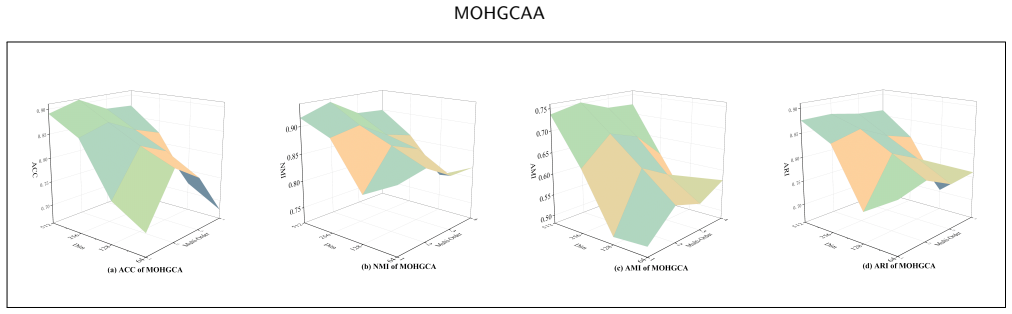
- [Sections 5.2.5 and 5.3.5] The number of multi-order steps K (4 for unsupervised, 2 for supervised) is selected after inspecting performance on the evaluation data, and the final Tables 4 and 6 use the selected configuration. If K is chosen on the same test data, the reported comparisons are optimistically biased. The authors should specify a validation-based selection procedure or report results for all K on a hold-out set.
minor comments (8)
- [Section 2 heading] The heading 'Relate Work' should be 'Related Work'.
- [Table 4] The row name 'MOHGAA' is inconsistent with the model name 'MOHGCAA' used elsewhere in the paper.
- [Table 1] The 'Kelin model' (also written 'Kälin Model' in Section 3.2) should be the Klein model.
- [Table 5] 'Traing rate' should be 'Training rate'.
- [Section 5.2.1] DGI is attributed to reference [43], which is the Graph Attention Networks paper; DGI should instead cite Veličković et al., Deep Graph Infomax.
- [Figure 5 caption] The caption states that the final representation is mapped into hyperbolic space through the log_o function; based on the pipeline it should be exp_o.
- [Section 4.2.2] The text says the node set changes (V ≠ V') while the adjacency matrix remains the same; feature corruption typically keeps the node set identical and changes feature values. Please clarify.
- [Section 4.2.4, Eq. (20)] The contrastive loss formula appears garbled in the manuscript text, making it impossible to verify the objective; please re-typeset and define all symbols.
Circularity Check
Mild circularity: the multi-order count is selected on the same test metrics and then reported as an optimality finding; the benchmark claim itself remains externally grounded.
-
fitted input called prediction
[Section 5.2.5 (Impact of Different Multi-Order Steps on Model Performance) with Table 3 and Table 4; also Section 5.3.5 with Table 5 and Table 6]
"As illustrated in Figure 8, both in high-dimensional and low-dimensional settings, the best performance is consistently achieved at the fourth aggregation step. ... consistent with the findings from the previous ablation study, the best overall performance is achieved at the second order."
The 'Multi-order' hyperparameter is set to 4 in Table 3 (unsupervised) and 2 in Table 5 (supervised) after inspecting ablation curves on the same datasets and metrics that are later reported in Tables 4 and 6. The stated optimality findings are therefore not independent predictions but restatements of the value selected on the evaluation data. The final configuration is fitted to the very numbers it is used to produce, making the ablation-based optimality claim circular. This is only a mild partial circularity because the baseline comparisons themselves use external published results.
full rationale
The central claim is empirical: MOHGCAA is benchmarked against published Euclidean and hyperbolic baselines on standard datasets, so the main comparison is not derived from the method's own definitions. The hyperbolic machinery (exponential/logarithmic maps, tangent-space convolution) is standard and is not argued from the reported outcomes. I found no load-bearing self-citation chain, no imported uniqueness theorem, and no renaming of a known result. The one mild circular element is the selection of the multi-order count K on the same test metrics that are then used to report the optimal-order 'finding'; that finding is a restatement of the selection rather than an independent prediction. Separately, Eq. 9 defines the attention score s_i^k without the order index k or the order-specific representation h_i^k, so the claimed adaptive order-weighting is not implemented as written; this is a formal/correctness problem rather than circularity. Score 2 reflects the minor fitted-parameter issue; the benchmark result against external baselines is not itself circular.
Assumptions & free parameters
free parameters (3)
- Hyperbolic curvature c =
not reported
- Number of multi-order steps K =
4 (unsupervised), 2 (supervised)
- Architecture hyperparameters =
hidden dimension 512, learning rate 0.1, dropout 10%, hidden layers 1 to 2
assumptions (4)
- domain assumption The social media graphs used here have a tree-like hierarchical structure that is better represented in hyperbolic space.
- ad hoc to paper Higher powers of the directed and self-loop adjacency matrices encode semantically meaningful multi-order relationships.
- ad hoc to paper Ollivier Ricci curvature is a useful signal for neighbor attention and can be learned with an MLP.
- domain assumption Feature corruption with a fixed adjacency matrix is a sufficient graph augmentation for contrastive learning on these graphs.
Cite this review
Pith. "Pith review of Multi-Order Hyperbolic Graph Convolution and Aggregated Attention for Social Event Detection." pith.science (2026). https://pith.science/paper/ZBDFAK5C
@misc{pith2026250200351,
  author       = {Pith},
  title        = {Pith review of: Multi-Order Hyperbolic Graph Convolution and Aggregated Attention for Social Event Detection},
  year         = {2026},
  howpublished = {\url{https://pith.science/paper/ZBDFAK5C}},
  note         = {Machine review of arXiv:2502.00351}
}
read the original abstract
Social event detection (SED) is a task focused on identifying specific real-world events and has broad applications across various domains. It is integral to many mobile applications with social features, including major platforms like Twitter, Weibo, and Facebook. By enabling the analysis of social events, SED provides valuable insights for businesses to understand consumer preferences and supports public services in handling emergencies and disaster management. Due to the hierarchical structure of event detection data, traditional approaches in Euclidean space often fall short in capturing the complexity of such relationships. While existing methods in both Euclidean and hyperbolic spaces have shown promising results, they tend to overlook multi-order relationships between events. To address these limitations, this paper introduces a novel framework, Multi-Order Hyperbolic Graph Convolution with Aggregated Attention (MOHGCAA), designed to enhance the performance of SED. Experimental results demonstrate significant improvements under both supervised and unsupervised settings. To further validate the effectiveness and robustness of the proposed framework, we conducted extensive evaluations across multiple datasets, confirming its superiority in tackling common challenges in social event detection.
Figures


Figures from the paper (7 more)




Reference graph
Works this paper leans on
-
[1]
M. Fedoryszak, B. Frederick, V. Rajaram, and C. Zhong. Real-time event detection on social data streams. InProceedings of the 25th ACM SIGKDD international conference on knowledge discovery & data mining, page 2774–2782, 2019
work page 2019
-
[2]
H. Peng, J. Li, Q. Gong, Y. Song, Y. Ning, K. Lai, and P.S. Yu. Fine- grainedeventcategorizationwithheterogeneousgraphconvolutional networks, 2019. arXiv preprint arXiv:1906.0458. Y. Liu et al.:Preprint submitted to Elsevier Page 12 of 15 MOHGCAA Figure 10: Comparison of Euclidean and Hyperbolic Spaces in Unsupervised and Supervised Settings. (a) Micro-F1...
-
[3]
Asurveyonmulti-modalsocial event detection.Knowledge-Based Systems, 195:105695, 2020
H.Zhou,H.Yin,H.Zheng,andY.Li. Asurveyonmulti-modalsocial event detection.Knowledge-Based Systems, 195:105695, 2020
work page 2020
-
[4]
Y. Cao, H. Peng, J. Wu, Y. Dou, J. Li, and P.S. Yu. Knowledge- preservingincrementalsocialeventdetectionviaheterogeneousgnns. InProceedings of the Web Conference 2021, page 3383–3395, 2021
work page 2021
-
[5]
W. Cui, J. Du, D. Wang, F. Kou, and Z. Xue. Mvgan: Multi-view graphattentionnetworkforsocialeventdetection. ACMTransactions on Intelligent Systems and Technology (TIST, 12(3):1–24, 2021
work page 2021
-
[6]
I. Afyouni, Z. Al Aghbari, and R.A. Razack. Multi-feature, multi- modal, and multi-source social event detection: A comprehensive survey. Information Fusion, 79:279–308, 2022
work page 2022
-
[7]
S. Qian, H. Chen, D. Xue, Q. Fang, and C. Xu. Open-world social event classification. In Proceedings of the ACM Web Conference 2023, page 1562–1571, 2023
work page 2023
-
[8]
Z. Qiu, J. Wu, J. Yang, X. Su, and C.C. Aggarwal. Heterogeneous social event detection via hyperbolic graph representations.IEEE Transactions on Big Data, 2024
work page 2024
Show all 51 references
-
[9]
Hierarchicalandincremental structural entropy minimization for unsupervised social event detec- tion
Y.Cao,H.Peng,Z.Yu,andS.Y.Philip. Hierarchicalandincremental structural entropy minimization for unsupervised social event detec- tion. Proceedings of the AAAI Conference on Artificial Intelligence, 38(8):8255–8264, 2024
2024
-
[10]
Y. Guo, Z. Zang, H. Gao, X. Xu, R. Wang, L. Liu, and J. Li. Unsu- pervised social event detection via hybrid graph contrastive learning and reinforced incremental clustering. Knowledge-Based Systems, 284:111225, 2024
2024
-
[11]
Mikolov, K
T. Mikolov, K. Chen, G. Corrado, and J. Dean. Efficient esti- mation of word representations in vector space. arXiv preprint arXiv:1301.3781
-
[12]
D. Ahn. The stages of event extraction. In Proceedings of the WorkshoponAnnotatingandReasoningaboutTimeandEvents ,page 1–8, 2006
2006
-
[13]
Liao and R
S. Liao and R. Grishman. Acquiring topic features to improve event extraction:inpre-selectedandbalancedcollections.In Proceedingsof the International Conference Recent Advances in Natural Language Processing 2011, page 9–16, 2011
2011
-
[14]
Aunifiedmodelofphrasalandsentential evidence for information extraction
S.PatwardhanandE.Riloff. Aunifiedmodelofphrasalandsentential evidence for information extraction. In Proceedings of the 2009 conference on empirical methods in natural language processing, page 151–160, 2009
2009
-
[15]
Nguyen and R
T.H. Nguyen and R. Grishman. Event detection and domain adapta- tion with convolutional neural networks. InProceedings of the 53rd Annual Meeting of the Association for Computational Linguistics and the 7th International Joint Conference on Natural Language Processing (Volume ...
2015
-
[16]
Y. Chen, L. Xu, K. Liu, D. Zeng, and J. Zhao. Event extraction via dynamic multi-pooling convolutional neural networks. InProceed- ingsofthe53rdAnnualMeetingoftheAssociationforComputational Linguistics and the 7th International Joint Conference on Natural Language Processing (...
2015
-
[17]
Zhang, W
Z. Zhang, W. Xu, and Q. Chen. Joint event extraction based on skip-window convolutional neural networks. InNatural Language Understanding and Intelligent Applications: 5th CCF Conference on Natural Language Processing and Chinese Computing, NLPCC 2016, and 24th International C...
2016
-
[18]
L. Li, Y. Liu, and M. Qin. Extracting biomedical events with parallel multi-pooling convolutional neural networks. IEEE/ACM transac- tions on computational biology and bioinformatics, 17(2):599–607, 2018
2018
-
[19]
Kodelja, R
D. Kodelja, R. Besançon, and O. Ferret. Exploiting a more global context for event detection through bootstrapping. In European conference on information retrieval, page 763–770, Cham, 2019. Y. Liu et al.:Preprint submitted to Elsevier Page 13 of 15 MOHGCAA Springer Internatio...
2019
-
[20]
S.Hochreiter.Longshort-termmemory.In NeuralComputationMIT- Press. 1997
1997
-
[21]
Ghaeini, X.Z
R. Ghaeini, X.Z. Fern, L. Huang, and P. Tadepalli. Event nugget detection with forward-backward recurrent neural networks. arXiv preprint arXiv:1802.05672
-
[22]
Eventextractionviabidi- rectionallongshort-termmemorytensorneuralnetworks
Y.Chen,S.Liu,S.He,K.Liu,andJ.Zhao. Eventextractionviabidi- rectionallongshort-termmemorytensorneuralnetworks. In Chinese Computational Linguistics and Natural Language Processing Based on Naturally Annotated Big Data: 15th China National Conference, CCL 2016, and 4th Internati...
2016
-
[23]
Jointlyextractingeventtriggers and arguments by dependency-bridge rnn and tensor-based argument interaction
L.Sha,F.Qian,B.Chang,andZ.Sui. Jointlyextractingeventtriggers and arguments by dependency-bridge rnn and tensor-based argument interaction. Proceedings of the AAAI conference on artificial intelli- gence, 32(1))
-
[24]
Biomedicaleventextractionbased on knowledge-driven tree-lstm
D.Li,L.Huang,H.Ji,andJ.Han. Biomedicaleventextractionbased on knowledge-driven tree-lstm. InProceedings of the 2019 Confer- ence of the North American Chapter of the Association for Compu- tational Linguistics: Human Language Technologies, volume 1, page 1421–1430
2019
-
[25]
Semi-supervisedclassificationwithgraph convolutional networks
T.N.KipfandM.Welling. Semi-supervisedclassificationwithgraph convolutional networks. arXiv preprint arXiv:1609.0290
-
[26]
Nguyen and R
T. Nguyen and R. Grishman. Graph convolutional networks with argument-awarepoolingforeventdetection. ProceedingsoftheAAAI Conference on Artificial Intelligence, 32(1))
-
[27]
X. Liu, Z. Luo, and H. Huang. Jointly multiple events extraction via attention-based graph information aggregation. arxiv preprint arxiv:1809.09078
-
[28]
Haoran Yan, Xiaolong Jin, Xiangbin Meng, Jiafeng Guo, and Xueqi Cheng. Event detection with multi-order graph convolution and aggregatedattention.In Proceedingsofthe2019conferenceonempir- icalmethodsinnaturallanguageprocessingandthe9thinternational joint conference on natural ...
-
[29]
Lai, T.N
V.D. Lai, T.N. Nguyen, and T.H. Nguyen. Event detection: Gate diversityandsyntacticimportancescoresforgraphconvolutionneural networks. arxiv preprint arxiv:2010.14123
2010 arXiv
-
[30]
Cui,B.Yu, T.Liu, Z.Zhang, X.Wang, andJ
S. Cui,B.Yu, T.Liu, Z.Zhang, X.Wang, andJ. Shi. Edge-enhanced graph convolution networks for event detection with syntactic rela- tion. arxiv preprint arxiv:2002.10757
2002 arXiv
-
[31]
Dutta, L
S. Dutta, L. Ma, T.K. Saha, D. Lu, J. Tetreault, and A. Jaimes. Gtn- ed: Event detection using graph transformer networks. arxiv preprint arxiv:2104.15104
-
[32]
Blei, A.Y
D.M. Blei, A.Y. Ng, and M.I. Jordan. Latent dirichlet allocation. Journal of machine Learning research, 3(Jan):993–1022
-
[33]
C. Li, H. Wang, Z. Zhang, A. Sun, and Z. Ma. Topic modeling for short texts with auxiliary word embeddings. In Proceedings of the 39th International ACM SIGIR conference on Research and Development in Information Retrieval, page 165–174
-
[34]
T. Shi, K. Kang, J. Choo, and C.K. Reddy. Short-text topic model- ing via non-negative matrix factorization enriched with local word- context correlations. In Proceedings of the 2018 world wide web conference, page 1105–1114
2018
-
[35]
Q. Liu, M. Nickel, and D. Kiela. Hyperbolic graph neural networks. InAdvances in neural information processing systems, page 32
-
[36]
W. Peng, J. Shi, Z. Xia, and G. Zhao. Mix dimension in poincaré geometry for 3d skeleton-based action recognition. InProceedings of the 28th ACM International Conference on Multimedia, page 1432–1440
-
[37]
Elsken, J.H
T. Elsken, J.H. Metzen, and F. Hutter. Neural architecture search: A survey. Journal of Machine Learning Research, 20(55):1–21
-
[38]
Constantcurvaturegraph convolutional networks
G.Bachmann,G.Bécigneul,andO.Ganea. Constantcurvaturegraph convolutional networks. In International conference on machine learning, page 486–496. PMLR
-
[39]
Z. Qiu, C. Ma, J. Wu, and J. Yang. An efficient automatic meta- path selection for social event detection via hyperbolic space. In Proceedings of the ACM on Web Conference 2024, page 2519–2529
2024
-
[40]
Representa- tion learning with contrastive predictive coding
Aaron van den Oord, Yazhe Li, and Oriol Vinyals. Representa- tion learning with contrastive predictive coding. arXiv preprint arXiv:1807.03748, 2018
2018 arXiv
-
[41]
Building a large-scale corpus for evaluating event detection on twitter
AndrewJMcMinn,YasharMoshfeghi,andJoemonMJose. Building a large-scale corpus for evaluating event detection on twitter. InPro- ceedings of the 22nd ACM international conference on Information & Knowledge Management, pages 409–418, 2013
2013
-
[42]
Collective classification in network data
Prithviraj Sen, Galileo Namata, Mustafa Bilgic, Lise Getoor, Brian Galligher, and Tina Eliassi-Rad. Collective classification in network data. AI magazine, 29(3):93–93, 2008
2008
-
[43]
Veličković, G
P. Veličković, G. Cucurull, A. Casanova, A. Romero, P. Lio, and Y. Bengio. Graph attention networks. arXiv preprint arXiv:1710.10903
-
[44]
Y. You, T. Chen, Y. Sui, T. Chen, Z. Wang, and Y. Shen. Graph con- trastivelearningwithaugmentations. Advancesinneuralinformation processing systems, 33:5812–5823
-
[45]
Chami, Z
I. Chami, Z. Ying, C. Ré, and J. Leskovec. Hyperbolic graph convolutional neural networks. In Advances in neural information processing systems, page 32
-
[46]
Ganea, G
O. Ganea, G. Bécigneul, and T. Hofmann. Hyperbolic neural networks. In Advances in neural information processing systems, page 31
-
[47]
W. Chen, X. Han, Y. Lin, H. Zhao, Z. Liu, P. Li, and J. Zhou. Fully hyperbolic neural networks. arXiv preprint arXiv:2105.14686
-
[48]
Kusner, Y
M. Kusner, Y. Sun, N. Kolkin, and K. Weinberger. From word embeddings to document distances. InInternational conference on machine learning, page 957–966. PMLR
-
[49]
J. Devlin. Bert: Pre-training of deep bidirectional transformers for language understanding. arXiv preprint arXiv:1810.04805
-
[50]
Reinforced, incremental and cross-lingual event detection from social messages
H.Peng,R.Zhang,S.Li,Y.Cao,S.Pan,andS.Y.Philip. Reinforced, incremental and cross-lingual event detection from social messages. IEEE Transactions on Pattern Analysis and Machine Intelligence, 45(1):980–998. A. My Appendix CRediT authorship contribution statement YaoLiu: Methodo...
2007
-
[2012]
Her research interests include en- vironmental space design within the context of regional culture
She is currently an Associate Professor with the Department of Art Design, The Engineering and Technology College of Chengdu University of Technology. Her research interests include en- vironmental space design within the context of regional culture. Yuxin Li received the mast...
Reviewed August 9, 2026 · model on record in the stance chip above.
Discussion (0). Continue with ORCID to comment.