REVIEW 3 major objections 7 minor 24 references
A new study of the $^{10}$B(p,$\alpha_1 \gamma$)$^{7}$Be reaction from 0.35 to 1.8 MeV
T0 review · 3 major / 7 minor · reviewed 2026-08-14 · deepseek-v4-flash
Pith's one-line read New absolute cross-section data for the 10B(p,α1γ)7Be reaction cover centre-of-mass energies from 348 keV to 1.8 MeV.
desk verdict Careful normalization-free 10B(p,α1γ)7Be cross sections that clean up a factor-of-two discrepancy, with a target-systematic question and a secondary α0 analysis that need tightening. read the letter →
The pith
A machine-rendered reading of the paper's core claim, the machinery that carries it, and where it could break.
The reading
What carries the argument
The argument rests on the yield-to-cross-section relation $Y(E_p)=\int_{E_p-\Delta E}^{E_p} \sigma(E)/\epsilon_{\mathrm{eff}}(E)\,dE$, where $\epsilon_{\mathrm{eff}}$ is the effective stopping power. Absolute normalisation comes from three ingredients: target composition and thickness measured by proton backscattering at three energies, absolute gamma-detection efficiencies calibrated with certified radioactive sources, and energy calibration from earlier resonances. The observable is the 429 keV transition of $^{7}\mathrm{Be}$; detecting it at two angles gives an internal consistency check on the assumed isotropy. The largest single systematic contribution is the target composition, which the paper follows the literature in identifying as the usual dominant uncertainty in absolute cross-section work.
What would settle it
Measure the same reaction with targets whose boron areal density is determined by an independent method, such as Rutherford backscattering on a boron-implanted standard, and compare the resulting cross sections; a systematic offset proportional to the density difference would reveal a biased target-composition scale.
Extended reading notes
Core claim
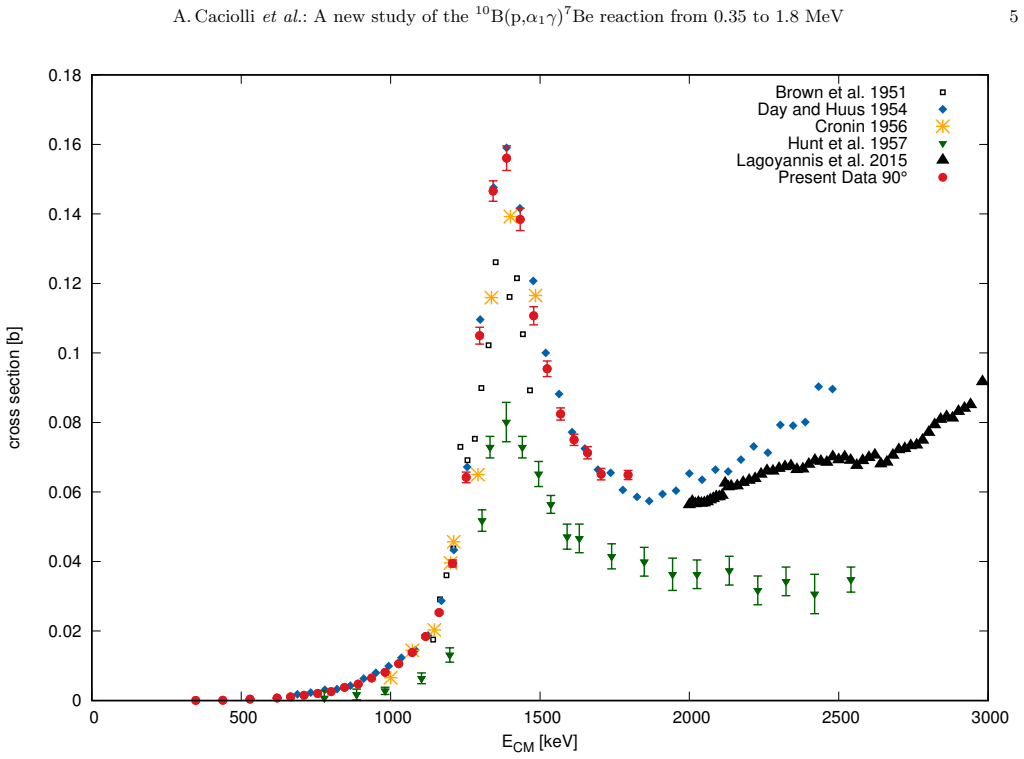
The central result is a table of absolute cross sections for $^{10}\mathrm{B}(p,\alpha_1\gamma)^{7}\mathrm{Be}$ at twenty-nine centre-of-mass energies between 348 and 1795 keV, measured independently at 90 degrees with an HPGe detector and at 45 degrees with a NaI(Tl) detector. The 90 and 45 degree values agree within the reported uncertainties, which the paper reads as confirmation that the gamma emission is isotropic across the whole range. Compared with the literature, the present values are compatible with the normalised data of [14], about 20 percent higher than [13], and nearly a factor of two higher than [16]. Because the measurement is absolute and needs no scaling, the paper presents it as a more reliable reference than the widely used [14] dataset, whose normalisation was based on an average of two older results. The data are then subtracted from the total $^{10}\mathrm{B}(p,\alpha)^{7}\mathrm{Be}$ cross section of [12] under the isotropy assumption, yielding the $\alpha_0$-channel S-factor; the correction is negligible below 1 MeV and reaches 11 percent at the highest measured point.
Load-bearing premise
The cross-section scale rests on the assumption that the two proton-backscattering-analysed samples from each evaporation batch are representative of the actual targets used in the irradiation, and that the stopping-power model in Eq. (1) converts measured yields to cross sections without bias.
Editorial extensions
If this is right
- Ion-beam analysis of boron can use these cross sections directly, without applying the arbitrary normalisation factor required by the older reference dataset, removing a known source of systematic error in boron quantification.
- The two-angle agreement strengthens the isotropic-emission assumption that underlies routine single-detector PIGE measurements of boron.
- Subtracting these data from the total cross section yields an updated low-energy S-factor for the $\alpha_0$ channel, with the $\alpha_1\gamma$ contribution reaching 11 percent at the highest energy point.
- The reduced uncertainty across the 1.38 MeV resonance region provides a sharper benchmark for the resonance parameters of the $^{10}\mathrm{B}+p$ system.
- Combining the absolute $\alpha_1\gamma$ data with total-cross-section measurements gives a cleaner two-channel decomposition for reaction-rate estimates at astrophysical energies.
Reading between the lines
- If the isotropy confirmed here holds at all energies, then a single well-calibrated detector at one angle is sufficient for accurate absolute measurements of this reaction, and future studies could reduce cost and complexity without losing accuracy.
- The persistent factor-of-two discrepancy with [16] and the 20 percent offset from [13] suggest that the older datasets are limited by normalisation or target-thickness errors; re-analysing them with modern stopping-power models could resolve the literature spread.
- Extending this same two-angle, no-scaling method to the 2-5 MeV range would connect directly to the high-energy dataset [17] and remove the current gap in overlapping coverage.
- The $\alpha_0$ isolation assumes isotropic emission; a direct measurement of the alpha particles at backward angles would test that assumption and sharpen the derived S-factor.
Signed reviews
Editorial analysis
A structured set of objections, weighed in public.
Referee Report
Summary. The paper reports new absolute cross-section measurements of the 10B(p,α1γ)7Be reaction over the center-of-mass energy range 348–1795 keV, using 10B-enriched targets of three nominal thicknesses. Gamma rays at 429 keV were detected at 45° with a NaI(Tl) detector and at 90° with an HPGe detector, with efficiencies calibrated by certified radioactive sources. Target composition was characterized by proton-EBS at three energies on two samples per evaporation batch. The new data are compared with previous measurements (Brown 1951, Day and Huus 1954, Cronin 1956, Hunt 1957, Lagoyannis 2015), and are used, together with a previous total-cross-section measurement [12], to extract the α0 channel contribution to the S-factor. The main claims are that the new absolute data agree with the normalized Day and Huus results, that the uncertainty is substantially reduced, and that no arbitrary normalization is needed.
Significance. If the quoted 6% total uncertainty is confirmed, this dataset is a valuable reference for ion-beam analysis and for the 10B(p,α) reaction in the low-energy region relevant to nuclear astrophysics and applications. The experiment has several genuine strengths: two independent detectors with multi-source efficiency calibration, a transparent systematic-error budget (Table 4), target characterization at three energies by two analysis codes, and a direct comparison with independent literature data without any scaling procedure. The two-angle agreement supports the assumption of isotropic γ-ray emission, and the extension of the cross-section data down to 348 keV fills a practical gap for IBA applications. The α0 extraction from the total S-factor, while secondary, is a useful application of the new data, provided its documentation is improved.
major comments (3)
- [Sec. 3, Tables 1 and 4] The target-composition systematic is not fully justified. For the 100 µg/cm2 batch used in this experiment, the two characterized samples differ by about 10% in oxygen areal density (343 vs 311 ×10^15 cm−2) and 13% in nitrogen (132 vs 149 ×10^15 cm−2), yet Table 4 assigns only 4% to 'Target analysis'. The text states that the maximum discrepancy was adopted as a systematic uncertainty, but it does not explain how the per-element sample-to-sample scatter propagates through the effective stopping power in Eq. (1) to the cross section, nor whether SIMNRA-versus-RUMP differences are folded into that 4%. Because the two targets that were actually irradiated are not the two characterized samples, a 10% common-mode change in the target composition would rescale every cross section in Table 3 by a few percent, which is larger than the claimed 4% target systematic. Please quantify this propagation or enlarge the target systematic accordingly.
- [Sec. 4, Table 5] The α0 extraction is underdocumented. The column '∆S' in Table 5 is not defined anywhere; it is unclear whether it is the difference S(total)−S(α1γ) or the uncertainty on the updated S-factor. The errors quoted for the updated S-factor do not show the propagation of the statistical and systematic errors of the present α1γ measurement, the 20% interpolation error, and the errors of the total S-factor from [12]. Since [12] used targets from the same evaporation batches, the correlated target-systematic errors should be addressed in the propagation. Please define every column and give the full error propagation.
- [Sec. 3, 'Experimental Setup and Analysis'] The yield extraction from the γ-ray spectra is not described. The paper does not specify how the 429 keV peak area was integrated, how the background (which is significant for the thin targets at low energy) was subtracted, whether dead-time and pile-up corrections were applied, or how the possible contribution from the 718 keV line (10B(p,p'γ)10B) was rejected in the NaI(Tl) detector. These details are essential for reproducing the absolute cross sections and for judging the reliability of the quoted uncertainties. Please add a description of the spectral analysis procedure.
minor comments (7)
- [Table 3] The 45° data start at ECM=846 keV; explain why no 45° point is reported below this energy.
- [Table 4] State explicitly that the components are added in quadrature to obtain the 6% total; the current text only says that for the efficiency errors.
- [Sec. 4] The statement that the present data are 'about 20% higher than Brown et al.' should be quantified with a specific energy or a fit over the overlapping range; a bald percentage over the whole range is misleading given the energy dependence.
- [Fig. 5] Only the 90° data are shown; clarify in the caption or text that the 45° data are omitted for clarity, or include them with different markers.
- [Sec. 3] The sentence 'The beam energy was calibrated with a precision of 1 keV' is followed by the claim that this translates to ≤1% uncertainty on the cross section; given the steep energy dependence near the 1.52 MeV resonance, please justify this estimate or reference a sensitivity study.
- [Table 1 caption] The manuscript uses 'bench' where 'batch' is meant; correct the wording for clarity.
- [Sec. 4] Reference [12] and the present work share authors and targets; when comparing or subtracting the two datasets, the correlated systematic uncertainties should be mentioned explicitly.
Circularity Check
No significant circularity: the reported cross sections are new absolute measurements reduced from raw yields via standard thick-target formulas, and the only same-author input (Ref. [12]) is used for an explicit algebraic subtraction, not as a fitted prediction.
full rationale
The central claim of the paper is an absolute measurement of the 10B(p,α1γ)7Be cross section from 348 to 1795 keV. The derivation chain is self-contained: Eq. (1) relates the measured thick-target yield to the cross section through the effective stopping power and the target composition; the effective efficiencies of the two gamma detectors are obtained from certified radioactive sources; the target composition is determined by proton-EBS on samples from the same evaporation batches. None of these steps defines the target cross section in terms of itself, and no fitted parameter is later renamed as a prediction. The comparison with Day and Huus, Brown, Cronin, Hunt, and Lagoyannis is an external benchmark against independent published datasets, so the agreement with Day and Huus is not a consequence of the analysis construction. The only load-bearing use of same-author work is Ref. [12], which is cited for the beam-energy calibration via standard 27Al(p,γ)28Si resonances and for the total S-factor used to extract the α0 channel. That extraction is an explicit algebraic subtraction (total S-factor minus the newly measured α1γ S-factor), not a fit or an assumption that the α1γ result itself is true. The target-composition sampling issue (two samples per batch, and Table 1 scatter in O and N) is a legitimate systematic-uncertainty concern, but it does not make the derivation circular: it concerns how accurately the measured composition represents the irradiated targets, not whether the output is equivalent to an input by construction. Overall, the paper does not exhibit self-definitional reasoning, fitted-input-called-prediction behavior, ansatz smuggling, or renaming of known results.
Assumptions & free parameters
free parameters (4)
- HPGe efficiency curve parameters =
not quoted, fit uncertainty 2%
- NaI(Tl) efficiency linear interpolation =
not quoted, interpolation uncertainty 3%
- Target areal densities (B, O, N) =
B ~ 296-1285, O 166-343, N 35-149 in 10^15 atoms/cm2 (Table 1)
- Conservative 20% interpolation error =
20%
assumptions (5)
- domain assumption The stopping power model (Iliadis, ref [18]) and mean-energy definition correctly describe beam energy loss in the target.
- domain assumption The EBS spectra analyzed with SIMNRA/RUMP provide unbiased element areal densities.
- domain assumption The 429 keV gamma-ray yield is attributed solely to the 10B(p,α1γ)7Be reaction, with no significant interference from contaminants.
- domain assumption The previous total cross section measurement in [12] is reliable for subtraction.
- domain assumption The gamma-ray angular distribution is isotropic for all measured energies.
Cite this review
Pith. "Pith review of A new study of the $^{10}$B(p,$\alpha_1 \gamma$)$^{7}$Be reaction from 0.35 to 1.8 MeV." pith.science (2026). https://pith.science/paper/ZBJ7RX2K
@misc{pith2026190807054,
  author       = {Pith},
  title        = {Pith review of: A new study of the $^10$B(p,$\alpha_1 \gamma$)$^7$Be reaction from 0.35 to 1.8 MeV},
  year         = {2026},
  howpublished = {\url{https://pith.science/paper/ZBJ7RX2K}},
  note         = {Machine review of arXiv:1908.07054}
}
abstract
The quantification of isotopes content in materials is extremely important in many research and industrial fields. Accurate determination of boron concentration is very critical in semiconductor, superconductor and steel industry, in environmental and medical applications as well as in nuclear and astrophysics research. The detection of B isotopes and of their ratio in synthetic and natural materials may be accomplished by gamma spectroscopy using the $^{10}$B(p,$\alpha_1 \gamma$)$^7$Be and $^{11}$B(p,$\gamma$)$^{12}$C reactions at low proton energy. Here, the $^{10}$B(p,$\alpha_1 \gamma$)$^7$Be cross section is reported in the center of mass energy range 0.35 to 1.8 MeV. The $E_\gamma$= 429 keV $\gamma$ rays were detected at 45$^\circ$ and 90$^\circ$ using a NaI(Tl) and an HPGe detectors, respectively. In the presented energy range, previous cross sections data revealed discrepancies and normalisation issues. Existing data are compared to the new absolute measurement and discussed. The present data have been subtracted from a previous measurement of the total cross section to derive the contribution of the $\alpha_0$ channel.
Figures


Figures from the paper (1 more)
Reference graph
Works this paper leans on
-
[12]
Caciolli, A., Depalo, R., Broggini, C., La Cognata, M., Lamia, L., Menegazzo, R., Mou, L., Puglia, S. M. R., Rigato, V., Romano, S. et al., Eur. Phys. J. A 52, 136 (2016)
work page 2016
- [1]
- [2]
-
[3]
L.R. Doolittle, Nuclear Instruments and Methods in Physics Research Section B: Beam Interactions with Materials and Atoms 9, 344 (1985)
work page 1985
-
[4]
Mayer, AIP Conference Proceedings 475, 541 (1999)
M. Mayer, AIP Conference Proceedings 475, 541 (1999)
work page 1999
- [5]
-
[6]
C. Jeynes, R.P. Webb, A. Lohstroh, Reviews of Ac- celerator Science and Technology 04, 41 (2011)
work page 2011
-
[7]
IBANDL database, IAEA (2019), http://www-nds.iaea.org/ibandl/
work page 2019
Show all 24 references
-
[8]
R. Sah, P. Brown, Microchemical Journal 56, 285 (1997)
1997
-
[9]
Mateus, A
R. Mateus, A. Jesus, M. Fonseca, H. Lu´ ıs, J. Ribeiro, Nuclear Instruments and Methods in Physics Re- search Section B: Beam Interactions with Materials and Atoms 264, 340 (2007)
2007
-
[10]
Moro, T.F
M.V. Moro, T.F. Silva, G.F. Trindade, N. Added, M.H. Tabacniks, AIP Conference Proceedings 1625, 120 (2014)
2014
-
[11]
Spitaleri, S
C. Spitaleri, S. M. R. Puglia, M. La Cognata, L. Lamia, S. Cherubini, A. Cvetinovic, G. D’Agata, M. Gulino, G. L. Guardo, I. Indelicato et al., Phys. Rev. C 95, 035801 (2017)
2017
-
[13]
Brown, C
A. Brown, C. Snyder, W. Fowler, C. Lauritsen, Phys. Rev. 82, 159 (1951)
1951
-
[14]
R.B. Day, T. Huus, Phys. Rev. 95, 1003 (1954)
1954
-
[15]
Cronin, Phys
J.W. Cronin, Phys. Rev. 101, 298 (1956)
1956
-
[16]
Hunt, R.A
S.E. Hunt, R.A. Pope, W.W. Evans, Phys. Rev. 106, 1012 (1957)
1957
-
[17]
Lagoyannis, K
A. Lagoyannis, K. Preketes-Sigalas, M. Axiotis, V. Foteinou, S. Harissopulos, M. Kokkoris, P. Mis- aelides, V. Paneta, N. Patronis, Nuclear Instruments and Methods in Physics Research Section B: Beam In- teractions with Materials and Atoms 342, 271 (2015)
2015
-
[18]
Iliadis, Nuclear Physics of Stars , 2 nd edn
C. Iliadis, Nuclear Physics of Stars , 2 nd edn. (Wiley- VCH, Weinheim, 2015)
2015
-
[19]
Caciolli, D.A
A. Caciolli, D.A. Scott, A. Di Leva, A. Formicola, M. Aliotta, M. Anders, A. Bellini, D. Bemmerer, C. Broggini, M. Campeggio et al., Eur. Phys. J. A 48, 144 (2012)
2012
-
[20]
Xhixha, G.P
G. Xhixha, G.P. Bezzon, C. Broggini, G.P. Buso, A. Caciolli, I. Callegari, S. De Bianchi, G. Fiorentini, E. Guastaldi, M. Ka¸ celi Xhixha et al., Journal of Ra- dioanalytical and Nuclear Chemistry 295, 445 (2013)
2013
-
[21]
Marta, E
M. Marta, E. Trompler, D. Bemmerer, R. Beyer, C. Broggini, A. Caciolli, M. Erhard, Z. F¨ ul¨ op, E. Grosse, G. Gy¨ urky et al., Phys. Rev. C81, 055807 (2010)
2010
-
[22]
Caciolli, C
A. Caciolli, C. Mazzocchi, V. Capogrosso, D. Be- mmerer, C. Broggini, P. Corvisiero, H. Costantini, Z. Elekes, A. Formicola, Z. F¨ ul¨ op et al., Astron. As- trophys. 533, A66 (2011)
2011
-
[23]
Chiari, G
M. Chiari, G. Ferraccioli, B. Melon, A. Nannini, A. Perego, L. Salvestrini, A. Lagoyannis, K. Preketes- Sigalas, Nuclear Instruments and Methods in Physics Research Section B: Beam Interactions with Materials and Atoms 366, 77 (2016)
2016
-
[24]
Rauscher, G
T. Rauscher, G. Raimann, Phys. Rev. C 53, 2496 (1996)
1996
Reviewed August 14, 2026 · model on record in the stance chip above.
Discussion (0). Continue with ORCID to comment.