REVIEW 4 major objections 4 minor 1 cited by
Multi-Embodiment Locomotion at Scale with extreme Embodiment Randomization
T0 review · 4 major / 4 minor · reviewed 2026-08-05 · deepseek-v4-flash
Pith's one-line read A single locomotion policy trained on 50 diverse robots transfers zero-shot to previously unseen real-world quadrupeds and, with limitations, humanoids.
desk verdict Real engineering advance in multi-embodiment locomotion, but the abstract's zero-shot humanoid claim is not supported by the paper's own experiments. read the letter →
The pith
A machine-rendered reading of the paper's core claim, the machinery that carries it, and where it could break.
The reading
What carries the argument
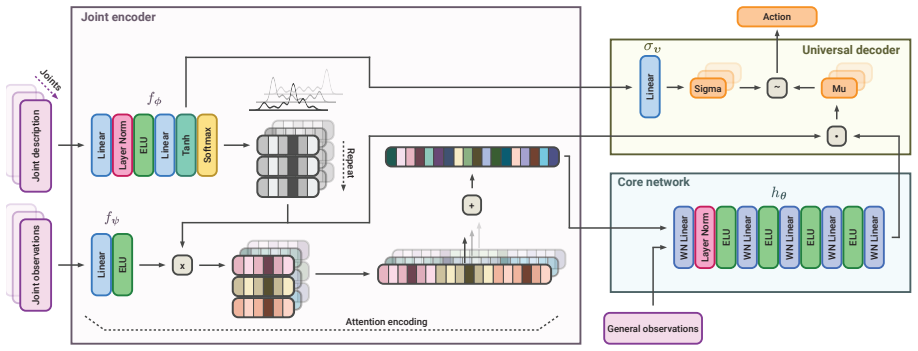
URMAv2, the Unified Robot Morphology Architecture v2, with three load-bearing parts: per-joint description vectors that reveal morphology to the policy; an attention-based joint encoder that aggregates joints into a fixed-size latent; and a new attention-based action decoder where each joint's mean action is the dot product of the action latent with that joint's attention weights, with per-joint standard deviations predicted from the joint description encoding. The second mechanism is the performance-based curriculum: every randomization range, perturbation, terrain attribute, and reward penalty is attached to a single curriculum coefficient beta that increases after consecutive successful e
What would settle it
Deploy the zero-shot policy on a held-out legged robot whose nominal parameters lie near or beyond the edges of the sampled percentage ranges—for example, a humanoid with a much larger trunk-to-leg mass ratio, a different number of joints per leg, or a body plan absent from the 50 training robots—under the same command protocol. If it cannot walk or falls on flat ground where the training robots succeed, the generalization claim is bounded to the training distribution rather than to arbitrary unseen embodiments.
Extended reading notes
Core claim
The central discovery is that extreme embodiment randomization combined with a performance-based curriculum lets a single policy learn to control a large, morphologically varied set of robots and generalize to robots absent from training. Every body parameter is sampled as a percentage perturbation of each robot's URDF nominal values and exposed to the policy through per-joint description vectors, so the policy can condition its actions on its own body. The curriculum coefficient beta throttles all difficulty components together based on recent success. Architecturally, URMAv2 replaces URMA's universal decoder with an attention-based decoder: joint attention weights from the encoder are dott
Load-bearing premise
The load-bearing premise is that percentage-based randomization around 50 nominal robot URDFs covers enough of morphology space that strong training performance on sampled variations implies control of an unseen robot, yet the paper gives no coverage metric or distance test between held-out robots and the training distribution.
Editorial extensions
If this is right
- A single policy can be trained across 50 robots and 5 billion environment steps in about 40 hours on one A100 GPU, outperforming zero-padding and multi-head baselines.
- Zero-shot transfer to unseen quadrupeds works in the real world, including the MAB Silver Badger with a spine joint not present in any training robot, and tolerates external pushes and leg pulls.
- Unseen humanoid zero-shot transfer works in simulation for the tested models, but real-world transfer is partial: the Booster T1 walks forward and sideward yet falls when turning or walking backward.
- The architecture's embodiment-aware conditioning is necessary: both URMA and URMAv2 significantly outperform zero-padding and multi-head baselines on multi-embodiment training.
- Training on the full set of 50 robots produced a policy that could locomote well on the Unitree H1 in every direction, suggesting that broad embodiment coverage can compensate for lack of zero-shot ability.
Reading between the lines
- If percentage-based randomization around 50 nominal robots is the real driver, then the practical reach of the policy depends on how well those 50 bases span morphology space; testing on robots deliberately far outside the sampled ranges would map a failure boundary.
- The single curriculum coefficient beta conflates embodiment difficulty with task difficulty; separating the two could speed training and clarify whether embodiment diversity or task exposure is what drives transfer.
- The attention decoder suggests that the policy may learn reusable attention patterns per body plan; inspecting whether attention weights cluster by quadruped versus humanoid could make its generalization interpretable.
- A natural extension is to use this policy as a learned initialization and fine-tune briefly on a new robot, comparing steps-to-solve against training from scratch to quantify the benefit of embodiment-randomized pretraining.
Editorial analysis
A structured set of objections, weighed in public.
Referee Report
Summary. The paper proposes URMAv2, an embodiment-aware architecture for multi-embodiment locomotion, and a performance-based curriculum that scales embodiment randomization (ER) to 50 legged robots with up to 10 million morphological variations. The policy is trained with PPO in MJX for 5 billion environment steps. The authors report that URMAv2 outperforms URMA, zero-padding, and multi-head baselines in training, and that a single policy transfers zero-shot to held-out robots in simulation. Real-world experiments are reported for two quadrupeds (Unitree Go2, MAB Silver Badger) and one humanoid (Booster T1), plus a deployment on Unitree H1 using the policy trained on all 50 robots. The abstract claims zero-shot transfer to unseen real-world humanoid and quadruped robots.
Significance. If fully supported, the result would be a meaningful step toward a single locomotion policy that generalizes across morphologies without per-robot fine-tuning. The paper's concrete strengths are the scale of the training setup (50 robots, 25600 parallel environments), the clear description of the architectural changes to URMA, the inclusion of held-out robot evaluations, and the real-world deployments on three platforms. The work does not claim a parameter-free derivation; the curriculum coefficient is trained from the policy's own return, so circularity is not a concern. However, the headline zero-shot claim is currently stronger than the evidence, and the paper lacks a quantiative analysis of how the embodiment randomization distribution covers the space of unseen robots. The contribution is still potentially publishable, but the claim and the supporting analysis need to be brought into alignment.
major comments (4)
- [Abstract; §IV-A; §V] The abstract's claim that the policy 'achieves zero-shot transfer to unseen real-world humanoid and quadruped robots' is not supported by the experiments. Section IV-A reports that the Booster T1 'struggles with turning and walking backwards, leading to regular falls,' and that zero-shot transfer to the Unitree H1 was not possible because 'the policy was not stable enough'; the H1 deployment used the policy trained on all 50 robots. Section V itself states that 'sim-to-real transfer to unseen humanoids still remains challenging.' The zero-shot real-world evidence for humanoids is therefore a single partial demonstration. This is load-bearing: the abstract and the introduction frame the contribution as zero-shot humanoid transfer. The claim must be revised or the experiments must be extended.
- [§III-B; §III-C] The percentage-based embodiment randomization is defined relative to each robot's nominal URDF parameters, but the paper gives no coverage analysis, no distance metric between a held-out robot and the training distribution, and no systematic study of how far a new morphology can be before zero-shot transfer fails. The claim that 'millions of morphological variations' imply control of an arbitrary unseen robot is an assumption, not a demonstrated property. Even if the abstract were revised to report only the demonstrated cases, the paper should either provide a quantitative analysis of embodiment-space coverage or explicitly qualify the generalization claim to robots within the randomized distribution's support.
- [§IV, Fig. 4] The zero-shot evaluation in simulation is described only qualitatively ('strong zero-shot performance', 'fairly well', 'falls occasionally'). For a paper whose main claim is generalization, the absence of quantitative metrics for the held-out robots is a significant gap. I would expect at least episode return, success rate, or fall count under standardized perturbations for each of the five held-out robots, including the failures. Without these numbers, Figure 4's training curves cannot be translated into a verifiable claim about zero-shot performance.
- [§III-C] The curriculum mechanism is central to the method, but the description is underspecified. The coefficient β is said to scale 'all training components: domain and embodiment randomization ranges, perturbations, sampling probabilities, terrain attributes, termination conditions, and reward penalty coefficients,' yet no equations or even a table list the baseline values and the scaling law (linear? multiplicative?) for each component. The text notes that only nominal joint positions and PD gains must be specified, but the actual ER ranges are not given. This makes the method difficult to reproduce or compare against. At minimum, please provide the exact ranges and the mapping from β to each component.
minor comments (4)
- [§IV-A] Typo: 'transfered' should be 'transferred' in 'we transfered to URMAv2 policy trained on all 50 robots.'
- [§II] Minor reference formatting issues: 'Isaac Gym/Sim' is inconsistently written, and the reference to 'Nervenet' should be capitalized consistently as 'NerveNet.'
- [§III-B] The claim of 'up to 10 million different embodiments per training run' appears without a derivation. With a 0.2% resampling probability per step over 5 billion steps, the number of unique sampled embodiments is not automatically bounded by 10 million. Please clarify how this number is computed.
- [Fig. 2] The architecture figure is dense and the text refers to WeightNorm and attention decoding, but the figure does not clearly show where the curriculum coefficient β enters the network or the training loop. Adding β to the figure or a separate training-loop diagram would improve readability.
Circularity Check
No circularity: the paper's zero-shot claims are empirical evaluations, not derivationally equivalent to its inputs.
full rationale
I find no step in the paper where a claimed result reduces by construction to an input or to a self-citation. The policy is trained with PPO on a reward signal; the curriculum coefficient beta is driven by the policy's own episode returns, but this is a training signal, not a post-hoc fit of the reported zero-shot transfers. The zero-shot evaluations are external: the paper reports training on 49 robots and evaluating on held-out Unitree Go2, MAB Silver Badger, Booster T1, Unitree G1, and Unitree H1 (Fig. 4), with real-world deployment on Go2, MAB Silver Badger, Booster T1, and H1 (the latter trained on all 50 robots). No fitted parameter is renamed as a prediction. The references to the authors' prior URMA work [5] and embodiment scaling laws [15] are motivated by prior empirical results, not by a self-citation chain that defines the conclusion. The main discrepancy—that the abstract claims zero-shot transfer to unseen humanoids while the body reports Booster T1 only partially successful and H1 required training on all 50 robots—is an overstatement of the experimental results, not circularity. Similarly, the lack of coverage analysis for the embodiment randomization ranges is an evaluation gap, not a definitional equivalence. The paper is self-contained against external baselines and real-robot deployments, so the circularity score is 0.
Assumptions & free parameters
free parameters (4)
- Curriculum step size Δβ
- Episode success threshold for the curriculum
- Embodiment randomization percentage ranges
- Reward coefficients
assumptions (4)
- domain assumption MJX/MuJoCo provides rigid-body dynamics accurate enough for sim-to-real transfer.
- ad hoc to paper Percentage-based embodiment randomization around nominal URDF parameters spans a useful morphology distribution.
- domain assumption The 50 collected URDFs are accurate descriptions of the real robots.
- standard math Standard PPO and reward shaping converge to an effective locomotion policy at this scale.
Cite this review
Pith. "Pith review of Multi-Embodiment Locomotion at Scale with extreme Embodiment Randomization." pith.science (2026). https://pith.science/paper/ZBNXP2S4
@misc{pith2026250902815,
  author       = {Pith},
  title        = {Pith review of: Multi-Embodiment Locomotion at Scale with extreme Embodiment Randomization},
  year         = {2026},
  howpublished = {\url{https://pith.science/paper/ZBNXP2S4}},
  note         = {Machine review of arXiv:2509.02815}
}
read the original abstract
We present a single, general locomotion policy trained on a diverse collection of 50 legged robots. By combining an improved embodiment-aware architecture (URMAv2) with a performance-based curriculum for extreme Embodiment Randomization, our policy learns to control millions of morphological variations. Our policy achieves zero-shot transfer to unseen real-world humanoid and quadruped robots.
Figures


Figures from the paper (2 more)


Forward citations
Cited by 1 Pith paper
-
Rapid Embodiment Adaptation for Quadrupedal Locomotion
Online embodiment identification lets a quadruped adapt to joint-limit and payload changes within 0.4 seconds, improving real-robot robustness over non-adaptive policies.
Reference graph
Works this paper leans on
-
[1]
Learning coor- dinated badminton skills for legged manipulators,
Y . Ma, A. Cramariuc, F. Farshidian, and M. Hutter, “Learning coor- dinated badminton skills for legged manipulators,” Science Robotics , vol. 10, no. 102, p. eadu3922, 2025
work page 2025
-
[2]
Hitter: A humanoid table ten- nis robot via hierarchical planning and learning,
Z. Su, B. Zhang, N. Rahmanian, Y . Gao, Q. Liao, C. Regan, K. Sreenath, and S. S. Sastry, “Hitter: A humanoid table ten- nis robot via hierarchical planning and learning,” arXiv preprint arXiv:2508.21043, 2025
arXiv 2025
-
[3]
Walk these ways: Tuning robot control for generalization with multiplicity of behavior,
G. B. Margolis and P. Agrawal, “Walk these ways: Tuning robot control for generalization with multiplicity of behavior,” in Conference on Robot Learning . PMLR, 2023, pp. 22–31
work page 2023
-
[4]
Extreme parkour with legged robots,
X. Cheng, K. Shi, A. Agarwal, and D. Pathak, “Extreme parkour with legged robots,” in RoboLetics: Workshop on robot learning in athletics @ CoRL , 2023
work page 2023
-
[5]
One policy to run them all: an end-to-end learning approach to multi-embodiment locomotion,
N. Bohlinger, G. Czechmanowski, M. Krupka, P. Kicki, K. Walas, J. Peters, and D. Tateo, “One policy to run them all: an end-to-end learning approach to multi-embodiment locomotion,” Conference on Robot Learning , 2024
work page 2024
-
[6]
Bridge the gap: Enhancing quadruped locomotion with vertical ground perturbations,
M. Stasica, A. Bick, N. Bohlinger, O. Mohseni, M. J. A. Fritzsche, C. H ¨ubler, J. Peters, and A. Seyfarth, “Bridge the gap: Enhancing quadruped locomotion with vertical ground perturbations,” Interna- tional Conference on Intelligent Robots and Systems , 2025
work page 2025
-
[7]
Orbit: A unified simulation framework for interactive robot learning environments,
M. Mittal, C. Yu, Q. Yu, J. Liu, N. Rudin, D. Hoeller, J. L. Yuan, R. Singh, Y . Guo, H. Mazhar, A. Mandlekar, B. Babich, G. State, M. Hutter, and A. Garg, “Orbit: A unified simulation framework for interactive robot learning environments,” IEEE Robotics and Automa- tion Letters , vol. 8, no. 6, pp. 3740–3747, 2023
work page 2023
-
[8]
Mujoco: A physics engine for model-based control,
E. Todorov, T. Erez, and Y . Tassa, “Mujoco: A physics engine for model-based control,” in 2012 IEEE/RSJ international conference on intelligent robots and systems . IEEE, 2012, pp. 5026–5033
work page 2012
Show all 17 references
-
[9]
Proximal policy optimization algorithms,
J. Schulman, F. Wolski, P. Dhariwal, A. Radford, and O. Klimov, “Proximal policy optimization algorithms,” arXiv preprint arXiv:1707.06347, 2017
2017 arXiv
-
[10]
Domain randomization for transferring deep neural networks from simulation to the real world,
J. Tobin, R. Fong, A. Ray, J. Schneider, W. Zaremba, and P. Abbeel, “Domain randomization for transferring deep neural networks from simulation to the real world,” in International conference on intelligent robots and systems , 2017
2017
-
[11]
Rapid locomotion via reinforcement learning,
G. B. Margolis, G. Yang, K. Paigwar, T. Chen, and P. Agrawal, “Rapid locomotion via reinforcement learning,” International journal of robotics research , vol. 43, no. 4, pp. 572–587, 2024
2024
-
[12]
Gait in eight: Efficient on-robot learning for omnidirectional quadruped locomotion,
N. Bohlinger, J. Kinzel, D. Palenicek, L. Antczak, and J. Peters, “Gait in eight: Efficient on-robot learning for omnidirectional quadruped locomotion,” International Conference on Intelligent Robots and Sys- tems, 2025
2025
-
[13]
Nervenet: Learning structured policy with graph neural networks,
T. Wang, R. Liao, J. Ba, and S. Fidler, “Nervenet: Learning structured policy with graph neural networks,” in International conference on learning representations, 2018
2018
-
[14]
Metamorph: learning universal controllers with transformers,
A. Gupta, L. Fan, S. Ganguli, and L. Fei-Fei, “Metamorph: learning universal controllers with transformers,” in International Conference on Learning Representations . ICLR, 2022
2022
-
[15]
Towards embodiment scaling laws in robot locomotion,
B. Ai, L. Dai, N. Bohlinger, D. Li, T. Mu, Z. Wu, K. Fay, H. I. Christensen, J. Peters, and H. Su, “Towards embodiment scaling laws in robot locomotion,” Conference on Robot Learning (CoRL) , 2025
2025
-
[16]
Weight normalization: A simple reparameterization to accelerate training of deep neural networks,
T. Salimans and D. P. Kingma, “Weight normalization: A simple reparameterization to accelerate training of deep neural networks,” Advances in neural information processing systems , vol. 29, 2016
2016
-
[17]
Rl-x: A deep reinforcement learning library (not only) for robocup,
N. Bohlinger and K. Dorer, “Rl-x: A deep reinforcement learning library (not only) for robocup,” in Robot world cup . Springer, 2023, pp. 228–239
2023
Reviewed August 5, 2026 · model on record in the stance chip above.
Discussion (0). Sign in to comment.