Disorder-Induced Enhancement of Fermionic Superradiance
Pith reviewed 2026-07-01 02:22 UTC · model grok-4.3
The pith
Disorder in atom-light couplings drives a fermionic superradiant phase where many grey modes contribute coherently, yielding parametrically enhanced condensate scaling with system size.
A machine-rendered reading of the paper's core claim, the machinery that carries it, and where it could break.
Core claim
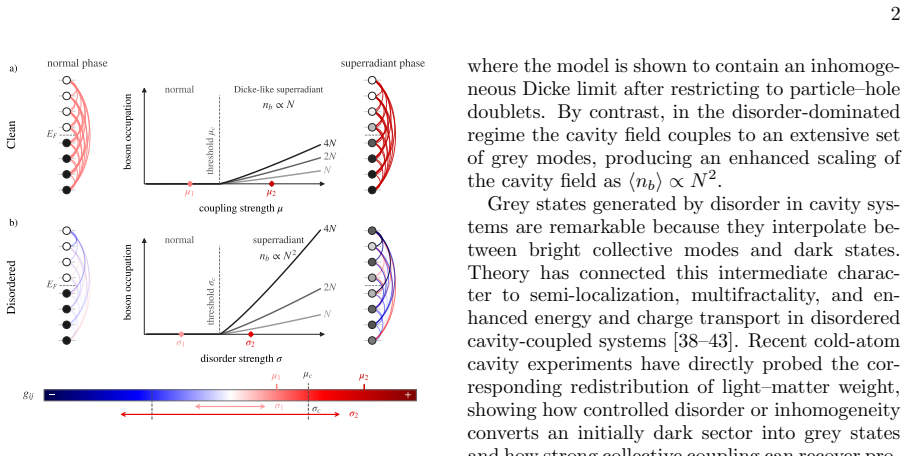
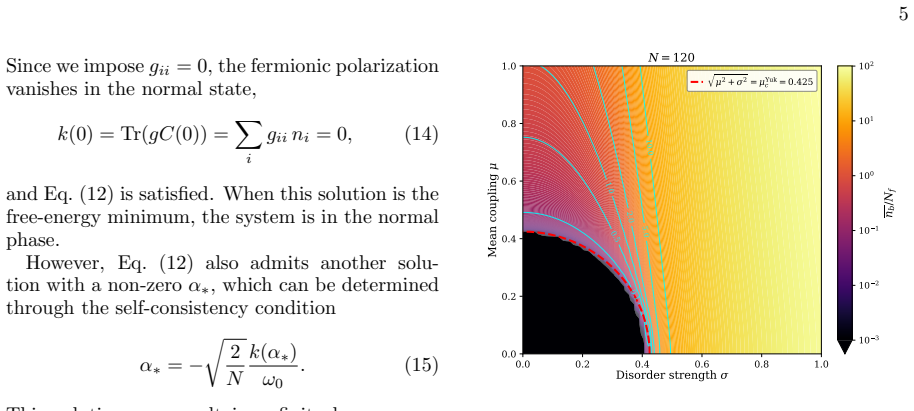
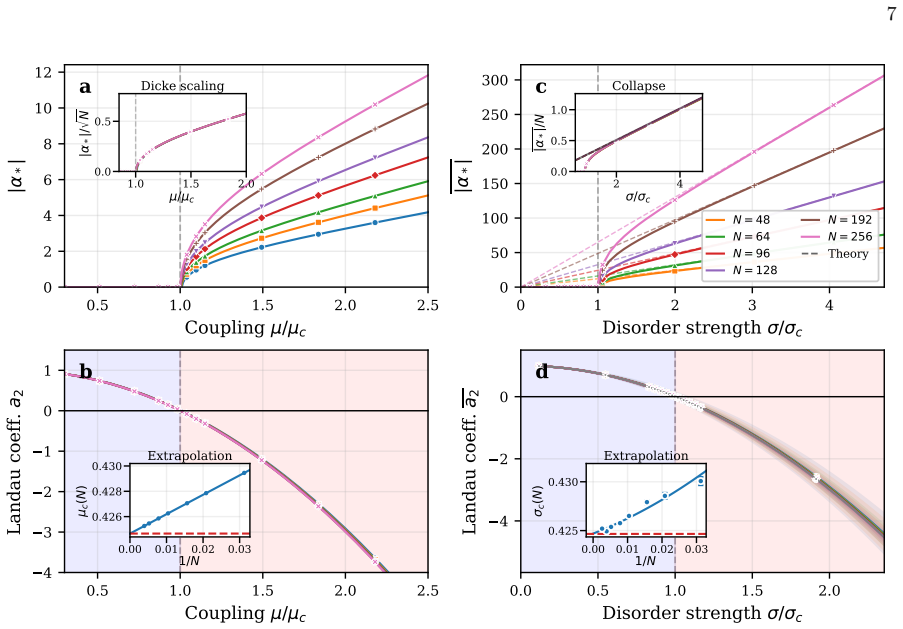
In the cavity model with fermionic particles coupled to a photonic mode via a random all-to-all interaction matrix with tunable mean and variance, mean coupling and disorder variance contribute identically to the onset of the superradiant phase, but inside the phase they produce qualitatively different collective states: uniform coupling supports a single bright fermionic mode with conventional Dicke-like scaling, while disorder supports coherent participation of many grey fermionic states that produces parametrically enhanced scaling of the condensate with system size.
What carries the argument
The random all-to-all interaction matrix with independent tunable mean and variance, which separates the onset condition from the internal structure of the condensed phase and enables the grey-mode collective regime.
If this is right
- Mean coupling and disorder variance add equally to the critical coupling strength for condensation.
- Uniform mean coupling produces a single bright collective fermionic mode with conventional scaling.
- Finite disorder variance recruits multiple grey fermionic states that participate coherently.
- The resulting condensate amplitude scales parametrically faster with system size than in the uniform case.
- Mean-field numerics, stability analysis, and random-matrix theory together locate the phase boundary and mode structure.
Where Pith is reading between the lines
- Similar disorder-induced recruitment of multiple modes could appear in other all-to-all or long-range interacting quantum-optical systems.
- If real atom-light couplings carry spatial correlations instead of pure all-to-all randomness, the grey-mode regime may require additional tuning or may be suppressed.
- The mechanism suggests a route to engineer stronger collective effects by controlled introduction of disorder rather than by increasing uniformity.
Load-bearing premise
The random all-to-all interaction matrix with independent mean and variance is assumed to faithfully represent the physical atom-light couplings.
What would settle it
Direct measurement of cavity-field amplitude versus fermion number at fixed disorder strength; observation of strictly linear rather than parametrically faster growth would falsify the enhanced-scaling claim.
Figures
read the original abstract
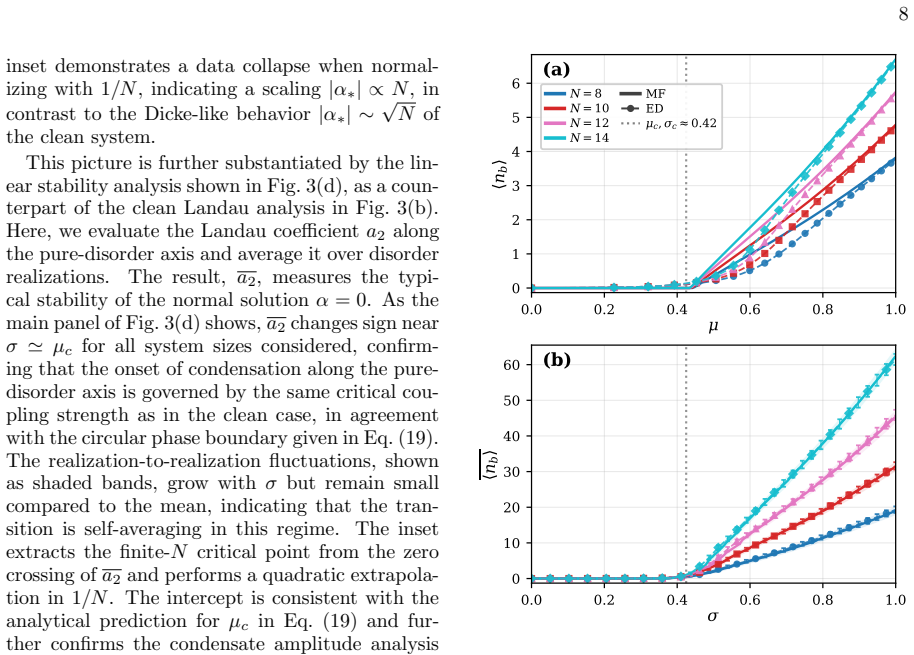
Collective light-matter phenomena such as Dicke superradiance are often described as a collection of effective spins coupled homogeneously to a bosonic mode, giving rise to a collective bright mode with enhanced light-matter coupling. In fermionic systems, Pauli exclusion and Fermi-surface structure can significantly modify this picture, while randomness in the atom-light couplings raises the question of whether disorder promotes or suppresses collective behavior. Here, we study a cavity model in which fermionic particles couple to a photonic mode through a random all-to-all interaction matrix with tunable mean and variance. Combining numerical mean-field methods, analytic stability analysis and random-matrix predictions, and benchmarks against exact diagonalization, we characterize both the onset and structure of the superradiant phase. While mean coupling and disorder variance contribute in the same way to the onset, they lead to drastically different behavior within the condensed phase. Uniform coupling supports a single bright collective fermionic mode with conventional Dicke-like scaling of the cavity field. Disorder, instead, gives rise to a qualitatively different collective regime in which many grey fermionic states participate coherently, producing a parametrically enhanced scaling of the condensate with system size. Our results reveal a mechanism through which disorder can, perhaps counterintuitively, promote collective light-matter phenomena.
Editorial analysis
A structured set of objections, weighed in public.
Referee Report
Summary. The paper examines a cavity model of fermions coupled to a photonic mode through a random all-to-all interaction matrix with independently tunable mean and variance. Combining mean-field numerics, analytic stability analysis, random-matrix predictions, and exact-diagonalization benchmarks, the work shows that mean coupling and variance contribute equivalently to the superradiant onset, yet produce qualitatively distinct condensed phases: uniform coupling yields a single bright fermionic mode with conventional Dicke scaling of the cavity field, while finite variance generates a multi-mode grey regime in which many fermionic states participate coherently, resulting in parametrically enhanced condensate scaling with system size.
Significance. If the reported scaling distinction holds, the result is significant because it identifies a concrete mechanism by which disorder can enhance rather than suppress collective light-matter coherence in a fermionic setting. The use of four complementary methods (mean-field, stability analysis, random-matrix theory, and exact diagonalization) provides internal cross-checks that strengthen the central claim.
minor comments (2)
- [Abstract] The abstract states that the enhanced scaling is 'parametrically' enhanced but does not quote the explicit functional form (e.g., N^α with α>1/2); a brief statement of the predicted exponent would improve clarity.
- [Model] The model section should explicitly state the precise distribution (Gaussian, uniform, etc.) from which the random couplings are drawn and whether the mean and variance are independent parameters or related by a single disorder strength.
Simulated Author's Rebuttal
We thank the referee for their positive assessment of our manuscript, the recognition of its significance, and the recommendation for minor revision. No specific major comments were raised in the report.
Circularity Check
No significant circularity; derivation is self-contained
full rationale
The paper derives its central claims (onset of superradiance and parametrically enhanced scaling under disorder) from a combination of mean-field numerics, analytic stability analysis, random-matrix theory predictions, and exact-diagonalization benchmarks on the stated random all-to-all coupling model. No step reduces by construction to a fitted parameter taken from the target data, no self-citation is load-bearing for the uniqueness of the grey-mode regime, and no ansatz is smuggled in. The distinction between mean-coupling and variance effects follows directly from the model's equations without circular redefinition.
Axiom & Free-Parameter Ledger
free parameters (2)
- mean of random coupling matrix
- variance of random coupling matrix
axioms (2)
- domain assumption Mean-field decoupling of the cavity-fermion interaction is valid near the superradiant transition
- domain assumption The all-to-all random matrix belongs to the Gaussian orthogonal or unitary ensemble
Reference graph
Works this paper leans on
-
[1]
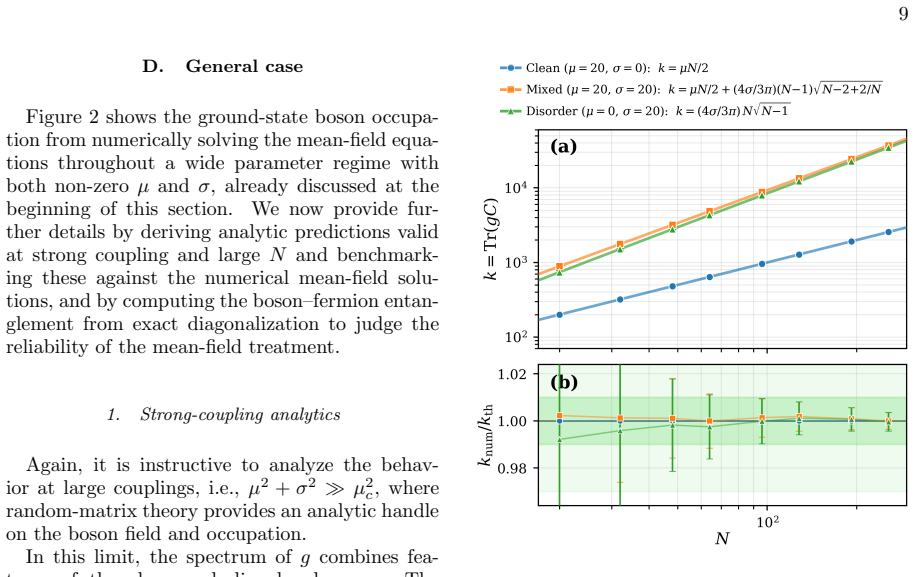
In this limit, the spectrum ofgcombines fea- tures of the clean and disordered cases
Strong-coupling analytics Again, it is instructive to analyze the behav- ior at large couplings, i.e.,µ 2 +σ 2 ≫µ 2 c, where random-matrix theory provides an analytic handle on the boson field and occupation. In this limit, the spectrum ofgcombines fea- tures of the clean and disordered cases. The nonzero mean coupling produces a bright mode with eigenval...
-
[2]
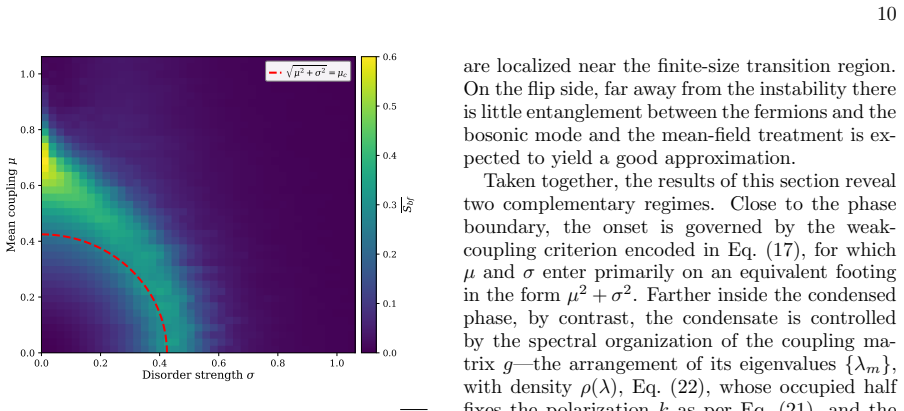
Boson–fermion entanglement To further discriminate the regimes where mean- field theory is reliable, we use exact diagonaliza- tion to probe the quantum correlations in the full Hamiltonian (1). Specifically, we compute the en- tanglement entropy between the cavity mode and the fermionic sector, which assumes the role played by the atom–field entropy in t...
-
[3]
R. H. Dicke, Phys. Rev.93, 99 (1954)
1954
-
[4]
Hepp and E
K. Hepp and E. H. Lieb, Annals of Physics76, 360 (1973)
1973
-
[5]
Y. K. Wang and F. T. Hioe, Phys. Rev. A7, 831 (1973)
1973
-
[6]
Emary and T
C. Emary and T. Brandes, Phys. Rev. E67, 066203 (2003)
2003
-
[7]
Kirton, M
P. Kirton, M. M. Roses, J. Keeling, and E. G. Dalla Torre, Advanced Quantum Technologies2, 1800043 (2019)
2019
-
[8]
Dimer, B
F. Dimer, B. Estienne, A. S. Parkins, and H. J. Carmichael, Phys. Rev. A75, 013804 (2007)
2007
-
[9]
Ritsch, P
H. Ritsch, P. Domokos, F. Brennecke, and T. Esslinger, Rev. Mod. Phys.85, 553 (2013)
2013
-
[10]
D. Nagy, G. K´ onya, G. Szirmai, and P. Domokos, Phys. Rev. Lett.104, 130401 (2010)
2010
-
[11]
Baumann, C
K. Baumann, C. Guerlin, F. Brennecke, and T. Esslinger, Nature464, 1301 (2010)
2010
-
[12]
Mivehvar, F
F. Mivehvar, F. Piazza, T. Donner, and H. Ritsch, Advances in Physics70, 1 (2021)
2021
-
[13]
Rza˙ zewski, K
K. Rza˙ zewski, K. W´ odkiewicz, and W.˙Zakowicz, Phys. Rev. Lett.35, 432 (1975)
1975
-
[14]
Bialynicki-Birula and K
I. Bialynicki-Birula and K. Rza ¸ ˙ zewski, Phys. Rev. A19, 301 (1979)
1979
-
[15]
Nataf and C
P. Nataf and C. Ciuti, Nature Communications1, 72 (2010)
2010
-
[16]
Keeling, M
J. Keeling, M. J. Bhaseen, and B. D. Simons, Phys. Rev. Lett.112, 143002 (2014)
2014
-
[17]
Piazza and P
F. Piazza and P. Strack, Phys. Rev. Lett.112, 143003 (2014)
2014
-
[18]
Y. Chen, Z. Yu, and H. Zhai, Phys. Rev. Lett. 112, 143004 (2014)
2014
-
[19]
Chen and Y
S. Chen and Y. Chen, Phys. Rev. A110, 013312 (2024)
2024
-
[20]
Zhang, Y
X. Zhang, Y. Chen, Z. Wu, J. Wang, J. Fan, S. Deng, and H. Wu, Science373, 1359 (2021)
2021
-
[21]
K. Roux, H. Konishi, V. Helson, and J.-P. Bran- tut, Nature Communications11, 2974 (2020)
2020
-
[22]
Helson, T
V. Helson, T. Zwettler, F. Mivehvar, E. Colella, K. Roux, H. Konishi, H. Ritsch, and J.-P. Bran- tut, Nature618, 716 (2023)
2023
-
[23]
Zwettler, F
T. Zwettler, F. Marijanovic, T. B¨ uhler, S. Chat- topadhyay, G. Del Pace, L. Skolc, V. Helson, S. Uchino, E. Demler, and J.-P. Brantut, Nature Communications17, 496 (2026)
2026
-
[24]
B¨ uhler, A
T. B¨ uhler, A. Fabre, G. Bolognini, Z. Xue, T. Zwettler, G. Del Pace, and J.-P. Brantut, Phys- ical Review Letters136, 143401 (2026)
2026
- [25]
-
[26]
Gopalakrishnan, B
S. Gopalakrishnan, B. L. Lev, and P. M. Goldbart, Phys. Rev. Lett.107, 277201 (2011)
2011
-
[27]
Gopalakrishnan, B
S. Gopalakrishnan, B. L. Lev, and P. M. Goldbart, Nature Physics5, 845 (2009)
2009
-
[28]
J. M. Lee and M.-J. Hwang, Frustrated superra- diant phases in one- and two-dimensional lattices (2026), arXiv:2606.05278 [quant-ph]
work page internal anchor Pith review Pith/arXiv arXiv 2026
-
[29]
M¨ uller, P
M. M¨ uller, P. Strack, and S. Sachdev, Physical Review A86, 023604 (2012), publisher: American Physical Society
2012
-
[30]
V. D. Vaidya, Y. Guo, R. M. Kroeze, K. E. Bal- lantine, A. J. Koll´ ar, J. Keeling, and B. L. Lev, Phys. Rev. X8, 011002 (2018)
2018
-
[31]
A. Periwal, E. S. Cooper, P. Kunkel, J. F. Wien- and, E. J. Davis, and M. Schleier-Smith, Na- ture600, 630 (2021), [Erratum: Nature 603, E29 (2022)], arXiv:2106.04070 [quant-ph]
-
[32]
Sauerwein, F
N. Sauerwein, F. Orsi, P. Uhrich, S. Bandy- opadhyay, F. Mattiotti, T. Cantat-Moltrecht, G. Pupillo, P. Hauke, and J.-P. Brantut, Nature Physics19, 1128 (2023)
2023
-
[33]
F. Orsi, N. Sauerwein, R. P. Bhatt, J. Faltinath, E. Fedotova, N. Reiter, T. Cantat-Moltrecht, and J.-P. Brantut, PRX Quantum5, 040333 (2024)
2024
-
[34]
B. P. Marsh, D. A. Schuller, Y. Ji, H. S. Hunt, G. Z. Socolof, D. P. Bowman, J. Keeling, and B. L. Lev, Phys. Rev. Lett.135, 160403 (2025)
2025
-
[35]
P. Das, S. W¨ uster, and A. Sharma, Phys. Rev. A 109, 013715 (2024)
2024
-
[36]
H. Yin, J. Hu, A.-C. Ji, G. Juzeli¯ unas, X.-J. Liu, and Q. Sun, Phys. Rev. Lett.124, 113601 (2020)
2020
-
[37]
J. Dubail, T. Botzung, J. Schachenmayer, G. Pupillo, and D. Hagenm¨ uller, Physical Review A105, 10.1103/physreva.105.023714 (2022). 14
-
[38]
Celardo, A
G. Celardo, A. Biella, L. Kaplan, and F. Bor- gonovi, Fortschritte der Physik61, 250
-
[39]
Strack and S
P. Strack and S. Sachdev, Phys. Rev. Lett.107, 277202 (2011)
2011
-
[40]
Botzung, D
T. Botzung, D. Hagenm”uller, S. Sch”utz, J. Dubail, G. Pupillo, and J. Schachenmayer, Physical Review B102, 144202 (2020)
2020
-
[41]
Dubail, T
J. Dubail, T. Botzung, J. Schachenmayer, G. Pupillo, and D. Hagenm”uller, Physical Re- view A105, 023714 (2022)
2022
-
[42]
Schachenmayer, C
J. Schachenmayer, C. Genes, E. Tignone, and G. Pupillo, Physical Review Letters114, 196403 (2015)
2015
-
[43]
Feist and F
J. Feist and F. J. Garcia-Vidal, Physical Review Letters114, 196402 (2015)
2015
-
[44]
Gonzalez-Ballestero, J
C. Gonzalez-Ballestero, J. Feist, E. Gon- zalo Bad’ia, E. Moreno, and F. J. Garcia-Vidal, Physical Review Letters117, 156402 (2016)
2016
-
[45]
N. C. Ch’avez, F. Mattiotti, J. A. M’endez- Berm’udez, F. Borgonovi, and G. L. Celardo, Physical Review Letters126, 153201 (2021)
2021
-
[46]
Baghdad, P.-A
M. Baghdad, P.-A. Bourdel, S. Schwartz, F. Ferri, J. Reichel, and R. Long, Nature Physics19, 1104 (2023)
2023
-
[47]
Sachdev and J
S. Sachdev and J. Ye, Phys. Rev. Lett.70, 3339 (1993)
1993
-
[48]
Kitaev, A simple model of quantum holog- raphy, Talks at KITP, University of California, Santa Barbara, April 7 and May 27, 2015 (2015)
A. Kitaev, A simple model of quantum holog- raphy, Talks at KITP, University of California, Santa Barbara, April 7 and May 27, 2015 (2015)
2015
-
[49]
Maldacena and D
J. Maldacena and D. Stanford, Phys. Rev. D94, 106002 (2016)
2016
-
[50]
Esterlis and J
I. Esterlis and J. Schmalian, Phys. Rev. B100, 115132 (2019)
2019
-
[51]
G. Pan, W. Wang, A. Davis, Y. Wang, and Z. Y. Meng, Physical Review Research3, 013250 (2021), publisher: American Physical Society
2021
-
[52]
Uhrich, S
P. Uhrich, S. Bandyopadhyay, N. Sauerwein, J. Sonner, J.-P. Brantut, and P. Hauke, A cav- ity quantum electrodynamics implementation of the sachdev–ye–kitaev model (2023)
2023
-
[53]
Baumgartner, P
R. Baumgartner, P. Pelliconi, S. Bandyopadhyay, F. Orsi, N. Sauerwein, P. Hauke, J.-P. Bran- tut, and J. Sonner, Quantum simulation of the sachdev-ye-kitaev model using time-dependent disorder in optical cavities (2024)
2024
- [54]
-
[55]
D. P. Solis, A. Windey, S. Bandyopadhyay, A. Legramandi, and P. Hauke, Phys. Rev. B (2026)
2026
-
[56]
J. Kim, X. Cao, and E. Altman, Phys. Rev. B 101, 125112 (2020)
2020
-
[57]
M. L. Mehta,Random Matrices, 3rd ed., Pure and Applied Mathematics, Vol. 142 (Else- vier/Academic Press, Amsterdam, 2004)
2004
-
[58]
G. W. Anderson, A. Guionnet, and O. Zeitouni, An Introduction to Random Matrices, Cambridge Studies in Advanced Mathematics, Vol. 118 (Cambridge University Press, Cambridge, 2010)
2010
-
[59]
P. J. Forrester,Log-Gases and Random Matri- ces, London Mathematical Society Monographs, Vol. 34 (Princeton University Press, Princeton, 2010)
2010
-
[60]
Peschel and V
I. Peschel and V. Eisler, Journal of Physics A: Mathematical and Theoretical42, 504003 (2009)
2009
-
[61]
Capitaine, C
M. Capitaine, C. Donati-Martin, and D. F´ eral, The Annals of Probability37, 1 (2009)
2009
-
[62]
Knowles and J
A. Knowles and J. Yin, Communications on Pure and Applied Mathematics66, 1663 (2013)
2013
-
[63]
Lambert, C
N. Lambert, C. Emary, and T. Brandes, Physical Review Letters92, 073602 (2004)
2004
-
[64]
G. J. Rodgers and A. J. Bray, Phys. Rev. B37, 3557 (1988)
1988
-
[65]
K¨ uhn, Journal of Physics A: Mathematical and Theoretical41, 10.1088/1751-8113/41/29/295002 (2008)
R. K¨ uhn, Journal of Physics A: Mathematical and Theoretical41, 10.1088/1751-8113/41/29/295002 (2008)
-
[66]
A. D. Mirlin, Y. V. Fyodorov, F.-M. Dittes, J. Quezada, and T. H. Seligman, Phys. Rev. E 54, 3221 (1996)
1996
-
[67]
D. Nagy, G. Szirmai, and P. Domokos, Phys. Rev. A84, 043637 (2011)
2011
-
[68]
B. P. Marsh, R. M. Kroeze, S. Ganguli, S. Gopalakrishnan, J. Keeling, and B. L. Lev, Phys. Rev. X14, 011026 (2024)
2024
-
[69]
R. M. Kroeze, B. P. Marsh, D. A. Schuller, H. S. Hunt, A. N. Bourzutschky, M. Winer, S. Gopalakrishnan, J. Keeling, and B. L. Lev, Sci- ence389, adu7710 (2025)
2025
-
[70]
Mandal, Annals Phys.474, 169925 (2025)
I. Mandal, Annals Phys.474, 169925 (2025). 15 Appendix A: Curvature atα= 0and the onset criterion on the ladder This appendix derives the curvature coefficienta 2 = 1 2 F ′′(0), introduced in Eq. (16), which determines the local stability of the normal solutionα= 0 for the harmonic ladder atT= 0 and half filling Nf =N/2. As in the main text, we assumeg ii...
2025
-
[71]
IV A, we start from the clean model interaction gij =µ(1−δ ij), i, j= 1,
Clean model To derive the results presented in Sec. IV A, we start from the clean model interaction gij =µ(1−δ ij), i, j= 1, . . . , N.(C2) Notice thatgis a circulant matrix. Each row is obtained from the previous one by a cyclic shift or, equivalently,g ij depends only oni−jmoduloN. Circulant matrices are diagonalized by a discrete Fourier transform. For...
-
[72]
IV B of the main text
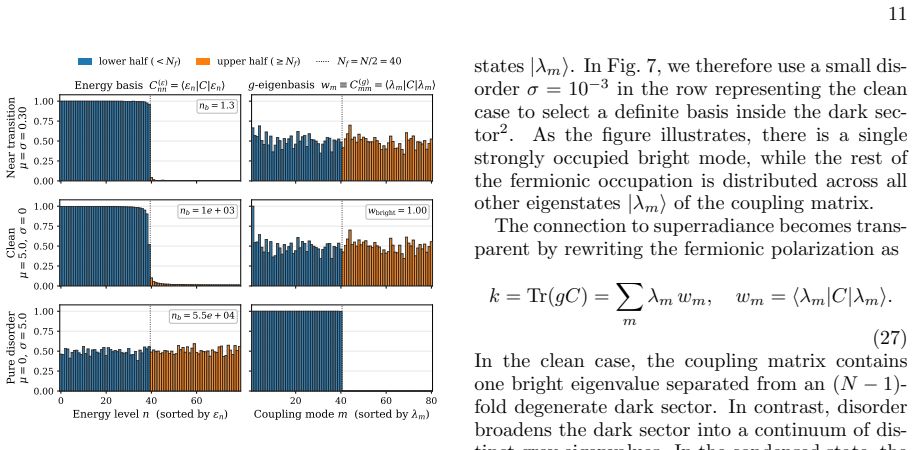
Pure-disorder regime This appendix derives the disorder-dominated scaling quoted in Sec. IV B of the main text. Let λ1 ≥λ 2 ≥ · · · ≥λ N be the eigenvalues ofgwith eigenvectors|λ m⟩. For large|α|, the eigenvalues of h(α) are approximately 2 p 2/N α λm. AtT= 0 and half filling, the ground state fills theN/2 lowest single-particle energies. Choosing the bra...
-
[73]
General case We now consider the general case discussed in Sec. IV D, where we have both finite mean and disorder gij =µ(1−δ ij) +σ ξ ij,(C21) or, in matrix terms g=µ(N|u⟩ ⟨u| −I) +σξ .(C22) Here,Iis the identity matrix and we have introduced the vector |u⟩= 1√ N (1, . . . ,1)T ,(C23) 3 Notice thatξis not strictly a GOE matrix, since it has vanishing diag...
discussion (0)
Sign in with ORCID, Apple, or X to comment. Anyone can read and Pith papers without signing in.