REVIEW 3 major objections 6 minor 16 references
Planet as a Brain: Towards Internet of AgentSites based on AIOS Server
T0 review · 3 major / 6 minor · reviewed 2026-08-16 · deepseek-v4-flash
Pith's one-line read AIOS Server turns any server into an AgentSite, letting AI agents collaborate across the internet without a central platform.
desk verdict A useful engineering report on a deployable agent-hosting runtime, but the 'internet-scale decentralized discovery' claim outruns the evidence. read the letter →
The pith
A machine-rendered reading of the paper's core claim, the machinery that carries it, and where it could break.
The reading
What carries the argument
The load-bearing mechanism is the combination of a Kademlia-style Distributed Hash Table (DHT) and a Gossip-based presence protocol, running beneath the AIOS Server runtime. The DHT gives each agent a keyed home for its metadata and promises logarithmic lookup cost as nodes grow, while the Gossip layer propagates liveness and capability updates with eventual consistency. On top of this, the communication protocol packages every interaction as a JSON-RPC request/response inside the Model Context Protocol, so agents, humans, and external tools exchange messages in one standard shape. The AgentHub registry nodes keep a global view in the deployed service, which means the system currently runs in a hybrid mode: a central registry for the public deployment and a decentralized DHT/Gossip prototype for the claimed scale-out path.
What would settle it
Run the decentralized registry on a few hundred geographically distributed nodes, let nodes join and leave continuously, and measure whether registration latency stays around one millisecond and whether capability lookups converge; if either degrades with network size, the decentralization claim fails. A simpler check is to query the public AgentHub and observe whether lookups are answered by the hub's central registry rather than by DHT/Gossip peers.
Extended reading notes
Core claim
The paper's central discovery is a working architecture for treating AI agents as first-class citizens of the web, on the same model as websites. Each AIOS Server node acts as an independent AgentSite, hosting one or more agents and exposing them to humans and other agents through JSON-RPC messages wrapped in the Model Context Protocol. Agents register themselves in a shared registry and are found through a Distributed Hash Table with a Gossip protocol for presence updates, which the paper presents as the search engine of the agent internet. The deployed system adds an AgentHub for registration and discovery and an AgentChat for interactive communication, and measurements on local and cloud deployments report sub-200-millisecond latencies and up to hundreds of requests per second. The intended outcome is an open, decentralized ecosystem in which task delegation, lookup, and collaboration happen across independent nodes rather than inside one provider's platform.
Load-bearing premise
The key assumption is that the decentralized agent-finding protocol works just as well on hundreds of nodes as it does on 3 to 7, since that is the only scale the paper measures and the currently deployed hub still uses central registries.
Editorial extensions
If this is right
- An AI agent can be hosted on a server anywhere in the world and still be findable by capability, so users are not locked into whichever platform deployed the agent.
- Agents can delegate tasks to agents on other nodes through the same JSON-RPC/MCP message format, making cross-machine multi-step workflows possible without fixed orchestration.
- Because discovery is replicated across a DHT, the design has a concrete path to logarithmic lookup scaling and tolerance to nodes joining or leaving, provided the protocol behaves at large node counts.
- The public deployment provides a reference point for what an open agent internet looks like: registration, discovery, chat, and task logging are all exposed as standard serving interfaces.
- The paper's own future-work list treats large-scale DHT validation, security, and trust modeling as open, so the near-term practical value is strongest for small or loosely coupled multi-agent systems.
Reading between the lines
- We infer that the central-registry AgentHub is best read as the bootstrap phase of the system; the paper's decentralization claim would only be settled by running discovery entirely over the DHT/Gossip layer with hundreds of nodes under churn.
- We infer that trust and verification, not routing, will become the next constraint: an open DHT makes it easy to advertise fake capabilities, so some reputation or attestation layer will likely be needed before agents can rely on strangers.
- We infer that the website-to-AgentSite analogy will invite the usual internet services, such as naming, caching, and traffic management, to grow around this core protocol.
Signed reviews
Editorial analysis
A structured set of objections, weighed in public.
Referee Report
Summary. The paper introduces AIOS Server, a runtime framework for hosting and executing AI agents on individual network nodes, which it calls AgentSites. It argues that such AgentSites, connected over the internet, form an 'Internet of Agentsites' analogous to the World Wide Web. The technical contributions are a communication protocol built on MCP and JSON-RPC, a deployed system (AIOS-IoA) consisting of AgentHub for registration/discovery and AgentChat for human-agent interaction at planet.aios.foundation, and a prototype decentralized discovery mechanism based on Kademlia DHT and a Gossip protocol. The evaluation measures communication latency/throughput in local and cloud settings (50-200 requests) and registration latency on 3, 5, and 7 nodes. The central claim is that AIOS Server provides a practical, decentralized, internet-scale foundation for agent collaboration.
Significance. If substantiated, the paper would make a useful systems contribution: it provides an open-source implementation, a publicly accessible deployment, a concrete communication protocol, and a modular separation between protocol logic and task execution. The reproducibility of the implementation and the existence of a live deployment are genuine strengths. However, the load-bearing claims about decentralization and internet-scale scalability are not currently supported by the evidence. The deployed architecture is described as using central registry nodes, while the DHT/Gossip discovery mechanism is explicitly a prototype whose large-scale validation is listed as future work. The evaluation is too small in scale and too thin in methodology to estimate real-world performance under churn, contention, or failure.
major comments (3)
- [Sections 5.2 and 5.4] There is a direct contradiction between the decentralized design claim and the description of the deployed system. Section 5.2 states that the DHT and Gossip mechanism 'avoids centralized coordination,' while Section 5.4 and Figure 8 describe AgentHub as 'central registry nodes' that 'manage a global view of agent availability through a registry database,' and Section 3 says AIOS nodes 'interact with an agent registry node for agent registration, discovery, task assignment, and health monitoring.' The paper never reconciles these two architectures. This is load-bearing because the paper's headline claim of a decentralized Internet of Agentsites depends on which architecture is actually deployed. The authors should either explicitly state that the public deployment uses the central-registry AgentHub and that the DHT/Gossip mechanism is only a prototype, or show how the two designs coexist without compromising decentralization.
- [Section 6.3 and Section 7] The evaluation of the DHT/Gossip discovery mechanism does not support the claim of scalable, decentralized agent discovery. Section 6.3 reports registration tests on only 3, 5, and 7 nodes, with no repetitions, no error bars, no churn, no failure injection, and no comparison baseline. The claim of O(log n) scalability is asserted from the Kademlia design but never demonstrated at any scale beyond 7 nodes. This limitation is in fact acknowledged by the authors themselves in Section 7, future work item (4), which lists 'DHT registry validation at scale: Integrating the DHT + Gossip registry into a larger distributed deployment with hundreds of nodes.' The paper should therefore soften the scalability claims and either add a larger-scale simulation or explicitly present the DHT/Gossip system as prototype work that is not yet part of the validated deployment.
- [Section 6.2 and Table 3] The communication performance evaluation is too limited to support the paper's general claims of low-latency, high-throughput, and robust coordination. Table 3 reports only 50, 100, and 200 total requests under 5, 10, and 20 concurrent users respectively, with no repetitions, no standard deviations, no baseline system, and no sensitivity analysis. The statement in Section 6.2 that 'Throughput increased with load' is an artifact of the concurrency settings rather than evidence of scalability, and '100% response success' is meaningful only if we know the request mix and failure conditions, which are not described. At minimum, the authors should provide error bars, repeated trials, and a comparison against a simple baseline, or else restrict their claims to small-scale deployments and treat the larger-scale behavior as untested.
minor comments (6)
- [Abstract] The abstract describes AIOS-IoA as 'the world's first practically deployed Internet of Agentsites,' but the paper's own evidence and Section 7 future-work list indicate that the decentralized DHT/Gossip discovery layer is not fully deployed or validated. Suggest using 'a first public deployment' or 'an initial deployment' to avoid an unsupported superlative.
- [Section 5.2] The text says the decentralized registration system is 'designed and implemented,' but Appendix D repeatedly calls it a 'prototype.' Please use consistent terminology so that readers know whether the code is integrated into the production AIOS deployment or is a standalone prototype.
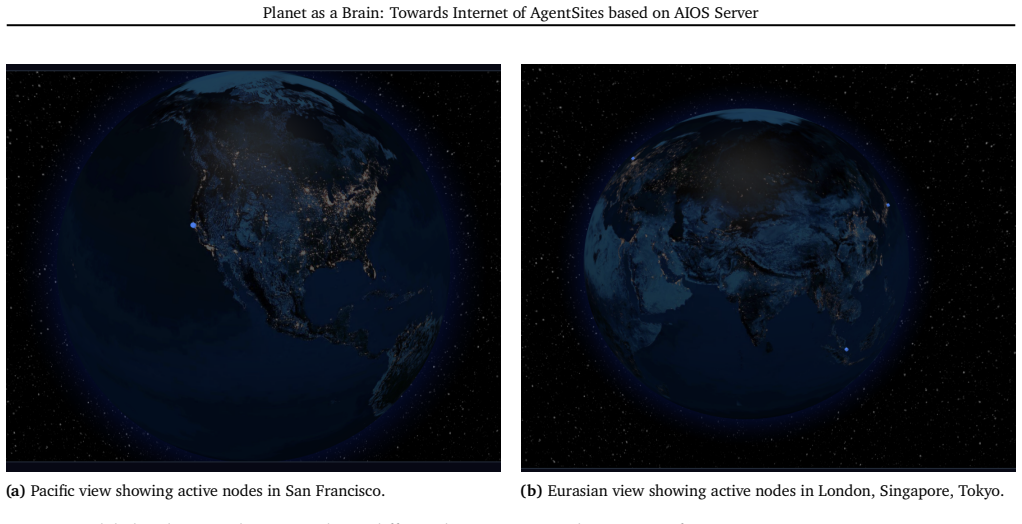
- [Section 6.4] The screenshots and global maps in Figures 9-12 are presented as validation, but they are illustrative only. The paper should explicitly label them as demonstration artifacts and keep the quantitative claims separate.
- [Table 2] Table 2 compares 'Centralized AIOS' and 'Decentralized AIOS' in terms of scalability, fault tolerance, and routing, but no experiment in Section 6 directly measures these differences. Please mark the table as a design comparison rather than an empirical result.
- [Throughout] The paper has several typographical issues, including inconsistent spacing in JSON examples (e.g., 'la st _s ee n') and occasional missing words such as 'AIOS server' versus 'the AIOS server.' A careful proofreading pass is needed.
- [Title and Section 1] The title and Section 1 mention 'Planet as a Brain,' but the rest of the paper does not develop this metaphor or provide evidence for any global-brain-like coordination. Either discuss this framing in the body or remove it from the title.
Circularity Check
No circularity found: the paper is a build-and-measure systems description with no fitted predictions and no self-citation-forced conclusion.
full rationale
The paper contains no derivation chain that reduces a claimed result to its own inputs. Its contributions are a runtime implementation (AIOS Server), a public deployment (AIOS-IoA), a DHT and Gossip discovery prototype, and empirical latency, throughput, and registration-time measurements. No parameter is fitted to data and later presented as a prediction; the claim that DHT provides O(log n) lookup is a standard property of Kademlia, not a fitted output. The authors cite their own prior AIOS work (Mei et al., 2024) as background and as the foundation on which AIOS Server builds, but the present claims are not justified by that citation alone: the implementation is public on GitHub and the evaluation is empirical, so the self-citation is not load-bearing. The internal inconsistency between Section 5.2's claim of no centralized coordination and Section 5.4's description of central registry nodes, as well as the 3-7 node discovery evaluation, are substantive correctness and evidence concerns but not circular reductions. No circularity is present, so the score is 0.
Assumptions & free parameters
assumptions (5)
- standard math Kademlia DHT provides O(log n) lookup complexity and resilience under churn.
- standard math Gossip-based synchronization provides eventual consistency of presence information.
- domain assumption Model Context Protocol (MCP) v1.2.1 is a secure and interoperable communication standard.
- domain assumption All AIOS nodes run the same code base and can act as both server and client, enabling decentralized coordination.
- domain assumption The public endpoint at planet.aios.foundation is a real deployment of the described system.
invented entities (2)
-
AgentSite
independent evidence
-
Internet of Agentsites (AIOS-IoA)
independent evidence
Cite this review
Pith. "Pith review of Planet as a Brain: Towards Internet of AgentSites based on AIOS Server." pith.science (2026). https://pith.science/paper/ZCEWIM7L
@misc{pith2026250414411,
  author       = {Pith},
  title        = {Pith review of: Planet as a Brain: Towards Internet of AgentSites based on AIOS Server},
  year         = {2026},
  howpublished = {\url{https://pith.science/paper/ZCEWIM7L}},
  note         = {Machine review of arXiv:2504.14411}
}
read the original abstract
The internet is undergoing a historical transformation from the "Internet of Websites" to the "Internet of AgentSites." While traditional Websites served as the foundation for information hosting and dissemination, a new frontier is emerging where AgentSites serve as the hubs of the internet, where each AgentSite hosts one or more AI agents that receive tasks, address them, and deliver actionable solutions, marking a significant shift in the digital landscape and representing the next generation of online ecosystems. Under this vision, AIOS, the AI Agent Operating System, serves as the server for the development, deployment and execution of AI agents, which is a fundamental infrastructure for the Internet of Agentsites. In this paper, we introduce AIOS Server, a runtime framework to host agents and enable global-scale collaboration among decentralized agents. AIOS Server provides a communication protocol leveraging the Model Context Protocol (MCP) and JSON-RPC to enable agent-agent or human-agent interactions. Each AIOS node operates as a server to host and execute agents, while supporting peer-to-peer coordination without reliance on centralized orchestration. Based on AIOS Server, we further present the world's first practically deployed Internet of Agentsites (AIOS-IoA), including AgentHub for agent registration and discovery and AgentChat for interactive communication, at https://planet.aios.foundation. The agent discovery mechanism based on Distributed Hash Tables (DHT) and a Gossip protocol serves as the search engine for the internet of agentsites. This work provides a practical foundation for building the Internet of Agentsites-a new paradigm where autonomous agents become first-class citizens of the web. The implementation is available at https://github.com/agiresearch/AIOS.Server and is integrated into the AIOS main branch at https://github.com/agiresearch/AIOS.
Figures


Figures from the paper (9 more)




Reference graph
Works this paper leans on
-
[1]
Chi-Min Chan et al. Chateval: Towards better llm-based evaluators through multi-agent debate.arXiv preprint arXiv:2308.07201,
-
[3]
Yilun Du et al. Improving factuality and reasoning in language models through multiagent debate.arXiv preprint arXiv:2305.14325,
-
[5]
Zelong Li et al. Formal-llm: Integrating formal language and natural language for controllable llm-based agents.arXiv preprint arXiv:2402.00798,
-
[6]
14 Planet as a Brain: Towards Internet of AgentSites based on AIOS Server Tian Liang et al. Encouraging divergent thinking in large language models through multi-agent debate.arXiv preprint arXiv:2305.19118,
-
[7]
Gaia: A benchmark for general ai assistants.arXiv preprint arXiv:2311.12983,
Grégoire Mialon et al. Gaia: A benchmark for general ai assistants.arXiv preprint arXiv:2311.12983,
-
[8]
Self-alignment of large language models via multi-agent social simulation
Xianghe Pang, Shuo Tang, Rui Ye, Yuxin Xiong, Bolun Zhang, Yanfeng Wang, and Siheng Chen. Self-alignment of large language models via multi-agent social simulation. InICLR 2024 Workshop on Large Language Model (LLM) Agents,
work page 2024
-
[9]
Communicative agents for software development.arXiv preprint arXiv:2307.07924,
Chen Qian et al. Communicative agents for software development.arXiv preprint arXiv:2307.07924,
-
[10]
Voyager: An open-ended embodied agent with large language models
Guanzhi Wang et al. Voyager: An open-ended embodied agent with large language models. arXiv preprint arXiv:2305.16291,
Show all 16 references
-
[11]
A survey on large language model based autonomous agents.Frontiers of Computer Science, 18(6): 186345, 2024a
Lei Wang, Chen Ma, Xueyang Feng, Zeyu Zhang, Hao Yang, Jingsen Zhang, Zhiyuan Chen, Jiakai Tang, Xu Chen, Yankai Lin, et al. A survey on large language model based autonomous agents.Frontiers of Computer Science, 18(6): 186345, 2024a. Zora Zhiruo Wang, Jiayuan Mao, Daniel Frie...
-
[12]
Os-copilot: Towards generalist computer agents with self-improvement
Zhiyong Wu et al. Os-copilot: Towards generalist computer agents with self-improvement. arXiv preprint arXiv:2402.07456,
-
[13]
A-mem: Agentic memory for llm agents
Wujiang Xu, Zujie Liang, Kai Mei, Hang Gao, Juntao Tan, and Yongfeng Zhang. A-mem: Agentic memory for llm agents. arXiv preprint arXiv:2502.12110,
-
[15]
Agent security bench (asb): Formalizing and benchmarking attacks and defenses in llm-based agents.arXiv preprint arXiv:2410.02644,
Hanrong Zhang, Jingyuan Huang, Kai Mei, Yifei Yao, Zhenting Wang, Chenlu Zhan, Hongwei Wang, and Yongfeng Zhang. Agent security bench (asb): Formalizing and benchmarking attacks and defenses in llm-based agents.arXiv preprint arXiv:2410.02644,
-
[16]
jsonrpc": Protocol version identifier (e.g.,
15 Planet as a Brain: Towards Internet of AgentSites based on AIOS Server APPENDIX A. Human-Agent Communication A.1. Message Schema Explanation The following explains each field of the human-agent communication request: • "jsonrpc": Protocol version identifier (e.g., "2.0"). •...
2025
-
[2023]
Metagpt: Metaprogrammingformulti-agentcollaborativeframework
SiruiHongetal. Metagpt: Metaprogrammingformulti-agentcollaborativeframework. arXivpreprintarXiv:2308.00352 ,
-
[2024]
Agentverse: Facilitating multi-agent collaboration and exploring emergent behaviors.arXiv preprint arXiv:2305.12112,
Weize Chen et al. Agentverse: Facilitating multi-agent collaboration and exploring emergent behaviors.arXiv preprint arXiv:2305.12112,
-
[2025]
React: Synergizing reasoning and acting in language models.arXiv preprint arXiv:2210.03629,
Shunyu Yao, Jeffrey Zhao, Dian Yu, Nan Du, Izhak Shafran, Karthik Narasimhan, and Yuan Cao. React: Synergizing reasoning and acting in language models.arXiv preprint arXiv:2210.03629,
Reviewed August 16, 2026 · model on record in the stance chip above.
Discussion (0). Continue with ORCID to comment.