REVIEW 3 major objections 5 minor 10 references
Efficient Cross-Validation of Echo State Networks
T0 review · 3 major / 5 minor · reviewed 2026-08-14 · deepseek-v4-flash
Pith's one-line read Cross-validating ESNs for roughly the cost of one split
desk verdict Useful practical paper on fast cross-validation for ESNs, but the efficient algorithm silently changes the CV scheme by letting validation data leak into reservoir states for later training blocks. read the letter →
The pith
A machine-rendered reading of the paper's core claim, the machinery that carries it, and where it could break.
The reading
What carries the argument
The central objects are the global Gram matrices $XX^\top$ and $Y_{\mathrm{target}}X^\top$, collected in one pass over the full sequence. Per split, the validation fold's contribution is subtracted from these global sums to form the ridge-regression training quantities, and the reservoir state saved at the fold boundary lets the next fold continue without a fresh run. This segment-decomposition identity, combined with the Markovian state update and the linear readout, is what carries the complexity saving and yields the bound $O(N_r^2T + kN_r^3)$.
What would settle it
Measure wall-clock time of the proposed k-fold algorithm on a long synthetic continuous series with $T$ much larger than $N_r$ (for example, $T = 10^6$, $N_r = 100$) for $k = 2, 10, 50$; if running time grows roughly linearly with k while k is well below $T/N_r$, the constant-in-k dominant term is not realized, and permuting the fold order so boundary states cannot be reused should make the speedup vanish.
Extended reading notes
Core claim
Cross-validating an ESN does not require rerunning the reservoir for every fold. Because the reservoir state is Markovian and the readout has no feedback into it, the state at each fold boundary can be saved during one full pass. The algorithm stores global $XX^\top$ and $Y_{\mathrm{target}}X^\top$ once, then for each split either reuses or reruns only the validation fold, subtracts that fold's contribution to obtain the training Gram matrices, and solves ridge regression per split. This reduces the dominant time term from $O(kN_r^2T)$ to $O(N_r^2T)$, leaving only the per-split matrix inversions $O(kN_r^3)$. For $T \gg N_r$ and $k < T/N_r$, k-fold cross-validation therefore has essentially the same time and space complexity as a single validation.
Load-bearing premise
The savings rely on the validation folds being consecutive blocks of one continuous time series, with the reservoir state saved at each boundary and carried into the next split; if folds are shuffled or non-contiguous, or the readout feeds back into the reservoir, the reservoir must be rerun and the $O(N_r^2T + kN_r^3)$ bound no longer follows.
Editorial extensions
If this is right
- For long time series with $T \gg N_r$, the cost of k-fold cross-validation stays flat as k grows until k approaches $T/N_r$, so practitioners can use many folds for nearly the price of one validation.
- The same time and space bound applies to any reservoir-type model with a linear readout and no output feedback, not only classical ESNs.
- The proposed CV, AV, and FV schemes give concrete alternatives to static validation; the experiments suggest AV and FV select better forward-predicting models on drifting data, while CV improves hyperparameter estimates on scarce data.
- The final trained model can be produced by retraining, averaging readout matrixes, or choosing the best-validated split, making the choice of final-model strategy a joint decision with the validation scheme.
Reading between the lines
- The same Gram-matrix subtraction trick should transfer to any linear-readout model whose hidden state evolves independently of the trained output, so long as validation folds remain contiguous blocks of one continuous series.
- A direct stress test is to shuffle or randomize the folds: the predicted speedup should disappear because saved boundary states no longer connect folds, which would cleanly separate the algorithm's benefit from implementation noise.
- The complexity bound suggests an adaptive strategy: for a single continuous series, use k up to roughly $T/N_r$ at no extra cost, effectively replacing single-split validation with full cross-validation in the data-rich regime.
- In the complementary regime where k exceeds $T/N_r$, the $kN_r^3$ inversion term dominates, so the practical gain is confined to long-series settings; for short series the method still helps but the speedup is less pronounced.
Signed reviews
Editorial analysis
A structured set of objections, weighed in public.
Referee Report
Summary. The paper proposes several temporal cross-validation schemes for echo state networks (CV, AV, FV, and their k-step variants) and an efficient implementation that avoids rerunning the reservoir for every split. The central idea is to accumulate the global gram matrices XX^T and YtargetX^T in one pass through the data and, for each split, subtract the validation fold's contribution before solving the ridge regression. This leads to the claimed complexity O(Nr^2 T + k Nr^3) in Eq. (9), i.e., no growth in the dominant reservoir pass with the number of folds k. The authors also report experiments on four generative time-series datasets and the Japanese Vowels classification benchmark, concluding that AV/FV schemes often give better test generalization than a single static split, and they discuss how the final model can be produced by retraining, averaging, or selection.
Significance. If the complexity claim held for the actual cross-validation procedure, this would be a practically valuable contribution: it would remove the main computational obstacle to routine k-fold validation of ESN hyperparameters. The paper's notation is clear, the complexity decomposition in Eqs. (7)-(9) is explicit, and the proposed schemes are sensible and well motivated. The empirical comparison on several real-world datasets, despite limitations, is a genuine attempt to evaluate the methods under different task types. No circularity is present: the complexity bound follows from the stated equations, and the paper does not reuse fitted constants in its derivation. However, as detailed below, the equivalence of the efficient algorithm to the defined CV scheme is not established for stateful time-series tasks, which is a load-bearing issue for the paper's central claim.
major comments (3)
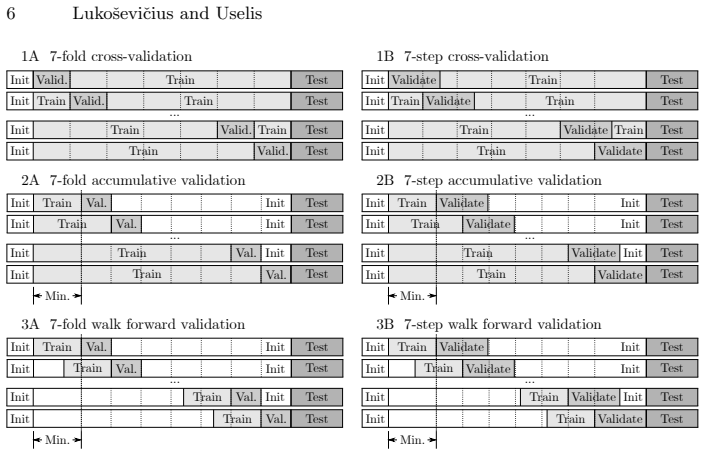
- [Section 2.5, Eq. (9)] The subtraction identity in Section 2.5 is not equivalent to the k-fold CV defined in Section 2.3 when the validation fold lies before a training block. In the single full pass used to build XX^T and YtargetX^T, the reservoir state at a later training block is computed from the inputs (and, under the teacher forcing described in Section 2.2, the targets) of the earlier validation fold. Subtracting the validation fold's contribution from the global sum removes the direct contributions of those time steps, but it does not remove the influence of those time steps on the feature vectors of subsequent training points. The resulting regression is therefore trained on a different, temporally leaky design matrix. Eq. (9) states the complexity of this leaky procedure, not of the CV procedure of Section 2.3. The authors should either restrict the one-pass implementation to settings where this contamination is absent (e.g., independent sequences in the classification setting, or validation folds placed after all training data as in AV), or explicitly present the leaked procedure as an approximate CV scheme and quantify its bias.
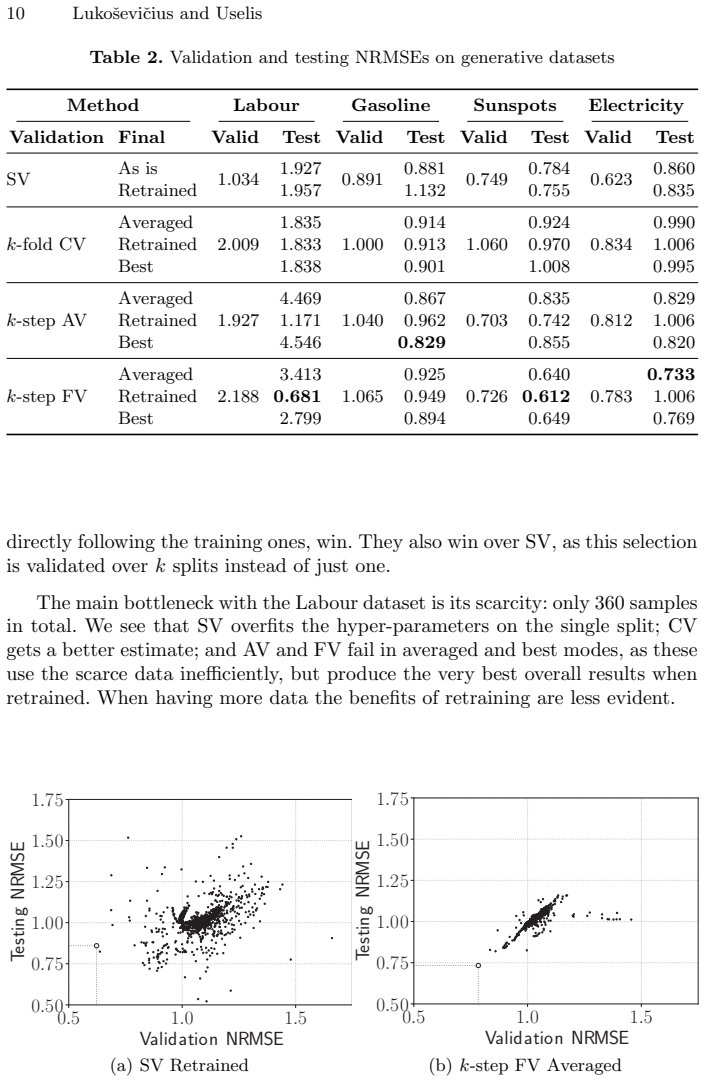
- [Section 3, Table 2] The empirical comparison for the generative datasets reports a single run per dataset, with no error bars or standard deviations. The claim that "in all the experiments either FV or AV find the hyper-parameters producing best generalizing models" is therefore not statistically supported, since random reservoir initialization alone can change the ranking. The paper also does not state the number of reservoir initializations, the washout length, or how fold-averaged validation errors are aggregated. Please report multiple seeds with mean and standard deviation, or at least clearly state that the results are illustrative rather than conclusive.
- [Section 2.5, Section 3, Figure 2] The claimed adaptation of the efficient algorithm to AV, FV, and k-step variants is not specified. For AV and FV, the training set of a split is a prefix or a fixed window, so the global-minus-validation-fold subtraction does not produce the required training gram; one would need fold-wise or rolling gram matrices. For the k-step variants, the overlapping validation blocks violate the "consecutive folds" assumption stated in Section 2.5. Since Table 2 and Figure 3 rely on k-step AV and FV, the paper should give the actual adapted algorithms and their complexity, or restrict the efficiency claim to the standard k-fold CV case.
minor comments (5)
- [Section 2.5] The phrase "k-means cross-validation" should read "k-fold cross-validation"; there is also a typo "propsed" in the same paragraph.
- [Table 3] The table title "Japanese Wovels" contains a typo and should be "Japanese Vowels."
- [Section 2.5] The reference to "Figure 2.1A" is ambiguous; it should refer to a specific panel, e.g., "Figure 2, panel 1A."
- [Section 3.1] The acronym NRMSE is used without a definition; please define it at first occurrence.
- [Table 2] The layout of Table 2 is hard to read: the grouping of the "Averaged", "Retrained", and "Best" rows under each scheme is not visually distinct, and the "Validation Final Valid Test" header is confusing. Consider using separate subtables or clearer horizontal rules.
Circularity Check
No significant circularity: the complexity result follows from the paper's stated linear algebra and is not obtained by reusing fitted constants or by a self-citation chain.
full rationale
The central claim, that k-fold cross-validation of ESNs can be performed in O(Nr^2 T + k Nr^3) time, is derived directly from the paper's own equations: the reservoir update (1)-(2), the ridge regression solution (6), the collection of gram matrices XX^T and YtargetX^T, and the algebraic subtraction of the validation-fold contributions from the global matrices in Section 2.5. This is an operation-count argument over explicitly stated matrix products and inversions, not a prediction that reduces to a fitted input or to a self-citation. The paper's citations to the authors' earlier ESN guides (e.g., [6]) supply background training details and notation, but the efficiency bound and the subtraction identity do not depend on any unverified claim imported from those references. A separate question is whether the subtractive procedure exactly reproduces the k-fold CV protocol as defined in Section 2.3, particularly for generative tasks where validation-fold inputs influence later reservoir states; that is a correctness or consistency concern, not a circularity concern, because the complexity result is about the algorithm the paper actually specifies. No step in the derivation chain is equivalent by construction to its own input, and no fitted parameter is renamed as a prediction. Thus the appropriate finding is no significant circularity, with score 0.
Assumptions & free parameters
assumptions (4)
- standard math The ridge regression estimate (6) is the training objective and the gram matrices decompose additively over time columns: S_train = S_all - S_val.
- domain assumption Reservoir state x(n) is generated independently of the readout, so one forward pass over the whole sequence suffices to build all design matrices.
- domain assumption The echo state / Markovian property allows phase switches and fold-boundary states to be reused without reinitializing the reservoir.
- standard math Dense matrix inversion costs O(Nr^3) in practical implementations.
Cite this review
Pith. "Pith review of Efficient Cross-Validation of Echo State Networks." pith.science (2026). https://pith.science/paper/ZCJMFK3X
@misc{pith2026190808450,
  author       = {Pith},
  title        = {Pith review of: Efficient Cross-Validation of Echo State Networks},
  year         = {2026},
  howpublished = {\url{https://pith.science/paper/ZCJMFK3X}},
  note         = {Machine review of arXiv:1908.08450}
}
abstract
Echo State Networks (ESNs) are known for their fast and precise one-shot learning of time series. But they often need good hyper-parameter tuning for best performance. For this good validation is key, but usually, a single validation split is used. In this rather practical contribution we suggest several schemes for cross-validating ESNs and introduce an efficient algorithm for implementing them. The component that dominates the time complexity of the already quite fast ESN training remains constant (does not scale up with $k$) in our proposed method of doing $k$-fold cross-validation. The component that does scale linearly with $k$ starts dominating only in some not very common situations. Thus in many situations $k$-fold cross-validation of ESNs can be done for virtually the same time complexity as a simple single split validation. Space complexity can also remain the same. We also discuss when the proposed validation schemes for ESNs could be beneficial and empirically investigate them on several different real-world datasets.
Figures

Reference graph
Works this paper leans on
-
[1]
Herbert Jaeger. The “echo state” approach to analysing and training recurrent neural networks. Technical Report GMD Report 148, German National Research Center for Information Technology, 2001
work page 2001
-
[2]
Herbert Jaeger and Harald Haas. Harnessing nonlinearity: predicting chaotic sys- tems and saving energy in wireless communication.Science, 304(5667):78–80, 2004
work page 2004
- [3]
-
[4]
Reservoir computing approaches to re- current neural network training
Mantas Lukoˇ seviˇ cius and Herbert Jaeger. Reservoir computing approaches to re- current neural network training. Computer Science Review , 3(3):127–149, August 2009
work page 2009
-
[5]
Cross-validatory choice and assessment of statistical predictions
Mervyn Stone. Cross-validatory choice and assessment of statistical predictions. Journal of the Royal Statistical Society: Series B (Methodological) , 36(2):111–133, 1974
work page 1974
-
[6]
A practical guide to applying echo state networks
Mantas Lukoˇ seviˇ cius. A practical guide to applying echo state networks. In Gr´ egoire Montavon, Genevi` eve B. Orr, and Klaus-Robert M¨ uller, editors,Neural Networks: Tricks of the Trade, 2nd Edition , volume 7700 of LNCS, pages 659–686. Springer, 2012
work page 2012
-
[7]
Yildiz, Herbert Jaeger, and Stefan J
Izzet B. Yildiz, Herbert Jaeger, and Stefan J. Kiebel. Re-visiting the echo state property. Neural Networks, 35:1 – 9, 2012
work page 2012
-
[8]
Christoph Bergmeir, Rob J Hyndman, and Bonsoo Koo. A note on the validity of cross-validation for evaluating autoregressive time series prediction.Computational Statistics & Data Analysis , 120:70–83, 2018
work page 2018
Show all 10 references
-
[9]
Short-term electricity demand forecasting using double seasonal ex- ponential smoothing
J W Taylor. Short-term electricity demand forecasting using double seasonal ex- ponential smoothing. Journal of the Operational Research Society , 54(8):799–805, aug 2003
2003
-
[10]
Optimiza- tion and applications of echo state networks with leaky-integrator neurons
Herbert Jaeger, Mantas Lukoˇ seviˇ cius, Dan Popovici, and Udo Siewert. Optimiza- tion and applications of echo state networks with leaky-integrator neurons. Neural Networks, 20(3):335–352, 2007
2007
Reviewed August 14, 2026 · model on record in the stance chip above.
Discussion (0). Continue with ORCID to comment.