Multiplicity-dependent Hadron Enhancement in High-Energy pp and p-Pb Collisions within an Effective Mass-Scale Framework
Pith reviewed 2026-06-28 18:15 UTC · model grok-4.3
The pith
An effective mass-scale parametrization organizes the multiplicity dependence of identified hadron-to-pion ratios in pp and p-Pb collisions.
A machine-rendered reading of the paper's core claim, the machinery that carries it, and where it could break.
Core claim
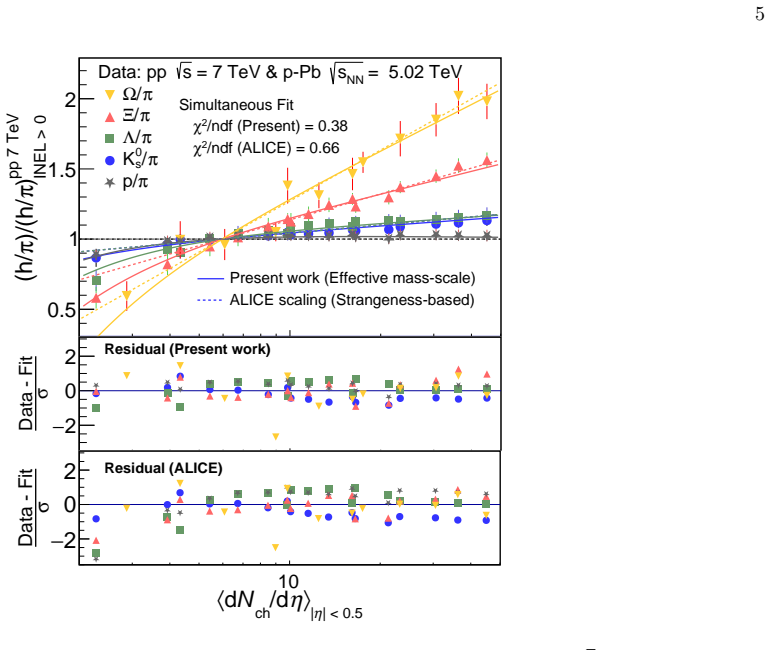
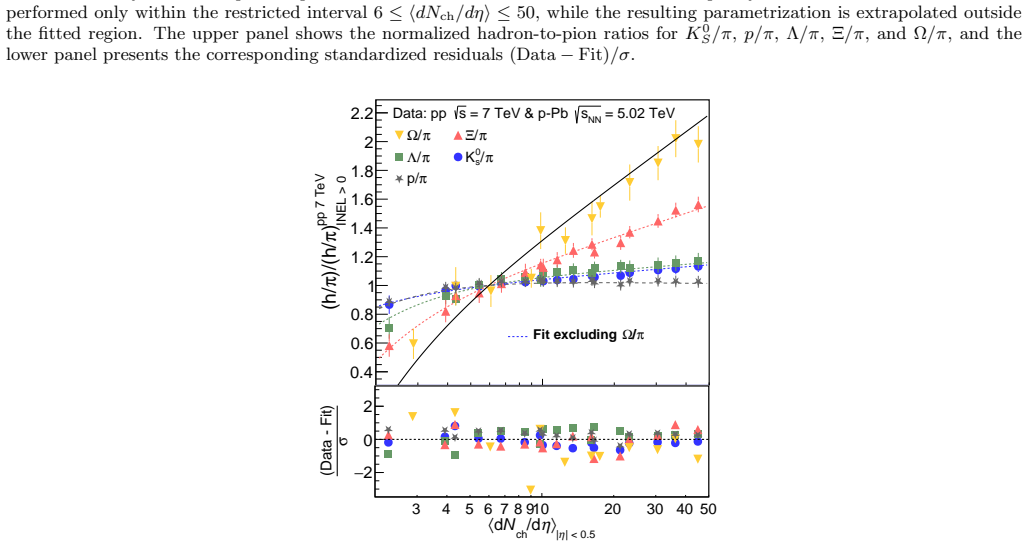
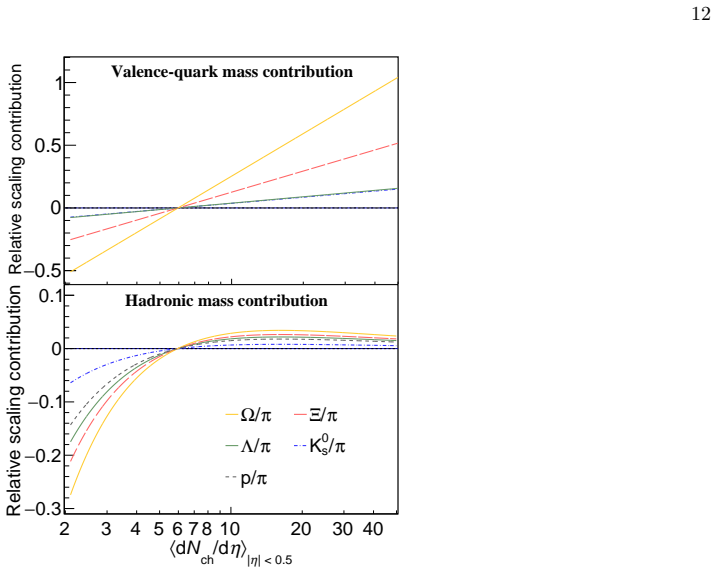
The multiplicity dependence of identified hadron production can be organized phenomenologically through an interplay of open strangeness, hadron species dependence, hidden-strangeness structure, and effective mass-related scales, as shown by a simultaneous description of non-strange, strange, and multi-strange hadron-to-pion ratios using an effective mass-scale parametrization in pp collisions at 7 TeV and p-Pb collisions at 5.02 TeV.
What carries the argument
effective mass-scale parametrization that relates hadron yields to hadronic and valence-quark mass scales relative to a pion baseline
If this is right
- The parametrization yields stable reduced chi-squared values and consistent pull distributions across the fitted data sets.
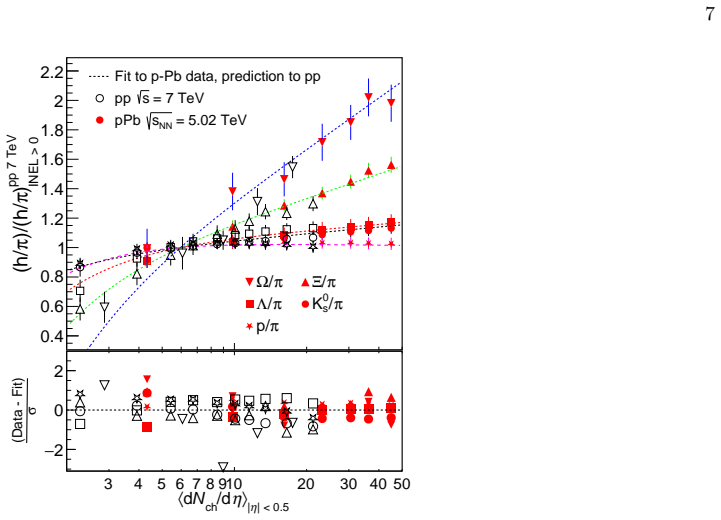
- Cross-system predictions between pp and p-Pb collisions remain consistent with the observed ratios.
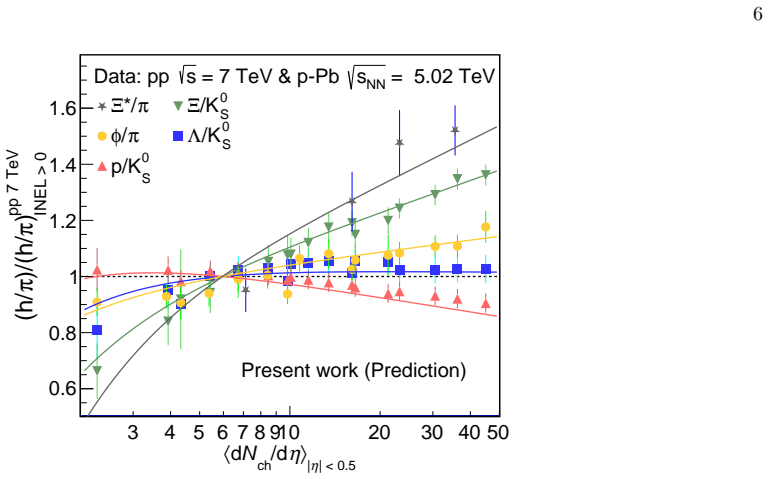
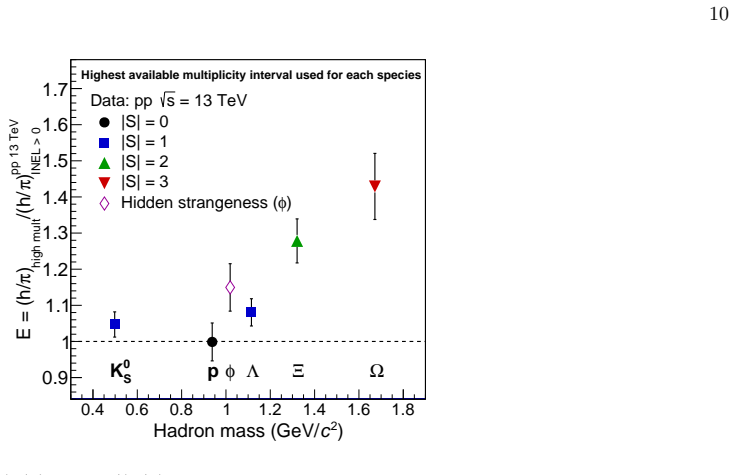
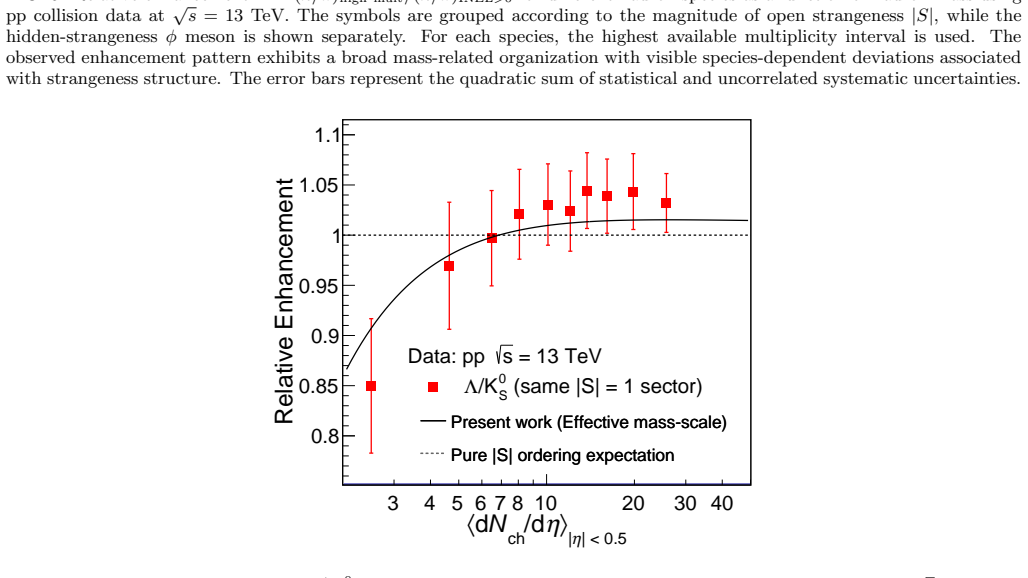
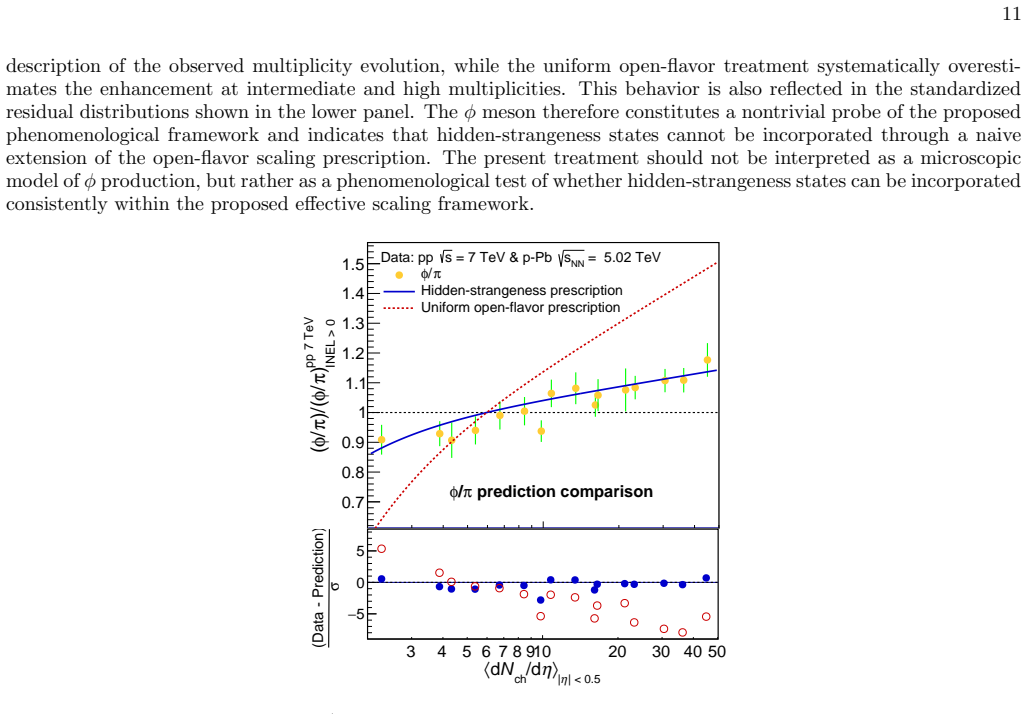
- Hidden-strangeness phi mesons exhibit relative enhancement patterns that deviate from pure open-strangeness ordering.
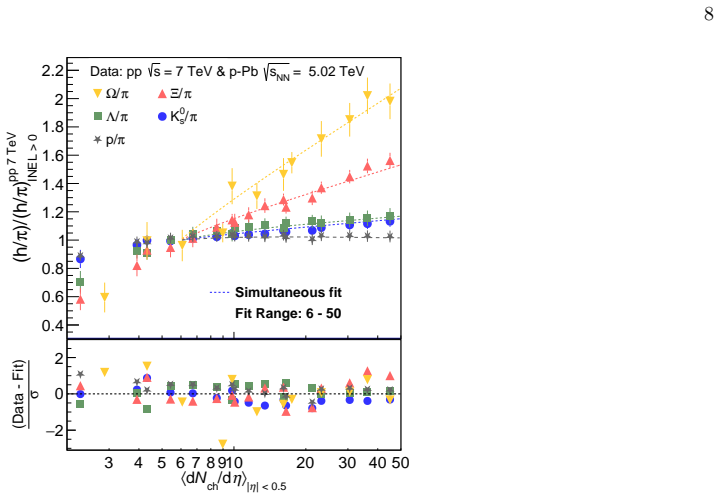
- The description holds under variations in the multiplicity ranges used for the fits.
Where Pith is reading between the lines
- The same mass-scale approach could be tested for consistency in heavy-ion collisions where collective effects are stronger.
- It remains open whether the extracted effective scales correspond to any underlying quark-mass or hadronization mechanism.
- Predictions for additional hadron species not used in the fit could provide an independent check of the parametrization.
Load-bearing premise
The effective mass-scale parametrization fitted to the hadron-to-pion ratios provides a stable description across the studied collision systems, energies, and multiplicity ranges.
What would settle it
A clear breakdown in fit quality or large shifts in fitted parameters when the parametrization is applied to data at a new energy or outside the fitted multiplicity ranges would falsify the stability claim.
Figures
read the original abstract
The multiplicity dependence of identified hadron yield ratios in high-energy pp and p-Pb collisions has commonly been interpreted in terms of strangeness-driven scaling and canonical suppression effects. In this work, we investigate whether the observed enhancement hierarchy may also admit a complementary phenomenological organization involving effective hadronic and valence-quark mass scales relative to a pion baseline. A simultaneous description of non-strange, strange, and multi-strange hadron-to-pion ratios is performed for pp collisions at \sqrt{s} = 7 TeV and p-Pb collisions at \sqrt{s_{NN}} = 5.02 TeV using an effective mass-scale parametrization. The stability of the parametrization is tested through reduced \chi^{2} values, pull distributions, parameter correlations, information-criterion comparisons, cross-system predictions, multiplicity-range variations, and studies of observables not included in the fit. Additional investigations involving relative enhancement patterns and hidden-strangeness \phi mesons are used to examine the extent to which the observed hierarchy is uniquely characterized by simple open-strangeness ordering. The analysis indicates that the multiplicity dependence of identified hadron production can be organized phenomenologically through an interplay of open strangeness, hadron species dependence, hidden-strangeness structure, and effective mass-related scales. The present framework should be interpreted as a complementary phenomenological description rather than as a microscopic theory of hadron production.
Editorial analysis
A structured set of objections, weighed in public.
Referee Report
Summary. The manuscript proposes a phenomenological effective mass-scale framework to organize the multiplicity dependence of identified hadron-to-pion yield ratios in high-energy pp (√s=7 TeV) and p-Pb (√s_NN=5.02 TeV) collisions. It performs a simultaneous description of non-strange, strange, and multi-strange ratios using an effective mass-scale parametrization, tests stability via reduced χ², pull distributions, parameter correlations, information criteria, cross-system predictions, multiplicity-range splits, and out-of-sample observables, and examines relative enhancement patterns including hidden-strangeness φ mesons. The work frames the approach as complementary to strangeness ordering rather than a microscopic theory.
Significance. If the parametrization proves robust under the listed tests, the paper supplies a compact phenomenological organization of hadron production data that interleaves mass-scale effects with open and hidden strangeness. This could serve as a useful data-driven reference for model builders and experimental analyses in small systems, provided the explicit functional form and numerical outcomes are clearly documented.
major comments (2)
- [Abstract / framework section] Abstract and framework description: the explicit functional form of the effective mass-scale parametrization (including how the single parameter enters the hadron-to-pion ratio) is not stated, nor are the specific data sets, fitted parameter values, or numerical results from the simultaneous fit provided. Without these, the central claim that the multiplicity dependence “admits a complementary phenomenological organization” cannot be verified or reproduced.
- [Methods / results section on parametrization] The effective mass scales are determined by fitting to the same multiplicity-dependent hadron-to-pion ratios the model is intended to describe. While cross-system predictions and multiplicity-range splits are mentioned as stability checks, the manuscript must demonstrate (e.g., via an explicit equation or table of fitted values versus predictions) that the framework supplies independent information beyond the fit itself; otherwise the circularity undermines the claim of a stable, complementary description.
minor comments (2)
- [Abstract] The abstract lists multiple statistical tests but does not report the actual reduced χ² values, pull distributions, or information-criterion differences; these numerical outcomes should appear in the main text or a dedicated table for transparency.
- [Introduction / framework] Notation for the effective mass scales (e.g., symbols for hadronic versus valence-quark scales) should be introduced consistently and early, with a clear statement of how many free parameters are actually used.
Simulated Author's Rebuttal
We thank the referee for the detailed review and constructive feedback on our manuscript. We address the two major comments below. We will revise the manuscript to include the explicit functional form, fitted values, and supporting tables as requested, while clarifying the scope of the phenomenological framework.
read point-by-point responses
-
Referee: [Abstract / framework section] Abstract and framework description: the explicit functional form of the effective mass-scale parametrization (including how the single parameter enters the hadron-to-pion ratio) is not stated, nor are the specific data sets, fitted parameter values, or numerical results from the simultaneous fit provided. Without these, the central claim that the multiplicity dependence “admits a complementary phenomenological organization” cannot be verified or reproduced.
Authors: We acknowledge that the explicit functional form of the effective mass-scale parametrization, the precise data sets, fitted parameter values, and numerical results from the simultaneous fit were not stated in the abstract or framework section. This omission limits immediate verifiability. In the revised manuscript we will add the explicit equation defining the parametrization (showing how the effective mass-scale parameter enters the hadron-to-pion ratio), list the specific ALICE data sets employed, and include a table of all fitted parameter values together with the resulting numerical ratios and goodness-of-fit metrics. revision: yes
-
Referee: [Methods / results section on parametrization] The effective mass scales are determined by fitting to the same multiplicity-dependent hadron-to-pion ratios the model is intended to describe. While cross-system predictions and multiplicity-range splits are mentioned as stability checks, the manuscript must demonstrate (e.g., via an explicit equation or table of fitted values versus predictions) that the framework supplies independent information beyond the fit itself; otherwise the circularity undermines the claim of a stable, complementary description.
Authors: The mass scales are obtained from a simultaneous fit to the multiplicity-dependent ratios, as stated. However, the manuscript already reports several out-of-sample tests (cross-system predictions, multiplicity-range splits, and observables excluded from the fit) that probe consistency beyond the original data. To address the concern directly we will insert an explicit equation for the parametrization and a dedicated table that juxtaposes the fitted values against the cross-system and split-range predictions, thereby documenting the degree of independent information supplied by the framework. We maintain that the approach is presented strictly as a compact phenomenological organization, not a first-principles theory, and these additions will make that distinction and the supporting evidence fully transparent. revision: yes
Circularity Check
No significant circularity; phenomenological fit with out-of-sample validation
full rationale
The paper explicitly frames its effective mass-scale parametrization as a simultaneous description of observed hadron-to-pion ratios, not a first-principles derivation. It reports multiple independent validation steps including cross-system predictions, multiplicity-range splits, observables excluded from the fit, reduced χ², pulls, correlations, and information criteria. No self-definitional equations, fitted inputs renamed as predictions without separation, or load-bearing self-citations appear in the provided text. The central claim reduces to an empirical organization tool whose stability is tested against external benchmarks within the paper's scope.
Axiom & Free-Parameter Ledger
free parameters (1)
- effective hadronic and valence-quark mass scales
axioms (1)
- domain assumption The observed enhancement hierarchy admits a complementary phenomenological organization involving effective mass scales in addition to strangeness effects.
Reference graph
Works this paper leans on
-
[1]
Rafelski and B
J. Rafelski and B. M¨ uller, Phys. Rev. Lett.48, 1066 (1982)
1982
-
[2]
P. Koch, B. M¨ uller, and J. Rafelski, Phys. Rept.142, 167 (1986)
1986
-
[3]
Nature Phys.13, 535 (2017)
2017
-
[4]
Phys. Lett. B728, 25 (2014)
2014
-
[5]
Phys. Lett. B712, 309 (2012)
2012
-
[6]
Eur. Phys. J. C80, 693 (2020)
2020
-
[7]
Braun-Munzinger, J
P. Braun-Munzinger, J. Stachel, and C. Wetterich, Phys. Lett. B596, 61 (2004)
2004
-
[8]
A. e. a. Andronic, Nature561, 321 (2018)
2018
-
[9]
Hamieh, K
S. Hamieh, K. Redlich, and A. Tounsi, Phys. Lett. B486, 61 (2000)
2000
-
[10]
Becattini and J
F. Becattini and J. Manninen, J. Phys. G35, 104013 (2008)
2008
-
[11]
Bierlich, G
C. Bierlich, G. Gustafson, and L. L¨ onnblad, Phys. Lett. B779, 58 (2018)
2018
-
[12]
C. e. a. Bierlich, JHEP10, 134
-
[13]
R. J. e. a. Fries, Phys. Rev. Lett.90, 202303 (2003)
2003
-
[14]
V. e. a. Greco, Phys. Rev. Lett.90, 202302 (2003)
2003
-
[15]
P. D. Group, Prog. Theor. Exp. Phys.2020, 083C01 (2020)
2020
-
[16]
Akaike, IEEE Transactions on Automatic Control19, 716 (1974)
H. Akaike, IEEE Transactions on Automatic Control19, 716 (1974)
1974
-
[17]
Schwarz, The Annals of Statistics6, 461 (1978)
G. Schwarz, The Annals of Statistics6, 461 (1978)
1978
discussion (0)
Sign in with ORCID, Apple, or X to comment. Anyone can read and Pith papers without signing in.