REVIEW 3 major objections 5 minor 67 references
Multilayer Modularity Belief Propagation To Assess Detectability Of Community Structure
T0 review · 3 major / 5 minor · reviewed 2026-08-14 · deepseek-v4-flash
Pith's one-line read This paper extends modularity-based belief propagation to multilayer networks and argues that convergence to a non-trivial fixed point is a reliable signal that communities are detectable, while matching a leading modularity optimizer in…
desk verdict A real multilayer extension of modularity belief propagation with a serious sign error in the published update equation that needs to be resolved before the results can be trusted. read the letter →
The pith
A machine-rendered reading of the paper's core claim, the machinery that carries it, and where it could break.
The reading
What carries the argument
The central object is the multilayer message update $\psi_{i\to k}^{t} \propto \exp\left[\gamma \beta \frac{d_i}{2m_{l_i}}\theta_{l_i}^{t} + \sum_{j\in\partial i\setminus k}\log\left(1+\psi_{j\to i}^{t}(e^{\tilde{A}_{ij}\beta}-1)\right)\right]$, with $\tilde{A}_{ij}=A_{ij}\delta(l_i,l_j)+\omega C_{ij}(1-\delta(l_i,l_j))$. The first term is the layer-specific field from the modularity null model, generalized to the multilayer objective; the sum over neighbors carries both intralayer edge weights and interlayer coupling. The companion stability formula, $\langle ((e^{\beta^*\tilde{A}_{ij}}-1)/(e^{\beta^*\tilde{A}_{ij}}+q-1))^2 \rangle_{ij}\hat{c}=1$, selects the inverse temperature at which the symmetric fixed point destabilizes, which is what makes convergence to a non-trivial fixed point a structured signal rather than a generic property of the iteration.
What would settle it
Generate multilayer networks with no planted communities but with degree sequences, edge weights, and layer coupling matched to benchmarks where multimodbp converges; count how often the algorithm converges to a non-trivial fixed point and how high the adjusted mutual information of that partition is against arbitrary labels. If a substantial fraction of such null networks produce converged non-trivial partitions, the convergence signal is not specific to real structure. A complementary test is to measure, on the temporal benchmark, whether non-converged runs' partitions align with ground truth often enough to undermine convergence as a necessary condition.
Extended reading notes
Core claim
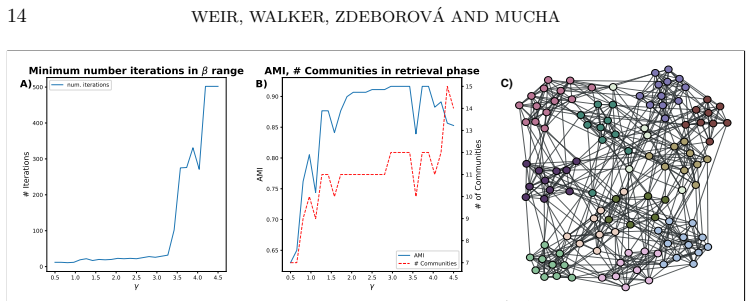
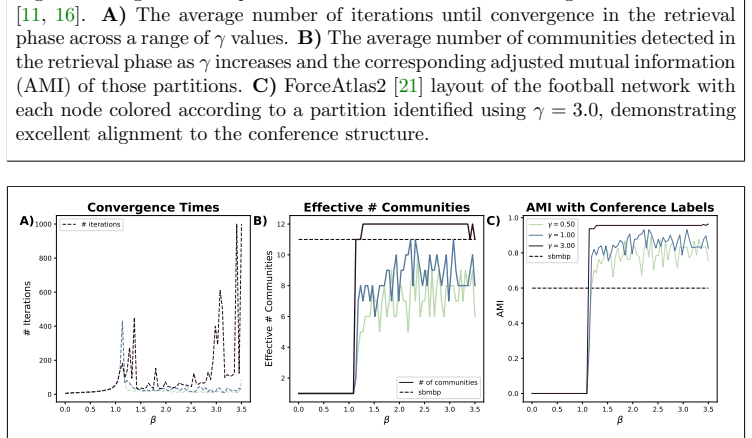
At the paper's core is a belief-propagation update for multilayer modularity in which each node-layer's belief about belonging to community t is proportional to an exponential of a layer-local null-model field, a sum over intralayer neighbors, and a sum over interlayer neighbors weighted by the coupling parameter. The updates are derived from the multilayer modularity Hamiltonian, and their fixed points are stationary points of the associated free energy. Linearizing around the symmetric fixed point gives a stability condition that selects the inverse temperature $\beta^*$ for each assumed number of communities, and the paper reports that running the algorithm at these $\beta^*$ values lands in the retrieval phase for the synthetic and real networks tested. The central empirical discovery is that the algorithm's convergence itself indicates detectability: when the planted structure becomes too weak, multimodbp stops converging to a non-trivial partition, whereas a modularity optimizer continues to return high-modularity partitions. On top of that, the marginals at the fixed point are used as a soft partition whose per-node entropy measures confidence in the community assignment.
Load-bearing premise
The method's practical value rests on the unproven premise that when the iterative message-passing updates settle into a non-trivial partition, the network genuinely has community structure rather than the iterations simply getting trapped; the paper says its heuristic provides no guarantees and acknowledges that some non-converged runs still match the planted structure.
Editorial extensions
If this is right
- On the dynamic stochastic block model benchmark, setting the resolution parameter to $\gamma=0.5$ widens the retrieval phase and matches single-layer detectability limits for low intralayer noise, while larger $\gamma$ and larger coupling $\omega$ pool signal across layers and push detection closer to the layer-aggregation bound.
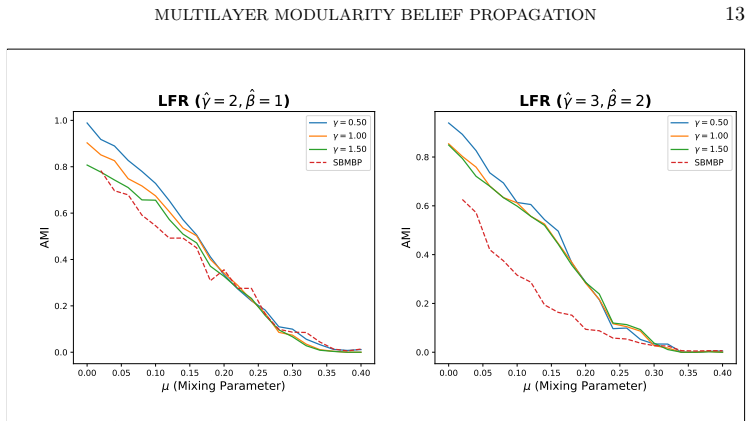
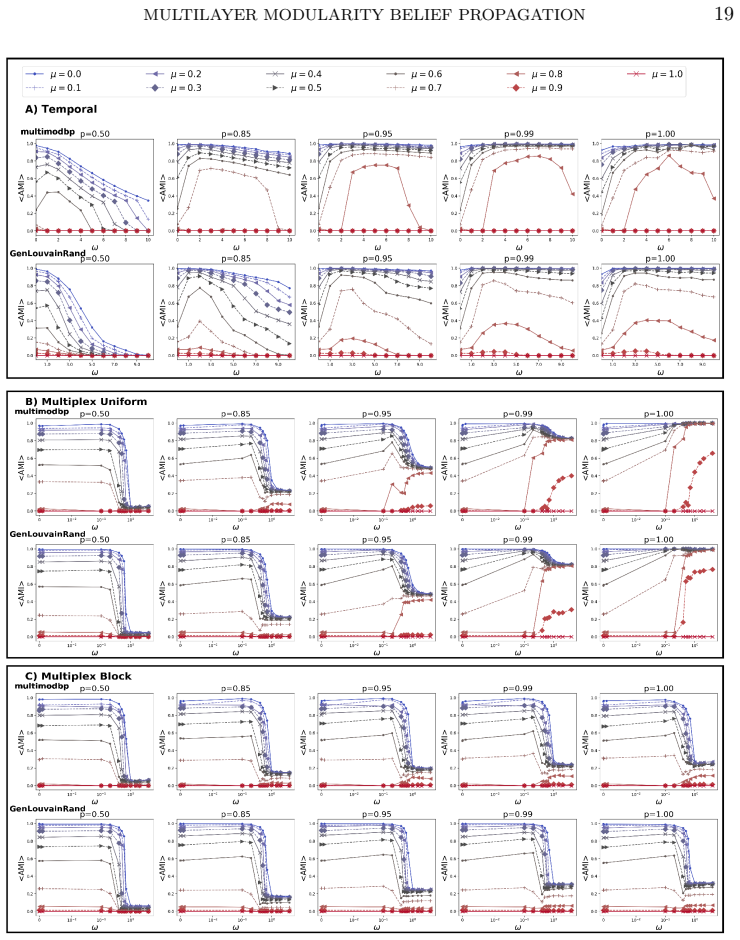
- On temporal, uniform-multiplex, and block-multiplex benchmarks, the retrieved partitions have AMI comparable to or better than a widely used modularity optimizer, with the largest gains in temporal networks with strong interlayer persistence.
- Because non-convergence tracks undetectable structure, the method can be used as a check on greedy modularity optimization: a high-modularity partition on a network where multimodbp never converges should be regarded as potentially spurious.
- Node-level marginals provide a confidence measure per node-layer that can be averaged over layers; in the voting-network example this reproduces known polarization history and labels bipartisan legislators, and in the law-firm example it maps which parameter regions align with metadata.
Reading between the lines
- Editorial inference: the convergence-versus-non-convergence dichotomy could be calibrated against a formal null model, such as degree-preserved random multilayer networks, to yield a model-free test of community significance; the paper demonstrates the signal but does not quantify its false-positive rate.
- Editorial inference: the marginals could be thresholded or resampled to produce overlapping or ensemble partitions, since a node with near-uniform beliefs is naturally compatible with multiple communities; the paper only reads them as confidence values.
- Editorial inference: the strong dependence of multiplex performance on spectral initialization suggests the fixed-point landscape has multiple basins; mapping which initializations converge to which partitions would tell users when a converged result is stable versus initialization-driven.
- Editorial inference: the same stability analysis could be applied to directed, signed, or edge-heterogeneous multilayer null models, giving analogous inverse-temperature formulas for those settings; the paper does not attempt those cases.
Signed reviews
Editorial analysis
A structured set of objections, weighed in public.
Referee Report
Summary. The paper develops multimodbp, a belief-propagation algorithm for maximizing multilayer modularity Q(γ,ω)=Σ_ij(A_ij−γP_ij+ωC_ij)δ(c_i,c_j). It extends the Zhang–Moore single-layer modularity belief-propagation approach by adding a resolution parameter γ, layer-specific null-model fields, and interlayer coupling in the update equations, and it derives a Bethe free energy and a β* stability criterion for selecting the inverse temperature. The authors evaluate the method on stochastic block models, LFR benchmarks, and multilayer generative benchmarks against GenLouvain, and they use convergence behavior and node-level marginals on U.S. Senate voting and Lazega lawyer networks to argue that the algorithm can signal the detectability of community structure.
Significance. If the technical issues are resolved, this is a useful contribution: it gives practitioners a multilayer community-detection heuristic with soft output (marginals), a convergence-based detection signal, and an accompanying Python package. The supplement contains detailed derivations of the update equations, the free energy, and β*; the synthetic benchmark comparisons are broad (DSBM, temporal, uniform and block multiplex); and the real-world examples illustrate the claimed extra information. That said, the manuscript currently contains a sign inconsistency in the printed update equations, and the empirical comparisons lack uncertainty quantification, so the results should be treated as provisional.
major comments (3)
- [Eq. (2.4), Eq. (2.5), Supplement S.1 (S.6–S.7, S.10) and S.23] In Eq. (2.4) the null-model field enters with a plus sign: the update is proportional to exp(γβd_iθ_{l_i}^t/(2m_{l_i}) + ...), where θ_{l_i}^t = Σ_{j∈V_{l_i}} d_jψ_j^t. In the derivation in Supplement S.1 the same field is derived with a minus sign (Eqs. S.6–S.7 and S.10): exp(−βd_iθ_{l_i}^t/(2m_{l_i})). The plus sign makes the null model attractive for high-degree nodes, which is the opposite of the penalty in Eq. (1.1), so a program implementing Eq. (2.4) would not be solving the stated multilayer modularity objective. The Bethe free energy in Eq. (2.5), whose final term has a plus sign, is consistent with the minus-sign update, as is the S.1 derivation; the same plus sign appears in Eq. (S.23). The authors must reconcile these equations and, ideally, confirm from the released code that the implemented update uses the minus sign.
- [Figs. 5 and 7] Figures 5 and 7 report point averages over 50 and 100 realizations, respectively, but no error bars, confidence intervals, or significance tests are given. Several claims of comparable or superior performance (e.g., the statement in §3.2.2 that GenLouvain has "a slight edge overall" in the uniform multiplex case, Figure 7B) depend on differences whose magnitude relative to run-to-run variability cannot be assessed. The authors should add error bars or otherwise quantify uncertainty.
- [§2.4, Fig. 8, Fig. S.24] The paper's title and contributions center on using convergence to non-trivial fixed points as a signal of detectable community structure, but this premise is explicitly heuristic: §2.4 notes that the β* heuristic "provides no guarantees," and Figure S.24 shows that some non-converged runs still align with ground truth. To support the detectability claim, the authors should quantify the behavior of the convergence signal on structureless null networks (e.g., Erdős–Rényi or configuration-model graphs with matched degree sequences) and report the overlap of the converged and non-converged AMI distributions over the parameter grid; Figure 8 alone covers one topology and one value of p.
minor comments (5)
- [§3.2.2 vs Fig. 7 caption] In Section 3.2.2 the temporal benchmark is described as having "150 node-layers in each layer with 100 layers," while the caption of Figure 7A says "100 node-layers in each layer with 150 layers"; both give 15,000 node-layers, but the text should agree.
- [Eq. (S.10)] Equation (S.10) contains a garbled symbol in the definition of θ_{l_i}^t ("V↕⟩"), which should be V_{l_i}.
- [Reference [63]] The reference for the released software [63] points to a GitHub repository, while the text states that the tool is available on PyPI; the reference should be updated or clarified.
- [Section 2.4] In Section 2.4, "Schülkeet al." should read "Schülke et al."
- [Fig. 1 caption] The Figure 1 caption phrase "From left to right, the plots show the retrieval modularity, number of iterations to convergence, and the AMI ... and the effective number of communities" describes four panels but is awkwardly worded; please revise for clarity.
Circularity Check
No significant circularity: the multilayer BP updates are derived from the modularity Hamiltonian and validated against external ground-truth benchmarks.
full rationale
The paper's central derivation is self-contained: Section S.1 of the supplement starts from the multilayer modularity objective (Eq. 1.1), splits the interaction into the edge term and the null-model field term, applies the standard sparse-graph 'field trick,' and obtains the update equations (Eq. 2.4). The null-model derivation is shown explicitly in Eqs. S.6-S.7, and the Bethe free energy is derived in Sections S.2-S.3 rather than being assumed. The stability heuristic for beta* (Eq. 2.9) is imported from prior work (Shi et al., and ultimately Zhang-Moore and Decelle et al.), but it is not fitted to the output being predicted; it is a parameter-free formula in the edge weights, degree distribution, q, and coupling, and the paper tests it against known synthetic ground truth (e.g., Figures S.13-S.14). The performance claims are benchmarked externally: AMI against planted partitions in DSBM and Bazzi et al. generative models, and comparison with GenLouvain on the same objective. Self-citations to Mucha et al. for multilayer modularity and to Weir et al. for domain post-processing are background building blocks, not load-bearing circular premises. The one notable internal issue is a sign inconsistency between main-text Eq. (2.4), which has a '+' on the null-model field term, and the supplement's derivation (S.6-S.7), which yields '−'. This is a correctness/typo concern about whether the published equation matches the stated objective, not a circularity, because the derivation proceeds from the objective rather than assuming the conclusion. Likewise, the paper's definition of 'significant structure' in terms of convergence is an explicit convention that is then empirically checked against ground truth, and Section 2.4 honestly states that the beta* heuristic 'provides no guarantees.' No prediction is equivalent to its inputs by construction.
Assumptions & free parameters
free parameters (5)
- gamma (resolution parameter) =
0.5, 1.0, 1.5, 3.0 used in experiments
- omega (interlayer coupling) =
e.g., 0, 1, 4 in DSBM experiments
- beta (inverse temperature) =
computed from Eq. 2.9, e.g., 0.5-4.5 scans
- qmax (maximum number of communities) =
4 for DSBM; unspecified for Bazzi benchmarks
- spectral initialization factor =
5
assumptions (6)
- domain assumption Sparse, tree-like network assumption (d_i << sqrt(2m_l/gamma))
- domain assumption Uncorrelated random perturbations around the trivial fixed point
- domain assumption Newman-Girvan null model within each layer
- domain assumption Mucha et al. multilayer modularity as the objective
- domain assumption Loopy belief propagation provides good approximations on loopy graphs
- ad hoc to paper Convergence to non-trivial fixed point indicates detectable structure
Cite this review
Pith. "Pith review of Multilayer Modularity Belief Propagation To Assess Detectability Of Community Structure." pith.science (2026). https://pith.science/paper/ZDGLL6LE
@misc{pith2026190804653,
  author       = {Pith},
  title        = {Pith review of: Multilayer Modularity Belief Propagation To Assess Detectability Of Community Structure},
  year         = {2026},
  howpublished = {\url{https://pith.science/paper/ZDGLL6LE}},
  note         = {Machine review of arXiv:1908.04653}
}
read the original abstract
Modularity based community detection encompasses a number of widely used, efficient heuristics for identification of structure in networks. Recently, a belief propagation approach to modularity optimization provided a useful guide for identifying non-trivial structure in single-layer networks in a way that other optimization heuristics have not. In this paper, we extend modularity belief propagation to multilayer networks. As part of this development, we also directly incorporate a resolution parameter. We show that adjusting the resolution parameter affects the convergence properties of the algorithm and yields different community structures than the baseline. We compare our approach with a widely used community detection tool, GenLouvain, across a range of synthetic, multilayer benchmark networks, demonstrating that our method performs comparably to the state of the art. Finally, we demonstrate the practical advantages of the additional information provided by our tool by way of two real-world network examples. We show how the convergence properties of the algorithm can be used in selecting the appropriate resolution and coupling parameters and how the node-level marginals provide an interpretation for the strength of attachment to the identified communities. We have released our tool as a Python package for convenient use.
Figures

Figures from the paper (8 more)





Reference graph
Works this paper leans on
- [1]
-
[2]
J. P. Bagrow, Communities and bottlenecks: trees and treelike networks have high modularity, Physical Review E, 85 (2012), p. 066118
work page 2012
-
[3]
M. Bazzi, L. G. S. Jeub, A. Arenas, S. Howison, and M. Porter , A framework for the construction of generative models for mesoscale structure in multilayer networks , Physical Review Research, (2020), https://journals.aps.org/prresearch/abstract/10.1103/ PhysRevResearch.2.023100
work page 2020
- [4]
-
[5]
L. Bennett, A. Kittas, S. Liu, L. G. Papageorgiou, and S. Tsoka , Community Struc- ture Detection for Overlapping Modules through Mathematical Programming in Protein Interaction Networks, PLOS ONE, 9 (2014), p. e112821
work page 2014
-
[6]
V. D. Blondel, J.-L. Guillaume, R. Lambiotte, and E. Lefebvre , Fast unfolding of com- munities in large networks, Journal of Statistical Mechanics: Theory and Experiment, 2008 (2008), p. P10008
work page 2008
-
[7]
U. Brandes, D. Delling, M. Gaertler, R. Gorke, M. Hoefer, Z. Nikoloski, and D. Wag- ner, On modularity clustering , IEEE Transactions on Knowledge and Data Engineering, 20 (2008), pp. 172–188
work page 2008
-
[8]
F. de Montgolfier, M. Soto, and L. Viennot, Asymptotic modularity of some graph classes, International Symposium on Algorithms and Computation, (2011), pp. 435–444
work page 2011
Show all 67 references
-
[9]
Decelle, F
A. Decelle, F. Krzakala, C. Moore, and L. Zdeborov ´a, Asymptotic analysis of the stochastic block model for modular networks and its algorithmic applications , Physical Review E, 84 (2011), p. 066106
2011
-
[10]
Decelle, F
A. Decelle, F. Krzakala, C. Moore, and L. Zdeborov ´a, Inference and Phase Transitions in the Detection of Modules in Sparse Networks , Physical Review Letters, 107 (2011), p. 065701
2011
-
[11]
T. S. Evans , Clique graphs and overlapping communities , Journal of Statistical Mechanics: Theory and Experiment, 2010 (2010), p. P12037
2010
-
[12]
Fortunato, Community detection in graphs , Physics Reports, 486 (2010), pp
S. Fortunato, Community detection in graphs , Physics Reports, 486 (2010), pp. 75–174
2010
-
[13]
Fortunato and M
S. Fortunato and M. Barth´elemy, Resolution limit in community detection , Proceedings of the National Academy of Sciences, 104 (2007), pp. 36–41
2007
-
[14]
Fortunato and D
S. Fortunato and D. Hric, Community detection in networks: A user guide , Physics Reports, 659 (2016), pp. 1–44
2016
-
[15]
Ghasemian, P
A. Ghasemian, P. Zhang, A. Clauset, C. Moore, and L. Peel , Detectability Thresholds and Optimal Algorithms for Community Structure in Dynamic Networks , Physical Review X, 6 (2016), p. 031005
2016
-
[16]
Girvan and M
M. Girvan and M. E. J. Newman , Community structure in social and biological networks. , Proceedings of the National Academy of Sciences, 99 (2002), pp. 7821–7826
2002
-
[17]
Q. Han, K. S. X. 0001, and E. M. Airoldi, Consistent estimation of dynamic and multi-layer block models., ICML, (2015)
2015
-
[18]
M. B. Hastings, Community detection as an inference problem, Physical Review E, 74 (2006), p. 035102
2006
-
[19]
T. C. Havens, J. C. Bezdek, C. Leckie, K. Ramamohanarao, and M. Palaniswami , A Soft Modularity Function For Detecting Fuzzy Communities in Social Networks , IEEE Transactions on Fuzzy Systems, 21 (2013), pp. 1170–1175
2013
-
[20]
P. W. Holland, K. B. Laskey, and S. Leinhardt, Stochastic blockmodels: First steps, Social Networks, 5 (1983), pp. 109–137
1983
-
[21]
Jacomy, T
M. Jacomy, T. Venturini, S. Heymann, and M. Bastian , ForceAtlas2, a Continuous Graph Layout Algorithm for Handy Network Visualization Designed for the Gephi Software , PLOS ONE, 9 (2014), pp. 1–12
2014
-
[22]
L. G. S. Jeub, A Python framework for generating multilayer networks with planted mesoscale structure., (2019)
2019
-
[23]
L. G. S. Jeub and M. Bazzi, A generative model for mesoscale structure in multilayer networks implemented in MATLAB, tech. report, 2019
2019
-
[24]
L. G. S. Jeub, M. Bazzi, J. S. Inderjit, and P. J. Mucha , A general- ized Louvain method for community detection implemented in MATLAB , URL http://github.com/GenLouvain/GenLouvain, (2011)
2011
-
[25]
Karrer and M
B. Karrer and M. E. Newman, Stochastic blockmodels and community structure in networks, MULTILAYER MODULARITY BELIEF PROPAGATION 45 Physical Review E, 83 (2011), p. 016107
2011
-
[26]
Kivel¨a, A
M. Kivel¨a, A. Arenas, M. Barth ´elemy, J. P. Gleeson, Y. Moreno, and M. A. Porter , Multilayer networks, Journal of Complex Networks, 2 (2014), pp. 203–271
2014
-
[27]
H. W. Kuhn , The Hungarian method for the assignment problem , Naval Research Logistics Quarterly, 2 (1955), pp. 83–97
1955
-
[28]
D. Lai, X. Shu, and C. Nardini , Correlation enhanced modularity-based belief propagation method for community detection in networks , Journal of Statistical Mechanics: Theory and Experiment, 05 (2016), pp. 053301–
2016
-
[29]
Lambiotte, J.-C
R. Lambiotte, J.-C. Delvenne, and M. Barahona, Laplacian dynamics and Multiscale Mod- ular structure in Networks , arxiv.org, 1 (2009), pp. 76–90
2009
-
[30]
Lambiotte, J.-C
R. Lambiotte, J.-C. Delvenne, and M. Barahona , Random Walks, Markov Processes and the Multiscale Modular Organization of Complex Networks , IEEE transactions on network science and engineering, 1 (2014), pp. 76–90
2014
-
[31]
Lancichinetti, S
A. Lancichinetti, S. Fortunato, and F. Radicchi, Benchmark graphs for testing community detection algorithms, Physical Review E, 78 (2008), p. 046110
2008
-
[32]
Lazega and others , The collegial phenomenon: The social mechanisms of cooperation among peers in a corporate law partnership , Oxford University Press on Demand, 2001
E. Lazega and others , The collegial phenomenon: The social mechanisms of cooperation among peers in a corporate law partnership , Oxford University Press on Demand, 2001
2001
-
[33]
Liu, Fuzzy modularity and fuzzy community structure in networks , 77 (2010), pp
J. Liu, Fuzzy modularity and fuzzy community structure in networks , 77 (2010), pp. 547–557
2010
-
[34]
M´ezard and A
M. M´ezard and A. Montanari , Information, physics, and computation , Oxford University Press, 2009
2009
-
[35]
Moody and P
J. Moody and P. J. Mucha, Portrait of political party polarization, Network Science, 1 (2013), pp. 119–121
2013
-
[36]
Mossel, J
E. Mossel, J. Neeman, and A. Sly , Belief propagation, robust reconstruction and optimal recovery of block models , in International Conference on Machine Learning, May 2014, pp. 356–370
2014
-
[37]
P. J. Mucha and M. A. Porter , Communities in multislice voting networks , Chaos: An Interdisciplinary Journal of Nonlinear Science, 20 (2010), p. 041108
2010
-
[38]
P. J. Mucha, T. Richardson, K. Macon, M. A. Porter, and J.-P. Onnela , Commu- nity structure in time-dependent, multiscale, and multiplex networks. , Science, 328 (2010), pp. 876–878
2010
-
[39]
R. R. Nadakuditi and M. E. J. Newman, Graph Spectra and the Detectability of Community Structure in Networks , Physical Review Letters, 108 (2012), p. 188701
2012
-
[40]
Newman and M
M. Newman and M. Girvan, Finding and evaluating community structure in networks , Phys- ical Review E, 69 (2004), p. 268
2004
-
[41]
M. E. J. Newman , Analysis of weighted networks , Physical Review E, 70 (2004), p. 056131
2004
-
[42]
M. E. J. Newman, Equivalence between modularity optimization and maximum likelihood meth- ods for community detection , Physical Review E, 94 (2016), p. 052315
2016
-
[43]
A. R. Pamfil, S. D. Howison, R. Lambiotte, and M. A. Porter , Relating Modularity Max- imization and Stochastic Block Models in Multilayer Networks , SIAM Journal on Mathe- matics of Data Science, 1 (2019), pp. 667–698
2019
-
[44]
Papadopoulos, F
A. Papadopoulos, F. Pachet, P. Roy, and J. Sakellariou , Exact Sampling for Regular and Markov Constraints with Belief Propagation , in Research in Computational Molecular Biology, Springer International Publishing, Cham, Aug. 2015, pp. 341–350
2015
-
[45]
Pearl , Probabilistic Reasoning in Intelligent Systems: Networks of Plausible Inference , (1988)
J. Pearl , Probabilistic Reasoning in Intelligent Systems: Networks of Plausible Inference , (1988)
1988
-
[46]
L. Peel, D. B. Larremore, and A. Clauset , The ground truth about metadata and commu- nity detection in networks , Science Advances, 3 (2017), p. e1602548
2017
-
[47]
T. P. Peixoto , Nonparametric Bayesian inference of the microcanonical stochastic block model, Physical Review E, 95 (2017), p. 012317
2017
-
[48]
M. A. Porter, J. P. Onnela, and P. J. Mucha , Communities in networks , Notices of the American Mathematical Society, 56 (2009), pp. 1082–1097
2009
-
[49]
Reichardt and S
J. Reichardt and S. Bornholdt , Statistical mechanics of community detection , Physical Review E, (2006)
2006
-
[50]
Rosvall and C
M. Rosvall and C. T. Bergstrom, Maps of random walks on complex networks reveal com- munity structure, Proceedings of the National Academy of Sciences, 105 (2008), pp. 1118– 1123
2008
-
[51]
M. T. Schaub, J.-C. Delvenne, M. Rosvall, and R. Lambiotte , The many facets of com- munity detection in complex networks , Applied Network Science, 2 (2017), p. 4
2017
-
[52]
Sch¨ulke and F
C. Sch¨ulke and F. Ricci-Tersenghi , Multiple phases in modularity-based community detec- tion, Physical Review E, 92 (2015), p. 042804
2015
-
[53]
S. Shai, N. Stanley, C. Granell, D. Taylor, and P. J. Mucha , Case studies in network community detection, arXiv, (2017). 46 WEIR, WALKER, ZDEBOROV´A AND MUCHA
2017
-
[54]
C. Shi, Y. Liu, and P. Zhang , Weighted community detection and data clustering using message passing, Journal of Statistical Mechanics: Theory and Experiment, 2018 (2018), p. 033405
2018
-
[55]
Stanley, S
N. Stanley, S. Shai, D. Taylor, and P. J. Mucha, Clustering network layers with the strata multilayer stochastic block model. , IEEE transactions on network science and engineering, 3 (2016), pp. 95–105
2016
-
[56]
Taylor, S
D. Taylor, S. Shai, N. Stanley, and P. J. Mucha , Enhanced Detectability of Community Structure in Multilayer Networks through Layer Aggregation, Physical Review Letters, 116 (2016), p. 228301
2016
-
[57]
V. A. Traag, G. Krings, and P. Van Dooren , Significant scales in community structure , Scientific reports, 3 (2013), p. 75
2013
-
[58]
N. X. Vinh, J. Epps, and J. Bailey , Information theoretic measures for clusterings compar- ison: is a correction for chance necessary? , the 26th Annual International Conference, (2009), pp. 1073–1080
2009
-
[59]
N. X. Vinh, J. Epps, and J. Bailey , Information theoretic measures for clusterings compar- ison: Variants, properties, normalization and correction for chance , Journal of Machine Learning Research, 11 (2010), pp. 2837–2854
2010
-
[60]
A. S. Waugh, L. Pei, J. H. Fowler, P. J. Mucha, and M. A. Porter , Party polarization in congress: A network science approach , arXiv.org, physics.soc-ph (2009)
2009
-
[61]
W. H. Weir, S. Emmons, R. Gibson, D. Taylor, and P. Mucha , Post-Processing Partitions to Identify Domains of Modularity Optimization , Algorithms, 10 (2017), p. 93
2017
-
[62]
W. H. Weir, R. Gibson, and P. J. Mucha, CHAMP package: Convex Hull of Admissible Mod- ularity Partitions in Python and MATLAB, 2017, https://github.com/wweir827/CHAMP
2017
-
[63]
W. H. Weir and B. Walker , multimodbp, 2018-2020, https://github.com/bwalker1/ ModularityBP Cpp
2018
-
[64]
Zdeborov´a and F
L. Zdeborov´a and F. Krzakala , Statistical physics of inference: thresholds and algorithms , Advances in Physics, 65 (2016), pp. 453–552
2016
-
[65]
Zhang, F
P. Zhang, F. Krzakala, J. Reichardt, and L. Zdeborov´a, Comparative study for inference of hidden classes in stochastic block models , Journal of Statistical Mechanics: Theory and Experiment, 2012 (2012), p. P12021
2012
-
[66]
Zhang and C
P. Zhang and C. Moore , Scalable detection of statistically significant communities and hi- erarchies, using message passing for modularity , Proceedings of the National Academy of Sciences, 111 (2014), pp. 18144–18149
2014
-
[67]
Zhang, R.-S
S. Zhang, R.-S. Wang, and X.-S. Zhang , Identification of overlapping community structure in complex networks using fuzzy c-means clustering , Physica A: Statistical Mechanics and its Applications, 374 (2007), pp. 483–490
2007
Reviewed August 14, 2026 · model on record in the stance chip above.
Discussion (0). Continue with ORCID to comment.