REVIEW 3 major objections 4 minor 58 references
Universal Parent Hamiltonians for Adiabatic Warm Starts
T0 review · 3 major / 4 minor · reviewed 2026-08-01 · deepseek-v4-flash
Pith's one-line read Any quantum state with a known preparation circuit can be made the starting point of adiabatic ground-state preparation via the Feynman–Kitaev clock Hamiltonian as a universal parent Hamiltonian.
desk verdict Worth engaging: a clean framework for warm-starting ASP via clock Hamiltonians, but the headline H6 gap improvement rests on an unverified truncation conjecture. read the letter →
The pith
A machine-rendered reading of the paper's core claim, the machinery that carries it, and where it could break.
The reading
What carries the argument
The central object is the Feynman–Kitaev clock Hamiltonian H_clock = H_init + H_prop, built from the circuit that prepares the warm-start state; its ground state is the history state, a uniform superposition over time slices of the circuit's intermediate states. Padding with identity gates (idling) concentrates probability on the target state. In the momentum basis the propagation term becomes a discrete 1D Laplacian with eigenvalues 1−cos(2πk/(T+1)), giving the Θ(T^{-2}) = Θ(D_c^{-2}) initial gap. The numerical simulations use a rotating-frame, momentum-space truncation that keeps only low-momentum clock modes; its validity rests on an explicit conjecture about small off-diagonal couplings
What would settle it
Compute the full adiabatic gap without momentum truncation for the GHZ-target system at a size where the full basis is still diagonalizable (e.g., n=5 with T=80) and compare with the truncated gap at the same retained-mode fraction; if the relative error exceeds 10% or grows with n rather than decaying with the retained fraction, the truncation conjecture is false.
Extended reading notes
Core claim
Central claim: the Feynman–Kitaev clock Hamiltonian, whose ground state is the history state of a preparation circuit, is a universal parent Hamiltonian for any state with a known circuit. Idling the circuit makes the history state overlap nearly perfectly with |+⟩_clock⊗|ψ_target⟩. The initial gap is Θ(D_c^{-2}) for deterministic depth D_c; amplitude amplification gives Θ(p_success/D_c^2) for probabilistic circuits, and Ω(1/(D^2 D_c^2)) for MPS of bond dimension D. Benchmarks on a GHZ-target MPS family and on linear H6 show the minimum gap stays open when the warm start lies in the target's phase: for H6, a D=4 MPS warm start keeps the rescaled gap above 0.87 versus 0.27 from Hartree–Fock.
Load-bearing premise
The paper's numerical evidence rests on an explicitly conjectured assumption: that off-diagonal couplings between slow and fast clock modes are small compared with the O(1) fast-mode energies, so that truncating the clock momentum basis to low modes does not change the spectral gap.
Editorial extensions
If this is right
- If correct, any classical or quantum ansatz with an efficient preparation circuit—MPS, stabilizer states, unitary coupled cluster, or a purely quantum circuit ansatz—can be converted into an ASP starting point, removing the requirement that the initial state be classically tractable.
- The Θ(D_c^{-2}) initial gap bound implies the warm-start overhead is polynomial in circuit depth, so the protocol is efficient whenever the preparation circuit is polynomial and the warm-start state lies in the same phase as the target.
- The H6 results indicate that a bond-dimension-4 MPS warm start roughly doubles the minimum adiabatic gap relative to Hartree–Fock across the strongly correlated stretched-bond regime, converting classical bond dimension directly into adiabatic gap improvement.
- For probabilistic preparation, the gap shrinks only polynomially with bond dimension after amplitude amplification, keeping measurement-based MPS preparation viable as a warm start.
Reading between the lines
- Editorial inference: the paper's phase-based picture suggests a testable design rule—choose a warm-start ansatz whose order parameter or symmetry sector matches the target phase; the gap along the adiabatic path then serves as a direct diagnostic of phase mismatch.
- Editorial inference: if the momentum-truncation conjecture holds, the block-Hamiltonian construction could become a general classical tool for estimating ASP gaps far beyond the small systems simulated, since cost scales with the number of retained slow modes rather than the full clock length.
- Editorial inference: the clock register multiplies the system size, so a natural next step—explicitly left open by the paper—is constructing parent Hamiltonians that avoid the ancilla overhead while preserving the warm-start property.
- Editorial inference: the authors' framing sharpens the classical–quantum competition: any classical ansatz preparable by a short circuit can be upgraded into a quantum starting point by UPHAWS, provided the phase is known, which reframes the open question of whether efficient quantum state preparation always implies a tractable classical ansatz.
Editorial analysis
A structured set of objections, weighed in public.
Referee Report
Summary. The paper introduces UPHAWS, a protocol for warm-starting adiabatic state preparation (ASP) using the Feynman–Kitaev clock Hamiltonian as a universal parent Hamiltonian for any state with a known preparation circuit. The history state of the clock Hamiltonian is used as the initial state; by padding the clock, it approaches |+>_clock⊗|ψ_target>. The authors derive the initial spectral gap scaling Θ(D_c^{-2}) for deterministic circuits, extend the analysis to probabilistic circuits via amplitude amplification, and introduce a momentum-space truncation for classical simulation. They benchmark the method on a Z2-symmetric MPS family interpolating to a GHZ target and on the linear H6 chain under symmetric bond stretching, reporting that a bond-dimension-4 MPS warm start keeps the minimum rescaled gap above 0.87 while Hartree–Fock falls to 0.27.
Significance. If correct, UPHAWS provides a general and conceptually clean way to convert any circuit-preparable ansatz into an ASP initial state, with a concrete O(D_c^{-2}) gap cost. This would address limitations of local ansätze associated with the orthogonality catastrophe and offers a phase-aligned strategy for avoiding first-order transitions. The gap derivation is explicit and self-contained, and the numerical comparison is well motivated. However, the central numerical claims currently rest on an unverified truncation conjecture and on a rescaled-gap comparison that may not reflect the actual adiabatic runtime. These issues are fixable but require substantive additional work.
major comments (3)
- [Sec. IV C, Fig. 5, abstract] The reported 'factor of two' improvement is for the minimum gap rescaled by the gap at s=0. This rescaling hides the cost of the clock register. For the clock protocols Δ(0)=Θ(T^{-2}); with the 0.86-overlap padding this is orders of magnitude smaller than the HF initial gap. Thus the absolute minimum gap of the MPS-D4 protocol is likely much smaller than that of HF, not larger. The adiabatic runtime is governed by the absolute gap (and ||dH/ds||), so the rescaled quantity does not support the abstract's factor-of-two claim. Please report absolute gaps or explicit runtime estimates for all three protocols.
- [Sec. III D and Sec. IV B/C] The momentum-space truncation is load-bearing for the H6 results, but the smallness of the slow–fast off-diagonal couplings is explicitly left as a conjecture ('we conjuncture that both will be small...', Sec. III D). The benchmark in Sec. IV B covers only GHZ systems with n≤4 and T≤80; no truncation-error estimate or k_cut convergence study is reported for H6. If the conjecture fails, the reported gap values in Fig. 5 and Fig. 6 could be truncation artifacts. Please provide a convergence check for H6 at representative R, or a rigorous bound on the discarded-state contribution.
- [Sec. III B, Eqs. (15), (22), (33), (34)] There is a boundary-condition inconsistency between the matrix in Eq. (15), which is the open-boundary path Laplacian, and the eigenvalues in Eq. (22), which are the periodic eigenvalues 1−cos(2πk/(T+1)). The exact gap of Eq. (15) is 1−cos(π/(T+1)) ≈ π²/(2(T+1)²), not 2π²/(T+1)². More importantly, the periodic momentum states of Eq. (33) do not diagonalize the open-chain H_kin; the block-diagonal form used in Eq. (34) therefore assumes a different, periodic clock Hamiltonian. The Θ(D_c^{-2}) scaling survives, but the numerical Hamiltonian and its off-diagonal momentum couplings need to be corrected or the periodic convention made explicit with the corresponding wrap-around term.
minor comments (4)
- [Appendix A] The Hamiltonian definition is inconsistent between the body and the appendix: Eq. (38) and Eq. (34) use s[(I_clock−|+><+|)⊗I_sys + I_clock⊗H_target], while Eq. (A1) writes s(|+><+|⊗I_sys + I_clock⊗H_target) and Eq. (A11) omits the δ_kj s I_sys term. Please align the notation.
- [Throughout] There are several typos: 'sepctral' (Sec. III B), 'conjuncture' (Sec. III D), 'drwabacks' (Sec. III C), and 'cv detailed derivation' (Sec. III D). The phrase 'we conjuncture' should be 'we conjecture.'
- [Fig. 3] The caption lists g=0 for the upper curve, but the MPS parameter family is defined for g∈[-1,0), and g=0 is approached as a limit. Please write g→0^{-}.
- [Eq. (22)] If the authors intend the open-boundary matrix of Eq. (15), the eigenvalues should be 1−cos(πk/(T+1)), k=0,...,T; if they intend periodic boundary conditions, Eq. (15) must include a term coupling |T><0| and |0><T|. The current text mixes both conventions.
Circularity Check
No significant circularity: the gap analysis is self-contained and the warm-start benchmarks are demonstrations, not fitted predictions.
full rationale
The paper's derivation chain is self-contained. The clock Hamiltonian is constructed by the standard Feynman-Kitaev terms (Eqs. 9-12), and the history state is its ground state by construction; the overlap formula in Eq. (18) is a direct computation from that definition, not an output fitted to data. The claimed initial gap scaling Δ(H_clock)=Θ(D_c^{-2}) follows from the discrete Laplacian spectrum (Eq. 22) and a scaling argument for the initialization penalty, with no free parameter fit to the benchmark gaps. The numerical sections are demonstrations: the MPS warm-start states are chosen to lie in the same phase as the target, so the observed behavior is expected qualitatively, but the gap values are computed rather than being forced by the input overlaps through a fitted relation. The momentum-space truncation conjecture in Sec. III D ('we conjuncture that both will be small compared to the fast-mode energies O(1)') is a genuine unproven approximation and a correctness risk for the H6 numbers, but it is not circular: the truncated model is an approximation to the derived Hamiltonian, not a restatement of the target result. Self-citations used in the paper, e.g. [11] for the orthogonality catastrophe, are background motivation and are not load-bearing for the UPHAWS construction or gap analysis. No step equates a fitted parameter with a predicted quantity, and no uniqueness theorem from the authors' prior work is used to force the central claim.
Assumptions & free parameters
free parameters (4)
- Clock padding ratio T/D_c =
overlap 0.86 in H6; variable in GHZ
- Warm-start MPS bond dimension D =
2 and 4
- Momentum truncation cutoff k_cut =
20-30% of modes in GHZ benchmark
- Z2 MPS family parameter g =
swept from -1 to -0.001
assumptions (4)
- standard math Adiabatic theorem runtime bound T ~ O(ϵ/Δ^2)
- domain assumption Initialization penalty does not modify the Θ(T^{-2}) gap scaling of the clock Hamiltonian
- domain assumption Same-phase adiabatic paths avoid exponentially small gaps, while first-order phase transitions cause exponentially small gaps
- ad hoc to paper Momentum-space truncation conjecture: off-diagonal couplings between slow and fast clock modes are small O(1/T) and O(D_c/T) compared to O(1) fast-mode energies
Cite this review
Pith. "Pith review of Universal Parent Hamiltonians for Adiabatic Warm Starts." pith.science (2026). https://pith.science/paper/ZDKH357H
@misc{pith2026260716857,
  author       = {Pith},
  title        = {Pith review of: Universal Parent Hamiltonians for Adiabatic Warm Starts},
  year         = {2026},
  howpublished = {\url{https://pith.science/paper/ZDKH357H}},
  note         = {Machine review of arXiv:2607.16857}
}
abstract
Computing the ground state properties of quantum systems is an important potential application of quantum computing. The success probability of quantum phase estimation approaches to ground state problems is proportional to the overlap of the input state with the ground state. Local ansatz state approaches suffer from the orthogonality catastrophe, whereas adiabatic state preparation (ASP) can prepare good approximations with a cost growing with the inverse square of the minimum spectral gap along the adiabatic path. When the initial and target Hamiltonians lie in quantum phases separated by a first order phase transition, the minimum spectral gap along the adiabatic path becomes exponentially small as a function of system size. We pursue a solution to this problem based on choosing an initial Hamiltonian for adiabatic state preparation whose ground state lies in the same quantum phase as the target ground state. We develop a protocol for universal adiabatic warm starts with universal parent Hamiltonians (UPHAWS) that can initialize ASP in any state whose preparation circuit is known. We use the Feynman--Kitaev clock Hamiltonian as a universal parent Hamiltonian, for preparation circuits with and without mid circuit measurement. We benchmark the framework on a $\mathbb{Z}_2$-symmetric matrix product state (MPS) family interpolating to a target GHZ Hamiltonian, and on the linear $H_6$ chain under symmetric bond stretching. For the $H_6$ system a bond-dimension-$4$ matrix product state warm-start increases the minimum gap on the adiabatic path by a factor of two relative to the Hartree-Fock initialization. To perform these classical benchmark simulations we develop a momentum-space truncation of the adiabatic Hamiltonian that may be of independent interest.
Figures


Figures from the paper (1 more)

Reference graph
Works this paper leans on
-
[1]
warm start
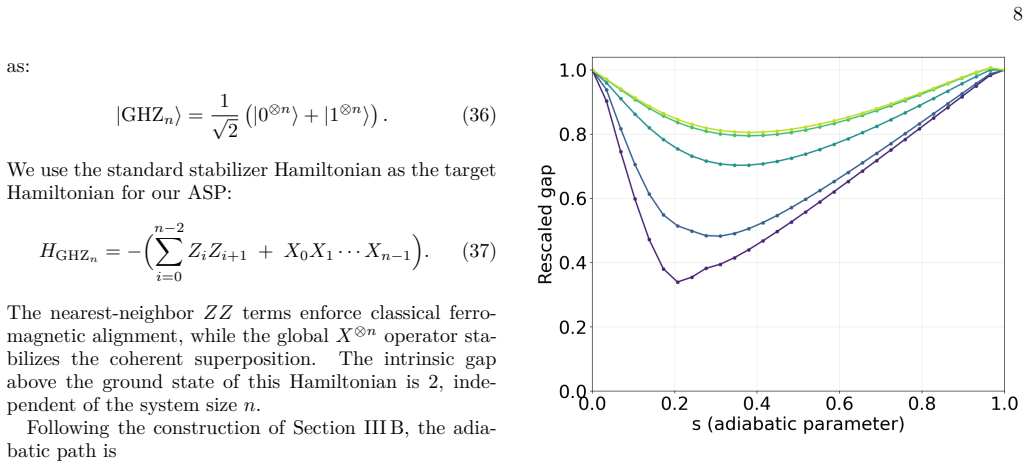
yield larger minimum gaps than the trivial product state atg=−1.0. FIG. 1. Rescaled spectral gap along the adiabatic path, for several values of the warm-start parameterg. From low- est to highest, curves correspond to warm-start valuesg= −0.9 (bottom, dark purple),−0.5 (blue),−0.1 (teal),−0.01 (green), and−0.001 (top, yellow), withη= 1/ √1−g.As g→0 − the...
-
[2]
The static clock Hamiltonian decomposes into initialization and propaga- tion terms,H clock =H in +H prop
Interaction Picture Transformation To accurately capture the dynamics established in Sec- tion III B, the composite adiabatic Hamiltonian acting on the spaceH clock⊗H sys is given by the decoupled formu- lation: HA(s) = (1−s)H clock +s(|+⟩⟨+| c⊗I sys +Ic⊗H target), (A1) where|+⟩= (T+1) −1/2∑T t=0|t⟩is the uniform superpo- sition of the computational clock...
-
[3]
Momentum Basis Representation We define the momentum basis states|k⟩via the Dis- crete Fourier Transform (DFT) of the temporal clock states: |k⟩= 1√ T+ 1 T∑ t=0 eiωkt|t⟩,whereω k = 2πk T+ 1 .(A3) We now analytically evaluate the block matrix elements Hkj(s)≡⟨k| ˜H(s)|j⟩c for each individual component of the Hamiltonian. a. 1. Propagation Term The termH pr...
-
[4]
Szabo and N
A. Szabo and N. S. Ostlund,Modern quantum chem- istry: introduction to advanced electronic structure theory (Courier Corporation, 1996)
1996
-
[5]
Schollw¨ ock, The density-matrix renormalization group, Reviews of modern physics77, 259 (2005)
U. Schollw¨ ock, The density-matrix renormalization group, Reviews of modern physics77, 259 (2005)
2005
-
[6]
Olivares-Amaya, W
R. Olivares-Amaya, W. Hu, N. Nakatani, S. Sharma, J. Yang, and G. K. Chan, The ab-initio density matrix renormalization group in practice, The Journal of chem- ical physics142(2015)
2015
-
[7]
Kohn and L
W. Kohn and L. J. Sham, Self-consistent equations in- cluding exchange and correlation effects, Physical review 140, A1133 (1965)
1965
-
[8]
ˇC´ ıˇ zek, On the correlation problem in atomic and molecular systems
J. ˇC´ ıˇ zek, On the correlation problem in atomic and molecular systems. calculation of wavefunction compo- nents in ursell-type expansion using quantum-field the- oretical methods, The Journal of Chemical Physics45, 4256 (1966)
1966
Show all 58 references
-
[9]
A. Y. Kitaev, Quantum measurements and the abelian stabilizer problem, arXiv preprint quant-ph/9511026 (1995)
1995 arXiv
-
[10]
Fomichev, K
S. Fomichev, K. Hejazi, M. S. Zini, M. Kiser, J. Fraxanet, P. A. M. Casares, A. Delgado, J. Huh, A.-C. Voigt, J. E. Mueller, and J. M. Arrazola, Initial state preparation for quantum chemistry on quantum computers, PRX Quan- tum5, 10.1103/prxquantum.5.040339 (2024)
2024 doi
-
[11]
Sch¨ on, E
C. Sch¨ on, E. Solano, F. Verstraete, J. I. Cirac, and M. M. Wolf, Sequential generation of entangled multi- qubit states, Physical review letters95, 110503 (2005)
2005
-
[12]
Anand, P
A. Anand, P. Schleich, S. Alperin-Lea, P. W. K. Jensen, S. Sim, M. D´ ıaz-Tinoco, J. S. Kottmann, M. Degroote, A. F. Izmaylov, and A. Aspuru-Guzik, A quantum com- puting view on unitary coupled cluster theory, Chemical Society Reviews51, 1659–1684 (2022)
2022
-
[13]
Kohn, Nobel lecture: Electronic structure of mat- 13 ter—wave functions and density functionals, Reviews of modern physics71, 1253 (1999)
W. Kohn, Nobel lecture: Electronic structure of mat- 13 ter—wave functions and density functionals, Reviews of modern physics71, 1253 (1999)
1999
-
[14]
J. R. McClean, R. Babbush, P. J. Love, and A. Aspuru- Guzik, Exploiting locality in quantum computation for quantum chemistry, The journal of physical chemistry letters5, 4368 (2014)
2014
-
[15]
S. Lee, J. Lee, H. Zhai, Y. Tong, A. M. Dalzell, A. Ku- mar, P. Helms, J. Gray, Z.-H. Cui, W. Liu, M. Kasto- ryano, R. Babbush, J. Preskill, D. R. Reichman, E. T. Campbell, E. F. Valeev, L. Lin, and G. K.-L. Chan, Eval- uating the evidence for exponential quantum advantage in ...
2023 doi
-
[16]
Y. Zhan, Z. Ding, J. Huhn, J. Gray, J. Preskill, G. K.-L. Chan, and L. Lin, Rapid quantum ground state prepa- ration via dissipative dynamics, Physical Review X16, 011004 (2026)
2026
-
[17]
Motta, C
M. Motta, C. Sun, A. T. Tan, M. J. O’Rourke, E. Ye, A. J. Minnich, F. G. Brandao, and G. K.-L. Chan, De- termining eigenstates and thermal states on a quantum computer using quantum imaginary time evolution, Na- ture Physics16, 205 (2020)
2020
-
[18]
Farhi, J
E. Farhi, J. Goldstone, S. Gutmann, and M. Sipser, Quantum computation by adiabatic evolution (2000), arXiv:quant-ph/0001106 [quant-ph]
2000 arXiv
-
[19]
Aharonov and A
D. Aharonov and A. Ta-Shma, Adiabatic quantum state generation and statistical zero knowledge (2003), arXiv:quant-ph/0301023 [quant-ph]
2003 arXiv
-
[20]
Messiah,Quantum mechanics(Courier Corporation, 2014)
A. Messiah,Quantum mechanics(Courier Corporation, 2014)
2014
-
[21]
Ambainis, On physical problems that are slightly more difficult than qma (2014), arXiv:1312.4758 [quant-ph]
A. Ambainis, On physical problems that are slightly more difficult than qma (2014), arXiv:1312.4758 [quant-ph]
2014 arXiv
-
[22]
Sachdev, Quantum phase transitions, Physics world 12, 33 (1999)
S. Sachdev, Quantum phase transitions, Physics world 12, 33 (1999)
1999
-
[23]
M. H. S. Amin and V. Choi, First-order quantum phase transition in adiabatic quantum computation, Physical Review A80, 10.1103/physreva.80.062326 (2009)
2009 doi
-
[24]
W. H. Zurek, U. Dorner, and P. Zoller, Dynamics of a quantum phase transition, Physical Review Letters95, 10.1103/physrevlett.95.105701 (2005)
2005 doi
-
[25]
T. J. Osborne, Simulating adiabatic evolution of gapped spin systems, Physical Review A75, 10.1103/phys- reva.75.032321 (2007)
2007 doi
-
[26]
M. B. Hastings and X.-G. Wen, Quasiadiabatic contin- uation of quantum states: The stability of topologi- cal ground-state degeneracy and emergent gauge invari- ance, Physical Review B72, 10.1103/physrevb.72.045141 (2005)
2005 doi
-
[27]
Jansen, M.-B
S. Jansen, M.-B. Ruskai, and R. Seiler, Bounds for the adiabatic approximation with applications to quan- tum computation, Journal of Mathematical Physics48, 10.1063/1.2798382 (2007)
2007 doi
-
[28]
Bachmann, S
S. Bachmann, S. Michalakis, B. Nachtergaele, and R. Sims, Automorphic equivalence within gapped phases of quantum lattice systems, Communications in Mathe- matical Physics309, 835–871 (2011)
2011
-
[29]
Motta, C
M. Motta, C. Genovese, F. Ma, Z.-H. Cui, R. Sawaya, G. K.-L. Chan, N. Chepiga, P. Helms, C. Jim´ enez- Hoyos, A. J. Millis, U. Ray, E. Ronca, H. Shi, S. Sorella, E. M. Stoudenmire, S. R. White, and S. Zhang (Simons Collaboration on the Many-Electron Problem), Ground- state pro...
2020
-
[30]
Hachmann, W
J. Hachmann, W. Cardoen, and G. K.-L. Chan, Multiref- erence correlation in long molecules with the quadratic scaling density matrix renormalization group, The Jour- nal of Chemical Physics125, 10.1063/1.2345196 (2006)
2006 doi
-
[31]
Lychkovskiy, O
O. Lychkovskiy, O. Gamayun, and V. Cheianov, Time scale for adiabaticity breakdown in driven many-body systems and orthogonality catastrophe, Phys. Rev. Lett. 119, 200401 (2017)
2017
-
[32]
Chen and V
J.-H. Chen and V. Cheianov, Bounds on quantum adi- abaticity in driven many-body systems from general- ized orthogonality catastrophe and quantum speed limit, Physical Review Research4, 043055 (2022)
2022
-
[33]
Pfeifer, How fast can a quantum state change with time?, Phys
P. Pfeifer, How fast can a quantum state change with time?, Phys. Rev. Lett.70, 3365 (1993)
1993
-
[34]
Pfeifer and J
P. Pfeifer and J. Fr¨ ohlich, Generalized time-energy un- certainty relations and bounds on lifetimes of resonances, Rev. Mod. Phys.67, 759 (1995)
1995
-
[35]
Affleck, T
I. Affleck, T. Kennedy, E. H. Lieb, and H. Tasaki, Rig- orous results on valence-bond ground states in antiferro- magnets, Physical review letters59, 799 (1987)
1987
-
[36]
Perez-Garcia, F
D. Perez-Garcia, F. Verstraete, J. I. Cirac, and M. M. Wolf, Peps as unique ground states of local hamiltonians (2007), arXiv:0707.2260 [quant-ph]
2007 arXiv
-
[37]
Perez-Garcia, F
D. Perez-Garcia, F. Verstraete, M. M. Wolf, and J. I. Cirac, Matrix product state representations, arXiv preprint quant-ph/0608197 (2006)
2006 arXiv
-
[38]
X. Ni, O. Buerschaper, and M. Van den Nest, A non- commuting stabilizer formalism, Journal of Mathemati- cal Physics56, 10.1063/1.4920923 (2015)
2015 doi
-
[39]
Qi and D
X.-L. Qi and D. Ranard, Determining a local hamiltonian from a single eigenstate, Quantum3, 159 (2019)
2019
-
[40]
Albash and D
T. Albash and D. A. Lidar, Adiabatic quantum compu- tation, Reviews of Modern Physics90, 10.1103/revmod- phys.90.015002 (2018)
2018 doi
-
[41]
Perez-Garcia, F
D. Perez-Garcia, F. Verstraete, M. M. Wolf, and J. I. Cirac, Matrix product state representations, Quantum Information and Computation7, 401 (2007)
2007
-
[42]
Schollw¨ ock, The density-matrix renormalization group in the age of matrix product states, Annals of Physics 326, 96 (2011)
U. Schollw¨ ock, The density-matrix renormalization group in the age of matrix product states, Annals of Physics 326, 96 (2011)
2011
-
[43]
Sch¨ on, E
C. Sch¨ on, E. Solano, F. Verstraete, J. I. Cirac, and M. M. Wolf, Sequential generation of entangled multi- qubit states, Phys. Rev. Lett.95, 110503 (2005)
2005
-
[44]
Ran, Encoding of matrix product states into quan- tum circuits of one- and two-qubit gates, Phys
S.-J. Ran, Encoding of matrix product states into quan- tum circuits of one- and two-qubit gates, Phys. Rev. A 101, 032310 (2020)
2020
-
[45]
Piroli, G
L. Piroli, G. Styliaris, and J. I. Cirac, Quantum circuits assisted by local operations and classical communication: Transformations and phases of matter, Phys. Rev. Lett. 127, 220503 (2021)
2021
-
[46]
K. C. Smith, E. Crane, N. Wiebe, and S. M. Girvin, Deterministic constant-depth preparation of the AKLT state on a quantum processor using fusion measurements, PRX Quantum4, 020315 (2023)
2023
-
[47]
D. Malz, G. Styliaris, Z.-Y. Wei, and J. I. Cirac, Prepa- ration of matrix product states with log-depth quantum circuits, Phys. Rev. Lett.132, 040404 (2024)
2024
-
[48]
K. C. Smith, A. Khan, B. K. Clark, S. M. Girvin, and T.- C. Wei, Constant-depth preparation of matrix product states with adaptive quantum circuits, PRX Quantum 5, 030344 (2024)
2024
-
[49]
D. T. Stephen and O. Hart, Preparing matrix product states via fusion: Constraints and extensions, Phys. Rev. B110, 235127 (2024). 14
2024
-
[50]
D. W. Berry, Y. Tong, T. Khattar, A. White, T. I. Kim, G. H. Low, S. Boixo, Z. Ding, L. Lin, S. Lee,et al., Rapid initial-state preparation for the quantum simulation of strongly correlated molecules, PRX Quantum6, 020327 (2025)
2025
-
[51]
L. Caha, Z. Landau, and D. Nagaj, Clocks in feyn- man’s computer and kitaev’s local hamiltonian: Bias, gaps, idling, and pulse tuning, Physical Review A97, 10.1103/physreva.97.062306 (2018)
2018 doi
-
[52]
T. J. Yoder, G. H. Low, and I. L. Chuang, Fixed-point quantum search with an optimal number of queries, Phys- ical Review Letters113, 10.1103/physrevlett.113.210501 (2014)
2014 doi
-
[53]
Koma and H
T. Koma and H. Tasaki, Symmetry breaking and finite- size effects in quantum many-body systems, Journal of Statistical Physics76, 745–803 (1994)
1994
-
[54]
M. M. Wolf, G. Ortiz, F. Verstraete, and J. I. Cirac, Quantum phase transitions in matrix product systems, Physical review letters97, 110403 (2006)
2006
-
[55]
Wecker, M
D. Wecker, M. B. Hastings, N. Wiebe, B. K. Clark, C. Nayak, and M. Troyer, Solving strongly correlated electron models on a quantum computer, Phys. Rev. A 92, 062318 (2015)
2015
-
[56]
Lloyd, Quantum approximate optimization is com- putationally universal, arXiv preprint arXiv:1812.11075 (2018)
S. Lloyd, Quantum approximate optimization is com- putationally universal, arXiv preprint arXiv:1812.11075 (2018)
2018 arXiv
-
[57]
Biamonte, Universal variational quantum computa- tion, Physical Review A103, L030401 (2021)
J. Biamonte, Universal variational quantum computa- tion, Physical Review A103, L030401 (2021)
2021
-
[58]
On the universality of the quantum approximate opti- mization algorithm: Mes morales et al., Quantum Infor- mation Processing19, 291 (2020)
2020
Reviewed August 1, 2026 · model on record in the stance chip above.
Discussion (0). Sign in to comment.